




42 Creative Living Room Partition Ideas That Actually Work in Open Spaces
You love the idea of an open floor plan — until you actually live in one. The living room bleeds into the dining area, the sofa faces nothing in particular, and no corner feels like it genuinely...

You love the idea of an open floor plan — until you actually live in one. The living room bleeds into the dining area, the sofa faces nothing in particular, and no corner feels like it genuinely belongs to you. The space is technically one room, but it doesn’t feel like any room at all. According to the National Association of Home Builders, open-concept floor plans remain among the most desired features in new homes — which means the challenge of dividing them beautifully is one of the most widely searched decorating problems online.
This article gives you 42 specific, visual, and practical living room partition ideas — from a $15 tension-rod curtain to a double-sided fireplace wall — organized for renters, homeowners, DIYers, and design beginners alike. Whether you have $50 or $5,000 to spend, and whether you’ve ever touched a power tool or not, there’s something here you can act on this weekend.
Quick answer: Living room partitions range from no-drill renter solutions like ceiling curtain tracks and leaning bookshelves to permanent architectural features like glass partition walls and built-in half-walls. The right option depends on your space size, budget, and rental situation. This list covers all of them — with clear notes on what works where and what to watch out for.
One honest note before you scroll: Fabric curtains, open bookshelves, freestanding screens, and plant arrangements create visual separation and spatial definition. They do not meaningfully reduce sound between zones. If noise control is your primary goal, acoustic panels or structural wall solutions are the right path. Everything in this list is about visual clarity and spatial purpose — and for most open-plan living rooms, that’s exactly what you actually need.
How to Divide a Living Room Without Building a Wall
No contractor quote, no drywall dust, and no lease violations required. Here are six specific ways to divide a living room into functional zones without structural work:
- Ceiling curtain track — mount a rail directly to the ceiling and hang floor-to-ceiling linen panels that slide open and closed on demand.
- Open bookshelf — place a freestanding unit perpendicular to your longest wall for a light-permeable visual boundary.
- Folding or freestanding screen — a rattan, bamboo, or fabric accordion screen repositions in minutes and needs zero installation.
- Indoor plants — a row of tall fiddle leaf figs, snake plants, or olive trees creates an organic, breathing green boundary between zones.
- Sofa placement — a sofa with its back facing the dining area, anchored by a rug beneath it, creates a clear psychological room-within-a-room effect.
- Half-wall with floating shelves — for homeowners, a structural knee-height half-wall topped with open shelving is the most architecturally finished permanent solution.
Living Room Partition Ideas
1. Open Bookshelf Divider Stacked with Books and Curated Decor
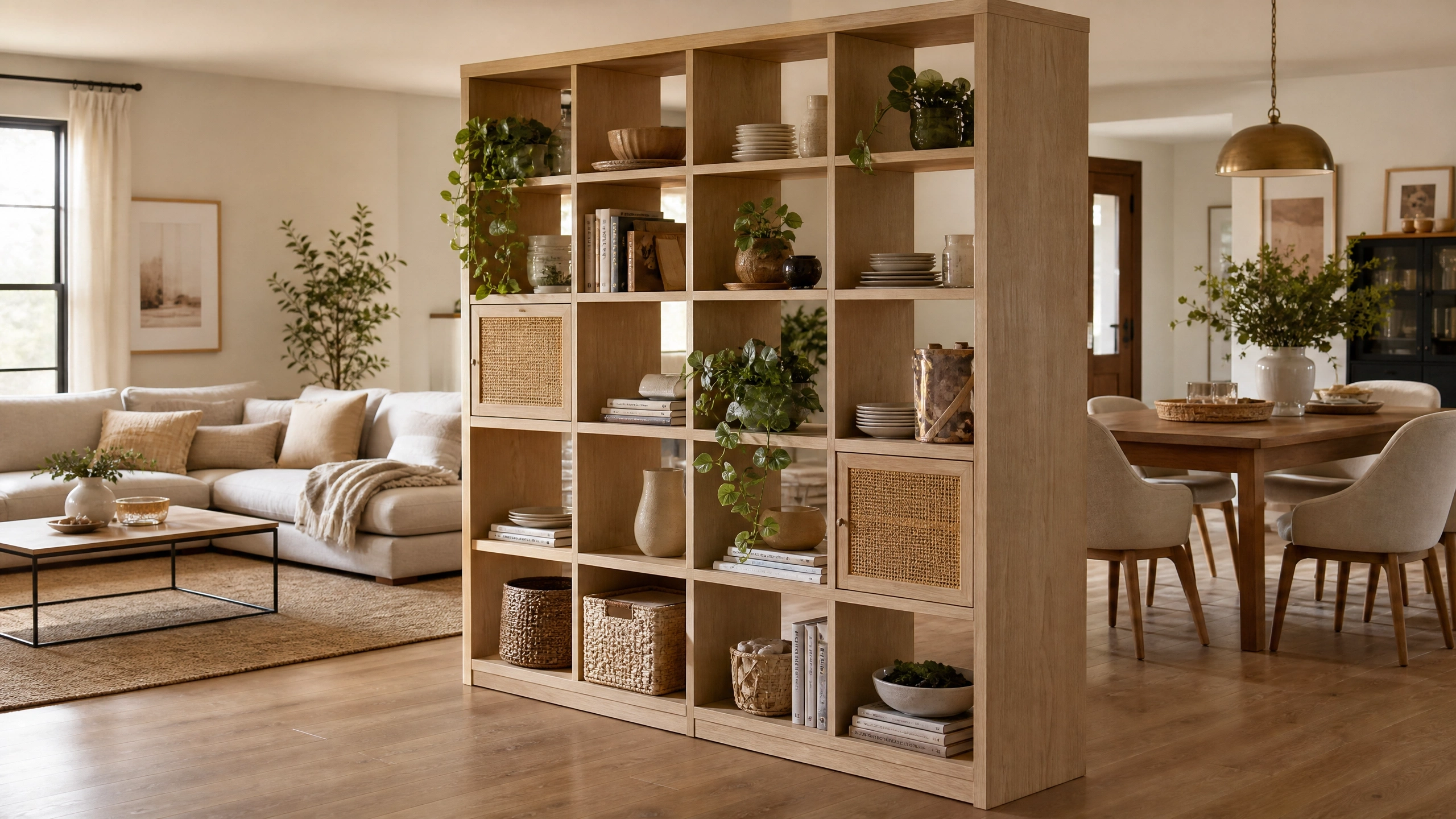
A tall, open bookcase placed perpendicular to your longest wall is one of the most elegant ways to break an open-plan space into distinct zones. Unlike a solid partition, it keeps the room visually connected — light still filters through, and sight lines remain open. The trick is choosing a unit at least 68 inches tall and wide enough to feel like an intentional statement rather than a piece of furniture that just happens to be standing in the middle of the room.
Style both sides of the bookcase separately — because both faces are on display. The living room-facing side might hold a curated mix of books, trailing pothos, and small ceramic vases, while the dining-side could display tableware, rolled linen napkins in a jar, or a compact cookbook collection. IKEA’s KALLAX series, starting under $100 in a 2×4 configuration, is the budget-friendly go-to here — hackable with door inserts, cane fronts, and paint finishes for a more designed finish.
2. Sheer Linen Curtain Panel Hung from a Ceiling-Mounted Track Rail
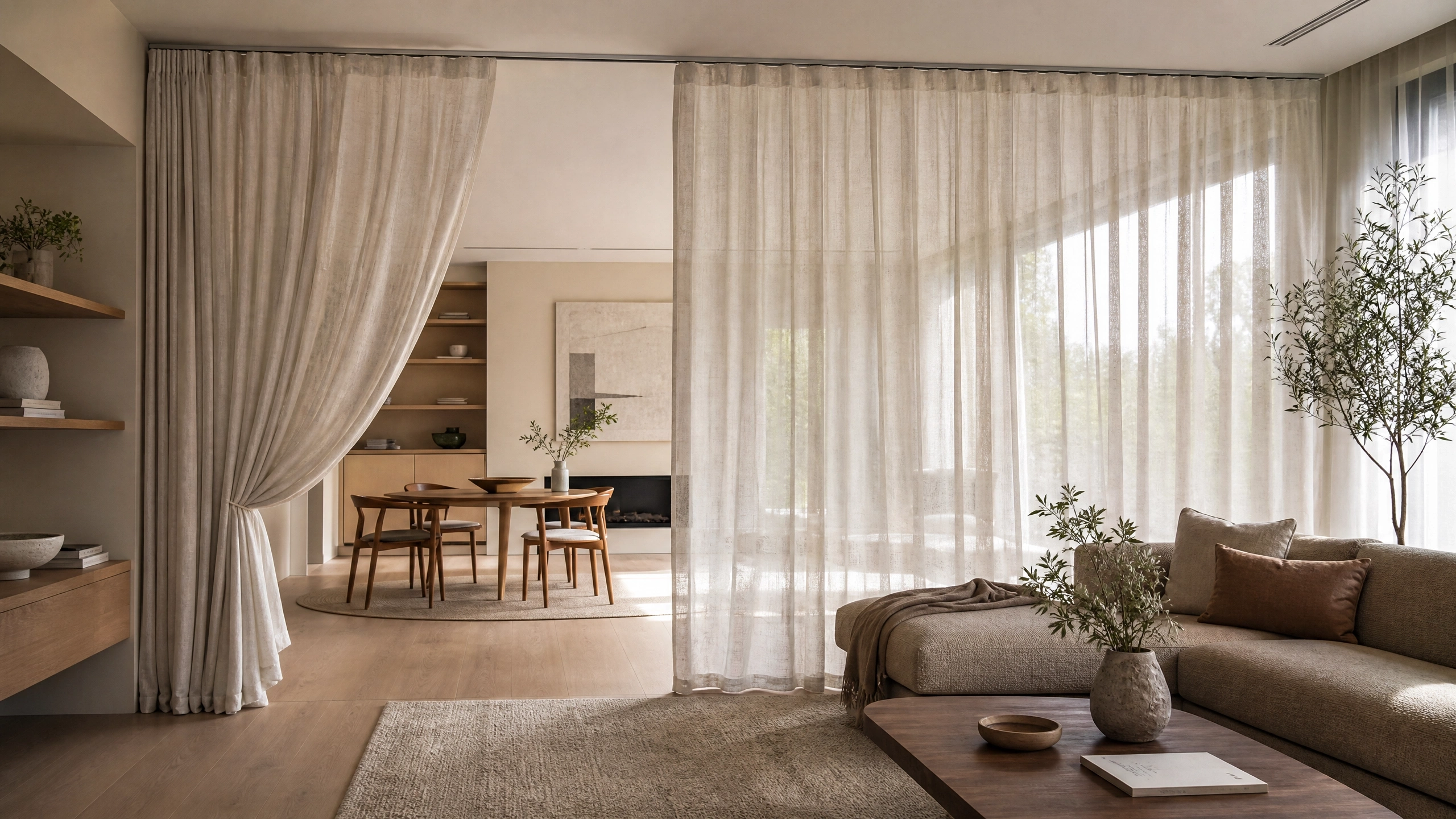
A ceiling curtain track transforms a simple length of linen or voile fabric into a soft, architectural room partition. The magic is in the flexibility — when the panels are gathered open, the room feels entirely connected; with a single pull, you have a full-height visual divider separating the living zone from a dining nook, reading corner, or home office. The look is quietly luxurious, especially when the fabric reaches the floor with an inch of gentle pooling at the hem.
For renters, look for adhesive-mount or tension-based ceiling track kits — several highly rated options are available without drilling a single hole. Stick with unlined natural linen in white, cream, or warm greige; these fabrics catch light without making the room feel heavier. One panel pair typically covers a 60–90cm divide, so measure your zone width carefully before ordering. Budget: $40–$120 for the track plus two panels depending on brand and fabric weight.
3. Warm Wooden Slat Screen with Integrated LED Strip Lighting Behind
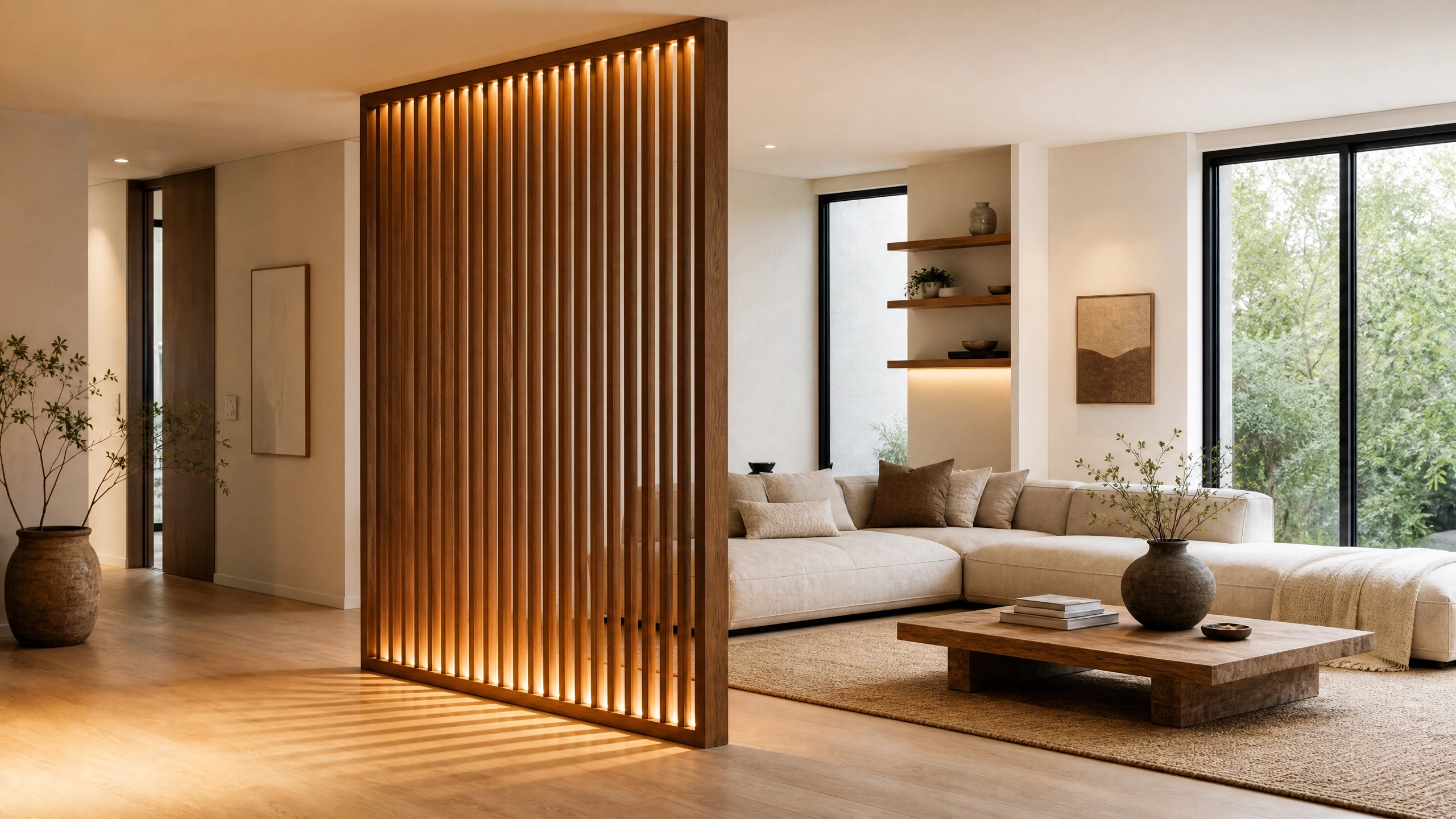
A vertical wooden slat screen — evenly spaced narrow hardwood strips running between a top and bottom frame — creates a partition that feels expensive and architectural even when it isn’t. The visual effect is warm and grounded, with light filtering softly through each gap to cast gentle linear shadows across the floor below. Stained in natural walnut, oak, or whitewashed tones, these screens suit Japandi, warm minimalist, and Scandinavian-leaning interiors particularly well.
Adding a single run of warm-white LED strip lighting behind the frame — tucked so it glows outward rather than blinds — elevates the whole piece into something that reads like an intentional architectural feature. Freestanding versions ideal for renters can be found at mid-range price points from West Elm and smaller design-focused Etsy makers. For homeowners, custom built-in versions can be framed into an existing opening or constructed as a structural room focal point at considerably higher cost.
4. Half-Wall Partition Topped with Open Floating Shelves and Plants
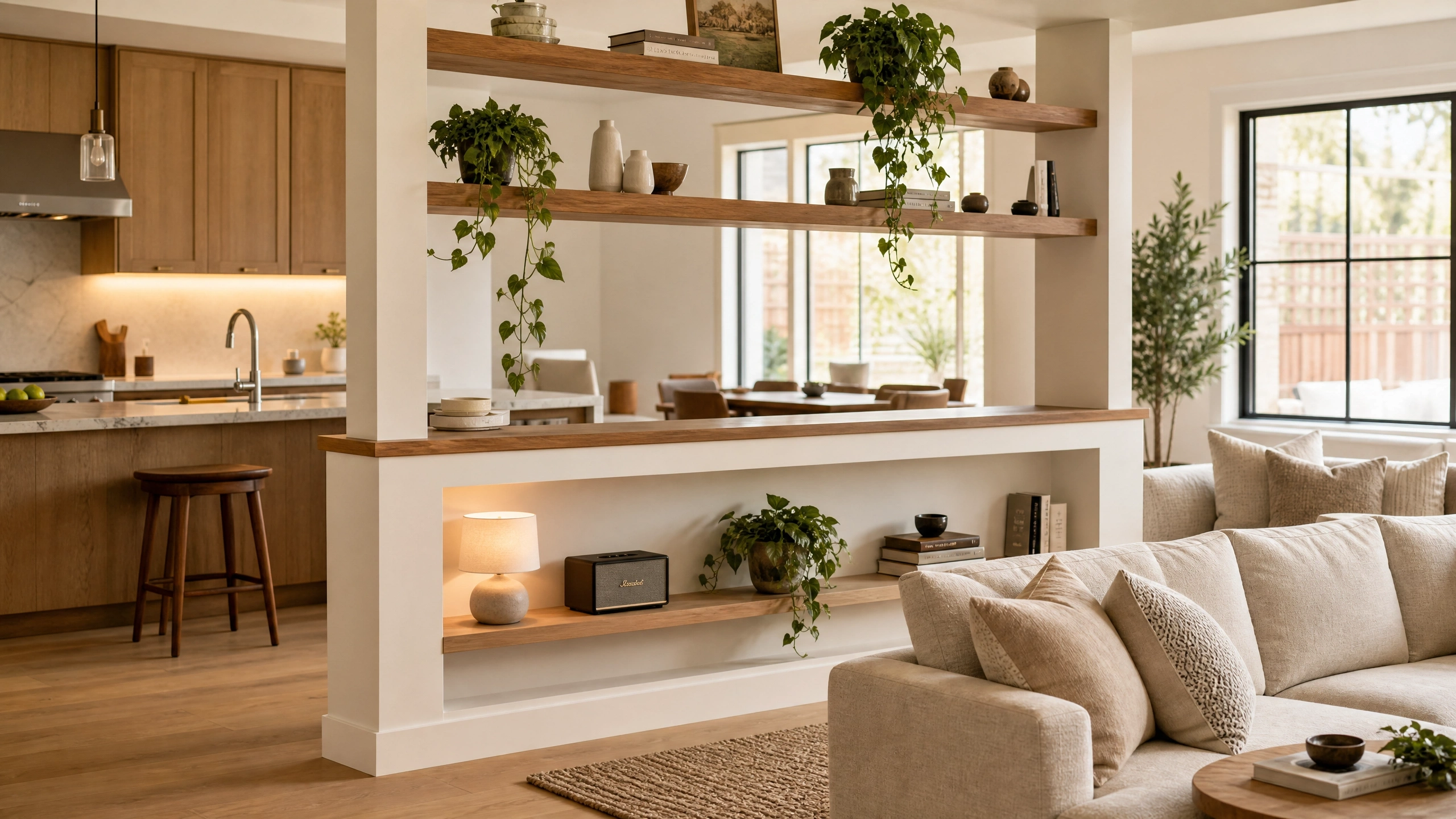
A half-wall sits roughly 36–42 inches from the floor — just above counter height — creating a visual and spatial boundary without closing off the upper half of the room. It works brilliantly between a kitchen and living area, where the partition becomes a natural pass-through ledge on the kitchen side and a display surface on the living room side. Above the wall, open floating shelves can hold trailing plants, art books, or sculptural objects that carry the eye upward.
This is a homeowner solution — it requires basic construction and planning, particularly around electrical or plumbing if the partition runs near a kitchen wall. The result feels genuinely permanent and polished in a way that freestanding dividers can’t quite match. Top the wall with a hardwood cap rail for a furniture-grade finish, and use the lower shelves for items that work from both sides — a speaker, a trailing plant, or a small lamp that reads beautifully from either room.
5. Black-Framed Glass Partition Wall for a Modern, Airy Living Room
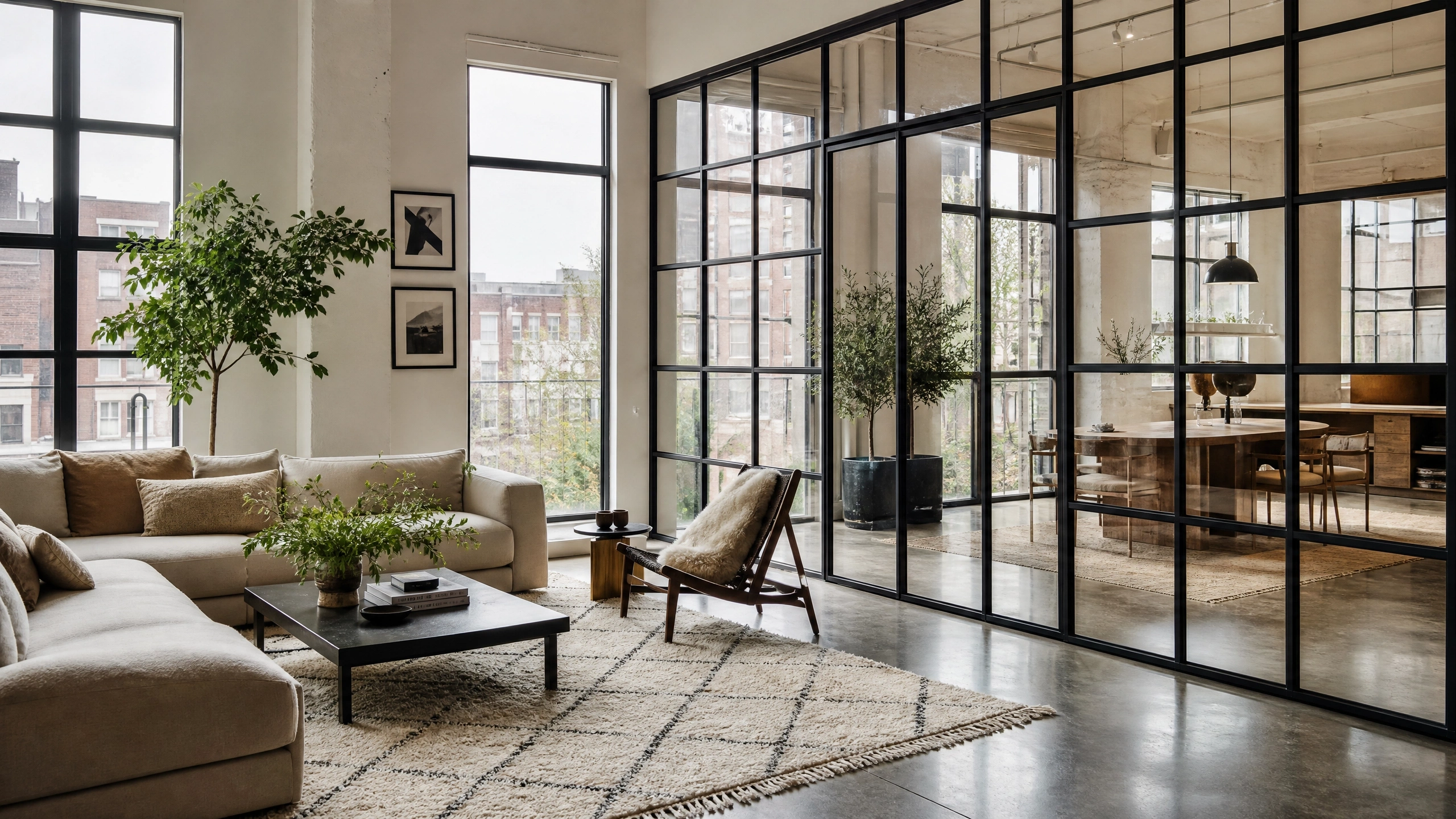
If your goal is division without darkness, a steel-framed glass partition is one of the most design-forward solutions available. The black steel grid frames the glass in a way that reads as bold and architectural rather than clinical — the kind of interior you’d see in a converted Brooklyn loft or a Scandinavian apartment feature. The partition creates a completely defined room boundary without sacrificing a single square foot of perceived light, which is the core design problem it solves so elegantly.
Glass partitions are a permanent homeowner investment, typically starting around $800–$2,500 depending on height, width, and whether you’re working with a prefab kit or a bespoke fabricator. Fixed pane versions are more affordable; sliding or pivoting door versions add cost but also functionality. This is not a renter-appropriate option, but for homeowners or those in long-term lease situations with written landlord approval, the architectural impact is genuinely transformative. Pair with a polished concrete floor and a Beni Ourain rug for a fully considered aesthetic.
6. Macramé Woven Hanging Panel as a Boho Textile Room Divider
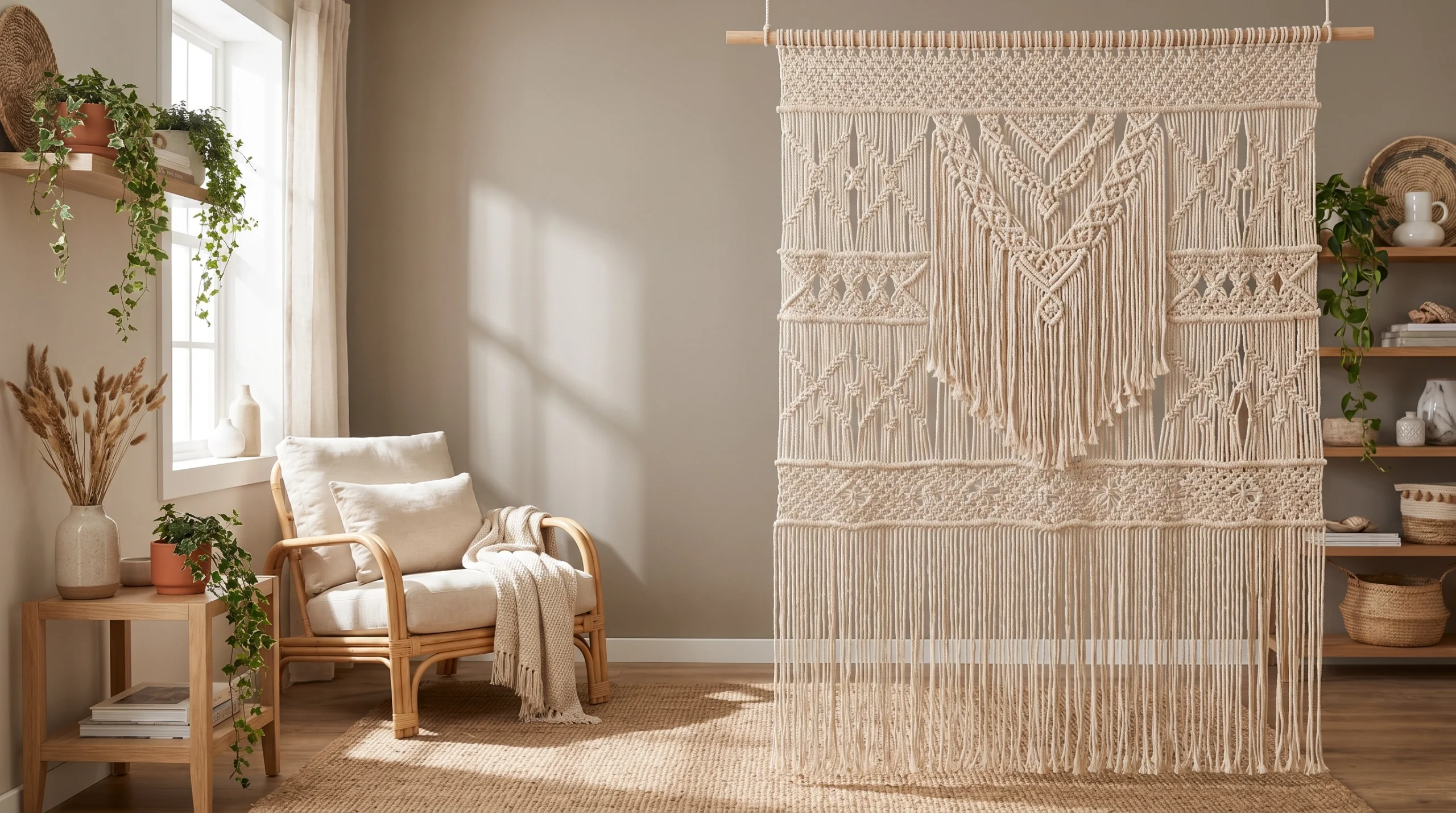
A large-scale macramé panel — 60 inches wide and hanging full-height from a ceiling-mounted wooden dowel — brings warmth, texture, and a sense of handcraftsmanship into a space that might otherwise feel undefined. The knotted cotton hangs loose enough to allow light and air to pass freely through, creating visual separation without enclosing the space. Against a white or warm greige wall, the natural fiber reads as much as a piece of art as a functional room divider — which is exactly what makes it save-worthy on Pinterest.
Macramé panels suit boho, coastal, and eclectic living rooms where layered textures and natural materials are already present. A panel of this scale can be commissioned from Etsy makers for $80–$250 depending on complexity, or made as a beginner DIY project with basic knot tutorials and roughly $30 in natural cotton cord. For renters, hang from a tension rod between walls or use a freestanding wooden arc frame. Pair with rattan furniture, jute rugs, and trailing greenery for a cohesive composition.
7. Japanese Shoji Screen for a Soft, Translucent, Light-Diffusing Partition
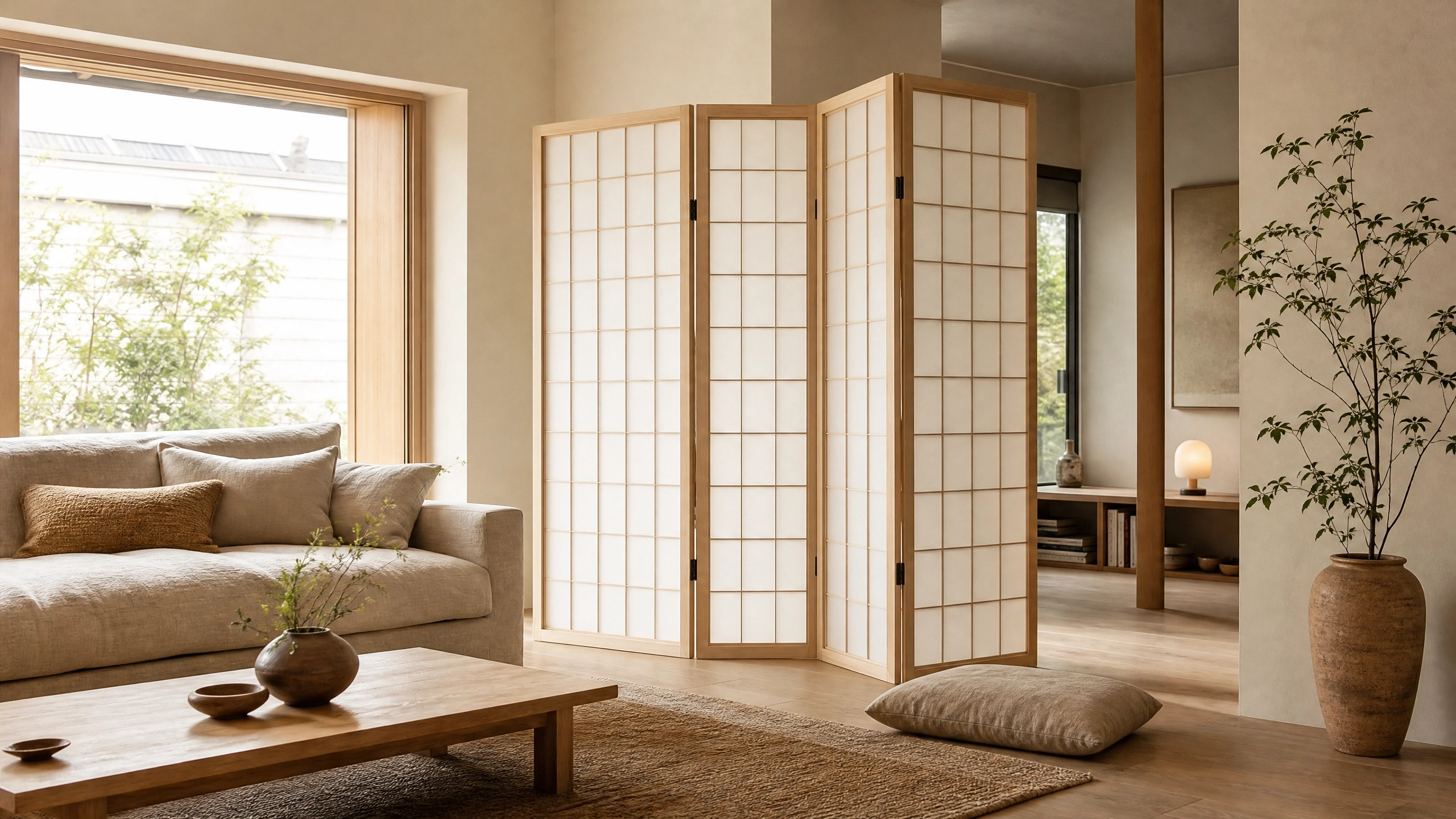
A shoji screen — a traditional Japanese folding or sliding panel with a wooden lattice frame and translucent washi paper infill — creates one of the most serene room partitions available. The paper diffuses light rather than blocking it, casting a soft, even glow across both sides of the divide that makes the whole room feel calmer and more considered. The effect is quiet luxury: minimal, purposeful, and entirely unlike anything you’d find in a generic home décor store’s room divider section.
Authentic shoji screens are available through Japanese homeware specialists and quality online sellers, typically ranging from $150–$500 for a freestanding three-panel version. The washi paper is delicate, so avoid placing the screen in high-traffic areas where it might be bumped repeatedly. The frame also responds to moisture over time — keep it away from kitchen steam or a humidifier. For modern interiors, choose a light ash or white oak frame rather than traditional dark lacquer, which can feel heavy in a smaller or lighter room.
8. Natural Bamboo Pole Screen for an Organic, Earthy Room Split
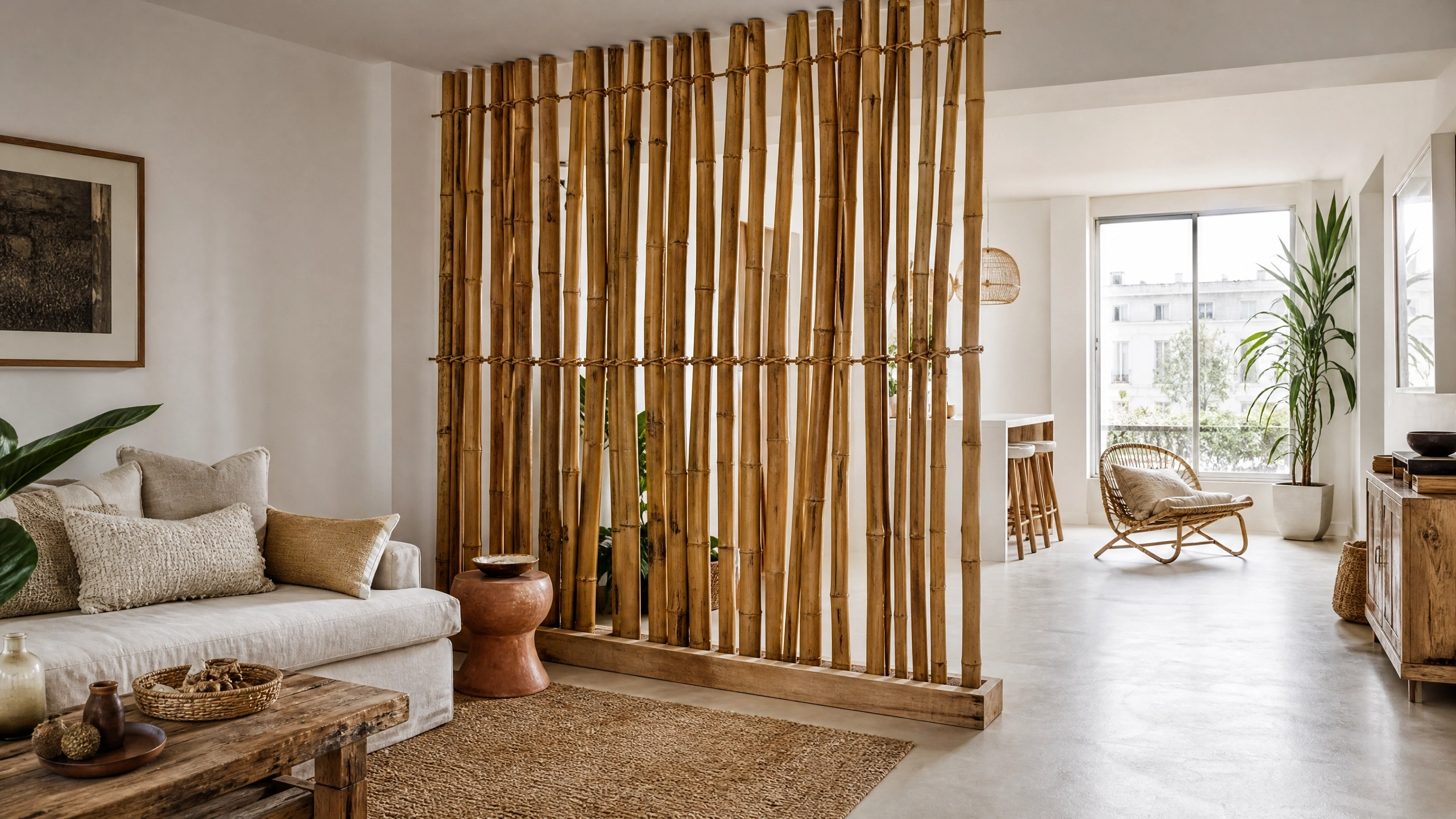
A cluster of natural bamboo poles arranged vertically — tied together or built into a lightweight freestanding frame — creates a partition that feels like a piece of landscape rather than a piece of furniture. The earthy, warm tone of natural bamboo reads beautifully against white walls, rattan chairs, and cream textiles. The contrast between the organic irregularity of the poles and the clean geometry of a modern apartment creates exactly the kind of visual tension that makes a space feel thoughtfully designed rather than casually assembled.
Bamboo pole screens can be purchased as finished products or assembled as a weekend DIY using raw poles from garden centers — typically $20–$60 for enough poles to span four to five feet. Freestanding versions use a simple base frame with tension ties at the top and mid-point. These work well in boho, coastal, tropical, and natural minimalist rooms and pair particularly well with jute or seagrass rugs, low-slung furniture, and terracotta-toned walls. Renter-safe when freestanding; no installation required.
9. Vertical Living Plant Wall as a Lush Green Room Divider
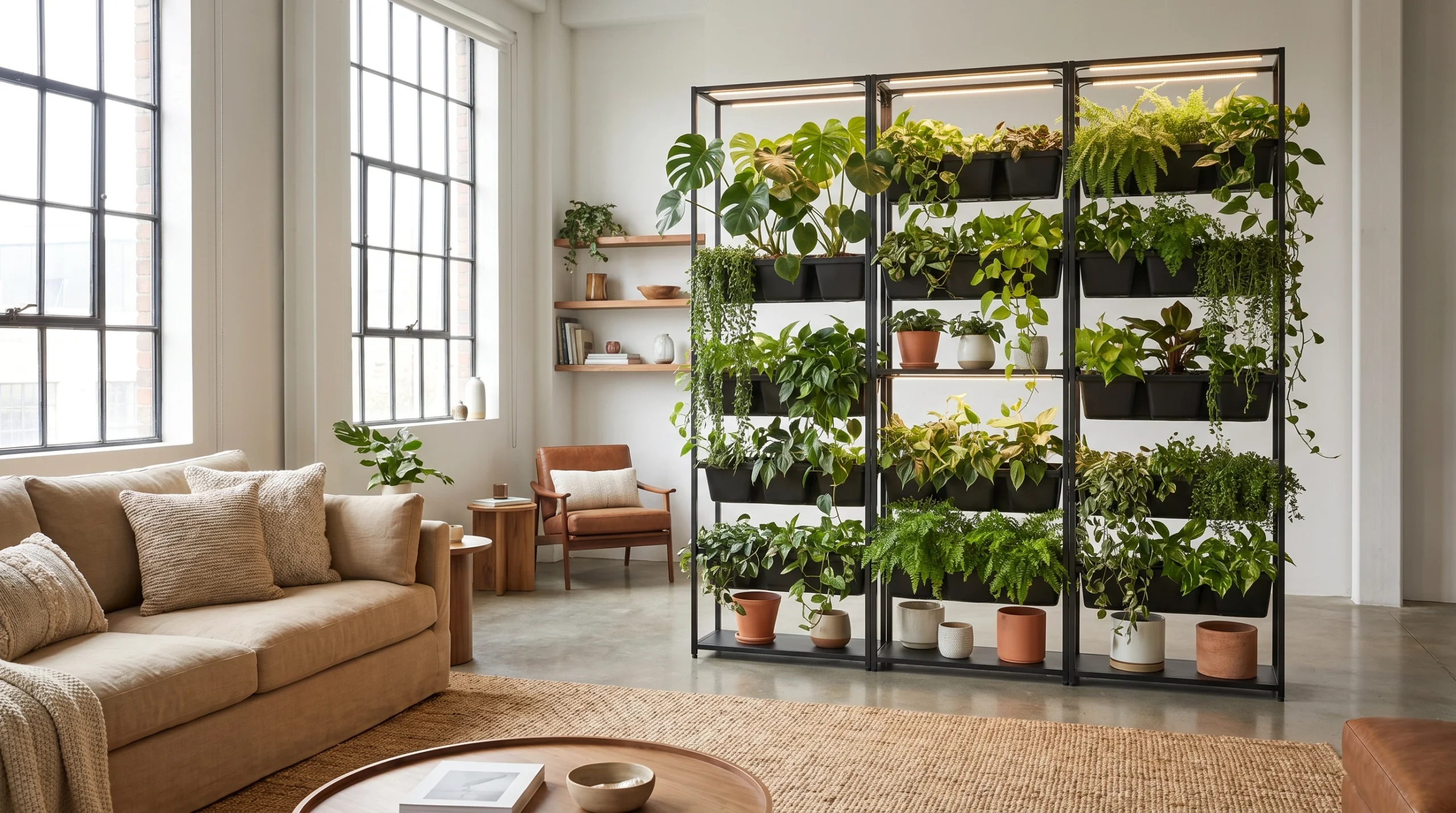
A vertical plant wall — a freestanding modular frame filled with pocket planters, stacked pots, or tiered shelving growing lush greenery from floor to near-ceiling — creates a partition that is genuinely alive. The effect in a living room is striking: a green expanse of monstera, pothos, heartleaf philodendron, and ferns creates a boundary that feels natural rather than architectural, transforming an open-plan room into two zones that feel genuinely separated without a single wall being touched or modified.
The practical realities need planning: living plant walls need consistent light (supplemental grow lights are often necessary for interior installations), regular watering, and occasional plant replacement. A freestanding modular system — available from brands like Umbra or various online retailers — typically costs $80–$200 for a basic setup, with plant costs on top. Choose trailing varieties that spill over each tier for maximum visual density and the jungle-corner effect that photographs beautifully and saves reliably on Pinterest home decor boards.
10. Laser-Cut Geometric Metal Screen as a Bold Statement Partition
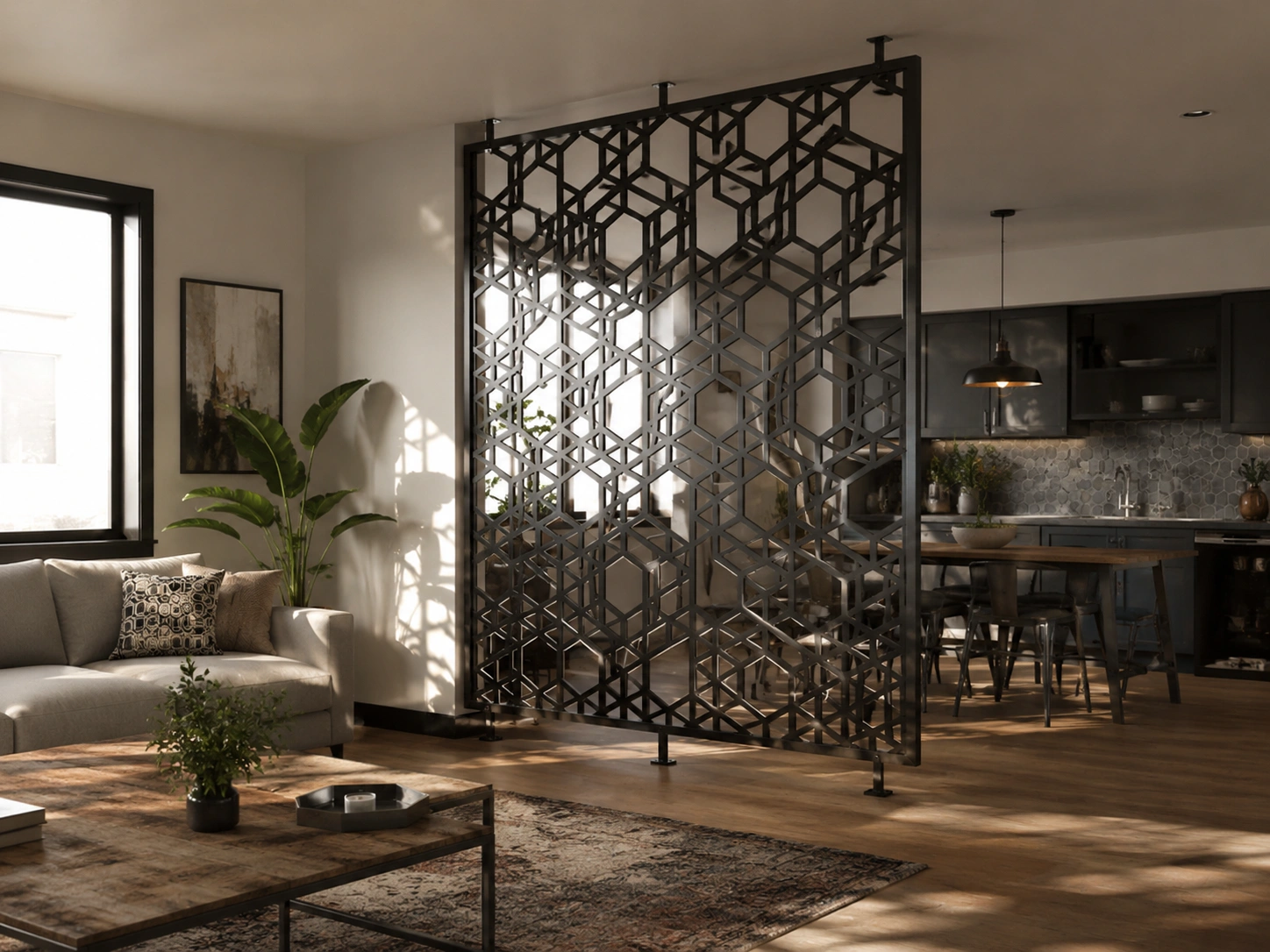
A laser-cut metal screen — in powder-coated black, brushed gold, or raw steel, with intricate geometric or botanical patterns cut through the panel — creates a partition that reads as furniture-scale art. The shadow play these screens cast across walls and floors when light hits them from behind is genuinely beautiful, shifting throughout the day as natural light changes angle. In a modern, industrial, or global-eclectic living room, a piece like this becomes the dominant visual element in the entire space.
These screens typically range from $200–$800 depending on size, material, and whether they’re custom-made or off-the-shelf. Many come as freestanding units with integrated feet; others can be wall-mounted by homeowners wanting a more architectural finish. Choose a pattern that references something already present in your room — a hexagonal motif might echo kitchen tile, while a floral lattice picks up botanical print textiles — so the screen feels selected for the space rather than placed in it. Not renter-appropriate if wall-mounted.
11. IKEA KALLAX Bookcase Hack Styled as a Double-Sided Room Divider
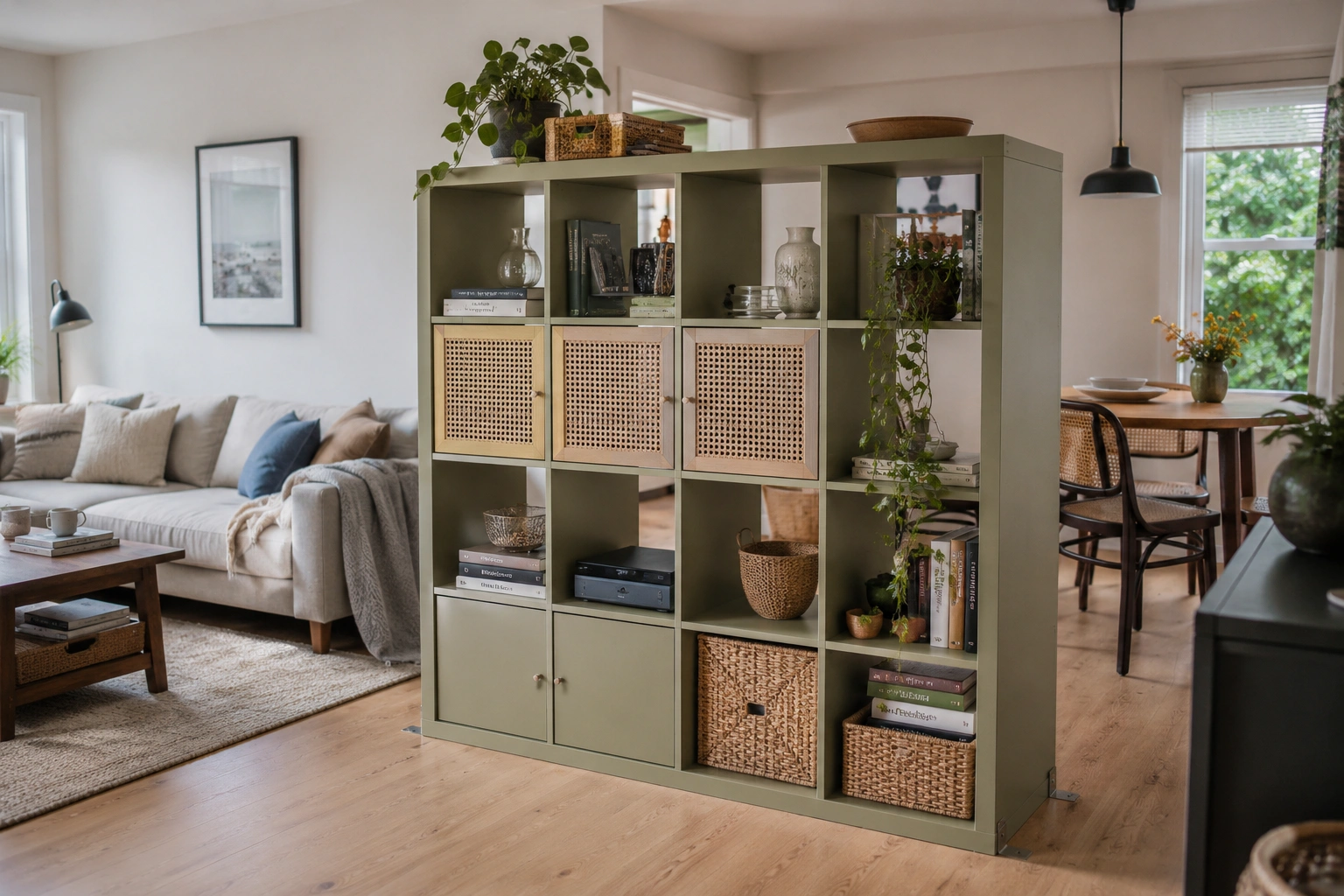
The KALLAX is arguably the most versatile room divider available for under $150, and the trick is treating both faces as equally designed surfaces rather than just filling one side with books and forgetting the other exists. Orient a 2×4 or 4×4 KALLAX perpendicular to the room — anchored to the floor with L-brackets to prevent tipping — and you have a partition that stores, displays, and divides simultaneously. The open cubbies allow light to pass through while creating a defined visual edge between spaces.
Hack the base unit with KALLAX inserts to elevate the look: add door inserts on one side for a media console finish, use cane-front panels for a boho touch, or paint the exterior a contrasting color to separate the unit visually from the room’s architecture. A 4×4 KALLAX can function as a TV cabinet on one side and a bookcase on the other — a dual-purpose solution that earns its floor space many times over. Budget: $99–$150 for the unit. Renter-safe with floor anchoring rather than wall attachment.
12. Reclaimed Pallet Wood Slat Divider as a Low-Cost DIY Build
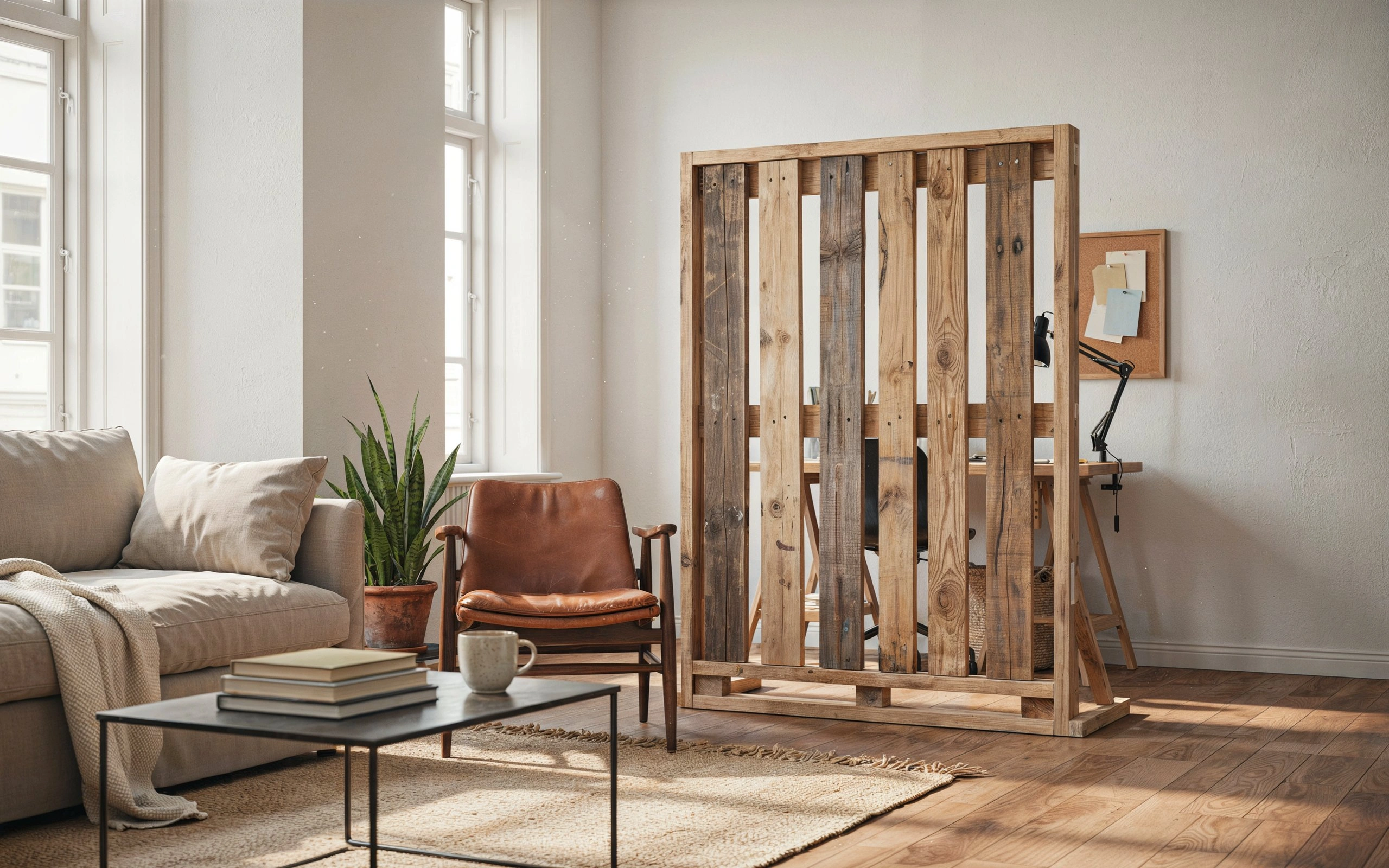
Sourcing five or six wooden shipping pallets — often available free from garden centers, hardware stores, or Facebook Marketplace — and arranging them vertically in a freestanding frame creates a partition that costs almost nothing and looks genuinely considered when styled well. The weathered, grain-heavy texture of reclaimed pallet wood suits industrial, rustic, and modern farmhouse interiors in particular, adding the kind of depth and material imperfection that expensive finishes spend a lot of money trying to replicate.
The build is manageable for a confident beginner: clean the pallets thoroughly, sand lightly to remove splinters, decide whether to paint (chalky white or charcoal both read well) or seal with clear matte varnish, then attach to a stable freestanding base frame. Total material cost often under $30. The main challenge is structural stability — a tall partition needs a weighted base or diagonal bracing to prevent tipping. For detailed build guidance and safe construction tips, The Spruce offers thorough step-by-step DIY room divider tutorials that cover exactly this kind of project.
13. Full-Width Accordion Fabric Door for Flexible, On-Demand Privacy
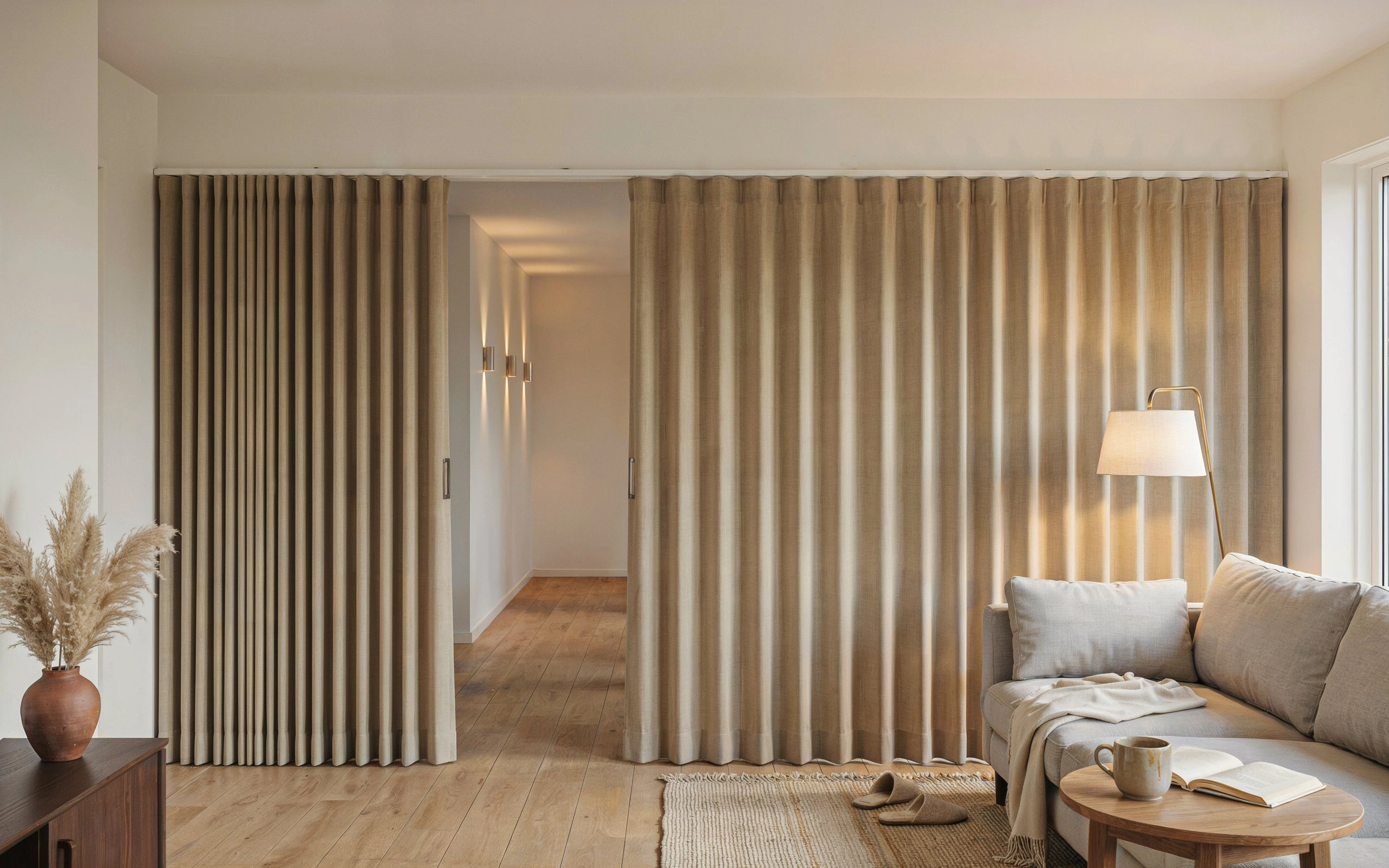
An accordion-style fabric or vinyl folding door — mounted into a top track rail and folding stack-style across the full width of an opening — is one of the most flexible partition options for spaces that switch between open and enclosed mode throughout the day. When folded open, it compresses compactly against one wall and takes up almost no visual space. When pulled across, it creates a complete, floor-to-ceiling room partition that fully separates two areas in seconds.
Material choice matters significantly here: cheap vinyl versions look dated and crinkle noisily, while fabric-panel versions in natural linen or canvas feel considerably more intentional. Better-quality fabric accordion systems — available through specialist door retailers or custom textile mills — typically cost $150–$400 for a standard doorway width. These work best when a defined opening already exists, such as between a living room and a hallway, rather than spanning a fully open floor plan where ceiling tracking can be complicated without existing structural anchor points.
14. Mirrored Screen Panel Divider to Visually Expand a Small Space
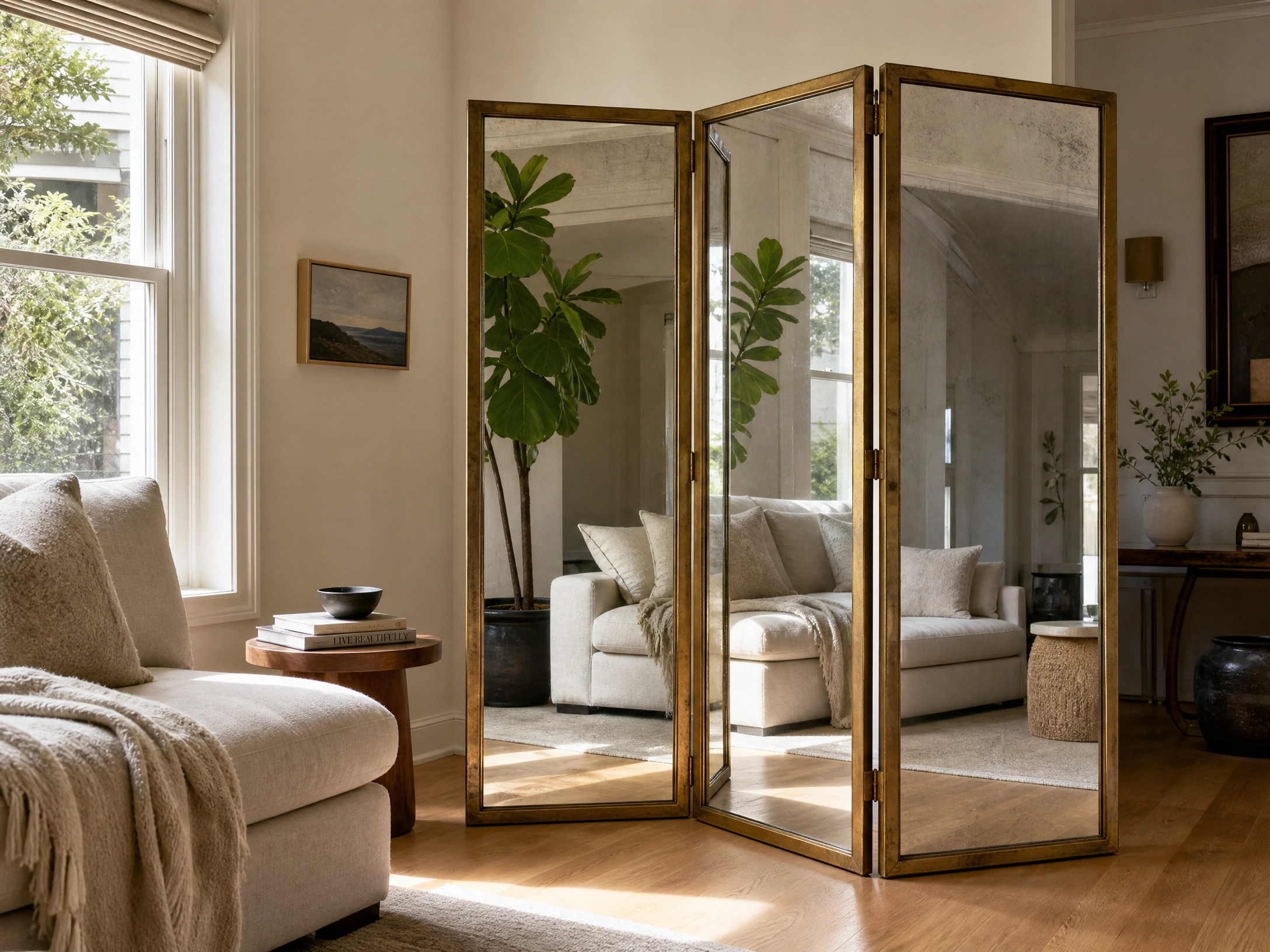
In a small living room, the worry about adding any partition is that it will make the space feel even tighter — and a mirrored folding screen is the direct answer to that concern. A three-panel screen with mirrored inserts reflects both natural light and the room’s depth, effectively doubling the visual space while still creating a defined zone boundary. The result feels more like an architectural trick than a furniture purchase, especially when positioned to reflect a window or the warm glow of a nearby lamp back across the room.
Mirrored folding screens are widely available at mid-range price points — West Elm, CB2, and various home décor platforms carry versions from $80–$300. Look for a frame with enough visual weight to feel intentional: a chunky brass or matte black border elevates a mirrored panel considerably compared to a thin chrome edge. Position perpendicular to your main window for maximum light reflection, and one important note: the mirror doubles everything in view, which works beautifully for styled spaces but equally for clutter, so keep what it reflects clean.
15. Shiplap Half-Wall with a Peg Rail and Hook Strip Running Along the Top
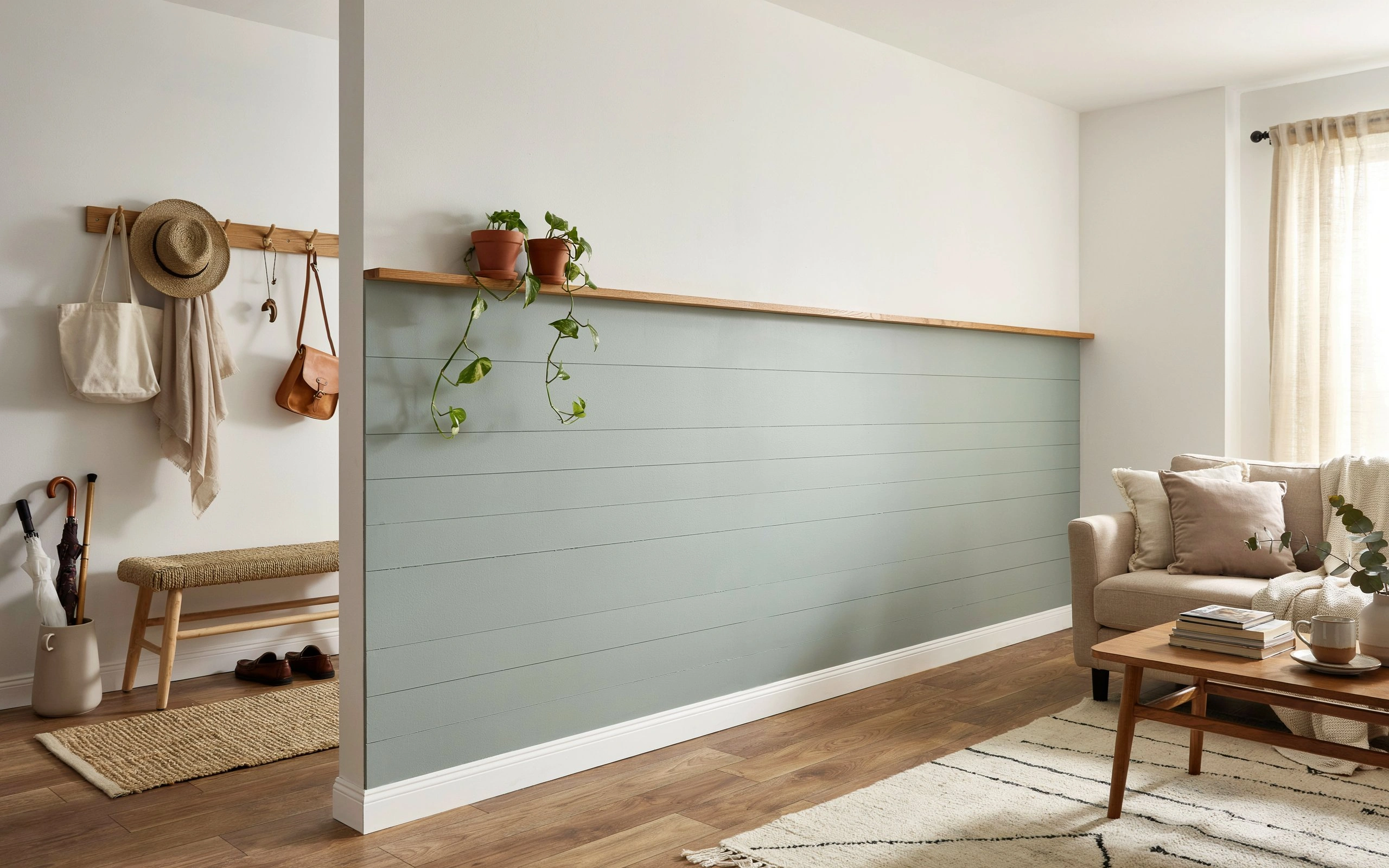
A shiplap half-wall — horizontally planked timber boards applied to a stud-framed structure — creates a partition that feels simultaneously architectural and deeply cozy. Painted in a saturated tone like dusty sage, warm terracotta, or crisp navy while keeping the upper wall white, it creates a two-tone room effect that feels considered and design-forward without a stylist’s involvement. The peg rail running along the top cap adds practical hanging storage for bags, hats, and trailing plants in small wall-mounted pots.
This is primarily a homeowner-focused option, though renters with written consent can attempt a lightweight non-structural version using adhesive shiplap panels and a floor-mounted frame. The top peg rail turns the partition into a dual-function feature — a room divider and a functional entry zone transition piece simultaneously. Installing this at the threshold between a living room and an entry area creates an implied foyer where none structurally exists. Total homeowner build cost typically runs $200–$500 depending on material quality and wall length.
16. Ceiling-Mounted Curtain Track System with Layered Linen Panels
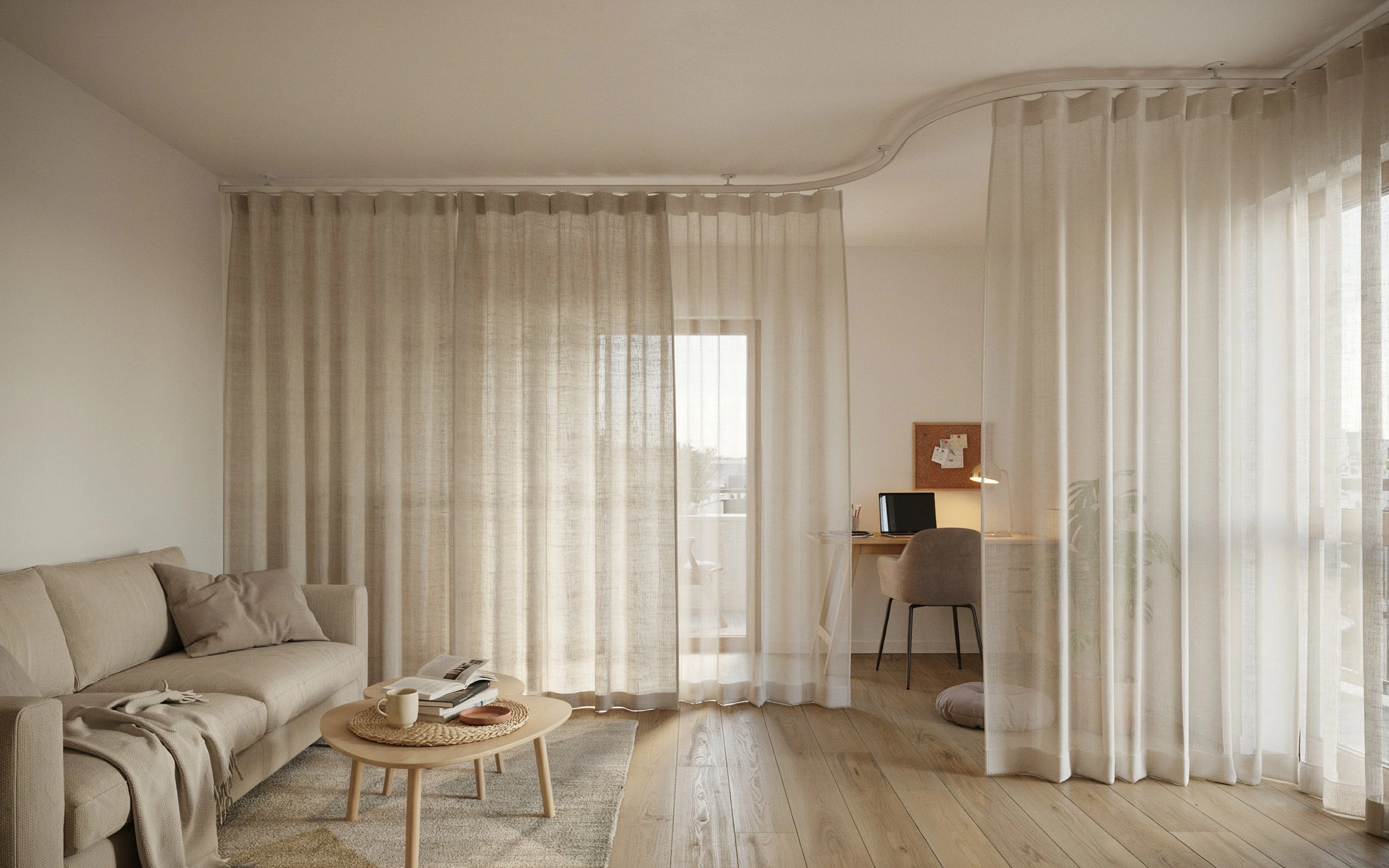
A ceiling curtain track — particularly one running on a curved or U-shaped rail — gives multi-functional zoning flexibility that a single curtain panel never could. By layering a sheer panel behind a heavier linen or velvet panel on the same track, you create two distinct modes: a light-diffusing filter for daytime and a heavier visual block for evenings or focused work. The layered look also photographs beautifully, creating the kind of bedroom-meets-salon softness that saves reliably on Pinterest home boards.
Ceiling track systems typically require ceiling anchors or track-specific adhesive mounts. Renters should specifically search for “no-drill” or “adhesive ceiling curtain track” systems — several brands offer these with impressive holding strength. Fabric choice matters here more than most people expect: undyed natural linen in white or ecru has a timeless quality that synthetic sheers lack. For a dramatic effect, choose panels at 110–120 inches in length rather than the standard 96 so they pool very slightly on the floor — an unexpectedly luxurious detail at budget cost.
17. Tension-Rod Curtain Divider — Fully Renter-Friendly and Damage-Free
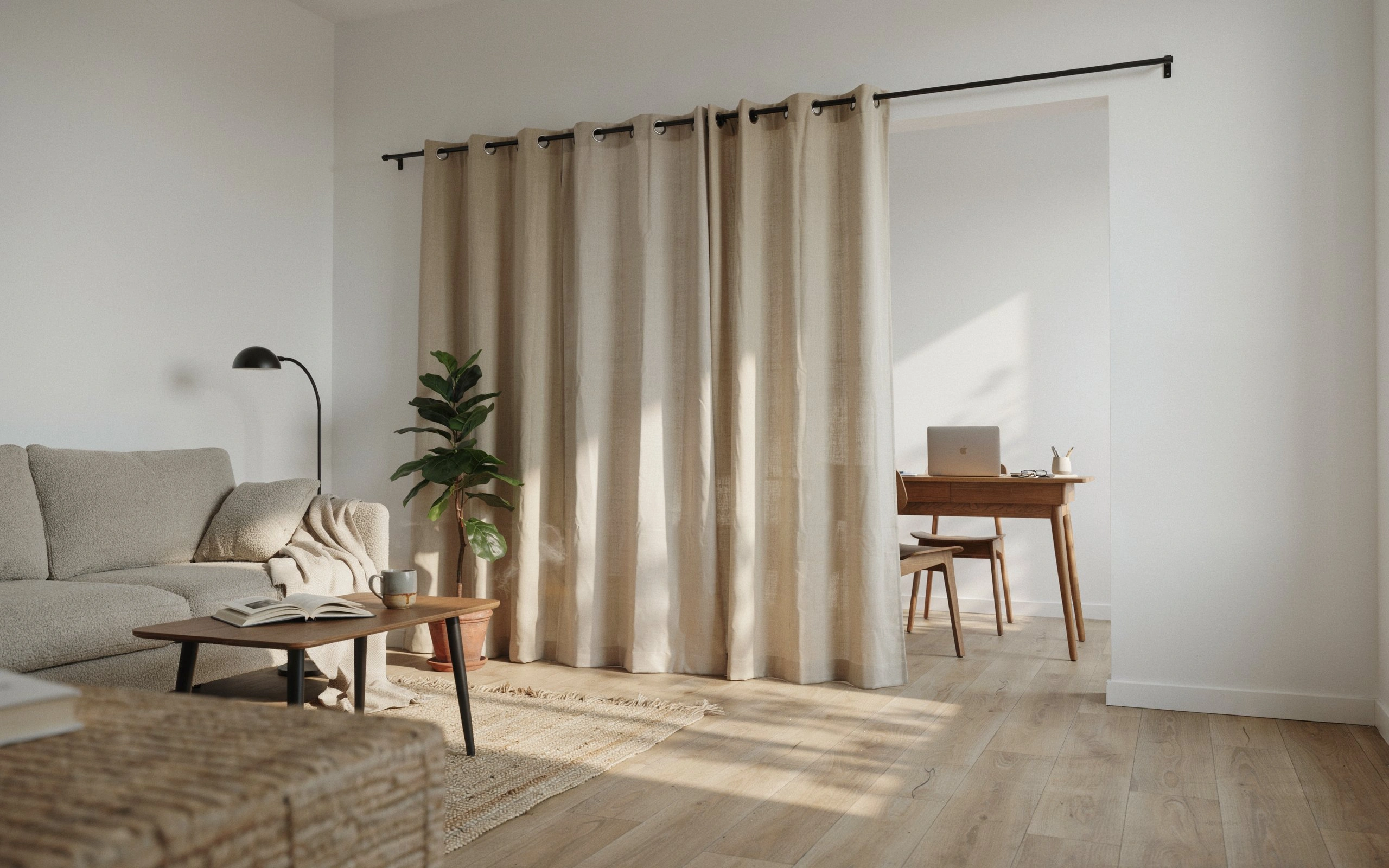
A tension rod installed horizontally between two parallel walls — or vertically using a floor-to-ceiling pole system — is the most budget-friendly and genuinely renter-safe partition approach in this entire list. No drilling, no adhesive, no landlord conversation required. A single tension rod with a full-length linen or blackout curtain panel creates an instant room divider that can be repositioned or removed in minutes without leaving a mark on walls, ceilings, or floors.
The limitation is physical: tension rods work best in contained openings — a hallway, an alcove, between structural columns, or spanning a defined pass-through. In a fully open-plan space with no natural bracketing surfaces, a standard tension rod won’t have walls to press against, so combine it with a floor-to-ceiling tension pole system or a pipe-and-base floor track instead. Budget: $15–$50 for the rod, plus fabric. For extra polish, match the rod finish to other metal fixtures in the room — matte black and brushed brass are both widely available.
18. Woven Rattan Screen Panel for a Warm Coastal Boho Living Room
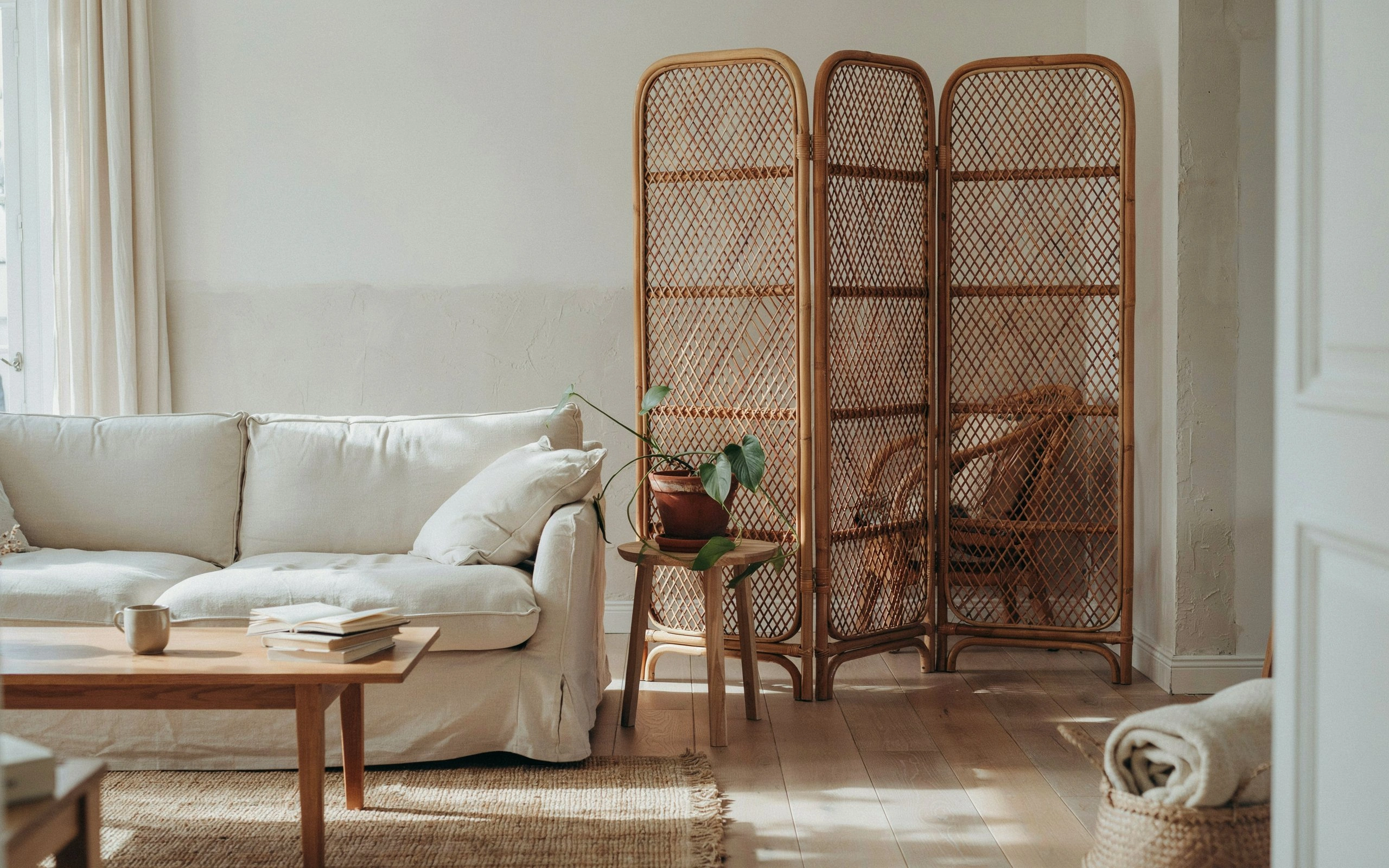
A woven rattan screen — typically three or four hinged panels in natural or honey-toned rattan with an open basket-weave pattern — creates one of the warmest, most visually appealing room partitions available at a sensible price. Rattan lets diffused light filter through the weave, keeping both sides of the divide feeling connected to the room’s ambient brightness rather than cut off from it. Leaned against a wall or opened at a slight angle, the screen adds rich organic texture and warmth that fabric or glass dividers simply don’t deliver.
West Elm carries rattan screen options in the $200–$400 range; more affordable versions from Wayfair and Amazon fall in the $60–$150 range for serviceable, if not heirloom-quality, pieces. The core styling rule: don’t crowd the rattan. Give it space to breathe — position it against a clean wall with minimal pattern competition, and allow a single trailing plant from a nearby side table to arc naturally toward the screen for a botanical composition that practically photographs itself. Renter-safe; freestanding, no installation required.
19. Hanging Rope Ladder Divider with Natural Driftwood Rungs
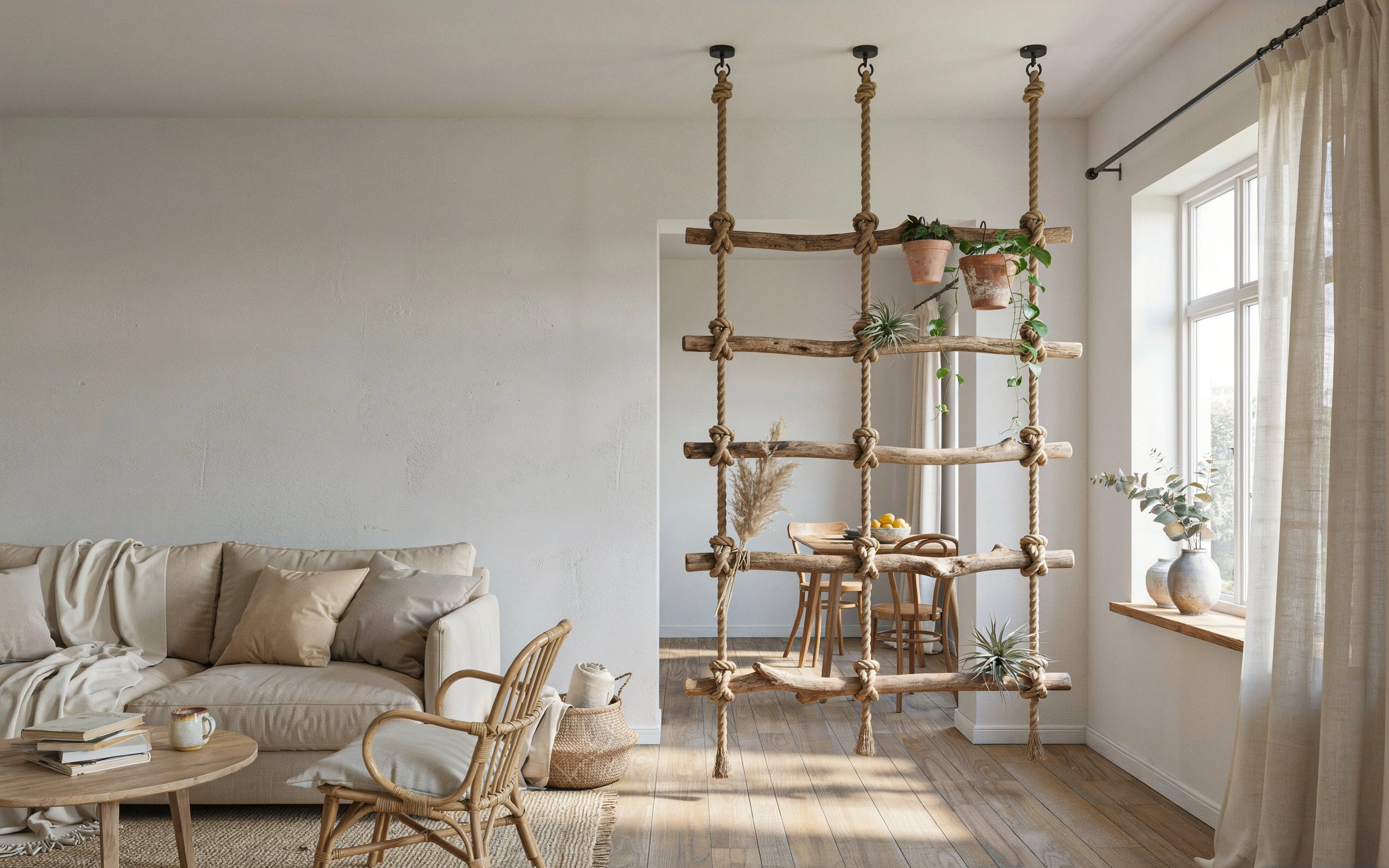
A hanging rope ladder — thick natural jute or hemp rope knotted around horizontal driftwood branches or turned wooden dowels, suspended from the ceiling — creates a partition that functions more as a sculptural object than a traditional room divider. The spaces between the rungs allow full light and sight-line access, but the vertical presence of the piece establishes a clear boundary that reads as intentional from both sides of the room. It suits bohemian, coastal, and artisan-leaning interiors especially well.
These can be DIY-made for under $25 using thick jute rope and driftwood collected from beaches or purchased from craft suppliers. The ceiling anchoring is the critical decision: you’ll need a hook rated for the piece’s weight, plus the weight of any air plants or woven additions you attach to the rungs. Renters should use a swag hook with a toggle bolt for plaster ceilings or seek pressure-mounted hanging alternatives. Add air plants, dried pampas sprigs, or small hanging terracotta pots to the rungs for a layered, gallery-quality finish.
20. Frosted Glass Sliding Door Set Into a Low-Profile Floor Track
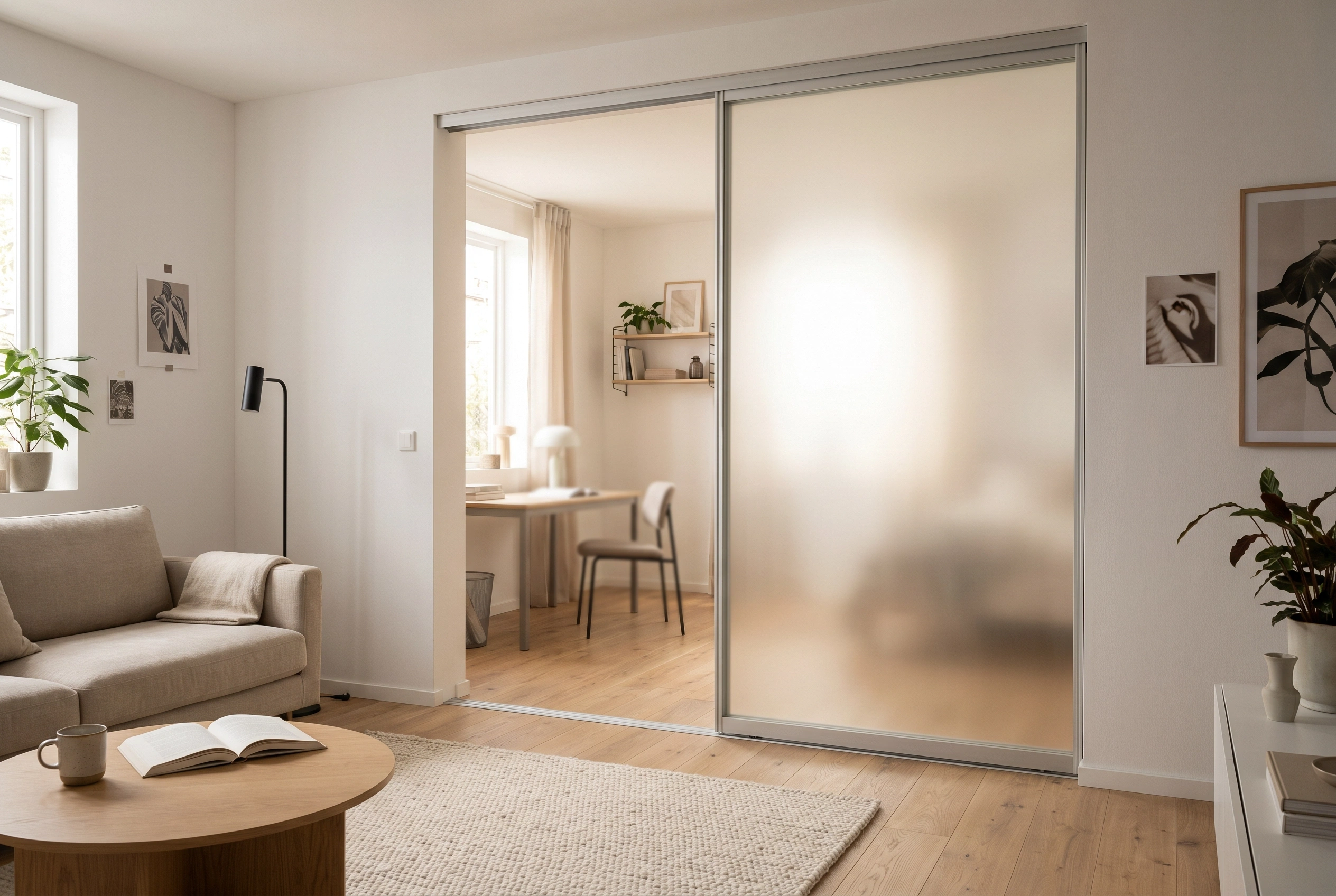
A frosted glass sliding door fitted into a slim aluminum floor track — without a full-height door frame — creates a clean, modern partition that offers genuine privacy on demand while maintaining an architectural lightness that opaque walls or curtain panels lack. The frosted surface diffuses and softens light beautifully, making the glass appear to glow when backlit, and keeping both sides of the room feeling bright even when the door is fully closed. It’s the kind of partition that makes an apartment feel like a thoughtfully designed home.
This is a homeowner or long-term rental solution — the floor track typically needs to sit flush with the floor surface, which involves some degree of floor modification. Installation costs range from a DIY prefab sliding door kit ($300–$600) to a bespoke fabrication by a glazier ($1,500+). Choose glass at least 6mm thick for a quality feel, and confirm the track is positioned so the open door doesn’t obstruct your main traffic path. For narrower openings between 90 and 140cm wide, this is a particularly elegant and achievable architectural solution.
21. Kitchen Bar Counter Styled as an Open-Plan Living Room Divider
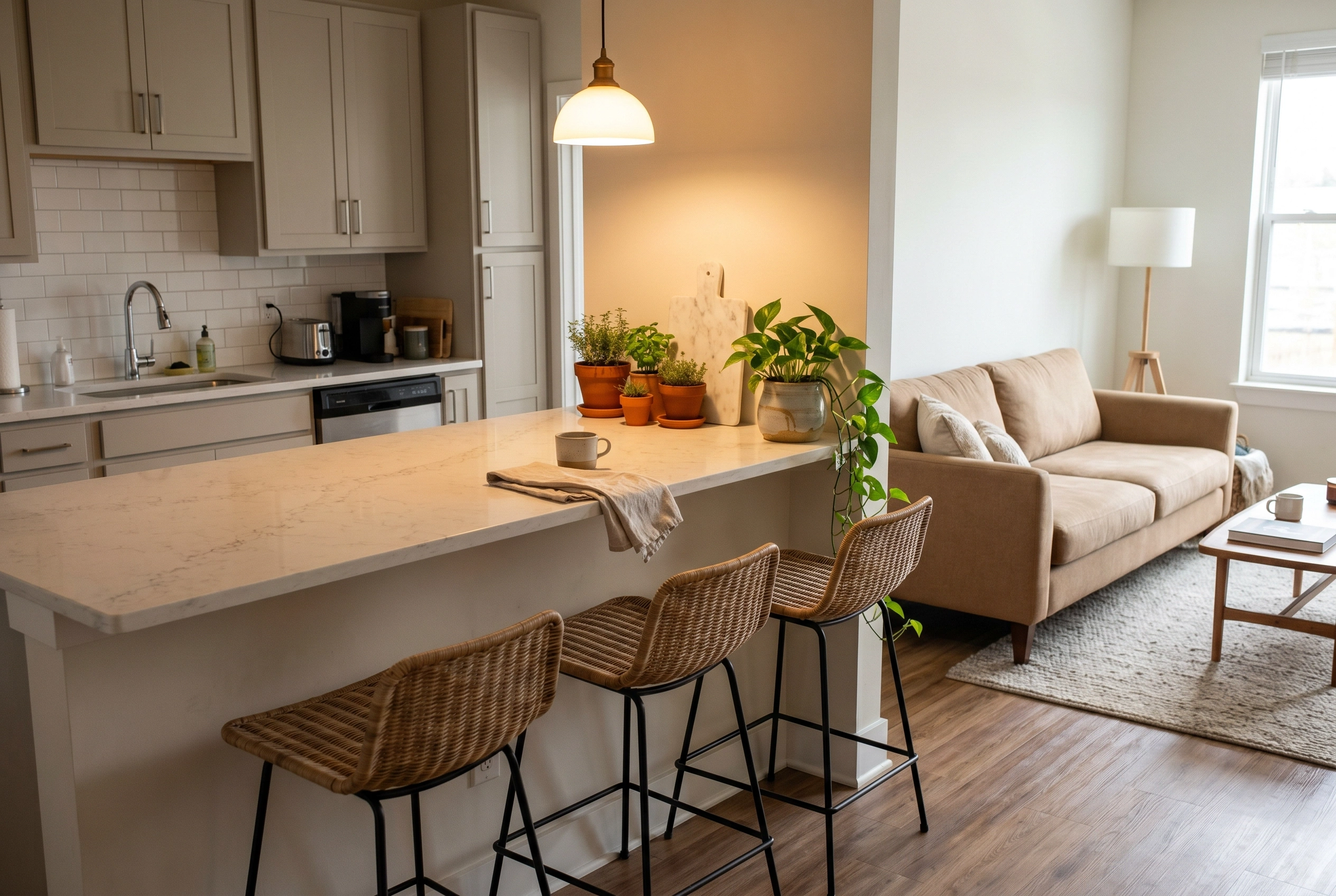
A kitchen island or bar counter positioned at the boundary between a kitchen and living zone is one of the most functional partition solutions that doubles as a genuine lifestyle feature. Tall bar stools on the living-room-facing side turn the counter into a casual dining spot, a morning coffee perch, a work-from-home station, or a social hub during gatherings — all while clearly defining where the kitchen ends and the living space begins. The counter itself acts as the architectural boundary without requiring anything installed above it.
For renters where the kitchen already has a peninsula or breakfast bar, styling the countertop intentionally makes a meaningful difference: a small potted herb garden, a marble chopping board, a trailing plant in a ceramic pot, and a pendant lamp above the counter transforms a builder-grade surface into a designed zoning element. For homeowners building or renovating, adding a counter-height partition island — between 36 and 42 inches tall — at the kitchen-living boundary remains one of the most practical structural investments available.
22. Wide Floating TV Console Used as a Low-Level Room Divider
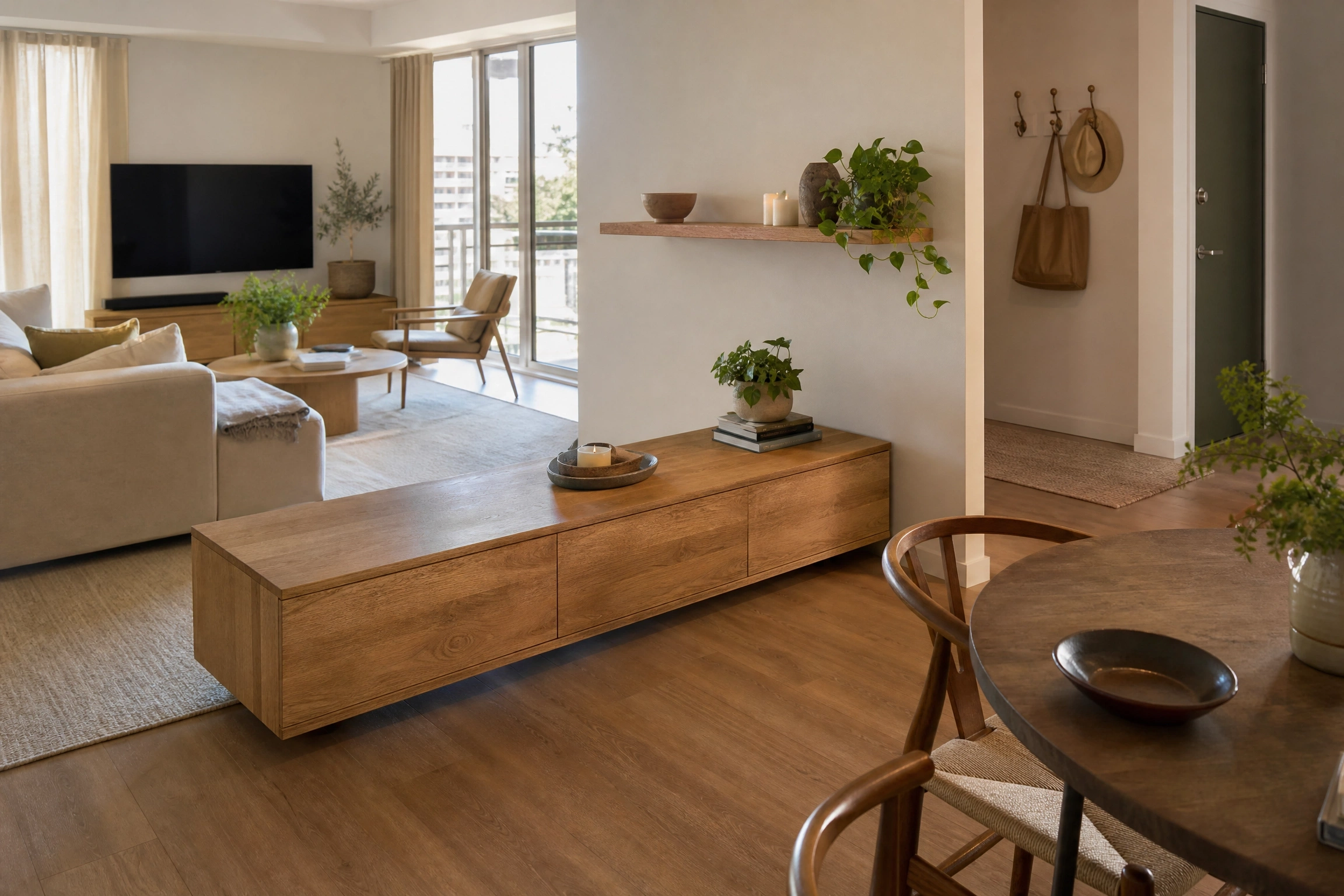
A wide, low-profile TV console — 60 to 80 inches long and no taller than 24 inches — placed with its back facing the dining or entry zone creates a natural, low-level partition that defines the living room without blocking sight lines or natural light. The TV faces the sofa while the back of the console becomes a visual anchor point for whatever space sits behind it. It’s a furniture-as-architecture approach that interior designers rely on regularly in open-plan projects.
The key is treating the rear face of the console as a designed surface, not a forgotten back panel. A small floating shelf positioned behind it at eye height from the dining side, a low candle arrangement, a trailing plant, or a sculptural object turns the console’s back into an intentional element that reads well from multiple directions. Look for pieces with natural wood finishes — acacia, mango wood, or oak — to add warmth. Budget: $200–$600 depending on brand and material. Renter-safe; repositionable.
23. Double-Sided Fireplace Built Into a Freestanding Central Partition Wall
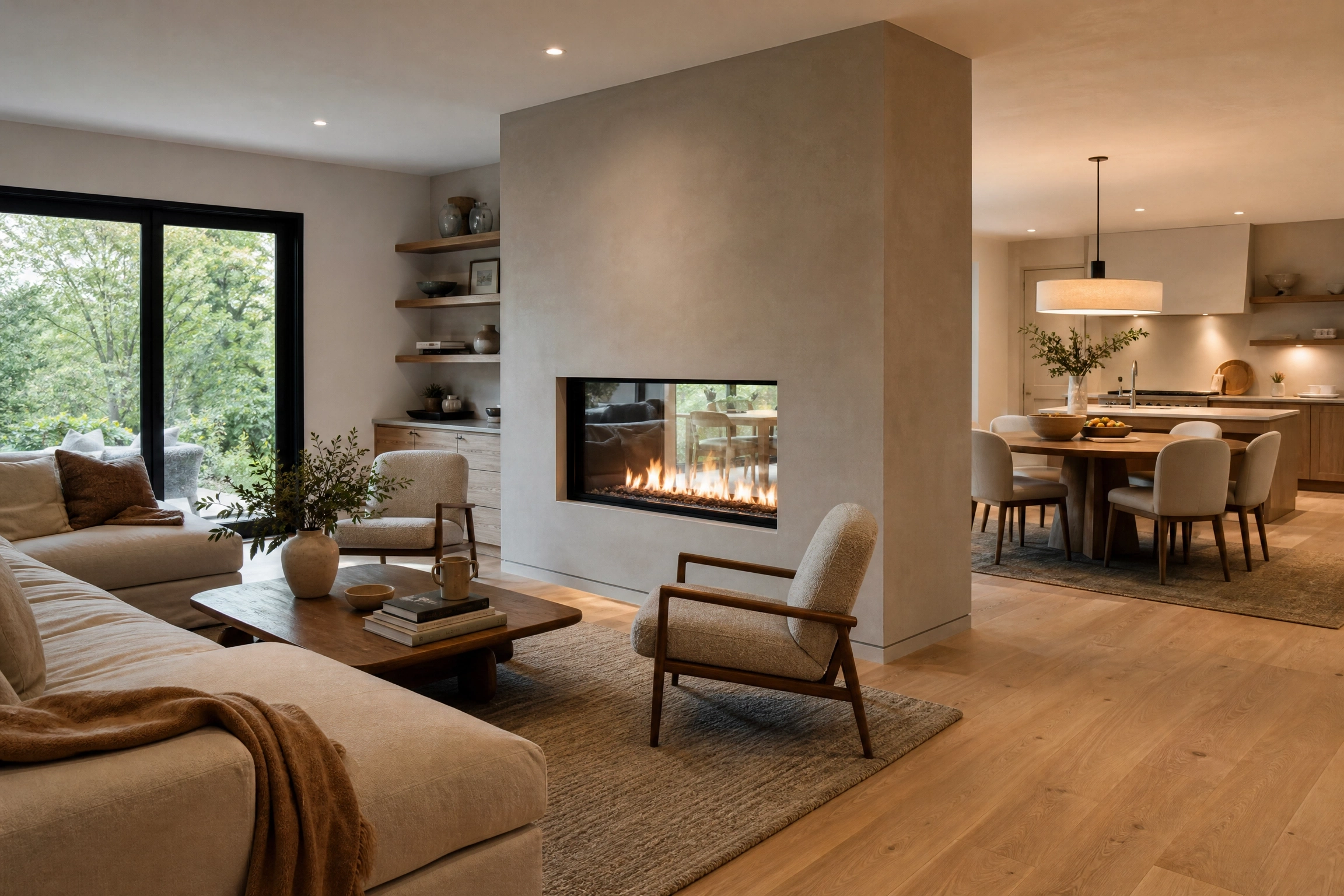
A double-sided fireplace — one with a combustion chamber or glass panel viewable from two directions — built into a central freestanding wall is among the most dramatic partition solutions available. From the living room side, the fire anchors the seating arrangement. From the dining or kitchen side, the warmth and light create an entirely separate atmosphere, giving each zone its own intimacy even though both share the same firebox. The effect is genuinely luxurious in a way that no curtain or bookcase can approximate.
This is a substantial homeowner investment — structurally and financially, typically starting at $5,000 and rising to $20,000+ for a custom-built architectural installation. Electric double-sided fireplaces (requiring no ventilation) are the most accessible entry point, with some freestanding units available from $800–$2,000, though the drama of a proper built-in double-sided piece is considerably greater. For those willing to invest, it’s the kind of partition that completely transforms how a home functions and is experienced daily.
24. Hand-Carved Jali Wooden Screen for a Traditional Artisan Partition
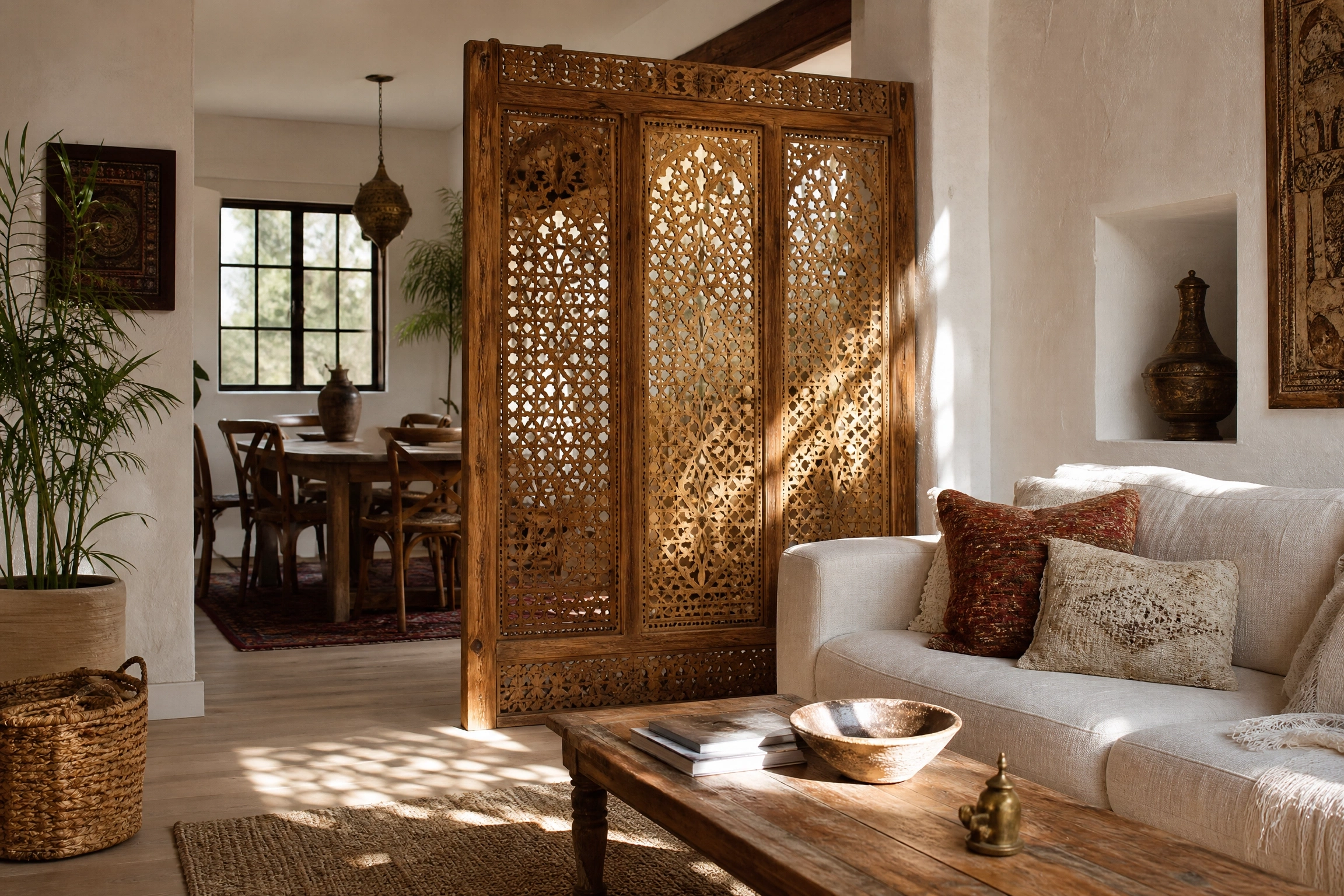
A jali screen — the intricate lattice-carved wooden panels originating from Mughal and Rajasthani architecture — brings a level of artisan detail to a room that no modern manufactured screen can replicate. The carved geometric or floral patterns cast extraordinary shadow play across floors and walls when light passes through them, and the richness of the craftsmanship reads as a genuine focal point rather than a background accessory. Against a whitewashed wall beside a simple linen sofa, a single jali panel becomes the defining element of the entire room.
Authentic hand-carved jali panels are available through Indian craft retailers, specialty import stores, and global artisan platforms like Etsy — typically in the $120–$500 range for a finished freestanding or wall-ready panel. They suit Moroccan, global eclectic, bohemian, and warm maximalist interiors most naturally, though a single restrained panel can work beautifully as a focal point in a more minimal room. Look for teak, sheesham, or mango wood options — these have genuine durability and a warm grain that enriches and deepens over time.
25. Stacked Stone Veneer Half-Wall with a Rustic-Modern Finish
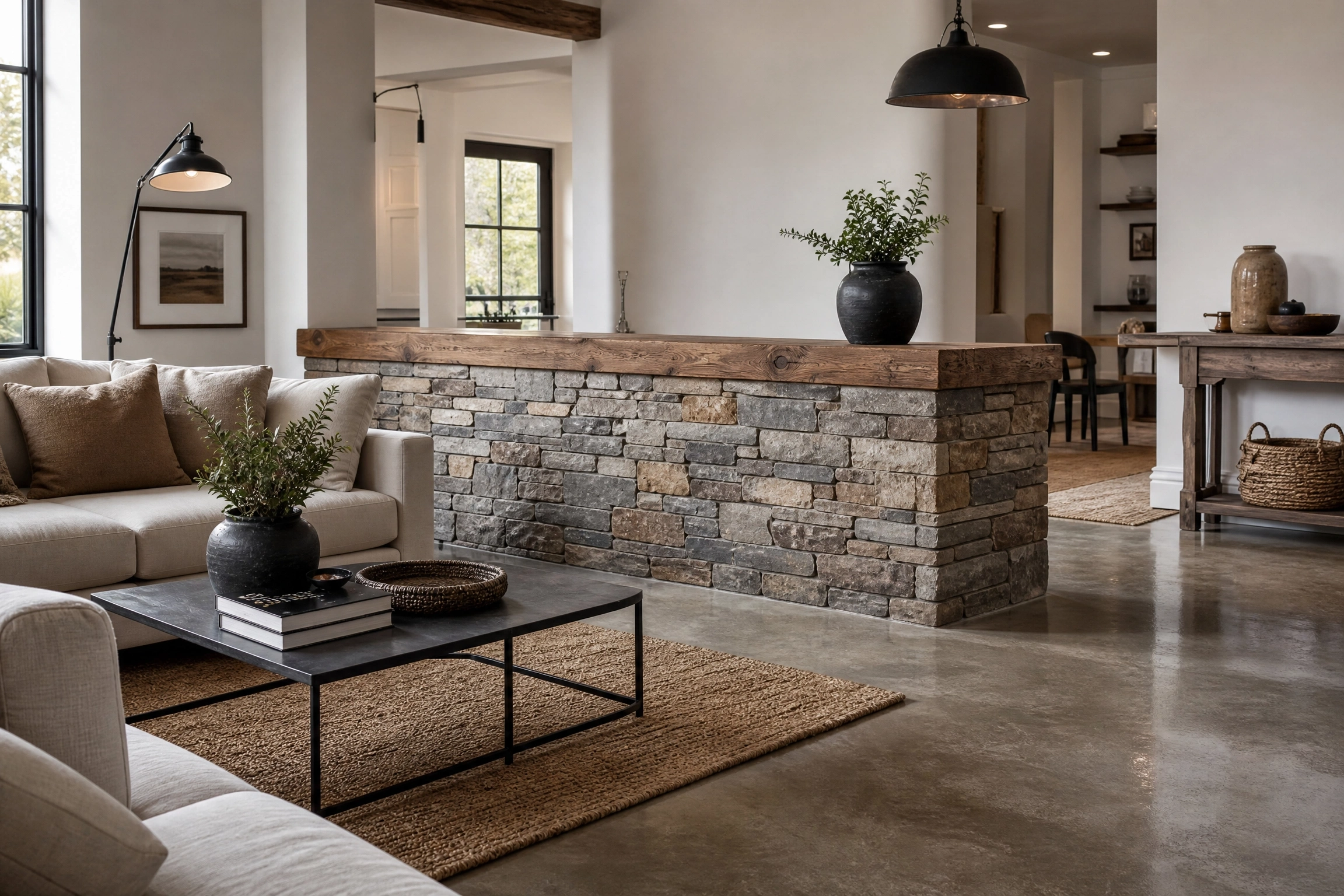
A stone veneer half-wall — lightweight stone panels applied over a stud-framed structure — creates the visual weight and texture of a solid stone partition without the structural complexity or cost of real masonry. The organic irregularity of the stone surface against clean white walls, polished concrete floors, and contemporary furniture creates a contrast that reads as curated and deeply considered. Topped with a reclaimed oak or walnut cap rail, it becomes a genuinely beautiful architectural feature that holds its own as a design statement.
This is a homeowner project with intermediate DIY skill requirements — not a beginner weekend job, but a well-documented build with long-lasting results. Stone veneer panels are available at most home improvement stores for $4–$12 per square foot; a typical partition of 8 feet long and 36 inches high costs $300–$700 in materials, not including labor. The textured, weighty surface suits modern farmhouse, industrial, and earthy organic modern interiors, and pairs especially well with raw metal lighting fixtures and natural-fiber rugs.
26. Exposed Concrete Block Partial Wall with Industrial Loft Styling
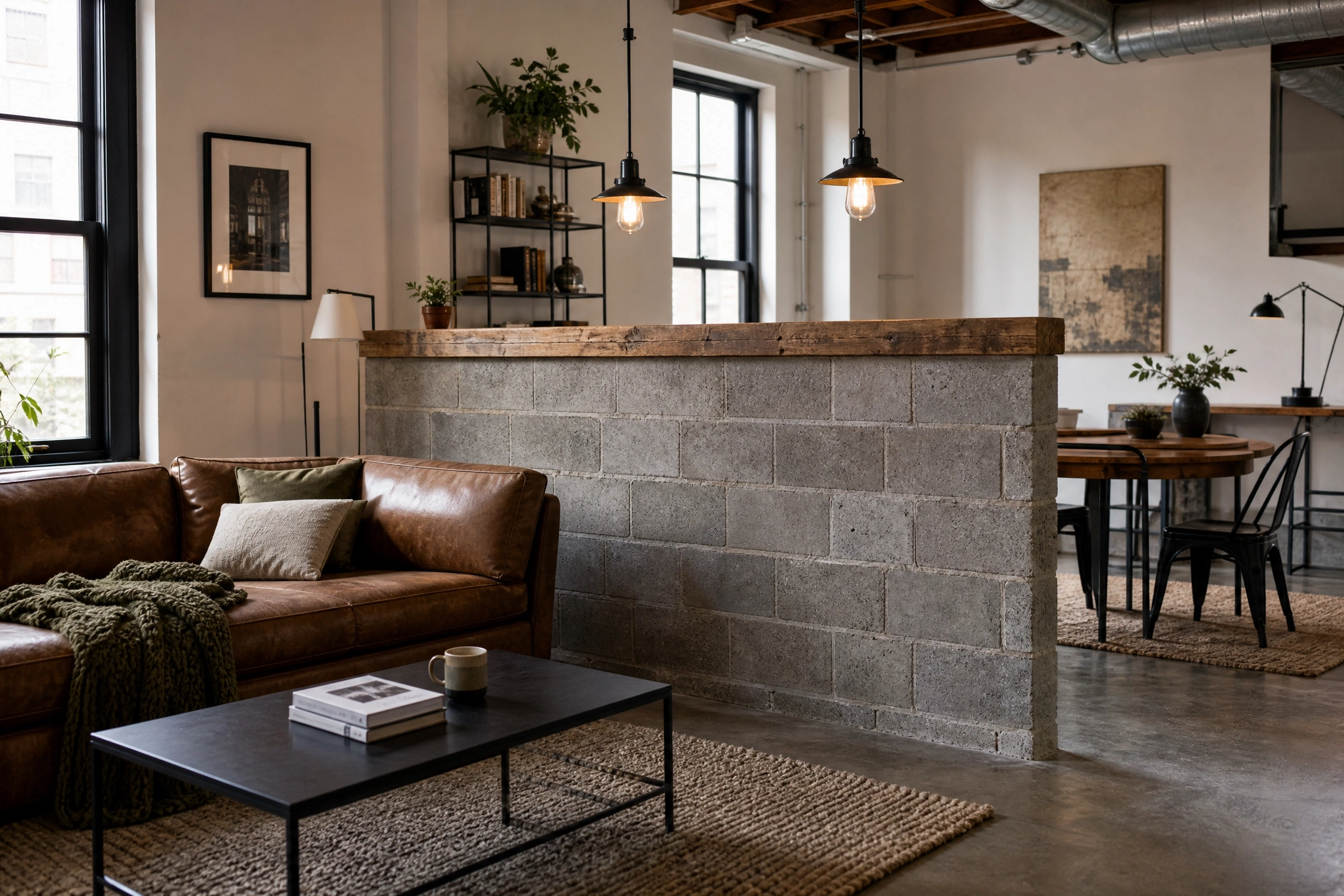
A concrete block half-wall — standard CMU blocks stacked and mortared to roughly 42-inch height — is one of the most economical structural partition materials available, and in an industrial or loft-style interior, it’s one of the most visually authentic. Left unsealed, the raw gray texture and exposed mortar lines create an undeniably cool material moment. Sealed and painted — matte gray, warm sand, or a deep olive — the same blocks read considerably more refined and liveable without losing their honest materiality.
The weight and permanence of a concrete block wall makes it a homeowner-only solution — most rental situations would never permit it, and it requires professional structural consultation before building in any load-bearing context. For those who can use it, the cost is remarkably low: concrete blocks typically run $1.50–$3.00 each, making a partial-height partition achievable for well under $200 in raw materials. Top with a reclaimed timber cap rail to soften the industrial edge, and illuminate from above with exposed filament pendants for a fully committed loft aesthetic.
27. Beaded Wood or Crystal Curtain Divider for a Retro Boho Statement
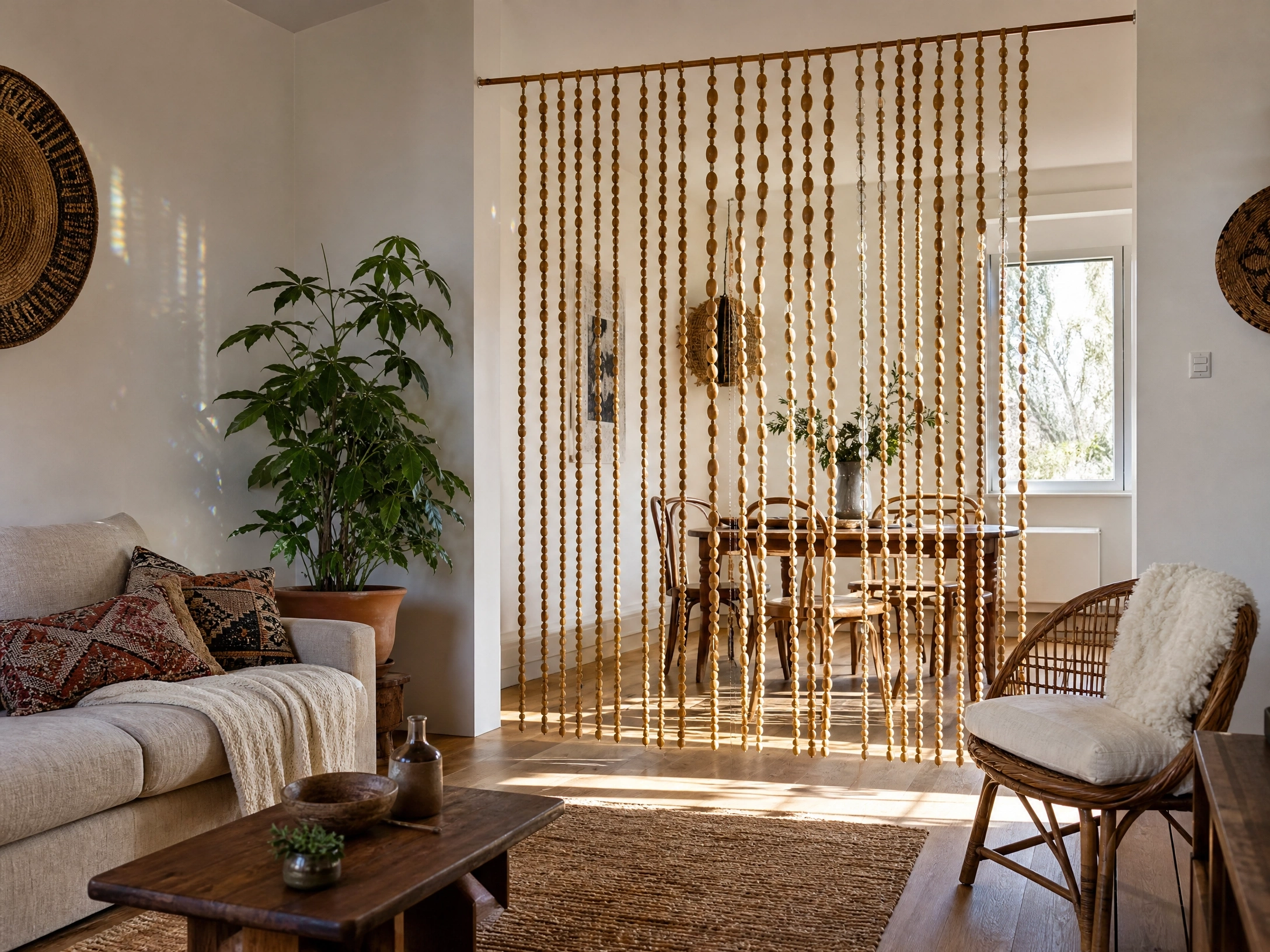
A beaded curtain — hundreds of wooden, shell, or crystal beads strung vertically from a ceiling-mounted rod — is having a genuine design moment right now, and the contemporary versions look considerably more intentional than their 1970s predecessors. In a living room, a wide wooden bead curtain hung across an archway or open threshold creates a boundary that feels textural, rhythmic, and deeply warm. Crystal or glass bead versions catch light differently — scattering tiny prismatic reflections when sunlight or candlelight passes through the strands.
The practical advantage is price: a quality wooden bead curtain panel costs $20–$60 for a standard doorway width, making this one of the most affordable partition options available. For a full-width room divider spanning four or five feet, use two to three panels side by side. Wood beads in natural or honey tones suit boho and coastal rooms; jet-black ebony beads read more dramatically in maximalist or eclectic spaces. Renter-safe when hung from a tension rod; one practical note: the strands tangle in high-traffic areas, so position this where people won’t part it repeatedly throughout the day.
28. Preserved Moss Panel Installed as a Living, Low-Maintenance Green Divider
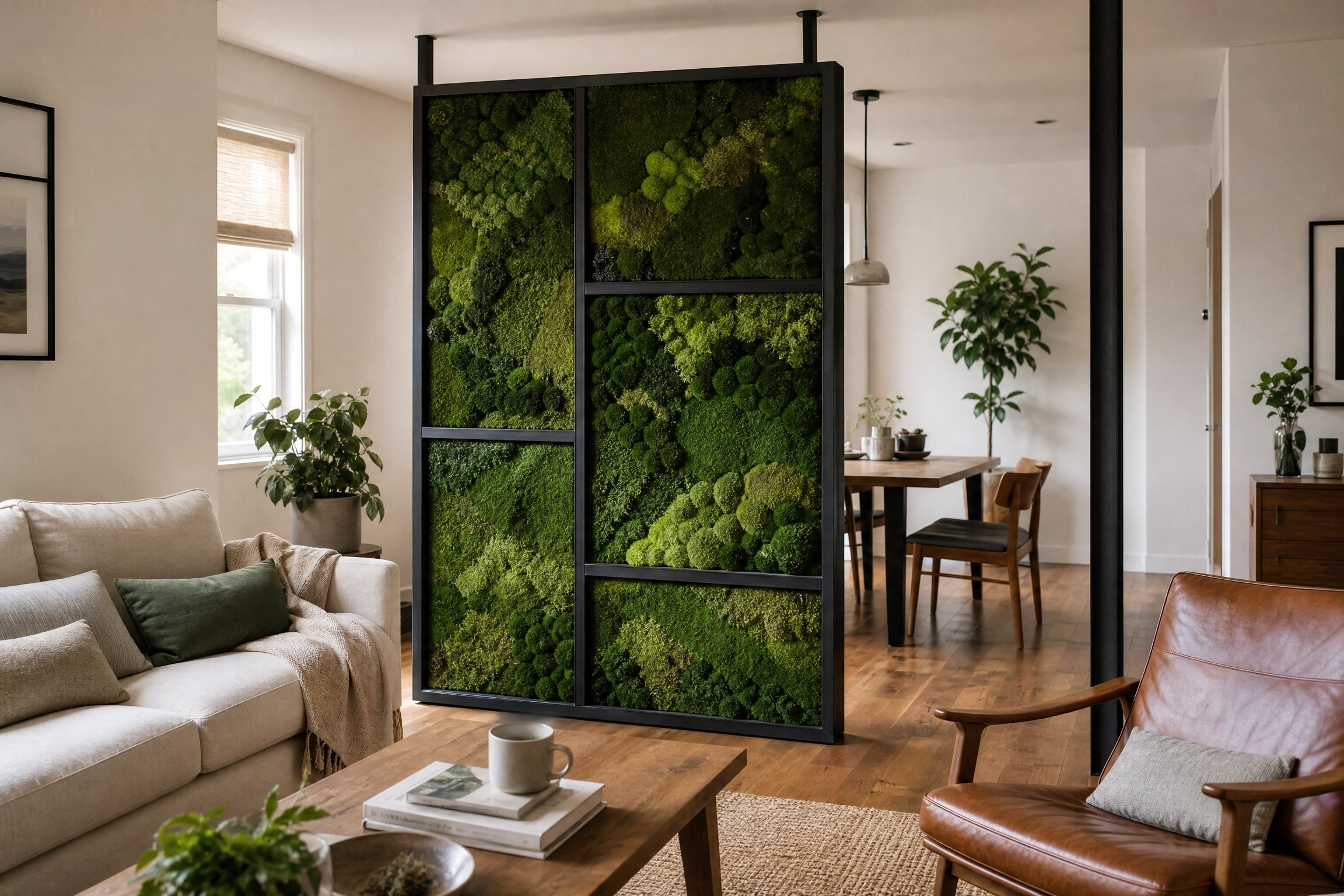
A preserved moss wall panel — framed sections of reindeer moss, flat moss, or pillow moss preserved in glycerin so it stays soft, green, and tactile indefinitely — creates the impression of a living plant wall without watering schedules, grow lights, or replacement costs. The texture is unexpectedly beautiful: the varied greens and subtle depth variations across the moss surface read like a landscape painting, giving any room a sense of natural quiet that both photographs beautifully and holds up beautifully in person.
Preserved moss panels are available through botanical décor brands and specialty Etsy sellers, typically ranging from $60–$200 per square foot depending on moss variety and frame quality. For a freestanding partition of five by seven feet, expect to budget $400–$800. The practical advantage: no watering, no sunlight requirements, no special humidity conditions — the panels simply sit and look quietly extraordinary for years. Avoid direct strong sunlight (which fades color over time) and high-moisture environments that could disturb the glycerin preservation treatment.
29. Kids’ Corner Partition with Built-In Cubby Storage on One Facing Side
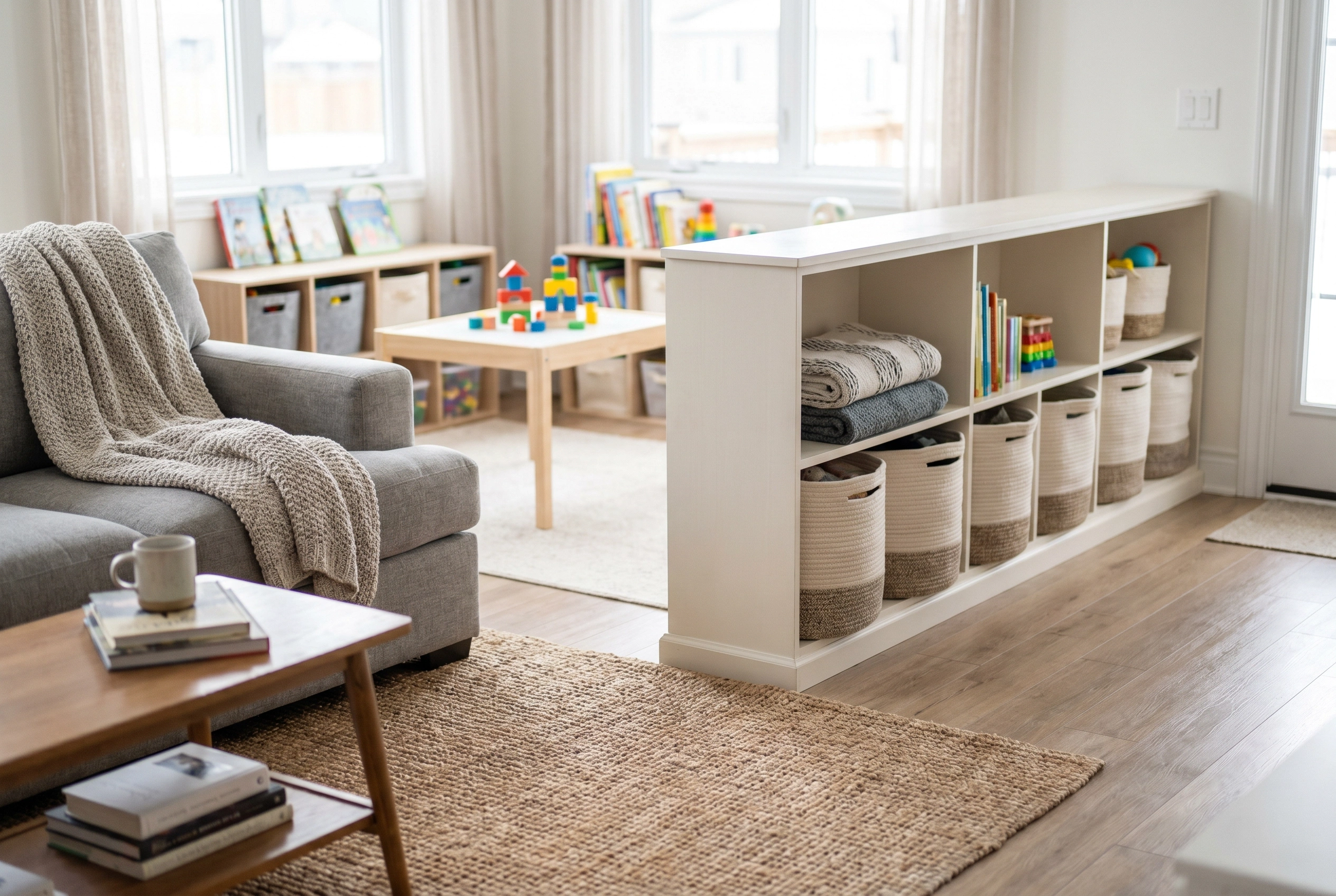
In households with young children, an open-plan living room often has to do double duty as both the adult living space and the kids’ play zone — and the result satisfies neither function well. A low-height partition of 36–48 inches — short enough that adults can see over it from the sofa — with built-in cubbies on the kids’-zone-facing side creates a defined play area with its own visual identity, while keeping the living space feeling organized and intentional rather than gradually overtaken by primary-color chaos.
The cubby-facing side stores toys, books, and craft supplies within an enclosed visual zone; from the living room side, the partition can be finished in the same wall color or with a textile panel for a clean, adult-facing appearance. Use durable, washable paint finishes and rounded corners for child safety. IKEA’s KALLAX, placed horizontally as a low unit rather than vertically, and loaded with DRÖNA fabric boxes on the kids’ side, works well here. Budget: $100–$200 for the unit. Renter-safe with floor anchoring.
30. Window Seat Nook with a Structural Back Panel Acting as a Built-In Divider
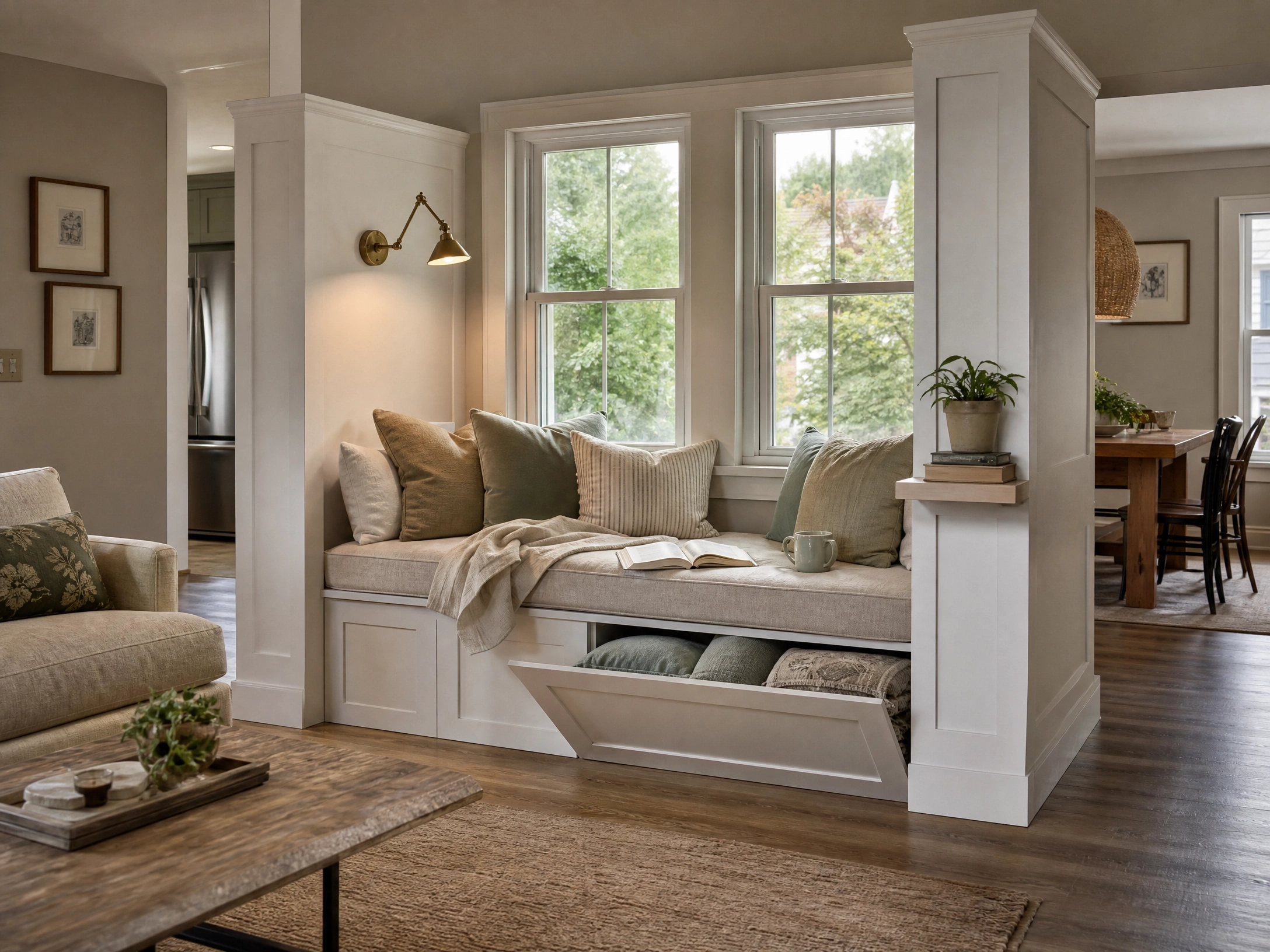
A built-in window seat — a cushioned bench running across a window, flanked by two tall end panels extending from floor to ceiling — creates a reading nook that naturally partitions a corner of the living room from the rest of the open-plan space. The tall end panels act as wing walls, giving the seat occupant a sense of enclosure and intimacy even though the space behind the seat remains fully open. It’s the architectural equivalent of a nest built inside a larger room.
This is a homeowner or permitted-renovation solution involving basic carpentry — stud frame, MDF or plywood casing, cushion, and paint — costing between $300 and $1,200 depending on size and finish quality. The seat base can also serve as storage: lift-up lids reveal deep compartments for blankets, spare cushions, or seasonal items. In a living room with bay or double-hung windows, this transforms an underused wall into the most beloved spot in the house. Style with a linen cushion, a small wall-mounted reading light, and a floating side shelf.
31. Freestanding Arched Frame Used as a Soft, No-Drill Visual Boundary
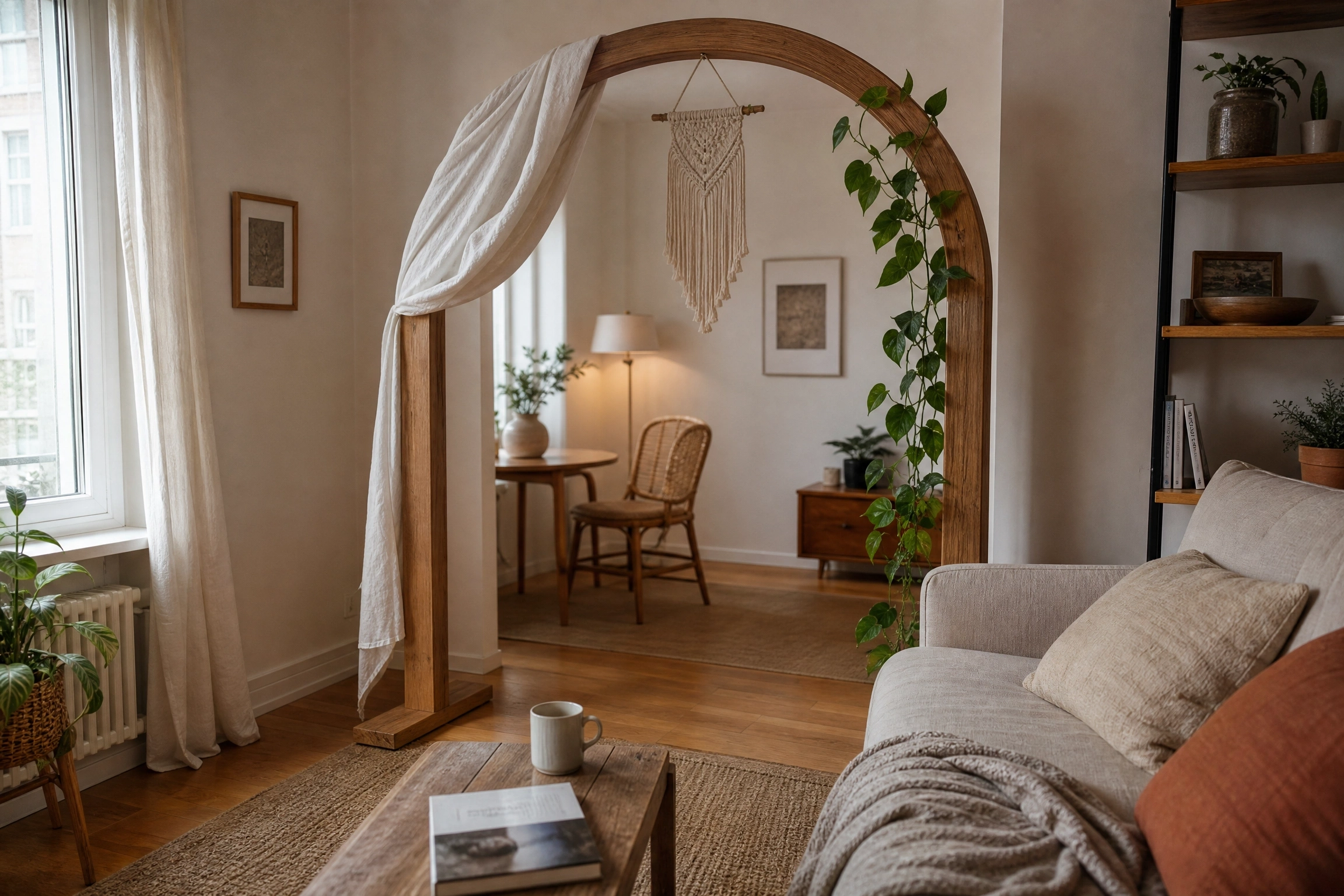
A freestanding arched frame — a large floor-standing arch in natural wood, bamboo, or matte black metal — creates a visual doorway between two zones without any installation whatsoever. The arch implies a threshold, signaling to anyone in the room that this is where one area ends and another begins, using only geometry and the quiet power of suggestion. Styled with a piece of linen draped softly over the frame, a trailing plant climbing one side, or a hanging macramé panel, it becomes a statement piece that anchors the room.
Finished arched frames are available from home décor brands and Etsy makers in the $80–$250 range. DIY builds using bentwood, painted PVC pipe, or rattan can come in under $30 for materials. The key placement note: position the arch so it sits in the natural sight line from your main seating area — the arch should frame a view or a moment in the room rather than interrupt one. Renter-safe and freestanding; requires no wall attachment, no drilling, and no adhesive.
32. Row of Tall Indoor Trees (Fiddle Leaf Figs or Olive Trees) as a Living Divider
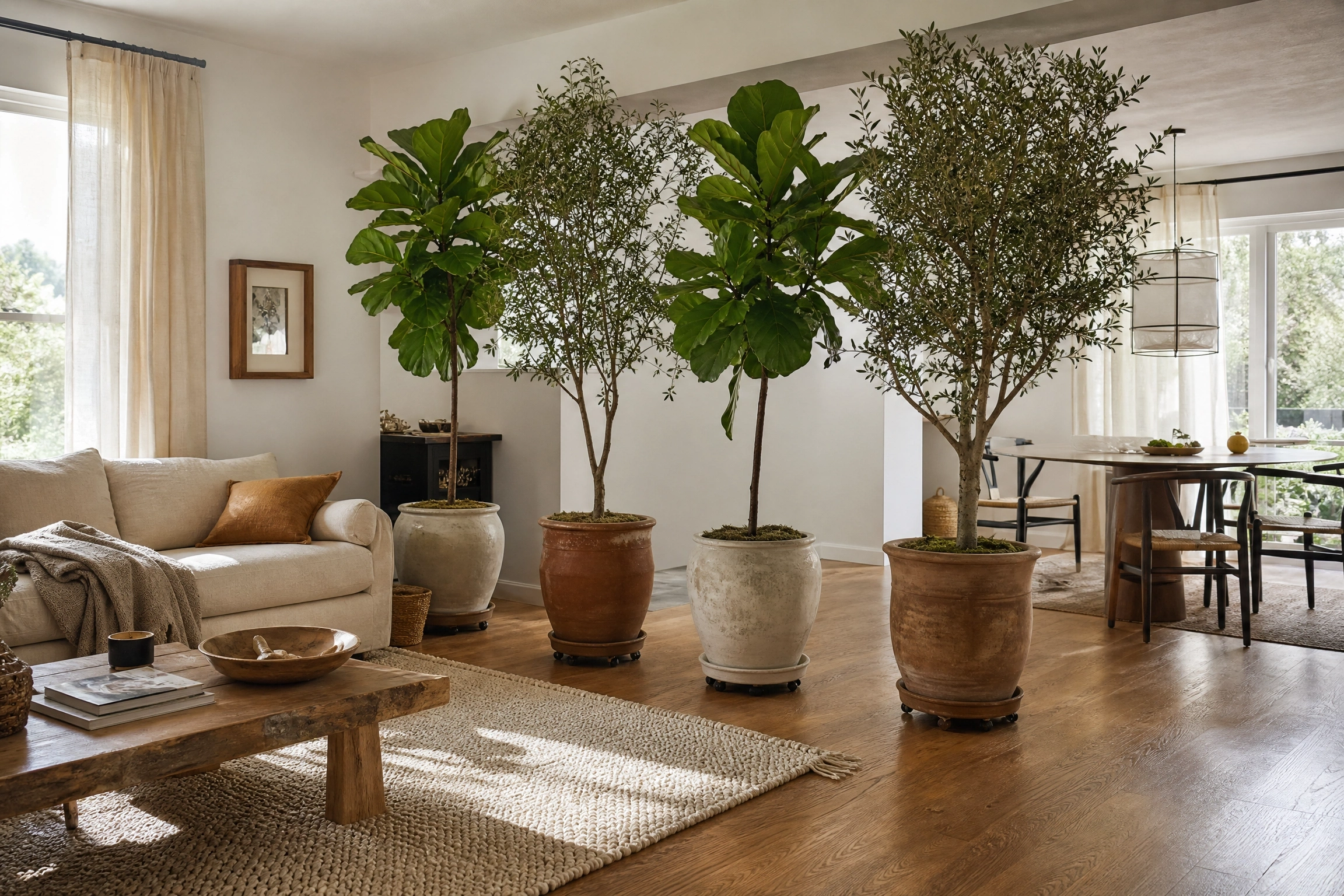
Three or four tall indoor trees — fiddle leaf figs, olive trees, tall rubber plants, or weeping figs — positioned in a row perpendicular to the room creates a breathing, organic room partition that works with the architecture rather than imposing on it. Each tree sits independently in its own large pot, allowing spacing and arrangement to be adjusted without commitment. The green canopy of the trees at ceiling height creates a visual ceiling within the ceiling, adding a remarkable sense of depth and intimacy.
The practical consideration is light: fiddle leaf figs and olive trees both need consistent bright indirect light to thrive indoors, and a row in the middle of a room may receive uneven light across all sides. Rotating plants every few weeks helps maintain even growth. For lower-light living rooms, choose tall snake plants, cast iron plants, or corn plants — more forgiving and still architecturally present. Budget: $80–$300 per tree depending on size and species; statement pots are often a similar cost again. Renter-safe; no installation required.
33. Pegboard Wall Divider with Customizable Hooks, Ledges, and Display Shelves
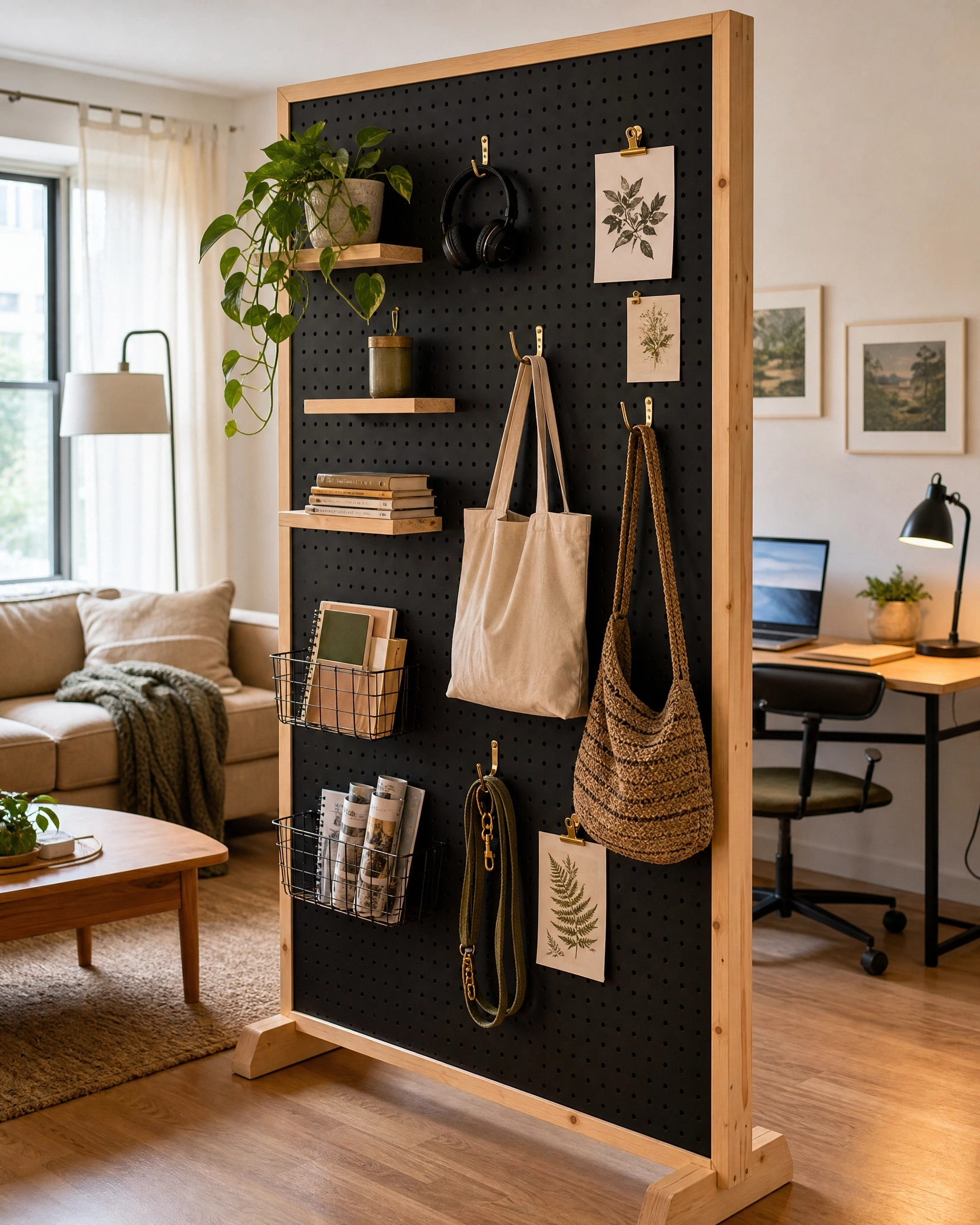
A large pegboard panel — a 4×8 foot sheet of MDF or hardboard drilled with a grid of quarter-inch holes — mounted into a freestanding frame creates a fully customizable storage and display partition that changes as often as your needs do. Hang hooks for bags, add small wooden ledges for plants and candles, clip in basket organizers, or build a mini gallery wall of pinned art prints. The pegboard adapts to whatever the space needs without buying anything new beyond a few inexpensive accessory hooks.
The visual character depends entirely on styling: painted matte black and loaded with brass hooks and ceramic planters, it reads as industrial-chic; left natural and hung with botanical prints and macramé, it suits a more organic aesthetic. A standard 4×8 sheet costs $15–$30; the freestanding frame adds another $30–$60 in lumber and hardware. For a cleaner finish, replace standard pegboard with a slot-wall or French cleat system, which offers the same flexibility with a more design-forward look. Freestanding versions are renter-safe.
34. Leaning Ladder Shelf as a Lightweight, Repositionable Room Separator
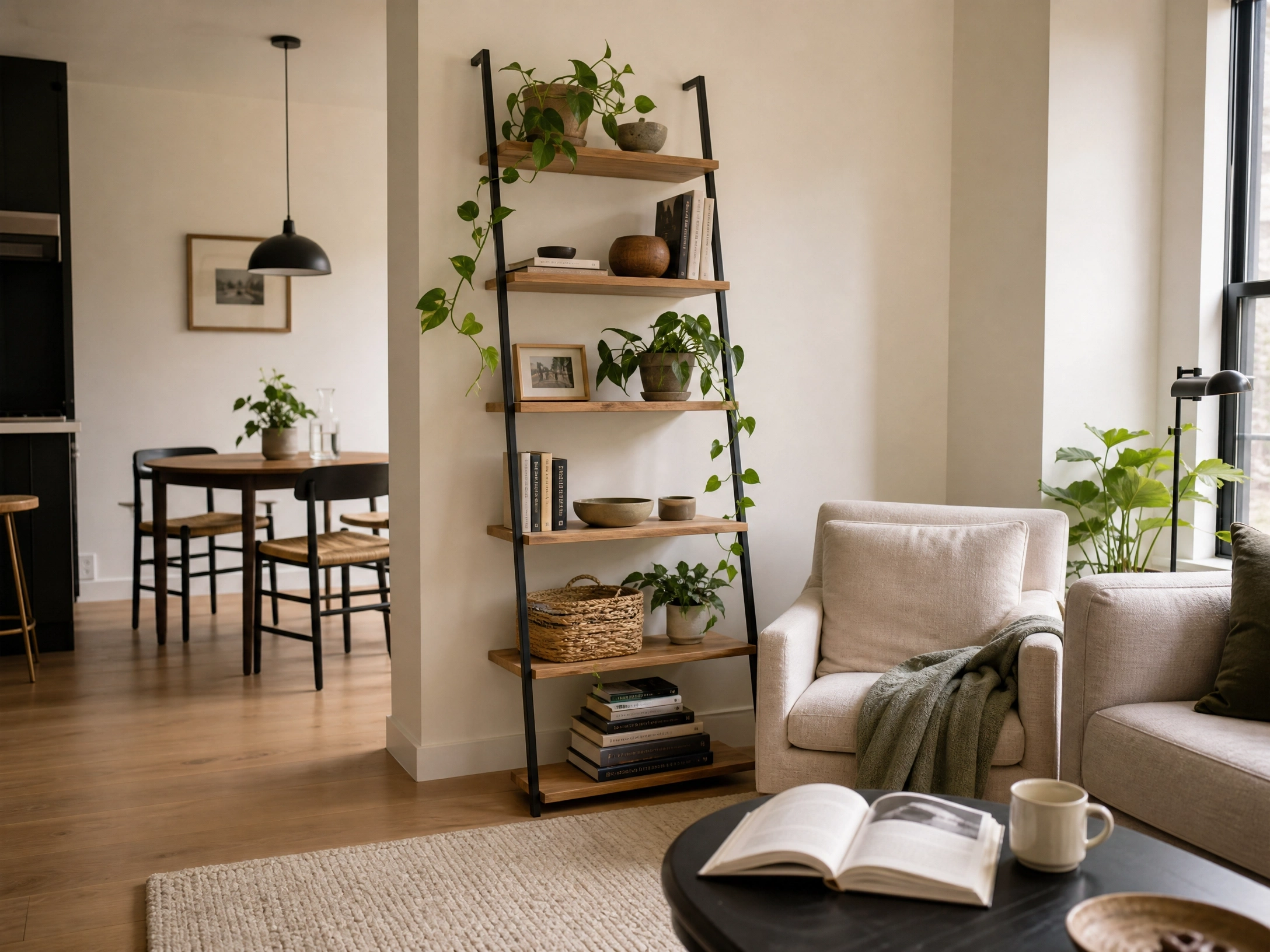
A tall leaning ladder shelf — five or six rungs of wood or metal, widening from the narrow top to the broader base — creates a gentle visual marker between two zones without the commitment of a freestanding unit you need to anchor. Leaned at an angle between a wall and an armchair, or positioned at the edge of a rug to mark the living zone’s boundary, it takes on a more purposeful architectural role than it might initially appear to offer. The simplicity is the point.
The repositionability is the real advantage: a ladder shelf costs $60–$180 and moves in seconds, suits multiple rooms equally well, and earns its purchase price even if your layout changes next season. For use as a room divider rather than just a display piece, choose a wider model — 24 to 30 inches across at the base — and load the shelves with plants, books, and objects that read well from both the front-facing and wall-adjacent sides. Renter-safe and fully commitment-free; no installation, no anchoring, no holes.
35. Diamond Lattice Trellis Partition with Trailing Vine Plants Woven Through
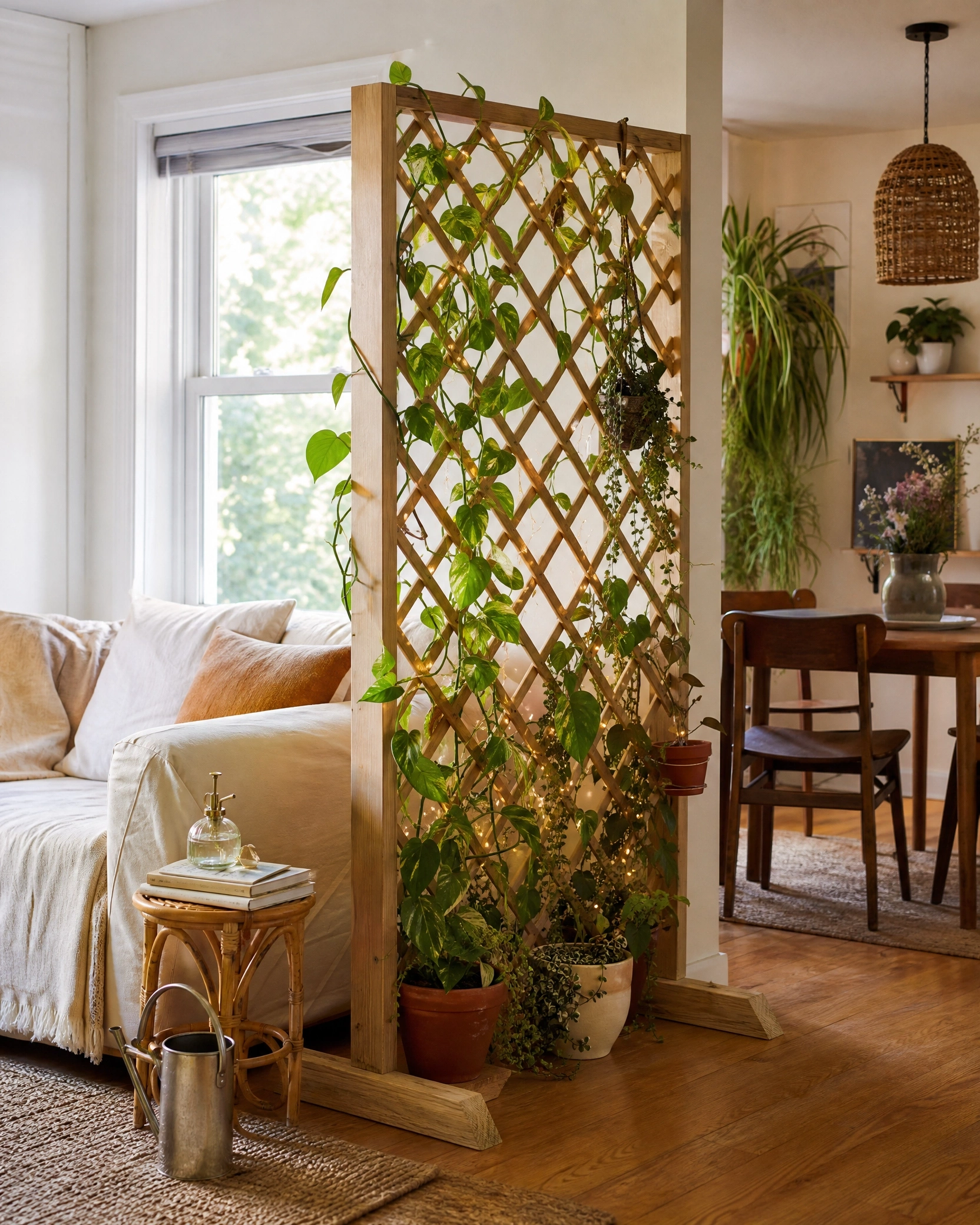
A diamond lattice trellis — the kind sold in garden centers as an outdoor plant support — mounted into a freestanding timber frame and woven with trailing houseplants creates one of the most original partition ideas on this list. Pothos, heartleaf philodendron, string of pearls, and hoya are all vigorous trailers that weave through lattice openings over weeks and months, gradually filling the structure with green without pruning or active training. The result is a partition that grows more beautiful over time rather than staying fixed.
The trellis itself is extremely affordable — a wooden lattice panel costs $8–$25, and a basic timber frame adds another $20–$40 in lumber. The plants are the ongoing investment, but most trailing varieties are available for $5–$20 each and propagate easily, multiplying your collection at minimal cost. Position near a window for adequate light, and water consistently rather than heavily. The look suits boho, maximalist, and biophilic living rooms especially well — and with fairy lights woven through the structure after dark, it becomes something genuinely special.
36. Mid-Century Modern Walnut Slatted Divider Screen with Angled Legs
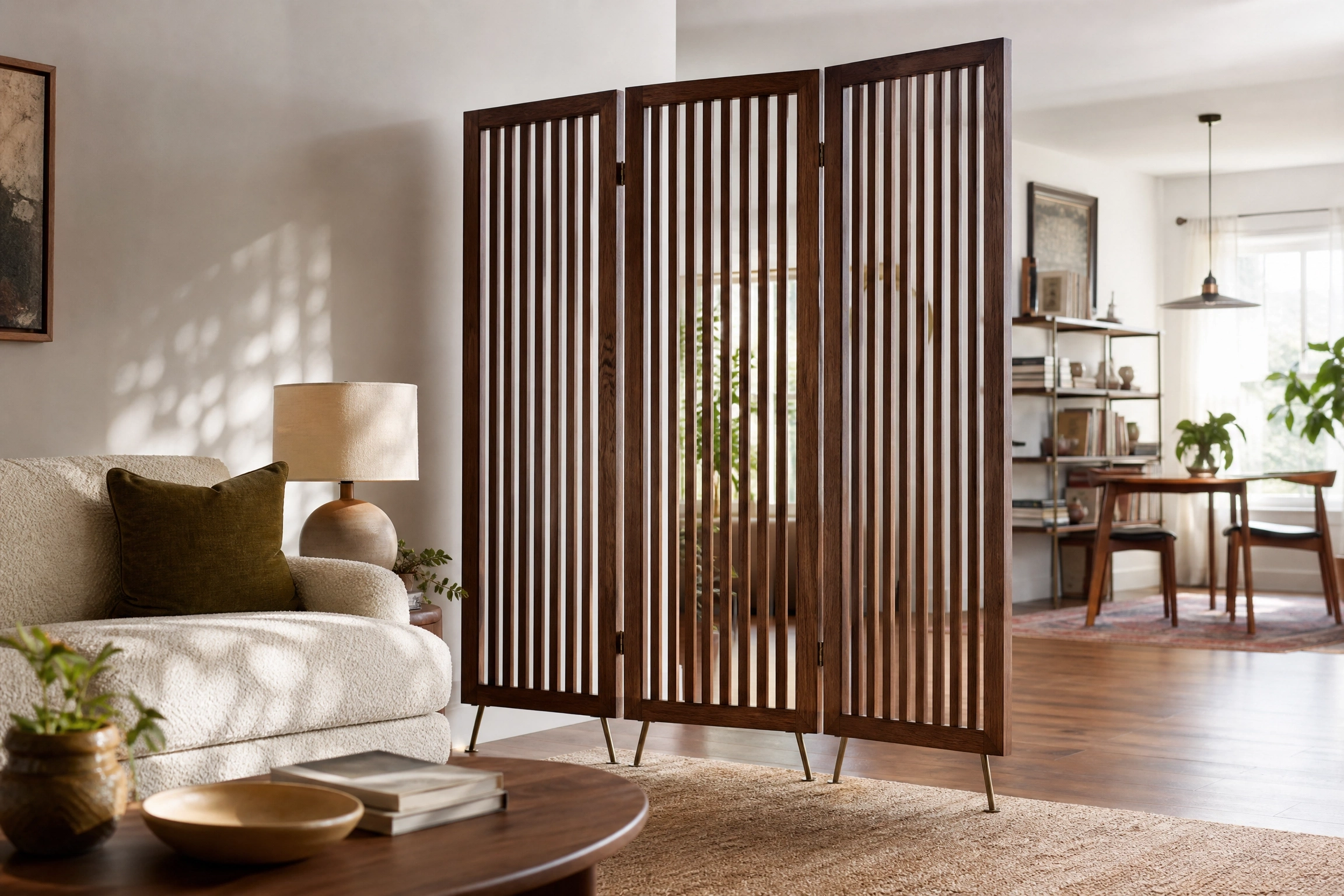
A slatted room divider in the mid-century modern tradition — warm walnut-stained vertical slats spaced at 2–3 inch intervals, set into a frame with tapered brass or dark metal legs — is one of the few partition styles that feels as relevant now as it did in the 1960s. The angled legs give the piece a lightness that keeps the room visually lifted rather than weighted down, and the slats create a dappled, rhythmic texture that suits modernist and warm-eclectic interiors alike. Against a white wall with a bouclé sofa nearby, the visual is unmistakable.
These dividers are available from mid-century furniture retailers and design-focused homeware brands, typically ranging from $250–$600 for a freestanding three-panel version. Authentic vintage pieces found through secondhand markets or estate sales can be significantly more affordable and carry an aged patina that reproduction pieces spend considerable money trying to simulate. When positioning, allow the tapered legs to rest on a rug rather than a hard floor — the warmer visual base helps the piece feel grounded and intentional rather than floating at random in the middle of the room.
37. Hanging Crystal Bead Curtain as a Glamorous, Light-Catching Room Separator
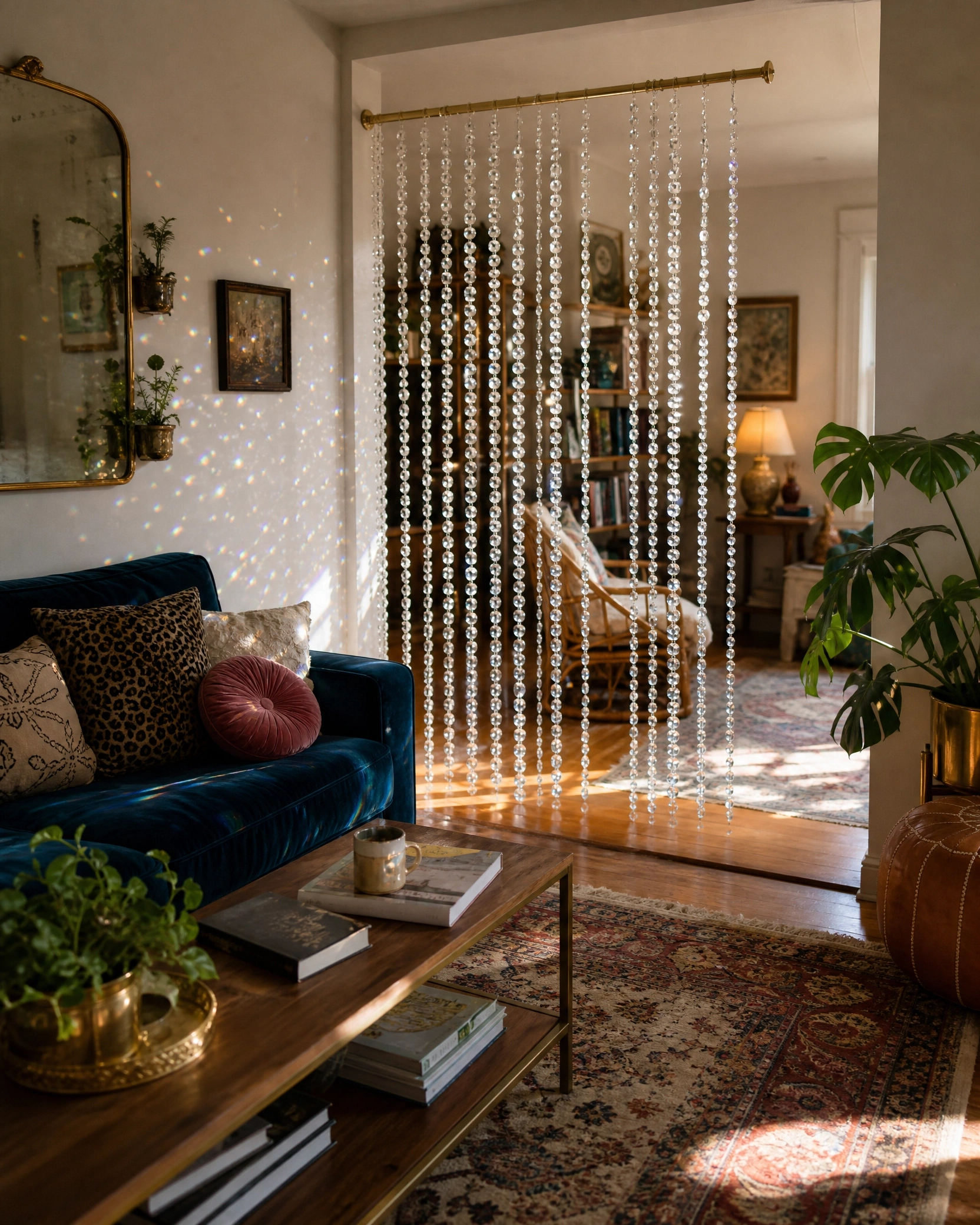
A crystal bead curtain — acrylic or glass strands hung from a slim rod, each bead catching and fracturing light into small prismatic reflections — creates a partition that genuinely changes throughout the day as natural light shifts across the room. Morning sunlight through the beads scatters tiny rainbows across the opposite wall. In the evening, warm lamp light turns the whole curtain into a soft, glimmering backdrop that makes the space feel celebratory rather than merely decorated. Few partition options create this kind of living atmosphere.
Crystal bead curtains are remarkably affordable — a single panel typically costs $15–$40 — and install easily on a tension rod or curtain hook. For a full-width room divider spanning four or five feet, use three to four panels side by side. The aesthetic suits maximalist, glam, eclectic, and boho interiors; it reads less well in spare minimalist or Japandi rooms where the reflective busyness can clash with the intended quietness. One practical note: the strands tangle easily in high-traffic areas, so position where the curtain won’t be parted repeatedly throughout the day.
38. Black Industrial Pipe Frame with Reclaimed Wood Shelves as a Room Divider
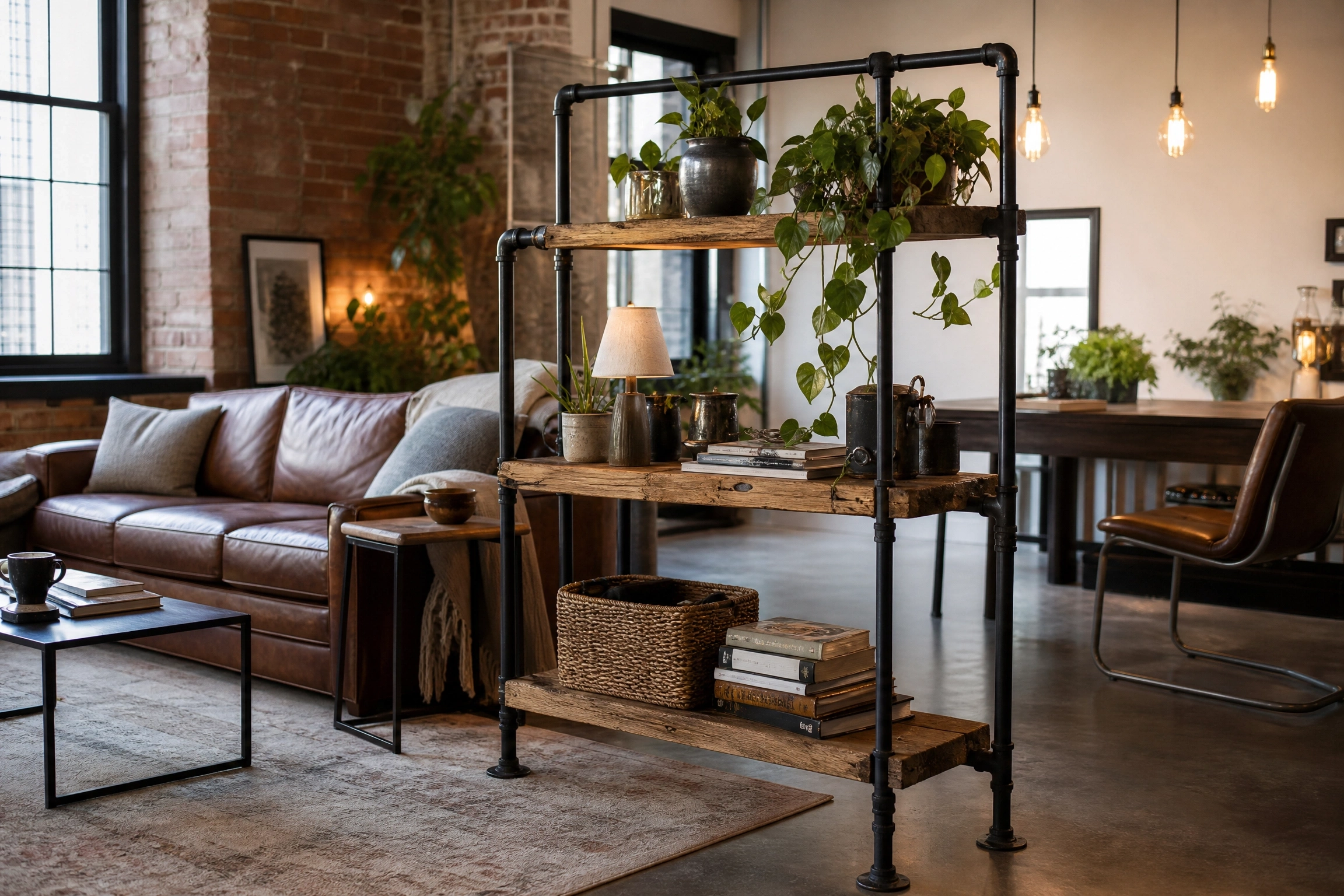
A shelving unit assembled from black iron pipe fittings and reclaimed wood planks — built into a floor-to-ceiling or mid-height freestanding frame — creates one of the most customizable and genuinely industrial room dividers available. The pipe fittings allow you to design any configuration of shelf heights, depths, and spans, adapting to unusual room geometries or non-standard ceiling heights in ways that off-the-shelf products simply can’t accommodate. The reclaimed wood adds visual warmth that prevents the black iron from reading as cold or clinical.
Pipe and wood shelf systems are sold as kits from various retailers, or can be assembled from plumbing pipe purchased at a hardware store. A mid-height system spanning 48 inches wide with three shelves typically costs $150–$350 in materials. The aesthetic suits industrial, modern farmhouse, and urban-loft interiors — pair with Edison bulb pendants and leather-seated furniture for a fully committed look. Floor-mounted freestanding versions are renter-appropriate; wall-anchored versions offer greater stability but require holes in the wall, making them a homeowner solution.
39. Gallery Wall of Oversized Framed Prints Creating a Visual Room Partition
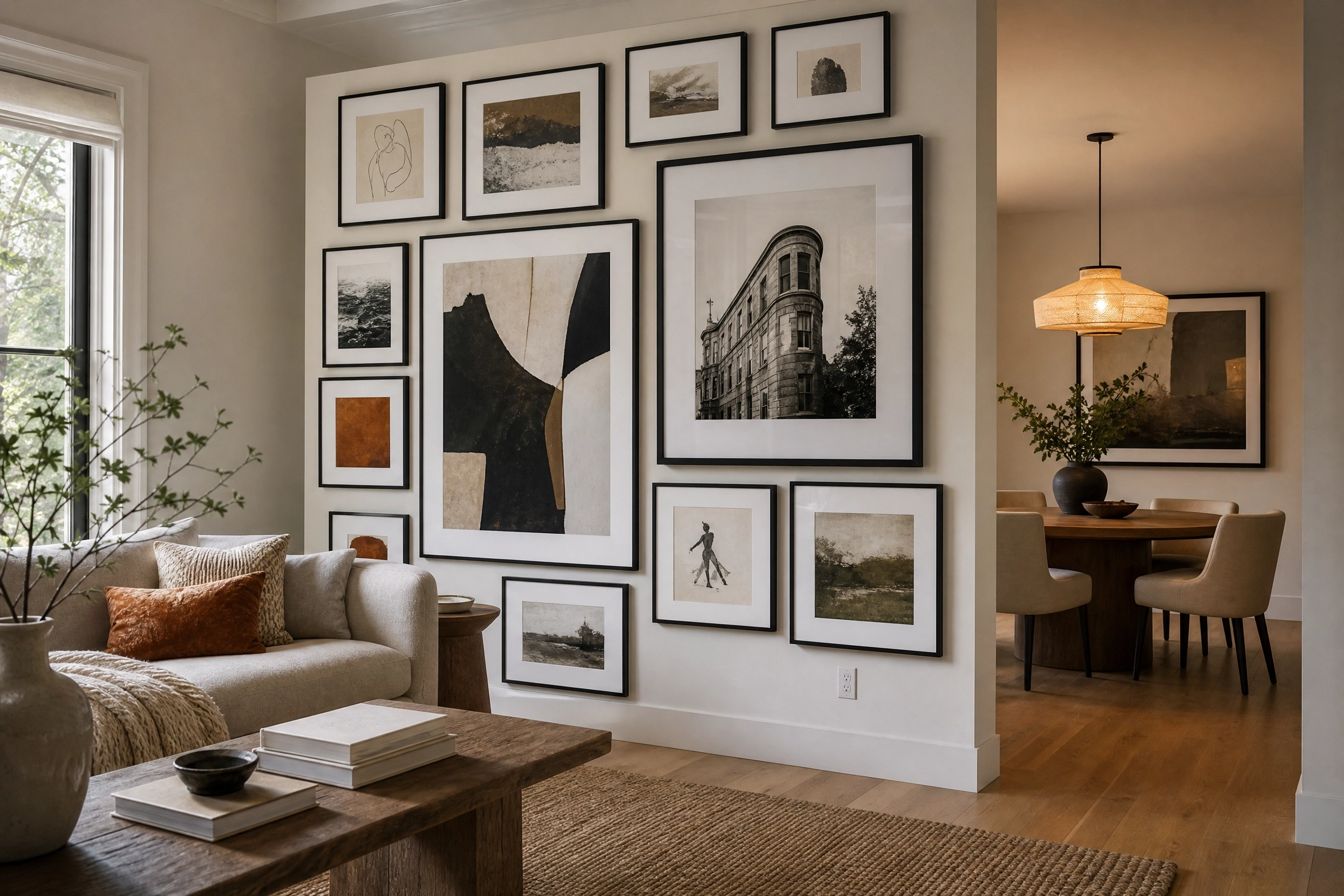
A floor-to-ceiling gallery arrangement — a dense, salon-style collection of oversized framed art prints installed along a narrow wall segment between two open-plan zones — creates a visual room boundary through sheer presence and visual weight alone. When the gallery spans a defined structural section at the boundary of a living zone, it acts as a visual anchor that draws the eye and signals clearly to anyone in the room that this is where one area ends and another begins.
This requires a real wall surface, making it a homeowner solution or a renter with permission for small nail holes (which most leases allow within reason). Print costs vary widely: options from Society6, Artifact Uprising, or local artists range from $15 to $200 per piece. For maximum impact, anchor the gallery with one or two large pieces — 24×30 inches or larger — surrounded by a collection of smaller prints in varied sizes. Keep the frames cohesive: all matte black, all warm brass, or all raw wood — the shared finish creates unity across the variety of imagery.
40. Open Matte Black Steel Railing Divider with a Loft-Style Architectural Edge
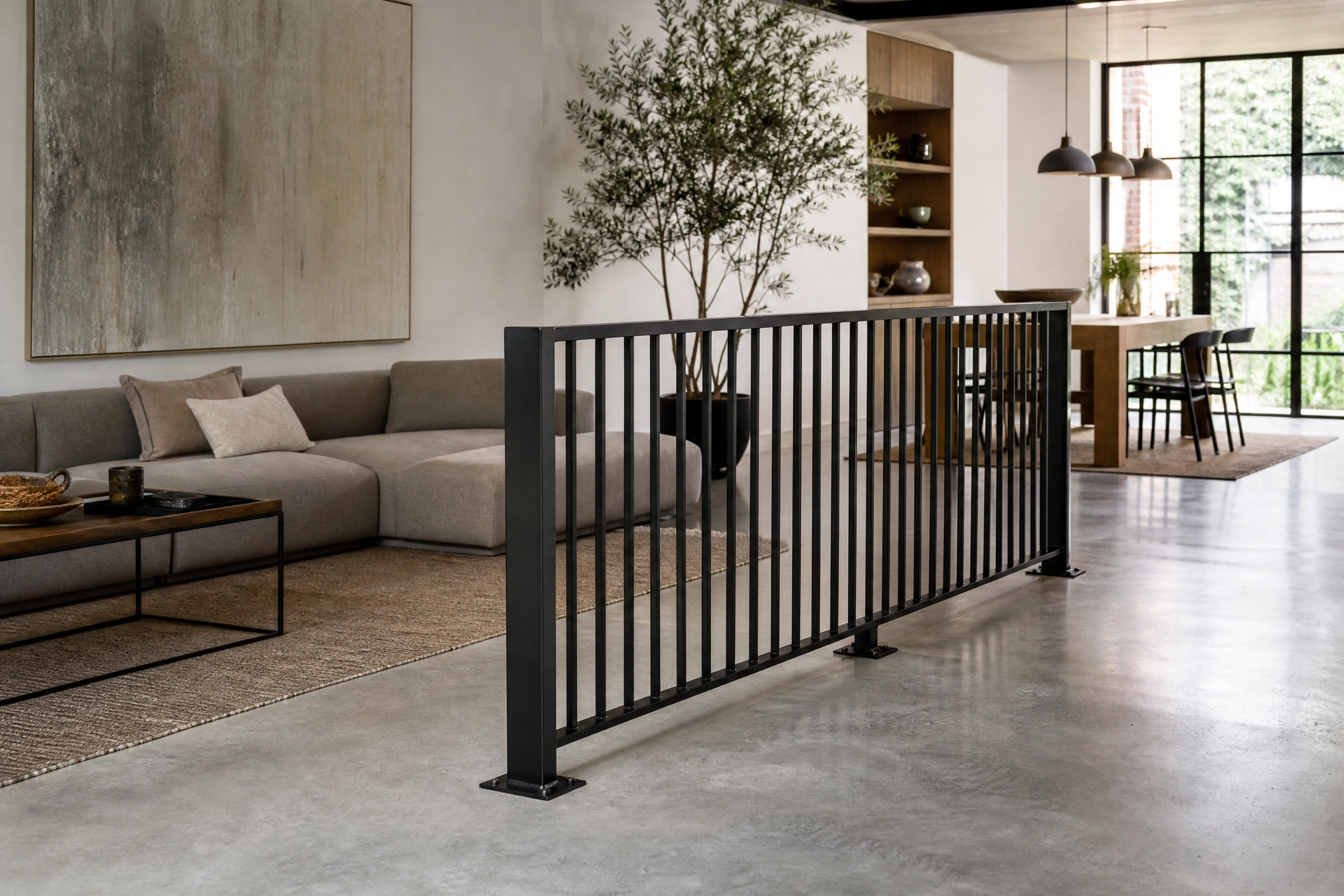
A matte black steel railing — the kind typically used for interior staircases or mezzanine edges — installed as a freestanding partition frame between two living zones creates a divider that feels genuinely architectural rather than decorative. The open frame and vertical rails create a visual boundary without blocking light or sight lines, defining the edge of a living zone in the same way a staircase railing defines the edge of a floor. Used on a ground floor open-plan room, the effect is unexpectedly bold and design-forward.
Custom steel railing systems can be fabricated by local metalworkers for $400–$1,200 depending on length, height, and whether the piece is freestanding or structurally attached. Pre-made cable railing kits — horizontal cable wires within a black steel frame — offer a similar aesthetic at a somewhat lower price with more DIY-friendly installation. This suits loft-style, industrial, modern coastal, and contemporary minimalist interiors. Pair with polished concrete floors, a low-profile sofa, and large-scale abstract wall art for a fully committed, editorial-quality living room composition.
41. Japandi-Style Sliding Paper Panel Partition for a Calm, Stripped-Back Room
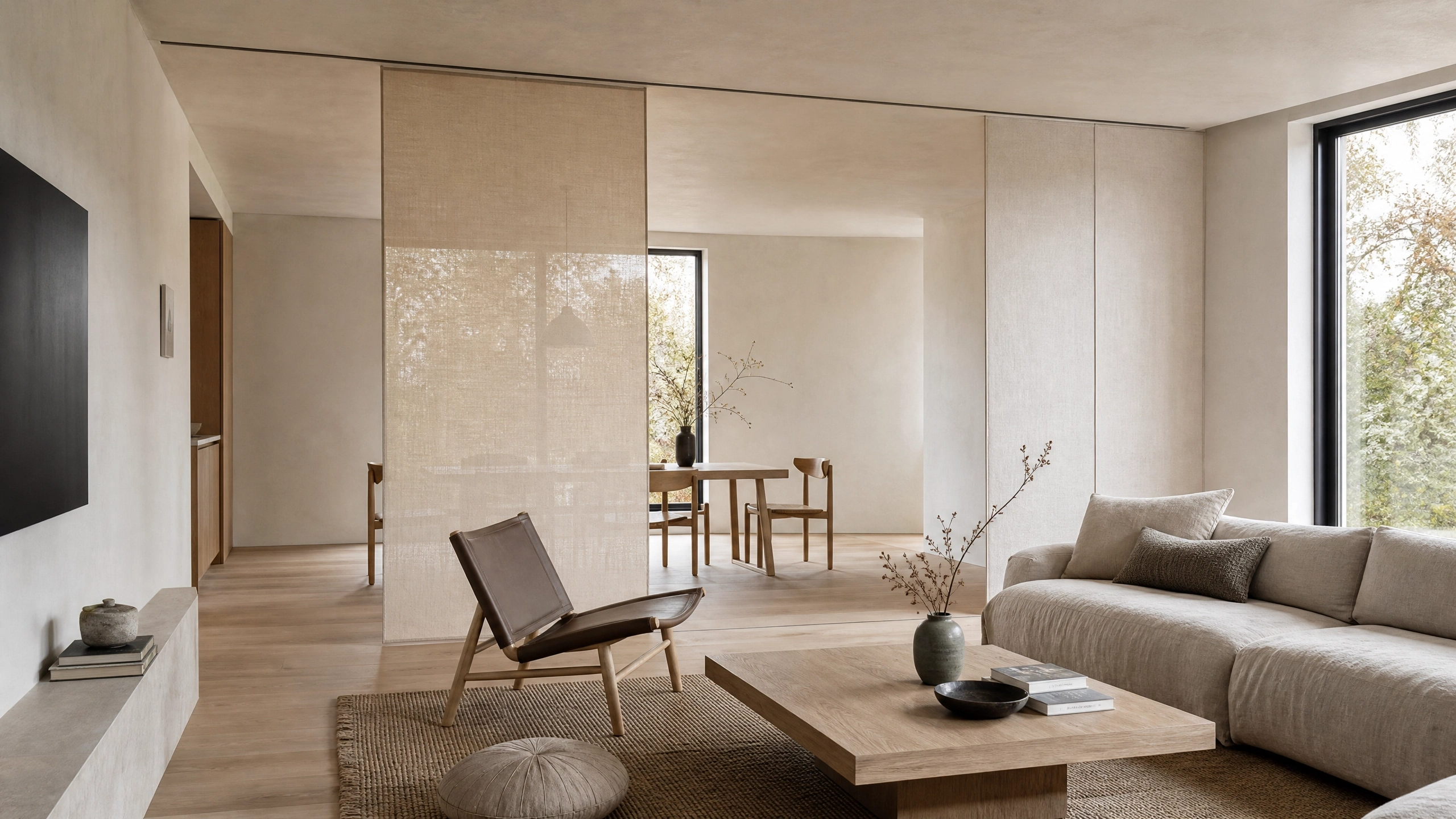
A sliding panel partition in the Japandi tradition — a flat, frameless paper or fabric panel mounted on a minimalist slim ceiling track — creates a room divider with an almost weightless quality. Unlike a shoji screen with its visible lattice grid, a plain flat panel in natural white or warm ivory reads as architecture rather than furniture, and when slid open and flat against the wall, it becomes nearly invisible. The effect in the room is serene: one space, quietly divided, with no hardware drama, no visual competition, no clutter.
These panels suit the Japandi, Scandi, and quiet-luxury interior movements most naturally — where the design ambition is always to subtract rather than add. Custom versions can be ordered through specialist Japanese interior suppliers or made to measure by blind and curtain makers. Off-the-shelf flat panel vertical blind systems — available for $80–$200 — suit the aesthetic when chosen in natural textures like washi cotton or linen-look blends. The rule is simplicity above all: the panel’s impact depends entirely on its quietness and the subtle shadow line it creates at the ceiling track when partially open.
42. Backlit Frosted Resin or Acrylic Panel for Soft, Warm Ambient Glow
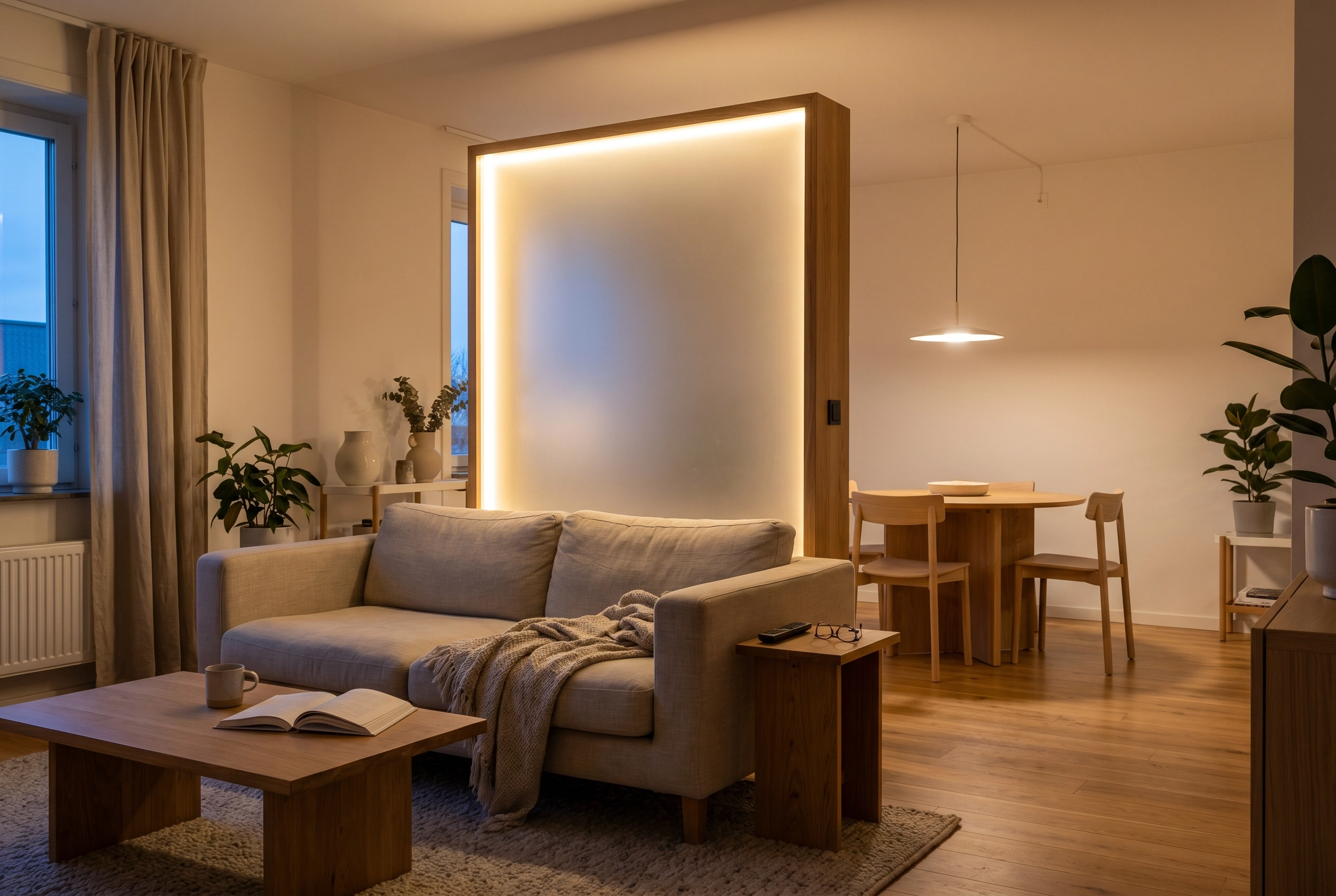
A frosted resin or acrylic panel — backlit with integrated LED strip lighting behind the panel face — functions as both a room divider and an ambient light source simultaneously. The warm, diffused glow that passes through the frosted surface creates an even, candlelit-quality ambience that no lamp or overhead fixture can quite replicate. At night especially, a backlit panel transforms the entire character of an open-plan space, giving it a considered, spa-like quality that makes the room feel genuinely designed from the inside out.
Backlit acrylic panels are available as custom fabrications from signage and display suppliers — who often make these cost-effectively for residential commissions — typically ranging from $200–$800 depending on size. Alternatively, frosted acrylic sheet can be purchased from hardware suppliers and combined with an inexpensive LED strip kit behind a simple timber-framed housing for a confident DIY build. Warm white or amber LED strips produce a softer, more liveable glow than cool white; adding a dimmer switch is worth the extra effort for complete atmosphere and mood control.
How to Choose the Right Partition for Your Space
Before committing to any idea from this list, four practical variables are worth thinking through:
- Height: A partition of 36–48 inches separates zones while maintaining visual openness — ideal for smaller rooms. A 60–72 inch partition creates stronger separation but can feel heavy in rooms under 12 feet wide. Full floor-to-ceiling height creates the most defined spaces and requires the most considered placement.
- Material: Solid materials — glass, stone, wood — define space most definitively. Semi-open materials — slats, screens, open shelving — maintain visual connection while still creating zones. Fabric and plant-based options create the softest, most flexible, and most forgiving boundaries.
- Placement: Run the partition perpendicular to the room’s longest wall for the most logical zone split. Avoid positioning it directly in a main traffic path or in front of a window where it would block your primary light source.
- Renter vs. owner: Many ideas in this list are fully renter-safe — no drilling, no adhesive, no permanent changes. Where an idea does require installation, that’s noted clearly above. Always check your lease before any adhesive mount, ceiling anchor, or floor-track project, even when products are marketed as damage-free.
FAQs
Can I add a room divider to a rental apartment without losing my security deposit?
Yes, many options in this list require zero installation: freestanding screens, leaning bookshelves, ladder shelves, arched frames, tall indoor plants, and tension-rod curtains all work without touching walls or ceilings. Always check your lease before using ceiling anchors or adhesive mounts, even “no-damage” versions.
How tall should a partition be to actually separate two zones in a living room?
A partition of 48–72 inches is the most practical range for most living rooms. Under 48 inches creates a suggestion of separation; over 72 inches creates strong division but can feel heavy in smaller rooms. Floor-to-ceiling height works best when the room is at least 12 feet wide.
Do room dividers help reduce noise, or do they only create visual separation?
Freestanding screens, curtains, bookshelves, and plant arrangements create visual zones only — they don’t meaningfully reduce sound transmission. For genuine noise reduction, acoustic panels or structural walls are necessary. Every idea in this article is focused on visual definition and spatial purpose.
What is the most affordable living room partition idea I can set up this weekend?
A tension-rod curtain divider is the most budget-friendly option — typically $15–$50 for the rod plus fabric — and can be set up in under an hour with no tools at all. A leaning ladder shelf or freestanding rattan screen are the next most accessible options, both under $150 and requiring zero installation.
What is the difference between a room divider and a partition wall?
A room divider is typically freestanding, temporary, or semi-permanent — a screen, curtain, bookshelf, or plant arrangement. A partition wall is a structural or semi-structural element built into the room, such as a half-wall, glass wall, or stud-framed enclosure. Room dividers are repositionable; partition walls are permanent.



No Comment! Be the first one.