




27 Long Narrow Living Room Layout Ideas That Actually Work
If your living room feels more like a hallway than a place to actually relax, you are not imagining things — long narrow rooms are genuinely tricky to arrange. Pushing everything against the walls...

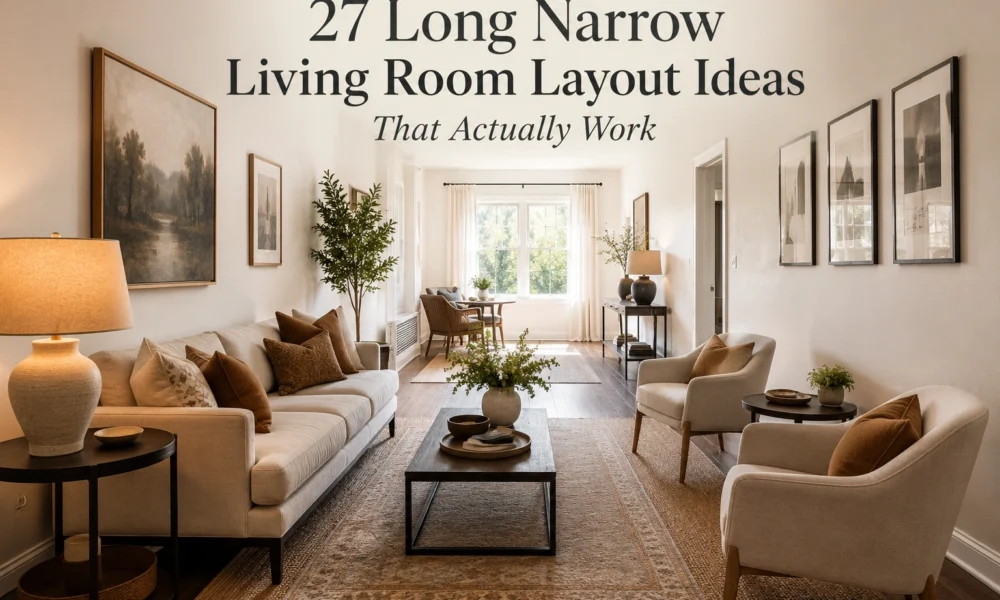
If your living room feels more like a hallway than a place to actually relax, you are not imagining things — long narrow rooms are genuinely tricky to arrange. Pushing everything against the walls (the most common instinct) makes it worse, not better, leaving you with a bowling-alley vibe, no clear focal point, and a sofa that seems to disappear against the far wall. The good news is that the right long narrow living room layout ideas make these spaces genuinely workable — and it starts with rethinking the room entirely rather than rearranging the same pieces in the same directions.
Every idea in this list ranges from free furniture rearrangements you can try tonight to smart purchases under $100 — and none require landlord permission, a drill, or a designer’s budget. Whether you are working with a 10-by-20-foot rental apartment or a 12-by-24-foot starter home, these strategies address the specific problems narrow rooms create: the tunnel effect, the awkward traffic flow, the nowhere-to-put-the-TV dilemma, and the sofa-against-the-wall trap. Before moving a single cushion, it is worth spending ten minutes using the free room planning tool from IKEA to map out a few layout options at your room’s actual dimensions.
How to Arrange Furniture in a Long Narrow Living Room (Step by Step)
Before getting into the full idea list, here is a five-step starting framework you can apply to any narrow room regardless of which specific ideas you choose below.
- Identify your two zones. Mentally divide the room in half — a main seating and TV area at one end, and a secondary zone (reading nook, casual dining, or workspace) at the other.
- Place the sofa perpendicular to the long wall. Rather than running the sofa parallel to the wall, position it so it faces across the room’s width. This immediately shortens the visual length.
- Float furniture away from the walls. Pull pieces 12 to 18 inches off the walls to create visual breathing room — especially behind the sofa.
- Anchor each zone with its own rug. A separate rug under each zone grounds the furniture and signals to the eye that two distinct areas exist.
- Add a focal point on the short end wall. A TV, a large piece of art, or a deep accent color gives the eye somewhere definite to land instead of traveling endlessly down the room’s length.
The Zone Strategy: Think in Two Rooms, Not One Long One
The reason most narrow room arrangements fail is that people try to design the entire space as one room. A room that is 10 feet wide and 22 feet long is not one room — it is two 10-by-11-foot rooms sitting end to end, and the moment you start treating it that way, most layout problems begin to solve themselves. Zone-based design means assigning each half a clear function — main seating plus reading nook, or TV area plus casual dining — giving each section its own rug anchor, and making sure each zone has a deliberate reason to exist rather than simply housing overflow furniture.
You do not need walls to create zones. A bookshelf turned perpendicular to the long wall, a shift in rug pattern, a change in light source, or even just the direction your seating faces can clearly signal where one area ends and another begins.
1. Float Your Sofa Away From the Wall
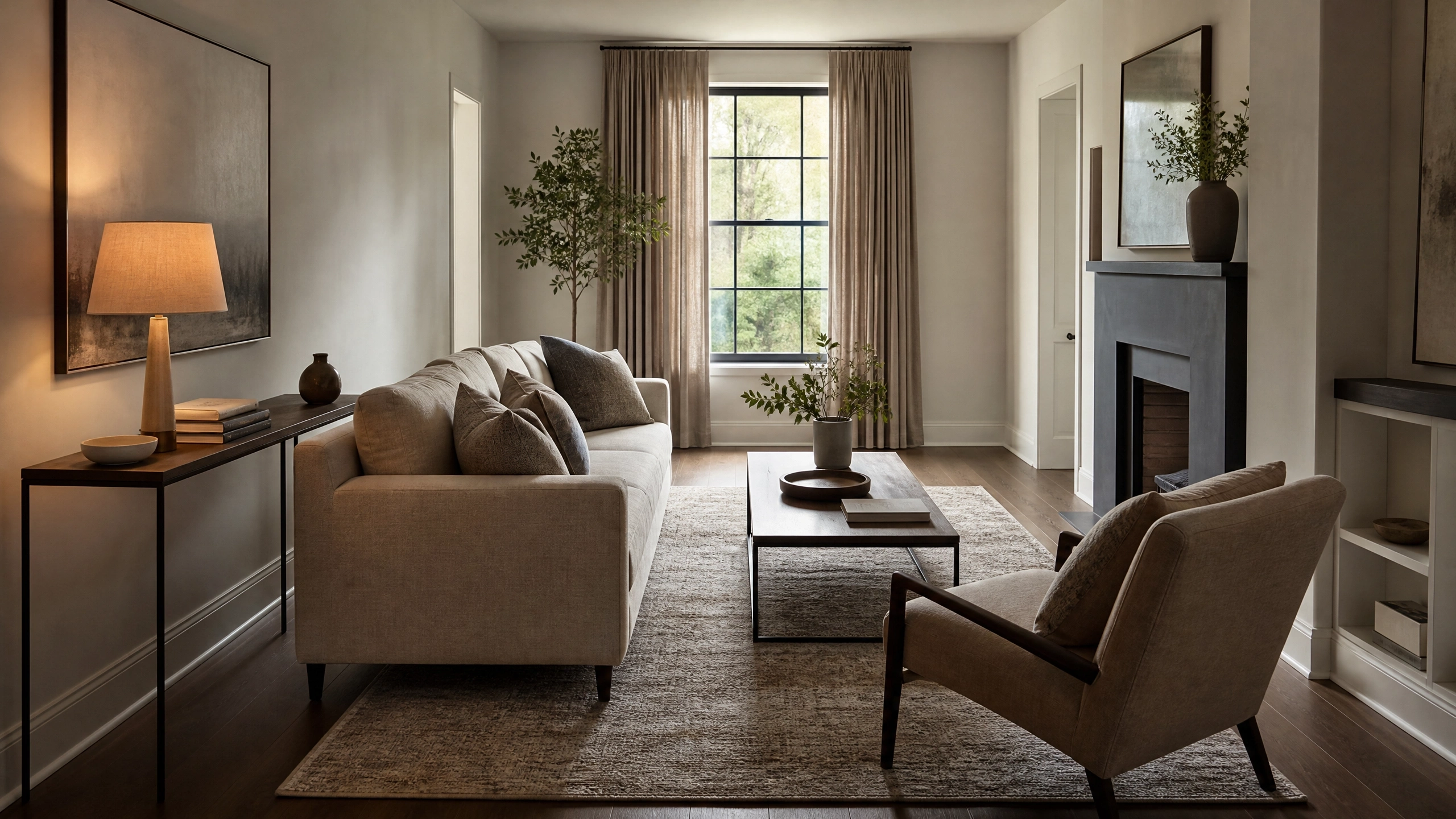
The single most counterintuitive move in a narrow living room — and the one that fixes almost everything — is pulling the sofa off the long wall. When the couch sits flush against the wall, it stretches the tunnel effect instead of breaking it, leaving an uninterrupted stretch of empty floor that makes the room look even longer and less livable. Even 12 to 18 inches of space behind the sofa changes the entire visual dynamic, creating a stop that interrupts the room’s relentless length.
That gap behind the sofa is also a natural home for a slim console table and lamp — a mid-height light layer the room desperately needs (see idea #6). If you are worried about losing floor space, just make sure at least 30 to 36 inches of clearance remains between the sofa front and the coffee table for comfortable traffic flow. This is one of the most effective narrow living room furniture arrangement moves you can make — and it costs nothing to try tonight.
2. Use Two Rugs to Define Two Distinct Zones
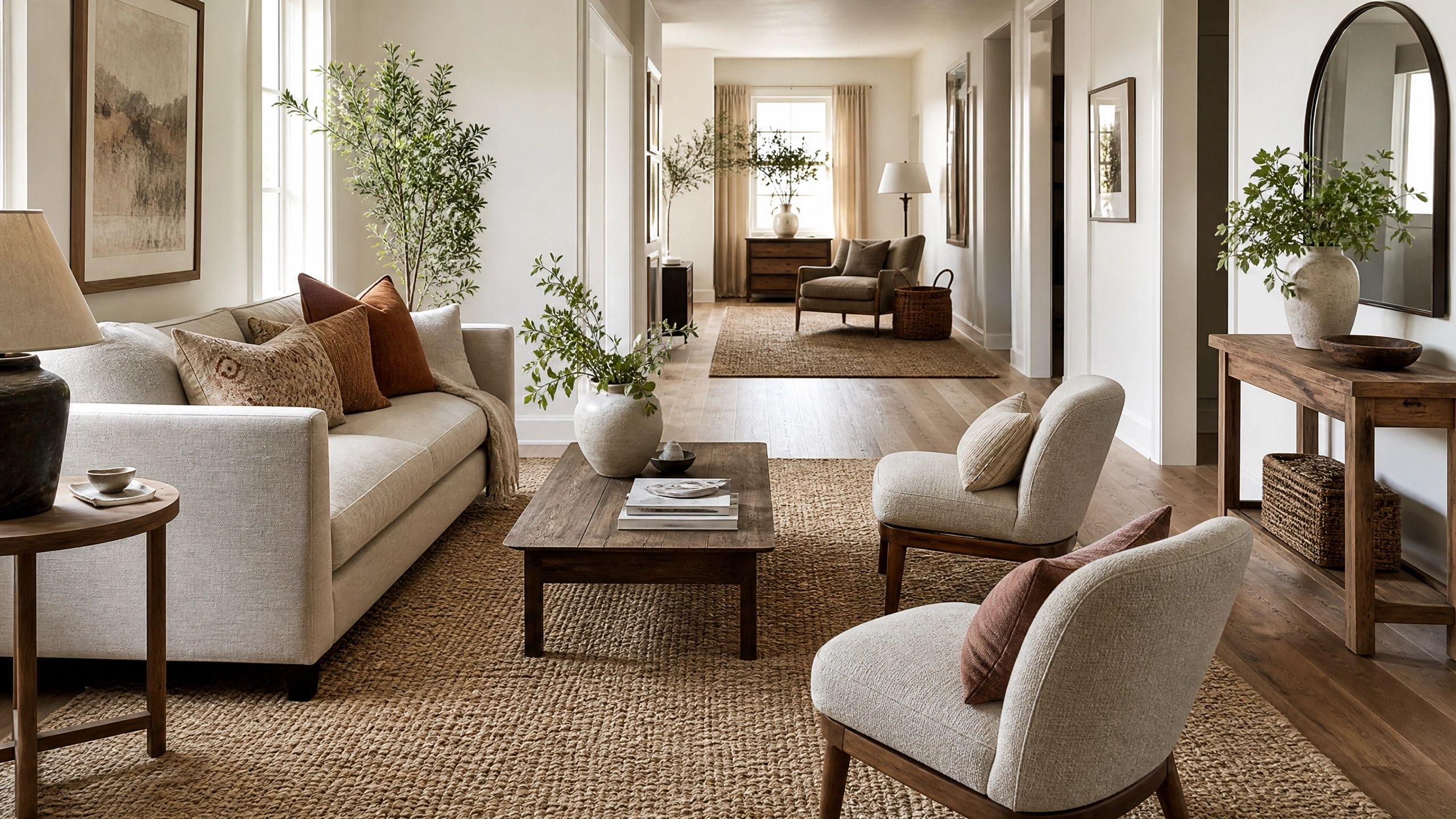
One large rug running down a narrow room tends to emphasize the length by creating one long uninterrupted visual strip. Two smaller rugs — one anchoring the sofa area and one defining a secondary sitting or reading space — do something entirely different: they visually split the room into two separate areas, which makes the whole space feel less like a corridor and more like a home that simply happens to have an open-plan layout.
The rugs do not need to match, but they should belong to the same visual family — similar warm base tones, complementary textures, or a pattern-and-solid pairing that feels cohesive. A 5×7 or 6×9 works well for most narrow seating zones depending on sofa scale. Avoid runners — they reinforce the tunnel shape rather than disrupting it.
3. Put the TV on the Short End Wall, Not the Long One
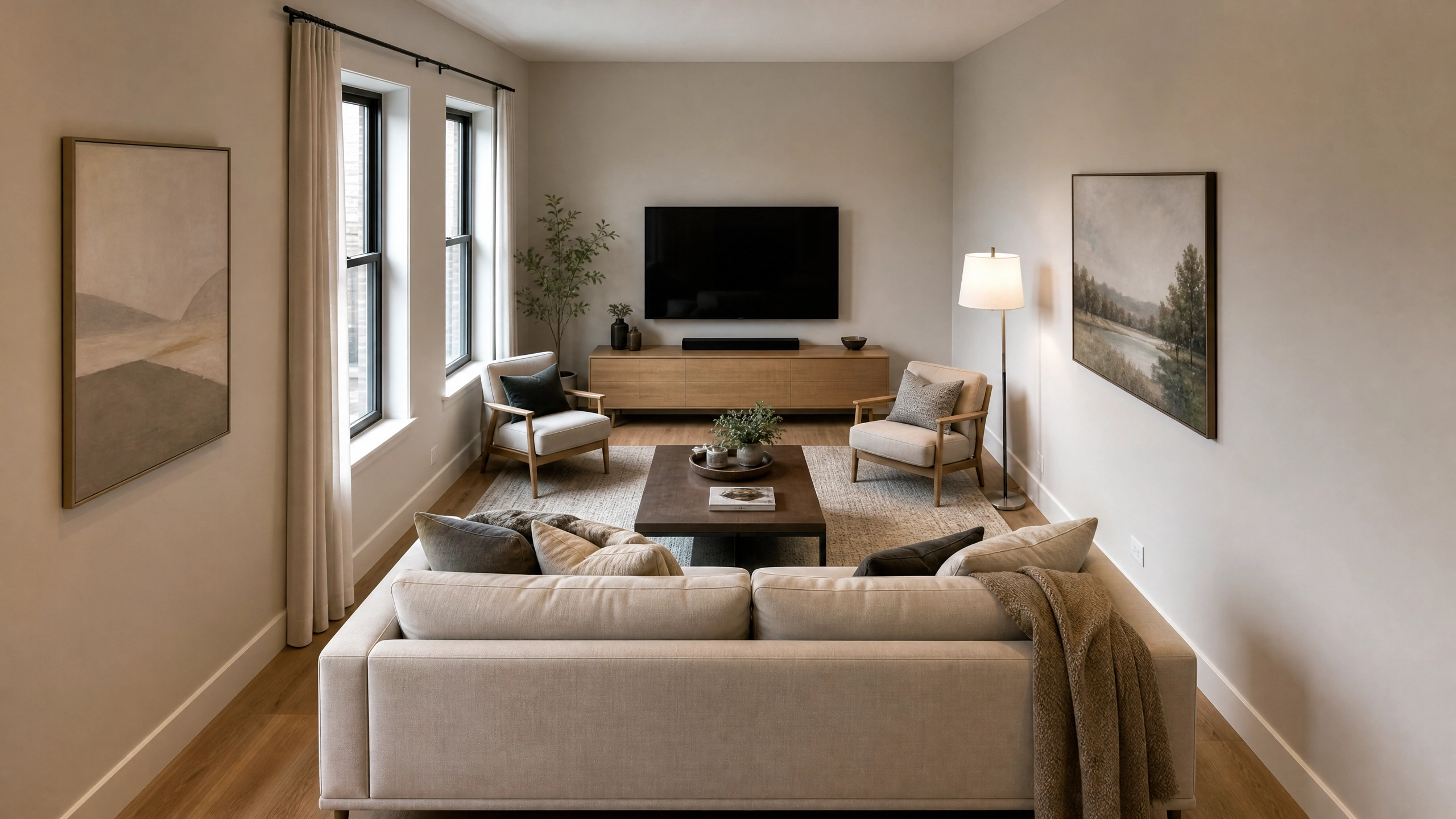
Most people instinctively mount the TV on the long wall because it feels like the obvious main wall. In a narrow space, that instinct consistently works against you — placing the TV on the long side pulls every seat into a sideways orientation, creates awkward sightlines, and reinforces the bowling-alley layout everyone is trying to escape. Placing the TV on the short end wall instead gives the room a clear focal point and draws the eye across the room rather than straight down the full length of it.
This placement also allows you to float the sofa and chairs facing the short wall, meaning your seating arrangement now runs across the room’s width rather than down its length — immediately making the space feel less narrow and more purposefully connected. Pair the TV with a slim media console under 60 inches wide to keep the end wall from feeling cluttered. Wayfair carries solid narrow media console options under $200 that work well in this exact configuration.
4. Turn a Bookshelf Into a Freestanding Room Divider
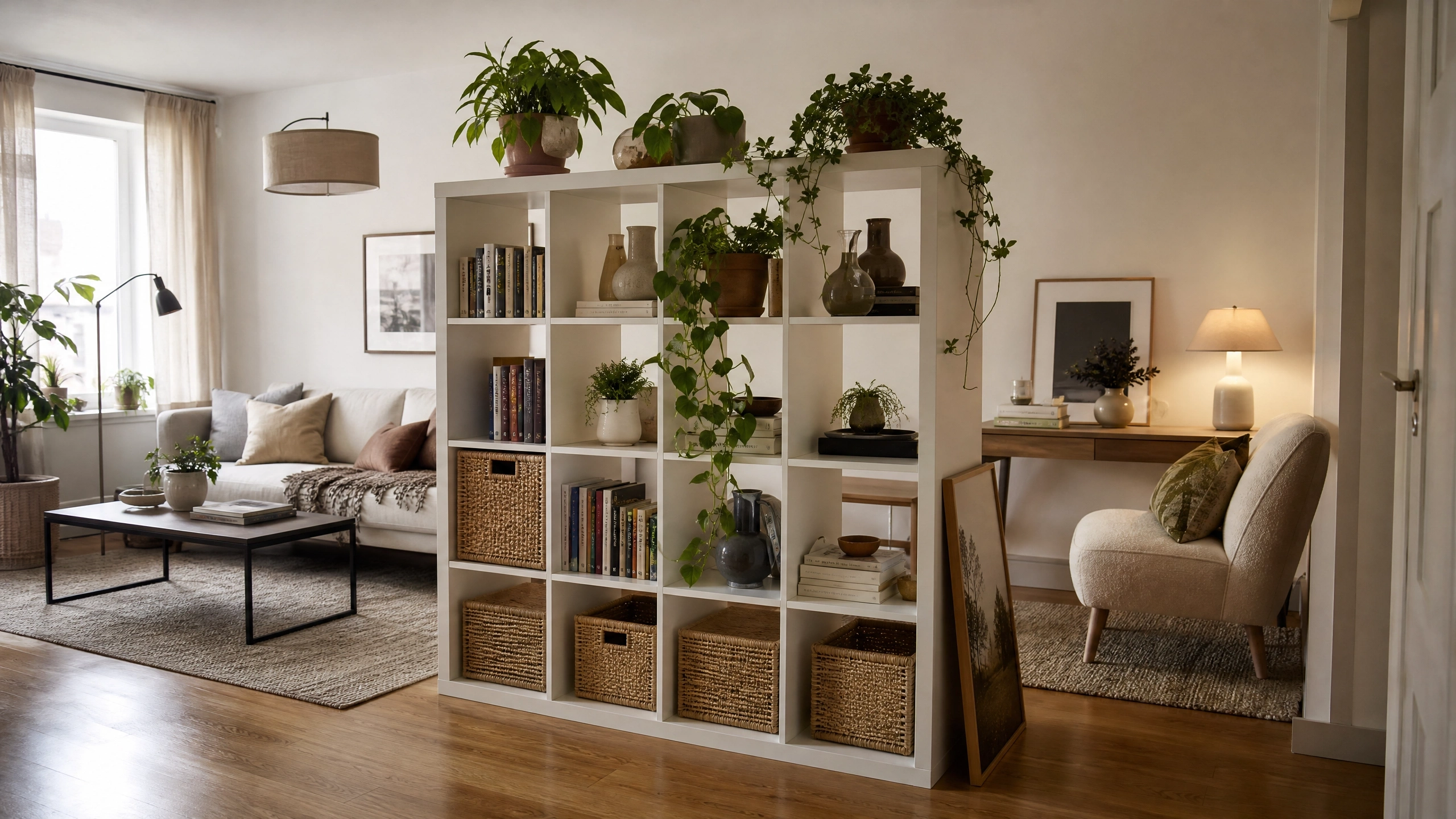
Instead of thinking of a bookshelf as storage that lives flat against a wall, consider it a freestanding wall you can actually move whenever you need to. An IKEA KALLAX unit placed perpendicular to the long wall — jutting into the room rather than running along it — creates a visible physical barrier between two zones without any construction, renovation, or permanent change. Suddenly the room has a seating area on one side and a reading nook, workspace, or secondary conversation area on the other.
The KALLAX works especially well because it is open on both sides, so light passes through and the room does not feel chopped off or closed in. Style each side differently — books and trailing plants on the living area side, a small lamp and framed art on the other — and you essentially have two distinct rooms that still breathe as one unified space. Renter-friendly note: no drilling required, and the entire setup moves out cleanly on lease-end without a single patch of spackling compound.
5. Choose a Loveseat-and-Chairs Combo Over a Full Sofa
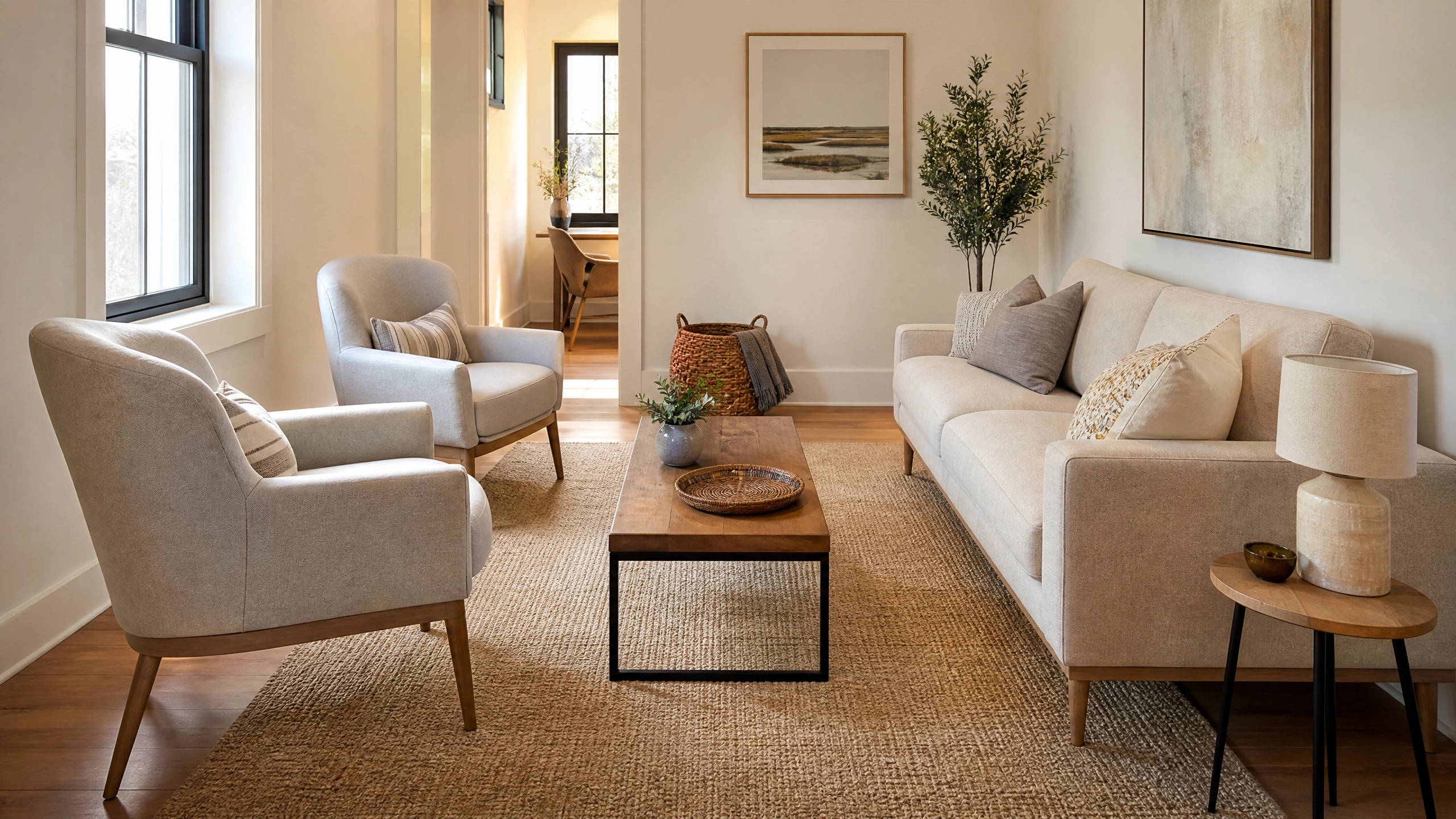
A standard 90-inch three-cushion sofa in a narrow room often leaves almost no room for anything else — it dominates the width, kills any chance of zone creation, and makes the room feel like a furniture showroom rather than a home. Swapping it for a loveseat (roughly 64 to 70 inches) and adding two slim armchairs gives you the same seating capacity in a far more flexible footprint you can actually arrange in multiple configurations.
For narrow living room furniture arrangement, the loveseat-plus-chairs combo allows a gentle U-shape or conversational L-shape that does not consume the entire floor plate. Look for chairs with visible legs rather than fully upholstered, skirted bases — a little air beneath the furniture reads as visual breathing room in any tight space. Target’s accent chair range under $200 hits the balance of slim profile, exposed legs, and genuine comfort without adding unnecessary bulk to the room.
6. Add a Console Table Directly Behind the Sofa
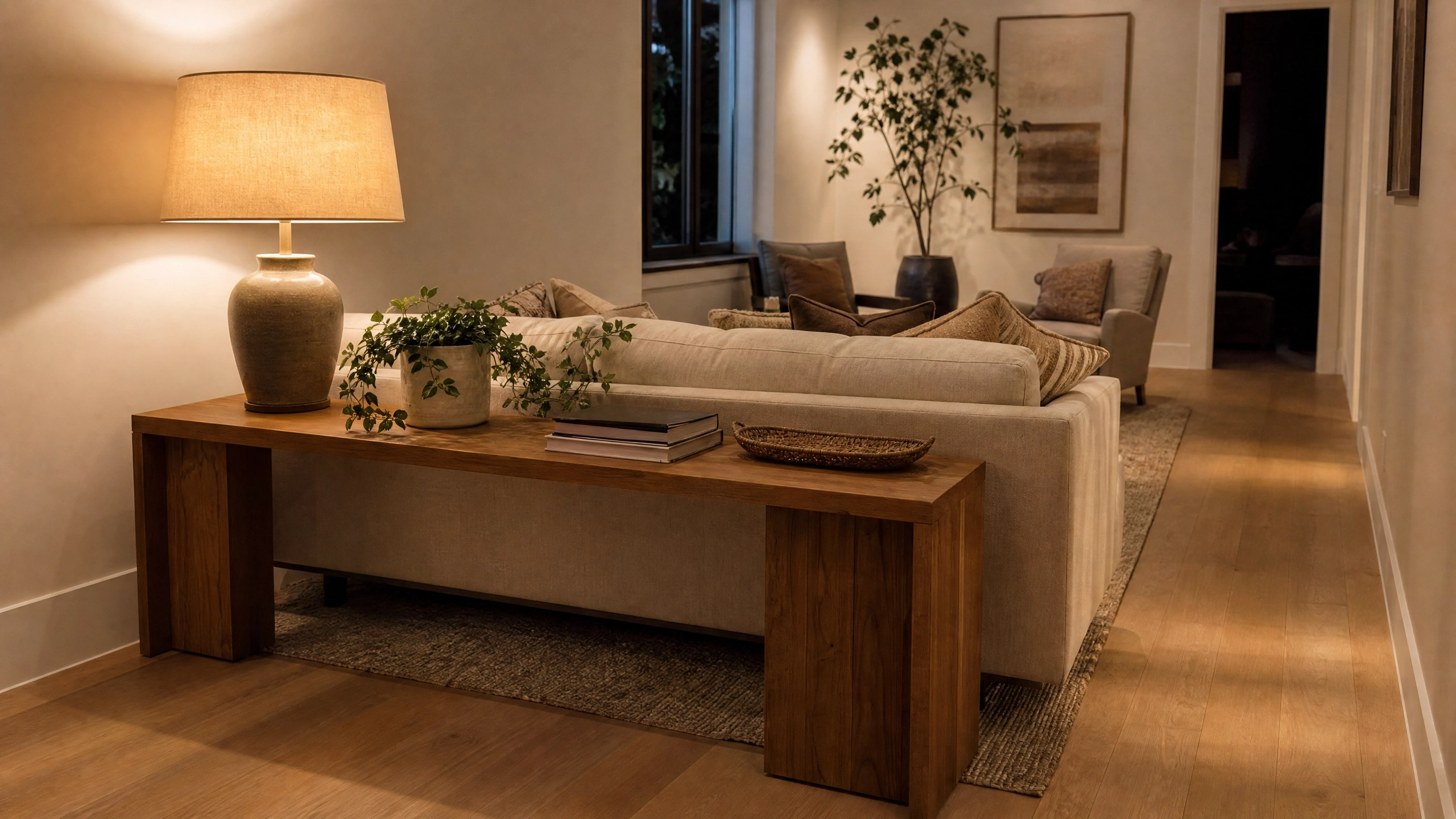
If you have already floated your sofa away from the wall (idea #1), the space behind it is not wasted — it is a genuine opportunity. A slim console table placed directly behind the sofa serves as a visual anchor, a surface for lamps and small decor items, and a subtle boundary between the sofa zone and the space behind it. It turns an awkward gap into a purposeful design element, making the floating sofa look completely intentional rather than randomly placed in the middle of the room.
Keep the console at sofa-back height — roughly 28 to 30 inches tall — so it sits just behind the cushions and flows into the seating area rather than interrupting it visually. Style it simply: a table lamp, a small trailing plant, and a stack of books or a decorative tray. The lamp matters most here — it adds a warm light source at medium height that breaks up the long, flat visual plane that makes narrow rooms feel so relentlessly tunnel-like after dark.
7. Go Vertical With Tall, Narrow Shelving Units
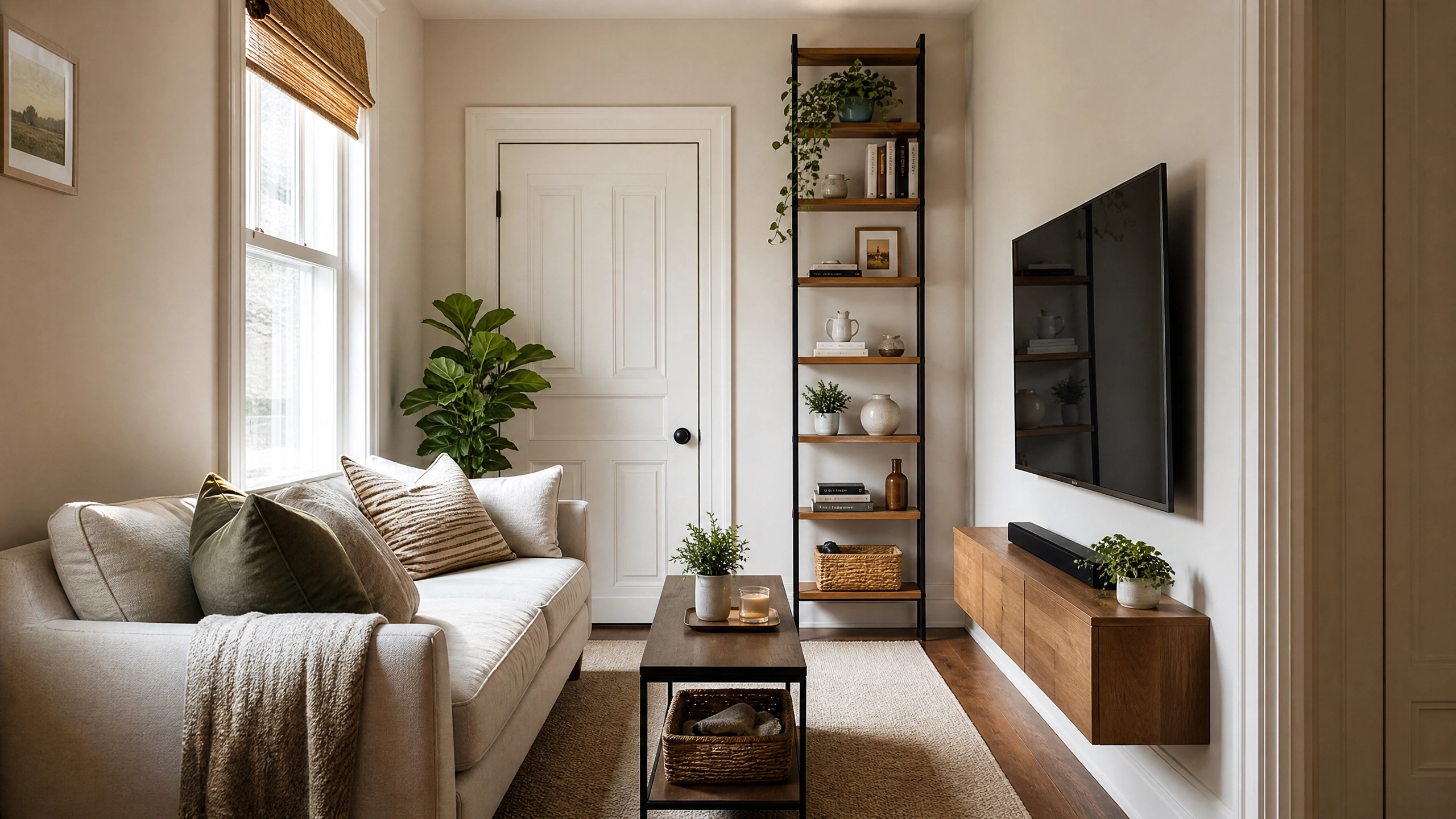
When floor space is limited, the answer is almost always to go up. A tall, narrow shelving unit — around 72 to 84 inches high and no more than 12 inches deep — draws the eye upward and adds visual height that makes the room feel less like a compressed canyon and more like a tall, airy space worth spending time in. Place it against the short end wall flanking the TV, or at the boundary of a seating zone, and it instantly creates a built-in feel without any construction cost.
Style the shelves with intention: alternate books, plants, small framed art, and woven baskets at varying heights rather than loading every shelf to capacity. A few intentionally empty shelves create visual breathing room. IKEA’s Billy bookcase in its narrowest configuration (15.75 inches wide) stays well under $100 and is a reliable go-to for this look. The vertical line it creates is one of the most practical small narrow living room design tips — it genuinely shifts how the entire room reads.
8. Hang Curtains Wide and High to Fake Window Width
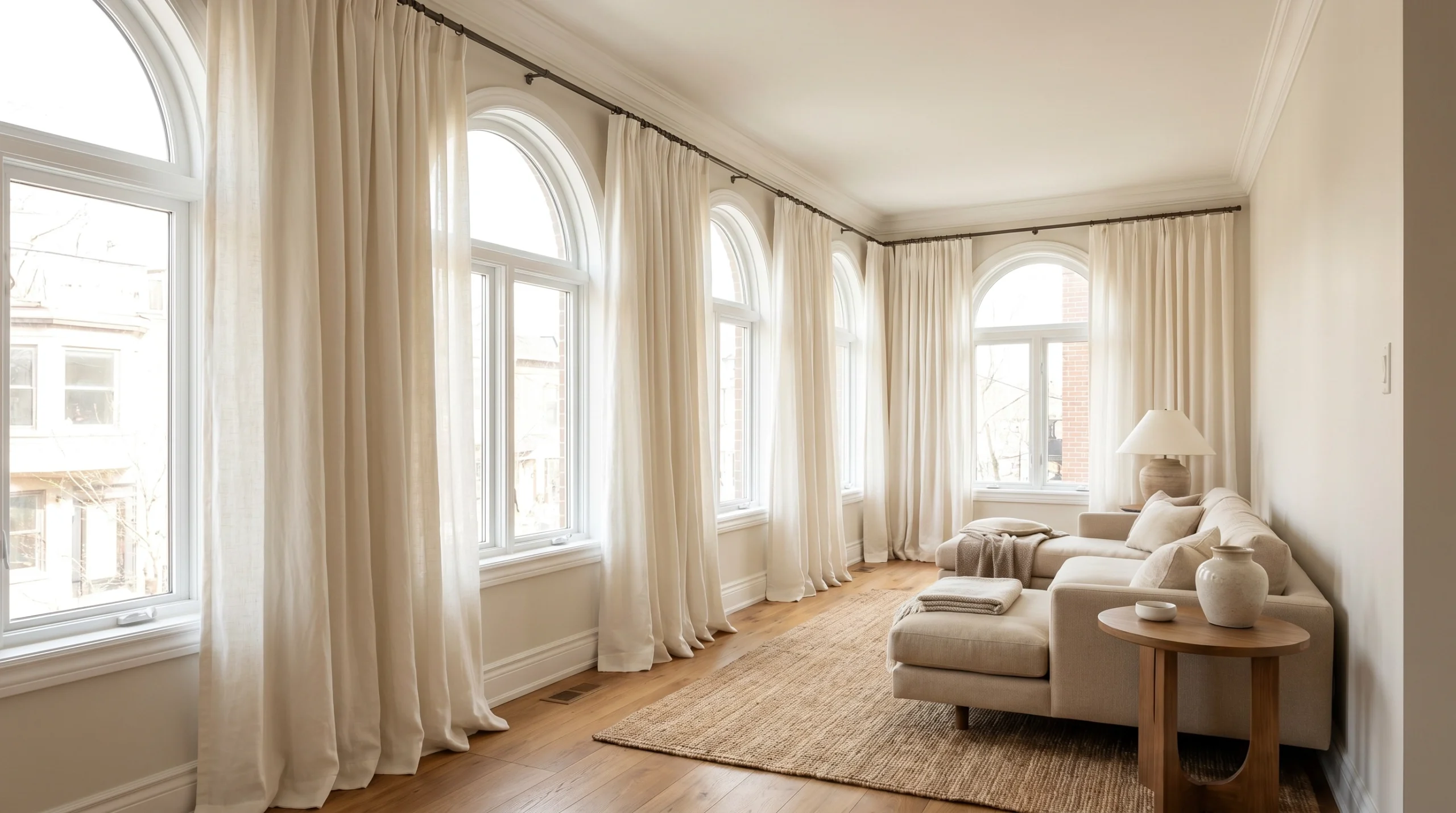
If your narrow room has windows along the long wall, the way you hang your curtains matters more than the curtains themselves. Mounting the rod several inches above the actual window frame — ideally at ceiling height or close to it — and extending it 12 to 18 inches on either side of the window makes the window appear significantly wider and taller than its actual size. The room instantly reads as taller, and that long side wall feels less like a corridor wall and more like an intentional architectural backdrop.
For a renter-friendly version, tension-mounted curtain rods work in many window frames without a single hole. Stick with light, flowing fabrics in warm white, soft ivory, or natural linen — heavy blackout curtains will close the room in rather than opening it up. When drawn open during the day, the panels puddle softly onto the wall beside the window rather than covering it, which expands the perceived visual width. It is one of the easiest long narrow room decorating ideas available and costs very little.
9. Place a Large Mirror Across From Your Main Window
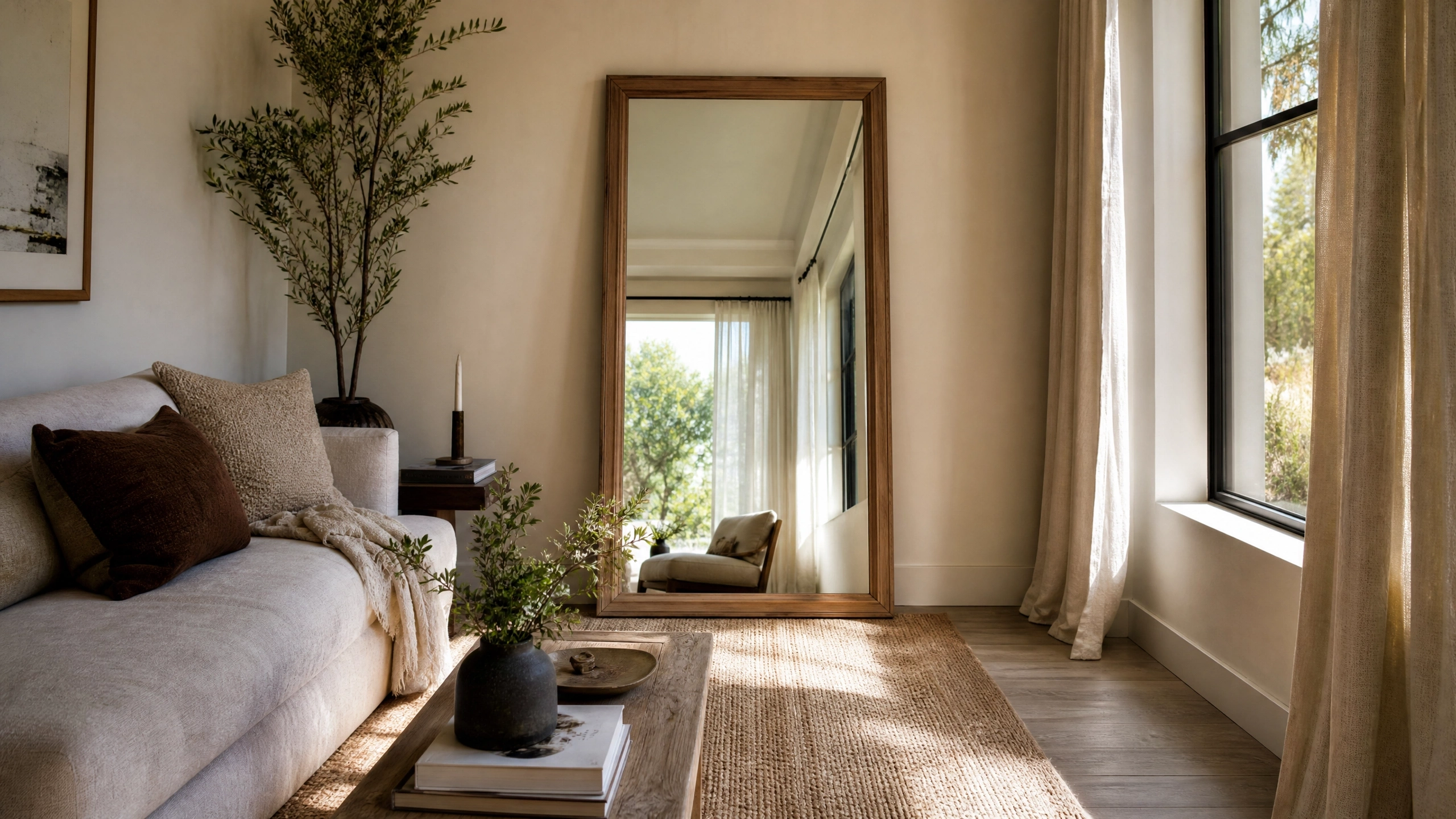
A large mirror hung directly across from your biggest window does two things simultaneously: it bounces natural light back across the room, and it creates the illusion of a window or opening where none exists. In a narrow space, that perceived depth on the opposite wall dissolves the closed-in feeling that makes these rooms so uncomfortable to be in. The room stops reading as a sealed tunnel and starts reading as a space with somewhere visually interesting to look other than straight down its length.
Size matters significantly here — a mirror under 24 inches wide will not have the spatial impact you need. Aim for 36 to 48 inches wide, proportioned to the wall it occupies. A large leaner mirror propped against the wall is a great renter-friendly option that requires no wall hardware at all and can be repositioned easily as the room evolves.
10. Use a Glass or Lucite Coffee Table to Keep Sight Lines Open
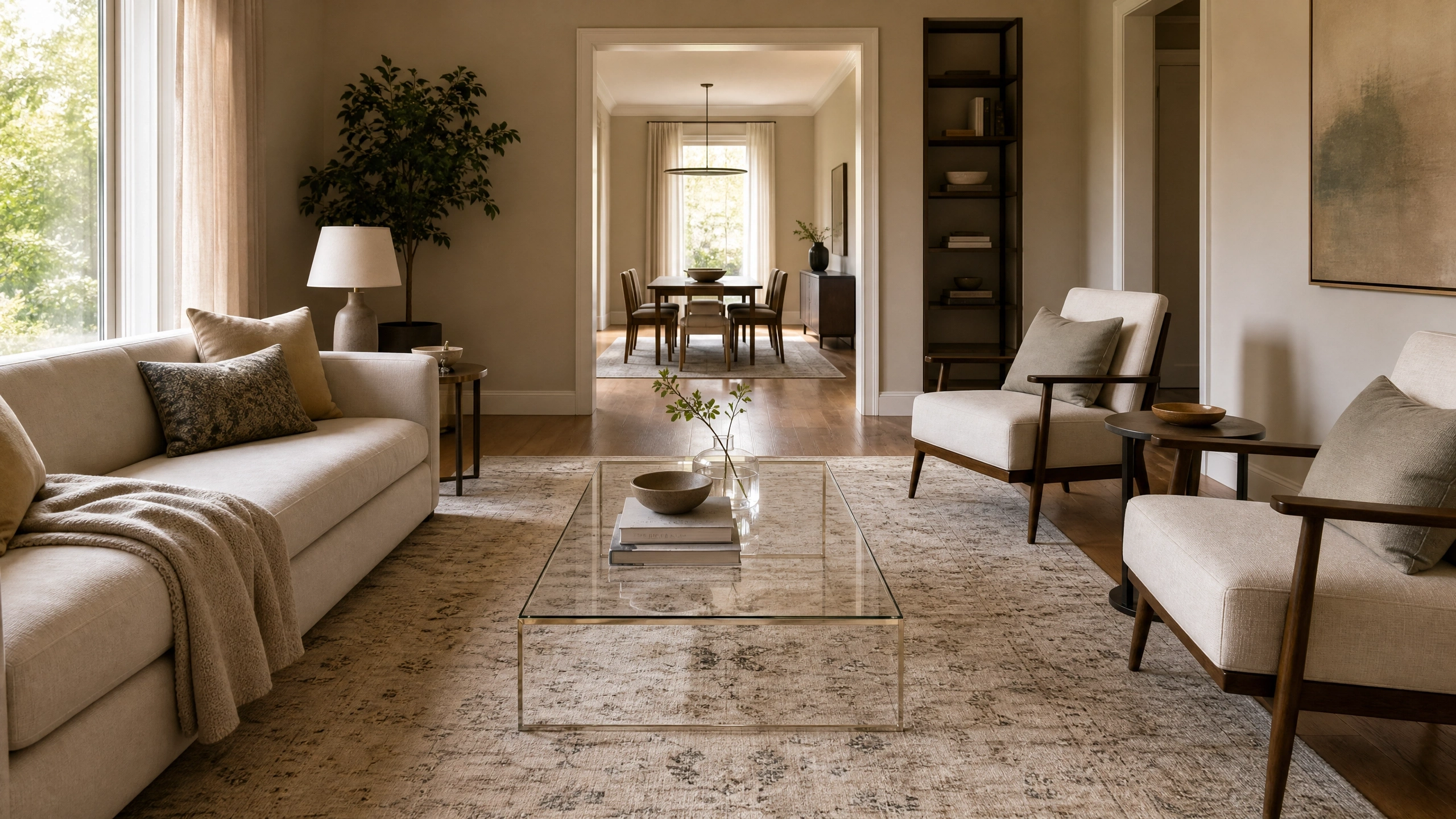
A solid wood or upholstered coffee table sitting in the center of a narrow seating area adds visual bulk right where you can least afford it — at eye level when you are seated. A glass or Lucite (clear acrylic) coffee table occupies the same floor footprint but lets light pass straight through, keeping sight lines open and preventing the seating zone from feeling closed in and cramped. The furniture is physically present; visually, it is nearly invisible from across the room.
This is one of those long narrow room decorating ideas that reads expensive but does not have to be. Amazon and Wayfair both carry clear acrylic coffee tables in the $80 to $150 range that look remarkably similar to the high-end designer version. Avoid glass tops with heavy metal frames — the frame adds visual mass right back into the space. Look for slim, minimal framing in brushed gold or nickel to keep the overall silhouette feeling light and appropriately airy.
11. Create a Reading Nook at the Far End of the Room
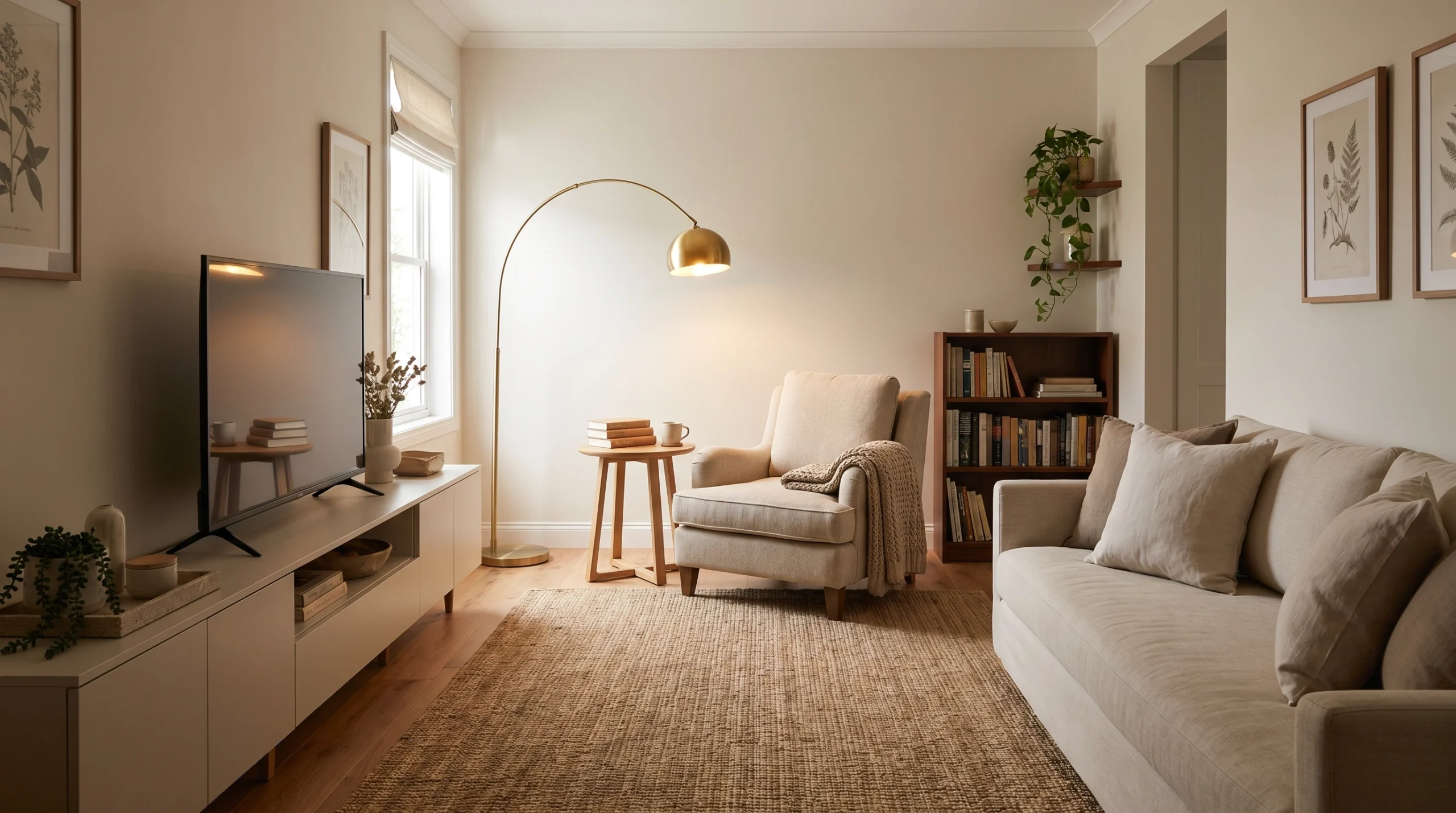
One of the best strategies for a long narrow living room is to embrace the length rather than fight it — and the far end of the room is perfect for a dedicated reading nook. Place a single armchair in the corner, add a small side table, and position an arc floor lamp so it curves overhead and casts a warm focused glow. Add a small shelf of books nearby and that far corner suddenly has a purpose, a personality, and a visual pull that makes the entire room feel intentional.
The reading nook also solves the “dead zone” problem that plagues nearly every narrow room — that awkward stretch of floor at the far end where nothing seems to logically belong. Anchoring it with a chair and a lamp creates a second destination in the space, which is the core principle behind zone-based design. Add a cozy throw folded on the arm of the chair and a trailing plant in the corner, and that space goes from dead zone to the spot every visitor gravitates toward first.
12. Line One Long Wall With a Storage Ottoman Row
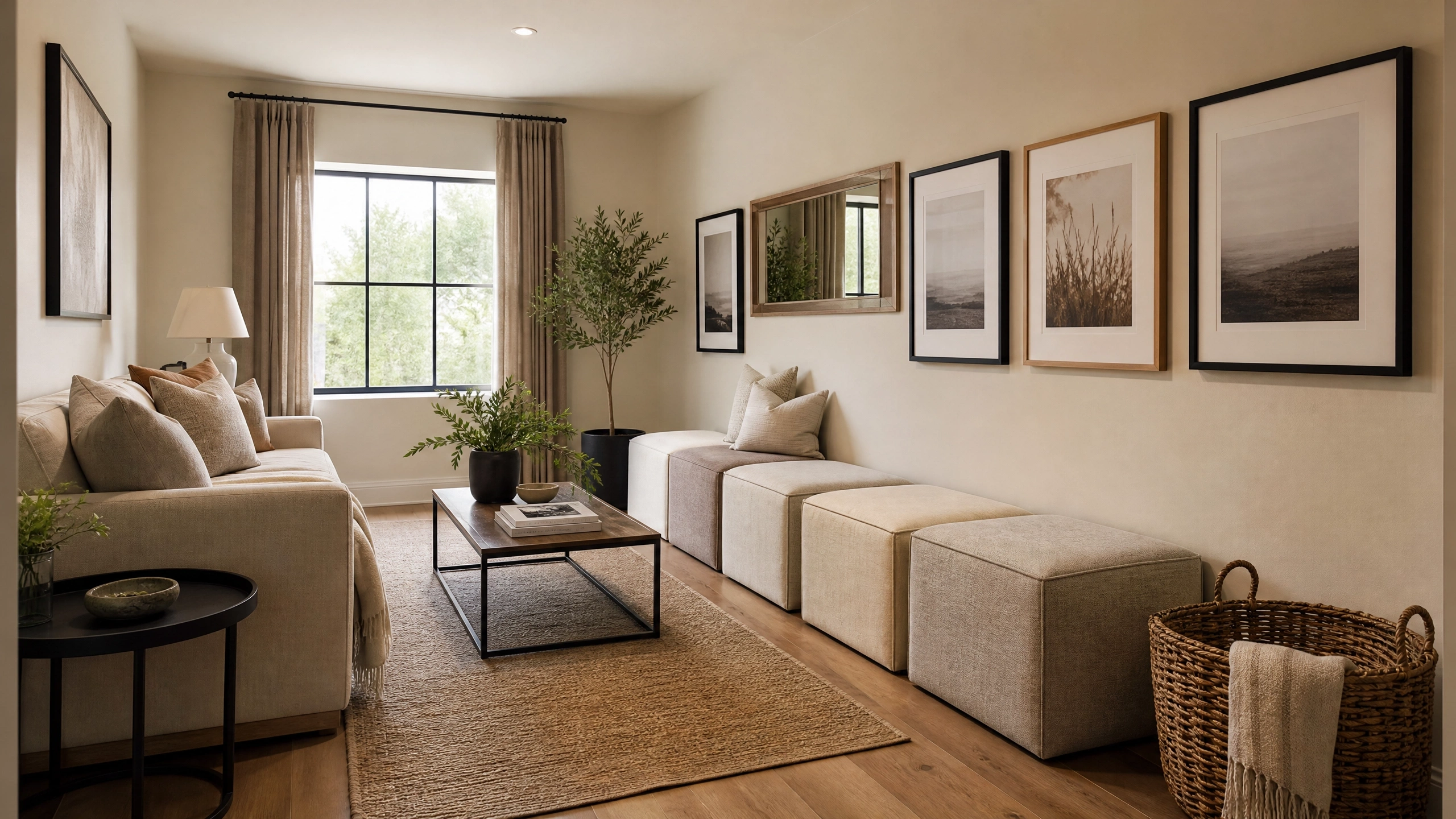
If one long wall of your narrow room feels like it is just there — unanchored, uninvolved in any zone, and not contributing to the room’s function — a row of storage ottomans or a low-profile upholstered bench along that wall is a practical and visually clean fix. It adds seating that does not intrude into the floor space, keeps the long wall from reading as an empty backdrop, and the storage inside quietly handles the clutter that accumulates in any living space without dedicated closed-storage options.
This works especially well in narrow rooms where a second sofa or sectional would block traffic flow entirely. Cube ottomans in matching or complementary fabrics lined up side by side create the look of a custom built-in bench without the cost or permanence. Style the wall above with a horizontal row of framed prints or a single long mirror to reinforce the intentional, designed feeling. Budget note: Target and HomeGoods both carry cube ottomans in the $30 to $50 range that work well placed side by side.
13. Anchor Each Zone With Its Own Pendant Light
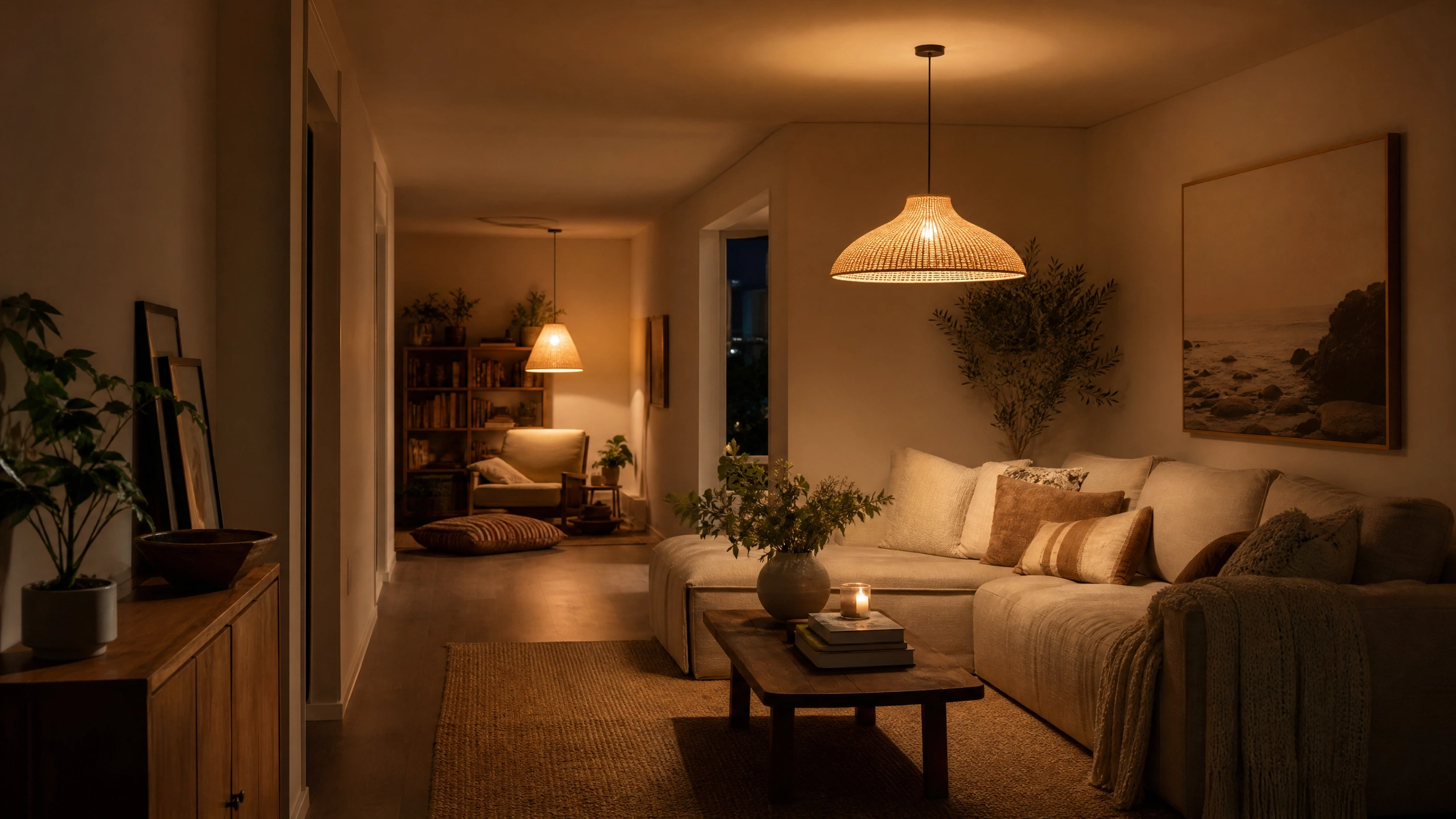
Overhead lighting in a long narrow room often works directly against the space — one flat ceiling fixture illuminates the full length as one undivided tunnel of light. Pendant lights positioned over each zone instead tell the eye where one area ends and another begins. They function as invisible walls, creating a warm defined circle of light over the main seating area and a separate, equally warm glow over the secondary zone — giving each section its own atmosphere and identity without moving a single piece of furniture.
Plug-in pendant lights are a renter’s best friend — no electrician, no rewiring, no landlord conversation required. Hang them from a ceiling hook and run the cord discreetly along the ceiling edge or behind furniture. Amber-toned bulbs warm the whole room and eliminate the cold, institutional glow that exposed overhead fixtures can cast. This is one of the most atmospheric long narrow room decorating ideas in terms of actual impact-per-dollar: it completely transforms the room after dark, and it works regardless of what layout you have chosen.
14. Paint the Short End Wall a Deep Accent Color
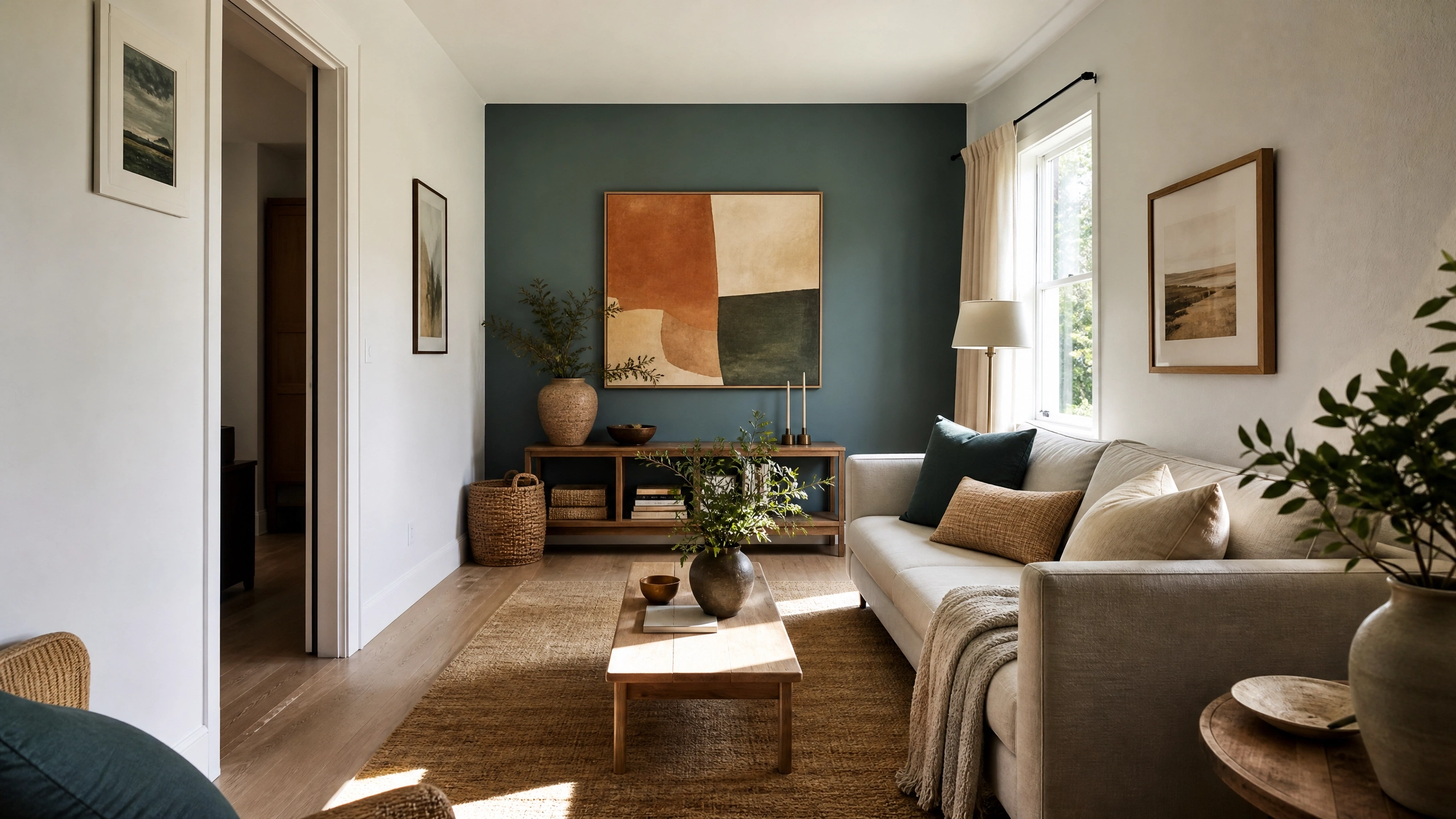
When you walk into a long narrow room, your eyes naturally travel straight to the far end wall. If that wall is the same beige or white as everything else, the room reads as endless — there is no visual destination, just more uninterrupted length. Painting the short end wall a deep, saturated shade — a warm terracotta, a moody olive, or a dusty teal — gives the eye somewhere to land intentionally and makes the room feel like it has considered depth rather than just uncomfortable, unbroken distance.
A richer color on the short wall also pulls that wall visually toward you — the optical trick of shortening the perceived length of the room without touching a single dimension. Renter-friendly alternative: a large-scale woven tapestry, a full gallery arrangement, or one oversized piece of art on that wall achieves the same visual stop effect without a drop of paint. This is one of the most elegant how-to-arrange-a-long-narrow-living-room moves — and the renter version costs almost nothing to execute.
15. Use a Daybed as a Dual-Purpose Sofa and Guest Bed
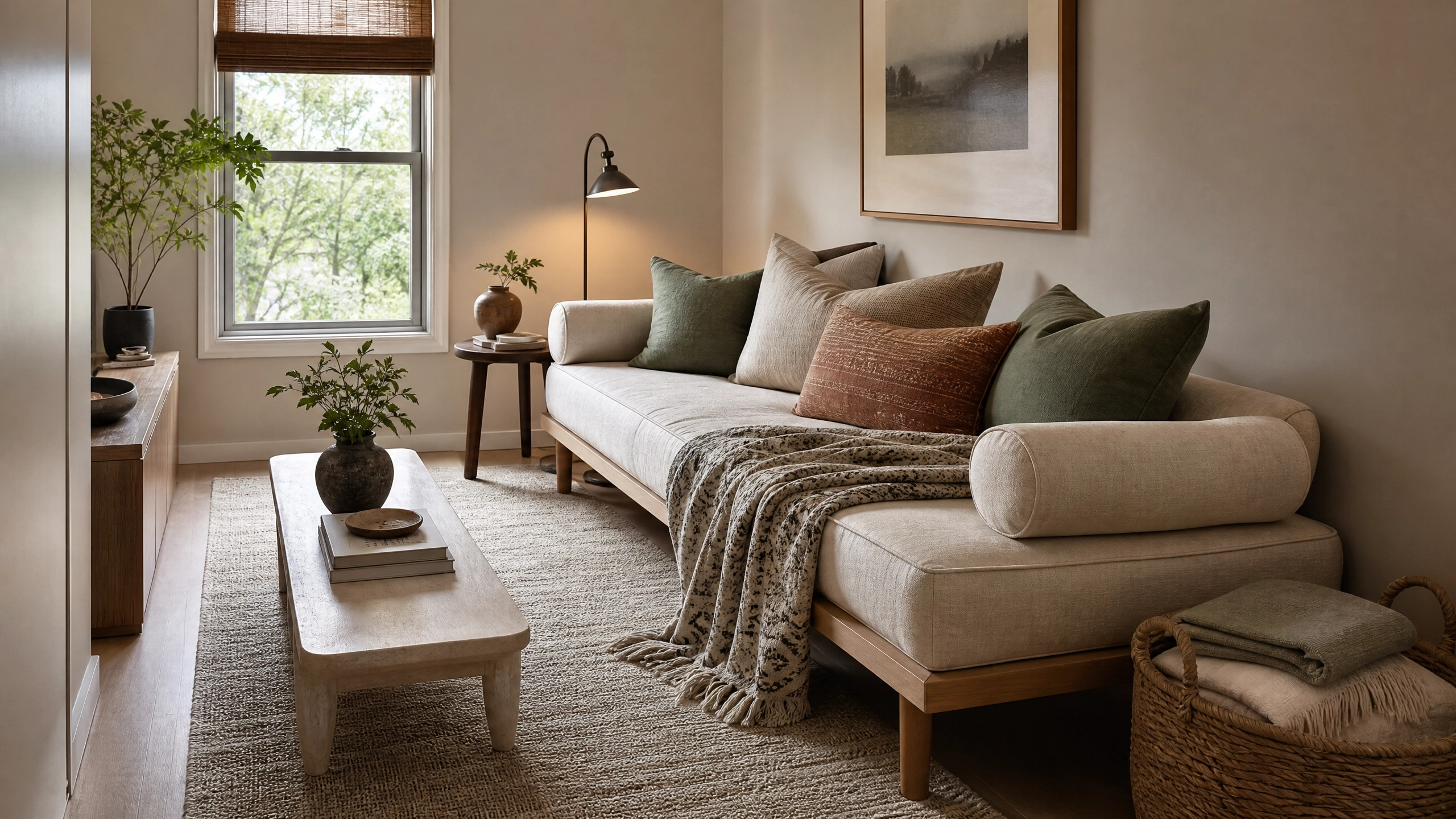
In a narrow room where a full sofa feels too wide and a loveseat feels too small, a daybed is the unexpected middle ground that quietly solves both problems at once. Positioned along one wall and styled with a bolster pillow at each end, a patterned throw, and a layered mix of cushions, a daybed functions as an inviting, casual sofa during the day — one that reads as designed rather than improvised. At night it converts to a guest bed without moving a single other piece of furniture.
The visual profile of a daybed in a narrow room also differs from a sofa in practically useful ways — it sits lower, reads longer and leaner, and often feels less bulky against the wall than a standard sofa’s backrest height. Look for a daybed with visible metal or wood legs rather than a fully skirted base to keep it visually light and open. IKEA’s daybed frames start under $300 and include a pull-out trundle for genuine overnight guests — functional without sacrificing the daytime look.
16. Place an L-Shaped Sectional at One End Only
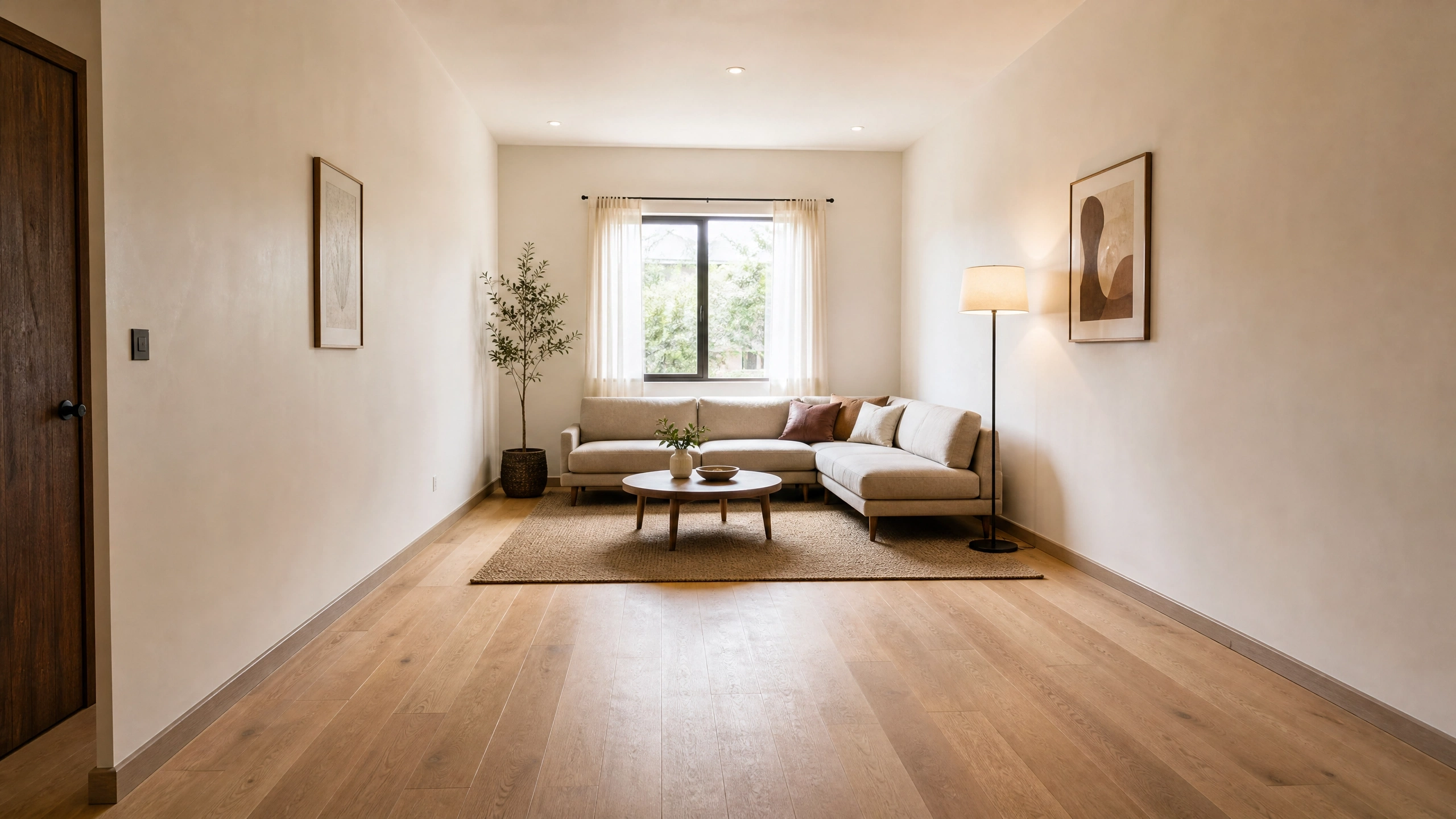
The most common sectional mistake in a narrow living room is running the chaise along the long wall — it consumes every available inch of width and compresses the space into something that feels even more difficult to breathe in. The better approach is placing the entire L-shaped sectional at one end of the room only, with the chaise tucked into the corner and the main sofa body running perpendicular to the long wall. This creates a cozy, intimate seating pit at one end while leaving the remainder of the room fully open and functional.
This configuration works best in rooms at least 12 feet wide — in a 10-foot room, even a compact sectional can overwhelm the footprint. Look for sectionals with a sofa depth of 36 inches or less, low-profile back cushions, and visible legs to avoid the heavy-furniture-wall effect. If you are shopping on Wayfair, filtering by “apartment size” or “small space” in the sectional category surfaces narrower-profile options specifically designed for rooms like yours.
17. Use a Narrow Media Console Under the TV
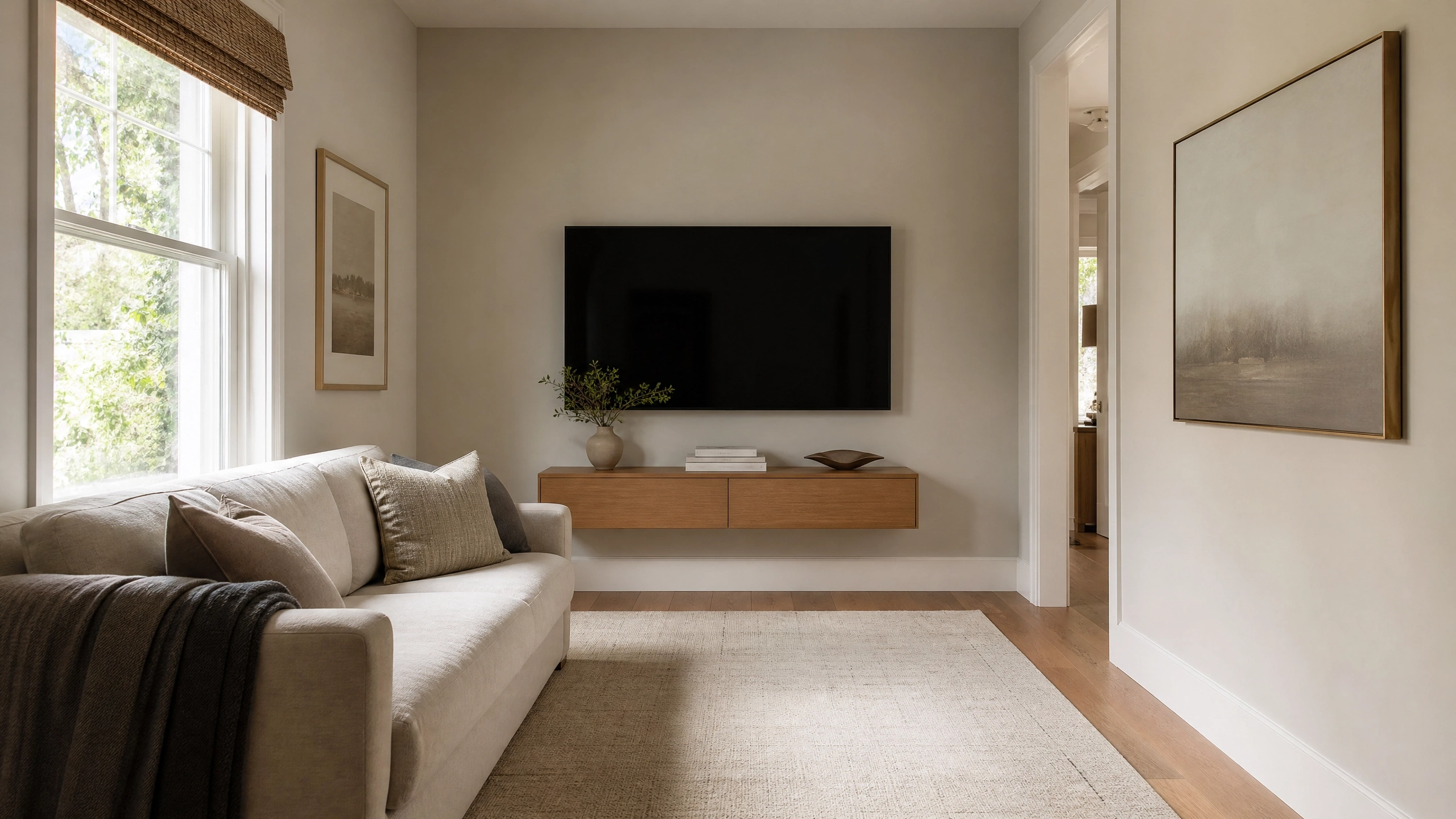
The TV console is one of the most overlooked furniture decisions in a narrow room — and one of the most impactful when you get it right. A bulky, deep entertainment center on the short end wall immediately eliminates the open, intentional feeling you are working to create. A slim media console — no more than 16 to 18 inches deep — keeps the floor visible and makes the TV feel properly mounted rather than dragged down by heavy furniture. The reduced visual mass at the base makes the entire end wall feel taller and more composed.
Look for a console in the 48-to-55-inch-wide range for a narrow TV wall — wide enough to feel purposeful, not so wide it fills the short wall edge to edge. A floating, wall-mounted console is even more effective: it creates the illusion of additional floor space beneath the TV and gives the whole wall a clean, built-in look. Renter note: if wall mounting is not permitted, choose a console with legs rather than a fully skirted base. IKEA and Wayfair both offer slim-profile options under $250.
18. Build the Whole Room Around One Statement Focal Point
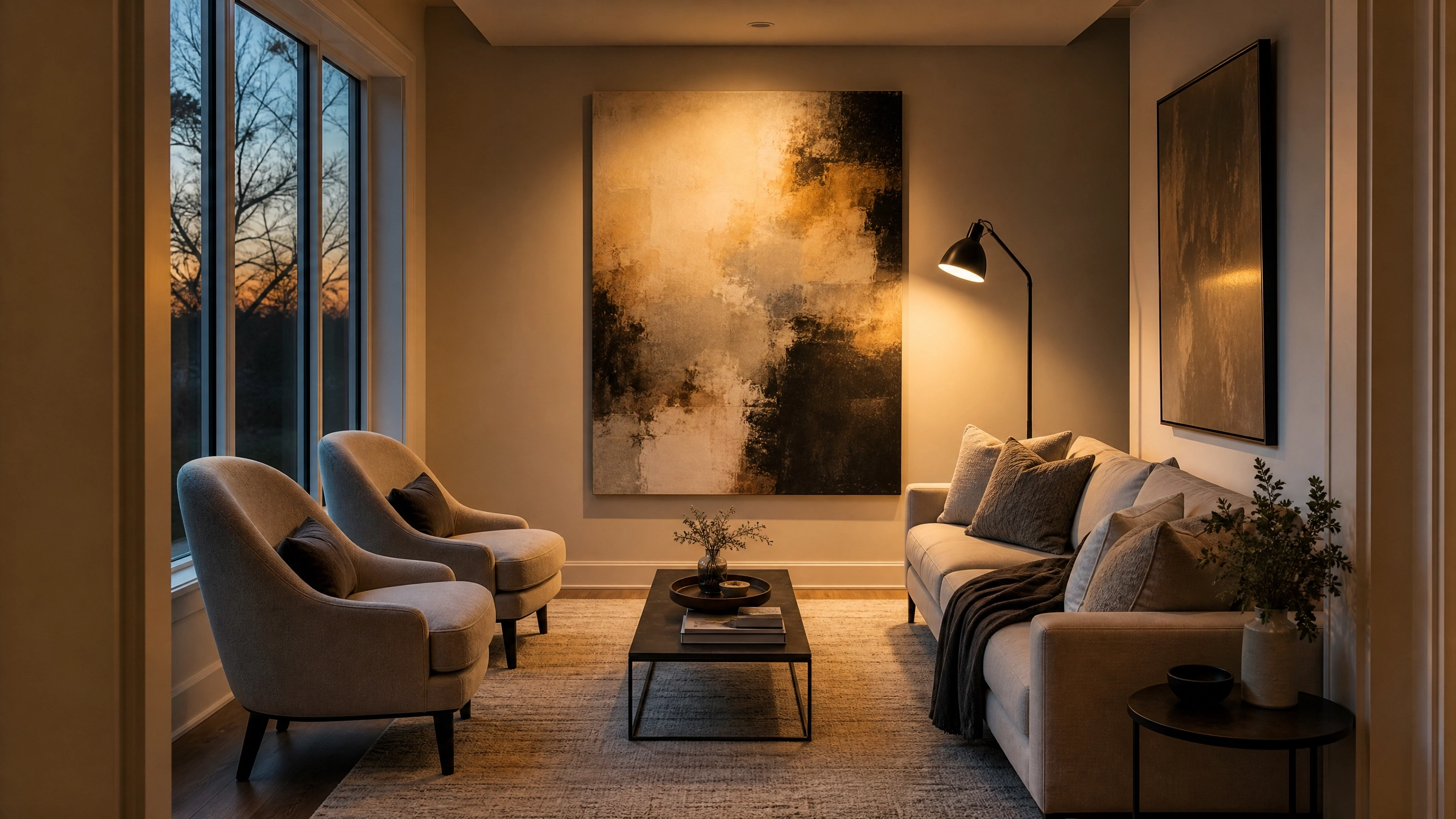
A narrow room without a single focal point feels restless — the eye bounces down the length with nowhere to settle, reinforcing the tunnel feeling at every glance. Choosing one thing to be the undeniable center of the room — a statement artwork, a fireplace surround, a bold wallpaper panel on the end wall, or a full gallery arrangement — and orienting all furniture to acknowledge it immediately anchors the space. The room stops being “a long, awkward room” and starts being “the room with that incredible art wall.”
If the room has no architectural focal point, create one deliberately. A large canvas — at least 36 by 48 inches — hung on the short end wall gives the room the visual destination it is missing. Keep the surrounding wall quiet so the piece reads loudly and clearly. Pair it with a directional floor lamp that highlights it in the evening and the focal point becomes even more defined and inviting as daylight fades and the warm lamp glow takes over.
19. Hang a Gallery Wall Along the Long Side Wall
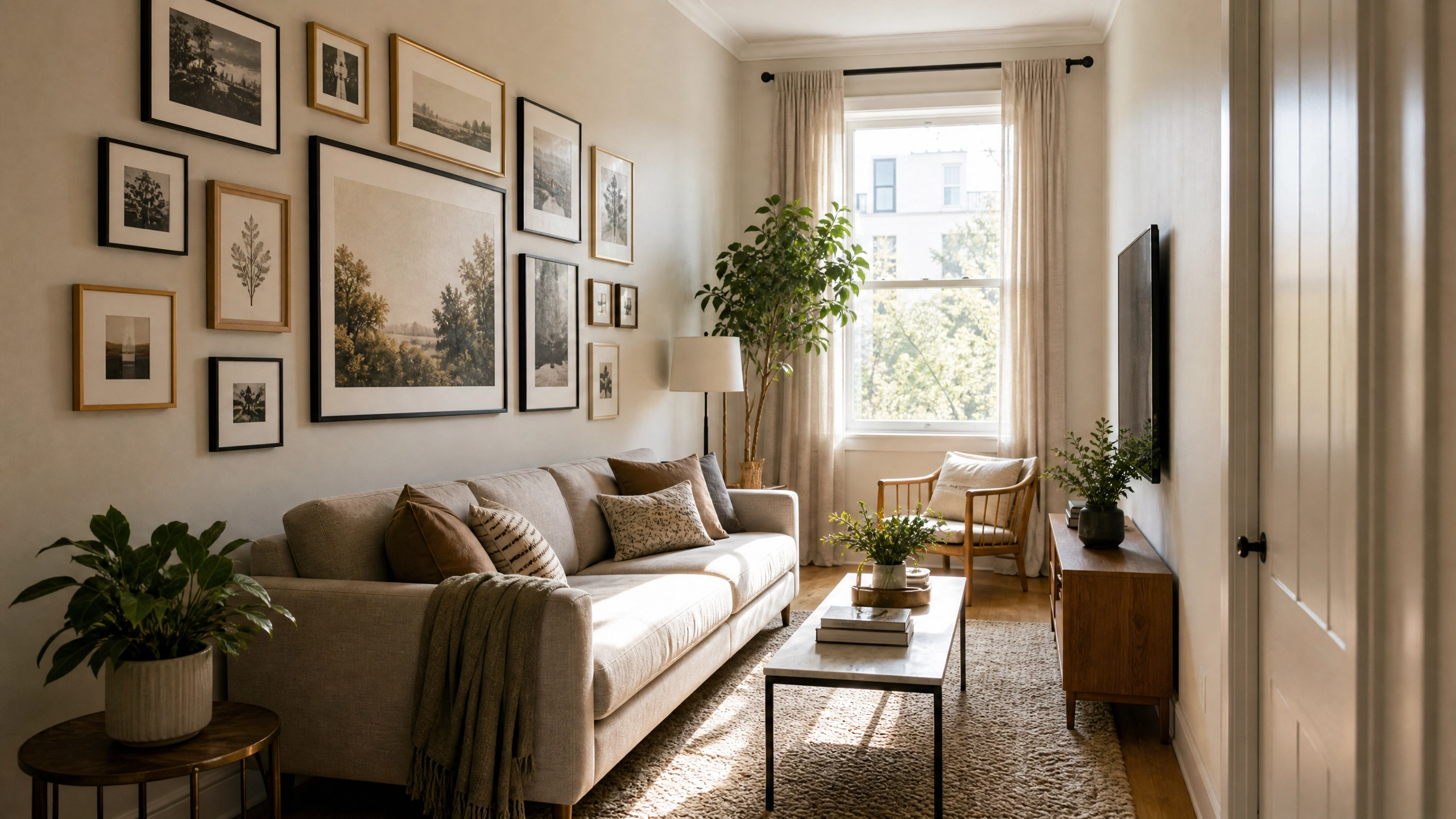
One reason narrow rooms feel like hallways is that the long side walls are often completely bare — an endless stretch of flat paint that gives the eye no reason to pause. A gallery wall arrangement on one long side wall does exactly the opposite: it creates a series of visual stops that break up the length, add warmth and personality, and give the room a collected, lived-in quality that no amount of furniture rearranging can achieve on its own. The right gallery wall makes the room feel inhabited in the best possible way.
To keep the gallery from reinforcing the horizontal stretch, arrange frames in a roughly square or vertical cluster rather than a long, single-line horizontal row. Mix frame sizes — one large anchor piece surrounded by smaller frames — to create movement and visual rhythm. Keep the arrangement centered at eye level between floor and ceiling. Command strips handle frames under 8 pounds without a nail hole, making this a completely renter-friendly way to transform the most challenging wall in the room.
20. Try Diagonal Furniture Placement for Unexpected Visual Flow
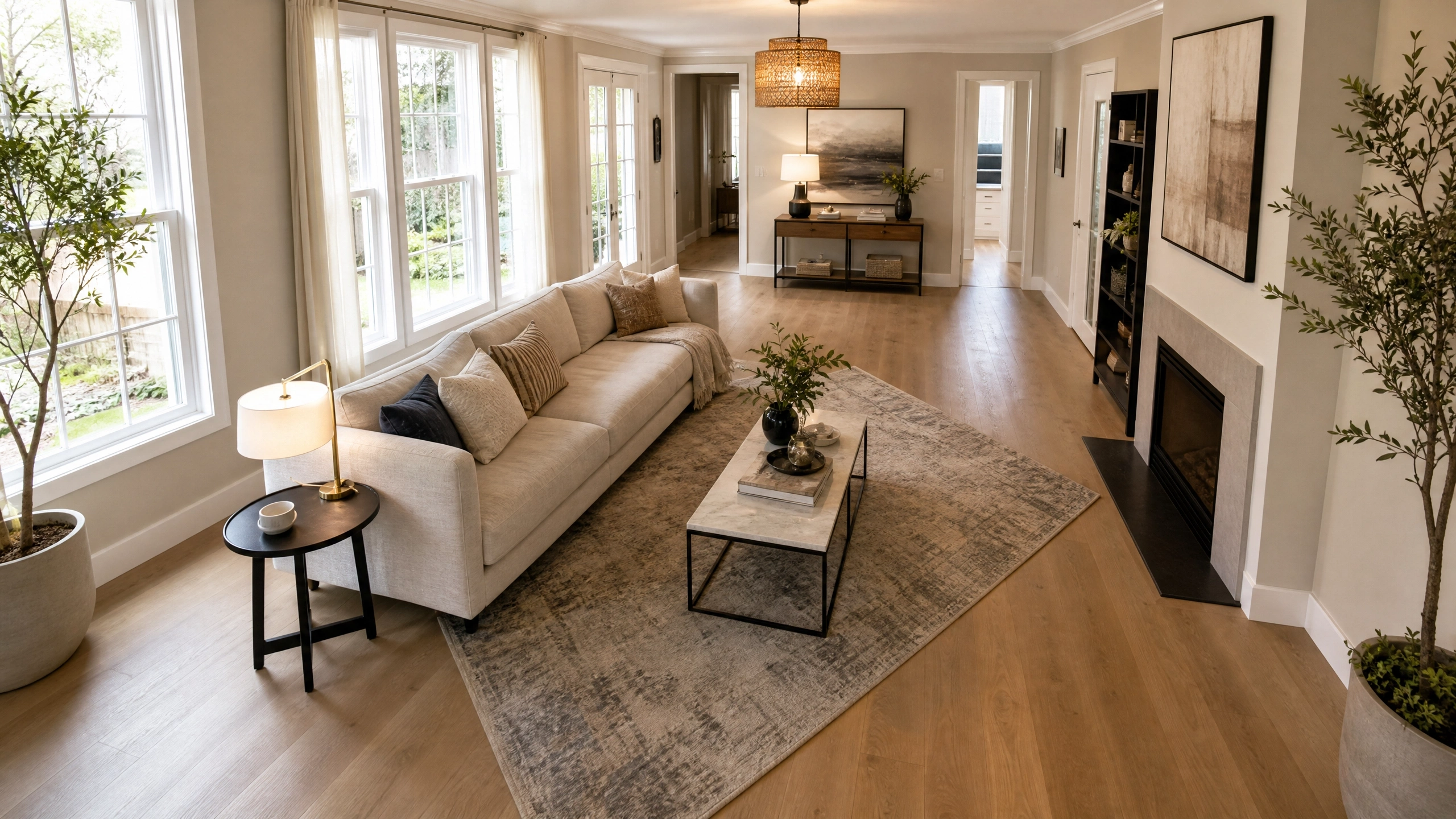
Diagonal furniture placement sounds risky in a narrow room, but done correctly it is one of the most effective layout strategies available for disrupting the tunnel effect. Angling the sofa at roughly 45 degrees in one corner — or placing the main area rug on a diagonal — pulls the eye across the room at an angle rather than straight down its length. That angled sightline makes the room appear wider because the eye travels the diagonal, which is always the longest visual line in any rectangular space.
This works best in rooms at least 11 feet wide and with a compact sofa that does not overwhelm the angled footprint. Place the coffee table parallel to the angled sofa to reinforce the diagonal line consistently throughout the arrangement. The challenge is maintaining traffic flow — make sure at least 30 inches of clear walking path exists on either side. In the right room with the right scale of furniture, this produces the kind of unexpected, thoughtful result that makes people stop mid-visit and ask how you did it.
21. Add a Bar Cart or Drinks Nook at One Far End
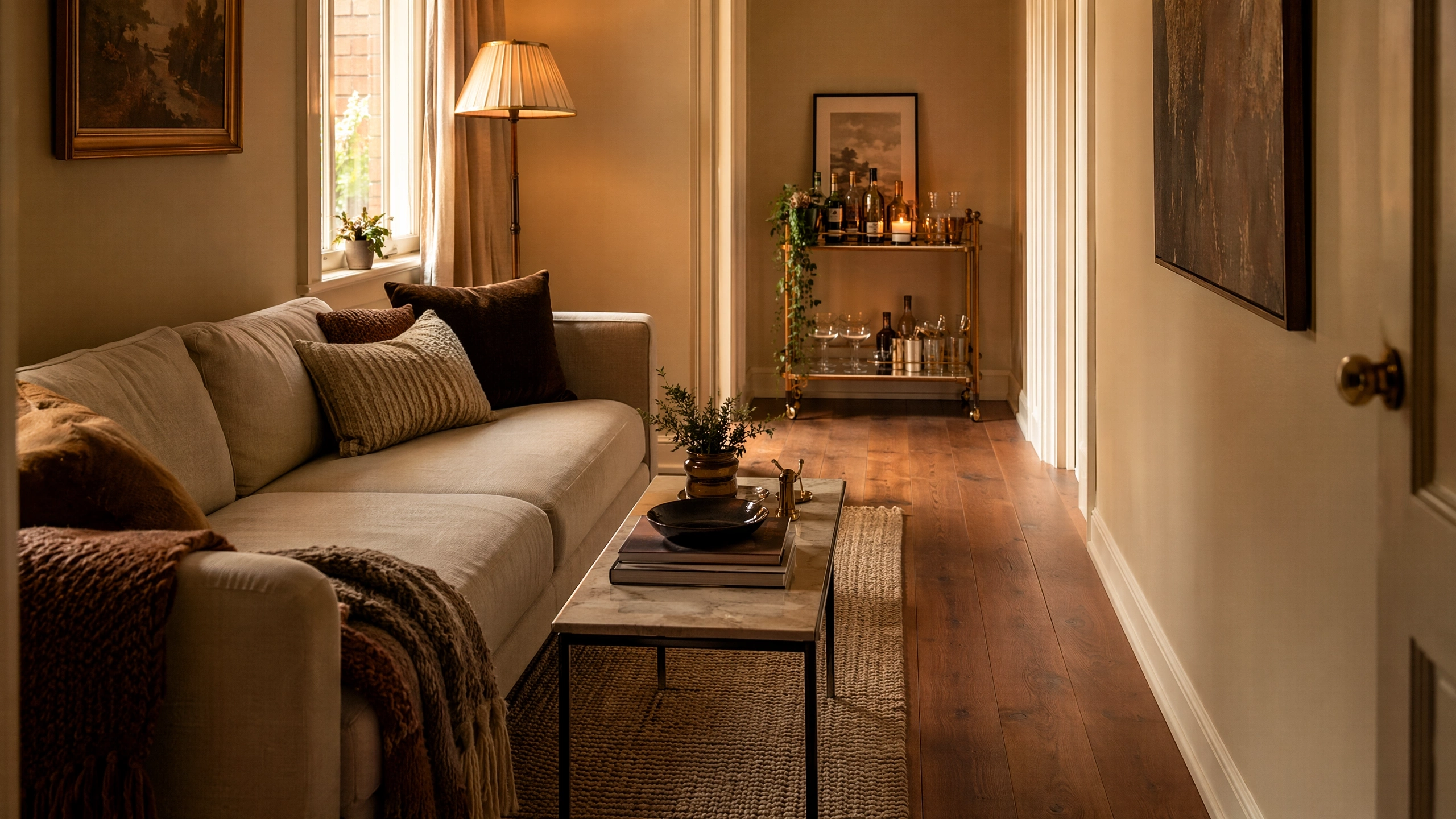
A bar cart tucked into the far end of a narrow living room does something disproportionately powerful for the overall feel of the space: it creates a destination. When the far end of a long room has a clear purpose — somewhere to mix a drink, display a few bottles, and keep a small styled tray of glasses — the room stops reading as wasted space and starts reading as a home that uses every inch thoughtfully and warmly. The dead end of the tunnel becomes the most inviting corner.
Keep the bar cart itself narrow and vertical rather than wide and flat — a two- or three-tiered cart with a small footprint takes almost no floor space but reads as a fully styled vignette. Add warm brass accessories, a small trailing plant, a candle, and a piece of framed art leaned against the wall behind it. The whole setup can come together for under $100 using cart and accessory finds from HomeGoods and takes roughly 20 minutes to arrange into something that looks completely intentional and polished.
22. Layer Three Light Sources to Remove the Tunnel Effect
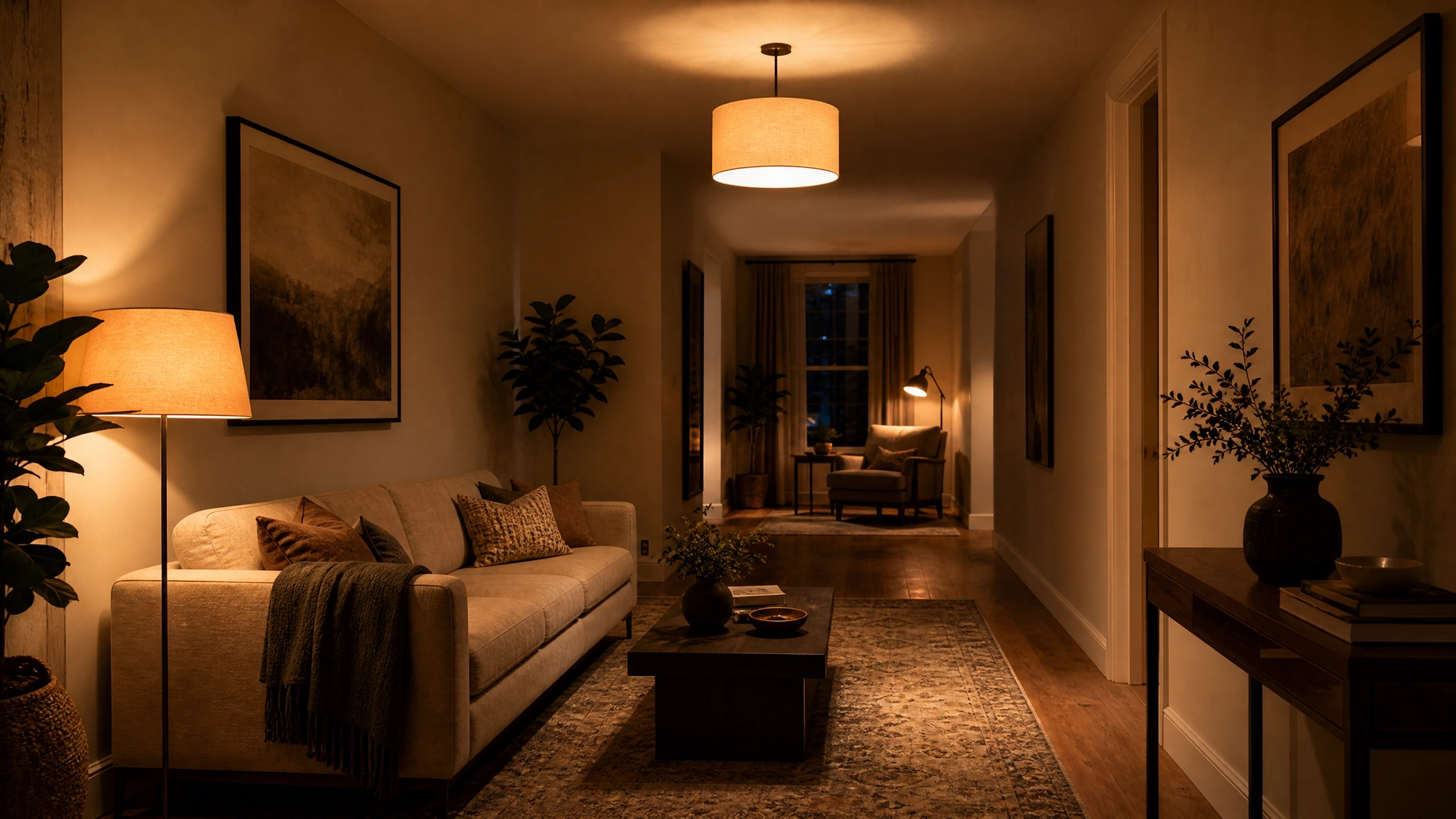
Lighting is one of the most underestimated tools in a narrow room — and most narrow rooms rely on a single overhead fixture, which casts a flat, even glow that reveals the full length of the space in one unforgiving sweep. Layering three types of light changes everything: an overhead fixture for general illumination, a floor or table lamp for ambient warmth in the main seating zone, and a smaller task light in the secondary zone each break the room into lit sections rather than one long, fully exposed corridor.
The key is letting each zone have its own distinct light source and allowing the spaces between them to stay slightly dimmer. In the evening with only the lamps on, the room naturally separates into warm, glowing pockets rather than one continuous tunnel of light. This is one of those long narrow room decorating ideas that completely transforms the space after dark without touching a piece of furniture. Just the light sources and a shift to warm amber bulbs (rather than cool white) make the entire difference.
23. Use Wide Horizontal Stripe Patterns on the Floor

Wide horizontal stripes on a rug — running across the short width of the room rather than down its length — optically stretch the space sideways. The eye follows the lines of a pattern instinctively, and when those lines run from long wall to long wall, the room reads as wider than it actually is. This is a genuine optical illusion that interior designers use regularly in narrow rooms, and it requires nothing more than choosing the right rug pattern when you are shopping for a rug anyway.
The stripes should be wide — at least 4 to 6 inches per stripe — for the spatial effect to register clearly at room scale. Thin pinstripes are elegant up close but lose all spatial impact when viewed from across the room. Wayfair’s indoor flatweave and cotton rug sections carry a strong selection of bold-stripe options in 5×7 and 6×9 sizes. Keep the palette calm — cream and warm white, sand and ivory, or soft terracotta and beige — so the stripes add visual width without making the floor feel graphically busy.
24. Hang Floor-to-Ceiling Curtains on the Long Walls
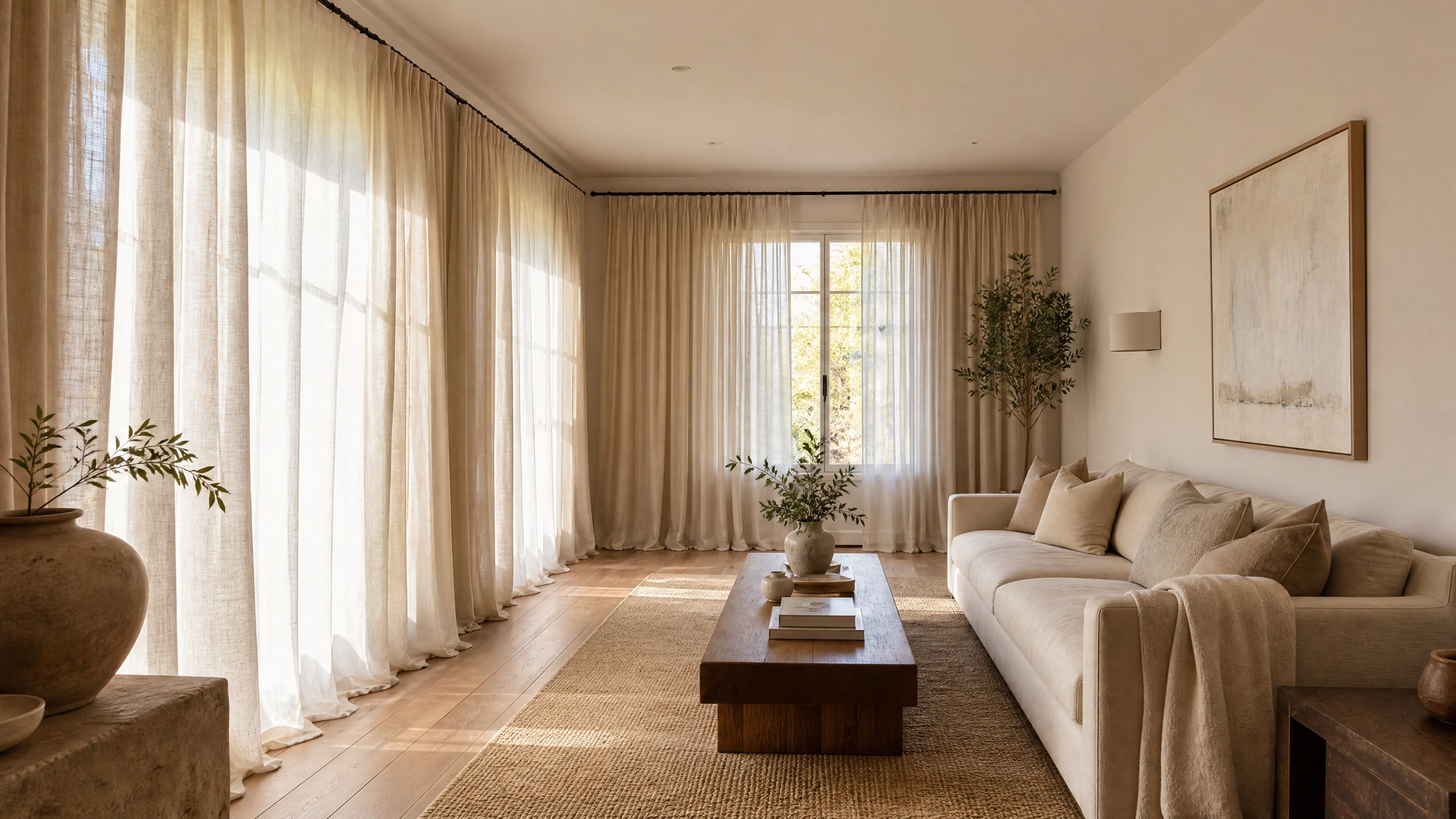
There is no long-wall treatment that adds more height, softness, and visual breadth than floor-to-ceiling curtains hung from a rod at ceiling height. Even on a long wall with no window at all, draping panels of linen or light cotton from ceiling to floor creates a layered, warm backdrop that makes the wall read as belonging to a much more intentional, generous space. The vertical lines of the fabric pull the eye upward rather than drawing it straight down the tunnel length of the room.
This is one of the more unexpected long narrow room decorating ideas because it places curtains on a non-window wall — and it consistently surprises people with how dramatically it shifts the room’s character. Ceiling-mounted curtain brackets or tension rods require no wall damage, making this fully renter-friendly. Stick to light, solid fabrics in warm white or natural linen so the panels feel soft and airy rather than heavy. If the long wall has a window, extend the rod all the way to the wall’s far edges on both sides for the most impactful result.
25. Face Two Slim Armchairs Toward the Sofa Instead of a Second Sofa
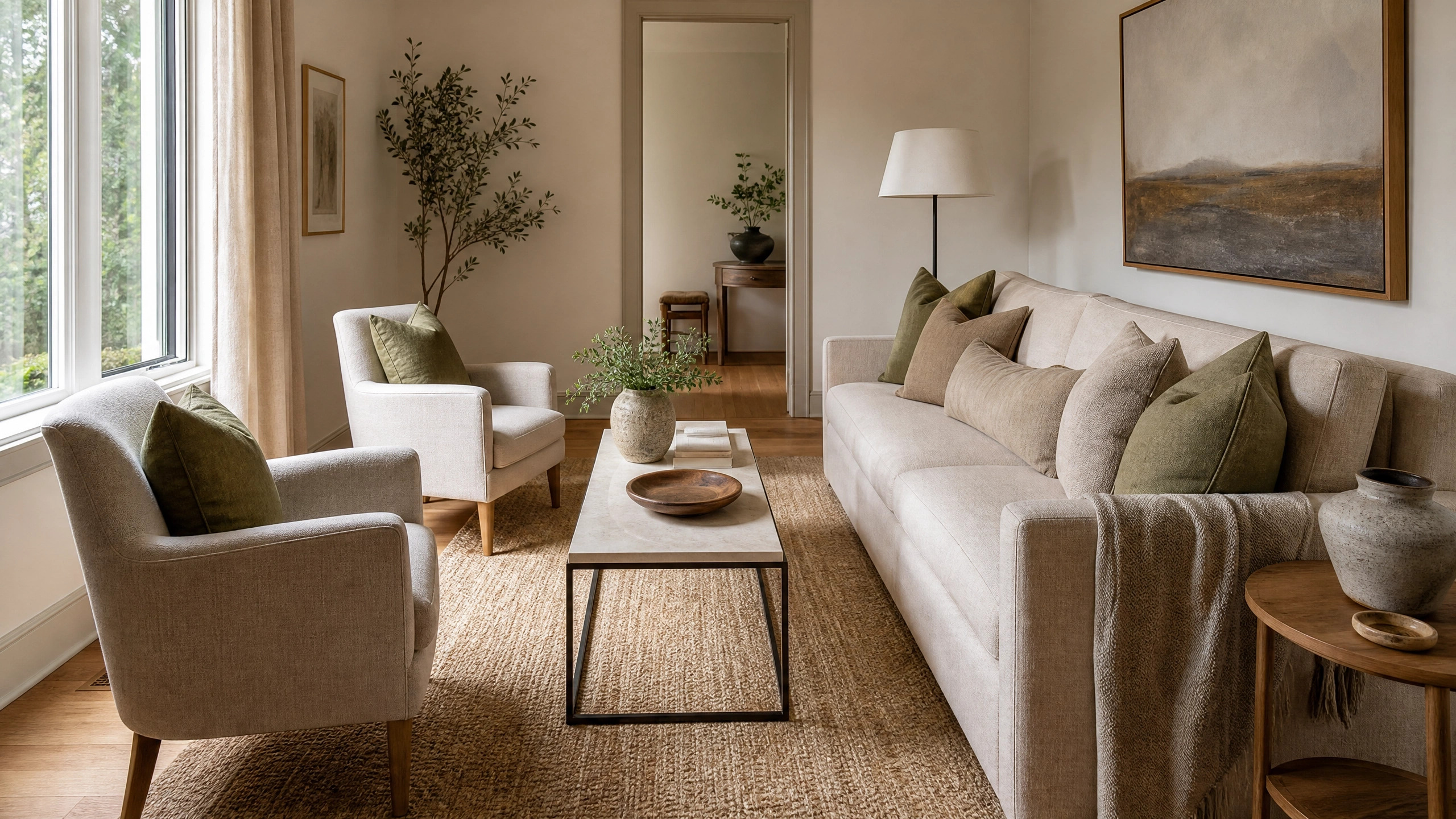
Adding a second seating piece in a narrow room almost always defaults to a second sofa — which uses up the remaining width, eliminates breathing room between the seating and the traffic path, and makes the whole room feel like a furniture showroom. Two slim armchairs placed directly across from the main sofa solve the seating problem without the bulk. They take up roughly the same footprint as a loveseat but feel open and airy, and they are far easier to reposition when the room needs to flex for a gathering.
Choose chairs with a simple silhouette: a straight or gently curved back, exposed wooden or metal legs, and a proportional upholstered seat that is not oversized or deeply padded. Leave 36 to 48 inches between the sofa and the chairs for the coffee table and comfortable movement through the space.
Matching one fabric detail in the chairs to an existing element already in the room — a pillow color, a rug tone — ties them in without requiring a full matched set.
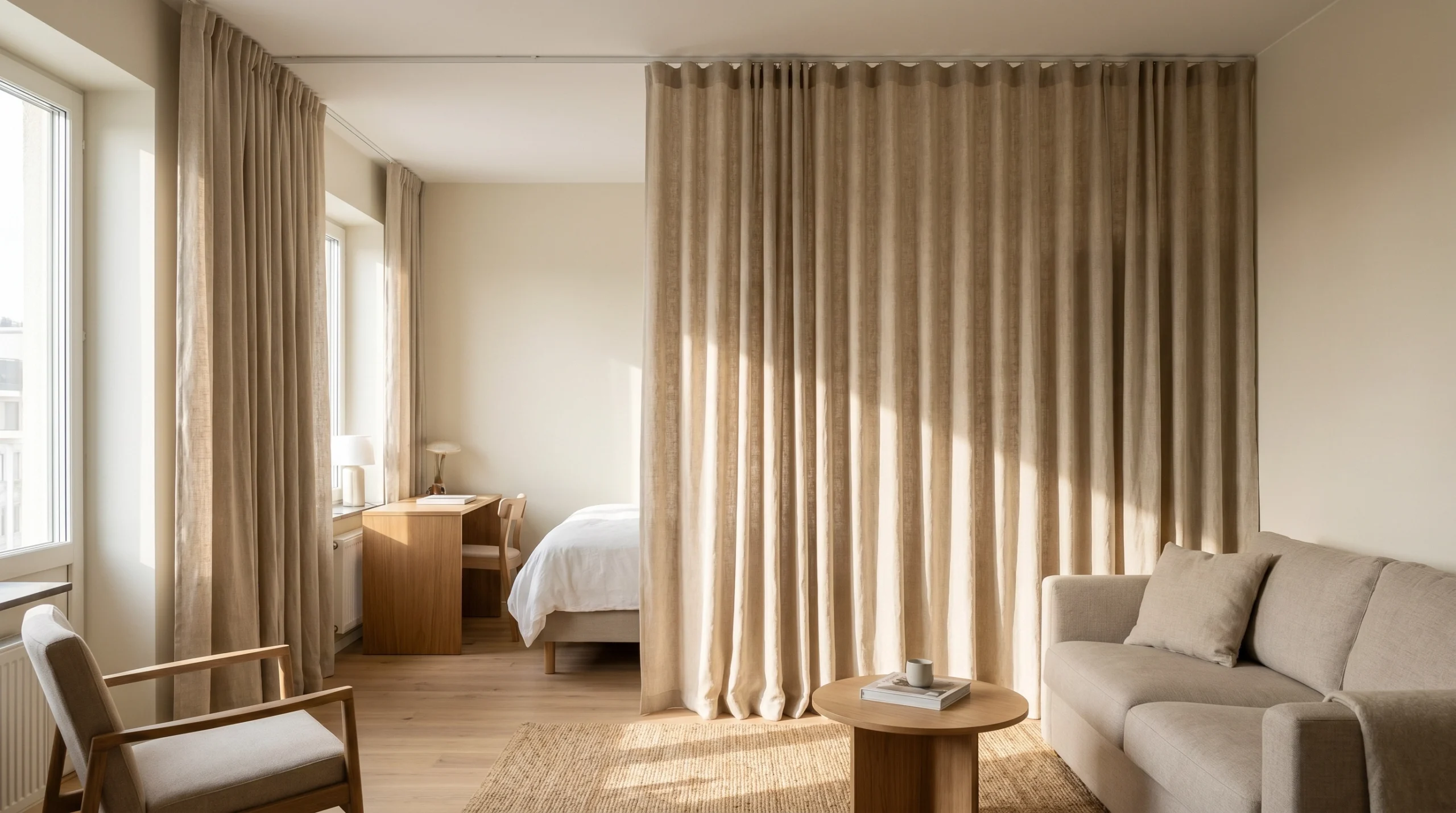
If a freestanding bookshelf divider feels too heavy or too permanent for your narrow room, a floor-to-ceiling fabric curtain hung from a ceiling-mounted track is the most flexible, renter-friendly zone separator available. A single panel of thick linen or cotton canvas drawn across the room’s width creates a complete visual and physical separation between zones when privacy or quiet is needed — and disappears to one side when you want the space to feel open, unified, and airy again.
Ceiling-mounted curtain tracks are available on Amazon for under $50 and require minimal hardware installation. A neutral linen in warm beige or oatmeal divides without closing the room in visually, while a textured or patterned fabric makes the divider feel like a deliberate design choice rather than a workaround. This is especially useful in studio or open-plan layouts where the narrow living area needs to be quietly separated from a sleeping or working zone without any construction, drilling, or permanent changes to the space.
27. Tie the Whole Room Together With Warm Neutrals and One Bold Accent
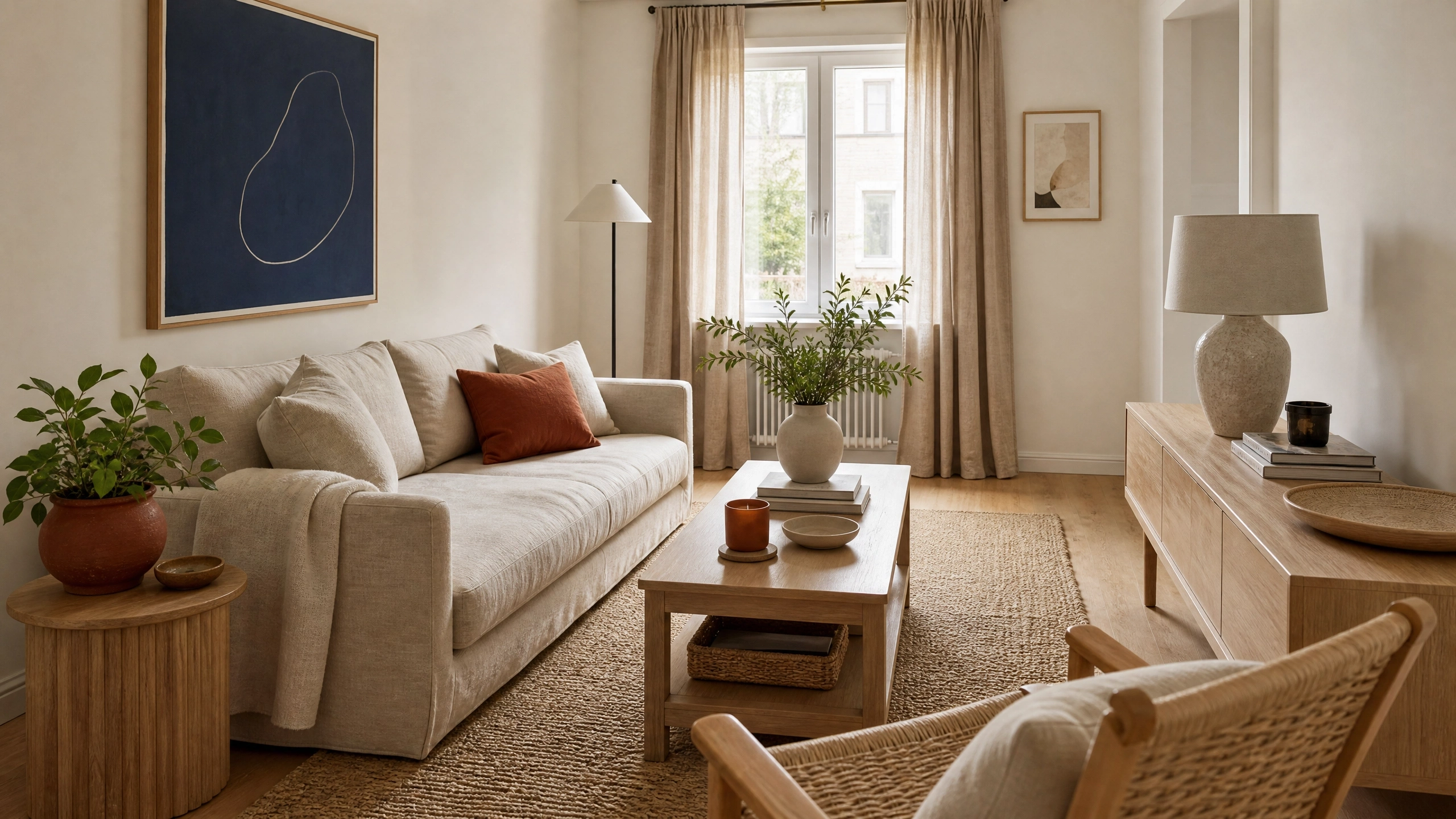
A narrow room with too many competing colors and patterns reads as chaotic — there is simply less space for the eye to rest between visual inputs. A palette built around warm neutrals (cream, oatmeal, warm white, soft tan, and taupe) gives the room a cohesive, restful backdrop that makes the length feel less pronounced. Everything reads as one calm whole rather than a series of disconnected pieces strung along the length of a corridor, and the room immediately feels more considered.
The one bold accent — a terracotta pillow, a dusty sage throw, a deep navy piece of art — keeps the neutral palette from feeling staged or empty. Repeat that accent color in two or three small elements throughout the room (a pillow, a plant pot, a candle holder) and it reads as intentional and curated rather than accidental. This is one of the simplest small narrow living room design tips in the entire list — and it applies to every other idea here. The right color strategy makes all 26 other layout ideas look more deliberate and beautifully pulled together.
FAQs
How do you arrange furniture in a long narrow living room?
Start by splitting the room mentally into two zones — a main TV and seating area at one end and a secondary space at the other. Float the sofa perpendicular to the long wall rather than along it, anchor each zone with its own rug, and place a clear focal point on the short end wall. Avoid pushing all furniture flat against the walls.
Should you put a sofa against the wall in a narrow living room?
No, pushing the sofa against the long wall typically makes the tunnel effect worse, not better. Pull it 12 to 18 inches away from the wall to break up the visual length and create space behind it for a console table or lamp, which adds a functional mid-height design layer the room needs.
What size rug works best in a long narrow living room?
A 5×7 or 6×9 rug works well for each seating zone in a narrow room. If you are using the two-rug strategy, place one under the main seating area and one at the far end. Avoid runners — they reinforce the tunnel shape rather than disrupting it. Each rug should be proportional to its zone’s furniture grouping.
Can you use a sectional sofa in a long narrow living room?
Yes, but placement is critical. Position the entire sectional at one end of the room with the chaise tucked into the corner rather than running it along the long wall. Look for apartment-size sectionals under 36 inches deep to avoid overwhelming the narrow footprint and blocking the room’s traffic flow.
What colors make a narrow living room look wider?
Warm neutrals on the main walls — cream, oatmeal, soft warm white — keep the space feeling open and restful. Painting the short end wall a deeper, richer color draws the eye forward and makes the room feel shorter overall. Avoid dark paint on both long side walls simultaneously, as it compresses the perceived width of the space.



No Comment! Be the first one.