




27 Kitschy Kitchen Ideas Full of Color and Personality
Your kitchen looks exactly like every other house on the block. Matching everything. Stainless everything. Nothing that says a single thing about the person who actually cooks there. You’ve...

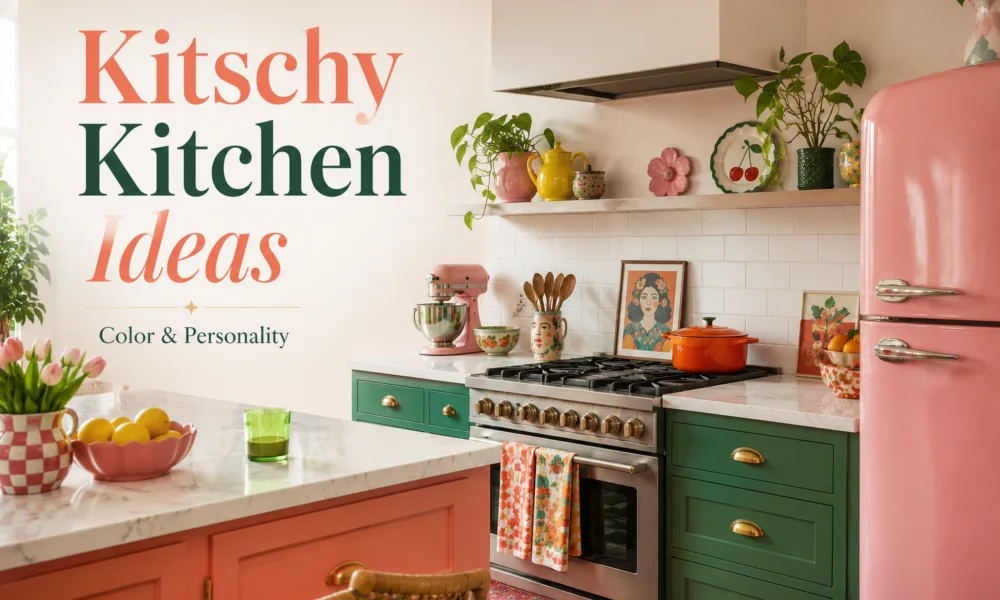
Your kitchen looks exactly like every other house on the block. Matching everything. Stainless everything. Nothing that says a single thing about the person who actually cooks there.
You’ve probably saved a hundred Pinterest pins that felt exactly right — then closed the app without knowing what to actually do next. That’s the gap this article closes.
According to Pinterest’s 2024 Predicts report, searches for “kitschy kitchen” rose 75% year-over-year while “eccentric kitchen” surged 160%. Pinterest named “Kitschens” one of its top verified trends for 2024 — the first time a maximalist kitchen style has led their annual forecast. The desire is real. What’s missing is a practical roadmap.
These 27 ideas are organized by investment level, flagged for renter-friendliness where it applies, and chosen because they work in real kitchens — not just in magazine shoots. Exact prices included so you know which moves cost $12 and which ones cost $1,800.
What Kitschy Kitchen Design Actually Means
There’s a distinction here that most style articles skip entirely — and it’s everything.
Kitschy kitchen design is a decorating approach that deliberately layers bold color, retro references, nostalgic objects, and playful pattern to create a kitchen with visible personality and visual warmth. The key word is deliberate. Every object earns its place — not because it’s expensive or minimal, but because it’s specific and charming.
Think of it as maximalism with a point of view. And, honestly, a sense of humor about itself.
Kitschy kitchens are instantly recognizable and deeply personal. They look collected over time, not assembled in a weekend. That quality — the sense that the room says something about the person who lives there — is exactly what draws people to the aesthetic.
According to Pinterest’s 2024 trend data, this is the first year in the platform’s history that a maximalist kitchen style has led the annual forecast, reflecting sustained year-over-year search growth rather than a single viral moment. Readers aren’t casually curious. They’re actively planning.
What most style guides skip is the distinction between kitschy and cluttered — and that distinction is everything. Kitschy kitchens have repetition of color, deliberate groupings, and objects displayed in context. Cluttered kitchens have the same number of objects but no organizing logic.
Here’s the thing: most people assume getting this look means pulling out cabinets or hiring a contractor. It doesn’t. The most-shared kitschy kitchen images on Pinterest involve zero structural changes. What they share is strong color choices, intentional pattern layering, and vintage objects displayed with enough purpose that they read as curated rather than accumulated.
Some interior designers argue kitschy design dates quickly and will feel tired by 2027. That’s worth taking seriously. I’ve seen conflicting predictions on this — some commentators call it a short cycle trend; others point to its five-year sustained search growth as evidence it’s shifting into a legitimate movement. My read is that a kitschy kitchen with a personal, collected quality ages better than interchangeable minimalism. The reason: a room that looks like you doesn’t go out of style the same way a room that looks like a trend does.
Or maybe I should say it this way: a kitchen that looks like you actually live there will feel right longer than one that looks like a showroom floor.
7 Big Visual Anchors: The Moves That Change Everything
Look — if your kitchen is completely neutral right now and you’re not sure where to start, this section is for you. These seven ideas create the visual foundation everything smaller builds on. You don’t need all seven. Most readers pick one or two as a focal point and layer from there.
The most effective kitschy kitchen rooms start with a single bold anchor — one statement appliance, one backsplash pattern, or one painted cabinet bank — rather than bold color on every surface simultaneously. Rooms that try to do everything at once often read as chaotic; rooms that commit to one strong move first give the eye a place to land.
1. A Retro-Silhouette Fridge as Your Kitchen’s Color Anchor
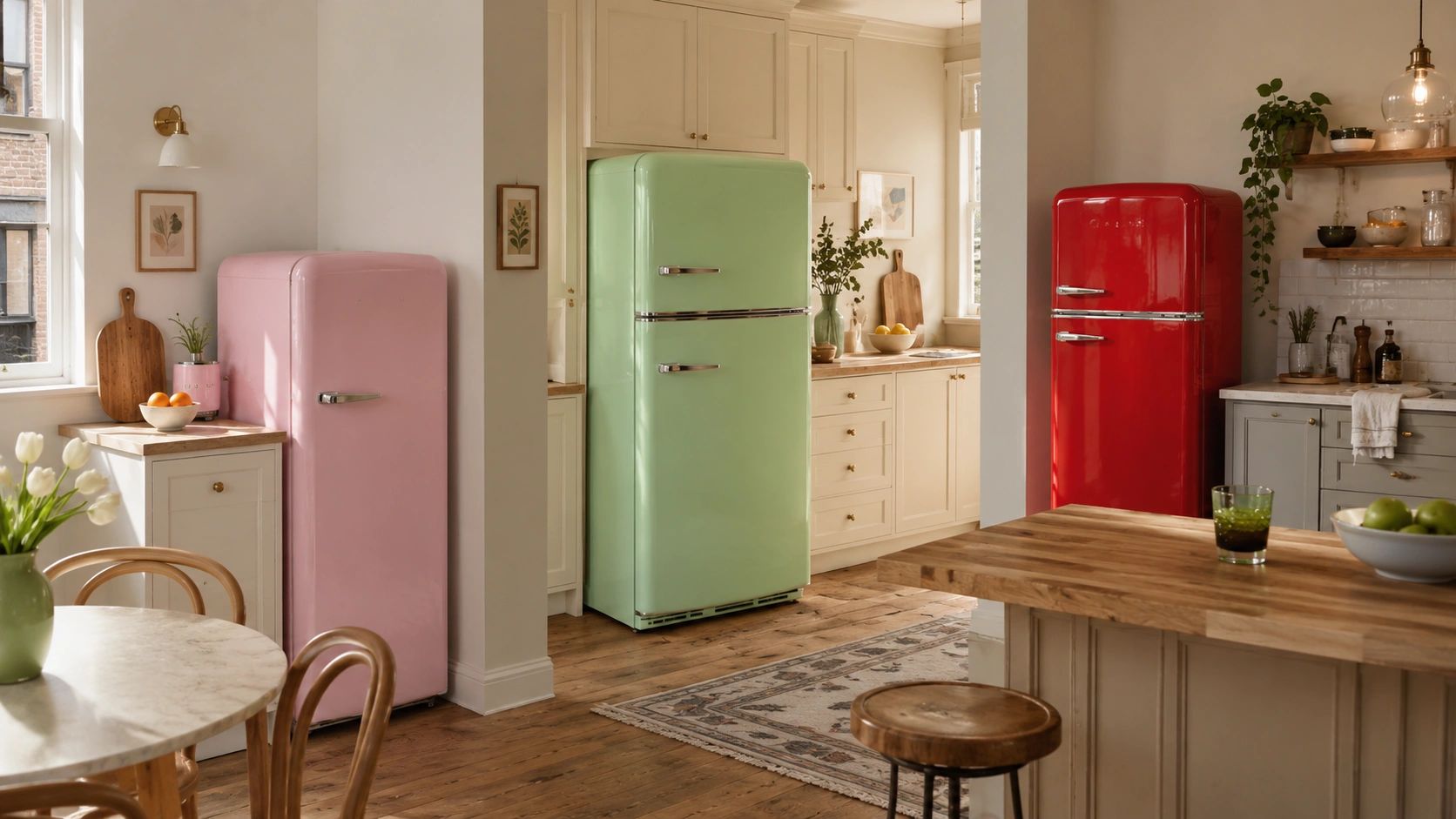
A refrigerator takes up more visual real estate than any other single object in a kitchen. Replace it with a retro-silhouette model in a bold color — even in an otherwise neutral room — and the entire space reorients around it.
The budget split matters here. Smeg FAB28 (~$1,400–$1,800) delivers an authentic 1950s Italian form in over 20 pastel and jewel tones. Big Chill (~$1,600–$3,500) handles full-size household needs in 200+ custom colors, including Buttercup Yellow and Jadite Green. Galanz (~$150–$400) is the genuine entry-level option — cherry red and mint green versions are available at major retailers and deliver most of the visual impact at a fraction of the price.
Smeg FAB28 vs. Galanz: Smeg is better suited for readers committed to the kitschy aesthetic long-term — the $1,400+ investment delivers an authentic 1950s Italian silhouette. Galanz works better when budget is the constraint or for renters testing the look first. The key difference is capacity: Smeg’s FAB models run compact; Galanz options run slightly larger for daily household use.
Quick Comparison: Retro Fridge Options by Budget
| Option | Best For | Key Benefit | Limitation |
|---|---|---|---|
| Smeg FAB28 | Statement anchor, smaller kitchens | Authentic 1950s silhouette, 20+ color options | $1,400+ investment; compact size only |
| Big Chill | Full-size needs, custom palette | 200+ colors, full family-size capacity | $1,600–$3,500; longer production lead time |
| Galanz | Budget-conscious households, renters | Under $400 at major retailers | Fewer color options, smaller capacity |
2. Bold-Color Paint on Lower Cabinets Only
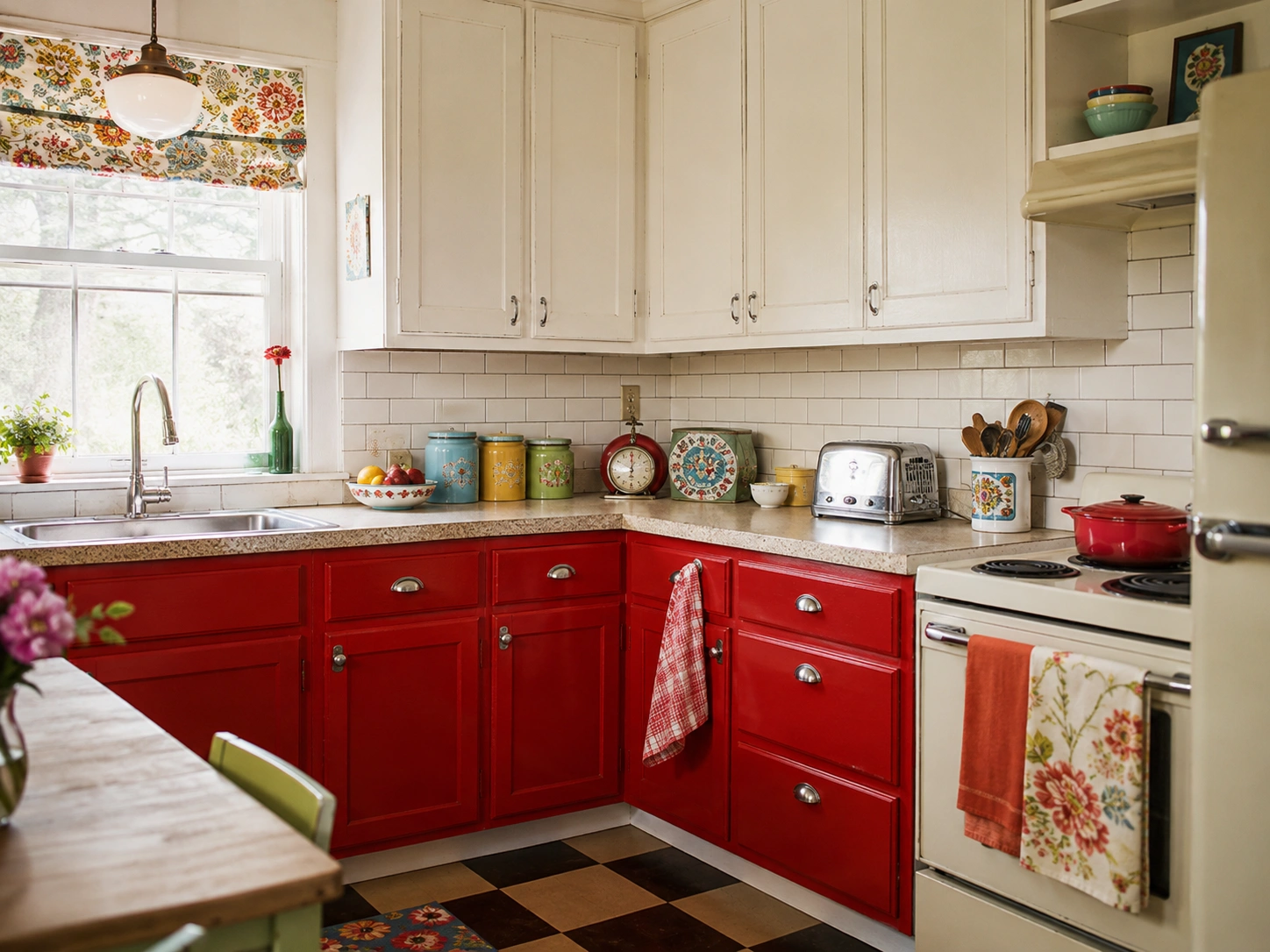
Painting every cabinet feels risky for most people — and it should, because it’s a large commitment. Painting just the lower bank while keeping upper cabinets white or off-white delivers the visual punch with a built-in anchor point at the bottom of the room.
Cherry red, cobalt blue, sage green, butter yellow, forest green, and deep terracotta all read unmistakably kitschy. Use semi-gloss or satin finish — it holds up better in kitchen humidity and reads more authentically retro than flat matte. Budget for professional application if you want clean lines around hardware; DIY works fine on flat cabinet faces.
Renter note: Semi-permanent. For zero-paint alternatives at a similar visual impact, see Ideas 9, 13, and 21.
3. Open Shelving Styled with a Curated Vintage Dish Collection
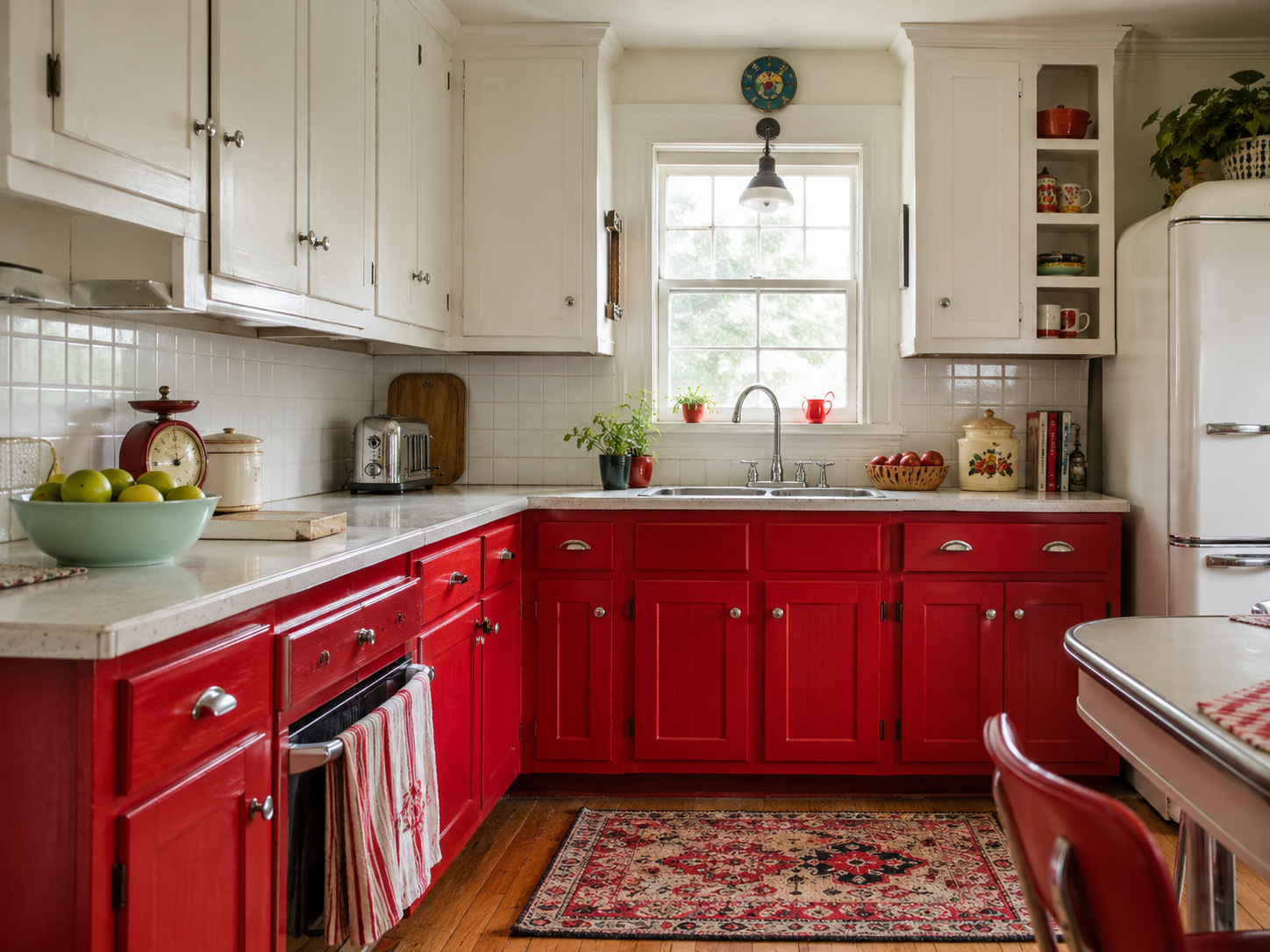
Pull the doors off one or two upper cabinets — or simply remove them without filling the hinge holes, which most standard hinges allow without damage — and use that open space for a deliberately styled vintage dish display.
The visual principle is form unity with surface variety: a shelf of dishes that share a color family but vary in pattern reads collected and curated. A shelf of perfectly matching dishes reads like a closed cabinet with the door removed. Good thrift-store starting points include Depression glass in pink or green ($2–$8 per piece), Fiestaware in mixed bold colors ($12–$25 new), or ironstone with blue transfer patterns. The collection doesn’t need to be complete. Three plates and two bowls can be enough.
4. Mismatched Retro Bar Stools in Coordinated Bold Colors
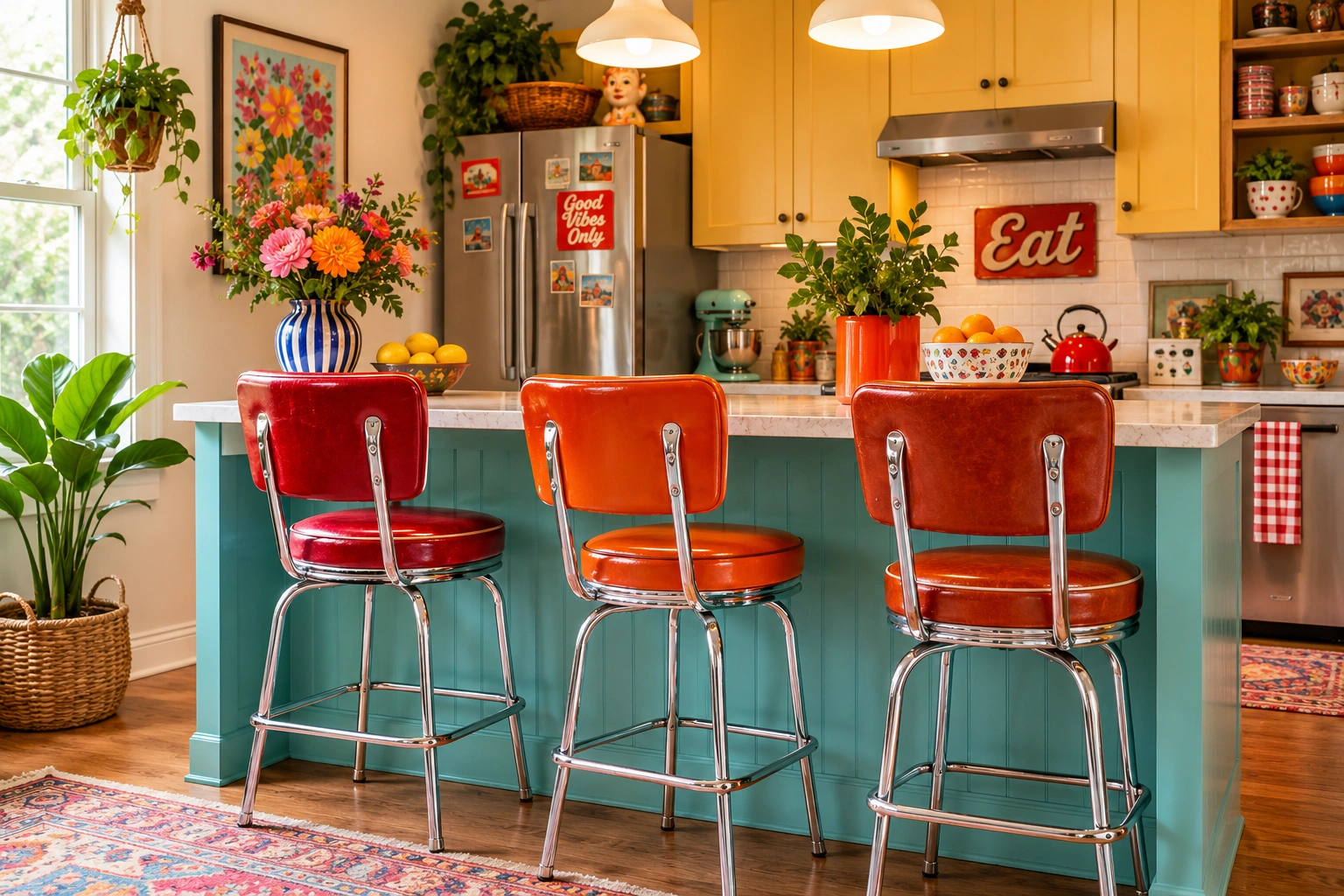
An island or breakfast bar fitted with stools in different-but-intentional colors is among the most-saved kitschy kitchen images on Pinterest. The rule: coordinate by color family, not by exact match. Three stools in cherry, tomato, and rust read cohesive. Three in cherry, cobalt, and yellow read deliberately eclectic but still unified by visual energy.
Thrift shops often carry vintage chrome-and-vinyl diner stools for $15–$40 each. Reproduction retro stools run $80–$160 on Amazon or Wayfair. And a can of spray paint on wooden stools you already own is the $15 version of this exact idea.
5. Statement Pendant Lights with Colored Glass or Rattan Shades
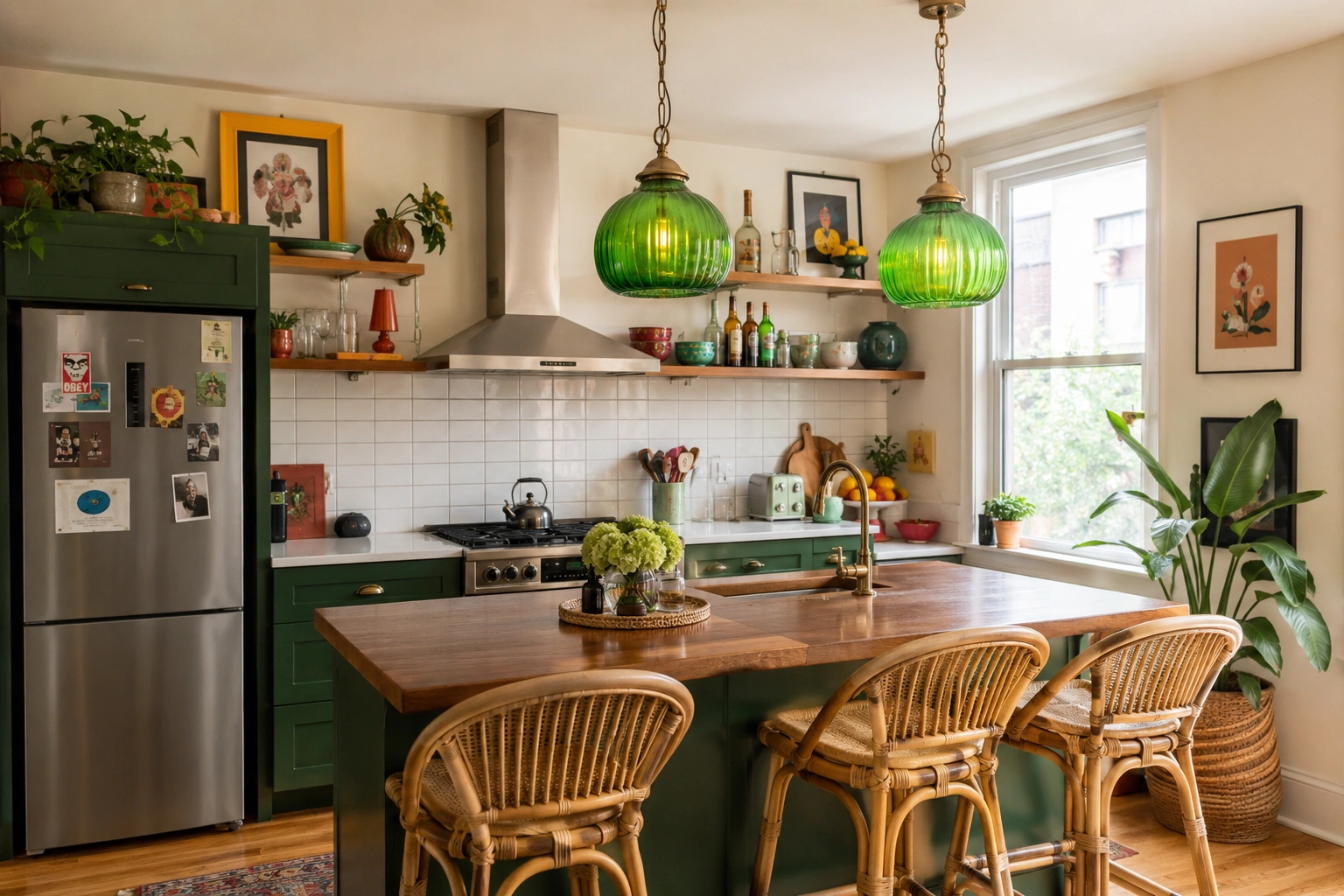
Lighting is the most underused kitschy kitchen tool by a significant margin. Swapping a standard ceiling fixture for pendants with amber glass, opaque colored glass (cobalt, cherry, emerald), or sculptural rattan dramatically changes the room’s mood and color temperature — without touching a single cabinet or wall.
A single pendant light over a kitchen island runs $60–$180 at West Elm, Anthropologie, or Wayfair. Renters: confirm fixture-swapping is permitted in your lease before doing this — it’s a standard light fixture swap but does require turning off a breaker.
6. A Pot Rack Displaying Copper or Colorful Enamel Cookware
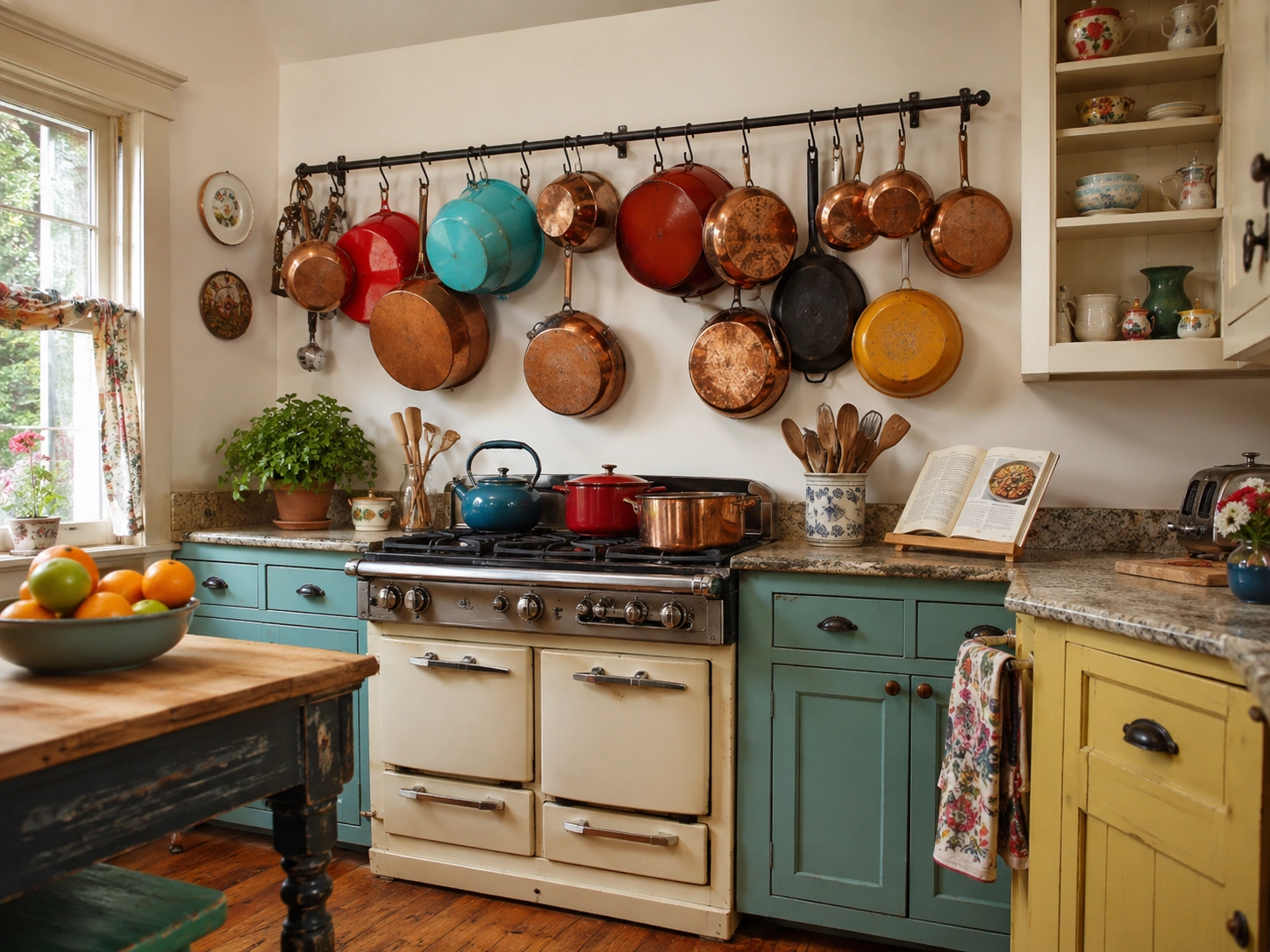
Hanging cookware is both functional and genuinely beautiful in a kitschy kitchen context. A ceiling-mounted or wall-mounted rack showing copper-bottomed pans, colorful enamel Dutch ovens, or vintage cast iron turns everyday tools into permanent, character-building decor.
This idea scales dramatically on price. Thrifted copper pots ($10–$30 each at estate sales) on a basic wall-mounted bar rack look exactly as good as a $600 custom artisan setup — sometimes better, because the patina is real and earned. That’s not something you can buy new.
7. A Bold Backsplash: Ceramic Tile, Zellige-Inspired, or Peel-and-Stick
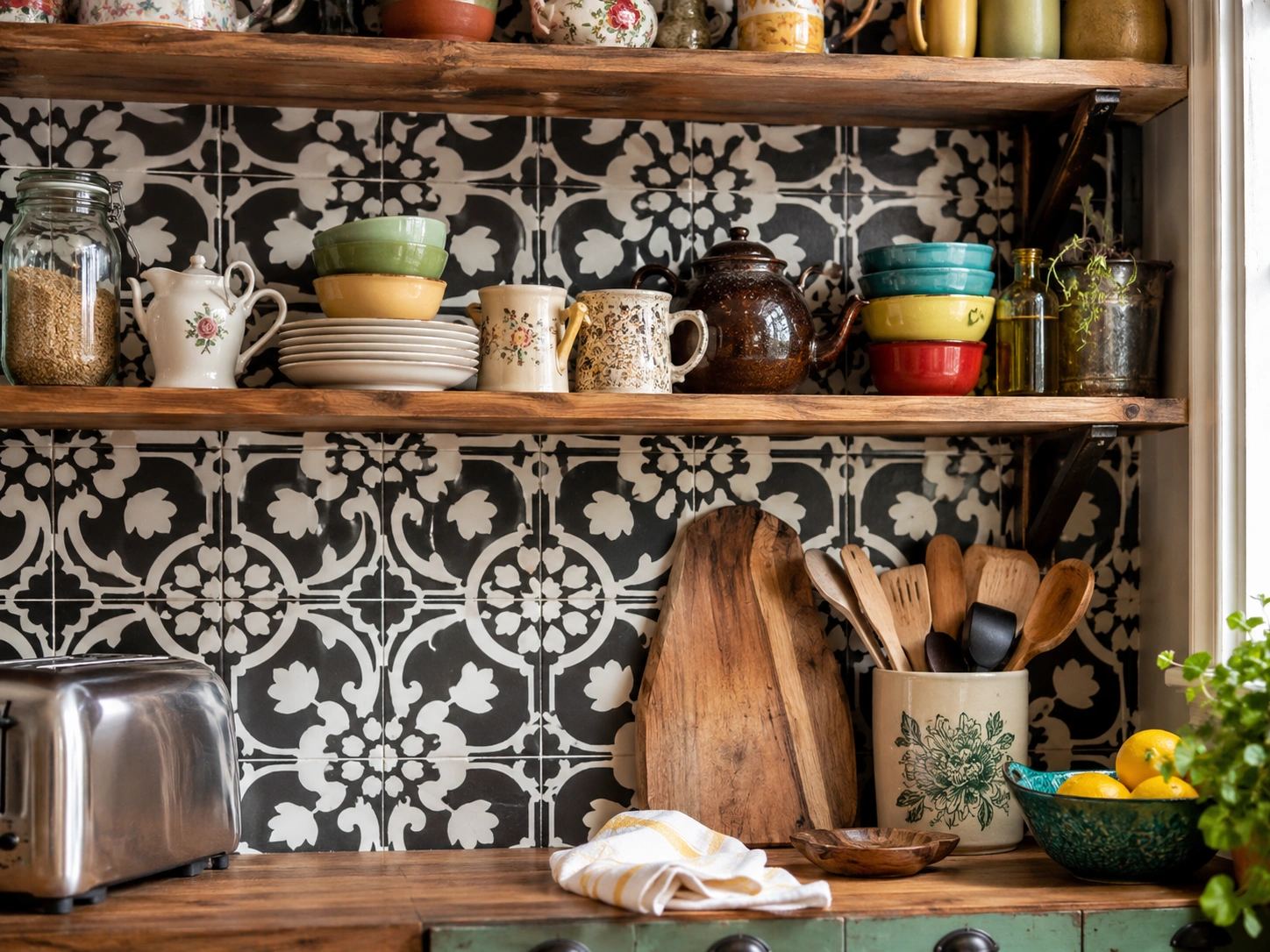
The backsplash is the highest-concentration visual surface in any kitchen. A kitschy pattern here earns disproportionate impact per square foot compared to the same visual effort applied anywhere else.
To install peel-and-stick backsplash tile: clean the wall surface thoroughly with isopropyl alcohol, measure the area, cut tiles starting from the center of the wall outward, press each tile firmly and smooth with a flat card to eliminate air bubbles, then finish edges with a thin bead of clear caulk for longevity. Budget: $30–$80 for most peel-and-stick options covering a standard backsplash area. Actual hand-painted ceramic tile runs significantly higher but is more permanent and more impactful.
Pattern Play: Checkered, Gingham, and Bold Print
Pattern does something color alone doesn’t. It signals a design era. Checkered floors say 1950s diner. Gingham curtains say farmhouse-meets-retro. Fruit-print wallpaper says mid-century kitchen, confidently. You don’t always need bold color to read as kitschy — the right pattern carries the same message.
8. Checkered Peel-and-Stick Floor Tiles
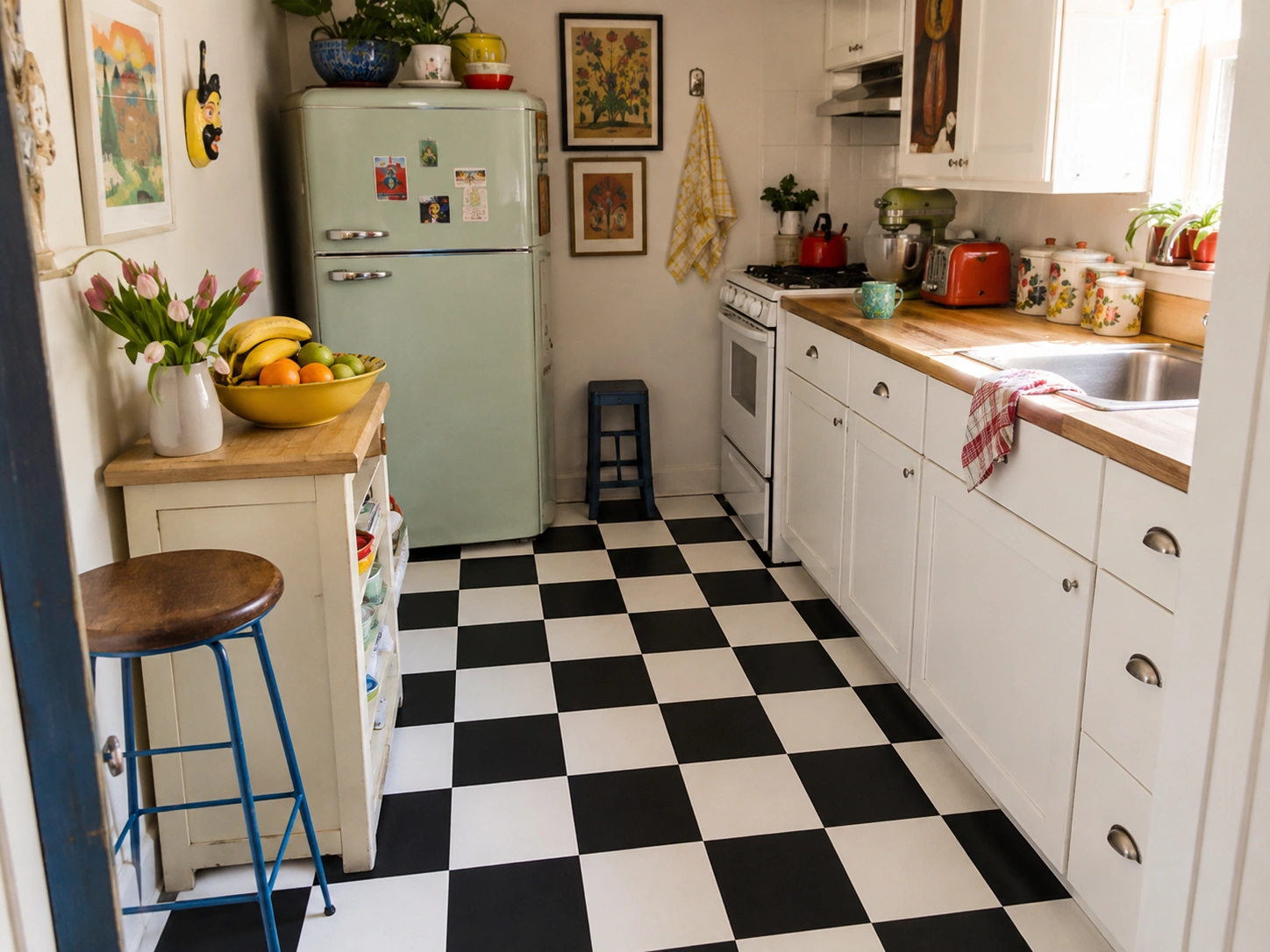
The most-pinned kitschy kitchen floor idea, by a significant margin. Classic black-and-white checker on a 12-inch grid is most common, but two-color combinations in red/cream, cobalt/white, or sage/off-white appear consistently in current Pinterest saves.
A standard 8×10 kitchen needs roughly 40–50 twelve-inch tiles, running about $40–$80 for a quality vinyl option. Brands like FloorPops and Aspect produce convincing results. Clean the existing floor surface thoroughly before application — grease and dust prevent adhesion and cause lifting at tile edges.
Renter-friendly? Usually yes. Most peel-and-stick vinyl comes up cleanly from smooth existing floors. Test one corner tile before committing to the full room.
9. Vintage-Inspired Peel-and-Stick Wallpaper on a Single Kitchen Wall
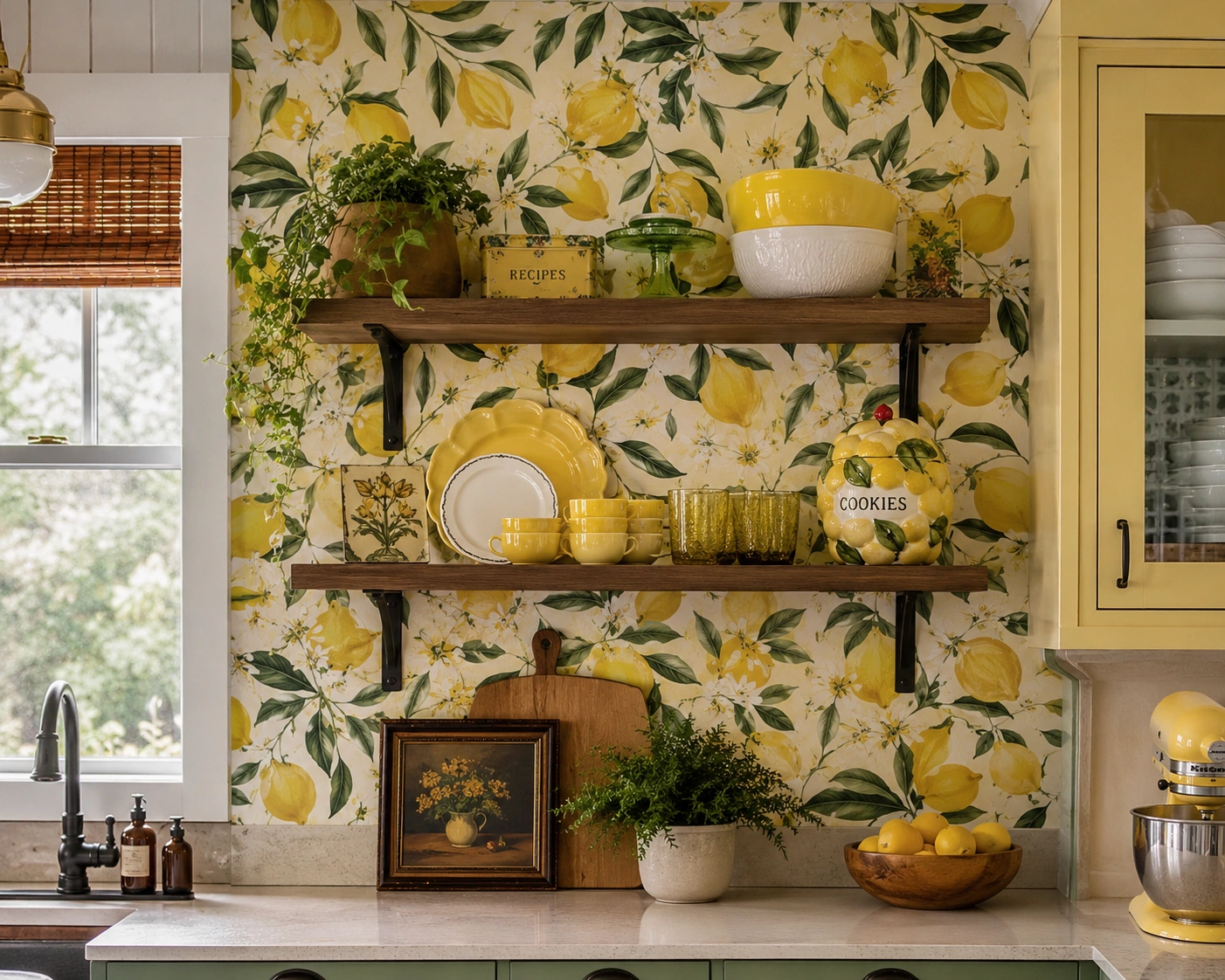
A single wallpapered panel — behind open shelving, on a wall between cabinet banks, or as a full accent wall — creates a rich backdrop without the full-room commitment. Popular kitschy patterns include fruit prints (lemons, strawberries, cherries), retro geometric shapes, vintage floral, and mid-century atomic motifs.
Peel-and-stick wallpaper runs $25–$60 per roll; most single-wall projects need two to four rolls. Chasing Paper, Rifle Paper Co., and Spoonflower carry designs that read genuinely retro rather than the theme-party version of this aesthetic.
10. A Retro Oilcloth Tablecloth or Runner in Checkered or Fruit Print
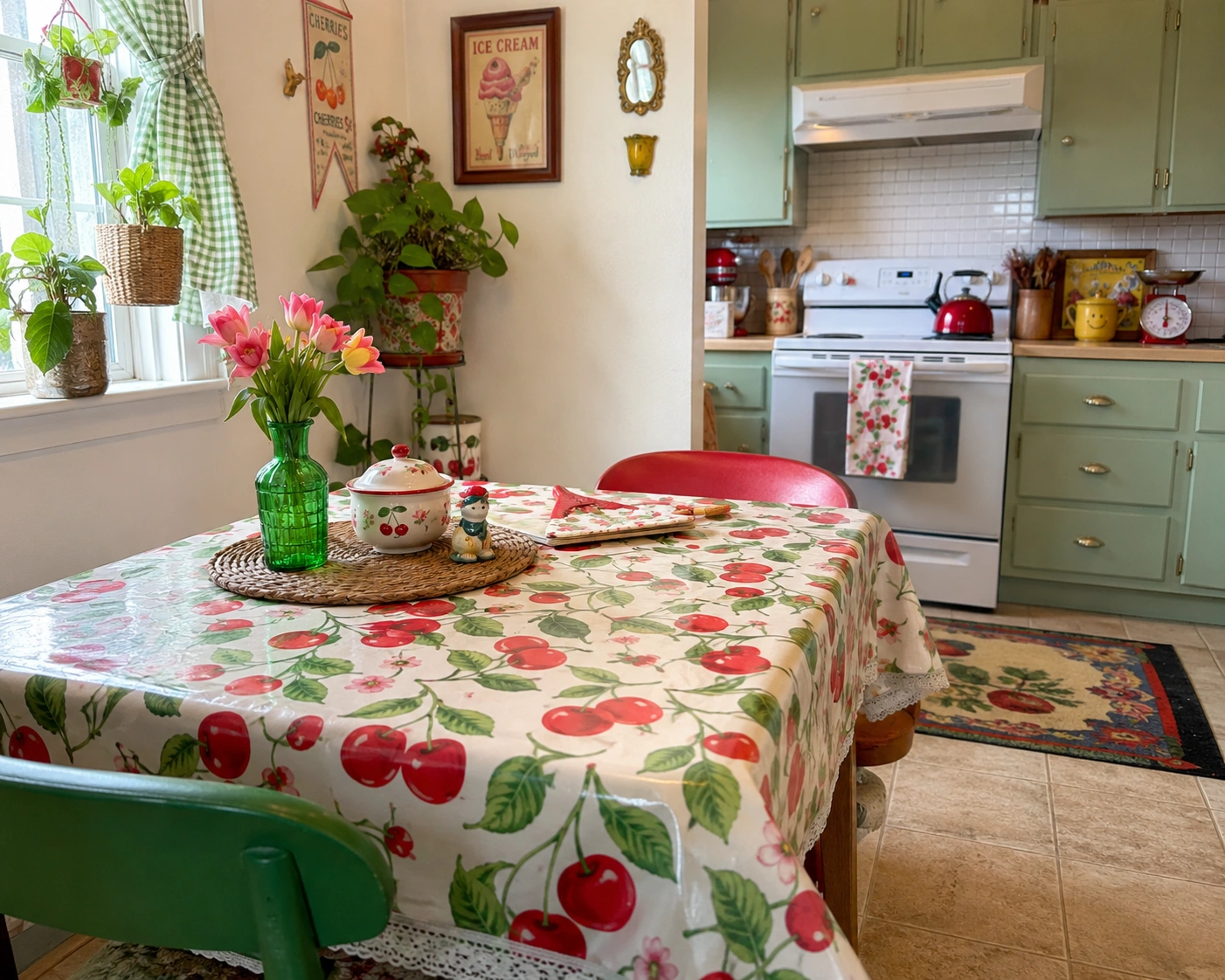
Oilcloth — the wipe-clean coated cotton fabric used in traditional tablecloths and vintage American kitchen covers — is one of the cheapest and most visually immediate ways to introduce kitschy pattern. A checkered or cherry-print tablecloth signals the entire aesthetic in a single object.
Find them at Latin grocery stores ($8–$15 for a full cloth), through Etsy sellers importing from Mexico, or at specialty fabric retailers. Water-resistant, easy to clean, and completely renter-friendly.
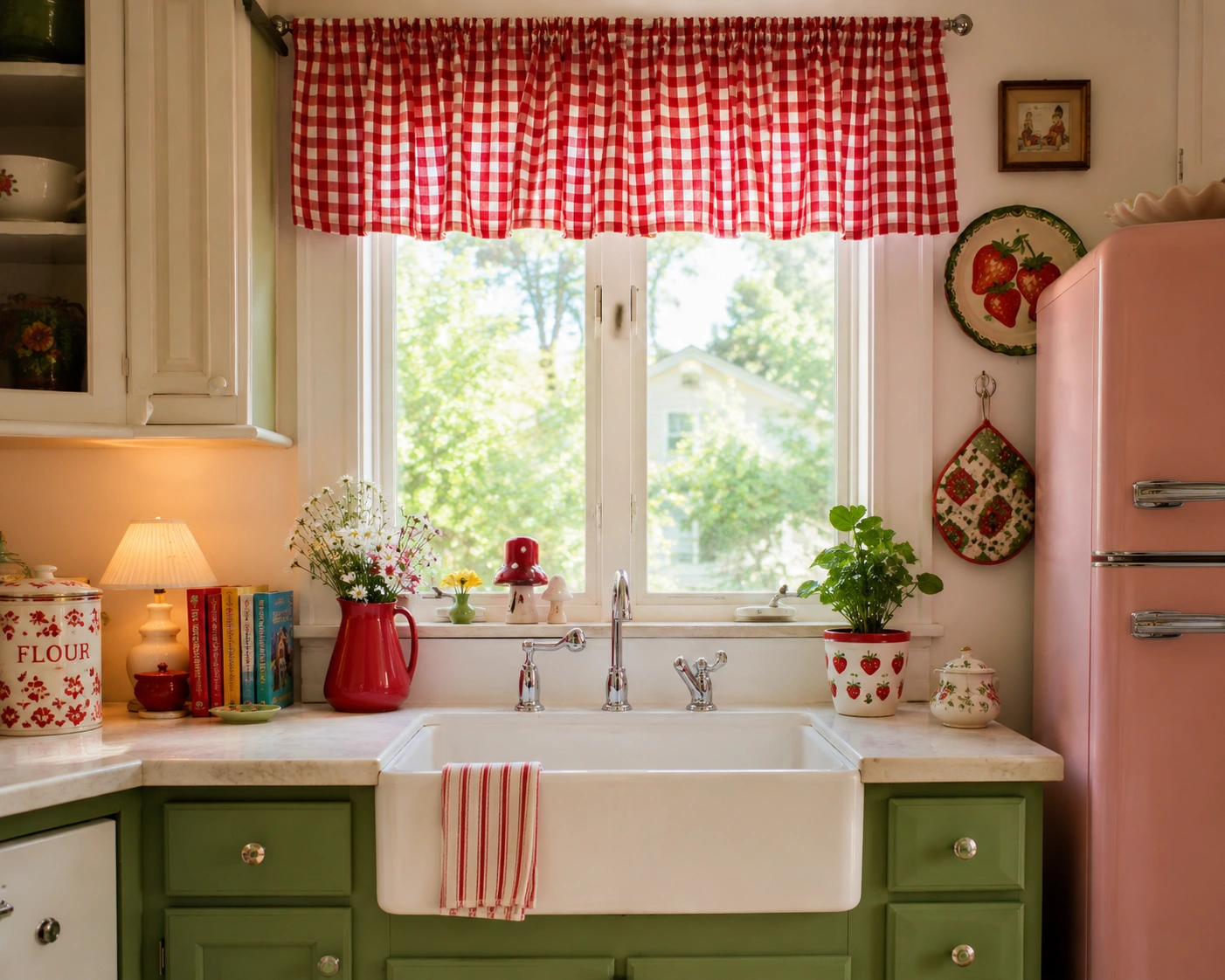
11. Gingham or Fruit-Print Kitchen Curtains
A single gingham valance in cherry red or sunny yellow above a kitchen window punches far above its price point. It’s one of the most underestimated moves in this style.
Strawberry or lemon print cafe curtains are particularly popular in the current kitschy kitchen wave on Pinterest. Cotton and linen-blend options on Etsy or Amazon run $20–$45. They’re easy to hem, easy to hang, and easy to swap seasonally.
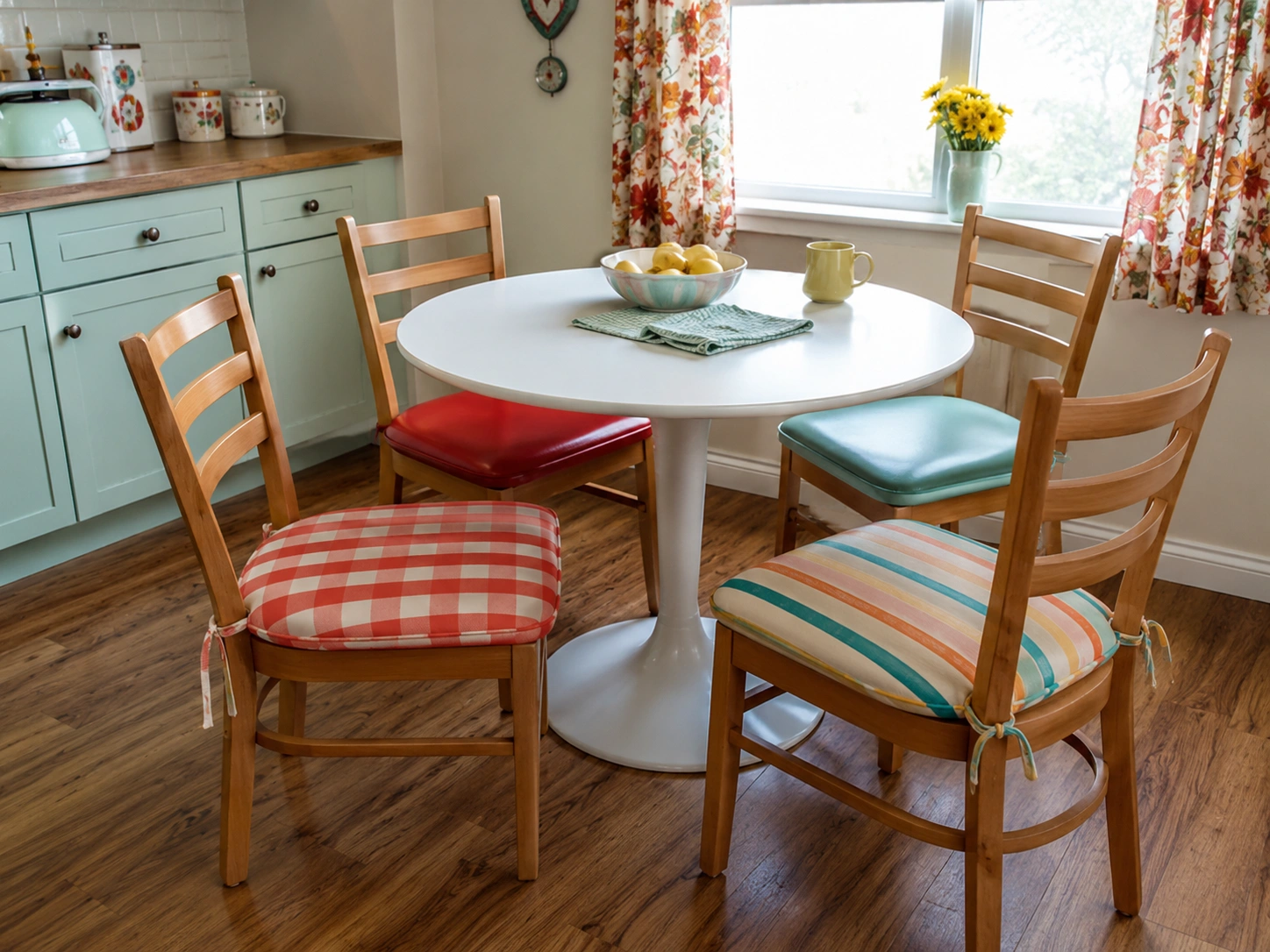
12. Retro-Style Seat Cushions or Chair Slipcovers for Existing Chairs
Plain wooden dining chairs or builder-grade side chairs become kitschy kitchen characters with the right seat cushion. Vinyl-look cushion covers in cherry red or mint green, tie-on cushions in checkered fabric, or full slipcovers in retro stripe patterns all qualify.
Cost: $12–$40 per chair depending on whether you sew your own or buy ready-made. Completely renter-friendly, swappable anytime.
13. Contact Paper Inside Cabinets for a Peek-a-Boo Pattern Moment
Line cabinet interiors with cherry-print, checkered, or vintage floral contact paper. Open a door — and there it is. This sounds minor until guests see it. They always notice, and they always comment on it.
Contact paper runs $8–$25 for a roll covering several cabinet interiors. Cut carefully, apply air-bubble-free using a credit card to smooth each section, and press edges firmly. Fully reversible, fully renter-friendly, and more charming per dollar than almost anything else on this list.
14. A Bold Striped or Checkered Kitchen Runner Rug
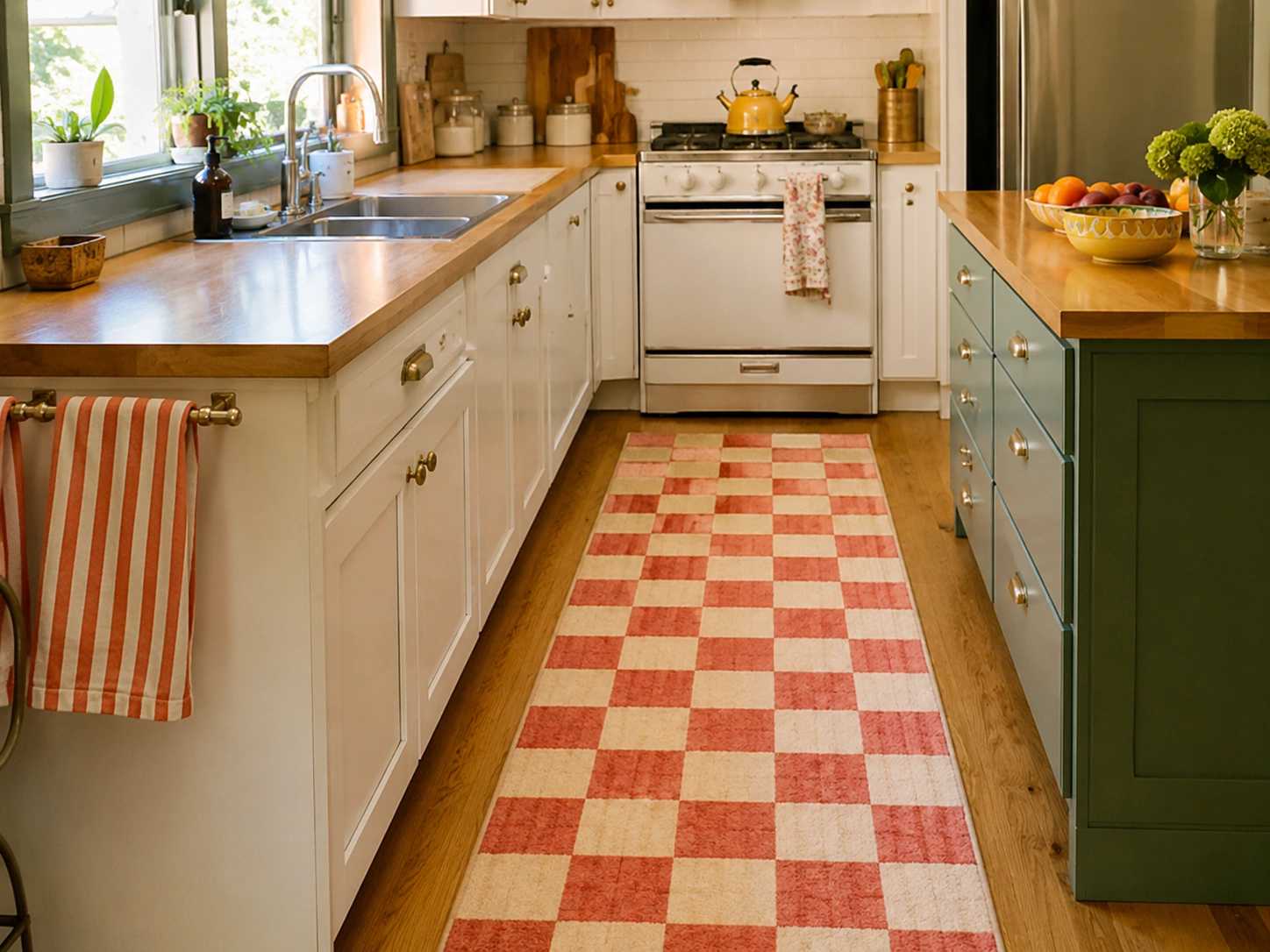
A long runner in the kitchen work zone — between stove and island, or the length of a galley kitchen — introduces pattern underfoot without touching the walls or cabinets. Bold stripe, French ticking, or checkered patterns in cotton or low-pile all read unmistakably kitschy.
Look for machine-washable options from Ruggable or Lorena Canals ($35–$120 depending on length). Portable, renter-friendly, and swappable whenever you want a color refresh.
Retro Appliances and Functional Display
These ideas make everyday kitchen objects earn double duty. The throughline: keep things visible, keep things in color, and display them with enough intention that they read as chosen rather than default.
15. A Colorful Small Appliance Lineup: Toaster, Kettle, and Coffee Maker
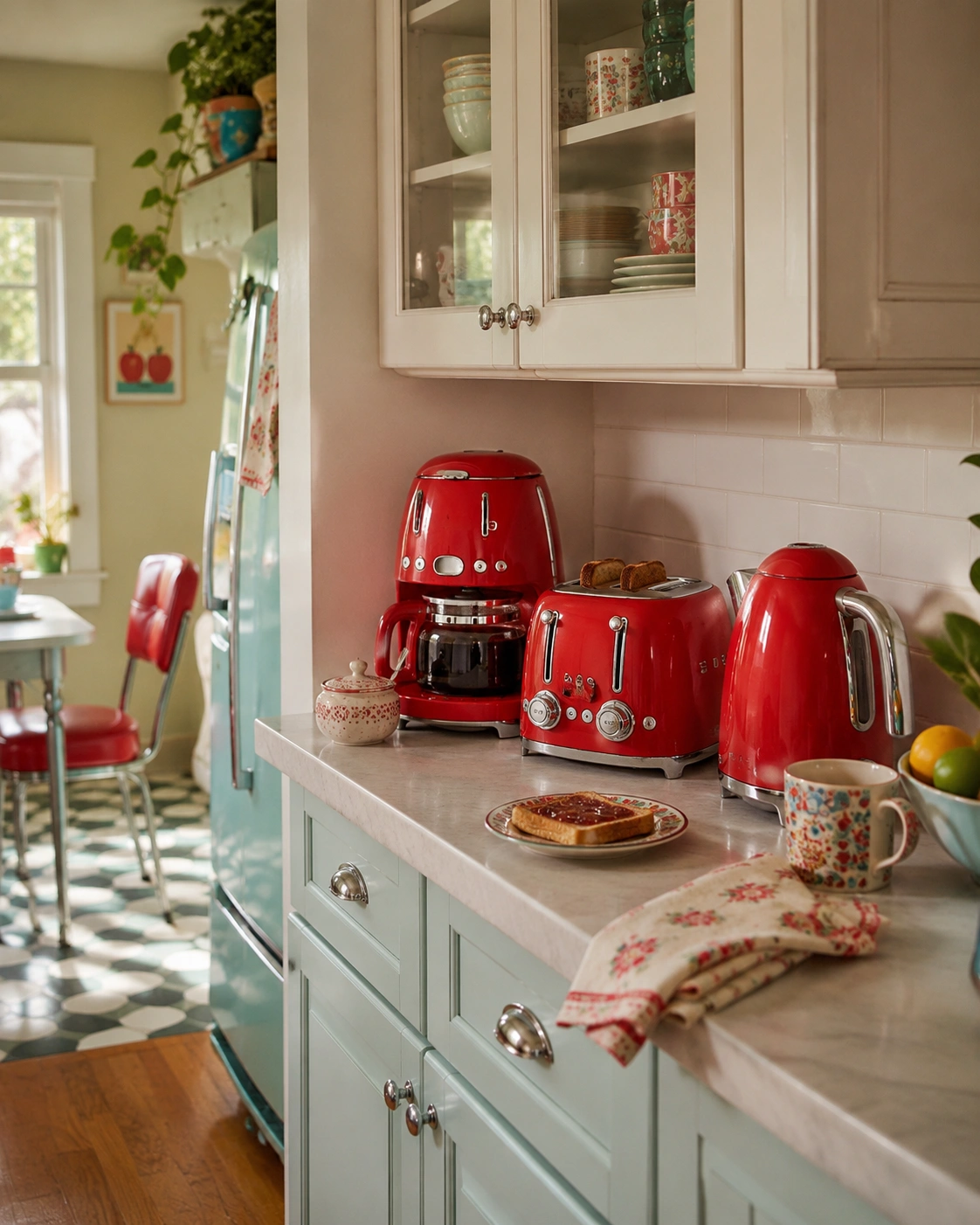
Coordinating small appliances in cherry red, mint green, cobalt blue, or butter yellow creates an instant retro countertop moment. KitchenAid, Smeg, and Cuisinart all offer color-coordinated appliance lines across multiple categories. Galanz provides a genuinely budget-accessible entry into this look for readers who want the aesthetic without the splurge price.
A toaster-and-kettle set in cherry red runs roughly $60–$120 at the entry level. It’s among the easiest starter moves in the entire kitschy kitchen playbook — fully portable, zero installation required.
16. Colorful Dutch Oven or Enamel Cookware Displayed on the Stove
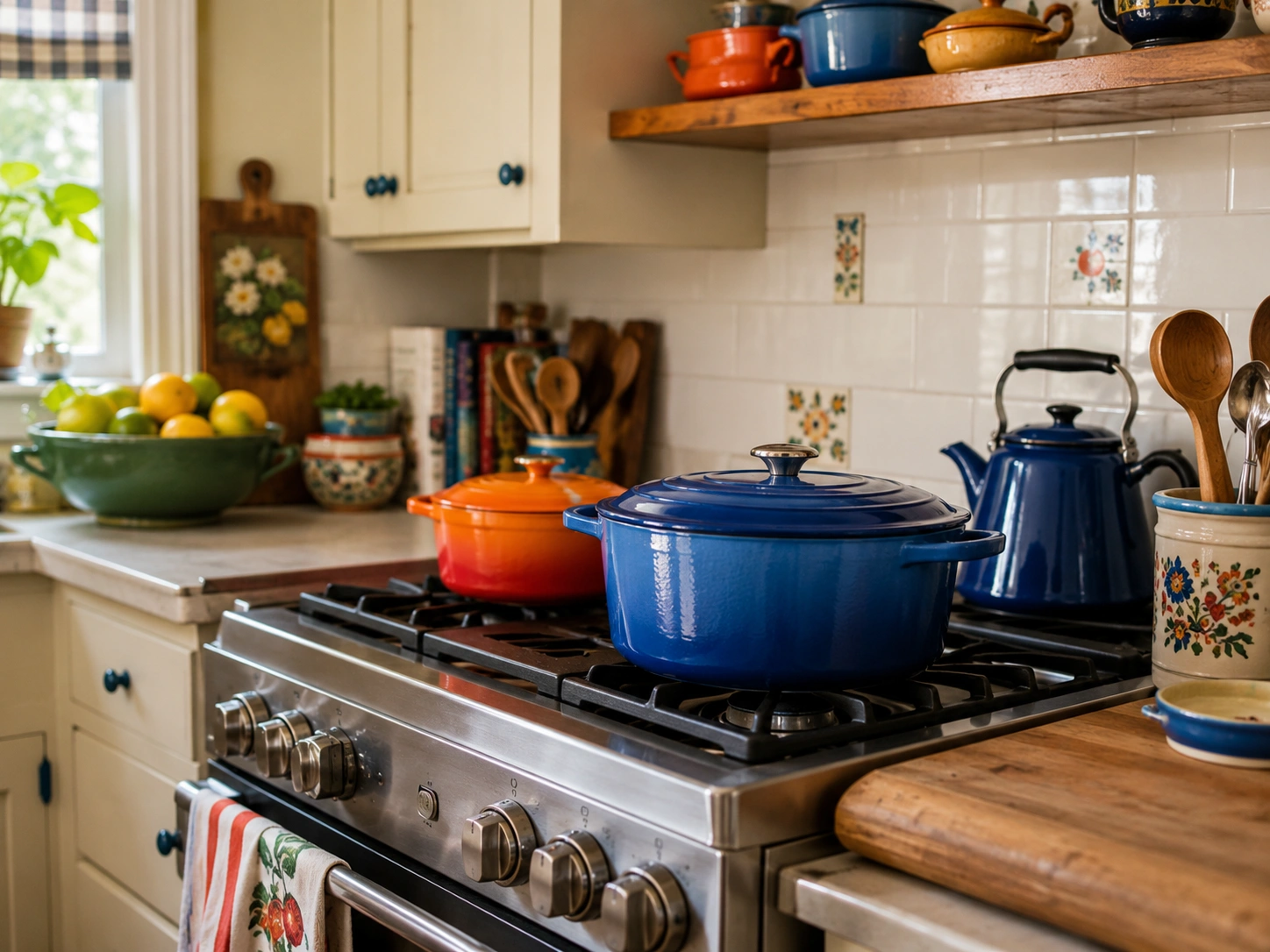
A Le Creuset in Marseille blue sitting on a stovetop burner isn’t just functional — it’s a statement. The same principle applies to Lodge enamel cast iron in Island Spice or Flame, or a thrifted Descoware piece in excellent original condition.
Splurge: Le Creuset 5.5 qt Dutch oven, approximately $380. Mid-range: Lodge enamel cast iron, $60–$80. Budget: a thrifted Descoware or Cousances piece in good condition, $15–$40 at estate sales.
17. A Retro KitchenAid Stand Mixer as a Countertop Color Moment
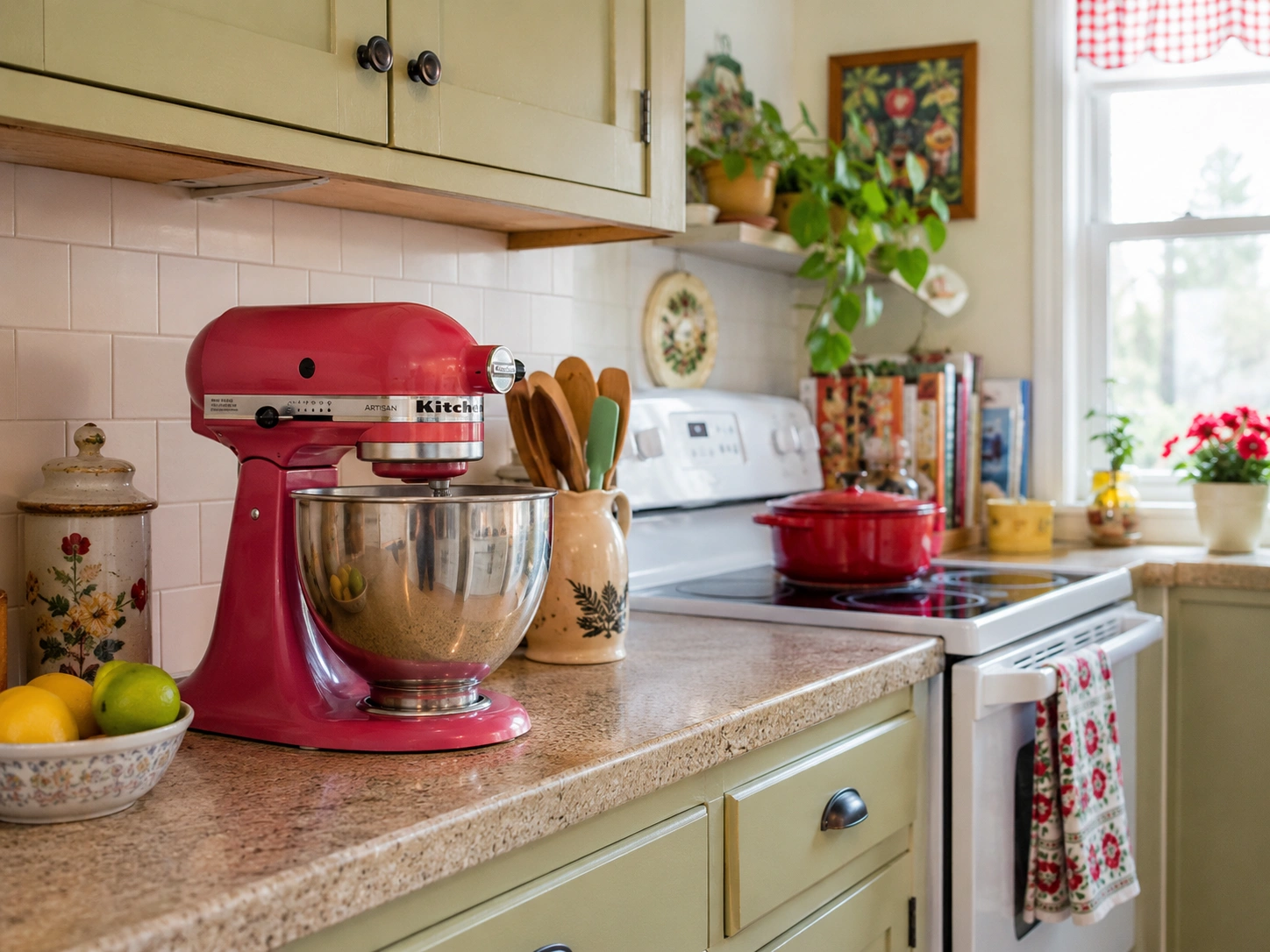
KitchenAid Artisan stand mixers have been sold in over 100 colors and limited-edition finishes since the 1990s. Displayed on the counter in Hibiscus, Petal Pink, Pistachio, or Candy Apple Red, a stand mixer functions as a significant decorative anchor — and it bakes, too.
New: $400–$500. KitchenAid’s certified refurbished program: $150–$250. Older models in popular colors on eBay: $100–$200 in reliable condition.
18. Mismatched Vintage Mugs and Colorful Glassware on Open Display
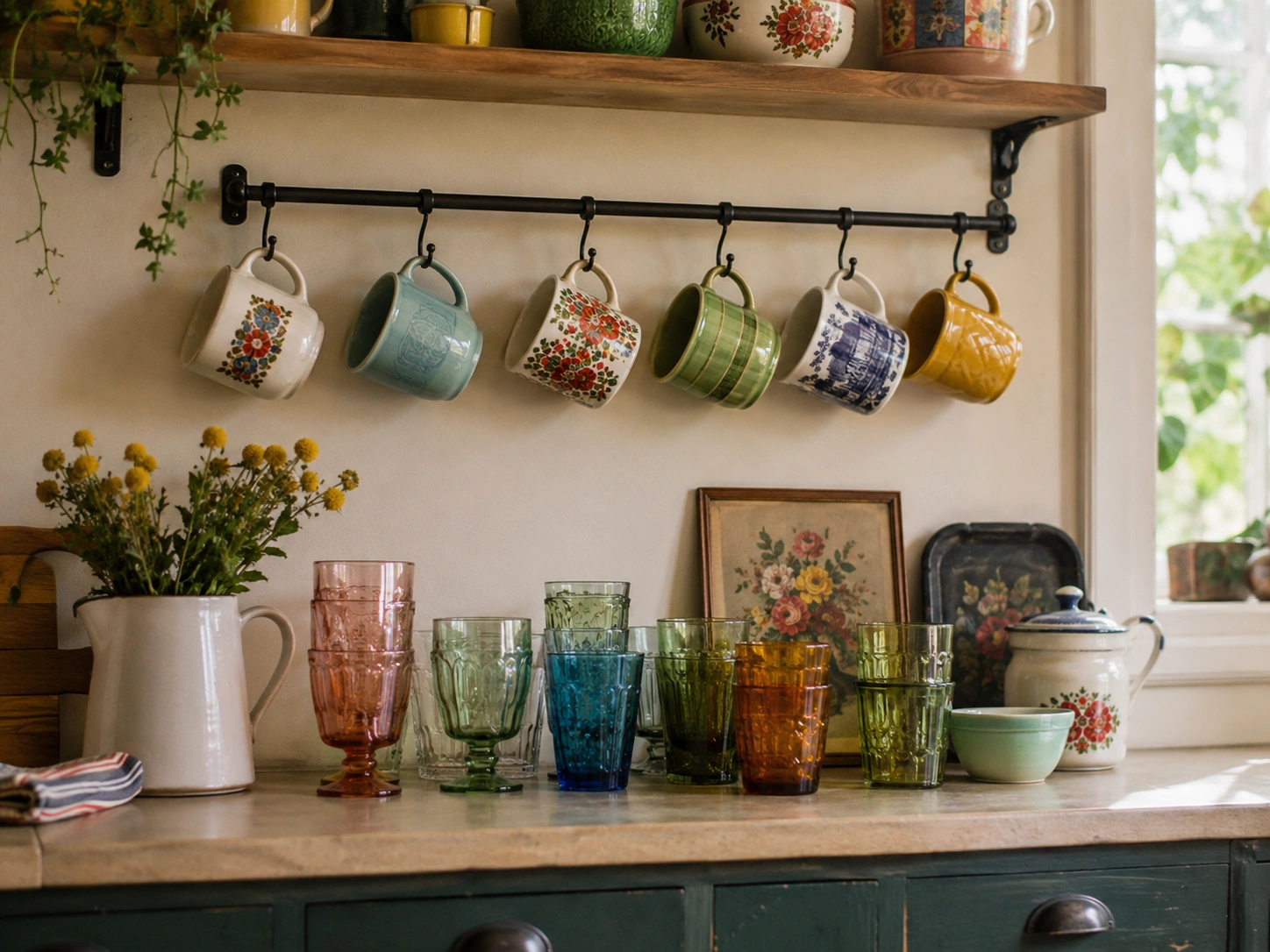
A simple hook rail with six vintage mugs — each a different pattern — reads warm, personal, and unmistakably kitschy. Form unity, surface variety: they’re all mugs, but no two match. That contrast is what makes the display read curated rather than random.
Cost: $0–$30 sourced almost entirely from thrift shops, estate sales, or garage sales. Depression glass tumblers, Fiesta mugs, or novelty souvenir mugs in varied patterns all qualify.
19. A Colorful Herb Garden in Painted or Patterned Ceramic Pots
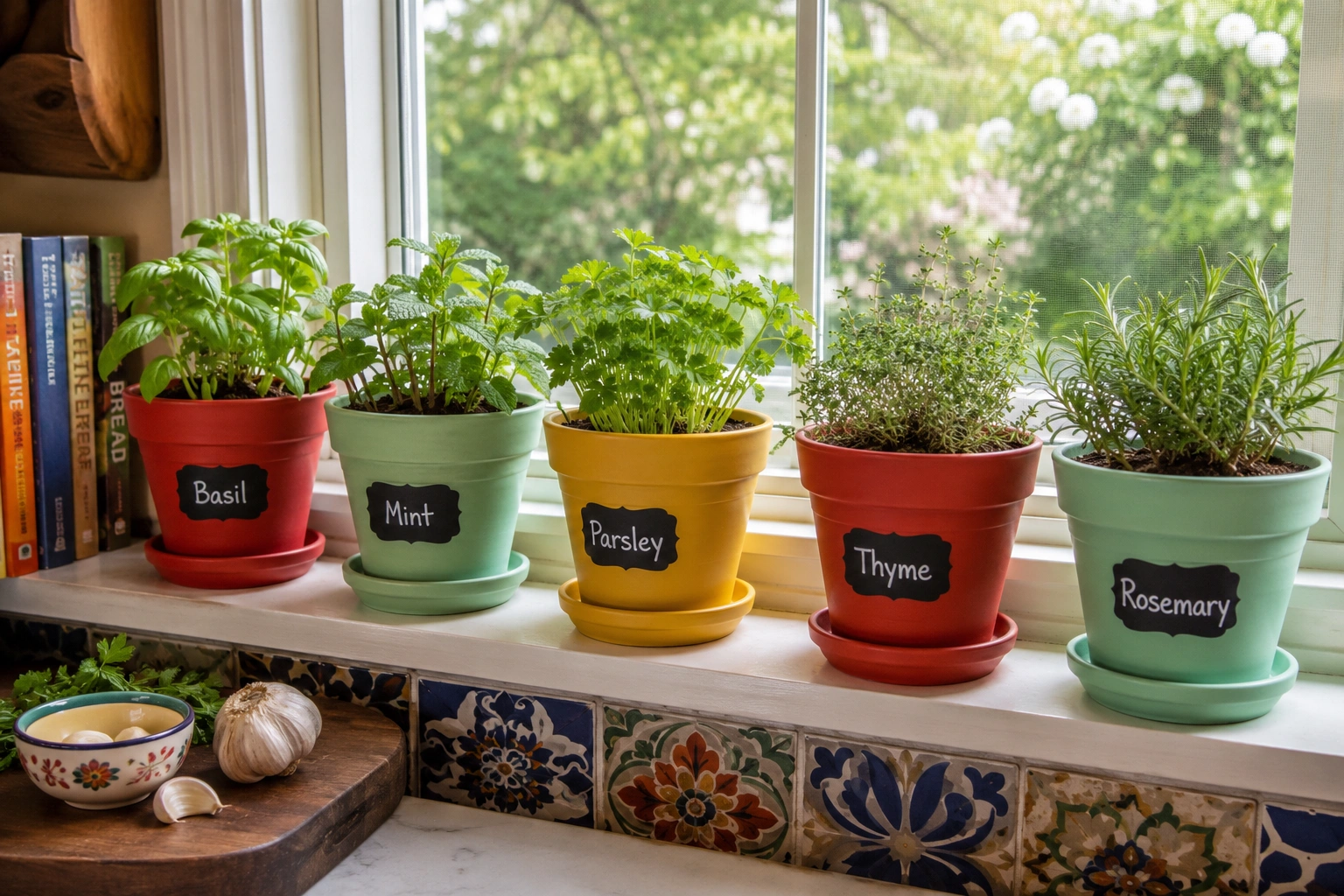
A small collection of coordinating pots — painted in bold chalk paint or featuring kitschy ceramic patterns — on a kitchen windowsill or small shelf brings living color and practical function into the room simultaneously.
Use plain terra cotta pots painted with chalk paint (a $4 can covers six small pots) or shop for ceramic herb pots with lemon, tomato, or geometric patterns from Etsy or HomeGoods. One practical note: this only works long-term if the herbs actually receive enough natural light. Don’t place it purely for the visual and expect the plants to survive.
20. Funky Fridge Magnets and a Magnetic Memo Board
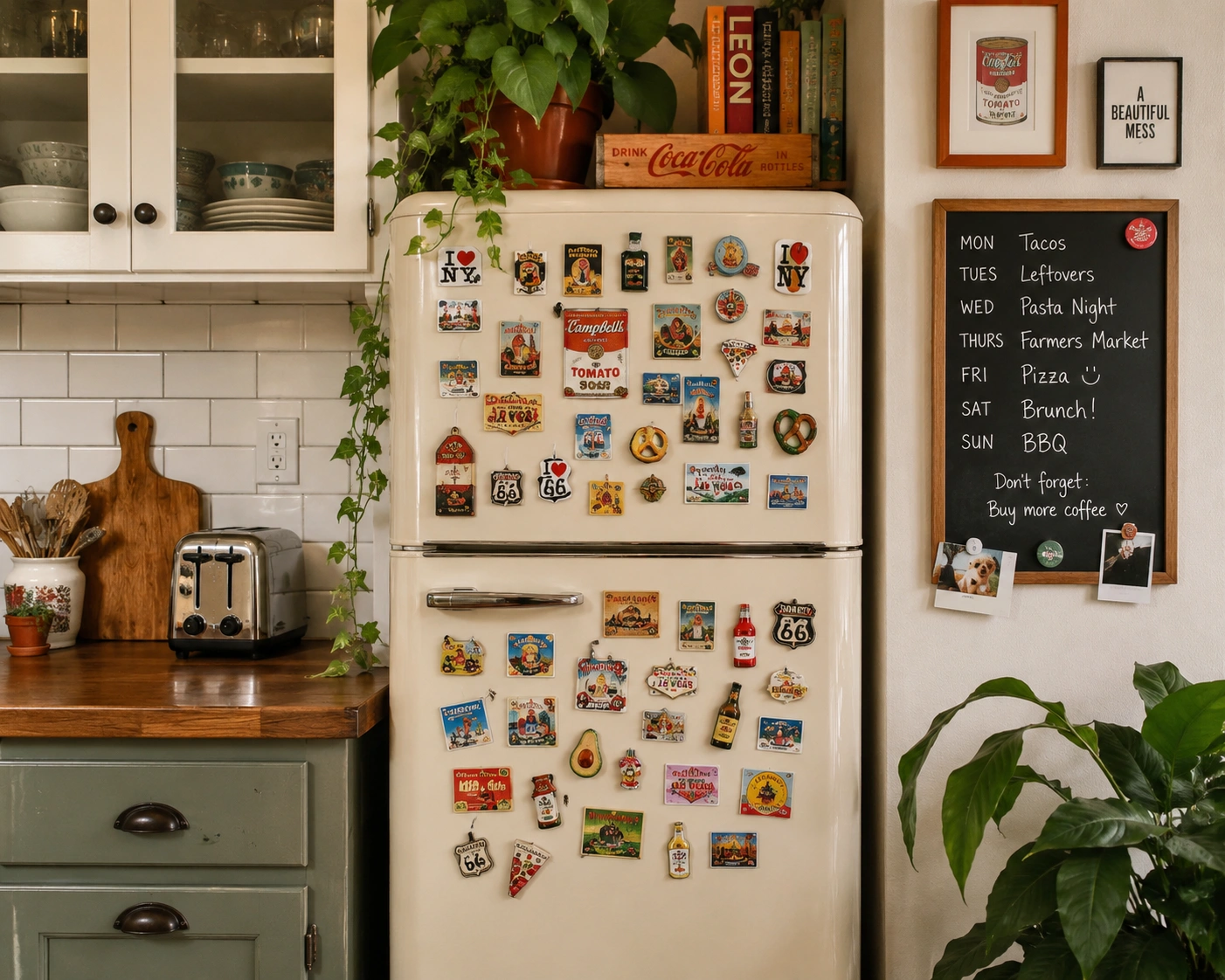
The lowest-effort, highest personality-per-dollar move on this entire list. Vintage souvenir magnets, enamel pin-style magnets, and retro food illustration magnet sets cost almost nothing individually and collectively tell the story of a life actually lived.
Thrift shops: $0.25–$1 per magnet. Etsy enamel-style magnets: $4–$10 each. Retro food illustration magnet packs on Amazon: $8–$15. Adding a small magnetic chalkboard or memo board beside the fridge extends the personality into the surrounding wall space without requiring additional counter space.
Small Details With Big Personality: The Finishing Layer
These ideas work as the final layer on top of bigger moves — or alone in a neutral kitchen that just needs a handful of specific personality markers to stop reading as a showroom. Small doesn’t mean low-impact here.
21. Bold Kitschy Cabinet Hardware: Fruit Knobs, Cherry Pulls, Mushroom Handles
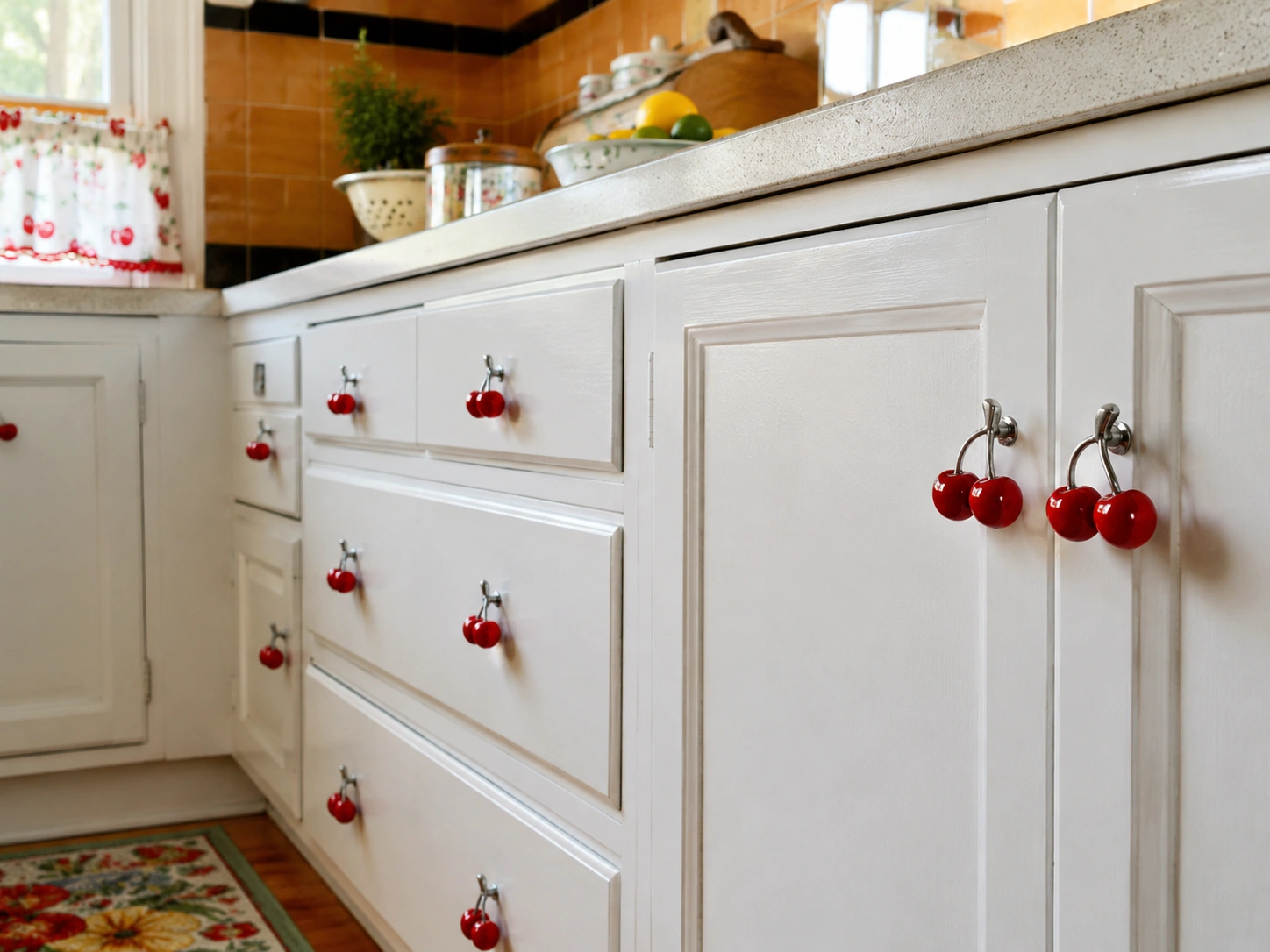
Cabinet hardware is the jewelry of a kitchen, and swapping it is the highest impact-to-effort ratio move on this entire list. Replacing standard brushed nickel knobs with ceramic cherry knobs, enamel mushroom pulls, or hand-painted fruit handles costs $3–$12 per piece and takes fifteen minutes per knob with a basic screwdriver.
A full set of twenty cherry red ceramic knobs across a white-cabinet kitchen runs under $80 total and changes the entire character of the space. No paint. No installation. Just a screwdriver and an afternoon.
22. A Vintage Cookie Jar Collection on the Countertop
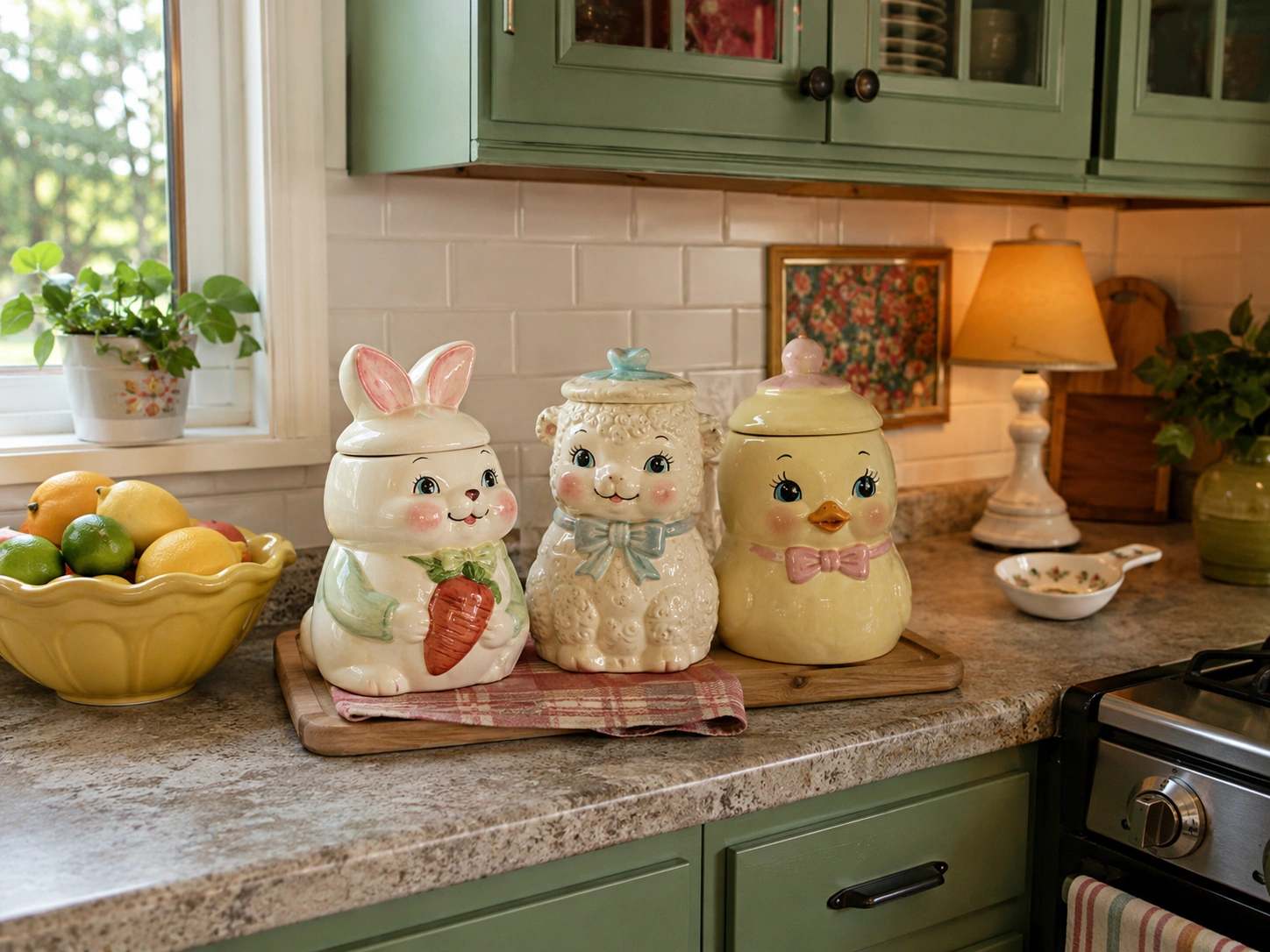
Three vintage cookie jars — different characters, related color family — make a strong display statement without requiring much counter space. McCoy ceramic character jars, Pottery Americana designs, and Metlox figures are the classics of this genre. You don’t need rare or expensive pieces; any visually interesting vintage ceramic jar in good condition qualifies.
Find them at thrift stores ($4–$20 each), Etsy ($15–$60 for popular styles), or estate sales. Group them on a small wooden tray or folded kitchen towel for display cohesion.
23. A Vintage Salt and Pepper Shaker Collection Displayed on a Tray
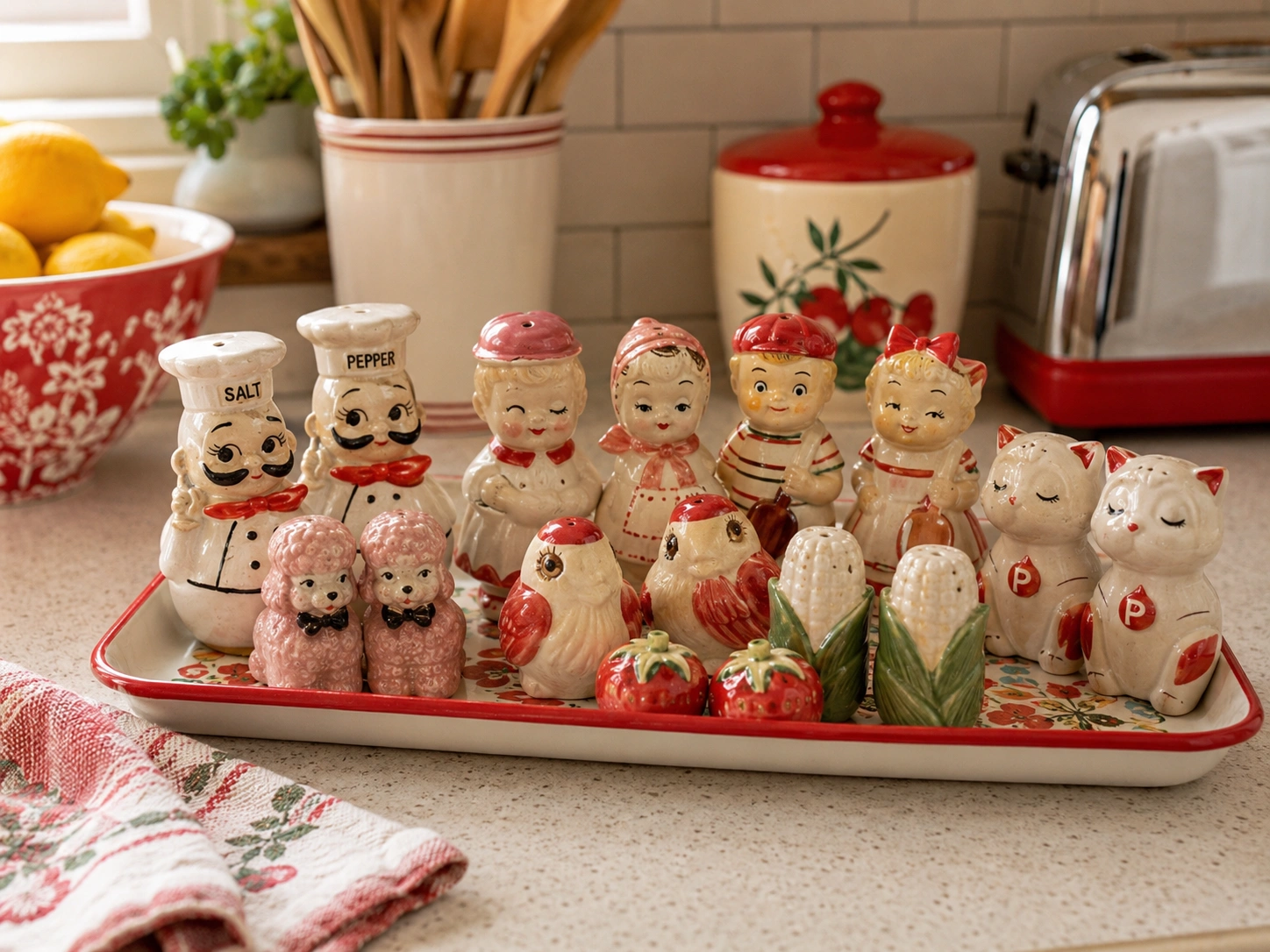
Novelty figural salt and pepper shaker sets — vegetables, animals, retro kitchen characters, Mid-century couples — are among the most collected pieces of kitschy kitchenalia. A small tray holding six to twelve sets creates a charming, low-effort countertop display that reads as genuinely personal.
Available at virtually every thrift store for $0.50–$4 a set. The visual goal is quantity and variety unified by color theme or subject matter — twelve sets in red-and-white tones reads curated; twelve completely random sets reads like a flea market table.
24. A Kitschy Kitchen Gallery Wall: Retro Ads, Fruit Art, and Diner Menus
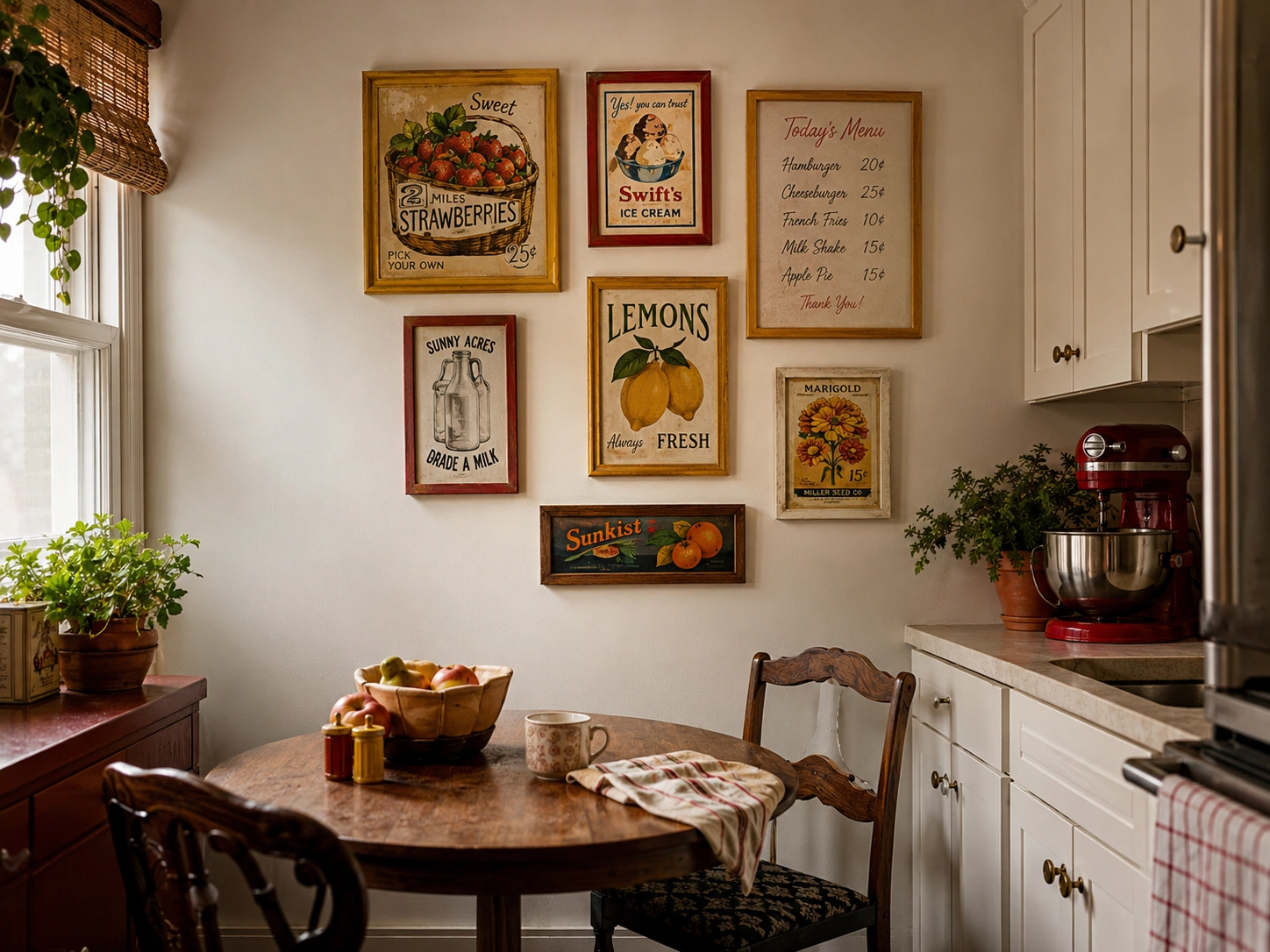
Five to seven frames in coordinating sizes — filled with vintage food advertisements, 1950s grocery product illustrations, antique seed packet art, or retro diner-style menu prints — creates a rich, personality-driven backdrop above a dining area or in the gap between cabinet banks.
Etsy digital print sellers ($2–$8 per print, printed at home), thrifted vintage frames repainted in coordinating colors, or Dollar Tree frames given a quick coat of spray paint. Total budget for a seven-piece wall: $25–$60.
25. A Novelty Retro Clock: Rooster, Cherry, or Sunburst Style
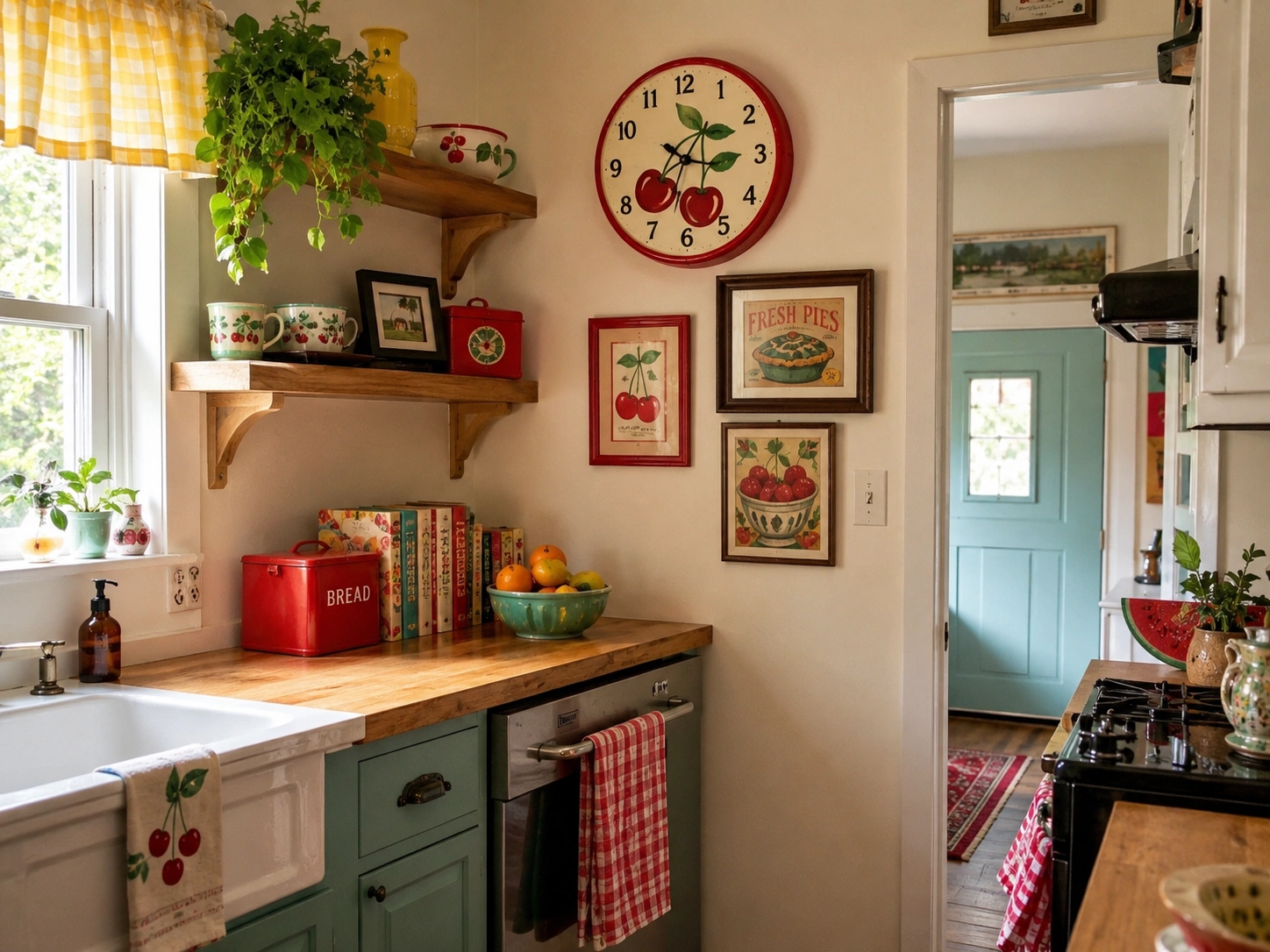
Wall clocks get overlooked in kitchen decor planning almost entirely. A starburst sunburst clock in gold, a ceramic rooster clock, or a cherry-motif round clock costs $25–$60 new and adds a single eye-catching vertical element that signals the retro aesthetic immediately.
Vintage clocks at thrift stores: $5–$20, often in better condition than reproductions. Cluster a clock near a gallery wall or above a shelf vignette — an isolated clock looks like an afterthought; a clock as part of a visual grouping looks intentional.
26. A Retro Neon or LED Sign with a Kitchen Phrase
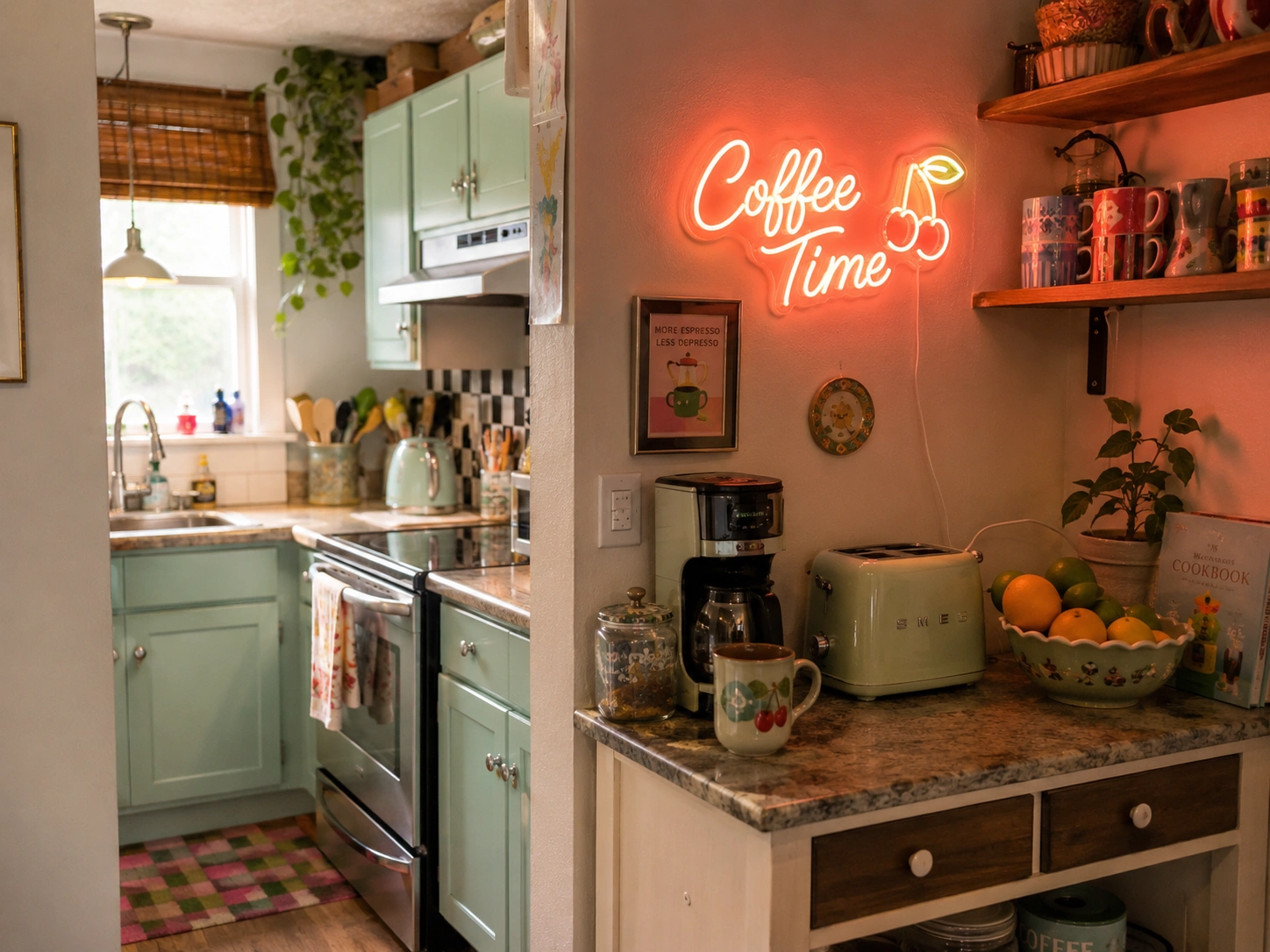
A small LED neon sign — “Eat,” “Coffee Time,” a cherry illustration, or a playful kitchen phrase — costs $30–$90 and adds warm-toned colored light alongside its visual character. It’s functional lighting and decor simultaneously.
LED neon signs (flexible, low-heat alternatives to traditional glass neon) are safe near kitchen surfaces and widely available on Amazon, Etsy, and Urban Outfitters. They’re renter-friendly — most mount with a single nail or a heavy-duty adhesive strip.
27. Novelty Kitchen Textiles: Mushroom Dish Towels, Diner Aprons, and Fruit Napkins
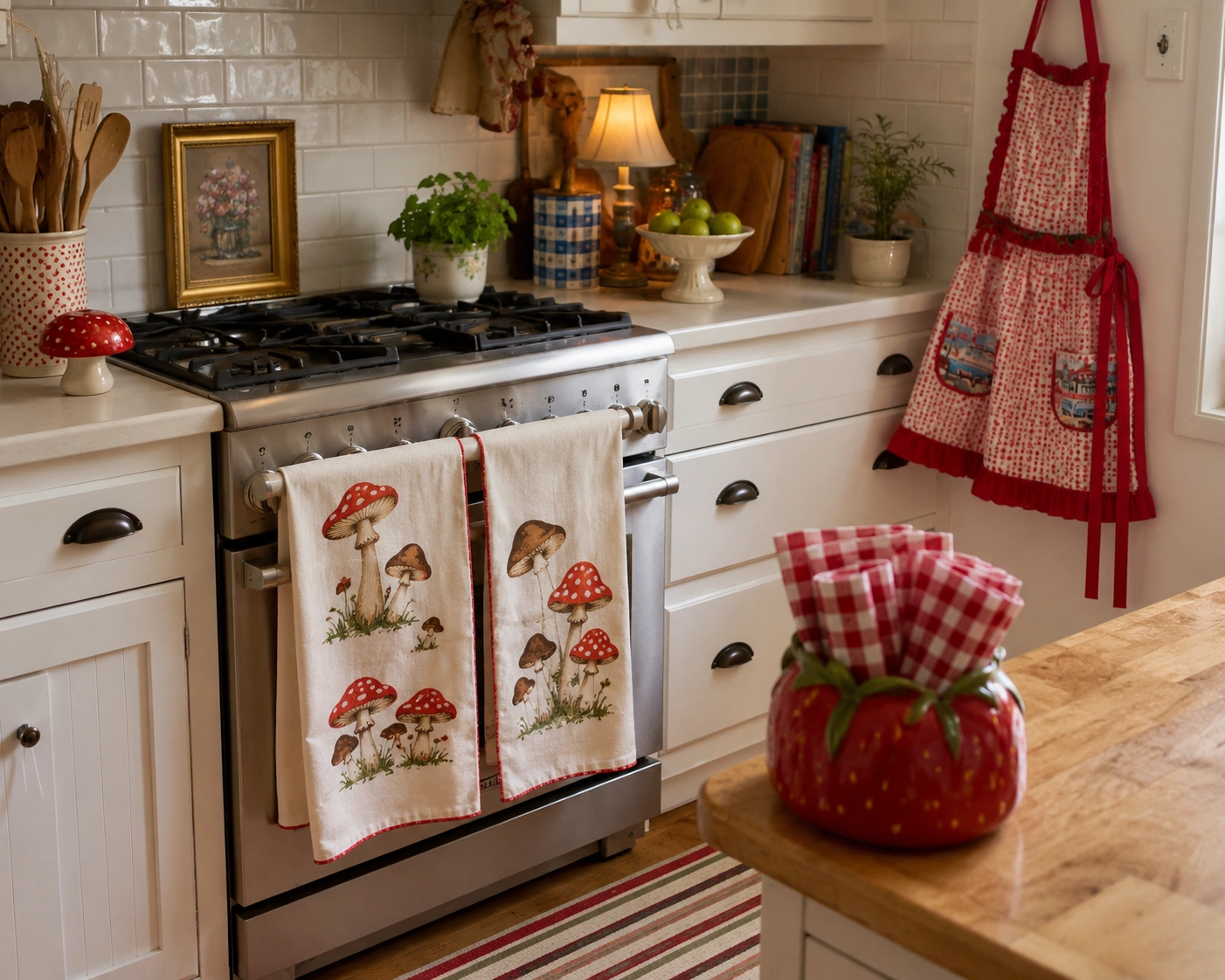
Dish towels, aprons, and napkins are the most-replaced objects in any kitchen — and the least likely to be treated as decor opportunities. A set of mushroom-print linen tea towels, a red-and-white retro diner apron, or gingham napkins folded in a ceramic holder adds layered textile pattern throughout the room at almost zero cost.
Budget: $10–$40 total. Sources: Etsy independent textile sellers, Anthropologie, and World Market carry the most consistently kitschy options.
5 Kitschy Kitchen Questions, Answered Directly
What’s the cheapest way to start a kitschy kitchen look?
Swap the cabinet hardware. Novelty ceramic knobs cost $3–$12 per piece. Under $80 total, you can change the entire character of a kitchen — no paint, no tools beyond a screwdriver.
How do I make it look intentional instead of cluttered?
Pick one anchor color and repeat it in at least three separate places. Color repetition is what makes maximalism read as curated rather than chaotic. The objects can vary; the color thread should hold.
Should I go fully kitschy or keep it mixed with neutral?
Start neutral. Most successful kitschy kitchens on Pinterest run about 60% neutral base — white or off-white cabinets, clean countertops — with bold personality layered on top. Going 100% bold everywhere usually reads as overwhelming rather than joyful.
When is a Galanz worth it versus investing in a Smeg?
If the fridge is your primary color anchor and you plan to stay in the home for five or more years, Smeg or Big Chill is worth the investment. If you’re renting, moving within two years, or still testing whether the aesthetic is right for you, Galanz delivers most of the visual at roughly 20% of the price.
Why does my kitschy kitchen still look cheap even though I followed ideas online?
Usually it’s a framing problem, not a budget problem. Objects floating alone in empty space look accidental. Those same objects grouped on a tray, a small shelf, or a wall cluster look intentional. Context creates the difference between decor and clutter — and context costs nothing.
Putting It All Together
A kitschy kitchen doesn’t require a renovation, a design degree, or a large budget. What it requires is a point of view: one color that repeats through at least three objects, one pattern that anchors the floor or a wall, and a handful of pieces chosen because they’re specific and genuinely charming — not because they were the safest option at Target.
Start with one idea from this list. Add a second the following month. This look builds over time, and that’s actually part of its appeal. Collected spaces never look completely finished all at once, and that’s exactly what makes them feel genuinely lived-in rather than staged for a camera.


No Comment! Be the first one.