




23 Real Kitchens With Black Granite Countertops That Actually Look High End
If you’ve been saving photos of kitchens with black granite countertops and quietly wondering why yours looks moody instead of magazine-worthy, you’re not imagining it. The stone was...

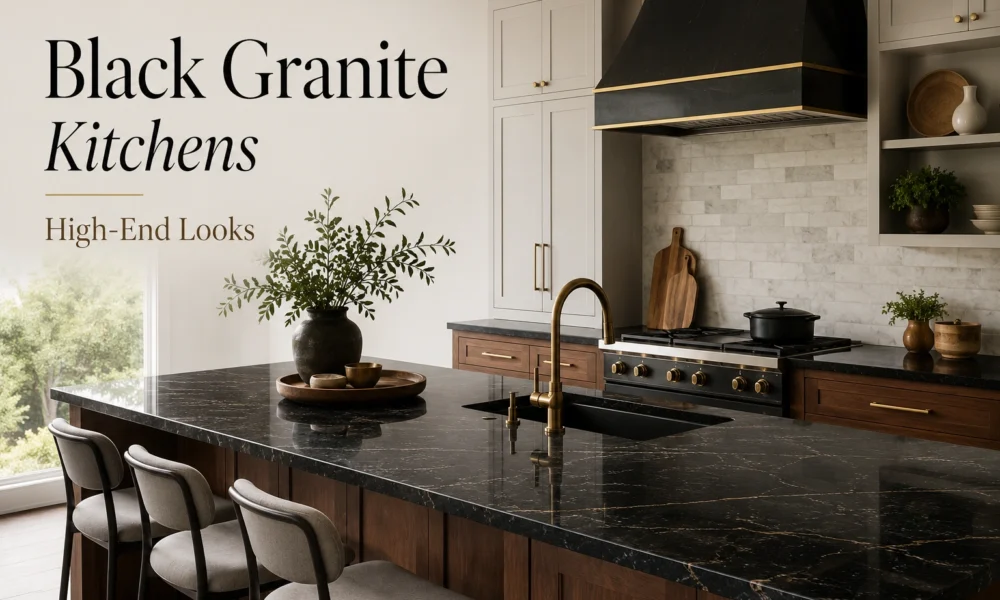
If you’ve been saving photos of kitchens with black granite countertops and quietly wondering why yours looks moody instead of magazine-worthy, you’re not imagining it. The stone was never the issue — the cabinets, hardware, and light temperature around it usually are. This works best for homeowners planning a partial refresh: new cabinet color, new hardware, new lighting, while keeping existing granite. It won’t help if your granite is chipped, dull, or needs to be replaced outright — that’s a different project. Below are 23 full styled scenes, not just swatch pairings, each built around one specific detail responsible for the “expensive” feeling.
Kitchens with black granite countertops refers to kitchen designs built around a dark, natural stone counter — typically Absolute Black, Black Pearl, or a similarly deep-toned granite — paired with cabinetry, lighting, and hardware chosen to balance its visual weight. The stone isn’t the styling problem. The pairing around it usually is.
What Makes Black Granite Countertops Look Expensive Instead of Heavy
Here’s the part most cabinet-color charts skip: black granite reads expensive when the room has visible material contrast and warm light, and it reads heavy when everything around it is flat, cool-toned, or glossy in the same way the stone is. Pacific Shore Stones reported NKBA data showing natural quartzite led material choice for both countertops (62%) and full-height backsplashes (61%) in 2026, alongside a 59% designer preference for natural wood-grain cabinets over painted finishes. Pacific Shore Stones NKBA 2026 report proves natural, textured materials are outperforming flat, uniform surfaces which tells you something useful: homeowners aren’t rejecting drama, they’re rejecting flatness. A busy, natural-patterned black granite actually has an advantage over a dead-flat black surface, because it already has the visual texture designers are chasing.
My honest, counter-intuitive read: swapping black granite for a “safer” light quartz doesn’t automatically fix a heavy kitchen. Plenty of glossy white-quartz kitchens still feel cold and showroom-flat because the lighting and hardware never got addressed. The stone color was never the whole story.
One caveat worth knowing before you fall in love with a leathered or honed finish: matte black granite shows water spots, oil, and fingerprints more visibly than a polished surface, and it needs resealing on a slightly more careful schedule. It’s a gorgeous finish, but not a low-maintenance one.
Some designers will tell you black granite is simply dated and should be replaced. That’s a fair take if the stone is glossy, uniform, and sitting under cool white lighting with matching black hardware and no wood in sight — that specific combination does feel like an early-2010s showroom. But swap in warm lighting, one natural material, and a hardware finish that doesn’t match the counter exactly, and the same stone reads current again.
23 Kitchen Scenes With Black Granite Countertops You Can Actually Recreate
1. Swap Builder-Grade Pulls for Warm Brass Bar Handles So the Granite Reads Rich, Not Heavy
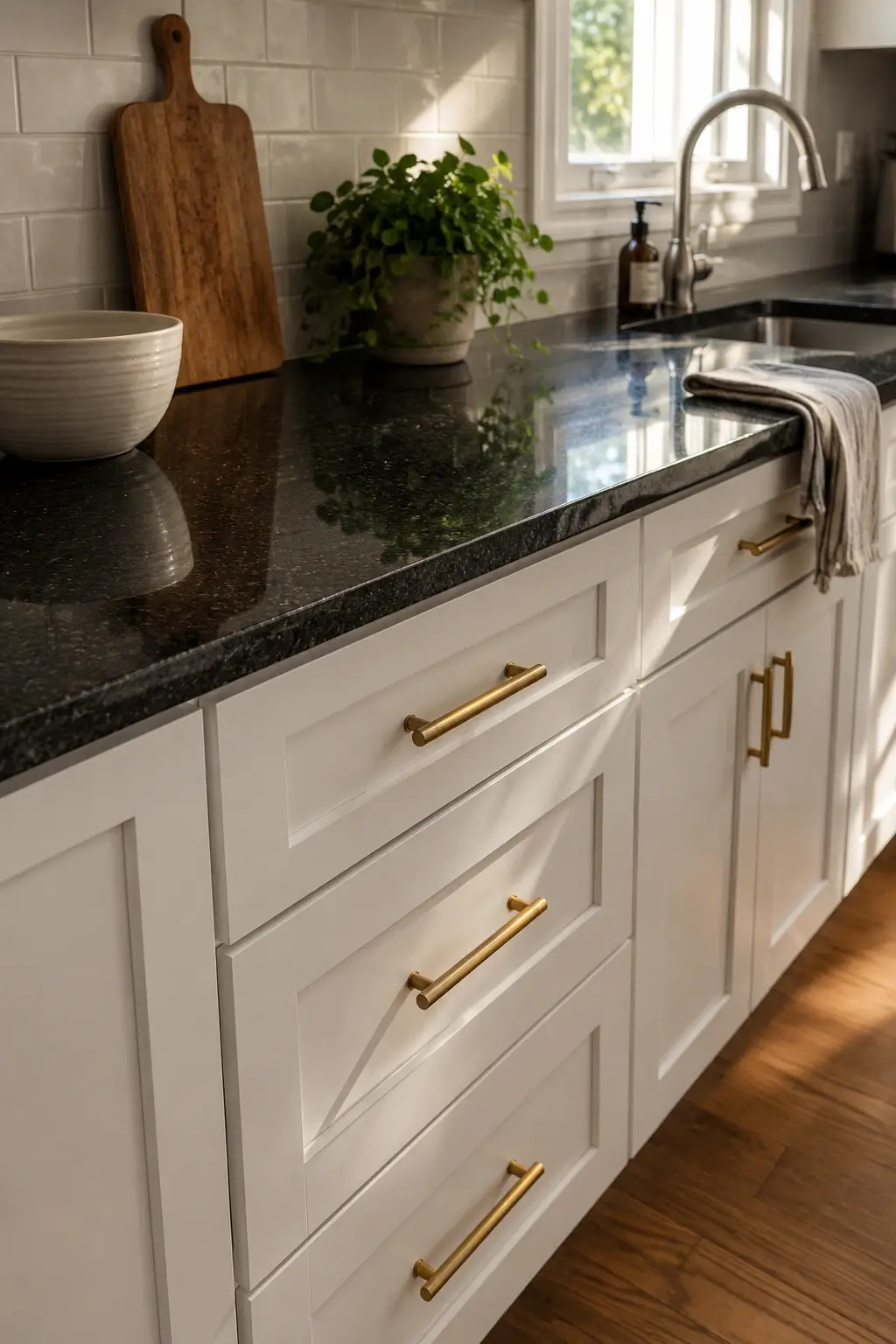
If your cabinets already came with cheap brushed-nickel or plastic pulls, that’s often the actual source of the “dated” feeling, not the counter. Swap them for warm, slightly aged brass bar pulls — no cabinet paint required, no contractor needed. The warmth in the metal pulls the eye away from the cool black stone and makes the whole run feel intentional. My read is this is the single highest-return, lowest-effort fix on this entire list, and it’s fully renter-reversible if you keep the old hardware in a drawer.
2. Paint the Perimeter Cabinets Chantilly Lace So a Leathered Black Granite Island Takes the Spotlight
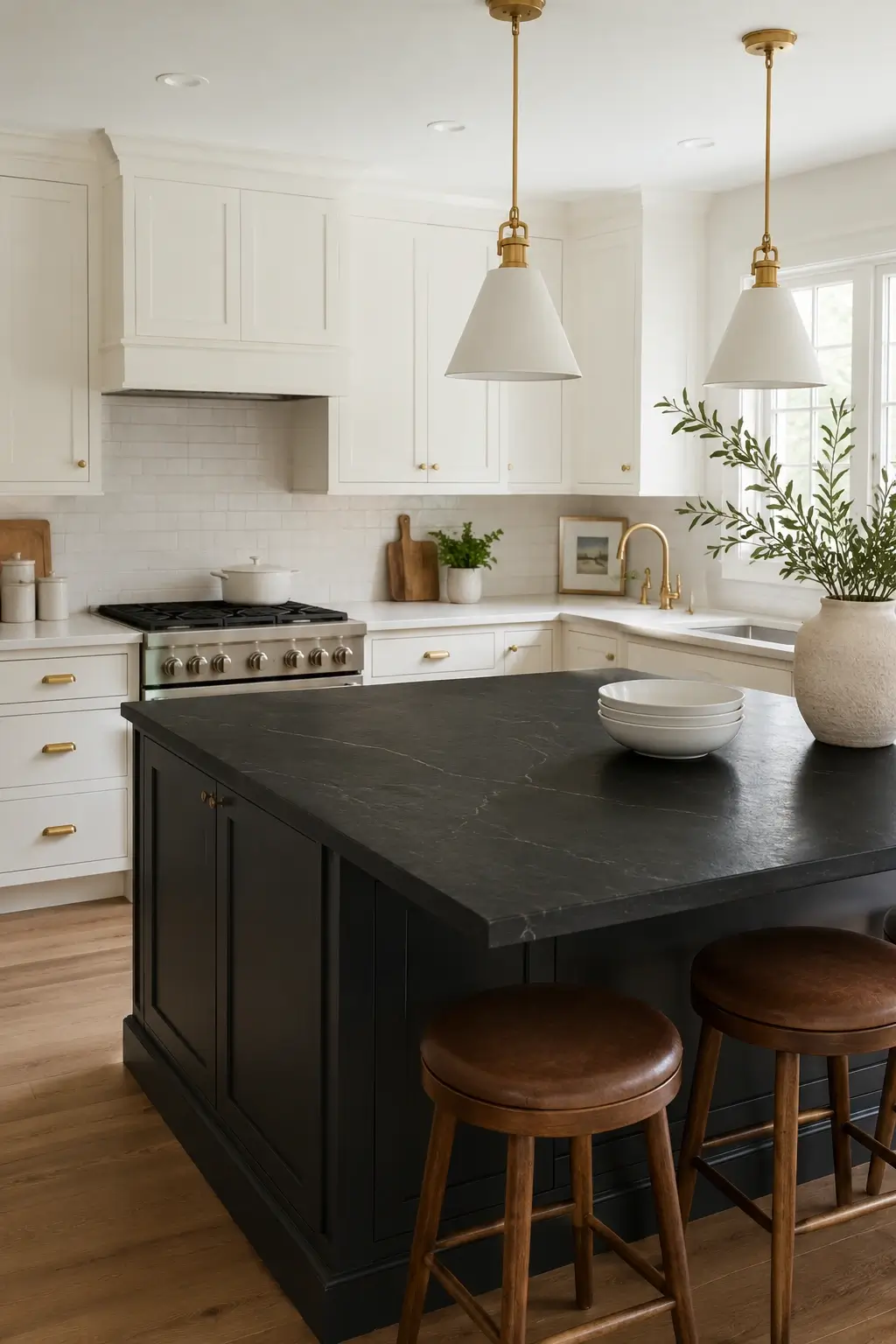
A crisp white like Benjamin Moore Chantilly Lace on the perimeter cabinets does something specific: it pushes all the visual weight toward the island, so a leathered black granite top there reads as a deliberate focal point instead of just “the dark counter.” The leathered texture catches light unevenly instead of throwing a hard glare, which softens the whole scene. Pair it with a single pendant cluster and the island starts to feel like the room’s centerpiece rather than its heaviest object.
3. Run a Honed Black Granite Waterfall Edge Down One Island Side for a Furniture-Like Focal Point
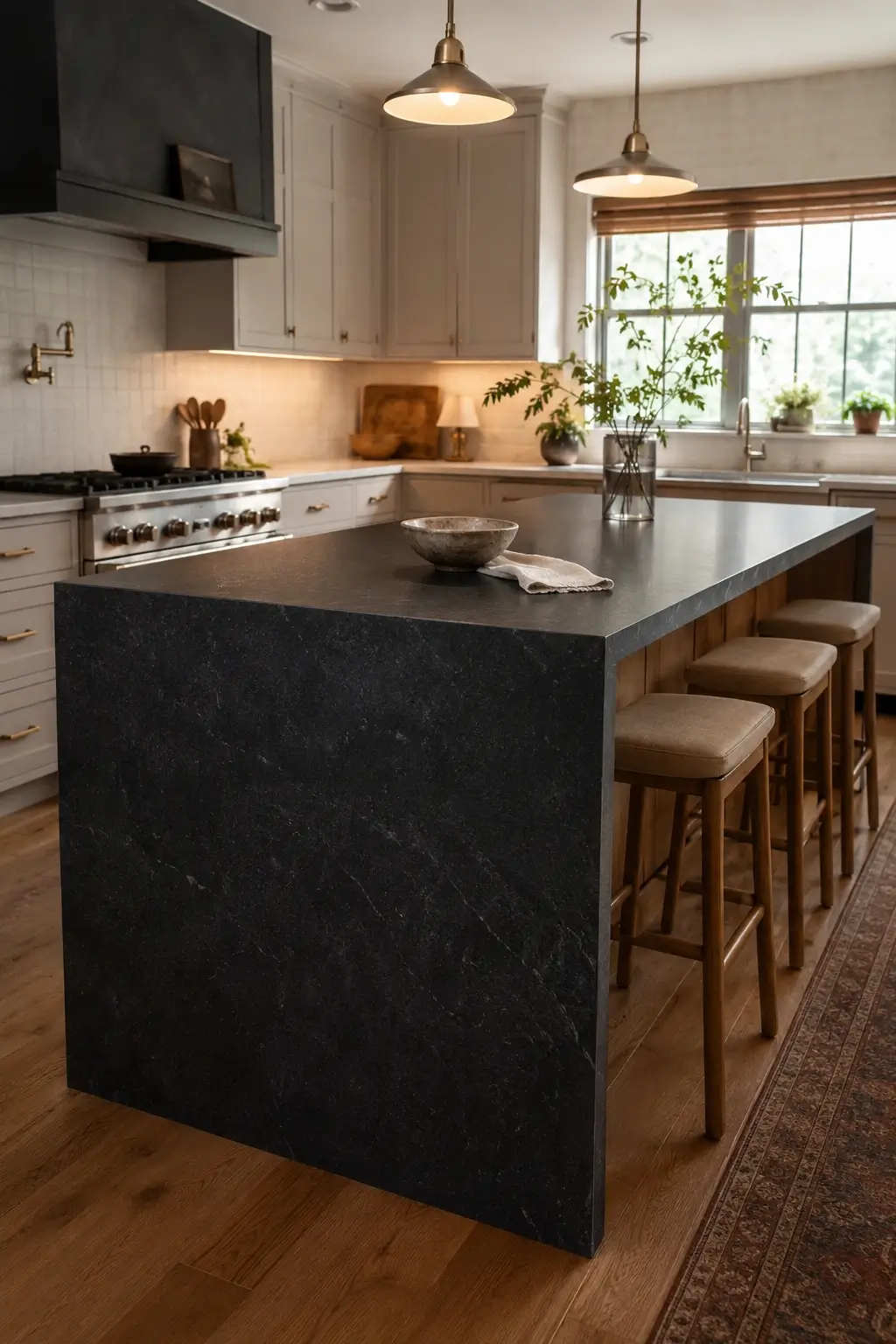
This is the one splurge worth considering, and only on the island — not the full perimeter. A waterfall edge turns the granite from “countertop” into “furniture,” and the honed finish keeps the drop-down face from looking like a slab of shiny stone bolted to the cabinet. It’s a bigger stone-fabrication cost, so I’d only splurge here if the island is already your kitchen’s visual center and you’re not planning to change the layout again soon.
4. Layer a Woven Runner Down the Galley Aisle So the Floor Feels Designed, Not Just Walked On
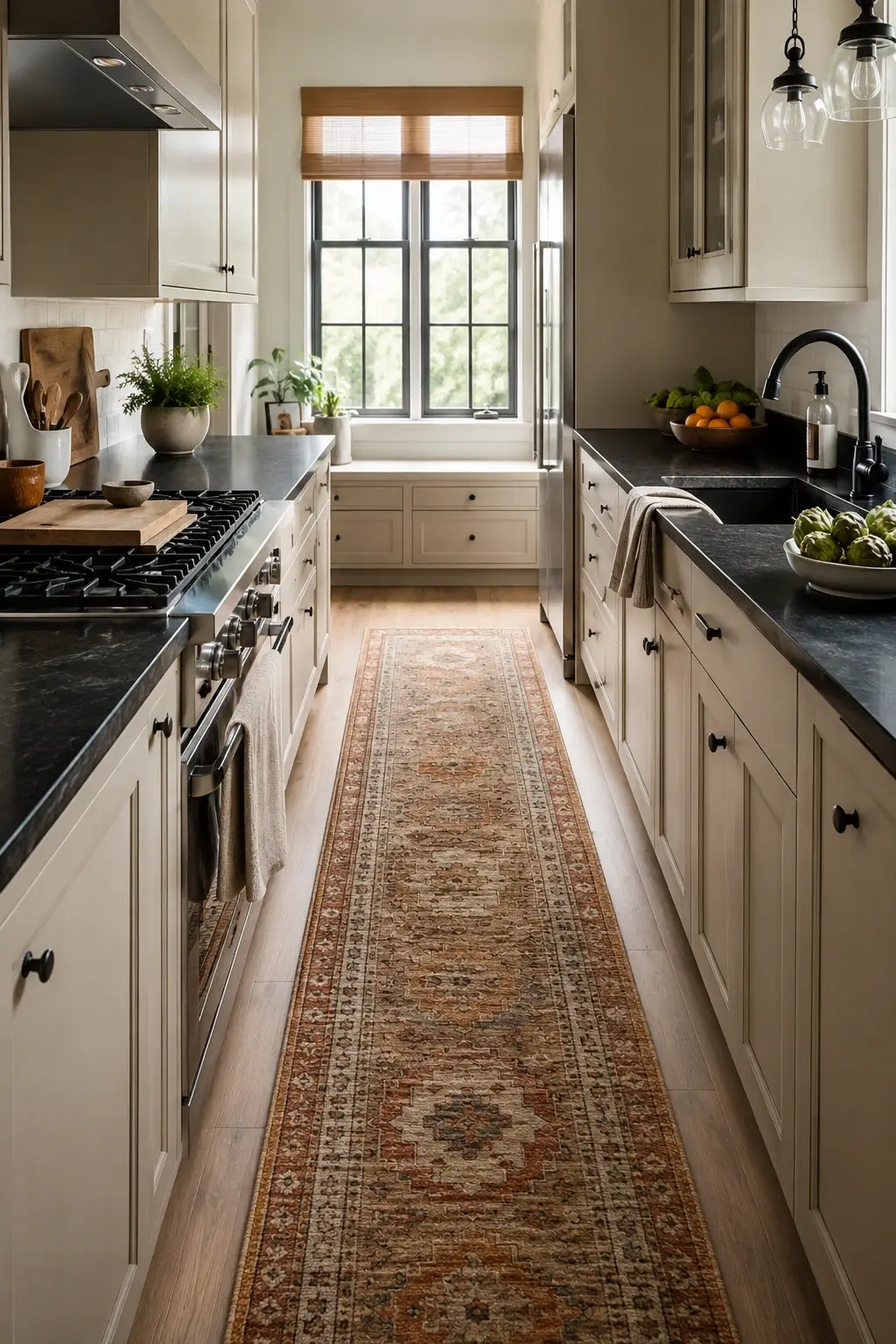
Galley kitchens with black granite on both sides can feel like a dark hallway if the floor is left bare and reflective. A woven, warm-toned runner breaks up that corridor feeling and gives the eye somewhere soft to land between two runs of stone. Pick a pattern with some texture rather than a flat solid, since flat solids next to flat granite just doubles the heaviness. It’s inexpensive, machine-washable options exist, and it’s one of the easiest changes to make this weekend.
5. Tuck a Warm LED Strip Under the Upper Cabinets So the Granite Glows Instead of Disappearing at Night
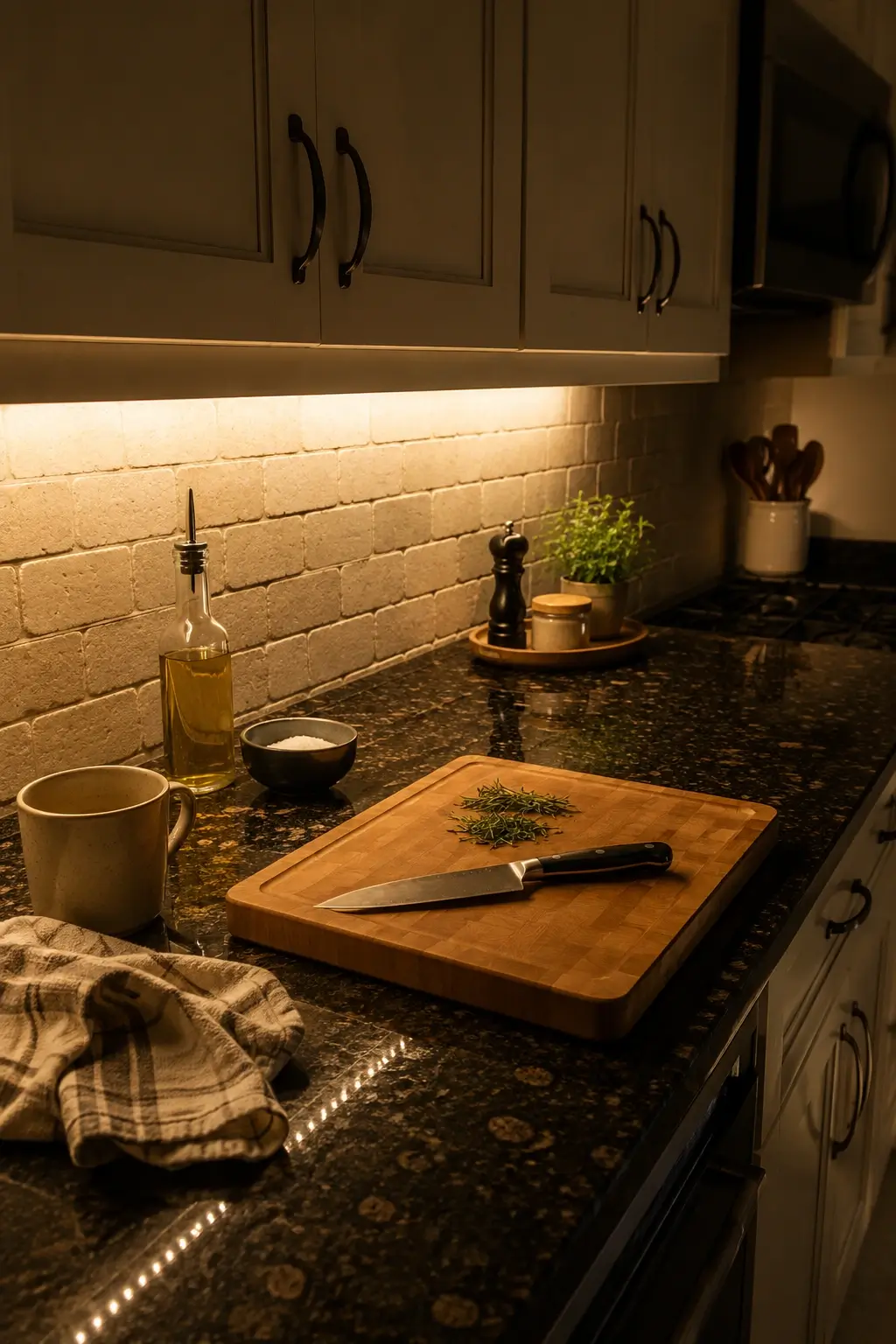
Black granite under a single overhead ceiling light can go nearly invisible after dark, which is exactly when a kitchen should feel warmest. A warm-white LED strip tucked under the upper cabinets throws light directly onto the counter, catching the stone’s natural flecks and veining instead of leaving it as a flat dark shadow. It also solves an actual cooking problem — task lighting where you’re chopping — so this one earns its spot for practicality, not just looks.
6. Pair Sage Green Lower Cabinets With Brass Pulls So the Kitchen Feels Collected, Not Trendy
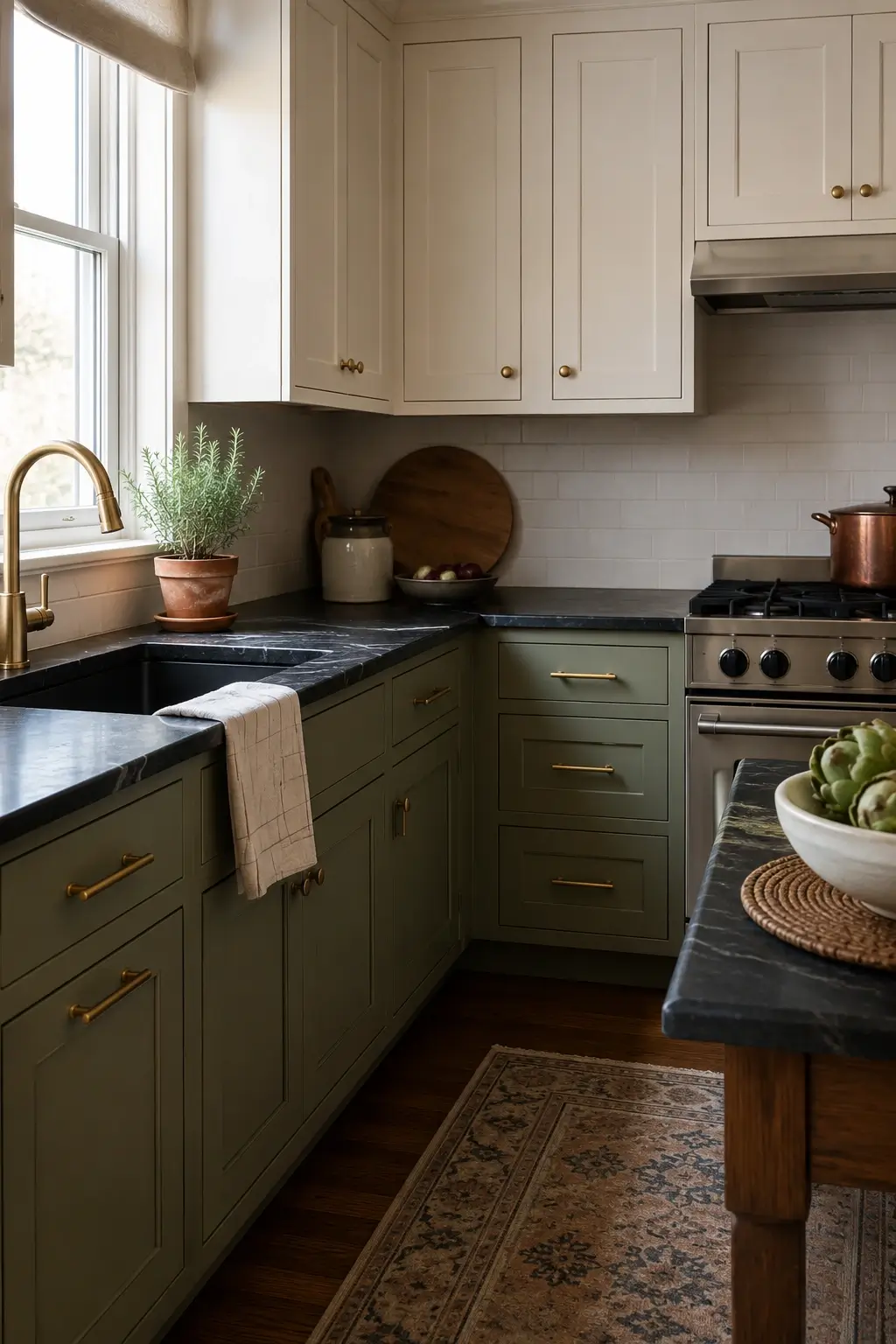
Sage green next to black granite works because it’s a muted, grayed-down color rather than a saturated one — it doesn’t compete with the stone’s darkness the way a bright green would. Add brass pulls instead of matte black hardware and the combination stops feeling like a trend-chasing photo and starts feeling like a kitchen someone actually put thought into over time. Keep the uppers white or a soft cream to keep the top half of the room light.
7. Build a Book-Matched Black Granite Backsplash Behind the Range as the One Dramatic Splurge
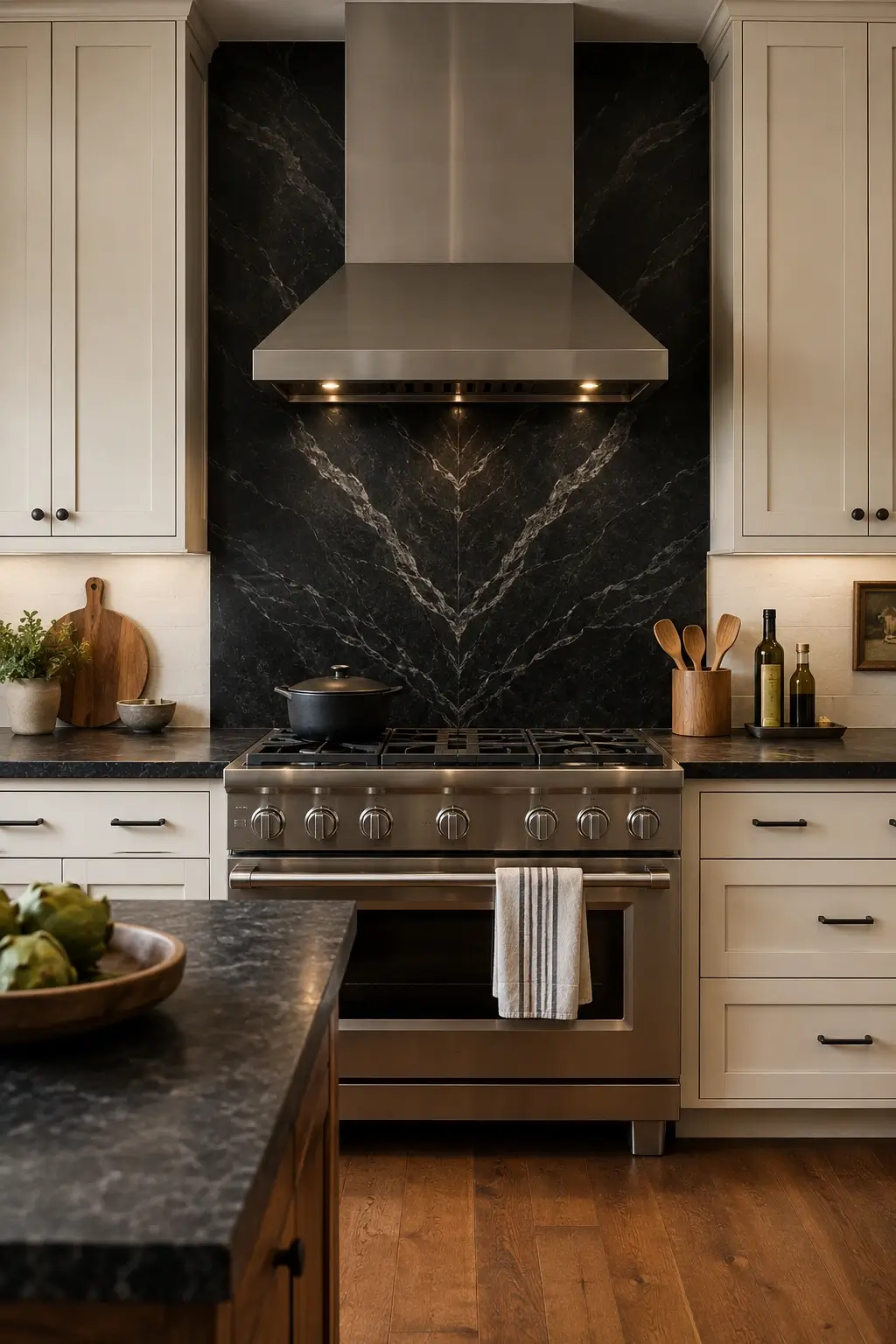
Instead of tiling the whole backsplash, a single book-matched granite slab behind the range mirrors the veining pattern down the center, which is what makes it read as intentional stone art rather than “we ran out of tile.” This is a genuine splurge, since book-matching requires cutting two slabs from the same block, so I’d only go here if the range wall is a true focal point and the rest of the backsplash stays simple tile or paint.
8. Cluster Three Matte-Black Pendants Over the Island So the Lighting Matches the Stone’s Weight on Purpose
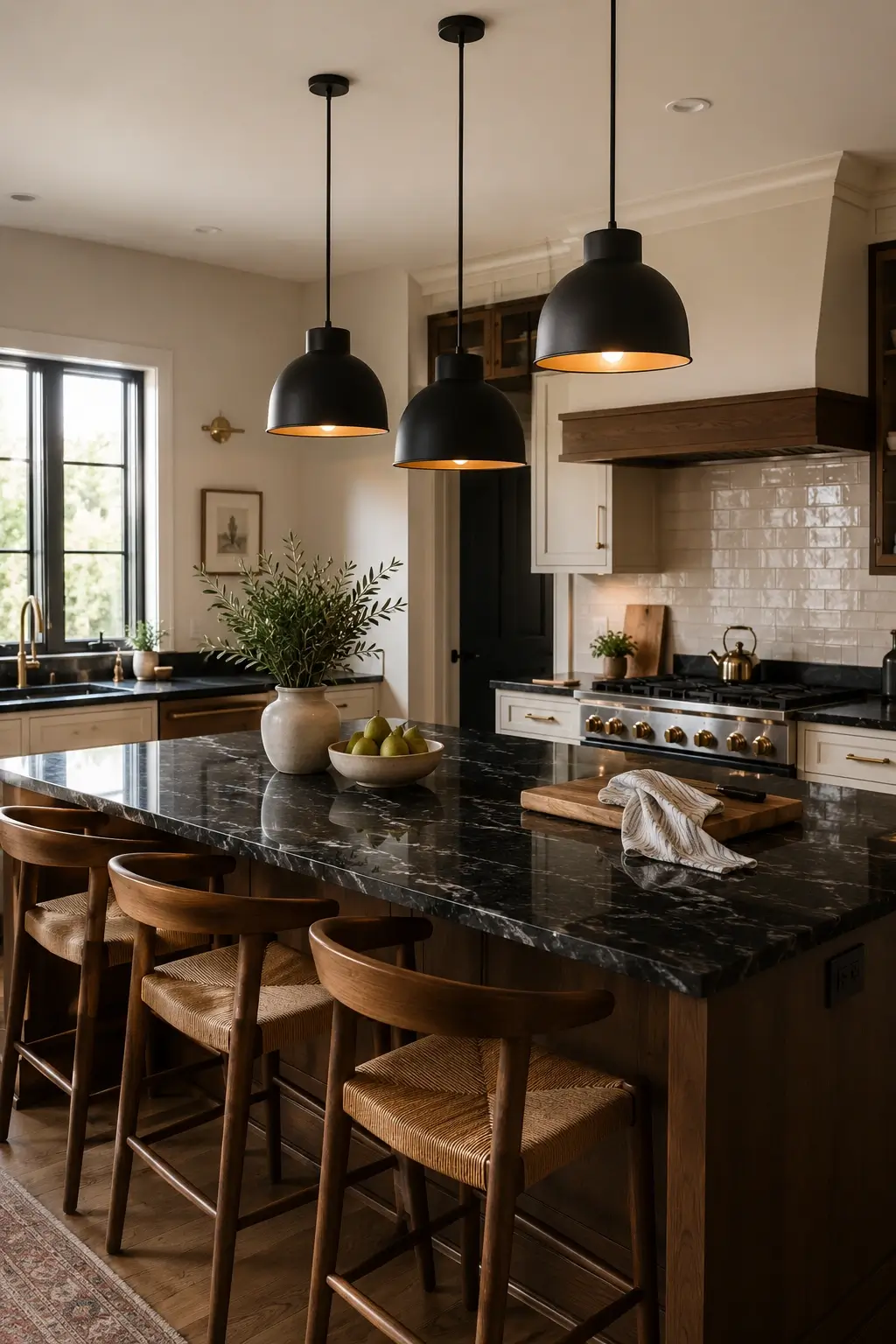
This one sounds counter-intuitive — more black in a kitchen that’s already dark — but it works because it makes the darkness feel deliberate instead of accidental. Three matte-black pendants of the same shape, hung at slightly staggered heights over the island, echo the granite’s tone above the counter line, so your eye reads it as one connected design choice rather than two separate dark elements fighting each other.
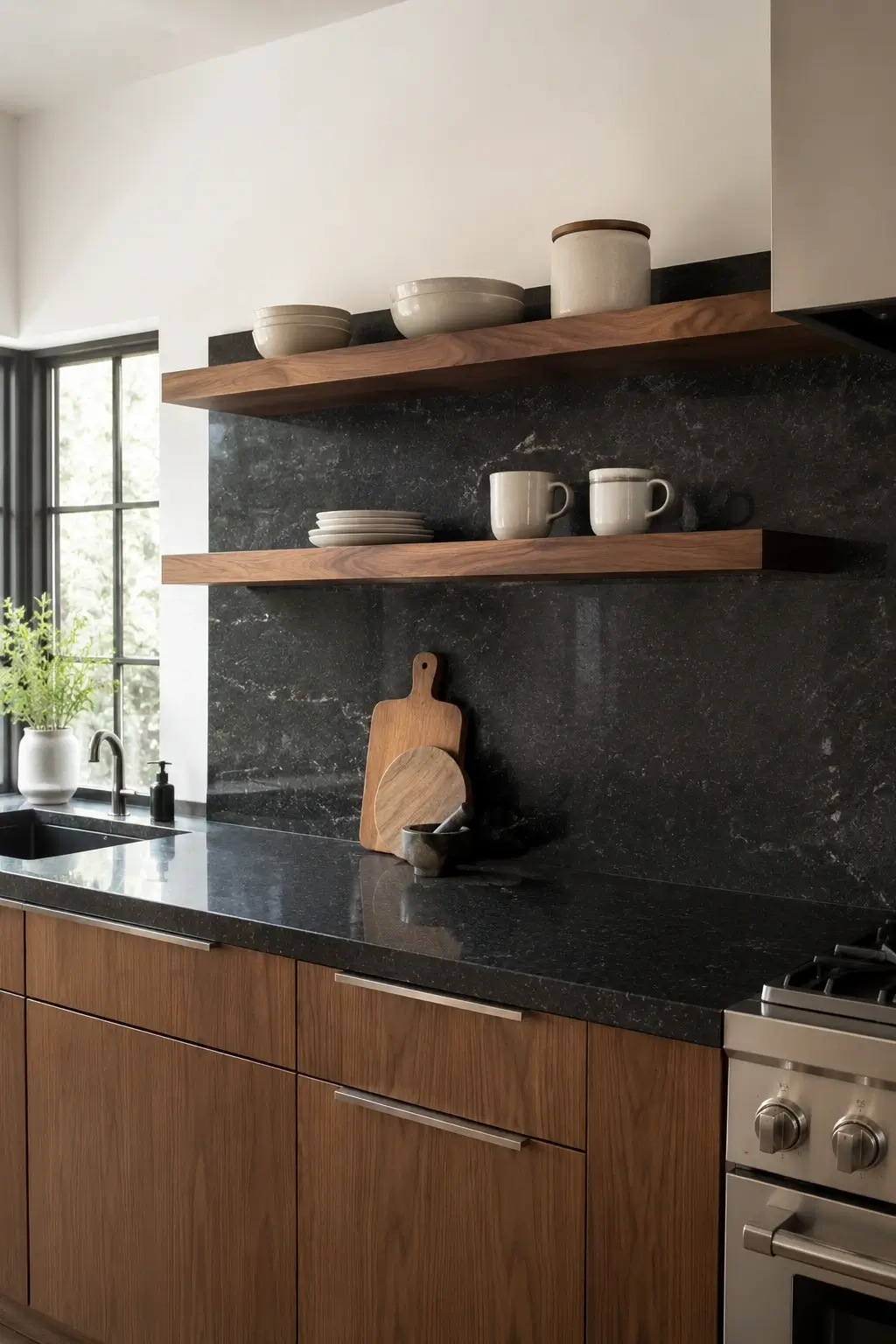
9. Open Two Floating Walnut Shelves Above the Counter to Break Up a Long Run of Dark Granite
 xx
xx
A long, unbroken stretch of black granite backsplash-to-cabinet-top can feel like a wall of dark stone. Two floating walnut shelves interrupt that line, add a warm wood tone the granite doesn’t have on its own, and give you a spot to style a few everyday ceramics without needing full upper cabinets. This works especially well in kitchens where the uppers already feel bulky next to the dark counter.
10. Keep the Island Black Granite and Switch the Perimeter to a Lighter Quartz for Built-In Contrast
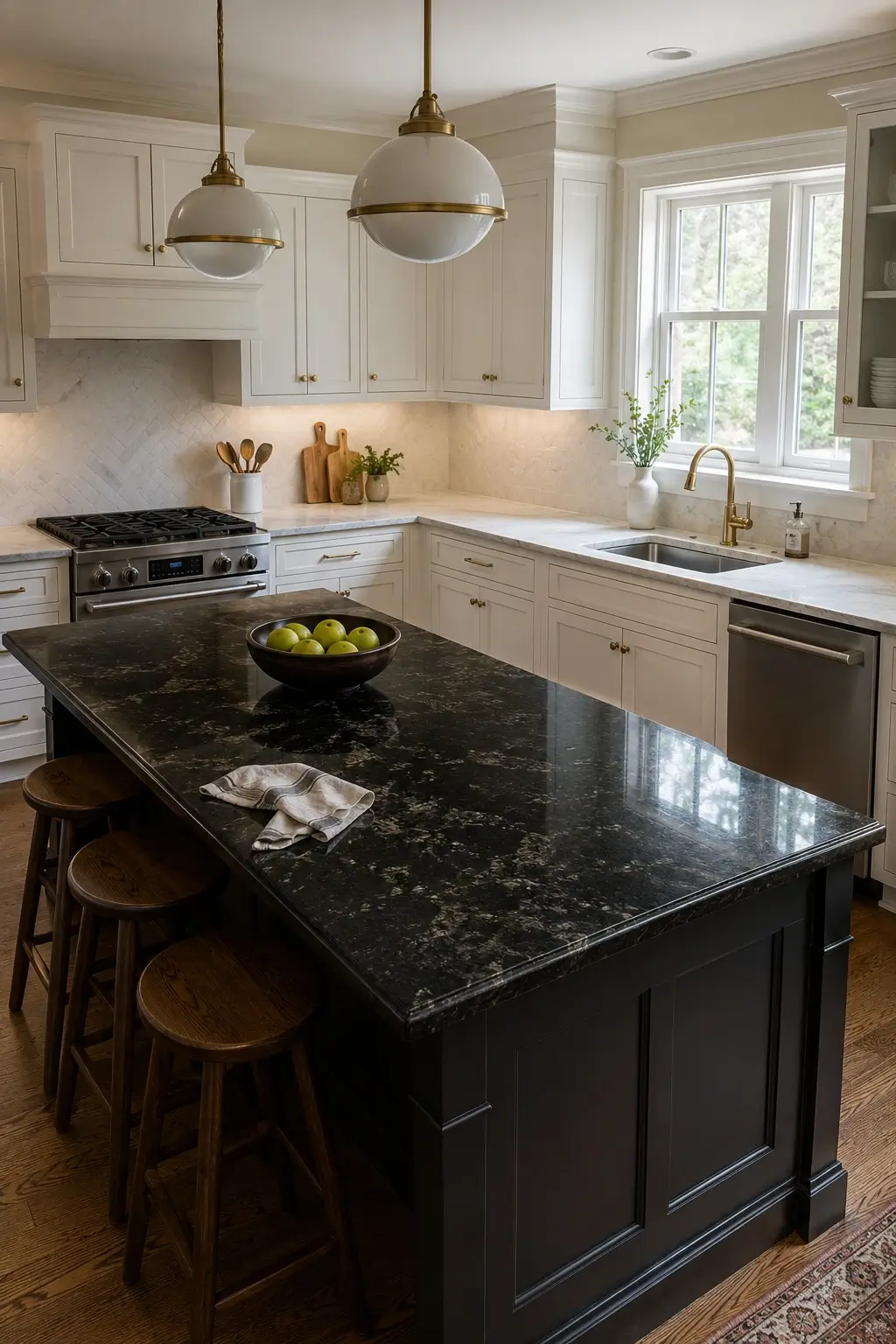
Full-kitchen granite can feel like a cave if the room doesn’t get much natural light. Keeping black granite on just the island and switching the perimeter counters to a lighter, subtly veined quartz creates contrast without a full material overhaul, and it’s a real option if you’re already replacing counters in stages rather than all at once. The island becomes the anchor; the perimeter stays bright and workable.
11. Swap the Faucet to an Unlacquered Brass Finish So the Sink Zone Stops Reading Cold
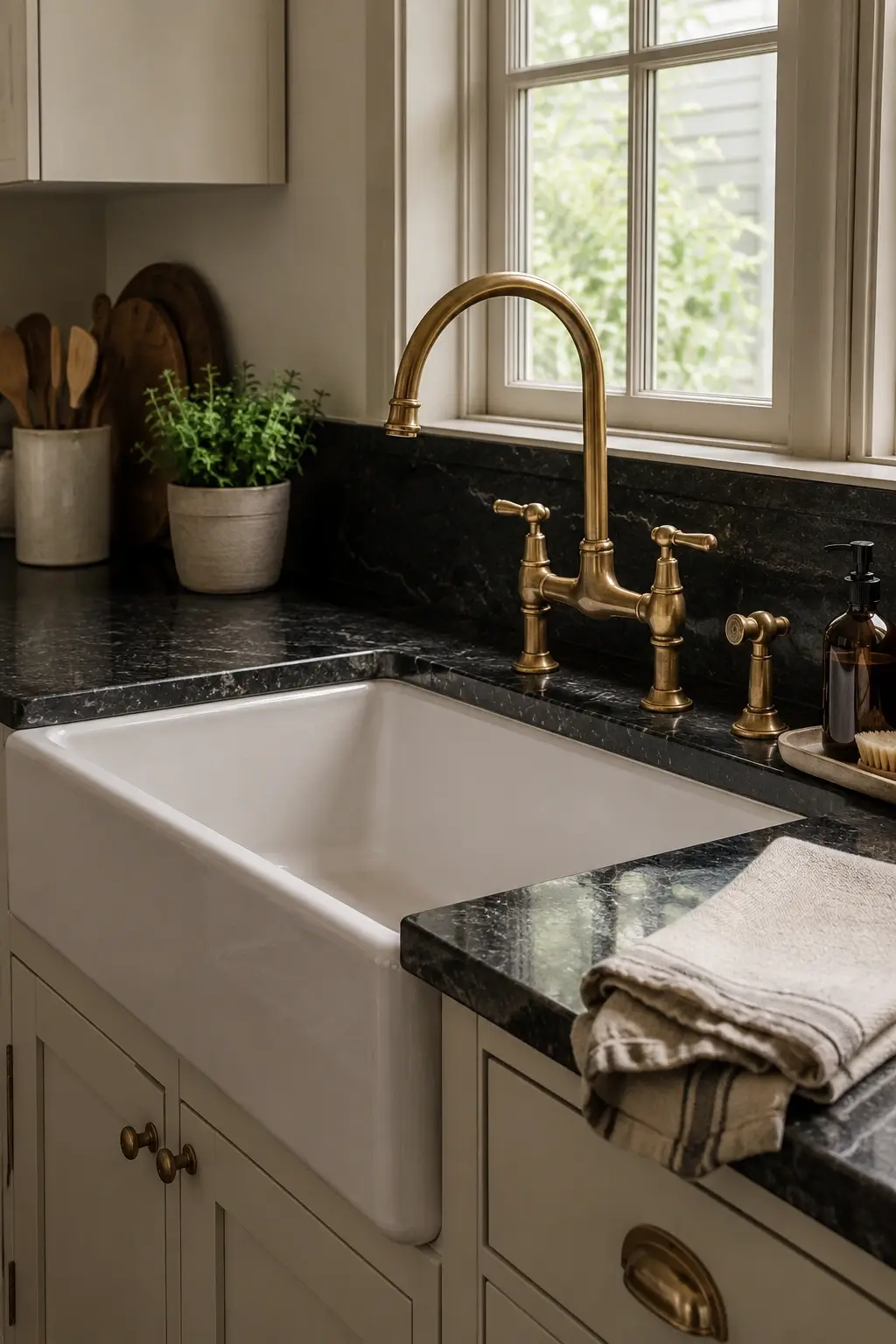
The sink area is often the coldest-feeling spot in a black granite kitchen, especially with a stainless or chrome faucet reflecting the dark stone back at itself. An unlacquered brass faucet warms that specific zone and develops a soft living patina over time, which reads as intentional rather than mismatched. It’s a contained, sink-only project — no cabinet or counter work involved — so it’s realistic on almost any budget.
12. Choose a Leathered Finish Over Polished So Light Softens Instead of Glares Across the Counter
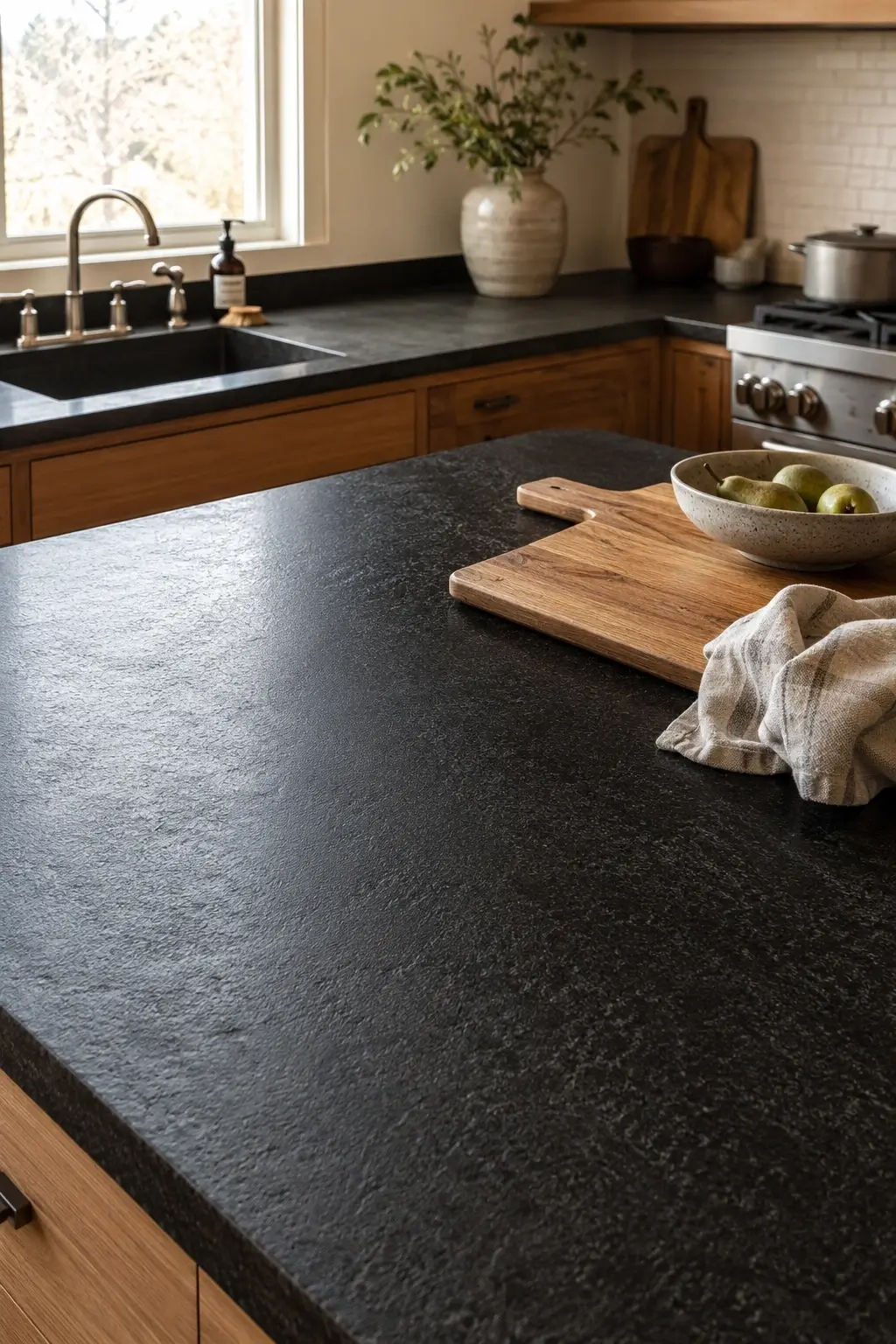
Polished black granite bounces overhead light straight back at you, which is part of why it can look harsh under cool bulbs. A leathered finish has a subtle texture that scatters light instead of reflecting it in one hard spot, which is why so many of the warmest-looking black granite kitchens on Pinterest aren’t shiny at all. Leathered black granite vs polished black granite: leathered is better for a matte, fingerprint-hiding surface because the texture disperses light unevenly. Polished works better when you want maximum shine in a smaller, darker kitchen. The key difference is how much light each finish bounces back into the room.
13. Pair Gray Shaker Cabinets With a White Subway Backsplash Set in Warm Grout So the Granite Doesn’t Read Too Dark
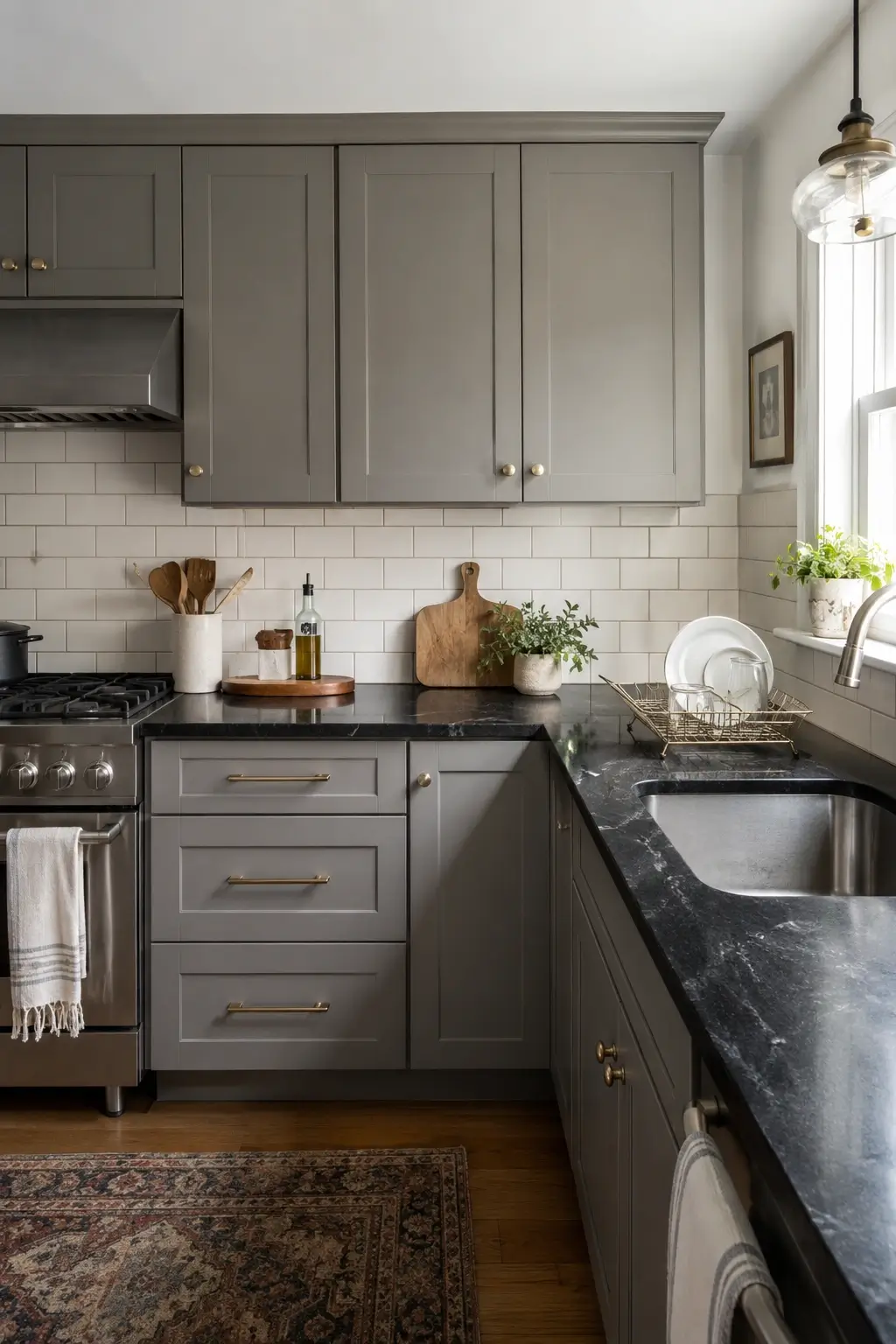
Gray cabinets sit closer in tone to black granite than white does, which can flatten the contrast if you’re not careful. A white subway tile backsplash set in a warm ivory grout — not stark white grout — adds a layer of lightness between the gray cabinets and dark counter, so the kitchen still reads balanced instead of gray-on-black-on-gray. This is one of the more requested combinations for a reason: it photographs well and wears well day to day.
14. Style One Corner of the Counter With a Wood Tray and Ceramic Bowl So the Granite Doesn’t Read Empty or Cold
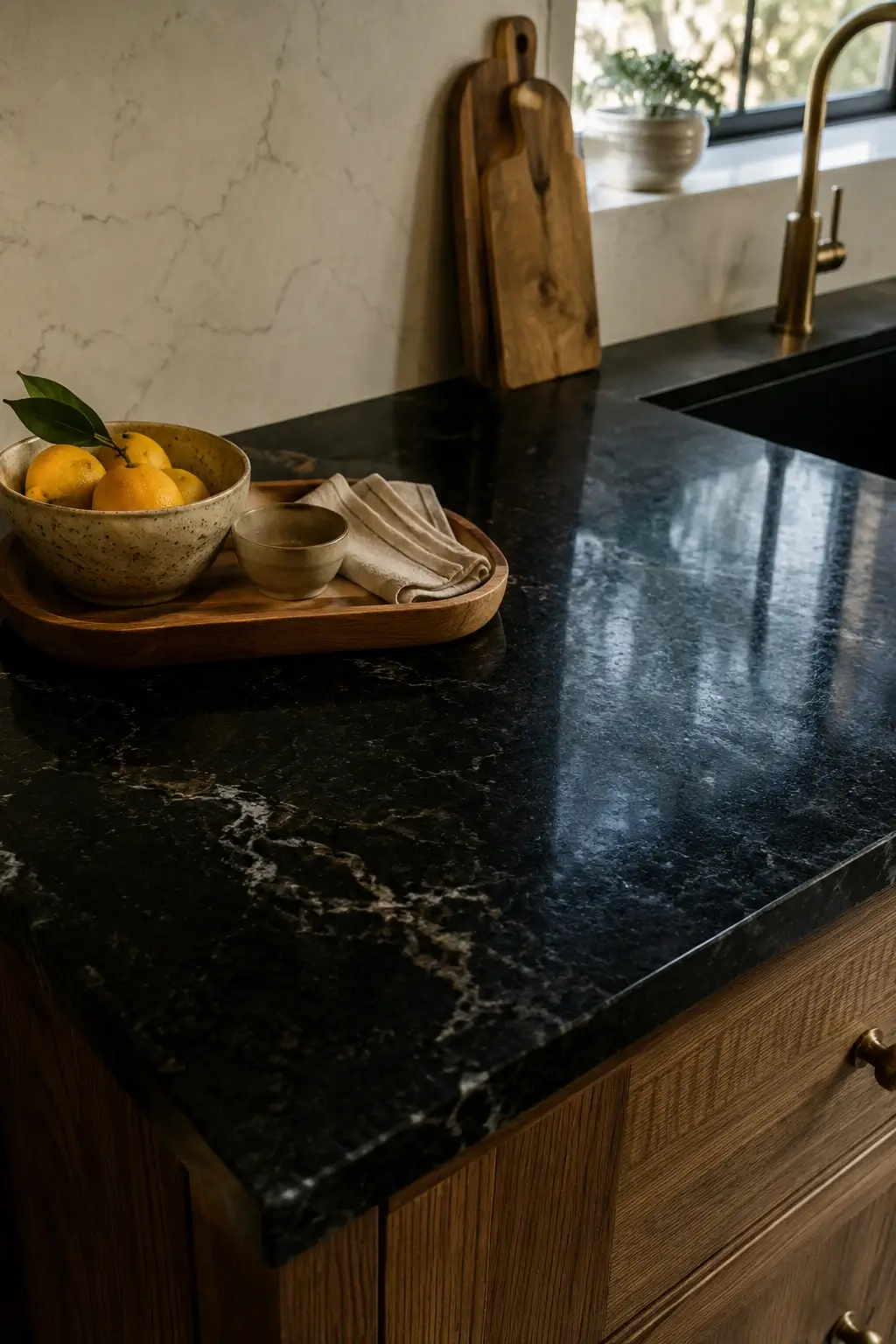
A completely bare black granite counter can feel more like a display surface than a lived-in kitchen. Grouping a warm wood tray, a ceramic bowl, and one or two everyday items in a single corner — not spread across the whole counter — gives the eye a soft, warm anchor point against the dark stone without tipping into clutter. Keep it to one grouping per counter run; more than that starts competing with the granite’s own pattern.
15. Anchor a Small Galley Kitchen With Black Granite on Just the Island So the Room Still Feels Open
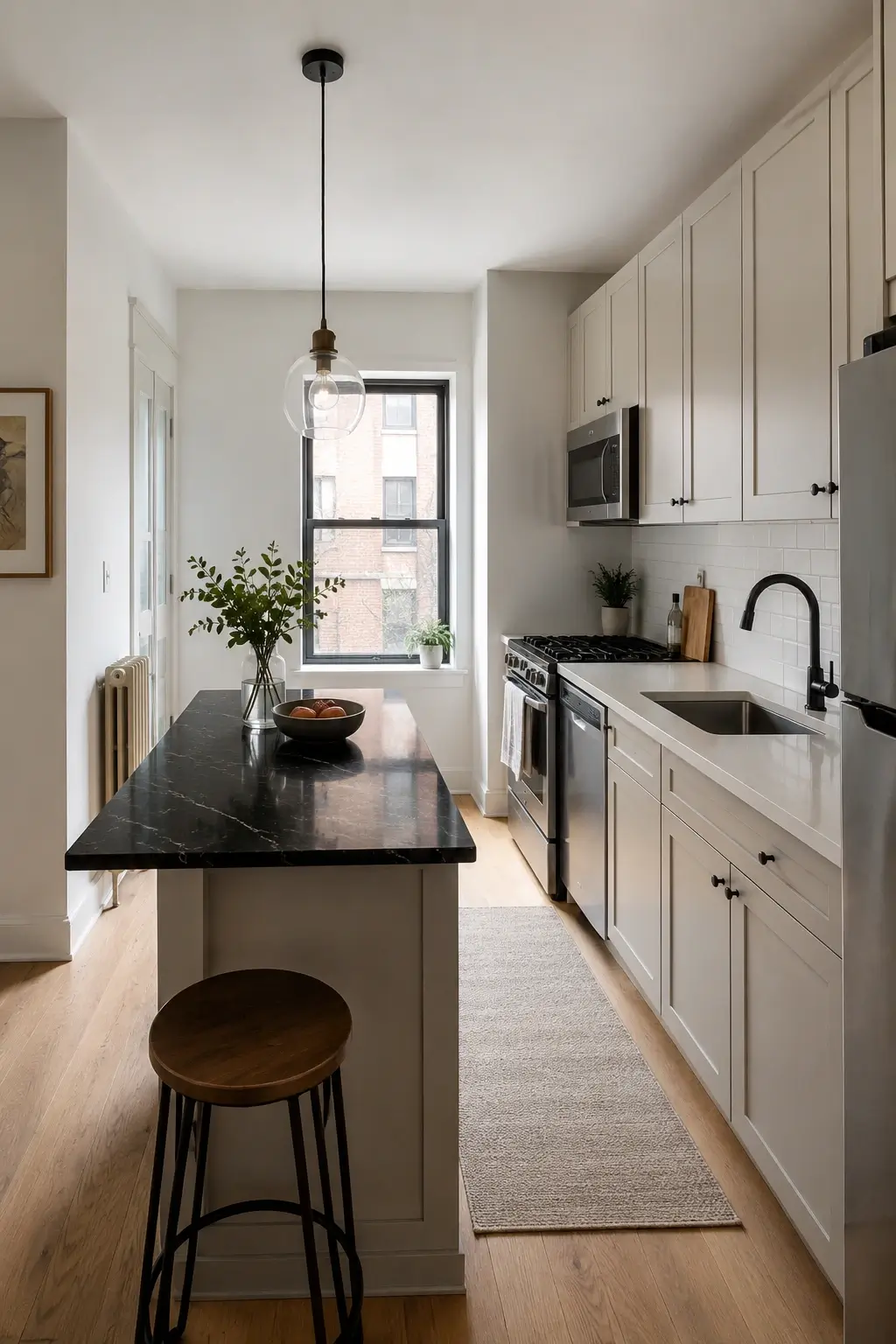
In a tight galley or apartment kitchen, black granite across every surface can shrink the room visually. Limiting it to a single small island or peninsula, with lighter countertops or open counter space around it, lets the stone act as one dramatic focal point instead of surrounding you on both sides. This is the realistic version of “small space, big statement” — one bold surface, not a wall-to-wall commitment.
16. Pick Navy Lower Cabinets So the Contrast Feels Intentional, Not Accidental
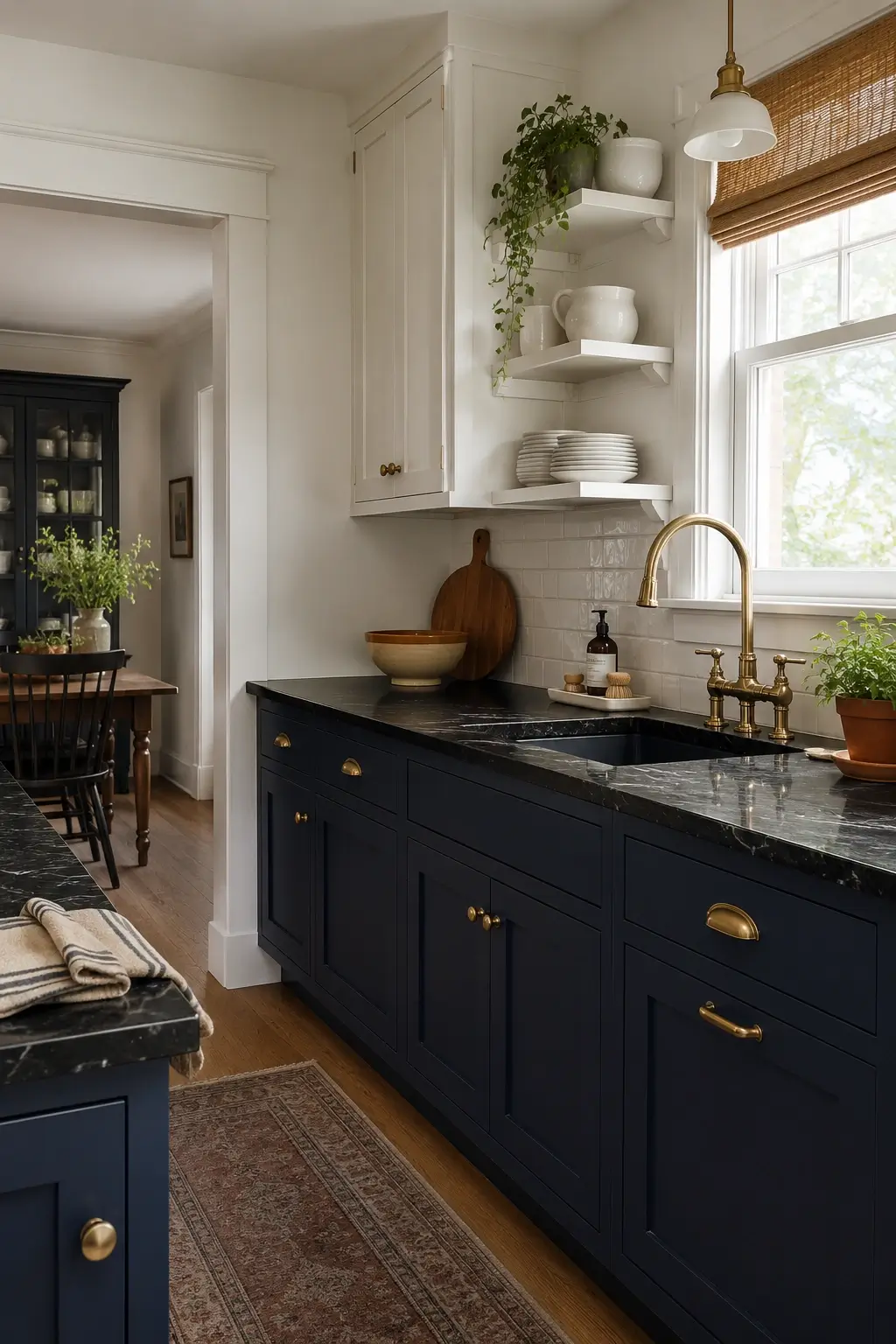
Navy and black granite sit close enough in depth of color that the pairing reads as a deliberate dark palette rather than two unrelated dark elements. It works especially well when the uppers or open shelving above stay light, since that split keeps the room from feeling like a single heavy block. Brass or warm gold hardware against navy lifts the whole combination noticeably more than matte black hardware does.
17. Add a Warm Plaster Accent Wall Behind Open Shelving to Soften a Monochrome Black Kitchen
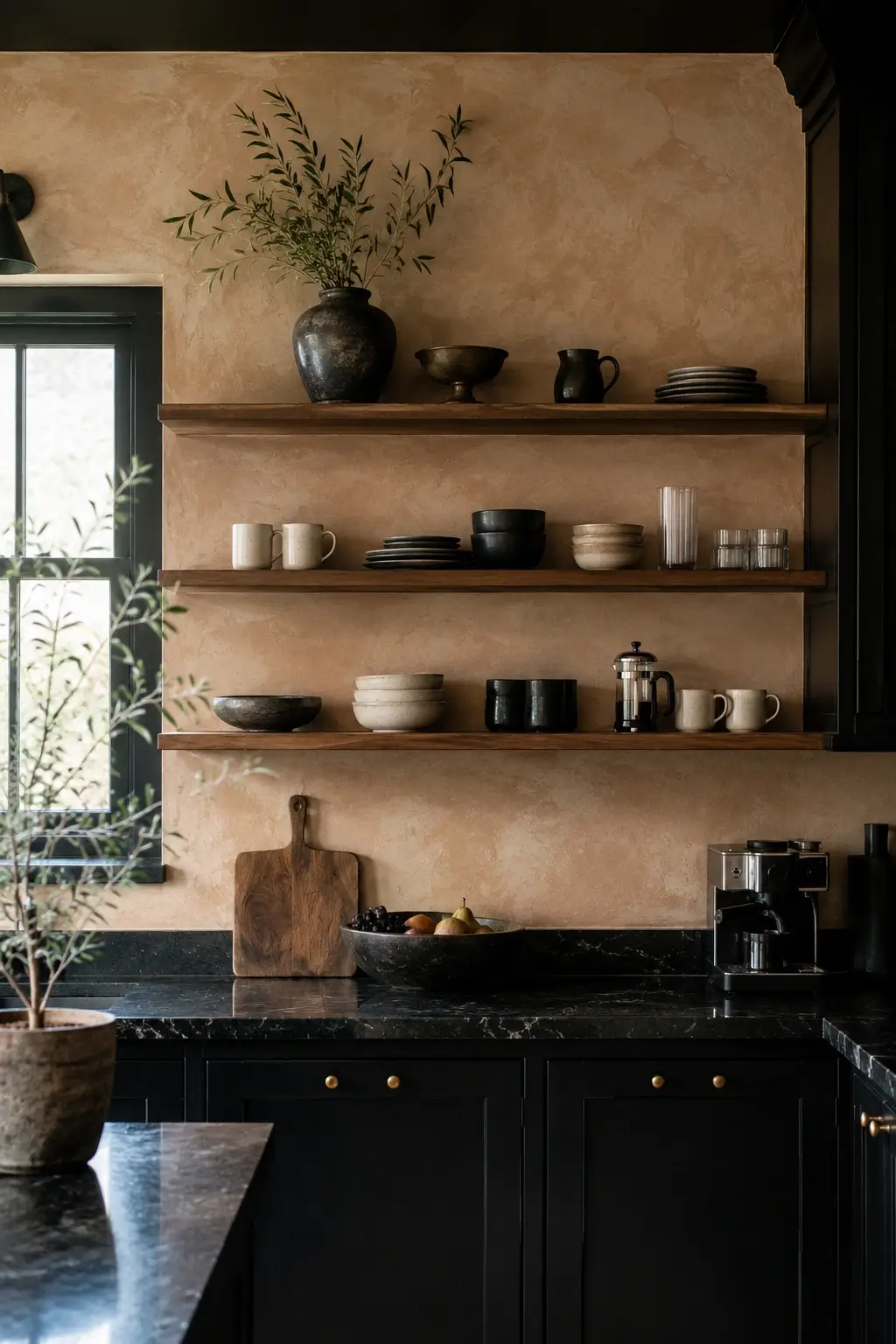
In a kitchen where the cabinets, counter, and backsplash are all dark, a warm limewash or plaster-textured accent wall behind open shelving gives the eye one place to rest that isn’t black or reflective. The slightly imperfect, hand-troweled texture also contrasts nicely with the granite’s polished or leathered surface, adding the kind of visual variety that keeps an all-dark kitchen from reading as one flat block of color.
18. Slide a Six-Inch Pull-Out Spice Rack Beside the Range So the Counter Stays Clear and the Stone Stays the Star
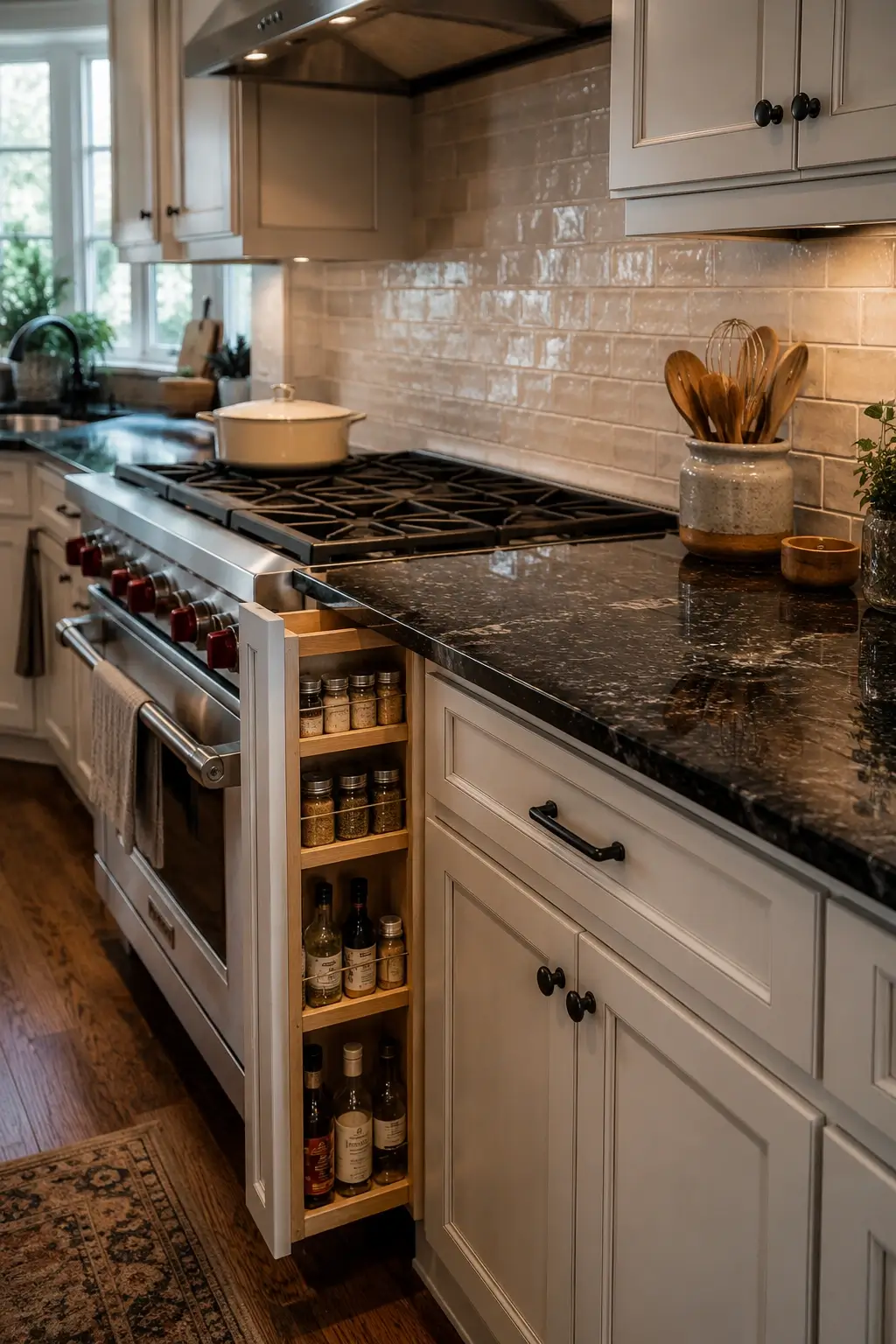
Cluttered counters are one of the fastest ways to make black granite feel chaotic instead of expensive, since every bottle and jar shows up as a hard-edged shape against the dark surface. A narrow six-inch pull-out beside the range gives spices, oils, and small jars a home that isn’t the counter, which keeps the granite’s natural pattern visible instead of buried under daily-use clutter.
19. Go Fully Black-On-Black With Cabinets and Granite, Then Break It Up With a Warm Wood Island Top
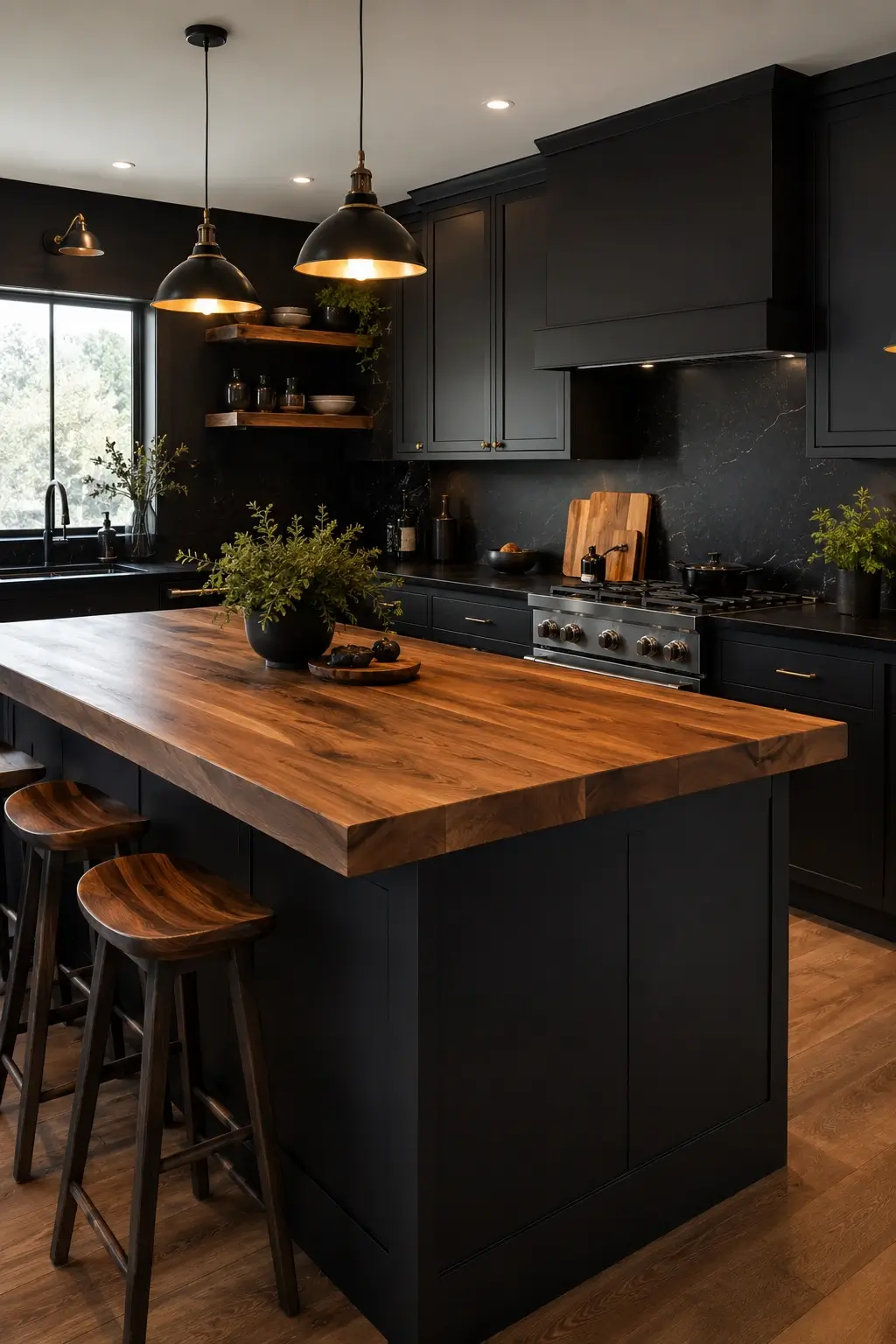
This is the boldest idea on the list, and it only works with one condition: somewhere in the room, warm wood has to interrupt the black. Matte black cabinets with black granite counters can look genuinely striking, but without a warm wood island top, open shelf, or floor to break the monochrome, it tips into cave territory fast. I’d only recommend this scene if you’re already committed to a dramatic, moody kitchen and have a wood element planned from the start.
20. Choose Warm 2700K Bulbs Over Cool White So the Granite Photographs Rich Instead of Flat
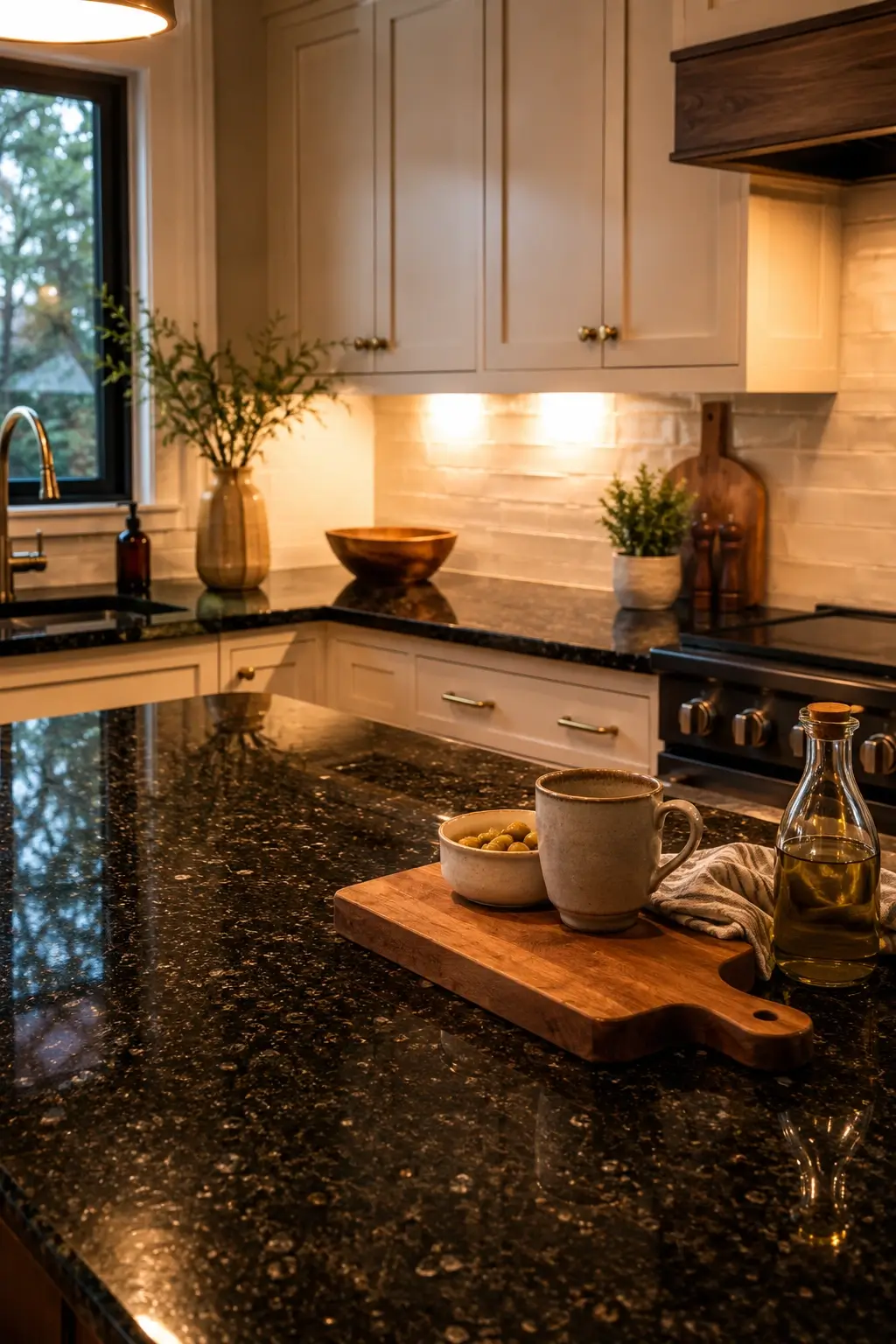
This costs less than almost anything else on this list and changes more than people expect. Cool white bulbs, typically 4000K and up, flatten black granite into a dull gray-black and make the whole kitchen feel clinical. Warm 2700–3000K bulbs bring out the stone’s natural warmth, browns, and flecks instead of just its darkness. Check your existing bulbs before changing anything else — this alone might solve half the “heavy” feeling you’ve been trying to fix.
21. Paint the Island Cabinet Soft Black to Match the Granite So the Stone Seems to Disappear Into It
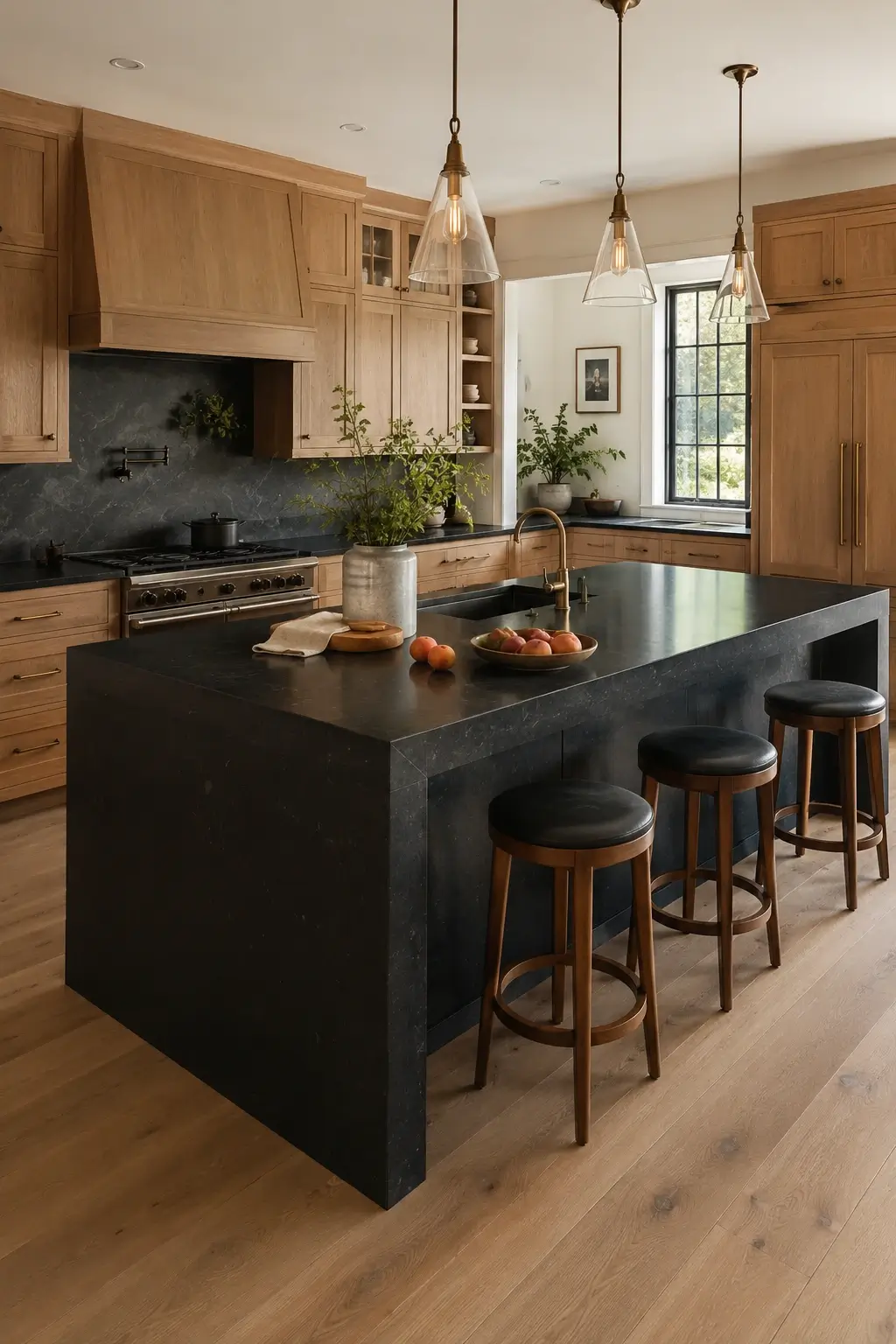
Instead of contrasting the island cabinet with the counter, paint it a soft, slightly warm black so the cabinet and granite blend into one continuous dark block. Keep the perimeter cabinets in a lighter wood tone like white oak. The effect reads as custom and expensive because it looks like the island was built as a single sculptural piece, not a cabinet with a countertop set on top of it.
22. Dress a Compact Coffee Station Ledge in Black Granite for a Small, Styled Daily Ritual Spot
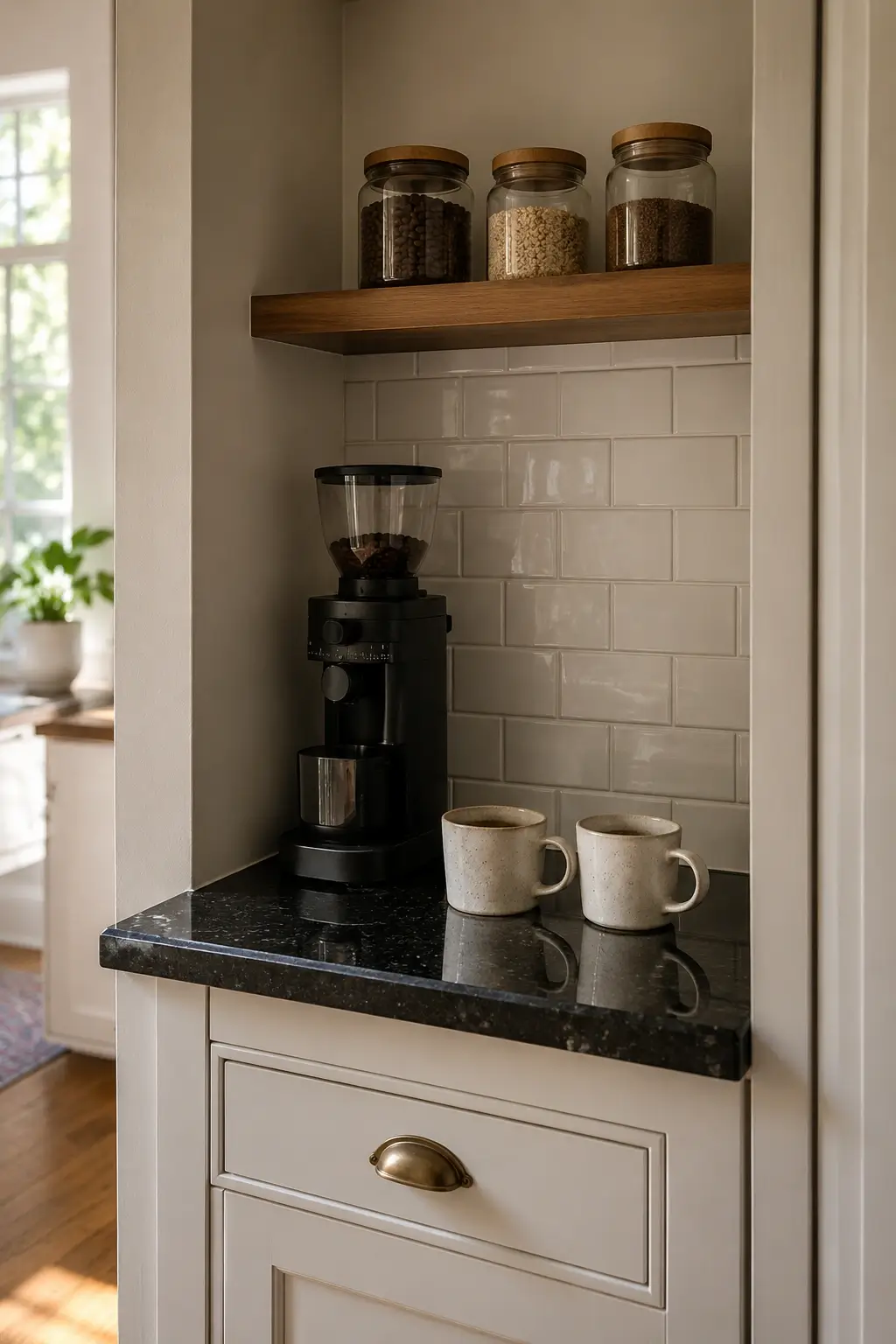
If a full black granite kitchen isn’t realistic for your budget or layout, a small dedicated coffee ledge is. A short run of black granite on a side counter or narrow nook, styled with a grinder, a few mugs, and nothing else, lets you test the material and the styling logic in miniature before committing to a full counter run — and it photographs beautifully as its own contained scene.
23. Widen a Narrow Kitchen With Large-Format Light Tile Behind Dark Granite to Trick the Eye Into More Space
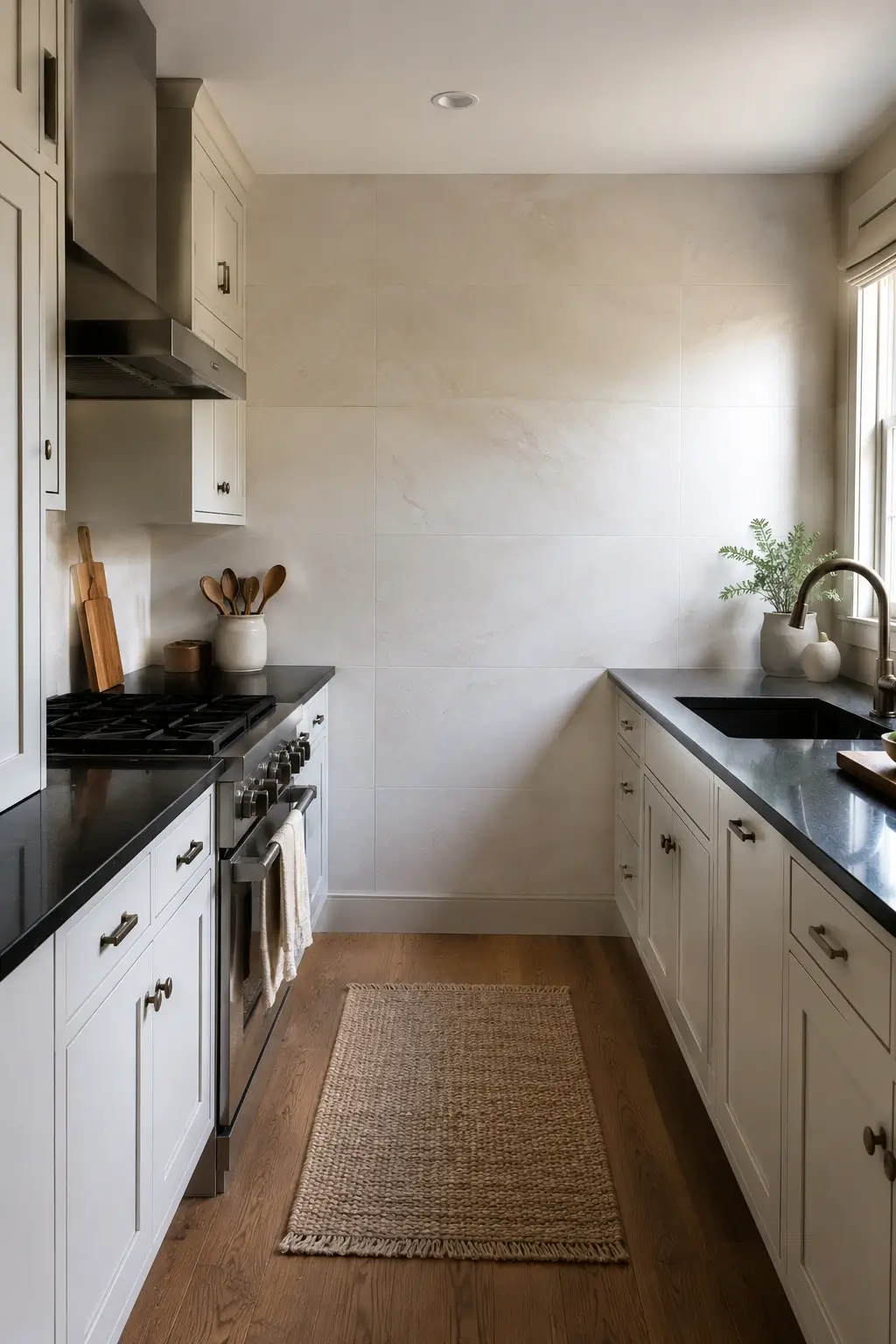
Narrow kitchens with black granite can feel tighter than they actually are, especially with small, busy backsplash tile adding visual noise. Switching to large-format light tile — fewer grout lines, more open surface — behind the dark counter creates a cleaner contrast line and makes the room read wider in photos and in person. This is a genuine visual-illusion fix, not just a style preference, and it works in almost any narrow layout.
How to Choose Cabinet Colors for Black Granite Countertops
To choose a cabinet color for black granite countertops, follow these steps: 1. Decide whether you want contrast, like white or gray, or a tonal match, like soft black. 2. Pick a hardware finish based on your lighting temperature — brass for warm light, matte black for cooler moody light. 3. Test a large sample board in your actual kitchen light before committing to paint or cabinet orders.
| Option | Best For | Key Benefit | Limitation |
|---|---|---|---|
| White or cream cabinets | Maximum brightness, small kitchens | Strong contrast, feels timeless | Shows fingerprints, needs more cleaning |
| Gray shaker cabinets | Modern, transitional kitchens | Softer contrast than white | Can flatten the room if grout/tile isn’t warm-toned |
| Sage green cabinets | Collected, non-trendy look | Muted color pairs gently with dark stone | Limited resale-neutral appeal in some markets |
| Navy cabinets | Bold, intentional dark palettes | Reads deliberate, not accidental | Needs a light element nearby or feels heavy |
| Warm wood (oak, walnut) | Farmhouse or organic-modern styles | Adds natural warmth granite lacks alone | Higher cost than painted cabinet finishes |
Common Questions About Black Granite Countertop Kitchens
What color cabinets go with black granite countertops?
White, warm gray, sage green, navy, and natural wood tones all work well. The finish and hardware color matter as much as the cabinet color itself.
Do leathered black granite countertops need special care?
Yes. They hide fingerprints better than polished granite but need more consistent sealing since the textured surface is more porous to spills.
Does black granite make a kitchen look smaller?
Only when it covers every surface under cool lighting. Limiting it to an island, adding warm light, and using lighter backsplash tile keeps the room feeling open.
Is black granite outdated in 2026?
Not inherently. Dated black granite kitchens usually have flat glossy stone with cool lighting and matching black hardware.
What backsplash works best with black granite?
White subway tile in warm grout, large-format light tile, or a book-matched granite slab all work, depending on your budget and how bold you want the range wall to feel.
Before You Start Planning
None of these 23 ideas require a full kitchen gut, and that’s intentional — most black granite kitchens don’t need to be replaced, they need better lighting, hardware, and cabinet contrast around a stone that was already a good choice. One honest limitation: this list covers cosmetic and styling decisions, not structural ones, so anything involving a waterfall edge or moved plumbing still needs a contractor’s sign-off before you commit. Save the scenes that match your layout, test the lighting temperature first since it’s the cheapest fix, and build outward from there.




No Comment! Be the first one.