




36 Warm and Stylish Tan Leather Couch Ideas for Every Living Room
Your tan leather couch is sitting in the middle of the living room, and something feels off. Maybe you thrifted it, inherited it, or bought it new — and now you’re staring at it wondering why...

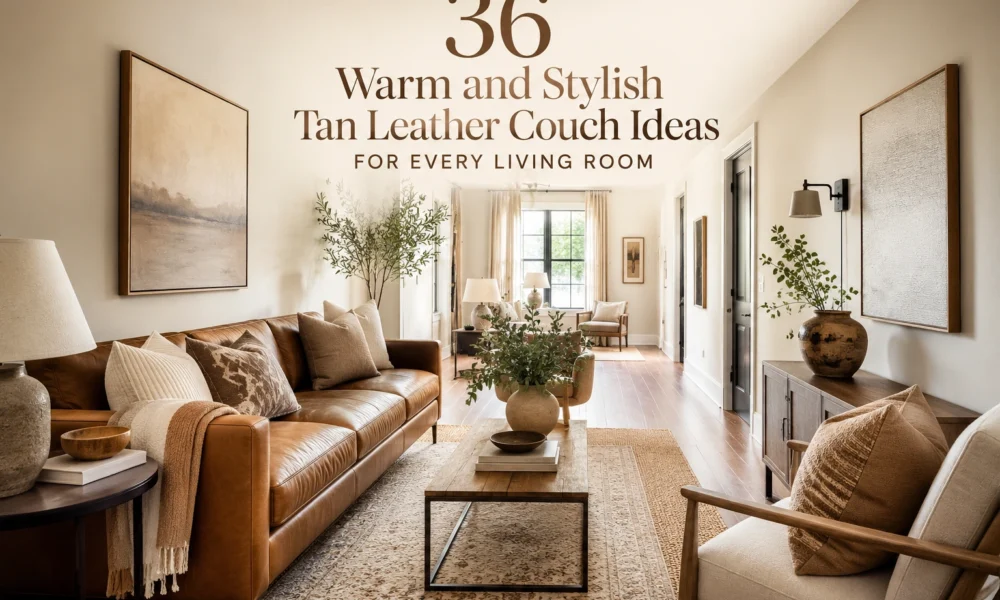
Your tan leather couch is sitting in the middle of the living room, and something feels off. Maybe you thrifted it, inherited it, or bought it new — and now you’re staring at it wondering why it reads like a furniture showroom placeholder instead of the warm, designed centerpiece it should be. The gray rug washed out the room. The cool-toned pillows you picked up felt disconnected. And every “leather sofa” result on Pinterest shows dark cognac or espresso — not the lighter, golden-toned tan leather couch you actually own.
Here’s what most decorating content misses: tan leather is not the same as brown leather, and it doesn’t play by the same rules. It reads warmer, lighter, and more golden, which means it responds to color, texture, and materials in its own specific way. These 36 tan leather couch ideas give you a concrete, visual, and achievable direction for every budget and room size — so you can stop second-guessing and start building a living room that feels like it was designed with intention.
What Colors Go With a Tan Leather Couch?
Tan leather carries a warm, golden undertone — which means it pairs best with colors in the earthy, warm-neutral, and rich jewel-tone families. Here are six specific colors that consistently work:
- Forest Green — deep and rich, it creates warm contrast that feels fresh and grounded without going cold
- Rust / Terracotta — shares tan leather’s warm amber undertone; the two colors reinforce rather than compete
- Deep Navy — cool enough to provide real contrast, saturated enough to feel luxurious rather than icy
- Warm Cream — keeps the palette soft and cohesive without washing out the leather’s natural glow
- Sage Green — muted and earthy, it softens the leather without fighting it for visual attention
- Charcoal Gray — functions as a deep, moody neutral when paired with warm wood tones and amber lighting
1. Layer a Rust and Ivory Moroccan Rug Underneath
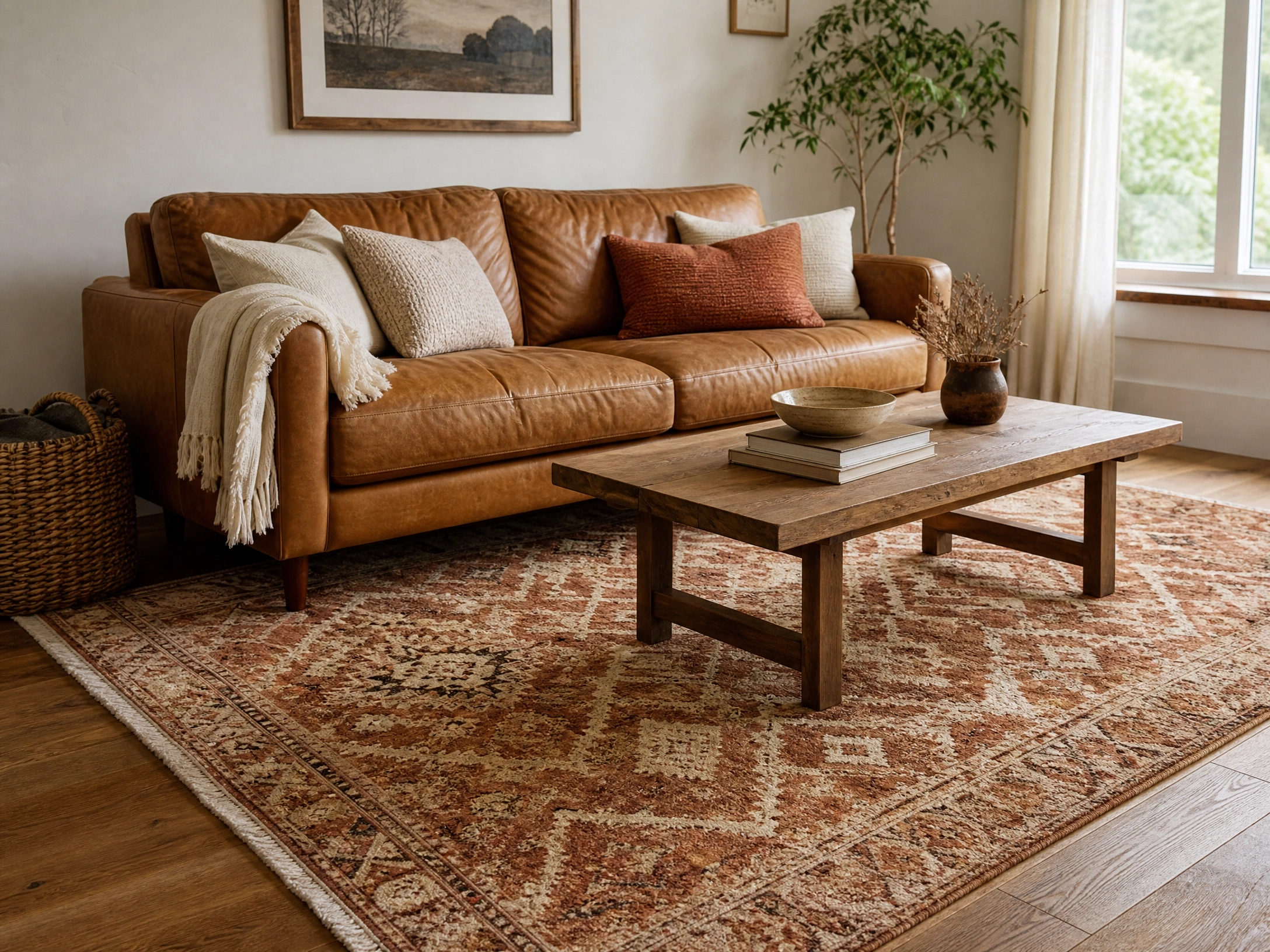
A rust and ivory Moroccan rug is arguably the single best upgrade you can make beneath a tan leather couch — because both colors already live inside the leather’s undertone. Rust echoes the warm amber in the hide; ivory keeps the palette from going too heavy. The geometric diamond or trellis patterns typical of Moroccan-style rugs add visual rhythm and complexity to the seating area without pulling focus away from the sofa itself. Everything lands together as though it was always planned that way.
Aim for a rug that’s at least 8×10 feet, and position it with only the front two legs of the couch resting on top — this is the classic “front legs on” method that grounds the furniture without making the rug look undersized. Loloi’s Layla and Alie collections offer this rust-and-ivory colorway at an accessible price point. If budget is tight, Facebook Marketplace and Rugs USA regularly carry similar Moroccan-style options for $60–$120 — often secondhand and barely used, which adds a layer of worn-in character.
2. Drape a Chunky Cream Knit Throw Over the Armrest
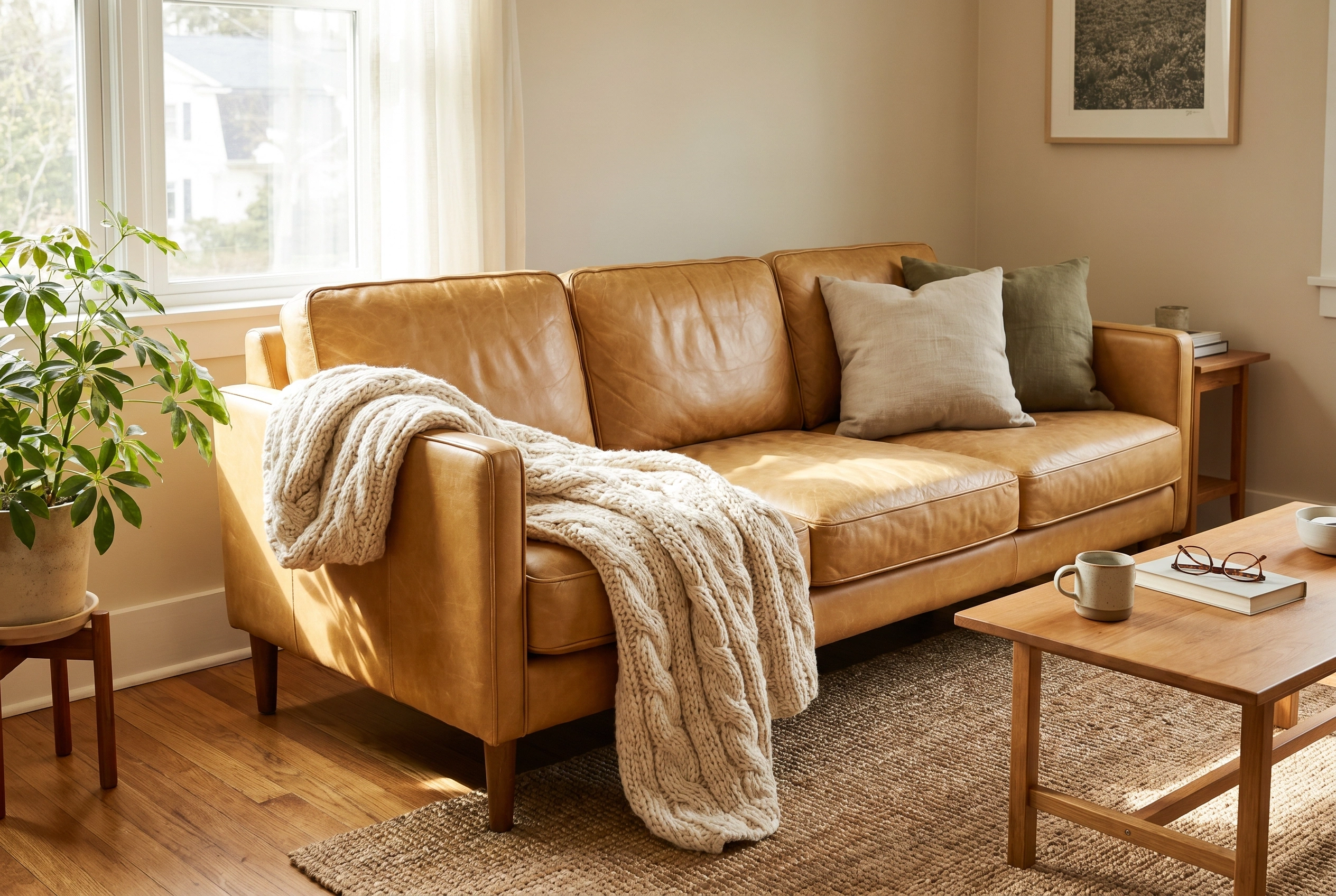
A chunky cream knit throw draped loosely over one armrest immediately softens the leather’s slightly formal edge and adds the tactile warmth the room needs. The contrast between the smooth, cool leather surface and the thick, textured knit is what makes this work — it’s the same visual logic as pairing a structured blazer with a soft, relaxed T-shirt underneath. Stick to warm cream rather than bright white, which reads too crisp and slightly cold against tan leather’s golden base tone.
Drape it naturally, not folded in a neat rectangle — gathered slightly at one end, as though someone sat down and pushed it aside. That casual, lived-in placement is exactly what reads as “styled” rather than “staged.” A 50×60 throw hits the right scale for both two-seat and three-seat sofas; anything smaller looks like a hand towel tossed over furniture. Target’s Studio McGee line carries chunky knit throws in warm cream at a very accessible price point, and they photograph beautifully under natural morning light.
3. Add Forest Green Velvet Throw Pillows for Rich Contrast
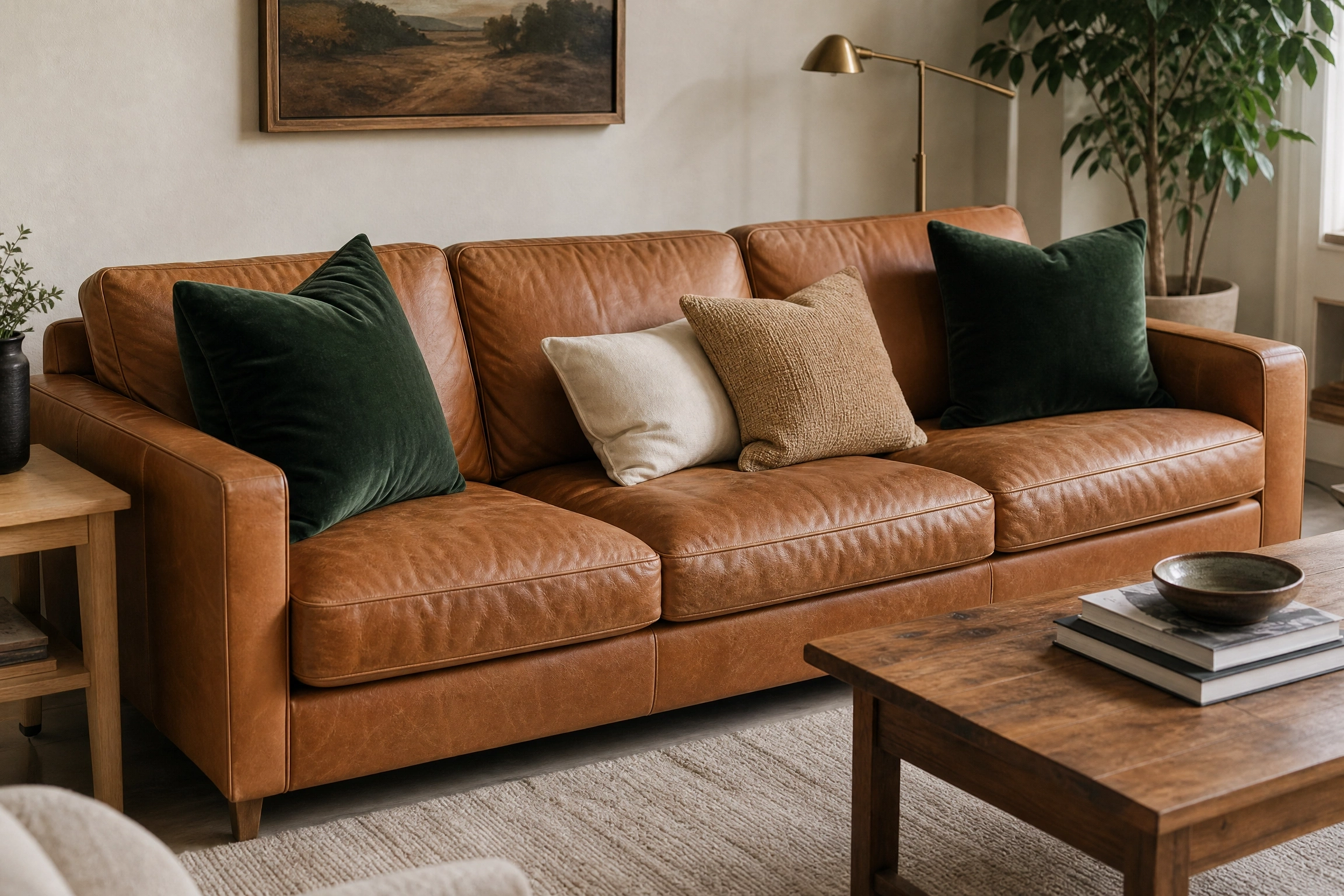
Forest green velvet pillows against tan leather is one of those combinations that looks counterintuitive until you actually see it — and then it’s immediately obvious. The deep, saturated green provides real contrast against the warm tan without going cold, and the velvet texture keeps the pairing from feeling modern-minimal or clinical. Two 20×20 forest green velvet pillow covers on a three-seat sofa is all it takes to shift the room from “builder-grade setup” to “decorating with clear intention.”
Mix the forest green pillows with one or two neutral companions — a warm cream linen or a dusty tan woven cover in a slightly smaller 18×18 size. That supporting cast lets the green read as a deliberate color choice rather than an impulse buy. West Elm carries excellent forest green velvet pillow covers in the $25–$35 range, and IKEA’s GURLI covers offer a similar deep green tone for under $10. Budget is not a barrier here — this is a pillow cover swap, not a design project.
4. Bring In a Brass Arc Floor Lamp for Warm Ambient Glow
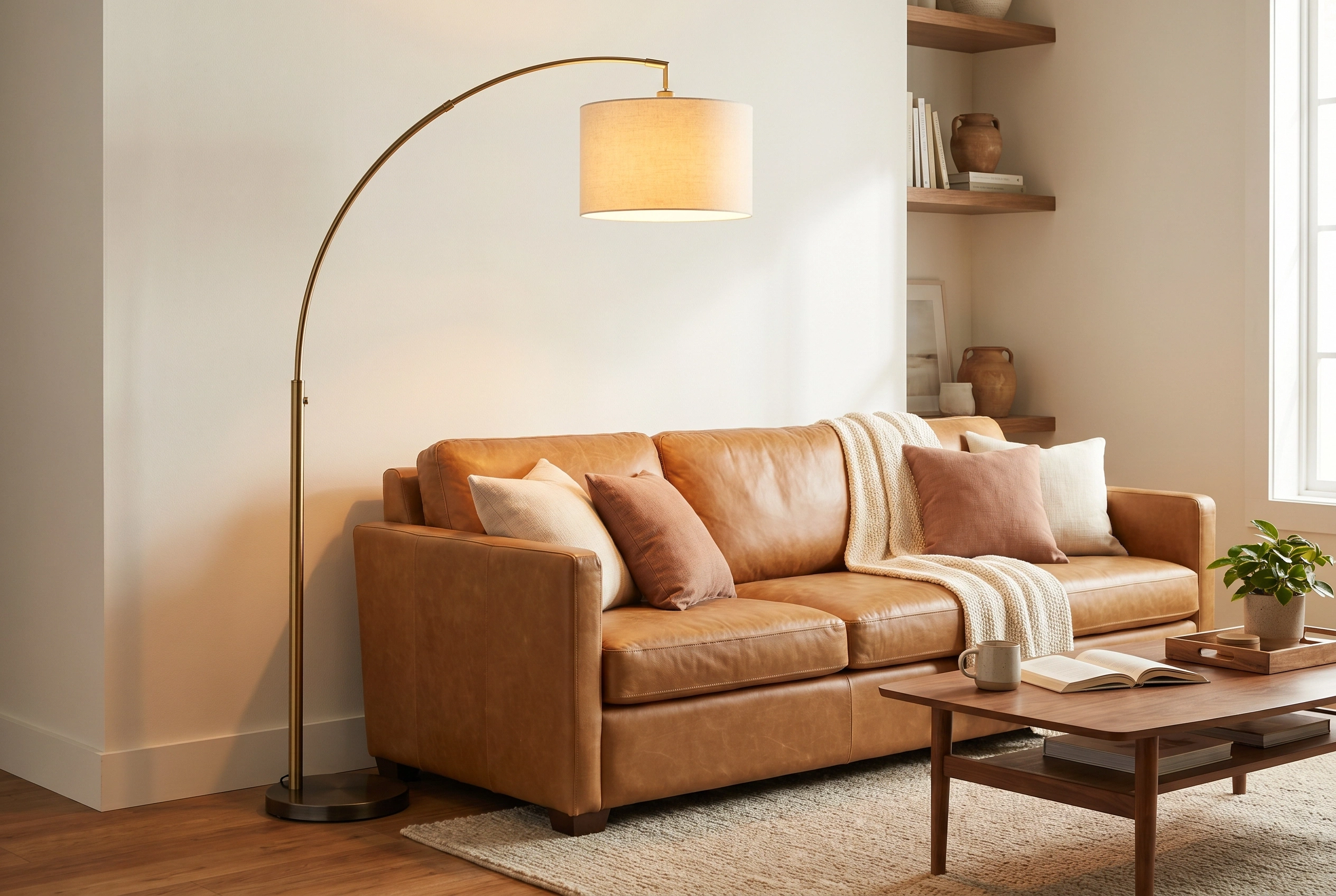
A brushed brass arc floor lamp positioned to curve over one end of your tan leather couch does two things simultaneously: it fills an empty corner without adding visual weight at floor level, and it casts a warm, amber glow directly over the seating area that makes the leather look genuinely beautiful. Tan leather and brass share the same warm, golden undertone family — they reinforce each other the way a well-chosen accessory ties together an outfit. The room immediately feels more considered.
Position the arc so the lamp head falls centered over the seat cushions at roughly eight to nine feet from the floor — intimate enough to feel layered, high enough not to be obtrusive when seated. Choose a linen or cream drum shade over a metal reflector; soft shades diffuse light gently and keep the glow warm and enveloping rather than directional and spotlit. West Elm’s mid-range brass arc floor lamps are a frequent presence in living room styling boards on Pinterest, and comparable versions are available at HomeGoods for under $90.
5. Pair It with a Live-Edge Wooden Coffee Table
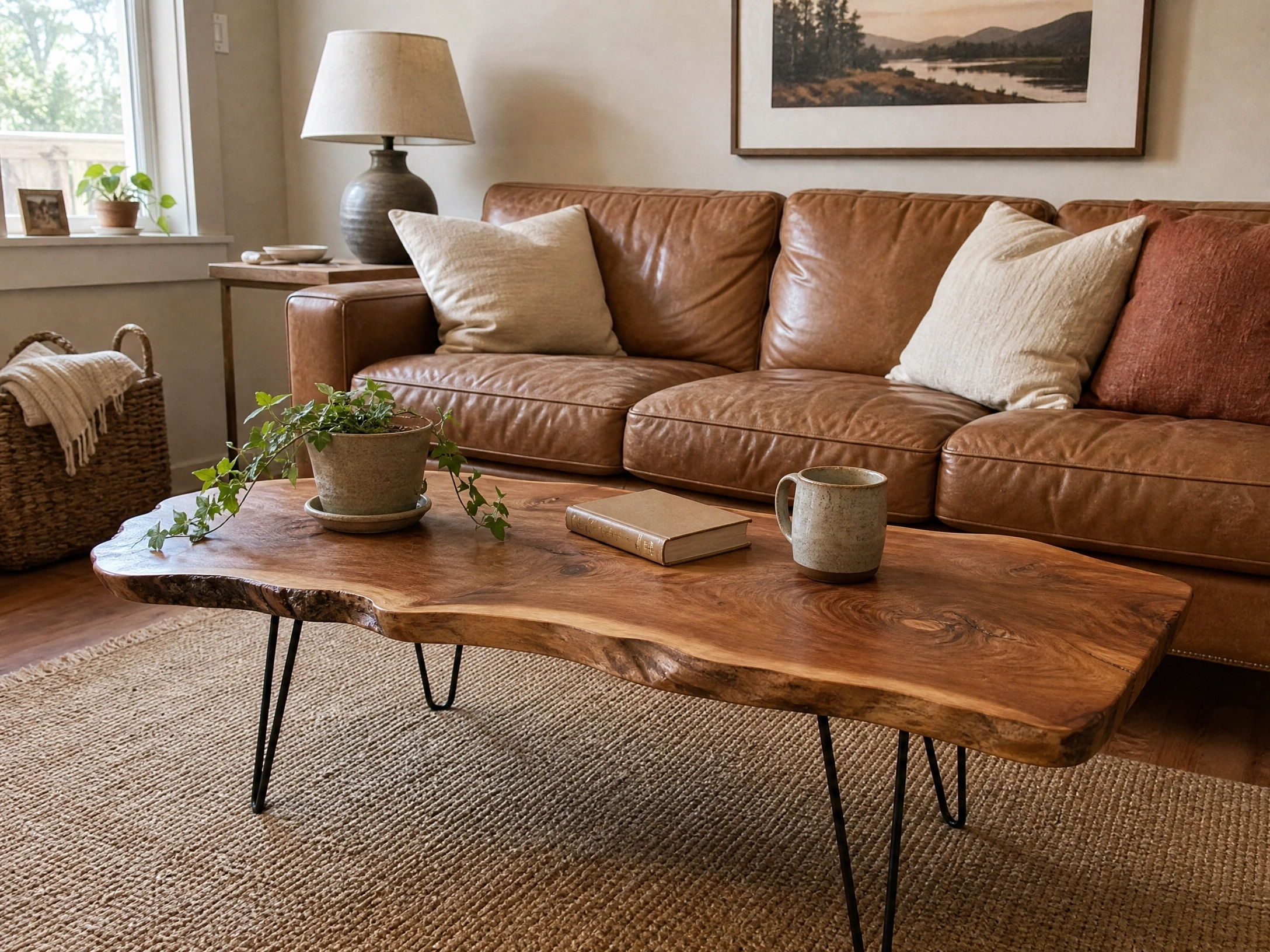
A live-edge wooden coffee table pulled up in front of a tan leather couch is a furniture pairing that feels inevitable once you see it together. The raw, organic edge of a slab-cut walnut or acacia wood piece echoes the natural origin of leather, and both materials carry that slightly imperfect, handcrafted quality that makes a room feel warm and lived-in rather than catalog-perfect. The uneven natural edge adds visual interest at the center of the seating area without competing with the sofa for dominance.
A mid-tone walnut or honey-toned acacia works best — avoid very dark espresso finishes, which can feel heavy against tan leather and muddy the overall palette. If a solid live-edge slab is outside your budget, look for live-edge-style coffee tables with a thin slab top and black metal hairpin legs. These hybrid pieces are widely available at World Market and Wayfair for $150–$250 and deliver the organic warmth of natural material without the high-end price commitment. A small potted plant or trailing vine on the table completes the nature-forward look.
6. Build a Warm Gallery Wall of Abstract Art Above the Couch
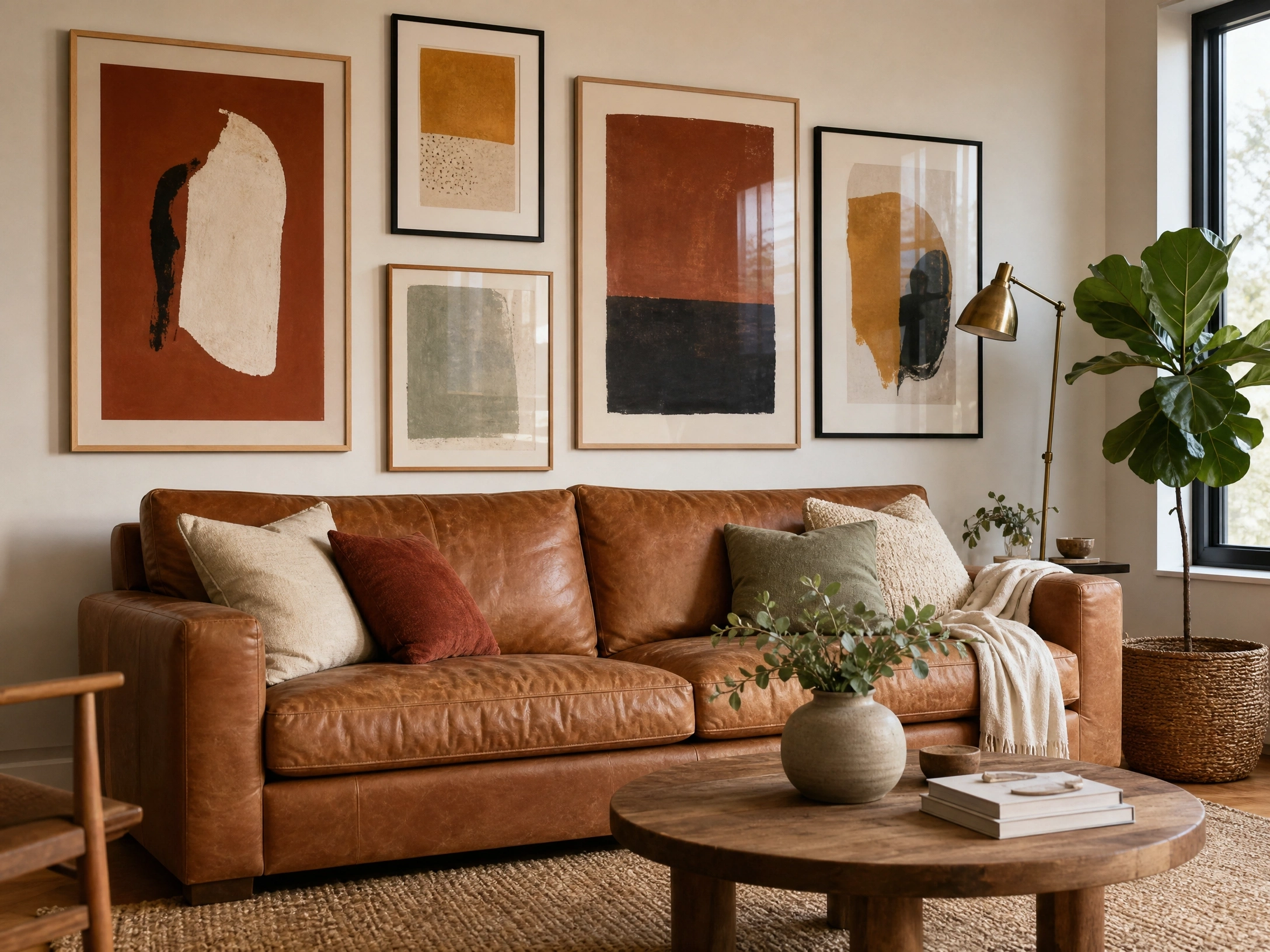
A gallery wall of abstract art above a tan leather couch is a high-impact move that requires zero wall renovation — just a hammer, a level, and some thoughtful curation. Choose prints that pull from a warm palette: earthy terracotta, muted gold, deep rust, dusty sage, or warm ivory. Three to five pieces in coordinating but non-matching frames — warm oak, matte black, and natural wood mixed together — creates that layered, collected-over-time look that feels genuinely personal rather than shopped all at once from the same display wall.
Keep the largest piece of the arrangement at eye level when seated — roughly 57 to 60 inches from the floor to the center. Lay the full gallery out on the floor before committing any nail to the wall; this single step saves enormous frustration during hanging. Society6 and Etsy have extensive libraries of printable abstract art in earth-tone palettes for $5–$25 per print. Frame them in IKEA RIBBA frames and you have a full gallery wall for under $75 — one that photographs strikingly well above a warm leather sofa.
7. Dot the Room with Terracotta Pots and Trailing Plants
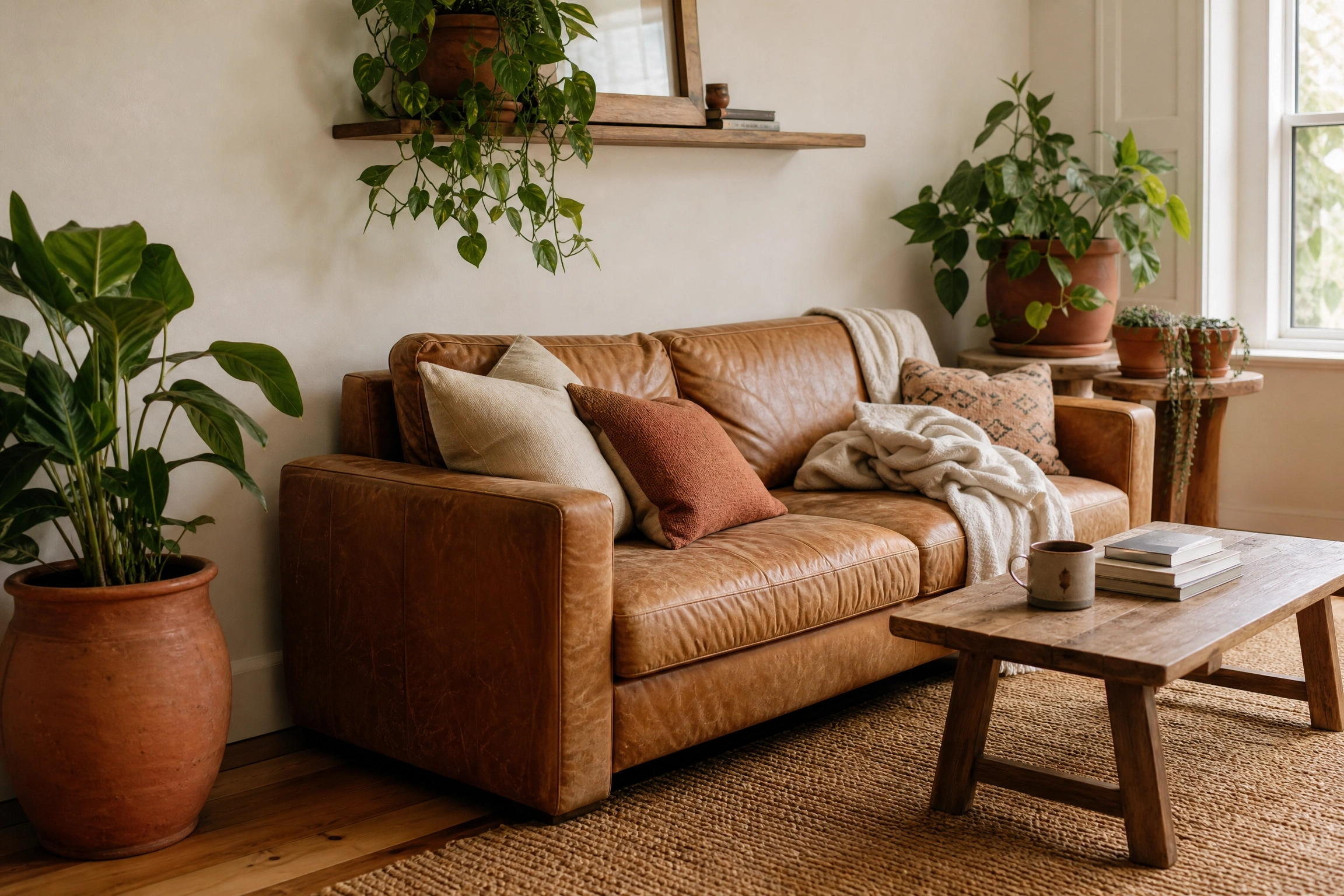
Terracotta pots — whether glazed in a warm matte finish or left raw and earthy — are one of the most affordable and visually effective styling additions to a room built around a tan leather couch. The clay tone of terracotta sits in the same warm, earthy family as tan leather without being matchy-matchy; the two complement each other naturally, like two pieces from the same color family worn in different shades. Place a pair of medium-sized terracotta planters flanking either end of the couch, or arrange a trio of varying sizes on the side table for a staggered, organic display.
Trailing plants like pothos, heartleaf philodendron, or string of pearls spill softly over the edge of a pot and bring an organic, living texture that softens the structured lines of leather furniture. Pothos is particularly forgiving — it thrives in low to medium light, needs watering only once a week, and cascades generously from a shelf or side table beside the sofa. Target’s Studio McGee × Threshold collection carries matte terracotta pots starting at $12–$25, and they consistently photograph as though they cost three times that amount.
8. Back It Against a White Limewash or Plaster Accent Wall
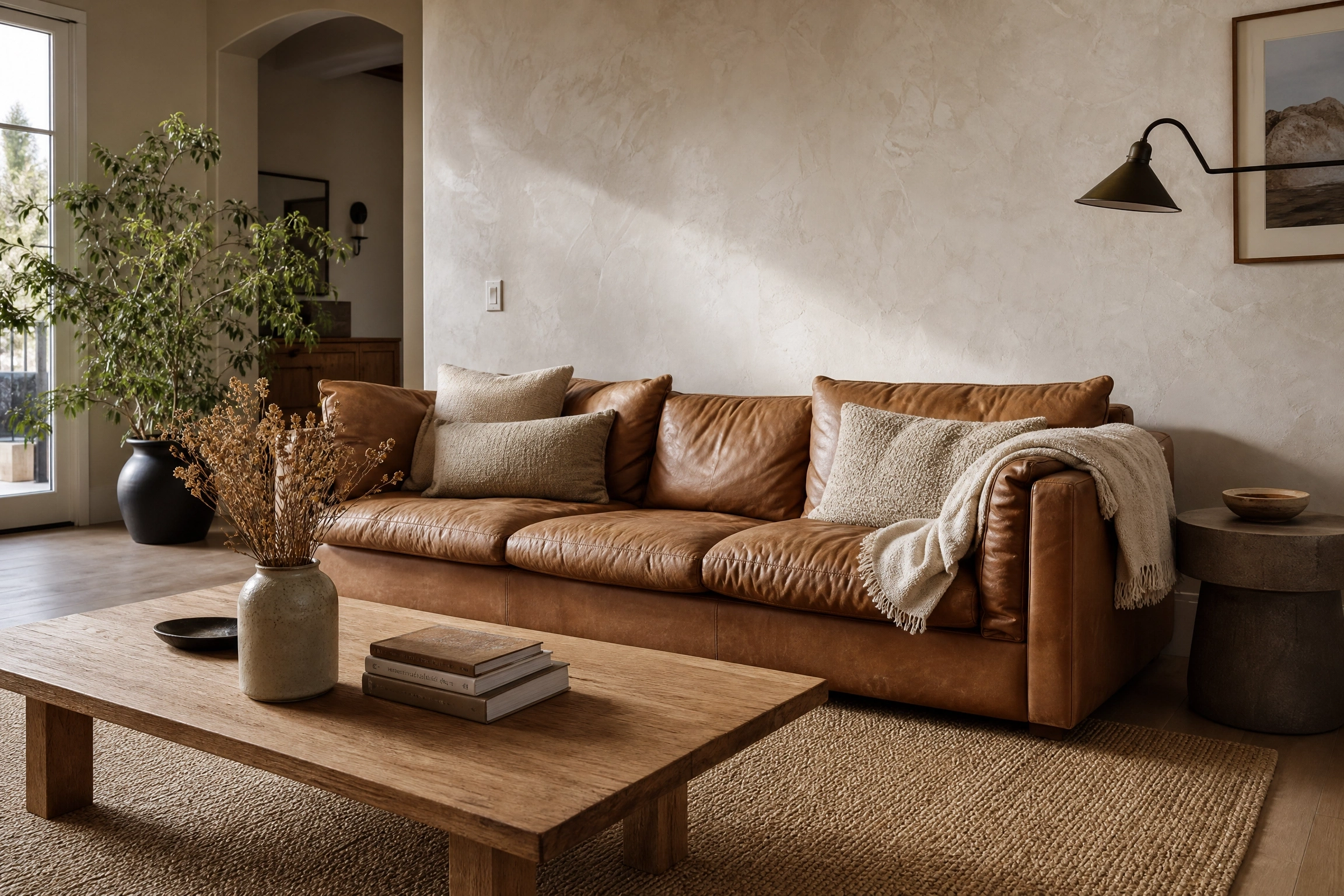
A white limewash or Venetian plaster accent wall behind a tan leather couch creates one of the warmest, most textured backdrops you can give a leather sofa. The slightly uneven surface of limewash catches light differently throughout the day — sometimes reading warm white, other times soft putty or pale sand — which means it shifts in harmony with the natural glow of the tan leather rather than creating a flat, static backdrop. The wall reads as a texture more than a color, which adds depth without adding visual noise.
Limewash paint is surprisingly beginner-friendly; brands like Portola Paints and Romabio offer it in quart sizes you apply with a wide brush in random overlapping strokes. A single accent wall typically requires $40–$80 in materials — one of the most affordable statement-wall options available. For renters who can’t paint, a large-format peel-and-stick wallpaper in a cream or plaster-effect print from Spoonflower or Amazon approximates the look without any landlord friction. The result in either version is warm, layered, and distinctly current.
9. Try a Deep Navy Accent Wall for a Moody, Dramatic Look
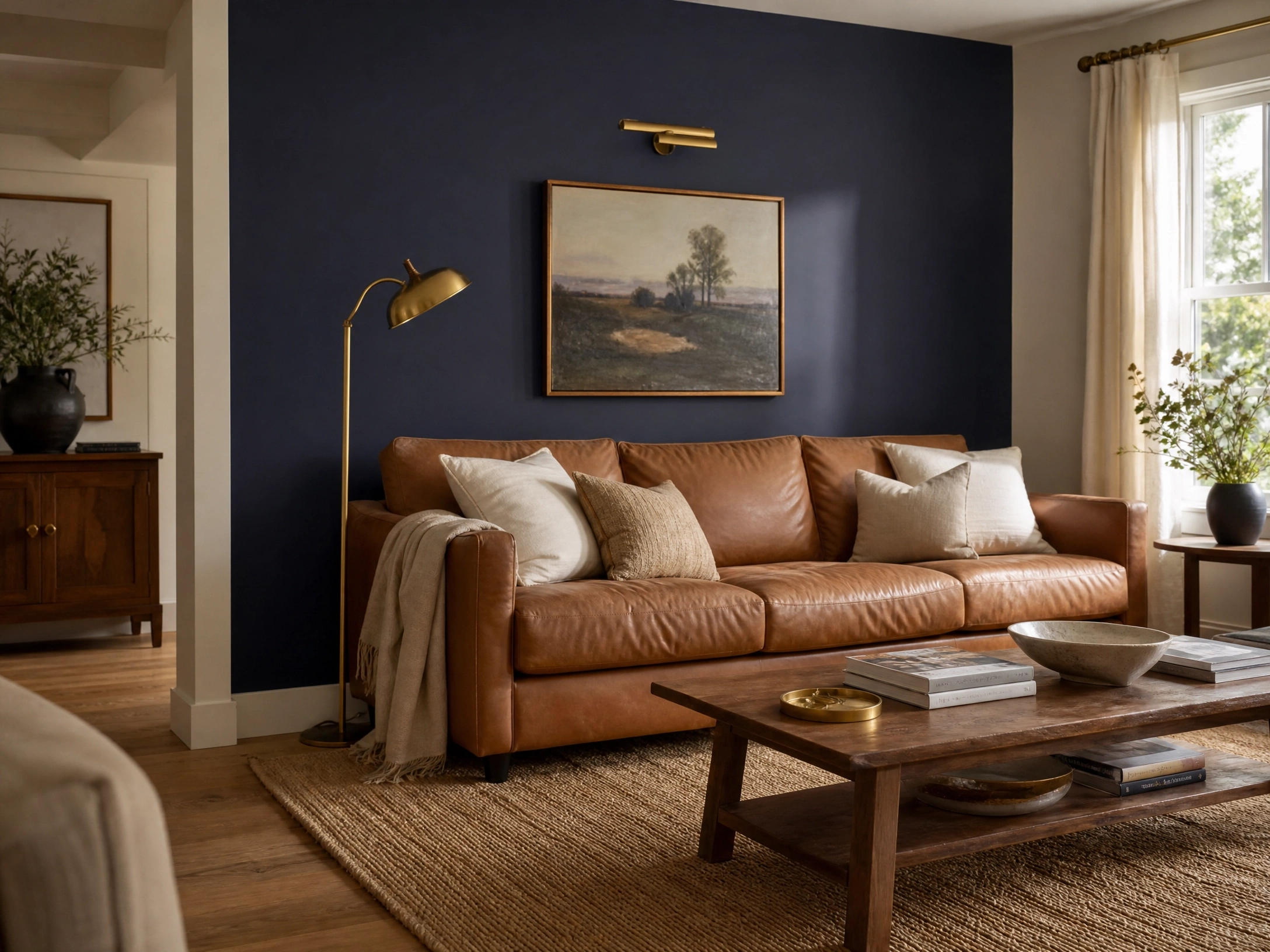
Painting the wall directly behind your tan leather couch in a deep, saturated navy creates a striking contrast that feels immediately more sophisticated and deliberate. Navy sits on the cooler, complementary end of the spectrum from tan leather’s warm amber, and that contrast tension is what gives the room its visual energy. The leather doesn’t disappear against the dark wall — instead, it glows noticeably warmer, almost golden, as the deep blue makes the tan undertone look richer than it does against white.
Benjamin Moore’s Hale Navy (HC-154) and Sherwin-Williams’ Naval (SW 6244) are both widely beloved in this color family and worth sampling before committing. A peel-and-stick paint sample swatch ($5) is infinitely more reliable than guessing from a tiny chip. For renters, deep navy removable wallpaper from Chasing Paper or Tempaper peels off cleanly with no wall damage. Pair the navy wall with brass hardware, cream linen pillows, and a natural jute rug to keep the overall palette warm rather than cold and dungeon-adjacent.
10. Toss a Plush Sheepskin Rug Across the Seat Cushions
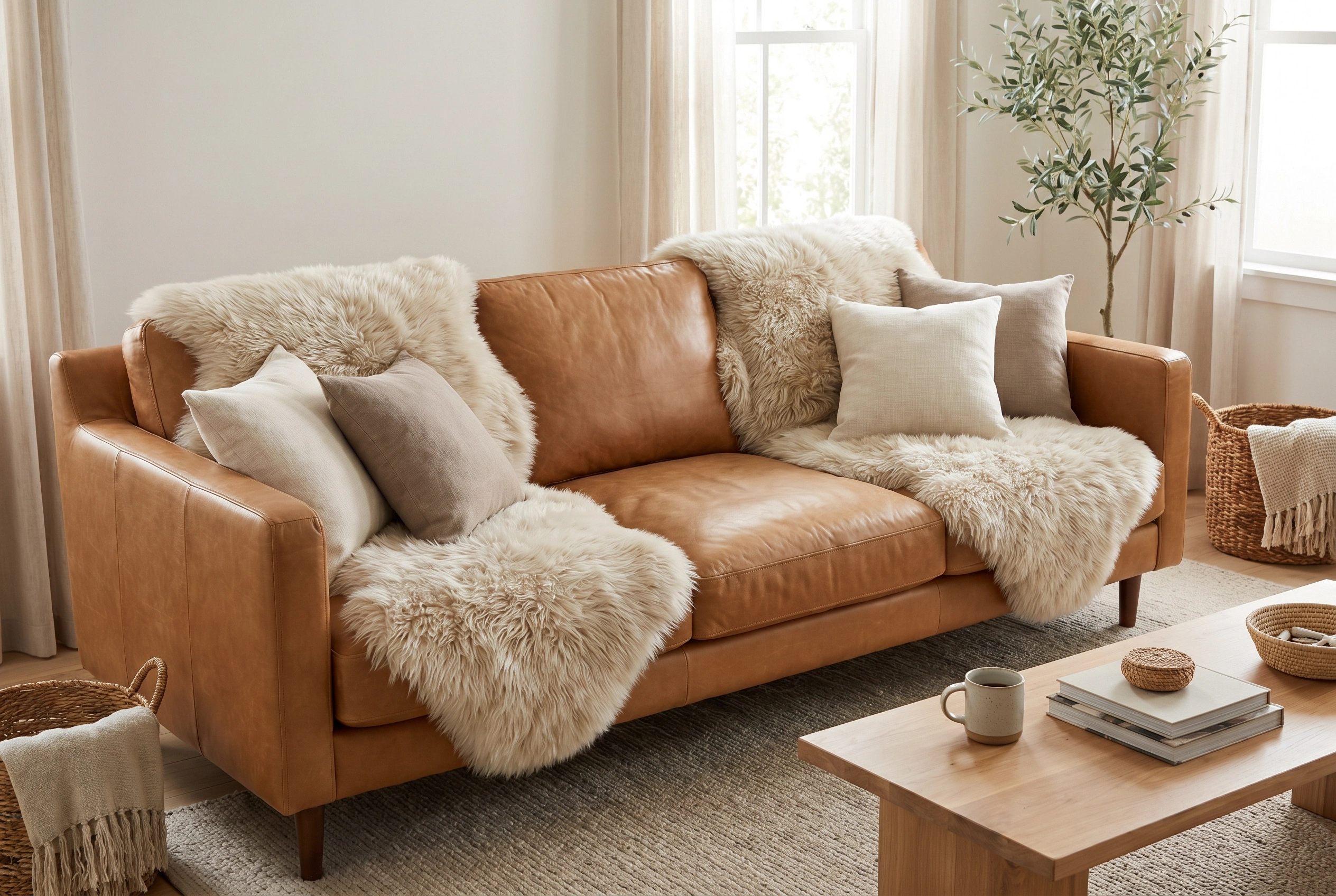
A sheepskin throw draped across the seat cushions of a tan leather couch is one of the fastest texture contrasts you can add — and it looks significantly more intentional than it might sound. The long, fluffy pile of a natural or faux sheepskin against the smooth, cool leather surface creates a tactile layering moment that makes the couch look immediately more inviting and visually interesting. White, ivory, and soft oatmeal sheepskin shades all complement tan leather without competing with its color or drawing attention away from it.
Drape the sheepskin across the back two-thirds of the seat cushions so the front edge falls naturally toward the floor — this keeps the look relaxed and organic rather than placed. A single small sheepskin, roughly 2×3 feet, is enough for one side of a sofa; two smaller pieces positioned symmetrically on either end creates a more balanced arrangement. IKEA’s RENS faux sheepskin rug starts at under $30, is machine-washable, and is nearly indistinguishable from the real thing in photographs or at typical viewing distance in a room.
11. Hang a Natural Rattan Pendant Light Overhead
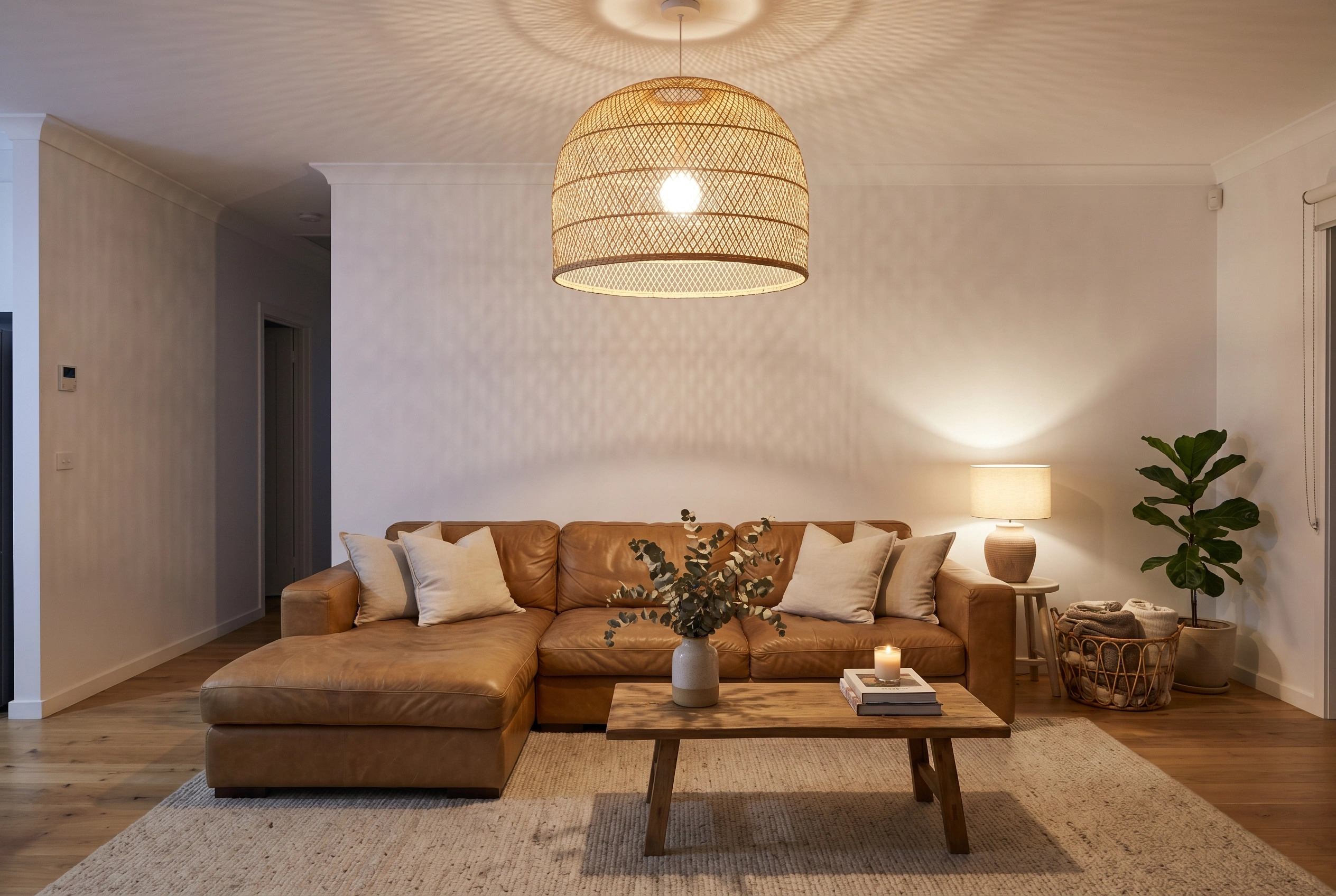
Swapping out a dated or generic overhead fixture for a natural rattan or woven pendant instantly shifts the tone of the entire room above your tan leather couch. Rattan’s warm, honeyed color and open woven texture filter light softly through the gaps, casting dappled, warm shadows on the ceiling that give the room a gentle, almost candlelit atmosphere in the evenings. It also introduces handcrafted organic texture at a visual height where rooms often feel the most blank — and that’s exactly what leather furniture needs to feel connected to the full room rather than isolated on the floor.
Rattan pendants work best with warm-white bulbs around 2700K, rather than cool daylight bulbs that fight the amber quality of both the fixture and the leather. A diameter of 16 to 24 inches looks proportional over most living room seating arrangements. McGee & Co., Serena & Lily, and Amazon all carry rattan pendants at different price points; even a mid-range option in the $60–$100 range elevates the room far more dramatically than its price suggests, and it photographs beautifully in both natural and warm evening light.
12. Style with Sage Green Cushions and Dried Eucalyptus Stems
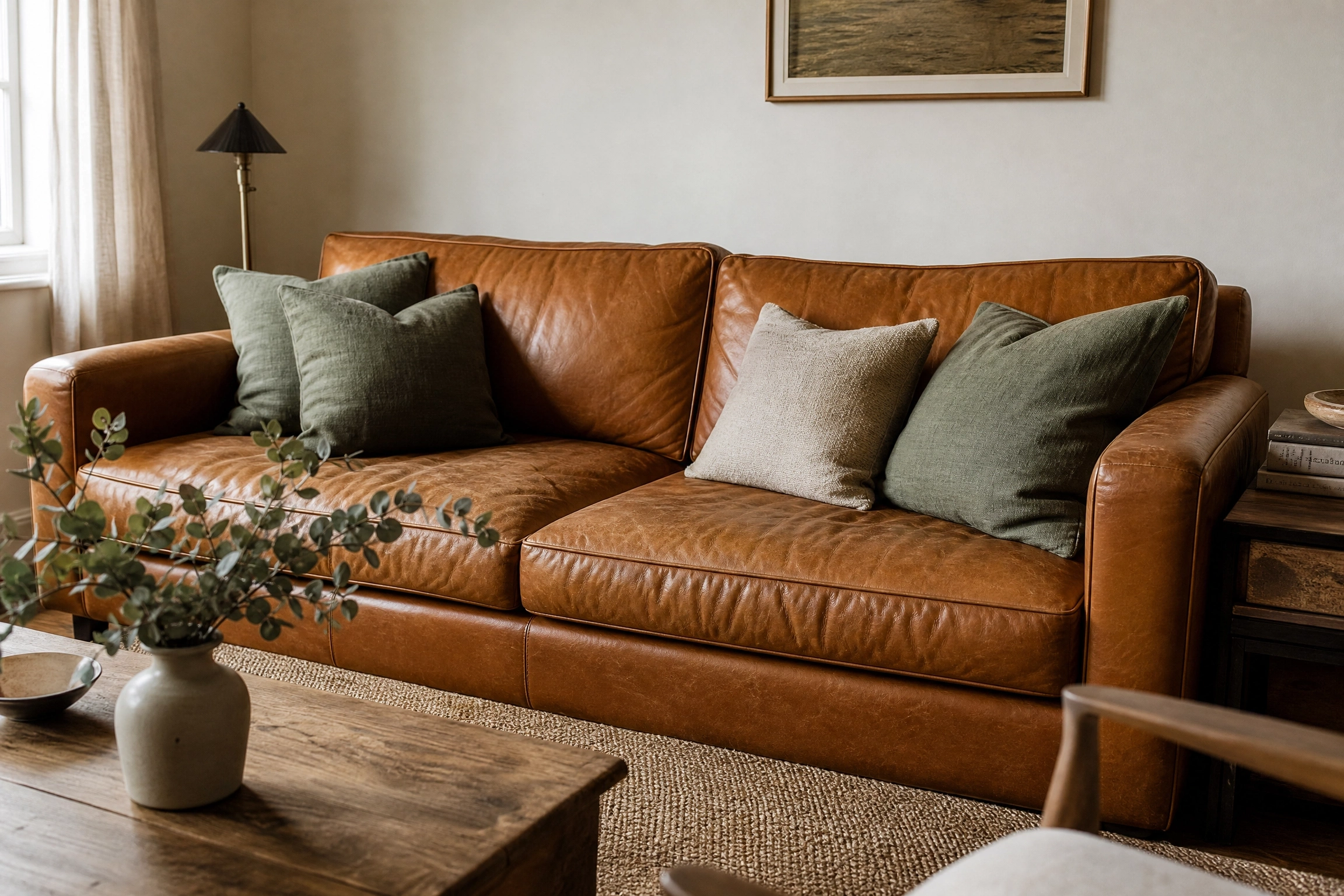
Sage green is the softer, more muted alternative to forest green when you want color on your tan leather couch without high contrast. Its slightly gray-green undertone keeps it from feeling too warm or too cool — it sits right in the middle, making it versatile enough for rooms with both warm and neutral lighting conditions. Two or three sage linen-blend cushion covers in a 20×20 size arranged across the sofa give the room a calm, editorial quality that photographs beautifully and feels elevated without requiring much effort.
Add a small ceramic vase of dried eucalyptus stems to the coffee table or side table nearby — the silvery-green of the dried leaves picks up the sage tone from the pillows and ties the two elements together effortlessly. Dried eucalyptus costs $8–$15 at a grocery store or craft shop, lasts for months with zero maintenance, and adds a subtle herbal scent in the first few weeks. Pair the sage cushions with a warm cream companion pillow, and the resulting palette — sage, cream, tan — works beautifully in almost any lighting situation.
13. Go Mid-Century Modern with a Walnut or Teak Side Table
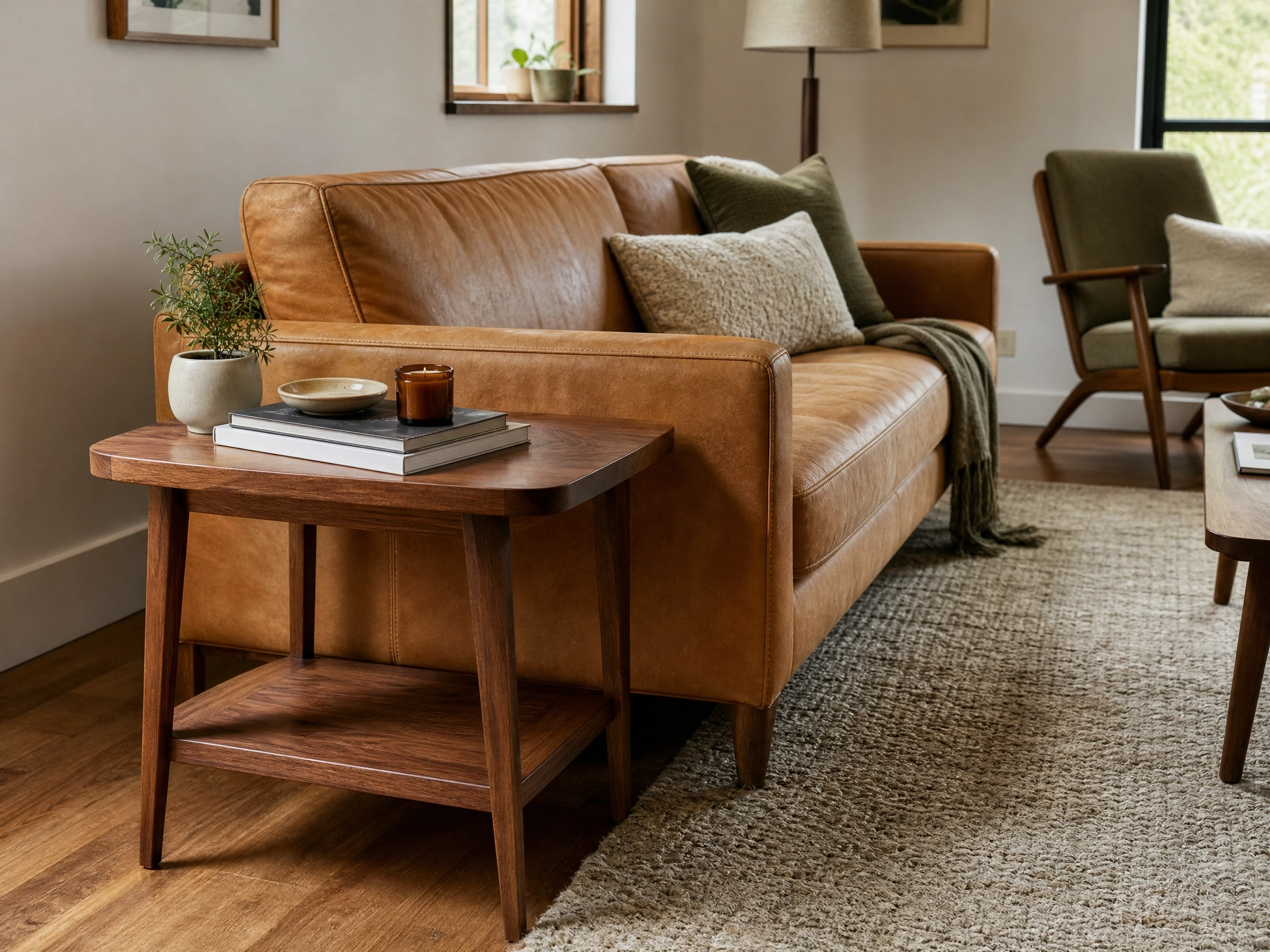
Mid-century modern is one of the cleanest and most effective design directions to build around a tan leather couch — and a walnut or teak side table is the piece that makes the whole aesthetic land. The warm, medium-brown tones of walnut complement the golden undertone in tan leather without matching it too closely, while the tapered legs and clean geometric silhouette of a classic mid-century side table add structure and visual intention to the space. The result feels warm, timeless, and anything but dated.
Position the side table to the left or right of the couch at armrest height — roughly 24 to 26 inches tall for most standard sofa arms. Style the top simply: a small round tray, a stacked book or two with interesting spines, and a warm-toned candle or small potted plant. IKEA’s LISABO series and World Market’s mid-century side table range offer authentic-looking walnut-finish options under $100. The walnut-against-tan-leather pairing reads beautifully both in real life and in smartphone room photography, which matters if you’re documenting the room’s evolution.
14. Build a Boho Corner with Macrame Wall Art and Trailing Pothos
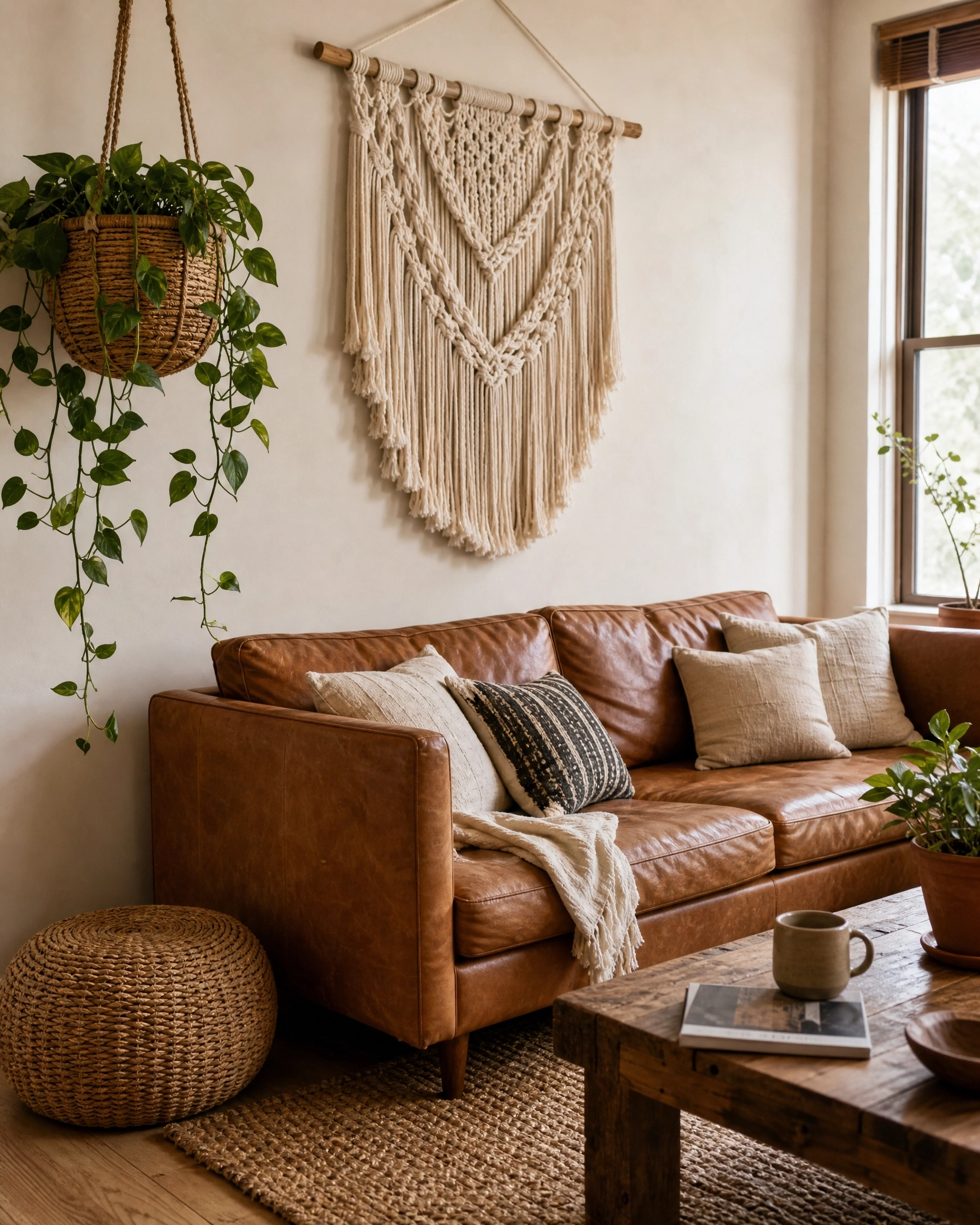
A boho corner built to one side of your tan leather couch — a large macrame wall hanging, a trailing pothos in a woven hanging planter, maybe a small rattan pouf on the floor — creates a soft, textured visual backdrop that makes the leather sofa feel right at home rather than out of place in an earthy, organic room. Macrame’s neutral cream and natural off-white tones align perfectly with tan leather’s warm base, and the layered rope texture adds wall depth without needing paint or wallpaper.
Hang the macrame piece centered behind the sofa at 12–15 inches above the top of the couch back — close enough to feel connected to the furniture below, not so close it looks crowded. Layer in a trailing pothos or heartleaf philodendron in a woven or rattan planter on one side for the full effect. Etsy is the best source for handmade macrame wall hangings in the 24–36 inch width range, typically priced $35–$90 for a piece substantial enough to anchor an entire boho corner.
15. Contrast It with a Black Iron Coffee Table for Industrial Edge
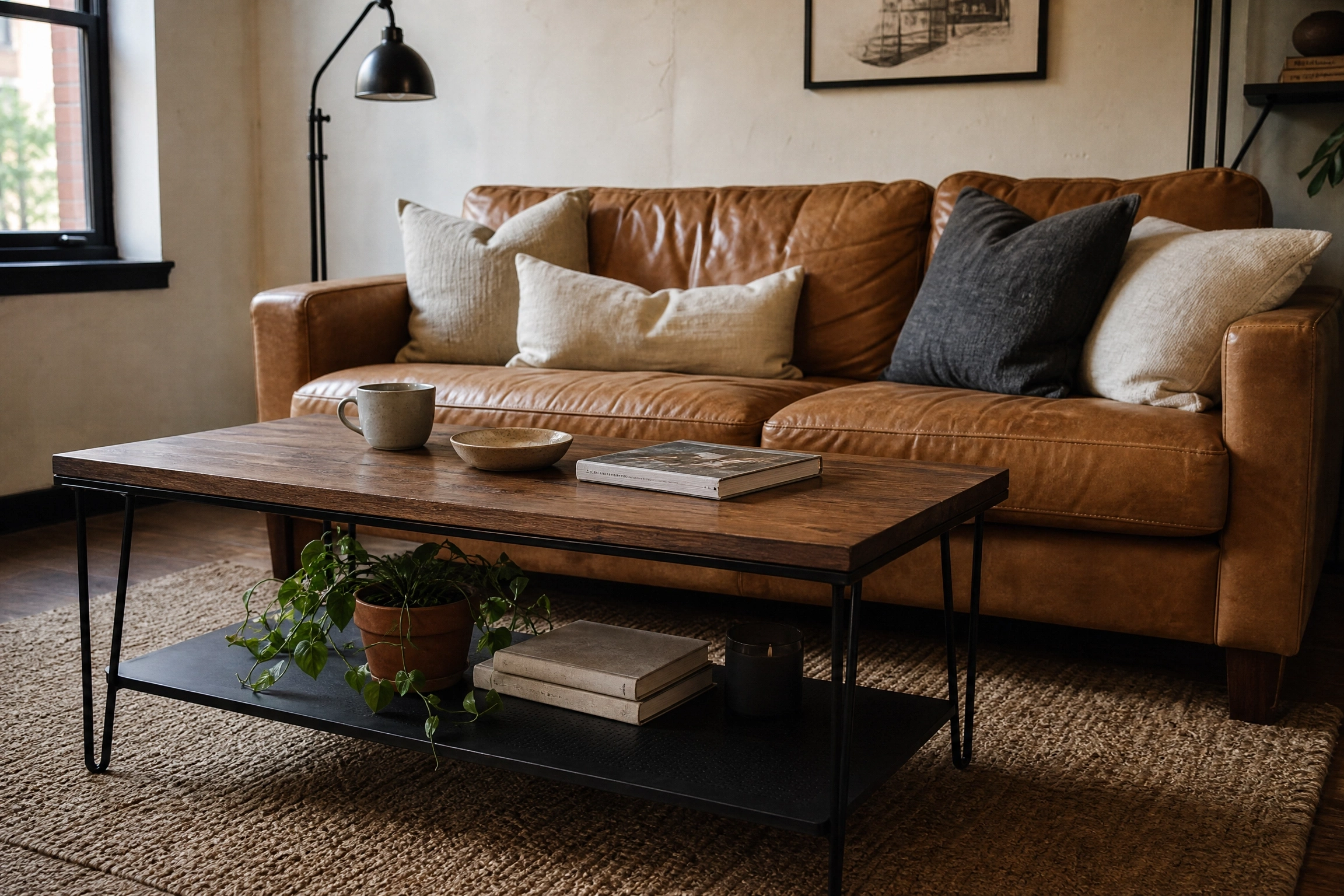
A matte black iron coffee table placed in front of a tan leather couch is a bold styling move that introduces a slight industrial edge — without making the room feel cold or harsh. The stark contrast between cool matte black and warm tan leather is exactly where the visual interest lives, and both materials carry a raw, slightly unfinished quality that makes them natural partners. It’s the design equivalent of pairing a leather jacket with black jeans — simple, deliberate, and effortlessly composed without looking like it tried too hard.
Look for a black iron coffee table with a lower shelf for storage — this adds functional value and prevents the piece from reading too sparse or minimal under a large sofa. A hairpin-leg version with a warm wood top in walnut or oak softens the industrial edge if the full-metal version feels too stark for the rest of your room. Style the lower shelf with a stack of linen-covered books, a small trailing plant in a terracotta pot, and a single candle in a matte black holder. Target and Wayfair both offer strong options in the $80–$180 range.
16. Go Monochromatic in Caramel, Tan, and Warm Cream Tones
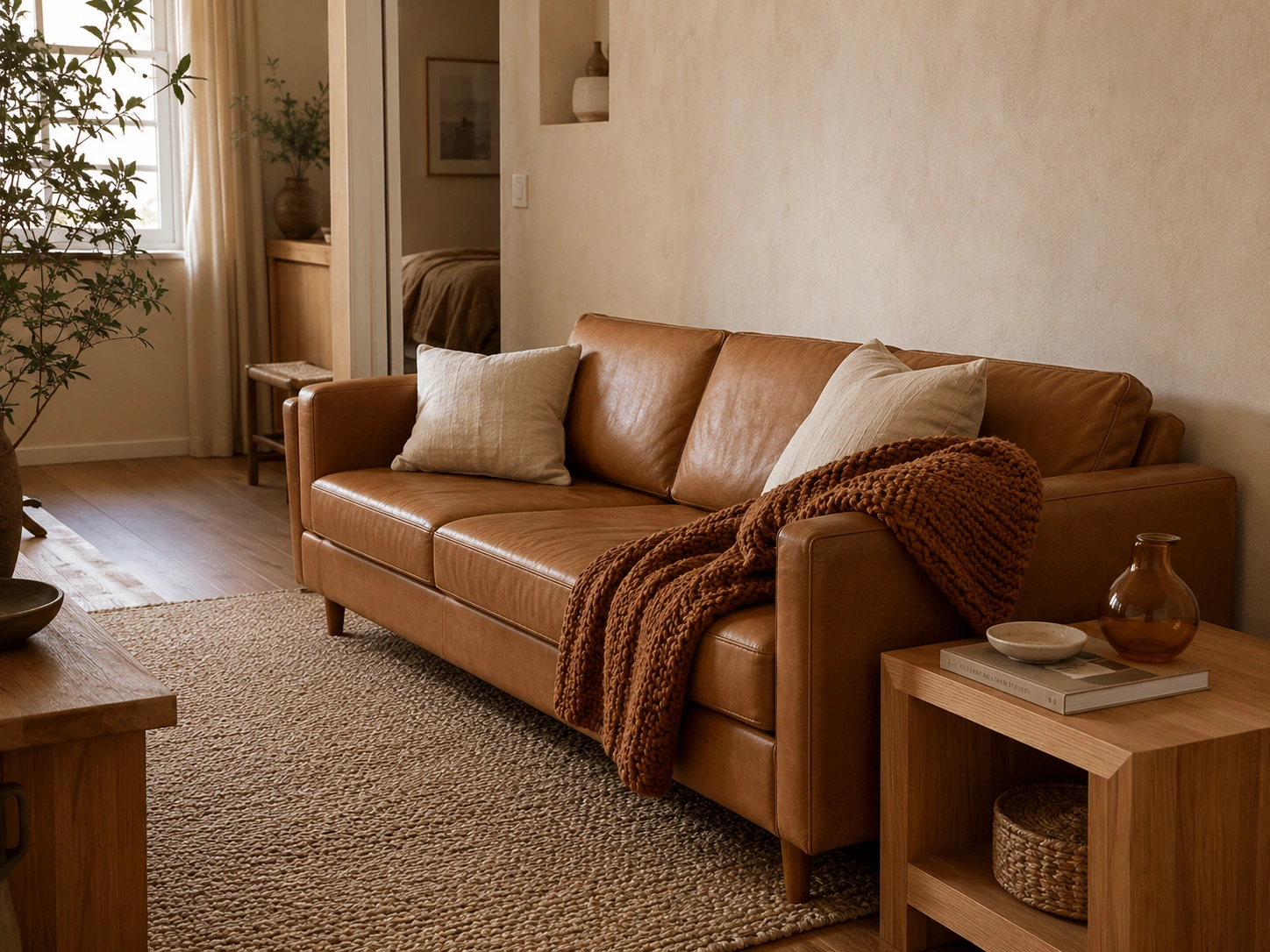
A monochromatic room built entirely within the caramel-to-cream color range is one of the most elegant and fool-proof approaches to a tan leather couch — and it photographs beautifully for both Google image results and Pinterest saves. The key is variation in tone and texture rather than color contrast: cream linen throw pillows, a warm caramel chunky knit blanket, a honey-toned wooden side table, and an oatmeal jute or sisal rug layered underneath. Everything reads within the same warm neutral family, but different materials keep the room from blurring into one indistinct beige mass.
The most common mistake with monochromatic rooms is choosing items too close in tone — so similar they blend into each other rather than layer. Range is the fix: your cream should be noticeably lighter than your tan, which should be visibly lighter than your caramel or amber accent piece. Aim for at least three distinct textures across the room: something woven, something knitted, something smooth. This approach is particularly effective in smaller apartments where introducing bold color in a tight space can feel overwhelming or visually chaotic.
17. Lay Down a Bold Black and White Geometric Rug for Modern Contrast
A high-contrast black and white geometric rug beneath a tan leather couch sounds unconventional until you see how the sharp graphic pattern actually grounds the warm leather rather than competing with it. The black adds the anchoring visual weight the room needs to feel finished, the white keeps things airy rather than cave-like, and the geometric pattern introduces a modern graphic quality that offsets the slightly traditional nature of leather furniture. It’s an unexpected combination that consistently creates a more interesting room than expected.
Balance the visual weight of the geometric rug by keeping everything else in the room warm and soft — cream or ivory throw pillows, a honey-toned accent table, warm white walls, and amber lighting. Let the rug carry the graphic energy while the rest of the room stays in the warm neutral register. Sizing still applies here: a minimum of 8×10 for most living rooms, with the front sofa legs on the rug and the coffee table sitting fully within the rug’s footprint. Rugs USA and Wayfair both carry striking black-and-white geometric options starting around $85.
18. Style Curated Floating Shelves Above the Couch
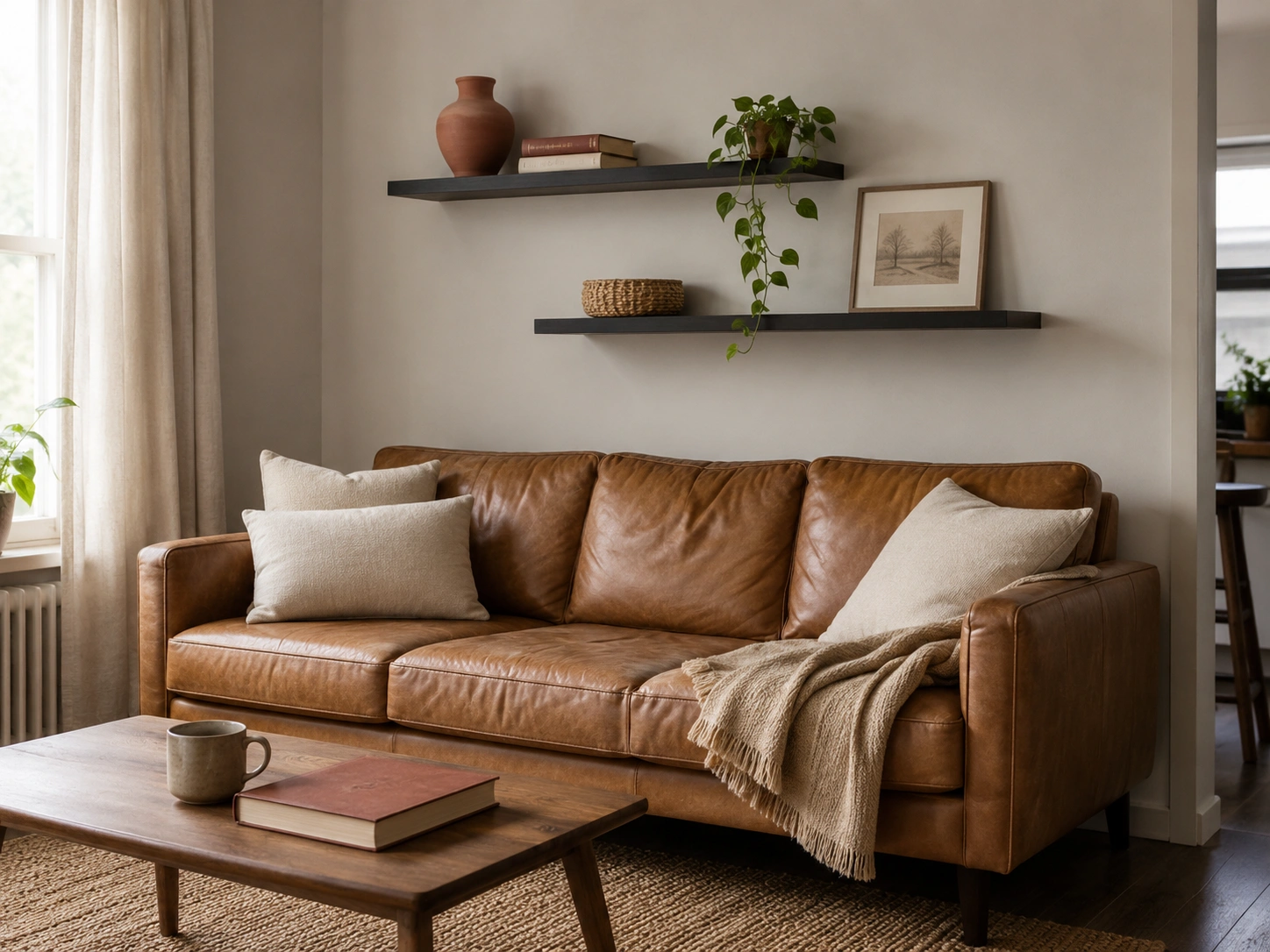
Floating shelves installed above a tan leather couch transform the wall behind the sofa from blank afterthought into an active part of the room’s design narrative. The word “curated” is doing real work here — not cluttered. Style the shelves with a considered mix: a terracotta vase, a trailing small plant, two or three books with coordinating spines, a small woven basket, and a single art print leaned casually against the wall rather than hung. The variation in object heights and materials is what makes a shelf arrangement feel designed rather than randomly assembled.
Keep the lowest shelf at least 10–12 inches above the top of the sofa back so there’s clear visual breathing room between the furniture and the display above it. Two shelves of different lengths look more architecturally interesting than three identically sized shelves stacked directly above one another. For renters, Command adhesive picture-hanging strips hold lightweight shelving up to 16 pounds — more than sufficient for a curated styling arrangement. IKEA’s LACK shelves in black or white cost under $15 each and create a genuinely designer-looking wall for almost nothing.
19. Wrap the Room in a Burnt Orange Throw Blanket
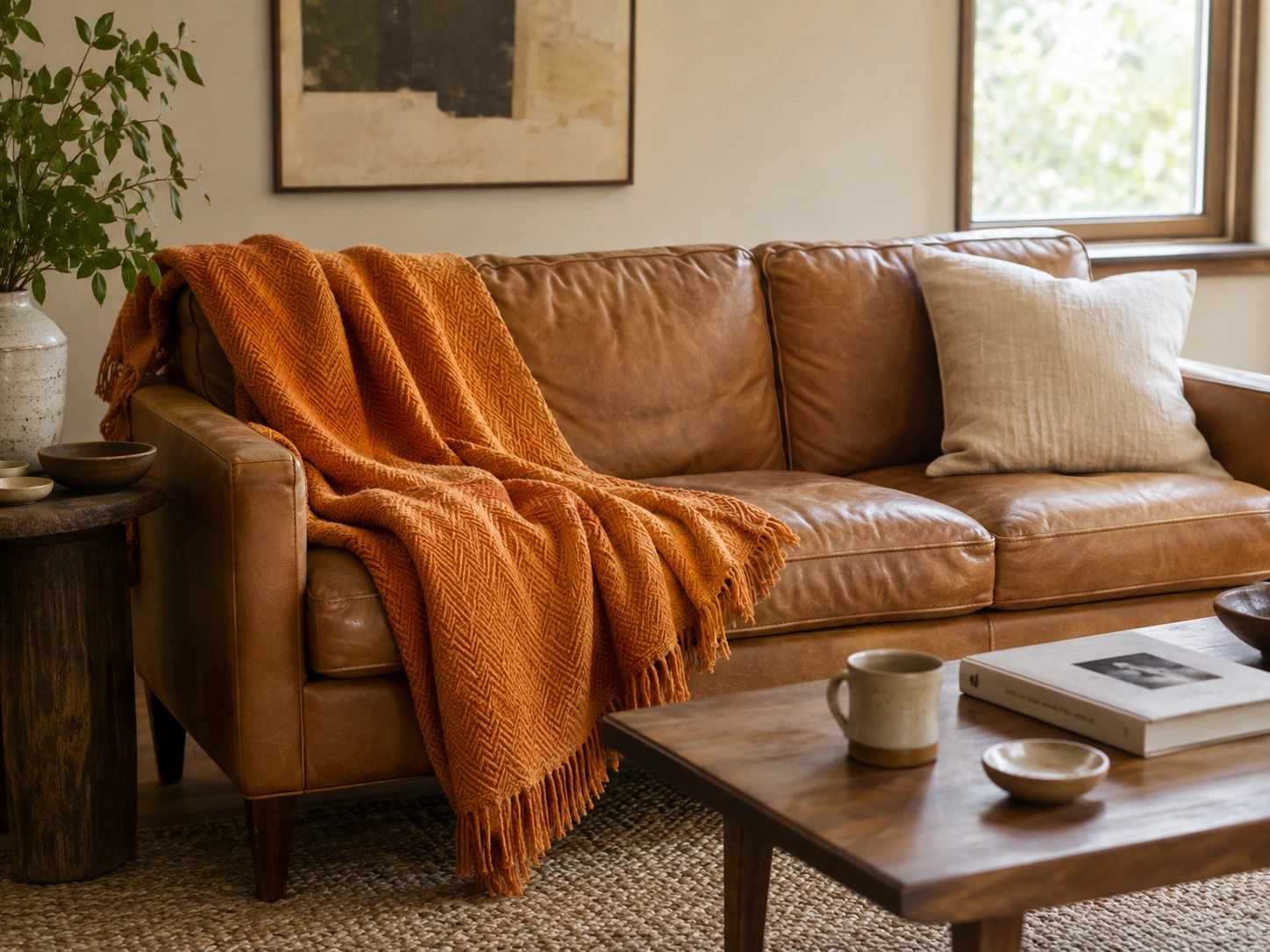
A burnt orange throw blanket draped across the back of a tan leather couch is the kind of styling decision that looks deliberate and Pinterest-worthy at minimal cost and effort. Burnt orange sits in the same warm amber-to-red family as tan leather — they share an undertone — which means the two colors enhance rather than fight each other across the room. The distinction between burnt orange and rust is subtle but real: burnt orange carries more yellow in it, giving it a slightly sunnier, more vibrant quality that reads particularly well in rooms with good natural light.
Drape the throw asymmetrically over one arm and across half the couch — not folded neatly over the back, which looks stiff and retail-display. A chunky woven or herringbone-textured throw in a 50×60 size hits the right scale. Amazon, Anthropologie, and TJ Maxx carry burnt orange throws in various textures and price points, with TJ Maxx in-store being particularly reliable for unexpected color finds. Pair it with a cream or off-white throw pillow at the opposite end of the sofa for warm, balanced color without going full autumn-harvest-festival in the living room.
20. Place It Against a Charcoal Gray Accent Wall
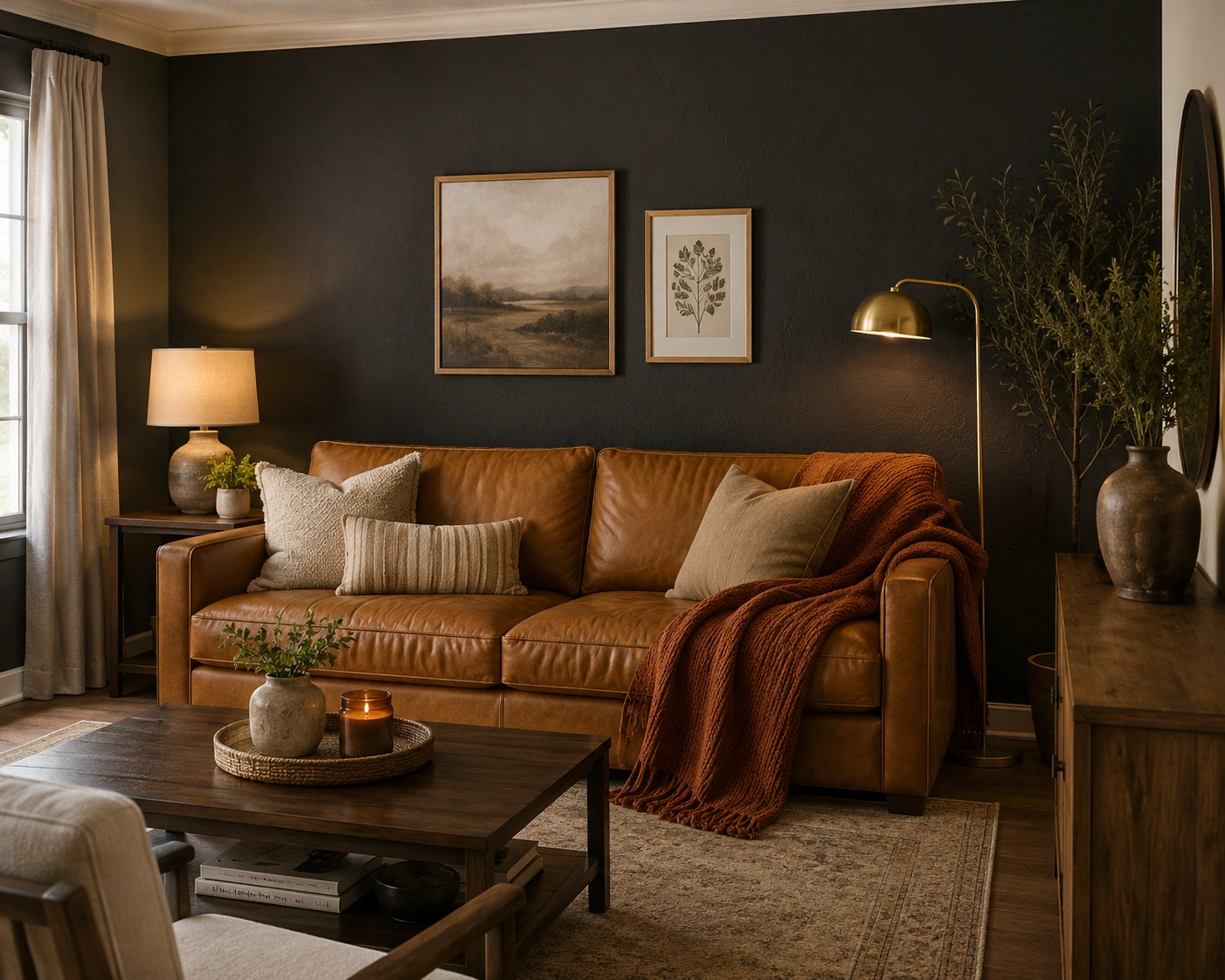
A charcoal gray accent wall behind a tan leather couch is the move you make when you want the room to feel genuinely grown-up and considered. The deep neutral gray doesn’t compete with the tan leather — it recedes, allowing the couch to appear to glow warmer in contrast. This effect is particularly striking in rooms with amber overhead lighting or table lamps with warm bulbs, where the charcoal wall seems to absorb the darkness and release the warmth around the leather and any wood elements in the foreground.
Sherwin-Williams’ Peppercorn (SW 7674) and Benjamin Moore’s Kendall Charcoal (HC-166) are both widely used designer choices in this color direction and worth sampling on the actual wall before committing. Keep everything else in the room warm — cream or tan throw pillows, walnut or oak furniture tones, and brass or amber lighting — to prevent the charcoal from pushing the space toward cold and cave-like. For renters, charcoal peel-and-stick wallpaper in a subtle woven texture from Tempaper achieves a very similar moody quality without a permanent application.
21. Layer Cream, Tan, and Dusty Brown Throw Pillows Together
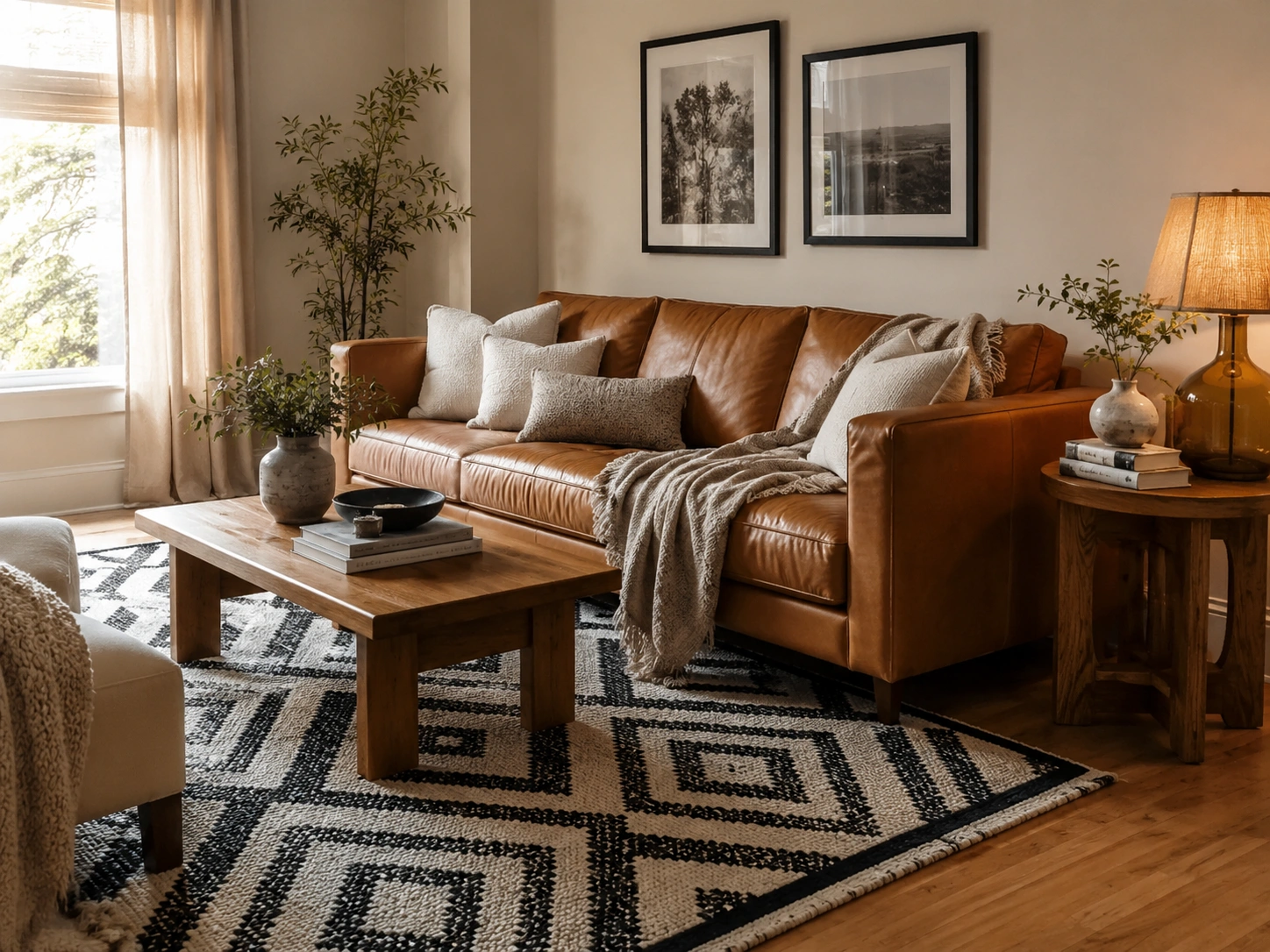
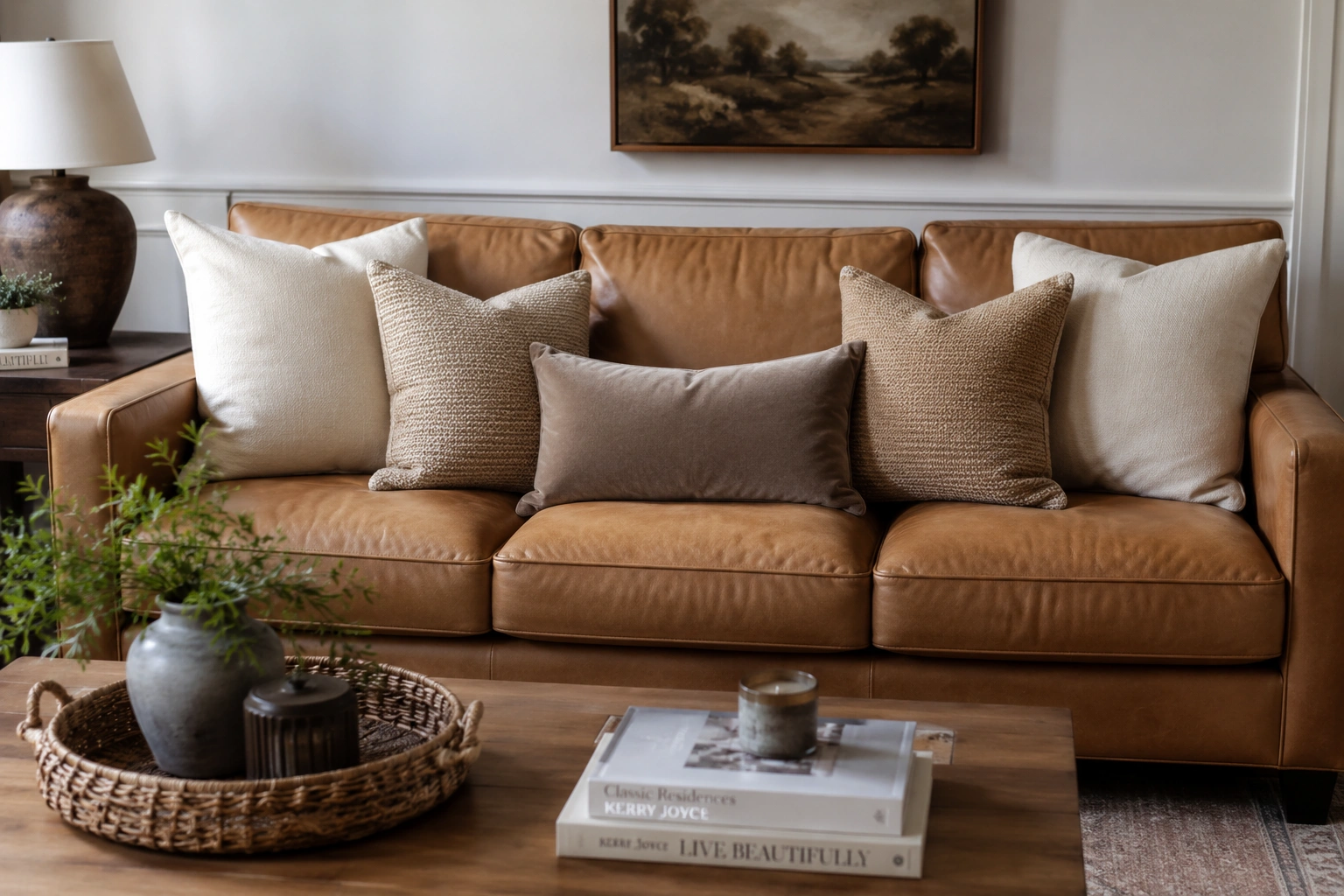
Layering throw pillows in cream, tan, and dusty brown on a tan leather couch creates a tonal, cohesive look that feels intentionally styled without the contrast of introducing a different color family. It might sound like it could disappear visually — all those similar neutrals together — but the texture differences between a cream linen cover, a tan woven jacquard, and a dusty brown velvet pillow create enough variation that each piece reads distinctly against the leather. The overall result is warm, calm, and quietly sophisticated in a way that layered bold colors can’t always achieve.
Use three pillows on a two-seat sofa, five on a three-seat — odd numbers consistently create a more natural, relaxed arrangement than even ones. Vary the sizes: two 20×20 pillows as the back layer, flanked by two 18×18 in the middle, with a smaller 14×18 lumbar pillow at the center front. Texture carries this entire look — every pillow should have a different surface treatment than the one beside it. IKEA and H&M Home both carry neutral-toned cushion covers at accessible prices, and mixing a $6 cover with a $28 one is entirely undetectable in the final result.
22. Swap the Coffee Table for a Dark Espresso Tufted Ottoman
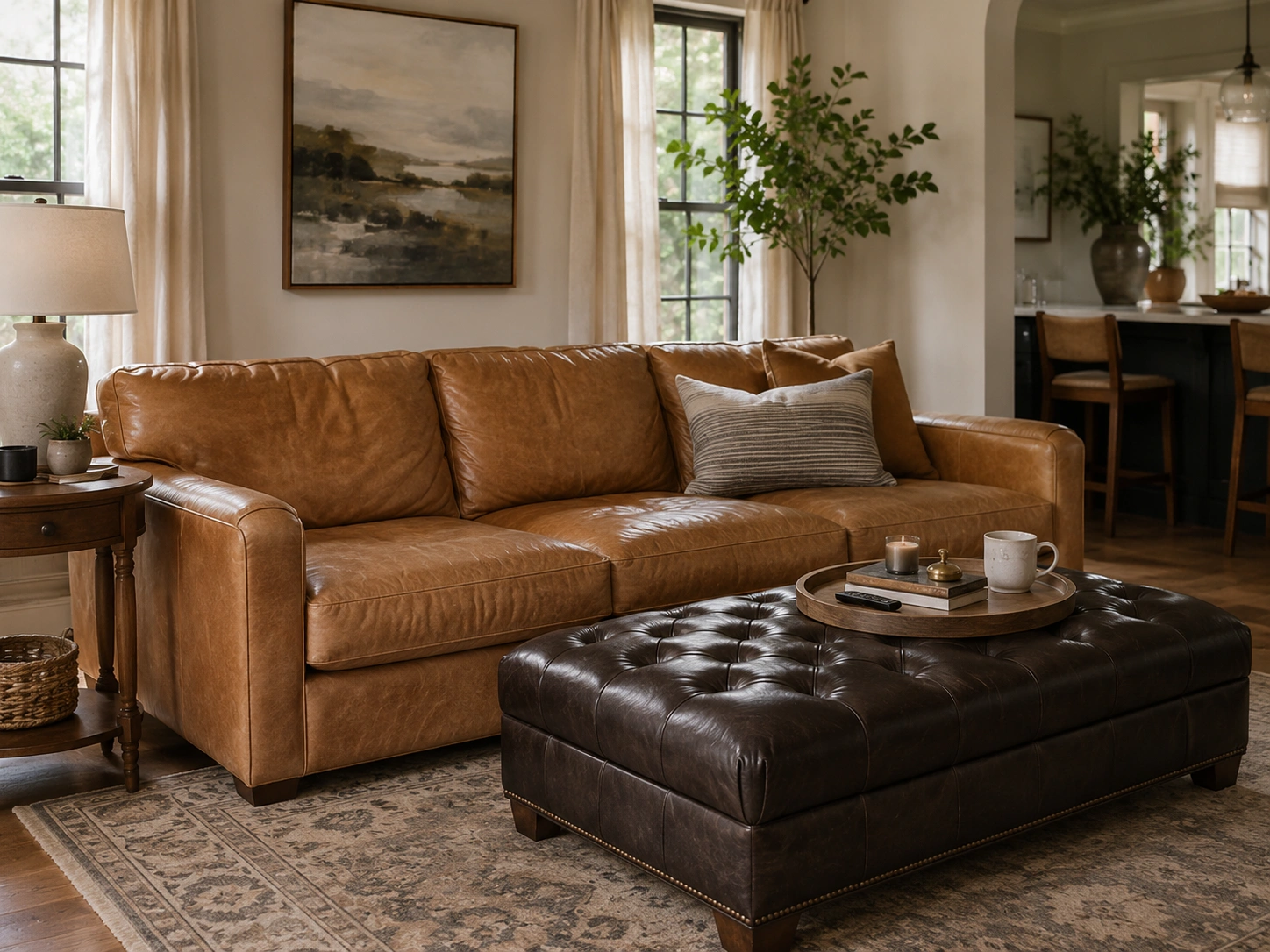
Replacing a standard coffee table with a large, dark espresso tufted ottoman in front of your tan leather couch creates a surprisingly sophisticated pairing. The contrast between the dark espresso and the lighter tan leather provides the visual anchor the room needs at floor level without requiring an entirely different material. Leather against leather in contrasting tones is a classic approach that translates beautifully into interior design — think of it as the interior equivalent of dark brown Oxford shoes paired deliberately with a tan leather belt.
Place a round wooden tray on the ottoman surface to create a stable, defined spot for a coffee mug or remote control. A tray styled with a small candle, a stacked couple of books, and one small decorative object keeps things purposeful without looking cluttered. Aim for an ottoman that’s roughly two-thirds the length of your sofa and 16–18 inches tall for the best proportional balance. World Market and Wayfair carry tufted espresso ottomans in the $120–$200 range that read as significantly more expensive than their actual price point, especially in room photography.
23. Create a Relaxed Coastal Vibe with Linen Pillows and Woven Baskets
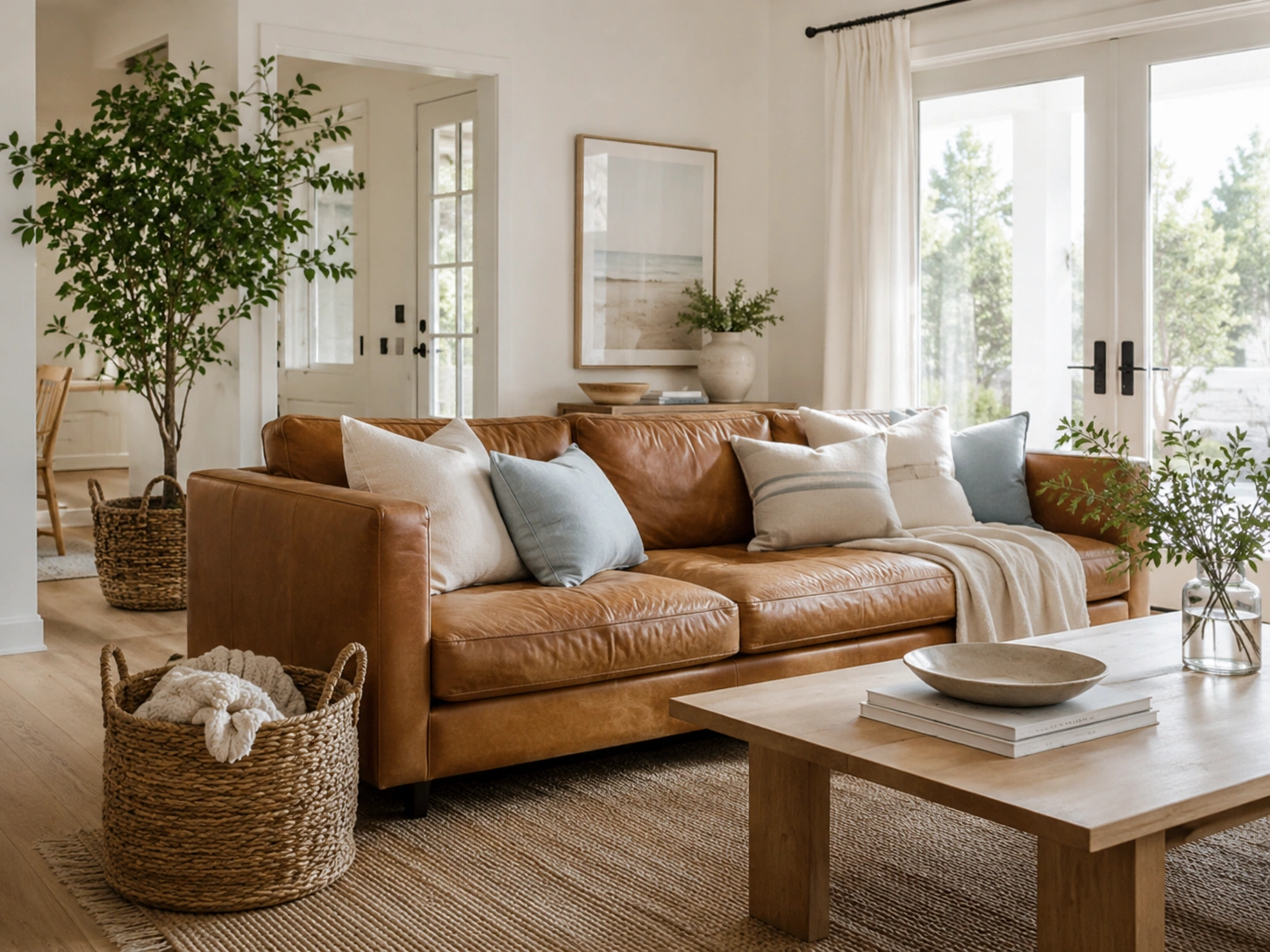
A relaxed coastal look — not the kitschy seashell-and-anchor version, but the clean, sun-bleached, breezy kind found in California or Mediterranean-inspired interiors — works surprisingly well around a tan leather couch. The foundation is washed linen throw pillows in natural, soft white, or muted pale blue; one or two large woven seagrass baskets used as plant holders or throw blanket storage; and minimal, light-toned accessories that let the leather breathe and remain the anchor piece. The overall palette feels warm, fresh, and effortlessly put together.
Choose pillows in a softened blue-gray or salt-white linen rather than bright or icy blue, which will fight tan leather’s warm undertone rather than complement it. Woven seagrass baskets from Target or IKEA ($15–$35) double as functional storage for extra throw blankets or magazines while adding that natural-material texture coastal rooms rely on. This look performs best in south-facing or east-facing rooms with abundant natural light, where the warm leather and the airy linen create a genuine light-meets-warmth balance that photographs strikingly in the mornings.
24. Hang a Bold Abstract Canvas as the Room’s Focal Point
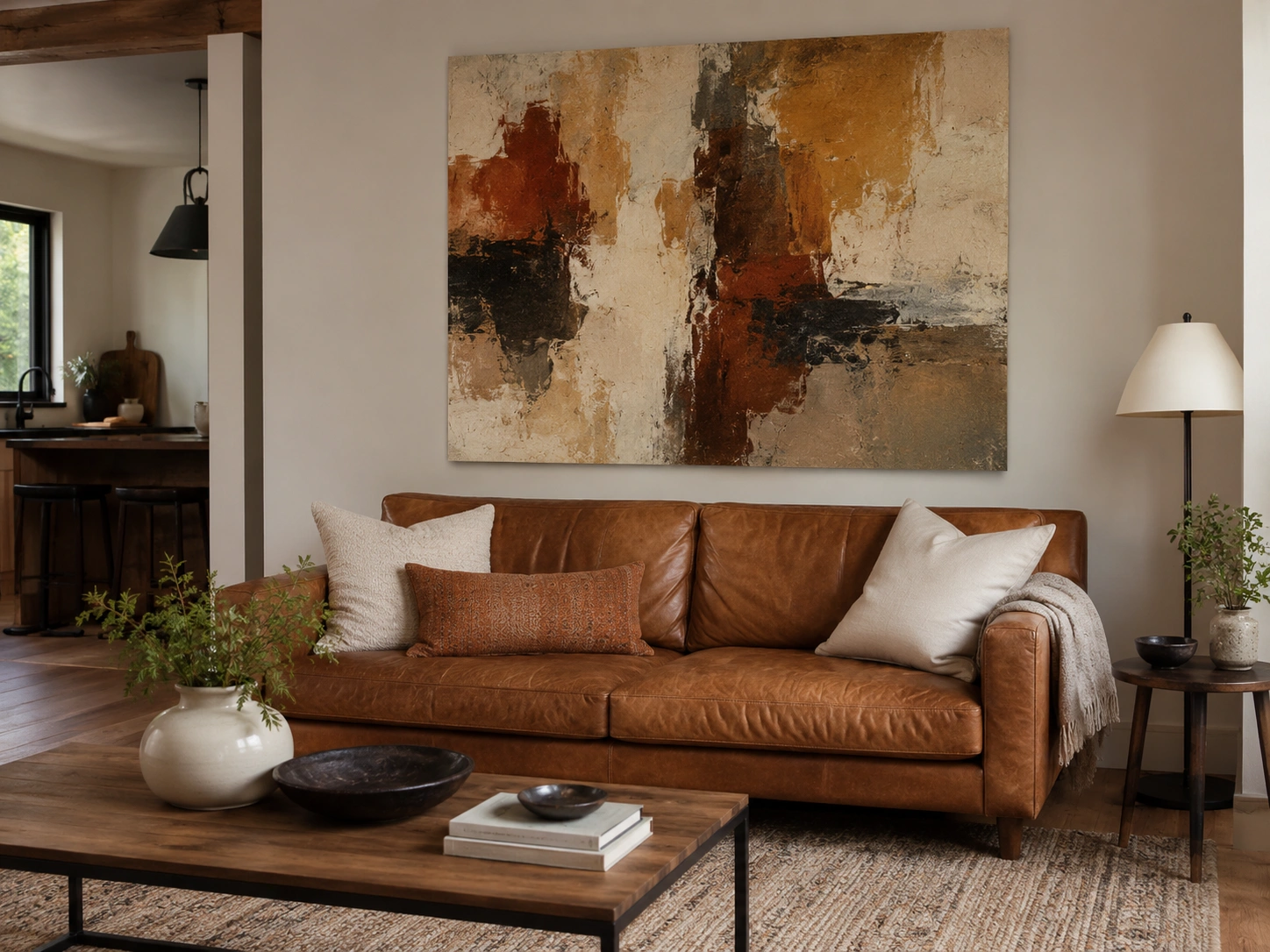
One oversized abstract canvas centered above your tan leather couch can serve as the room’s entire focal point — and when the canvas palette pulls from warm earth tones, it ties the whole space together in a single visual move. Look for prints or original works that include at least one warm tone — rust, ochre, burnt sienna, warm gold — alongside some neutrals. Scale matters enormously here: a canvas that’s 75–80% of the sofa’s width looks intentional; anything significantly smaller floats awkwardly on the wall and reads like an oversight.
Hang the canvas so its center sits at roughly 57 to 60 inches from the floor — eye level when standing — and leave 6–10 inches of clearance between the bottom edge of the frame and the top of the sofa back. Prints from Society6, Minted, or Etsy can be ordered at large canvas sizes for $40–$120 and arrive ready to hang. If your budget is tighter, download a high-resolution public-domain abstract from WikiArt and print it through Walmart Photo or Canvaspop for a custom canvas that costs under $25 but fills the wall with the same confident presence.
25. Place a Fiddle Leaf Fig or Monstera Plant Beside the Couch
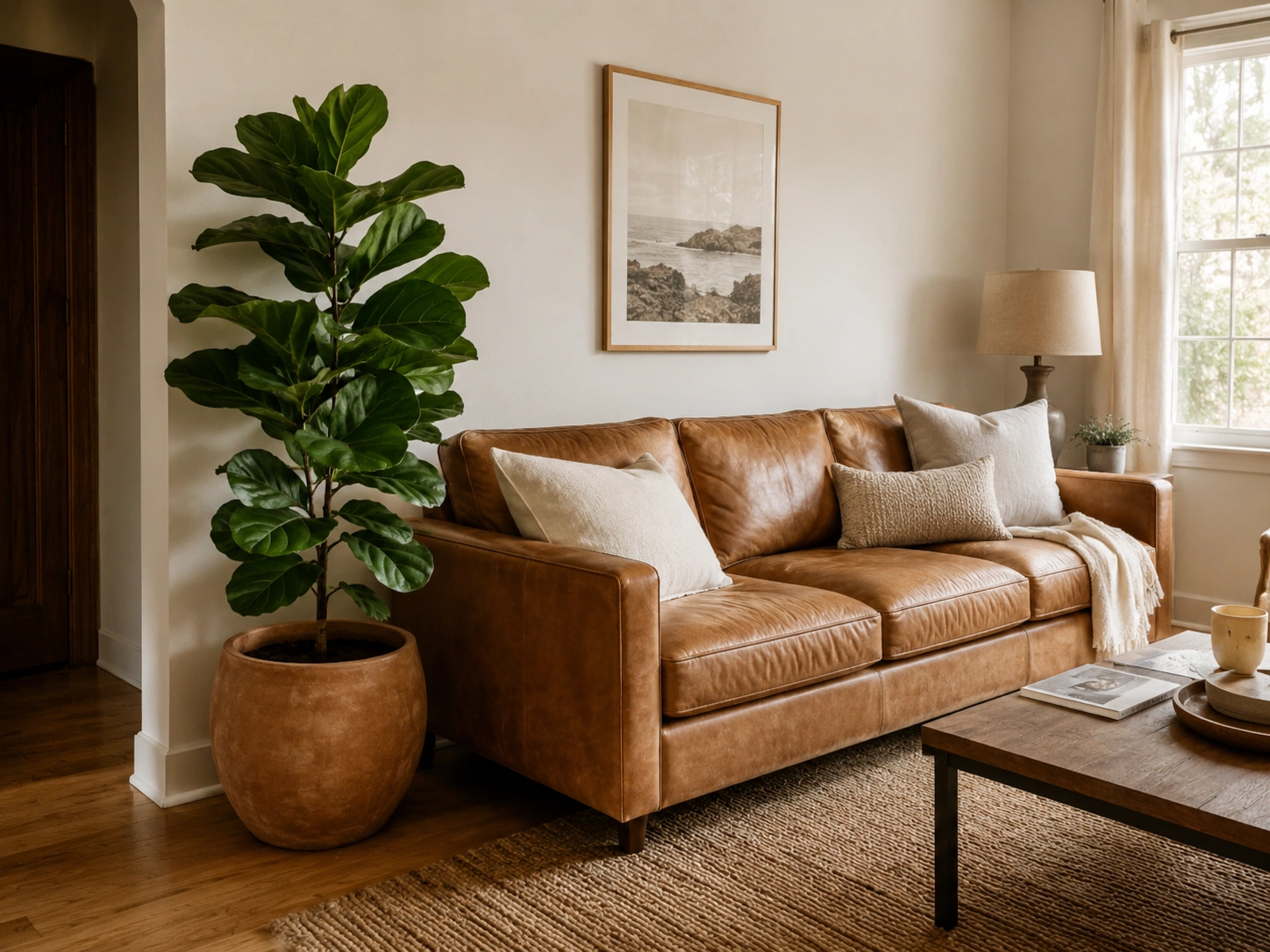
A tall fiddle leaf fig or a large monstera deliciosa placed directly beside one end of your tan leather couch is one of the most effective single-plant styling moves in a room — and the reason is scale. A plant of real height and presence brings vertical interest to the seating area, softens the hard edges of the leather furniture, and adds the kind of lush, organic life that makes a room feel genuinely inhabited by someone with a good eye. Both plants have large, dramatic leaves that create a bold visual contrast against the smooth leather surface.
Position the plant to one side of the couch rather than directly behind it — about 12–18 inches from the arm, with the canopy rising to roughly the same height as the top of the sofa back. Use a terracotta, matte black, or warm ceramic planter that supports the plant’s visual weight at floor level. Fiddle leaf figs prefer bright indirect light and dislike being moved once settled. If your room has lower or more variable light, a monstera is the more forgiving option — it grows happily in medium light and develops increasingly dramatic leaves as it matures.
26. Give It a Modern Farmhouse Feel with Plaid Throws and Wooden Trays
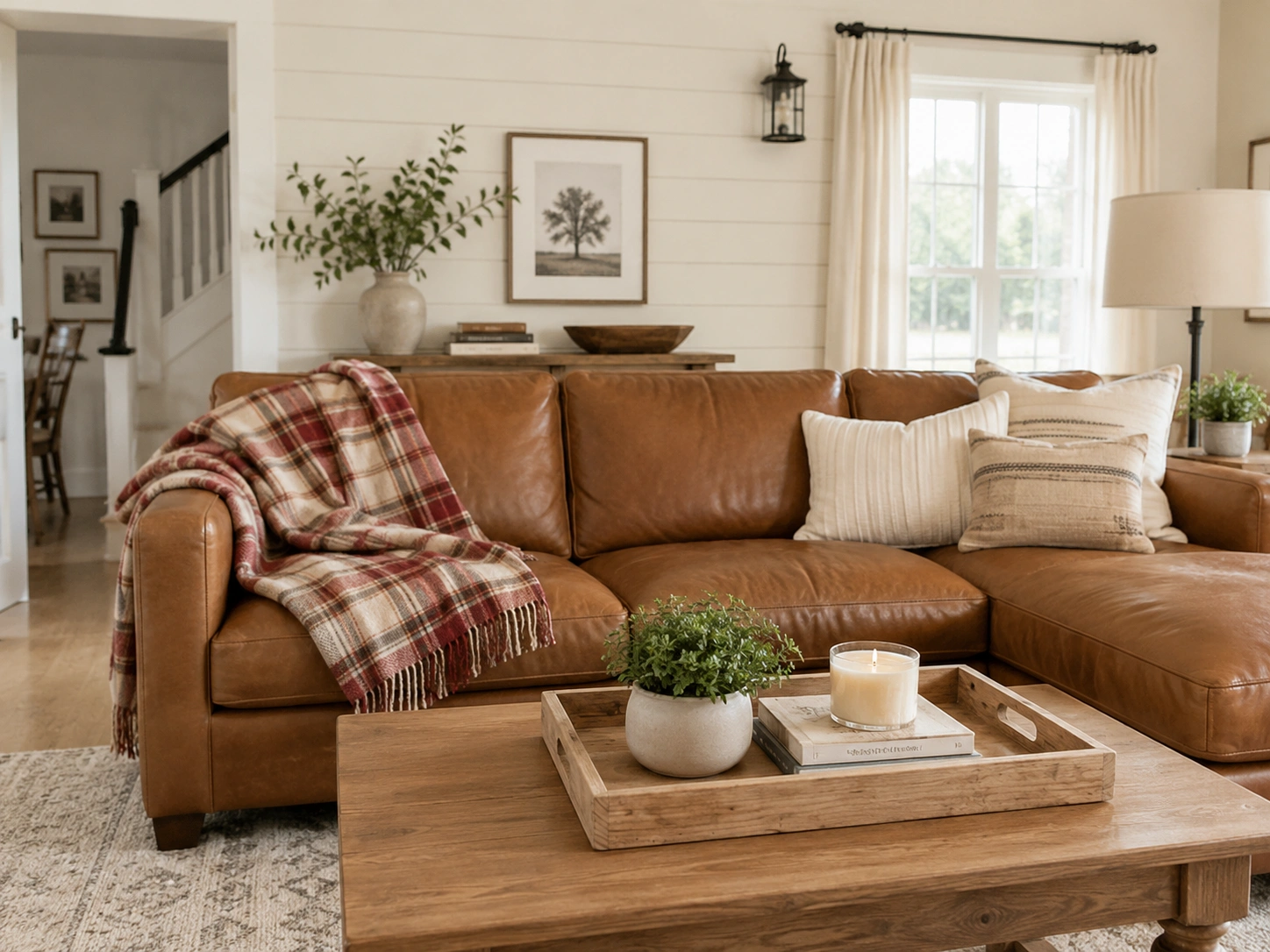
A modern farmhouse look built around a tan leather couch is cozier and more achievable than it might initially seem — and the leather itself does much of the heavy lifting. Layer in a plaid throw blanket in warm red, tan, and cream tones across one arm of the sofa, then style the coffee table with a rectangular wooden tray holding a candle, a small plant, and a stack of books. The plaid introduces pattern and warmth; the wooden tray anchors the table with a clean, organized quality that prevents the farmhouse aesthetic from tipping into cluttered territory.
Choose a plaid in a red-tan-cream or blue-tan-ivory colorway rather than one dominated by black, which pushes the look toward hunting-lodge rather than modern farmhouse. The wooden tray on the coffee table should be in light-to-medium oak or blonde wood — not dark espresso, which reads too heavy against the light palette this aesthetic depends on. Target’s Studio McGee collection carries inexpensive rectangular wooden serving trays in-store for around $18–$30 that work perfectly in this styling role and look significantly more considered than their price suggests.
27. Ground the Room with a Natural Jute Area Rug
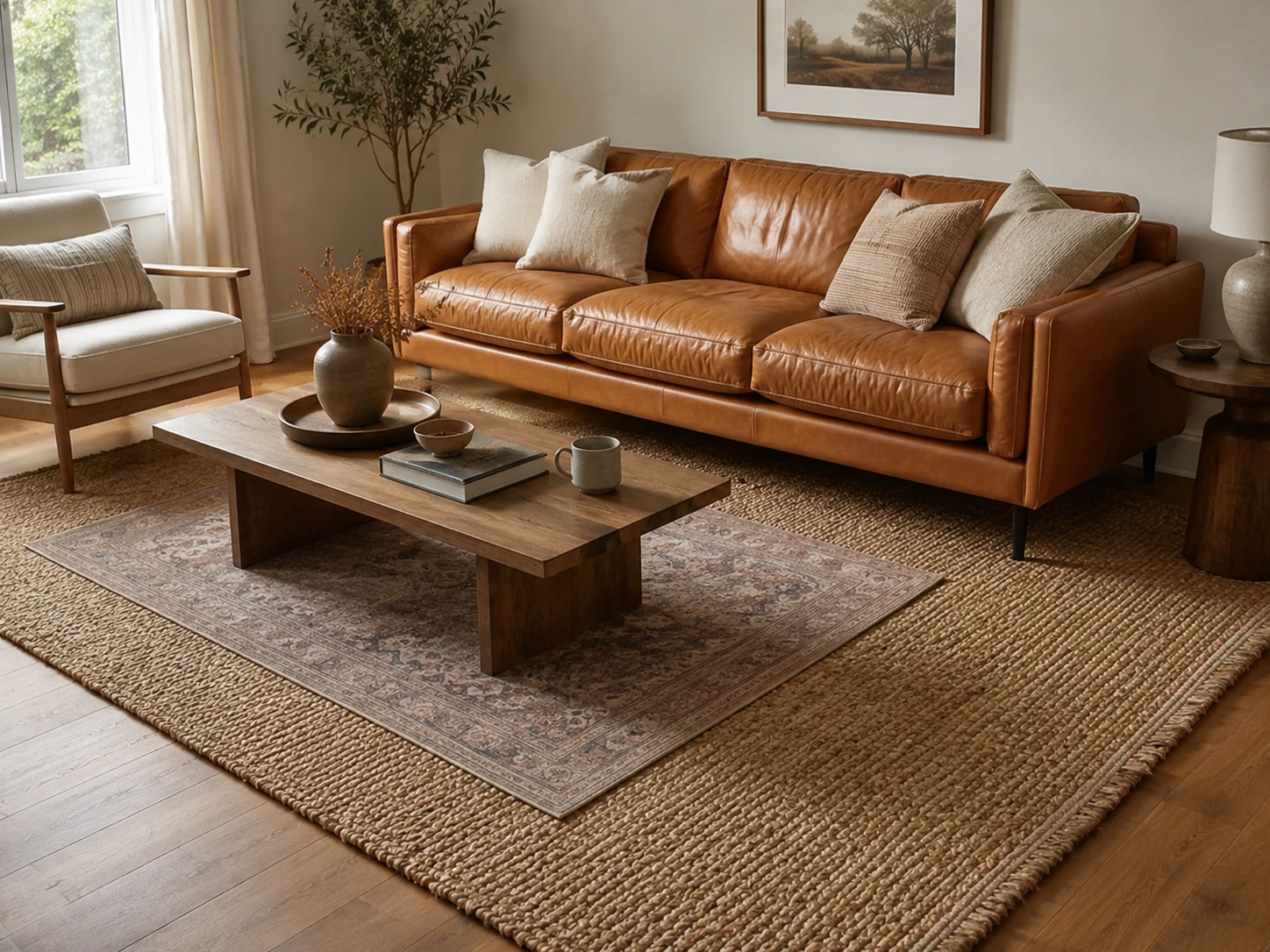
A natural jute rug is the most effortless pairing you can lay beneath a tan leather couch — and consistently one of the best-looking options despite being among the most affordable. Jute’s raw, earthy fiber and warm golden-brown tone share the same organic, natural-material quality as leather, which is why the two work together so seamlessly. Unlike patterned or printed rugs, jute allows the couch to remain the visual centerpiece while still providing the grounded, finished look that a bare floor underneath a sofa simply cannot deliver.
Natural flat-weave jute can feel rough underfoot, so look for a chunky braided or hand-woven style with some pile to it — these are noticeably softer and more comfortable underfoot. In a rental, jute is particularly ideal: it’s lightweight, easy to roll for moving, and looks appropriate in virtually every interior style. Loloi’s natural jute options and similar styles on Amazon and Rugs USA range from $60–$180 depending on size, with 8×10 being the practical minimum for most living rooms. Layering a smaller printed topper rug on top creates additional visual depth on a limited budget.
28. Create a Cozy Reading Nook Corner Beside the Couch
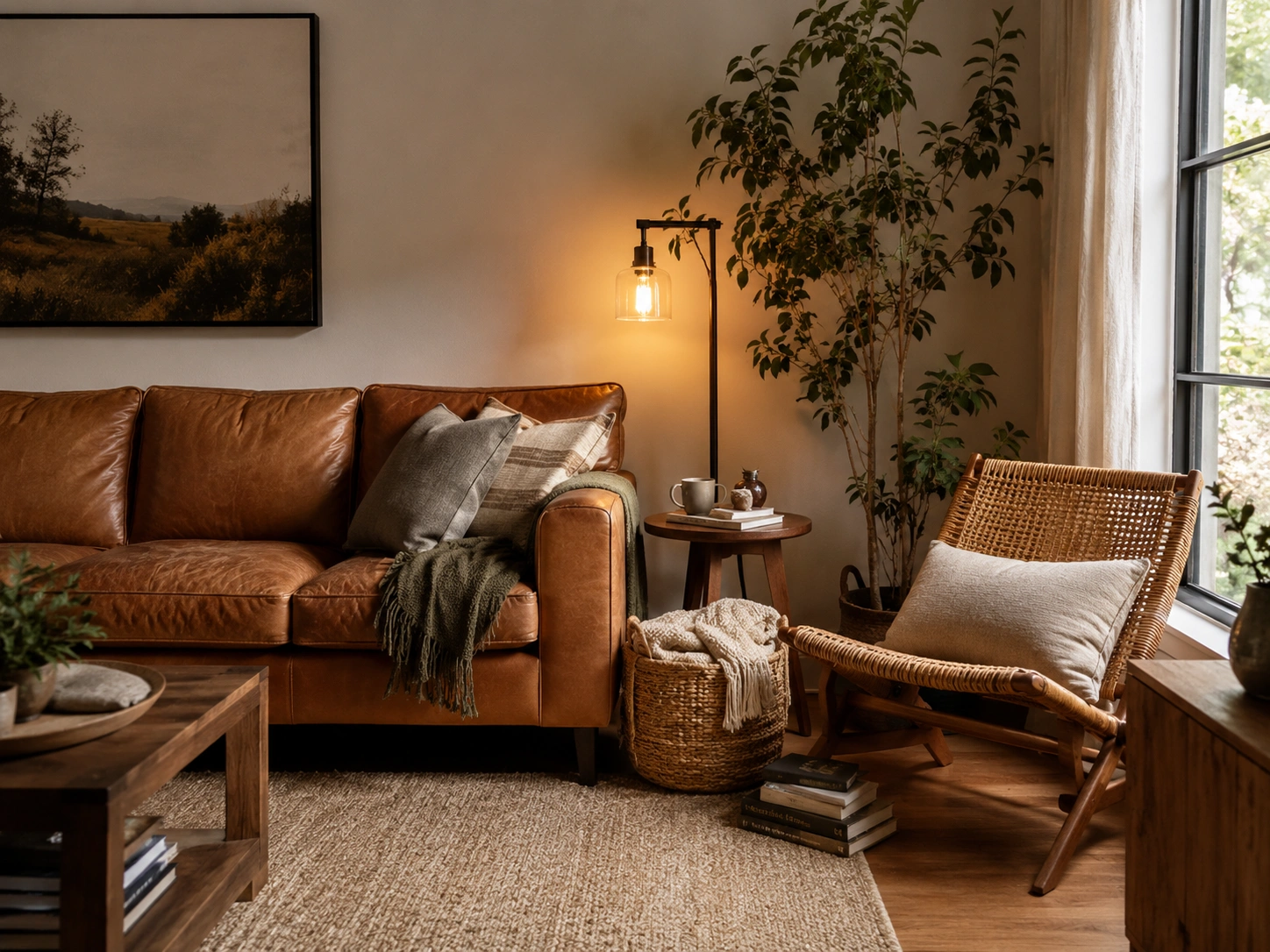
If one end of your tan leather couch sits near a wall or window, the corner beside it is an untapped opportunity to build a cozy reading nook that extends the sofa’s warmth into the rest of the room. The setup is simple: a floor lamp positioned just behind and slightly to one side of the couch, a small side table within arm’s reach, and a woven basket on the floor beside the arm holding an extra throw blanket. It’s a functional corner that photographs as though the whole room was designed around it.
A low-profile rattan or cane accent chair placed at a slight angle into the corner creates a more defined nook if you have the square footage. In a smaller room, a tall plant plus a floor lamp plus a small stack of coffee-table books stacked beside the sofa arm communicates the same “intentional cozy corner” energy without requiring significant additional floor space. Warm white Edison-style bulbs in the floor lamp cast the ideal reading light while keeping the overall room atmosphere amber and enveloping rather than bright and clinical.
29. Try the Layered Rug Technique — Jute Base with a Printed Topper
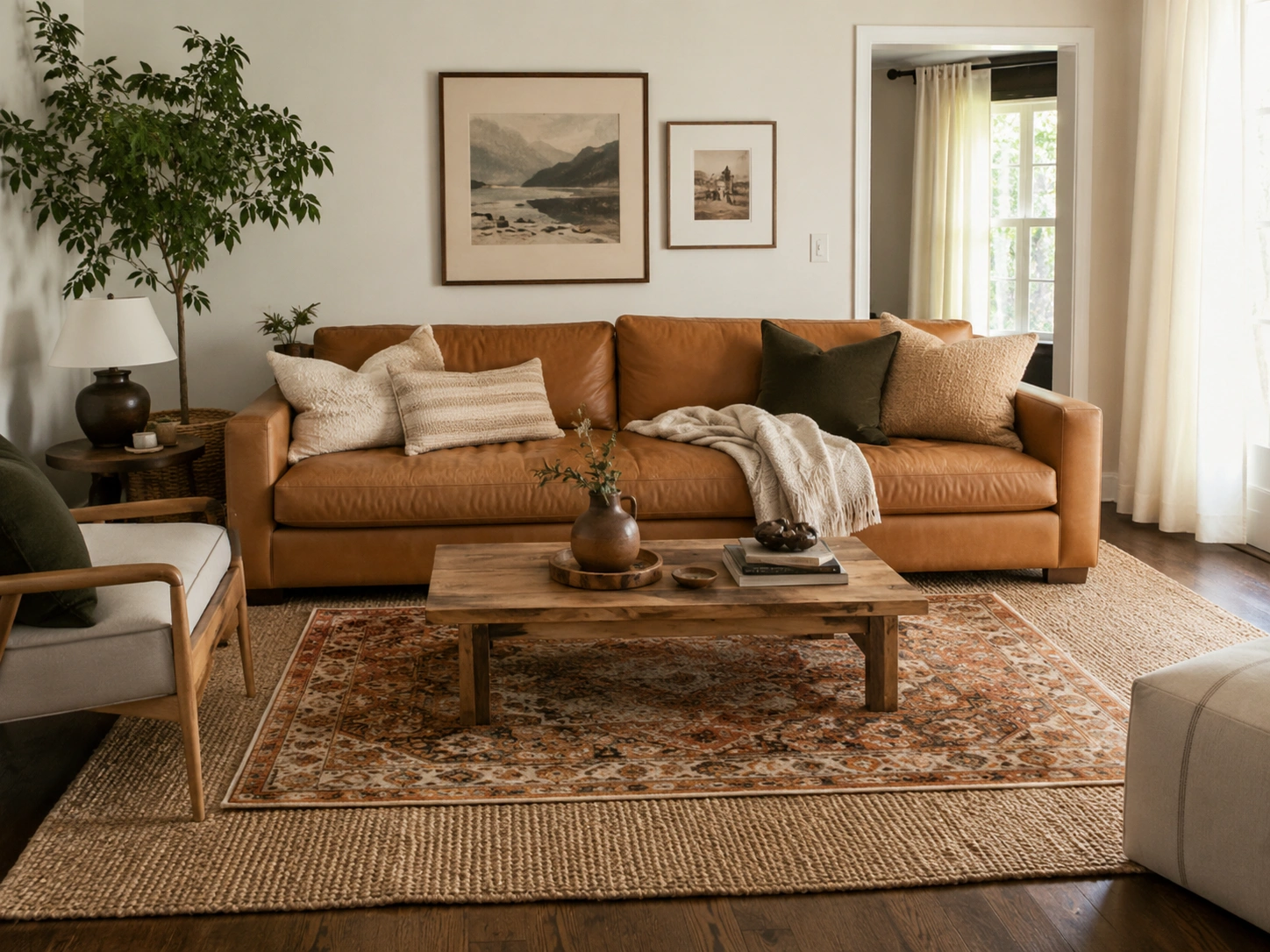
The layered rug technique — placing a smaller, patterned rug on top of a larger natural fiber base rug — is the fastest way to add pattern and warmth to a room without committing to one large printed rug. Under a tan leather couch, start with a large natural jute or sisal base in 8×10 or larger, then center a smaller printed rug in front of the sofa at roughly 4×6 or 5×8. The result is a designer-layered floor that’s often more affordable than buying a single large statement rug in a premium pattern.
For the printed topper, reach for something in a warm, earthy palette: a rust-and-ivory Moroccan kilim, a faded Persian in deep red and ivory, or a vintage-style Oushak in gold and dusty blue. Position the second rug so its front edge aligns with the front edge of the sofa cushions — not floating further forward. Vintage kilim and Oushak-style rugs in the 4×6 size are widely available on eBay, Facebook Marketplace, and Rugs USA for $30–$80, making this the most budget-friendly pattern option available for a tan leather living room.
30. Set the Mood with Edison Bulb Table Lamps and Warm Soft Lighting
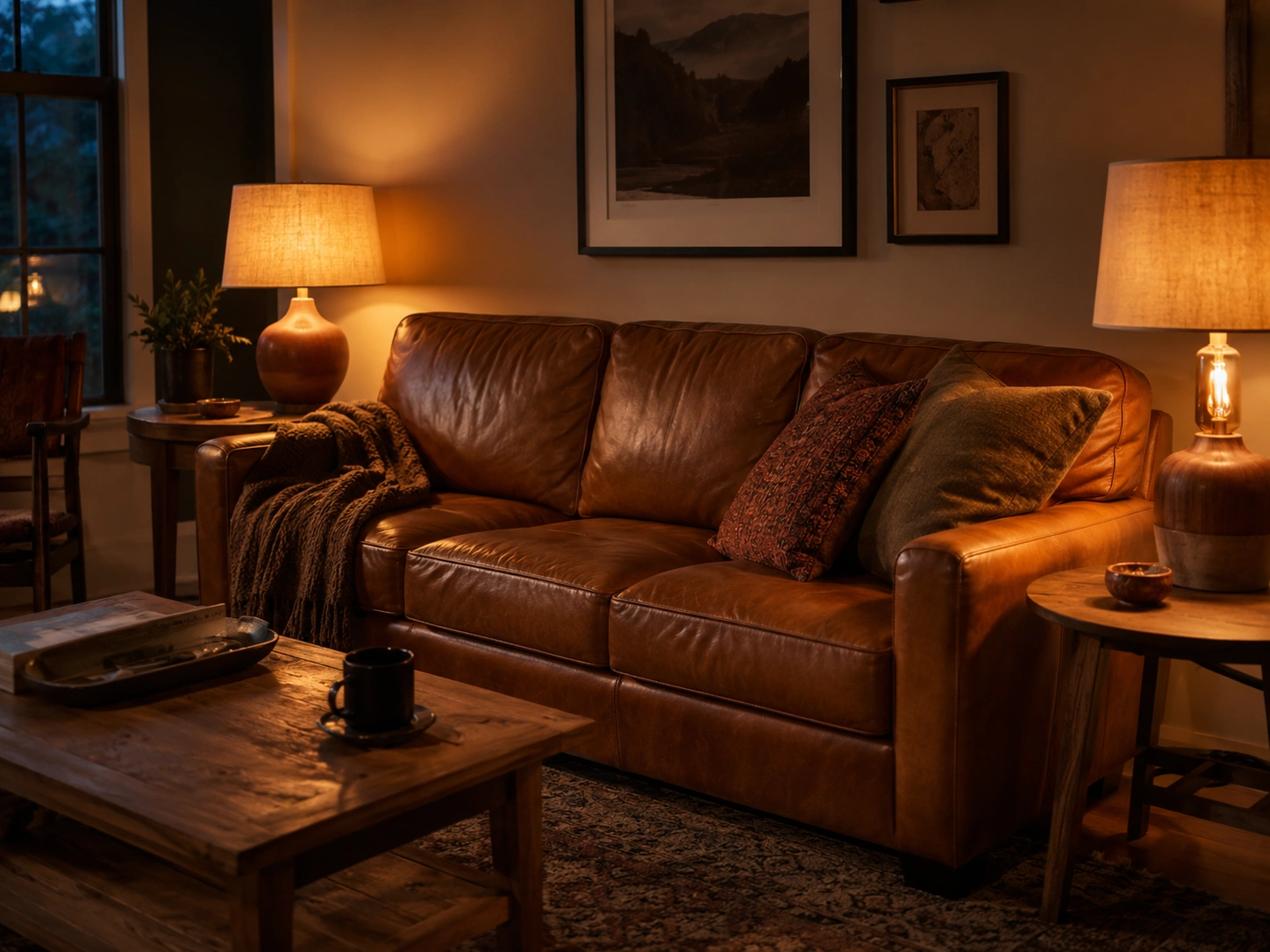
The right lighting completely changes how a tan leather couch reads in the room after dark, and Edison-bulb table lamps are one of the simplest and most affordable ways to get there. Edison bulbs in the 2200K–2700K color temperature range cast an amber, candlelit glow that makes tan leather look genuinely beautiful — rich, warm, and golden rather than flat or washed out under harsh overhead light. Position lamps on side tables at both ends of the couch so the warm light wraps the seating area from either side and creates an enveloping, intimate atmosphere.
Pair Edison bulbs with lamp bases in warm materials — brushed brass, matte terracotta ceramic, or turned raw wood — to keep the entire styling zone within the warm material palette. Avoid cool chrome or crisp white bases, which introduce a visual temperature conflict against the warm light and the leather. Lamp shades in linen, cotton, or loosely woven fabric diffuse light most gently. IKEA’s RANARP lamp and Target’s mid-range table lamp collection both offer warm-toned options in the $30–$60 range that perform beautifully beside a tan leather sofa in evening light.
31. Add a Pop of Blush Pink with Velvet Accent Pillows
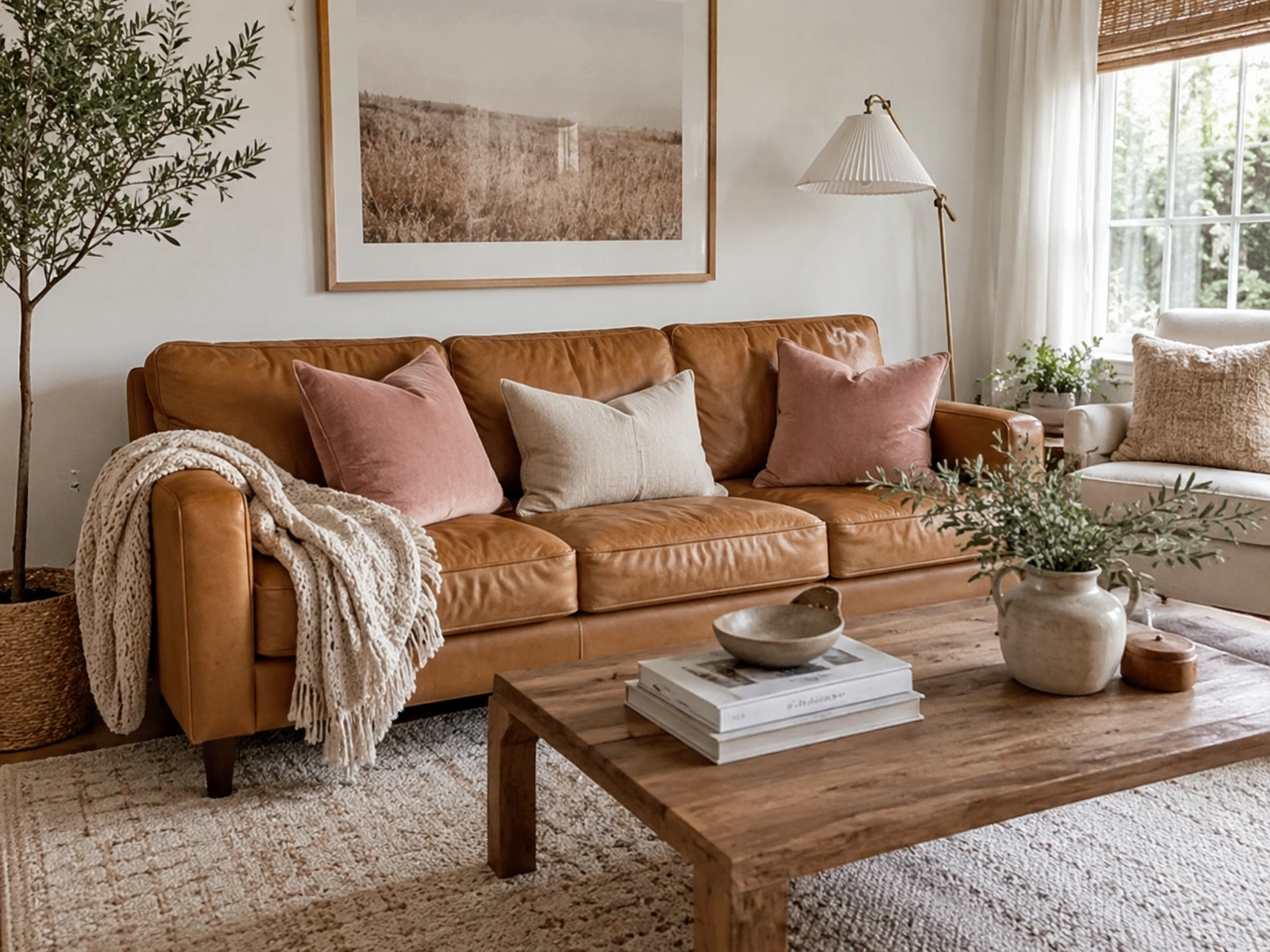
Blush pink velvet pillows on a tan leather couch land softer and more feminine than a bold rust or forest green, and the pairing works because blush carries the same warm undertone as tan leather rather than fighting it with cool contrast. The velvet texture does significant heavy lifting here — it adds a tactile richness that elevates the combination from budget to intentional, even when the pillow cover itself costs $12. Two blush velvet pillows alongside one cream or dusty white linen companion create a palette that’s soft and warm without becoming saccharine.
Use blush as an accent rather than the dominant color: no more than two blush pillows on a three-seat sofa, with the majority remaining in warm neutrals. A dusty rose or muted blush works better than a bright or cool-toned pink, which can read unexpected rather than warm next to the leather. Target and H&M Home both carry affordable velvet cushion covers in muted blush tones, available in-store so you can hold them against a photo of your couch before committing. This is also a particularly effective look for readers who want a softer, bedroom-adjacent warmth in the living room.
32. Use an Emerald Green Velvet Ottoman as a Coffee Table Alternative
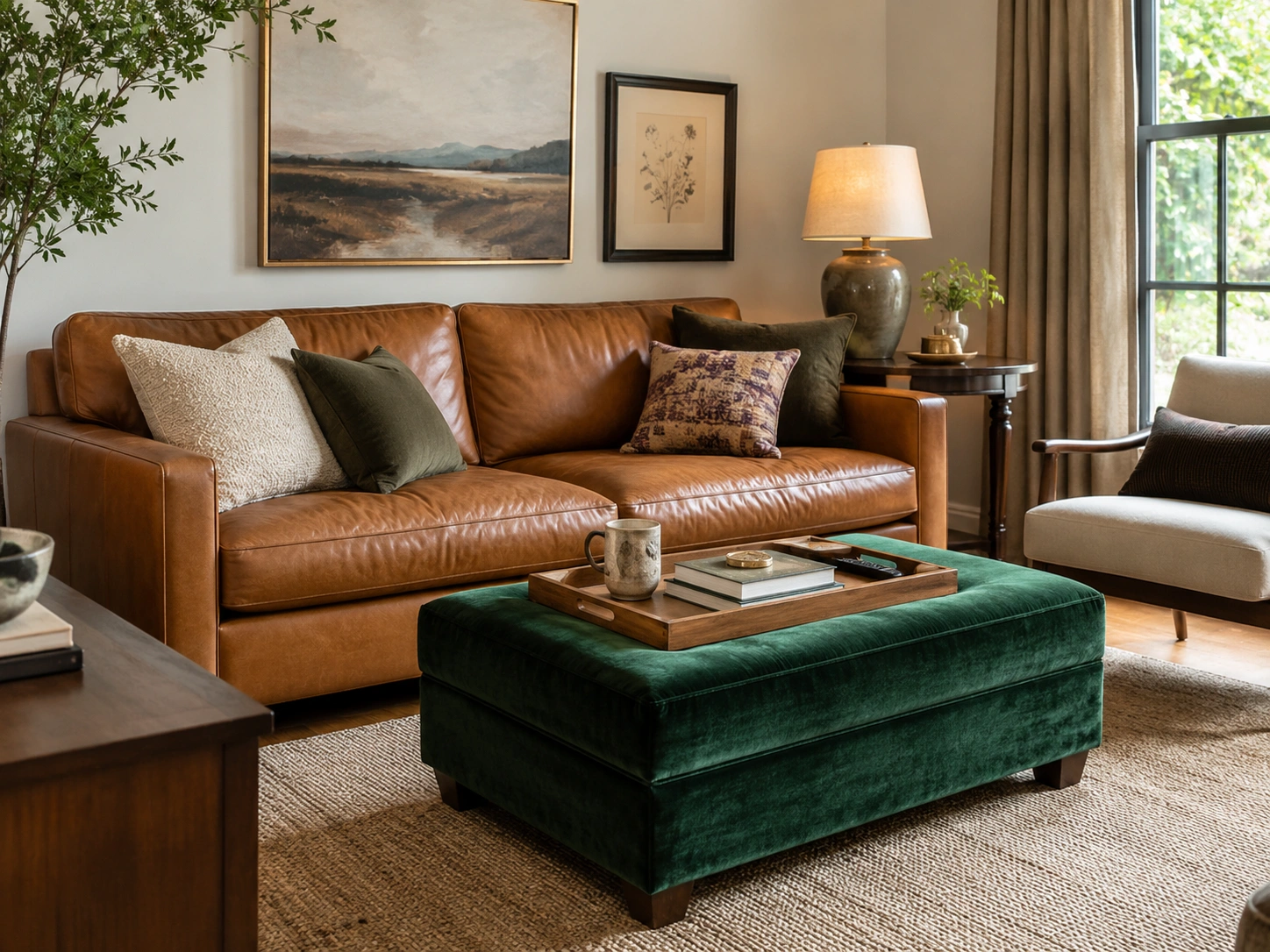
An emerald green velvet ottoman used in place of a traditional coffee table in front of a tan leather couch is a bold and genuinely beautiful design decision. Emerald green and tan leather sit in complementary territory — the richness of the jewel-toned green makes the tan appear warmer and more intentional, and the velvet texture adds a layer of quiet luxury that elevates the entire room. In smaller living rooms especially, a soft ottoman takes up the same floor space as a hard table while making the seating area feel warmer and more inviting to actually sit in.
Place a rectangular wooden tray on the ottoman surface to create a defined, stable spot for everyday objects. Size the ottoman to roughly 60–70% of the sofa’s length so the proportions feel deliberate rather than undersized. Velvet ottomans in emerald and deep jewel-toned greens are available from Wayfair, Overstock, and Amazon in the $80–$180 range. If emerald feels like a significant color commitment, a deep sage or forest green velvet is a subtler version of the same pairing — equally effective as a color anchor and slightly more forgiving in rooms with mixed natural light.
33. Keep It Calm and Clean with Scandi-Minimalist White and Natural Wood
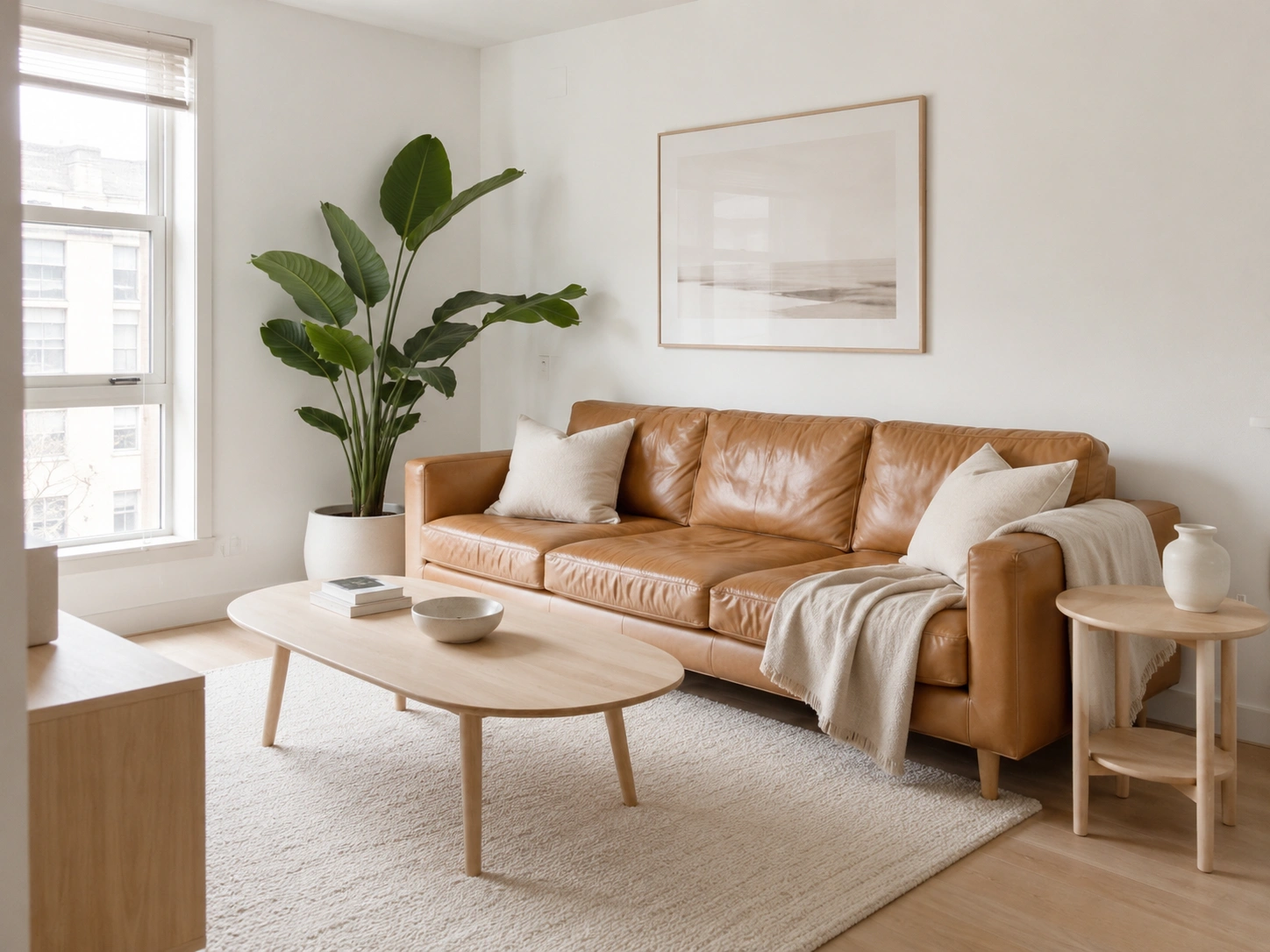
A Scandinavian-minimalist approach to a tan leather couch centers entirely on restraint: a clean white or off-white wall, natural light-toned wood furniture in blonde birch or pale ash rather than dark walnut, minimal accessories, and one or two carefully chosen plants. The tan leather couch becomes the warmest and most textural element in an otherwise serene, edited room — and that contrast is what makes the leather look intentional rather than dated. This direction is especially effective in smaller apartments where over-accessorizing quickly creates visual overwhelm.
Keep the throw pillow count to two or three maximum, in off-white or warm oatmeal linen — nothing with heavy pattern or saturated color. A single large-leaf plant in a simple white ceramic pot provides the only color note the room requires. This is also the most renter-friendly look on this list: white walls (almost always present already), a light wood IKEA side table, and two or three well-chosen neutral accessories are the entire investment needed. The result is quiet, grounded, and surprisingly compelling in person — particularly in rooms where natural light can do the heavy lifting.
34. Anchor the Room with a Vintage Persian Rug in Deep Red and Navy
A vintage or vintage-style Persian rug in deep red, navy, and ivory placed under a tan leather couch is one of the most classically effective and enduringly beautiful room combinations available — and it reads just as current today as it ever has, particularly when the furniture surrounding it is kept simple and modern. The deep jewel tones of a Persian rug ground the warmth of the tan leather with authority, and the intricate floral and geometric patterns contribute a richness and sense of history that a single-color rug simply cannot replicate at any price point.
Real vintage Persian rugs can be found at estate sales, Facebook Marketplace, eBay, and local thrift stores for $100–$400 depending on size and condition — often less expensive than a new mass-produced rug of comparable size. If the rug shows wear or slight fading, treat it as a feature, not a flaw: the softened quality is exactly what gives a vintage Persian its warmth and visual depth. Keep surrounding furniture and accessories simple and in warm wood tones, and let the rug hold the room’s visual complexity on its own.
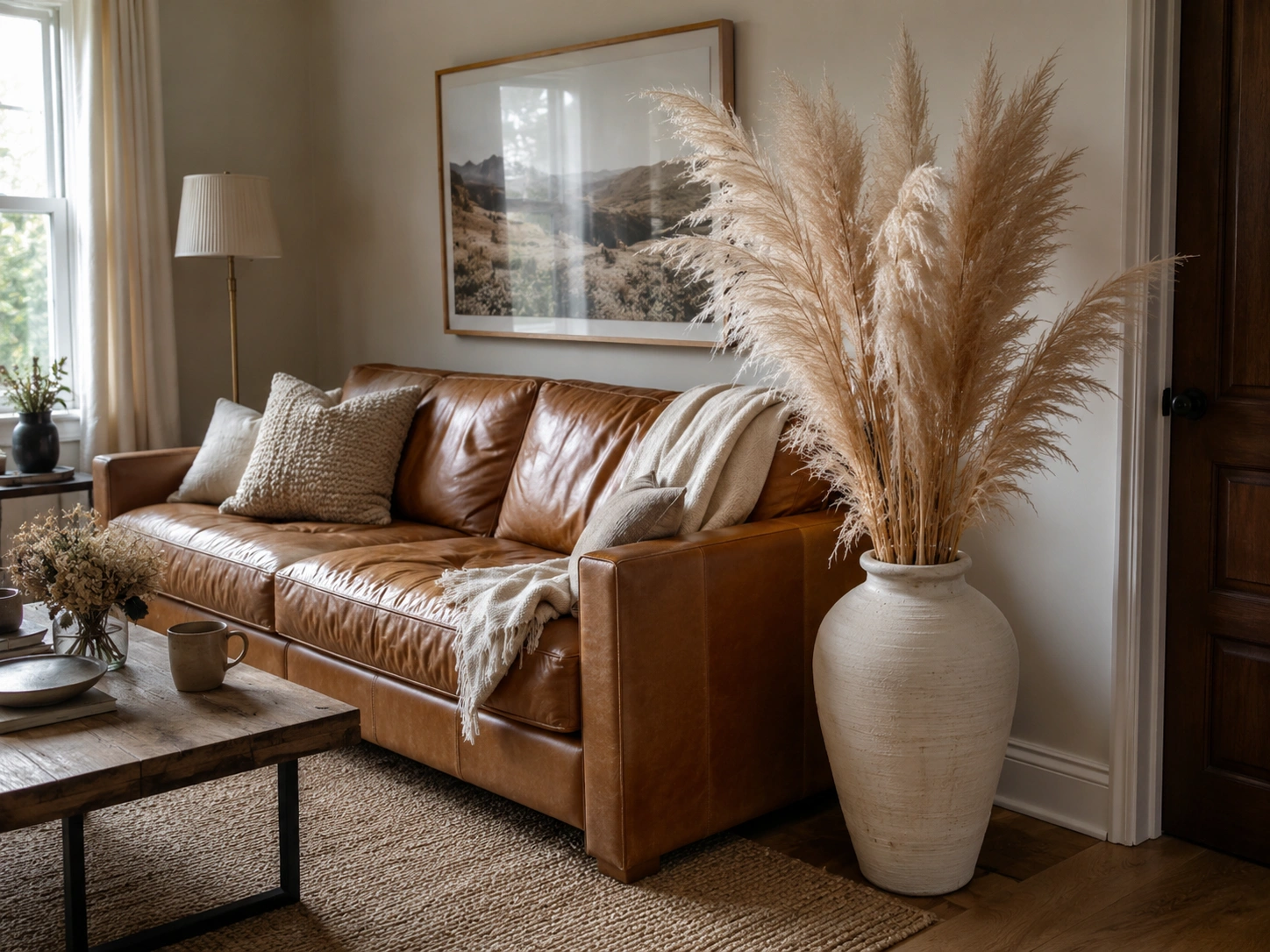
35. Style a Tall Vase of Dried Pampas Grass Beside the Couch
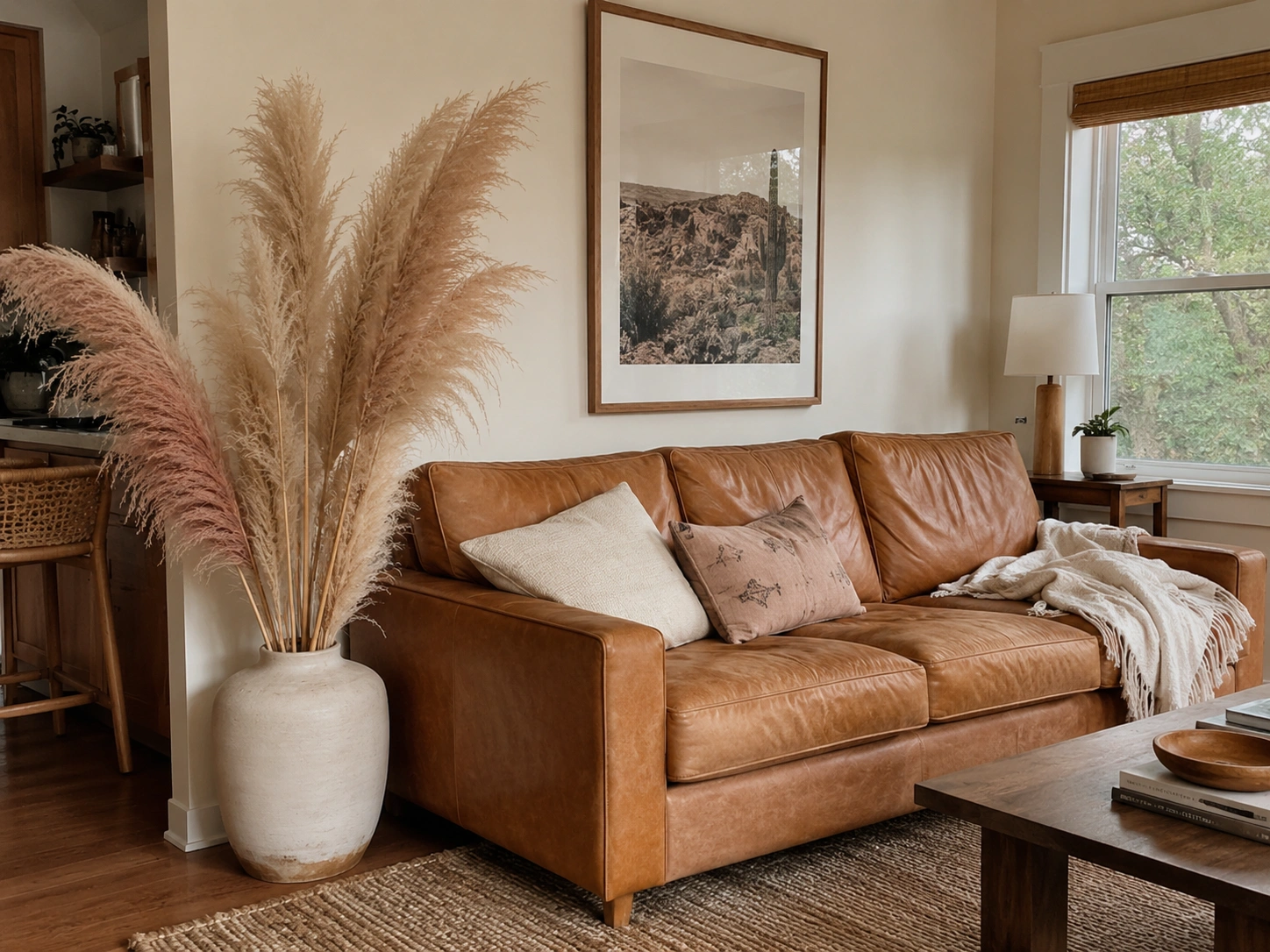
A tall floor vase or oversized ceramic vessel filled with dried pampas grass placed at one end of your tan leather couch is one of those accessories that costs very little and contributes a disproportionate amount of visual drama to the room. Pampas grass’s feathery cream-to-blush plumes echo the warm, organic texture of leather, and the tall, arching silhouette fills vertical space beside the sofa without adding visual heaviness. It’s soft, sculptural, entirely low-maintenance, and — because it’s dried — completely immune to neglect.
Choose a vase in terracotta, matte black, or warm white ceramic — tall enough, ideally 18 to 24 inches, to hold the stems upright with the plumes reaching 5 to 6 feet from the floor. Place the arrangement at one side of the couch rather than directly behind it so the arching grass frames the seating area from the side, creating a natural, organic border. Dried pampas is available at Michaels, Etsy, and increasingly at Target and TJ Maxx in the fall season, typically ranging from $15–$40 for a full, generous bunch.
36. Dress It for the Holidays with Faux Fur Throws, Candles, and Warm Textures
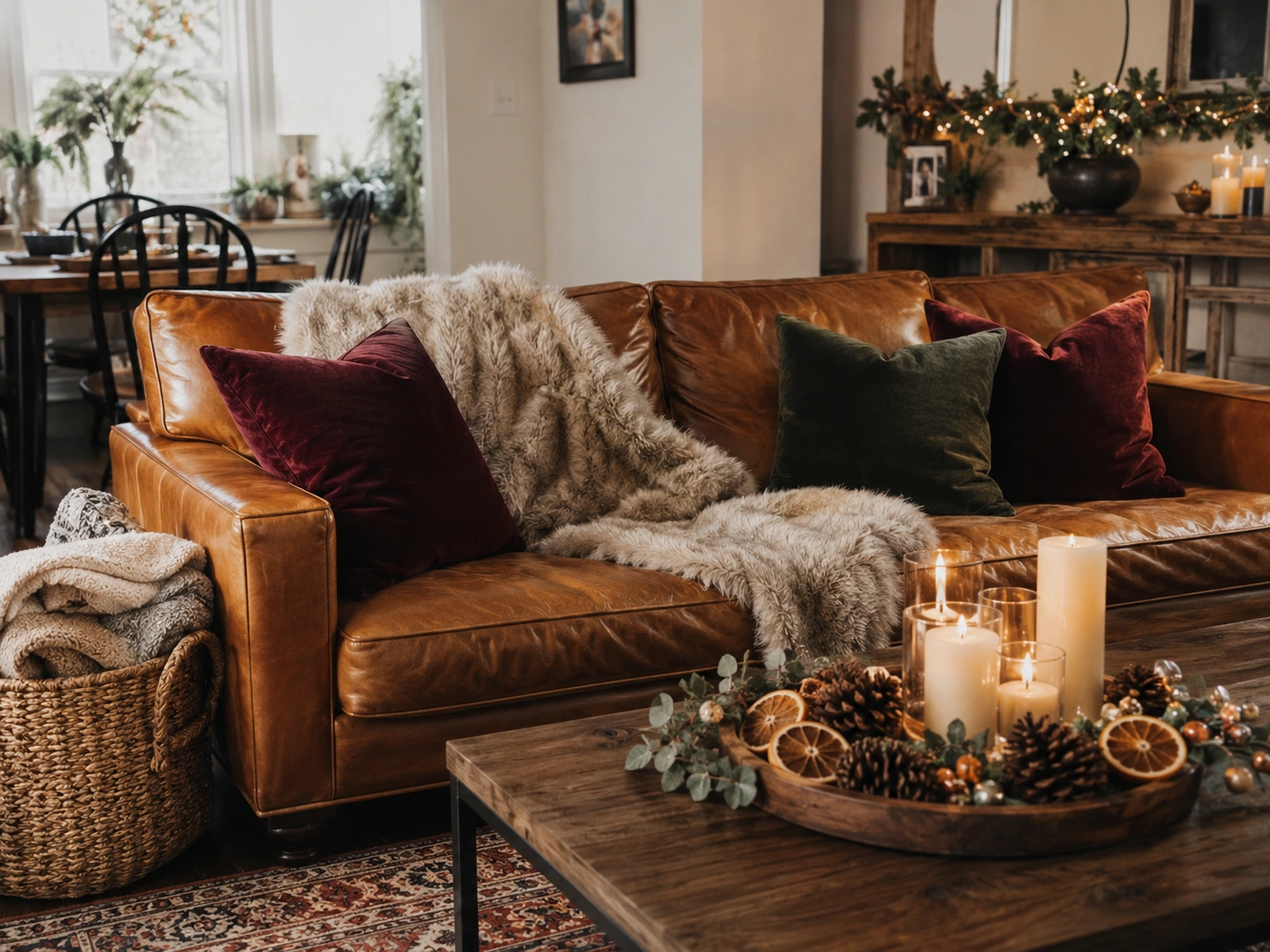
A tan leather couch in the holiday season is genuinely an asset — its warm amber tone pairs naturally with the candlelit, texture-rich atmosphere of winter decorating without requiring any special accommodation. Drape a plush faux fur throw in ivory or soft gray across the seat cushions, add two or three throw pillows in deep burgundy or forest green velvet, and arrange a cluster of pillar candles in varying heights on the coffee table. The combination of warm leather, soft fur, and candlelight creates a genuinely festive atmosphere without a single piece of tinsel in sight.
Add a woven seagrass basket beside the couch filled with extra blankets, and place a pinecone or dried citrus arrangement on the coffee table for a natural, seasonal scent element that doesn’t require a plug. A strand of warm white fairy lights woven loosely through a small garland of eucalyptus or dried orange slices on the coffee table or side shelf adds soft holiday twinkle without aggressive brightness. The overall effect is cozy, warm, layered, and completely save-worthy from early November straight through New Year’s Day.
FAQs
What color rug goes best with a tan leather couch?
Warm rust, ivory, deep navy, and natural jute tones are the strongest choices. Rugs in earthy or warm-neutral color families enhance the golden undertone of tan leather without fighting it. Avoid cool-gray rugs — they typically look disconnected and flat against the warmth of the leather’s base tone.
What throw pillow colors look good on a tan leather sofa?
Forest green, rust, burnt orange, sage green, blush pink, and warm cream all work well. Tan leather’s golden undertone responds best to colors in the warm or earthy family. Two accent-colored pillows alongside two neutral companions is the simplest and most reliable formula to follow.
What accent wall color complements a tan leather couch?
Deep navy, charcoal gray, and white limewash are three consistently effective choices. Deep navy creates dramatic high contrast. Charcoal gray adds sophistication without going so dark the room feels heavy. White limewash is the warmest and most texture-forward option, working beautifully under almost any light condition.
How do you modernize a tan leather sofa without replacing it?
Swap throw pillow covers for velvet or linen options in a current color — forest green, sage, or rust. Add a warm-toned area rug underneath. Bring in brass or natural-material accent pieces. Update the overhead lighting with a rattan pendant or arc floor lamp. These four changes combined cost under $200 and significantly shift how the room feels.
Is tan leather furniture still in style in 2025?
Yes, and more so than in recent years. Pantone named Mocha Mousse as its Color of the Year for 2025, placing tan, caramel, and warm leather tones at the center of the current global design conversation. Tan leather’s natural warmth and organic quality align directly with the earthy, grounded interior aesthetic that’s consistently trending across Pinterest and interior design publishing right now.




No Comment! Be the first one.