




29 Open Shelf Kitchen Ideas That Will Make You Reconsider Upper Cabinets Forever
You’ve saved the pins. You’ve watched the YouTube renovation videos twice. And you still don’t know if open shelving would actually work in your kitchen, or if it just looks good on...

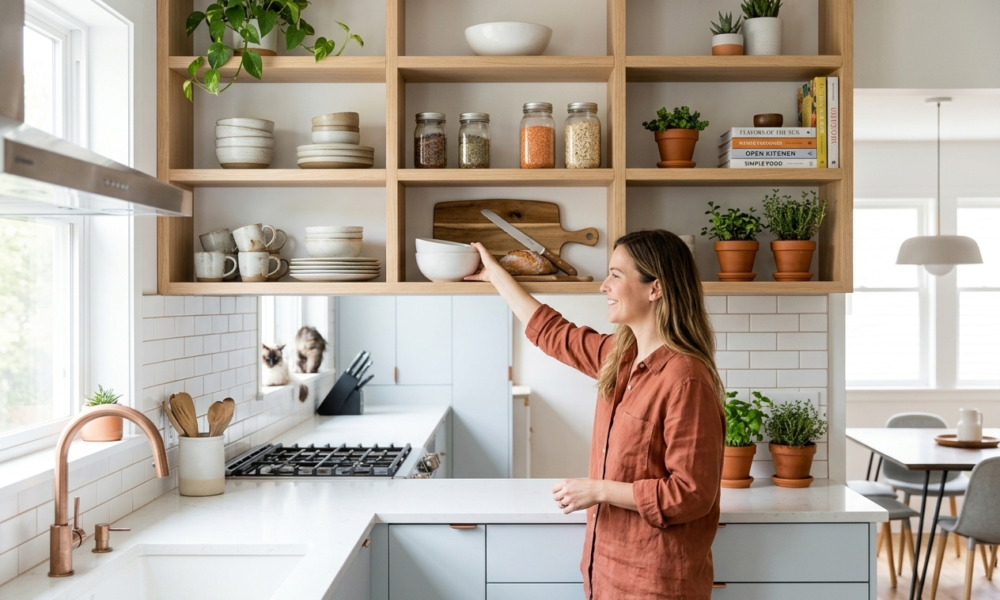
You’ve saved the pins. You’ve watched the YouTube renovation videos twice. And you still don’t know if open shelving would actually work in your kitchen, or if it just looks good on someone else’s. This works best for kitchens with at least one full wall or corner to dedicate to shelving and a willingness to keep things a little curated. It won’t help if your cabinets are the only wall storage you have and you’re not ready to lose any of it.
Open shelf kitchen ideas refers to design approaches that replace or supplement upper cabinets with exposed shelving for storing and displaying dishes, glassware, and kitchen tools. The goal is visual openness paired with real, daily-use storage — not a permanently staged display.
Renter-Friendly and Budget Open Shelf Ideas That Don’t Touch Your Deposit
You don’t need to own the walls to get the look. These five ideas are built around low commitment and low cost, which matters if you’re renting or just testing whether open shelving is right for you before committing to a bigger kitchen change.
1. Mount an IKEA EKBY Shelf on Renter-Safe Brackets So You Can Patch and Repaint in an Hour
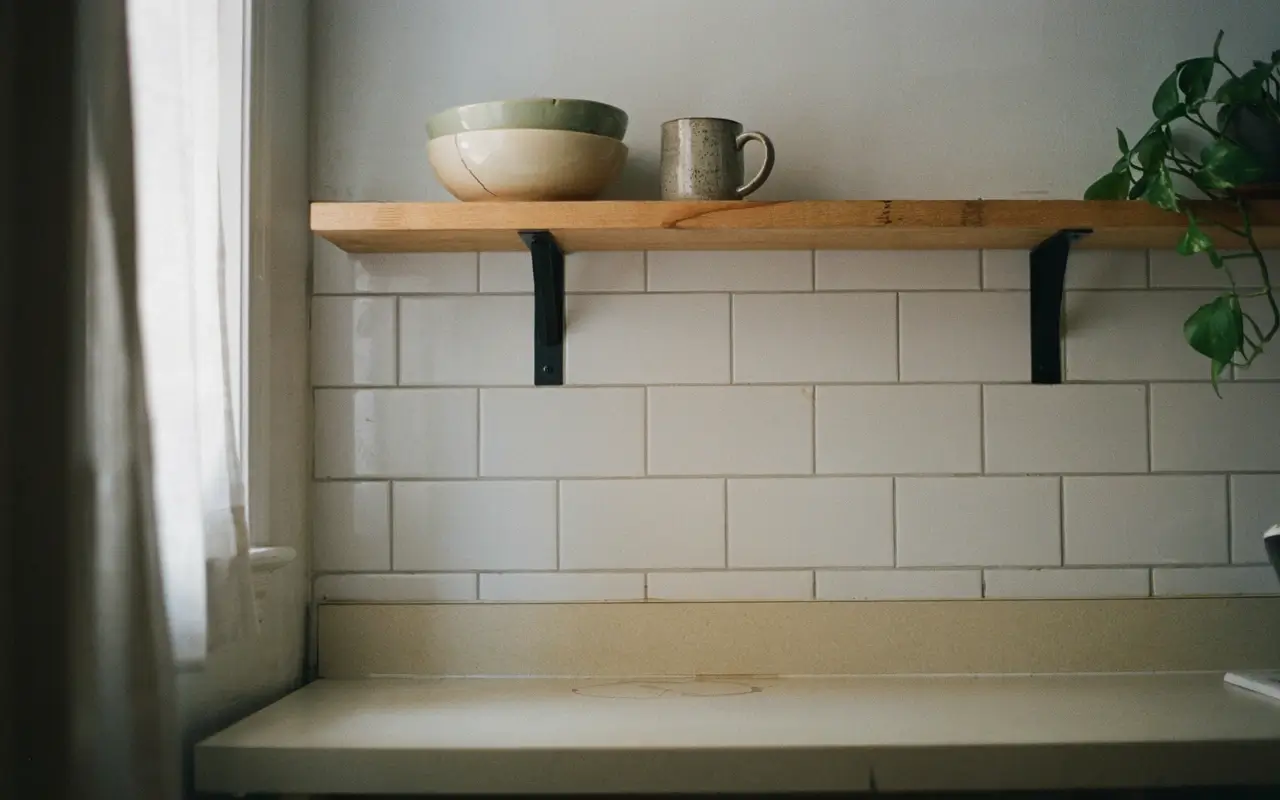
The problem with most open shelf tutorials is they assume you own the wall outright. An EKBY shelf on small, single-screw brackets solves that — the holes are tiny enough that a dab of spackle and a matching paint touch-up erase the evidence completely. It works because the shelf itself looks custom even though the install is genuinely simple. My read is this is the safest entry point if you’ve never drilled into a wall before. Style it with two stacked bowls and one mismatched mug so it doesn’t look like a showroom display you’re afraid to touch.
2. Stain a Raw Pine IKEA LACK Shelf Yourself and Mount It on $12 Brackets for a Custom Look Under $40
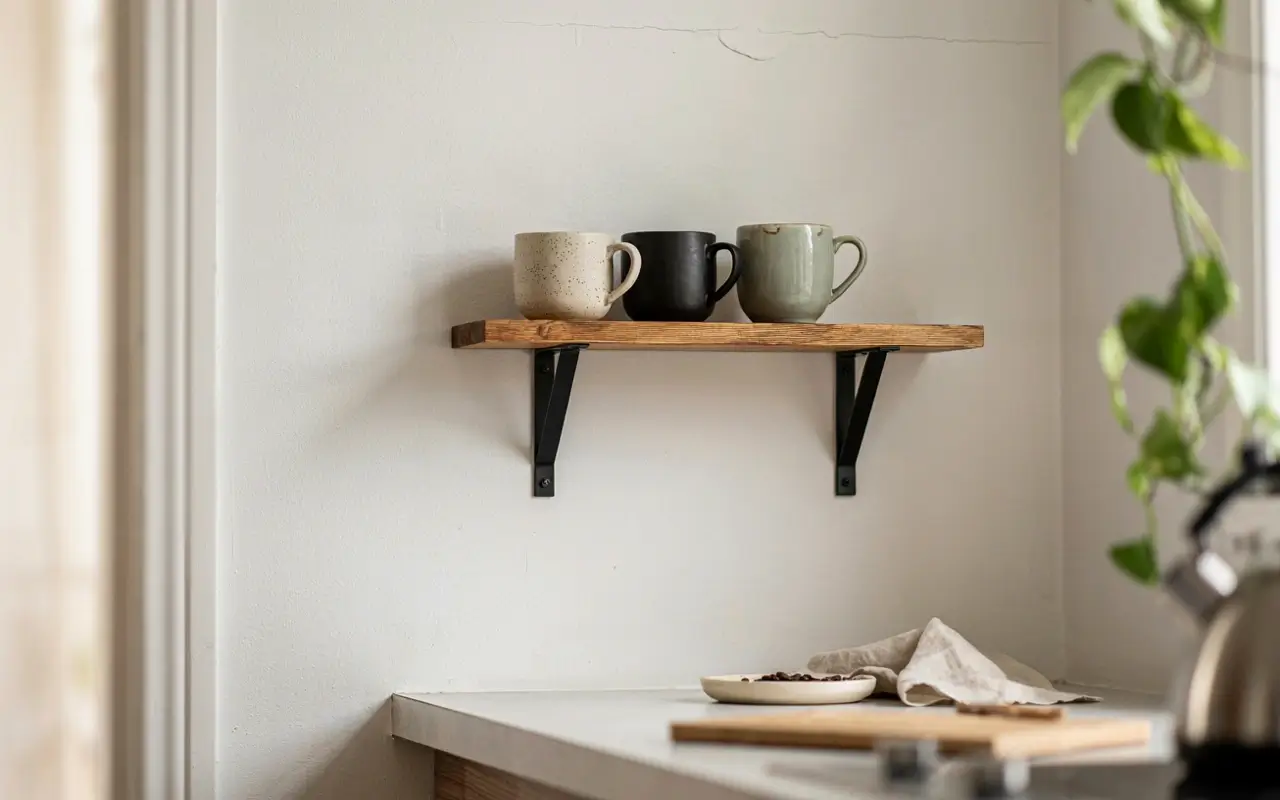
Flat-pack shelves read cheap when they’re left white and glossy. A coat of walnut or honey-toned stain changes that completely, and it takes one afternoon. The trick is sanding lightly between coats so the grain actually shows instead of sitting under a plastic-looking finish. This fixes the “obviously IKEA” look without an obviously IKEA price tag. I’d only skip this step if you’re already set on a specific wood tone your walls won’t complain about.
3. Skip Drilling Entirely With a Freestanding Bakers Rack Styled to Look Built-In
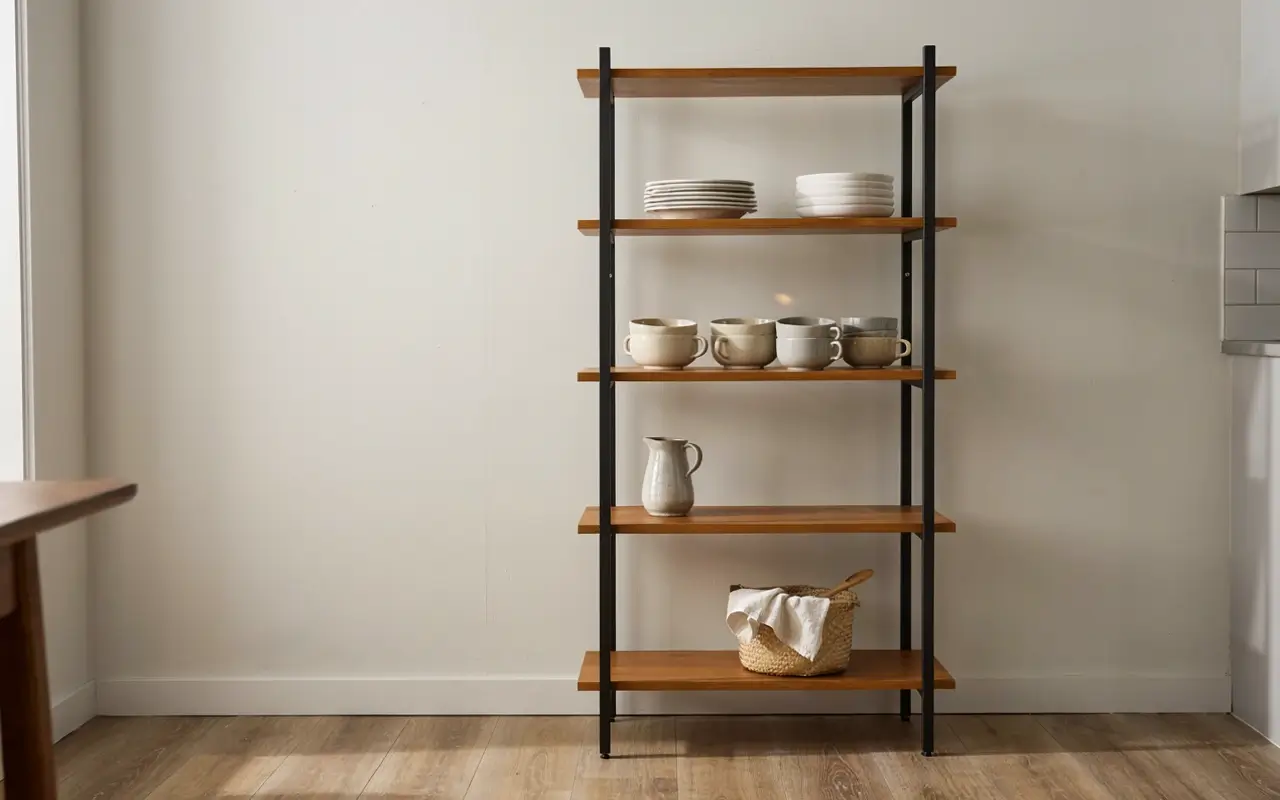
Some leases genuinely forbid wall drilling, full stop. A wood or metal bakers rack placed flush against an empty wall gives the visual rhythm of open shelving without a single screw involved. It works because the eye reads “shelf wall,” not “furniture,” once it’s styled with the same restraint you’d use on a mounted shelf — a few plates, one stack of bowls, nothing crowding the edges. The honest bonus is you take the whole thing with you when you move.
4. Corral Loose Pantry Bags on the Shelf Inside Labeled Container Store Bins So Open Still Looks Tidy
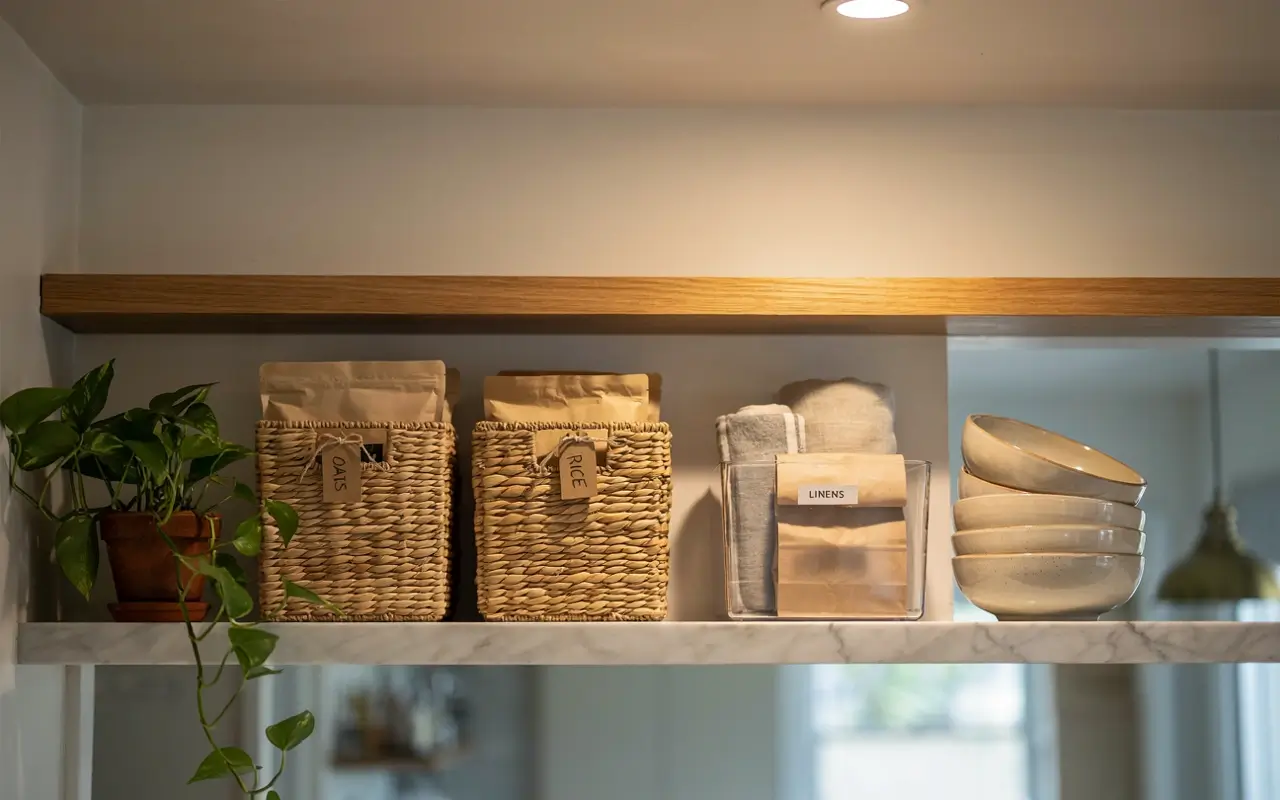
Open shelving falls apart visually the second cereal boxes and half-open bags of rice show up on it. Clear or woven bins with simple labels solve the actual daily problem — where does the loose, ugly stuff go — without hiding the shelf behind a cabinet door. This is the difference between a shelf that looks curated on day one and photographs the same way on day ninety. One warm truth: the bins matter more than the shelf material.
5. Cover the Wall Behind a Rental Shelf With Peel-and-Stick Backsplash Instead of Real Tile
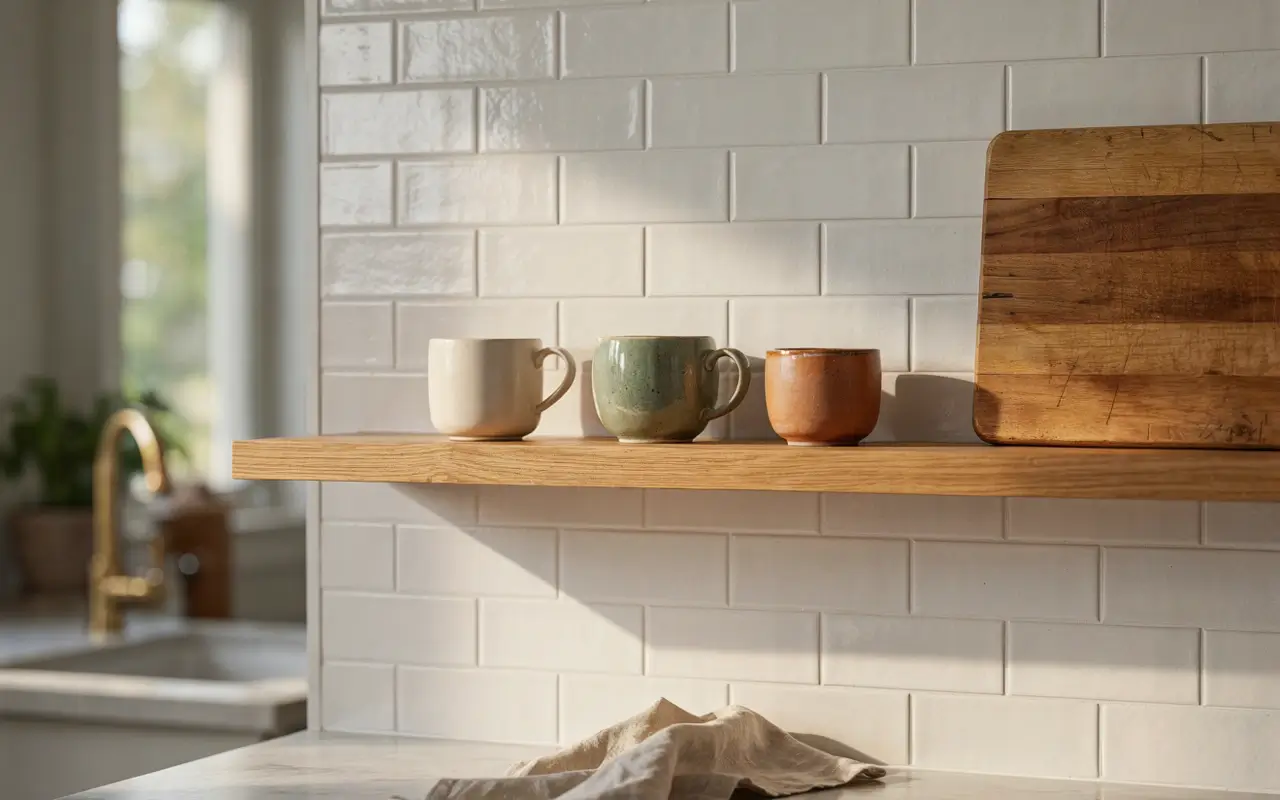
A bare painted wall behind a floating shelf can look unfinished no matter how nice the shelf is. Peel-and-stick subway tile solves that in an afternoon and comes off clean at move-out, which real tile never does. It works visually because texture behind the shelf gives the eye something to rest on between objects. I’d only splurge on the higher-grade vinyl versions — the cheapest ones show seams under direct light.
Small Kitchen and Layout-Smart Open Shelf Ideas
Small and awkward layouts are exactly where most competitor articles go quiet. These five ideas are built around real spatial problems — narrow galleys, single-wall kitchens, and dead corners — not just “small kitchen, add a shelf.”
6. Slide a Shallow Spice Shelf Into the Six Inches Beside the Stove Instead of Cluttering the Counter
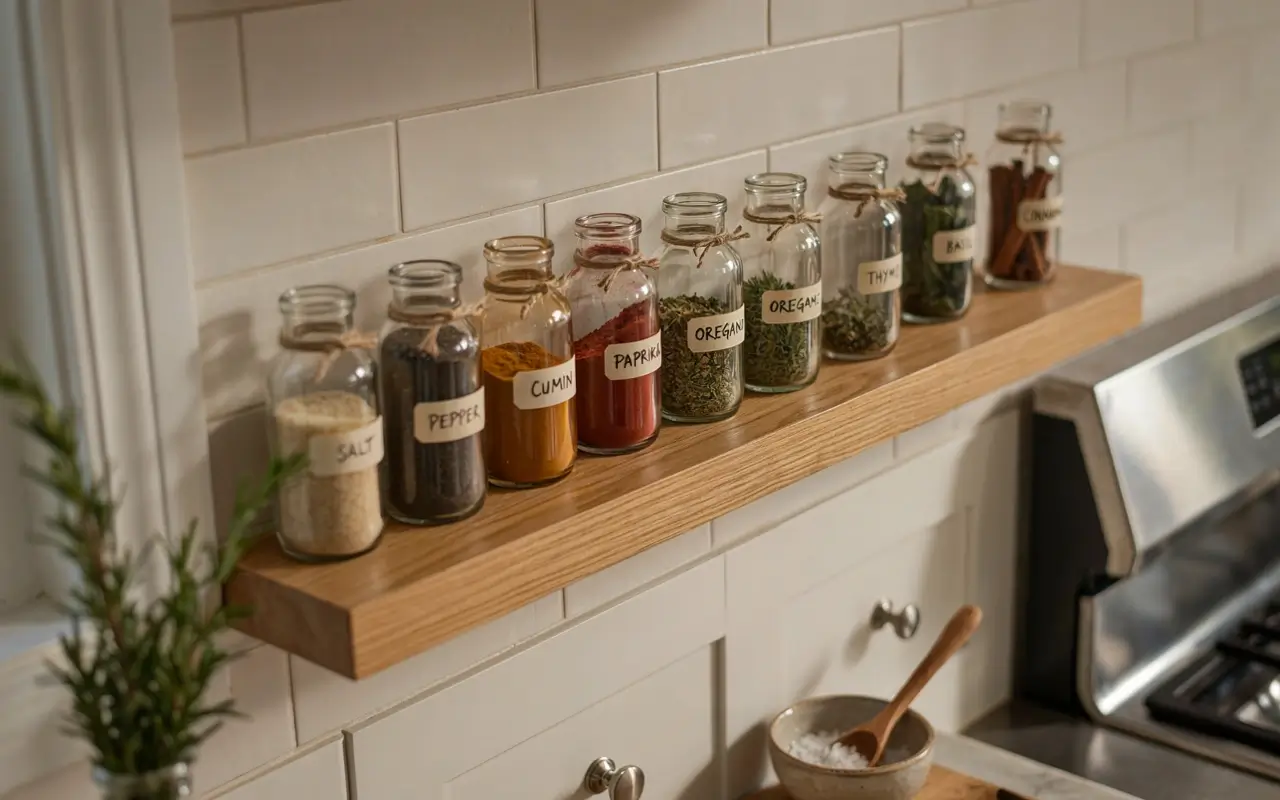
That narrow strip of wall next to the range usually goes unused because nobody thinks a shelf fits there. A four-inch-deep shelf holding spice jars in a single row solves the “where do spices live” problem without eating counter space or blocking a burner. It works because narrow shelves read as intentional built-ins rather than an afterthought. Keep the jars uniform in height so the row reads calm, not busy.
7. Stagger Two Shelf Depths on the Same Wall So a Narrow Galley Kitchen Reads Wider
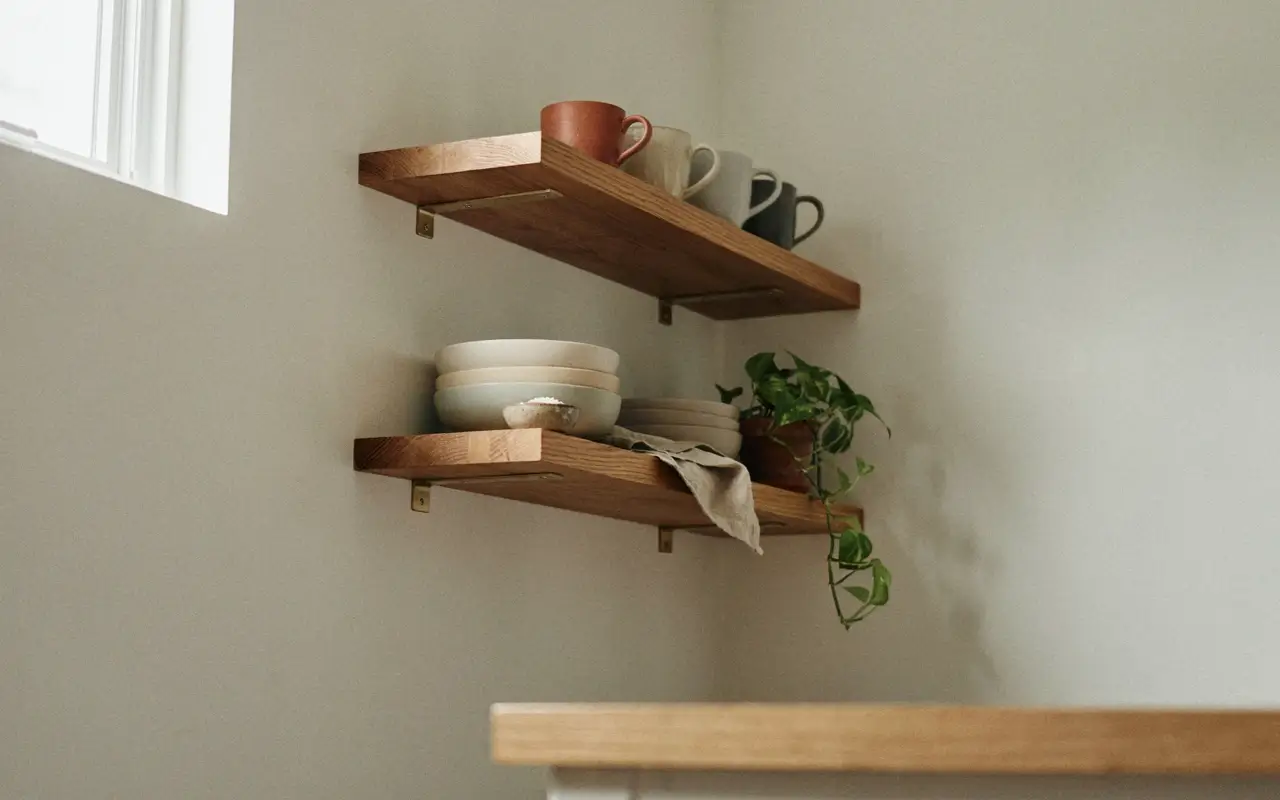
A single flat run of shelves in a tight galley can flatten the whole wall visually. Mounting one shallow shelf above a slightly deeper one breaks that flatness and tricks the eye into reading more depth than the room has. This works particularly well in galley kitchens under 8 feet wide, where every inch of perceived space counts. Keep the deeper shelf for bulkier items like bowls and the shallow one for cups only.
8. Run One Long Shelf Across the Whole Backsplash Instead of Stacking Two Short Ones
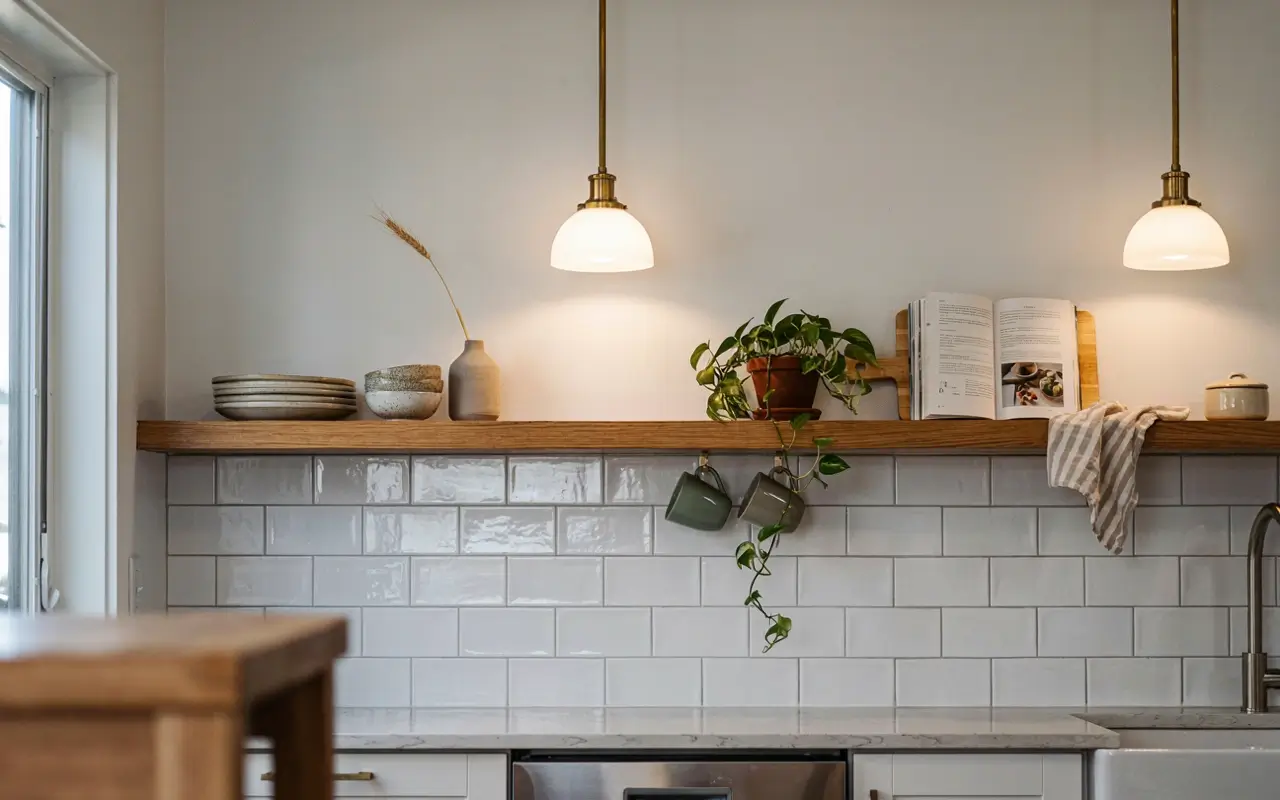
Two short shelves stacked on top of each other in a small kitchen often just recreates the boxed-in feeling of upper cabinets. One continuous shelf spanning the full backsplash width opens the sightline instead, because your eye travels sideways along an unbroken line rather than bouncing between two separate boxes. This works best on walls at least four feet wide. Style it in loose groupings rather than one long even row so it doesn’t look like a display case.
9. Catch the Dead Corner Triangle With a Floating Corner Shelf Most Kitchens Waste
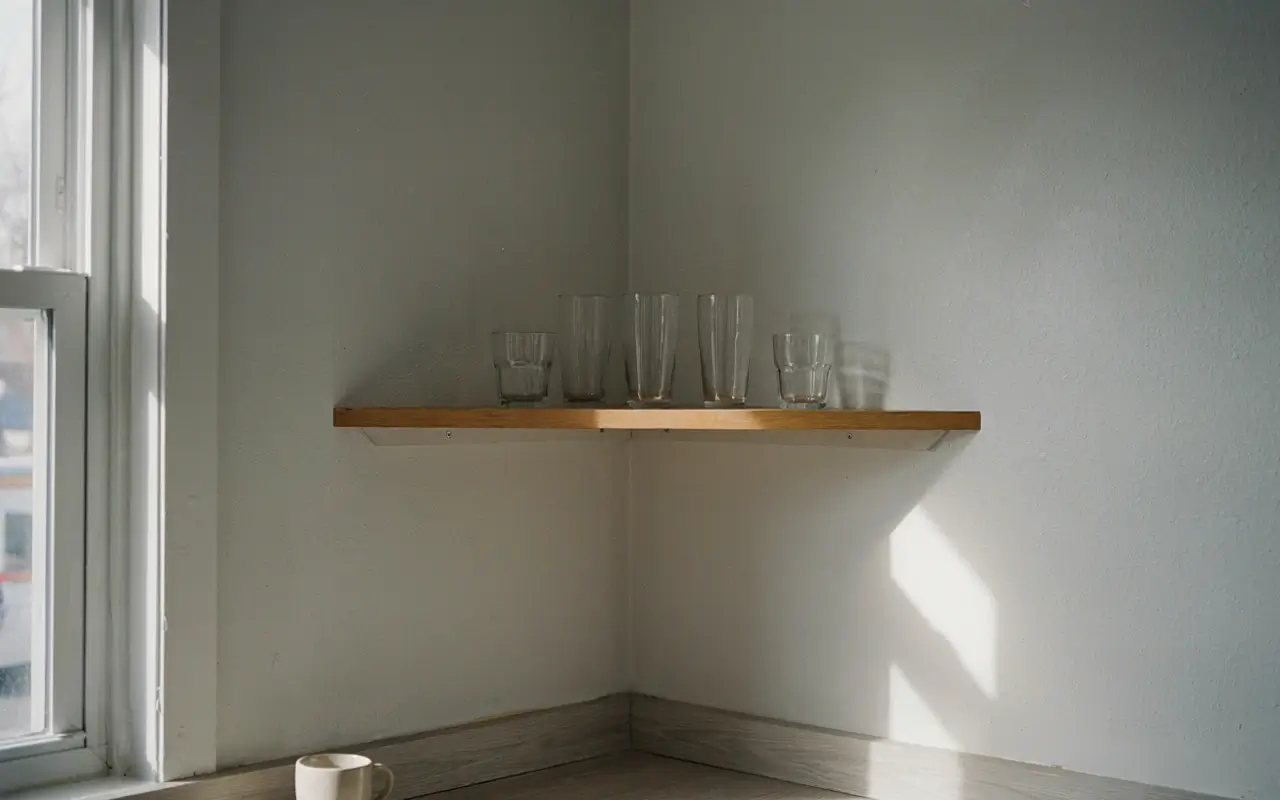
Almost every small kitchen has a corner where two counters or a counter and a fridge meet, leaving a triangle of wall nobody uses. A corner-cut floating shelf turns that dead space into real storage for the items you reach for daily, like everyday glasses. It works because it solves a spatial problem competitors don’t even mention, since most shelf articles only show straight walls. Keep the corner shelf load light — one shelf, one use, nothing stacked two-high.
10. Keep Shelving on the Sink Side of a Single-Wall Kitchen and Leave the Stove Side Fully Closed
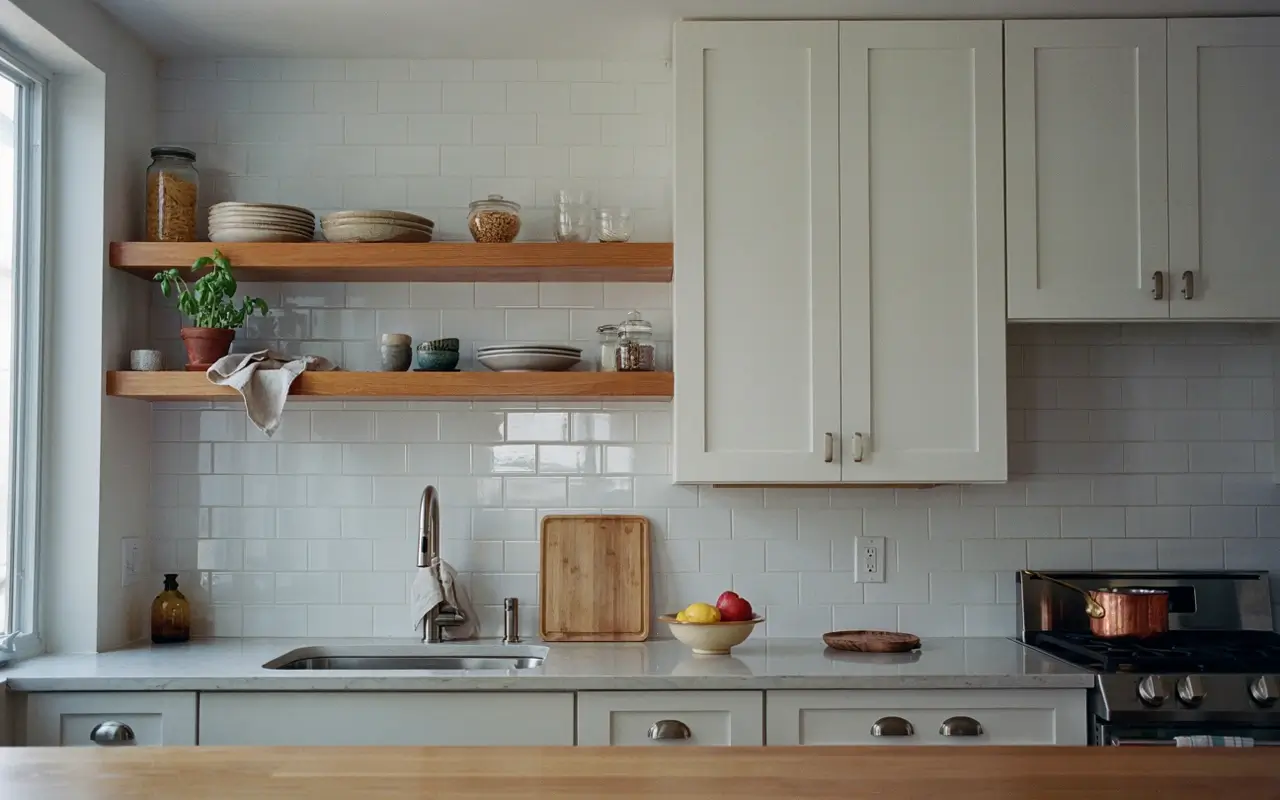
Single-wall kitchens force every decision onto one plane, which is exactly why mixing open and closed matters more here than anywhere else. Reserving the sink half of the wall for open shelves and keeping the stove half in closed cabinetry solves the grease problem before it starts, while still giving you the visual openness you actually wanted.
Farmhouse, Modern, and Mixed-Style Open Shelf Looks
Open shelving isn’t one look. These seven ideas cover the range Pinterest boards do well — different materials and styles — without recycling the same handful of staged photos.
11. Back a White Oak Shelf With Handmade Subway Tile So Every Mug Looks Gallery-Lit
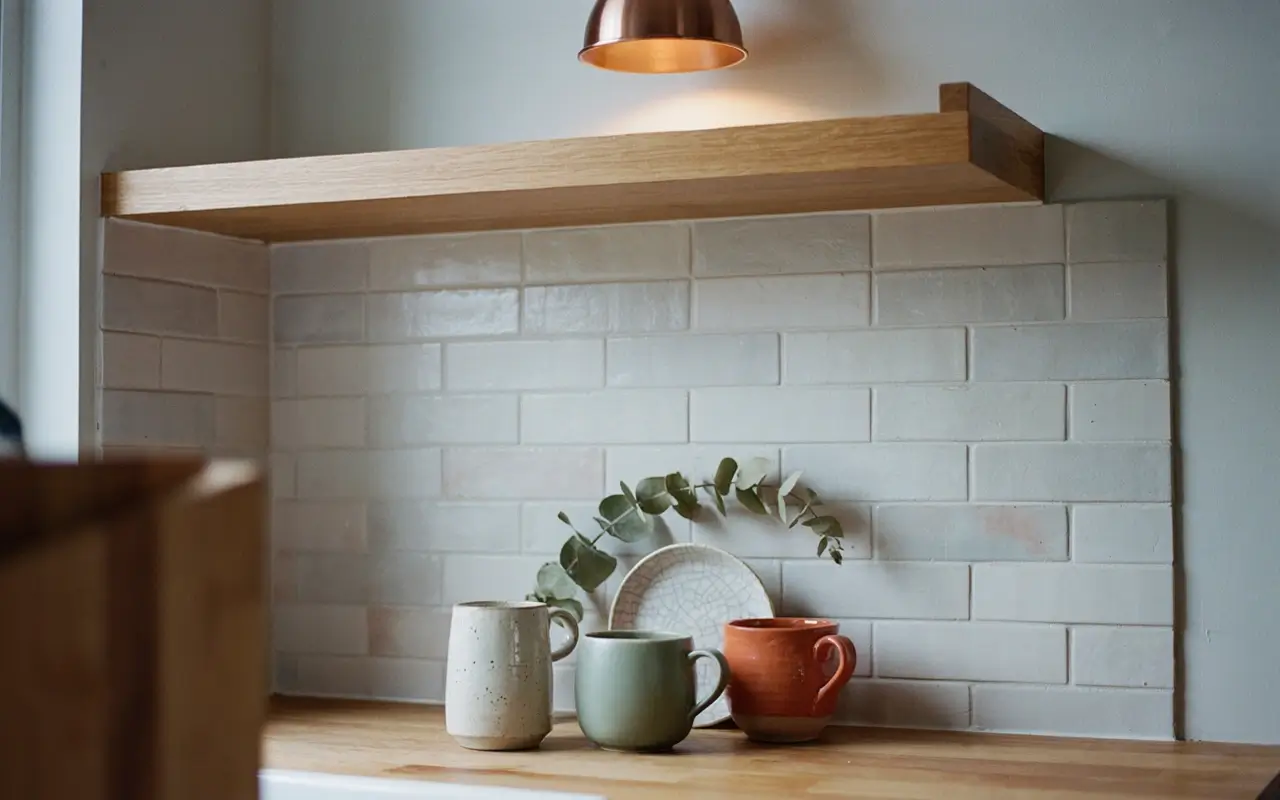
White oak floating shelves have become the default for a reason — the NKBA 2026 Kitchen Trends Report found white oak is the most popular wood tone among designers surveyed, cited by 51 percent. Pairing that warm tone with slightly irregular handmade tile behind it adds texture so the wall doesn’t read flat under kitchen lighting. Keep the tile in one consistent color family so the shelf stays the visual focus, not the tile.
12. Swap Only the Top Row of Uppers for Open Shelving and Keep Lower Cabinets Closed With Brass Pulls
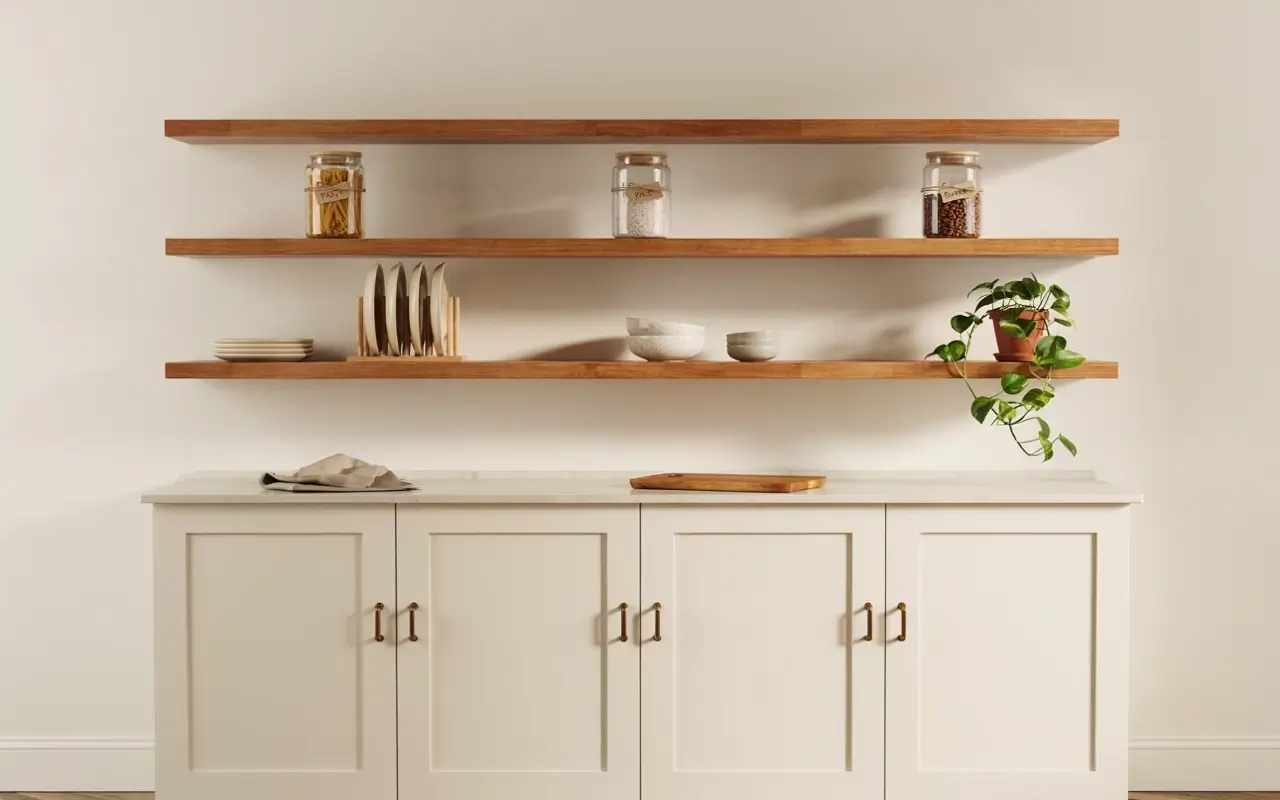
Going fully open is a real commitment, and plenty of kitchens don’t need to make it. Removing just the top row of upper cabinet doors and leaving the lower run closed, updated with brass pulls, gives you the visual lightness of open shelving while keeping deep, hidden storage for the stuff you don’t want on display. This is the mixed-storage approach competitor articles almost never show, since most treat “open” and “cabinets” as an either-or choice.
13. Pair Rough-Sawn Pine Shelves With Painted Beadboard for a Farmhouse Feel Without the Cliché
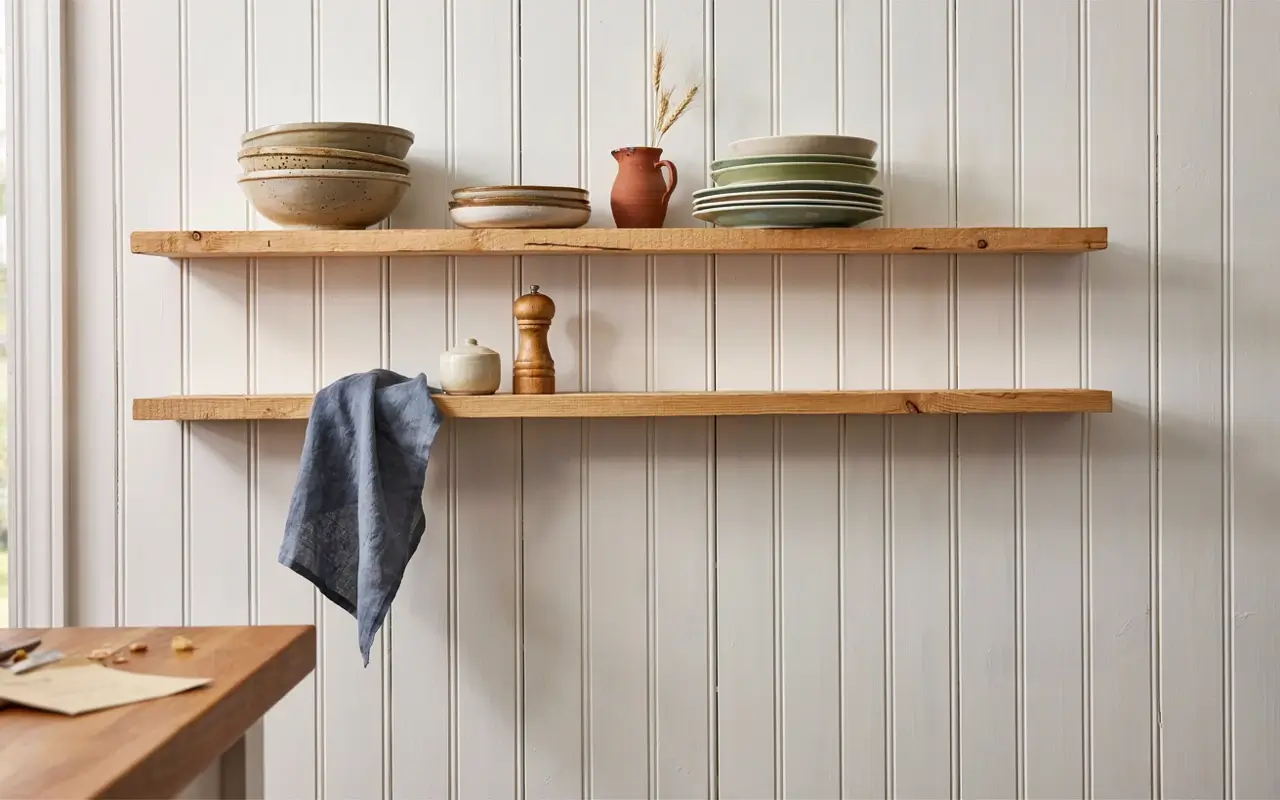
Farmhouse open shelving gets overdone with mason jars and rooster decor until it feels like a theme rather than a kitchen. Rough-sawn pine shelves against a plain painted beadboard backdrop keep the texture cues — wood grain, board lines — without leaning into props that date the room fast. It works because the materials do the storytelling instead of the accessories. Style it with everyday stoneware, not decorative jars nobody actually uses.
14. Float Matte Black Steel Shelves Against a Plain White Wall for a Gallery-Clean Modern Line
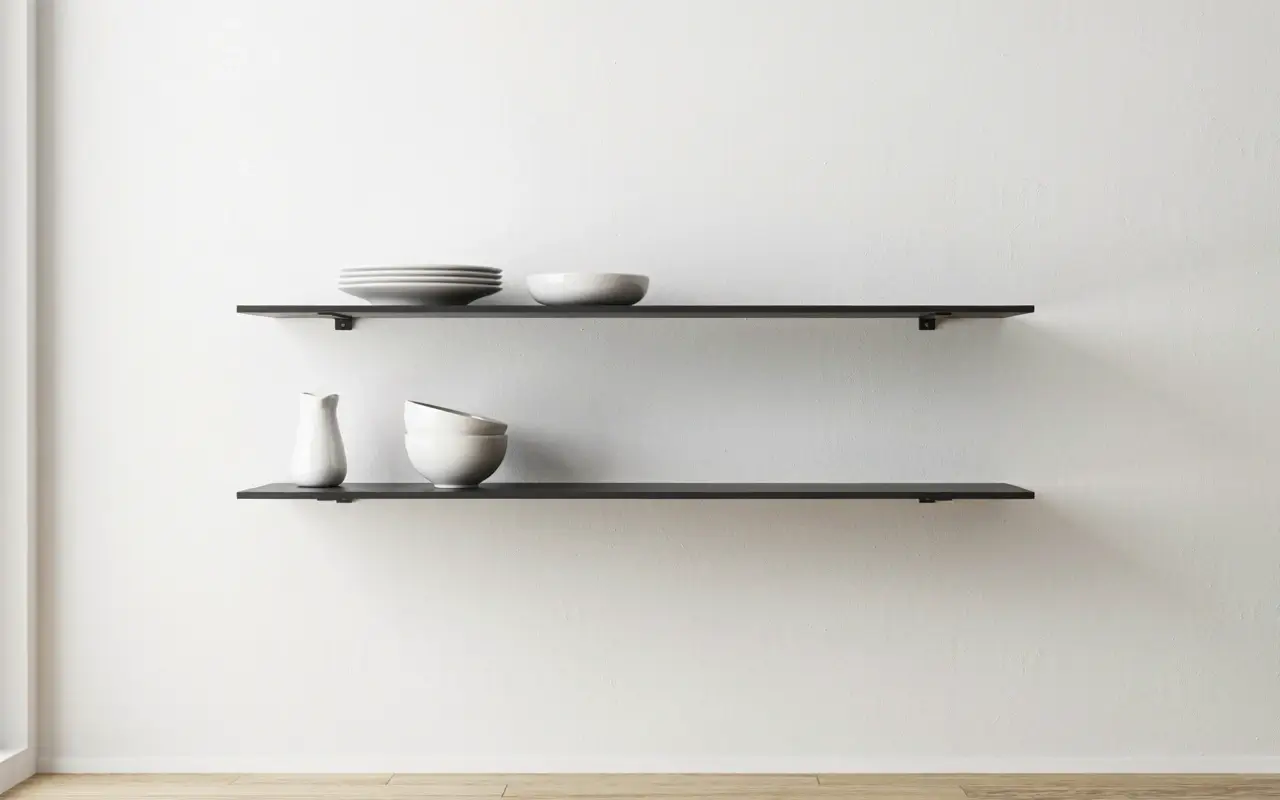
Wood tones dominate open shelving inspiration right now, which is exactly why thin matte black steel shelves stand out in a modern kitchen. The contrast against a plain white wall reads architectural rather than decorative, and the thin profile keeps the wall from feeling heavy. This works best in kitchens that are already minimal in palette, since the shelves need visual quiet around them to read as intentional rather than industrial.
15. Keep Glass-Front Cabinets on One Wall and Fully Open Shelving on the Facing Wall for Balance
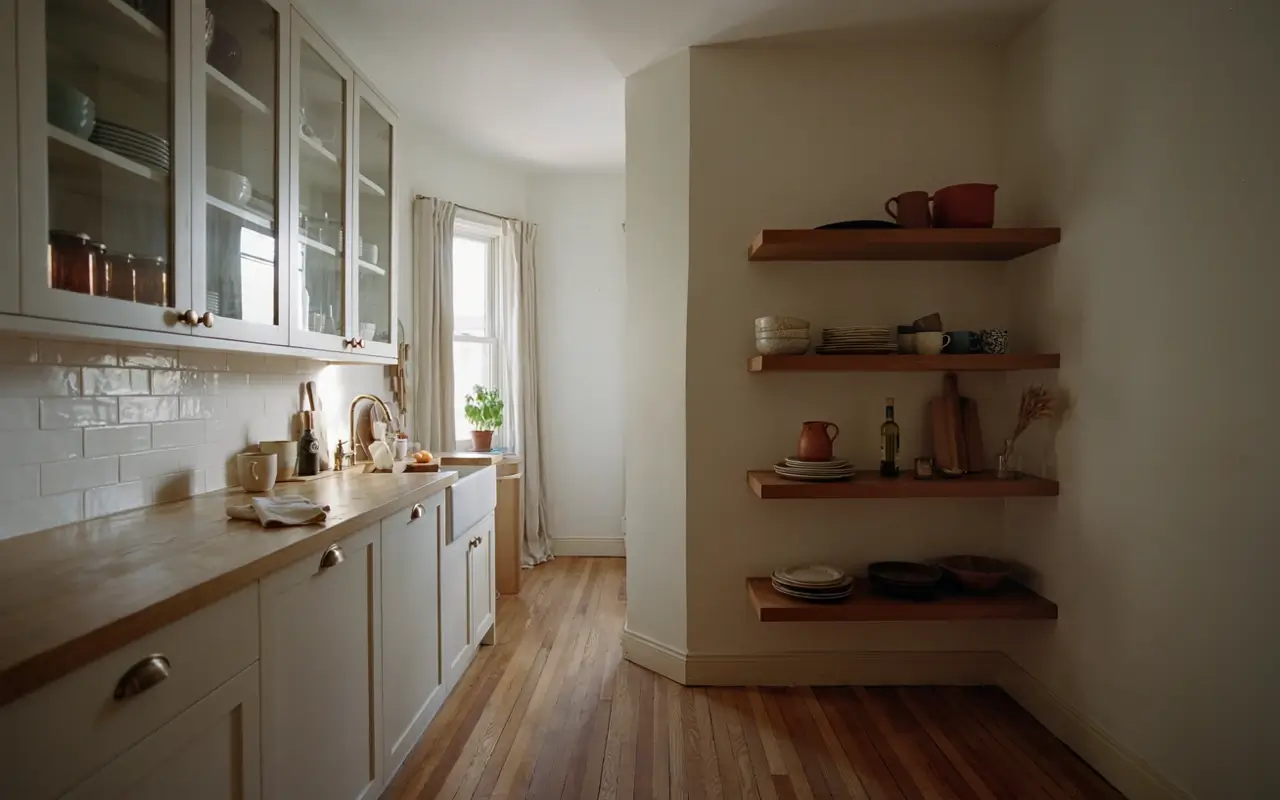
If going fully open on every wall feels like too much exposure, splitting the difference works. Glass-front cabinets on one wall give you closed protection with visual transparency, while the facing wall goes fully open for the display pieces you actually want seen. This balance solves the “I’m not ready to commit” hesitation directly, since you get to test full openness on just one wall first.
16. Build a Grooved Plate Rack Shelf So Everyday Plates Double as Wall Art
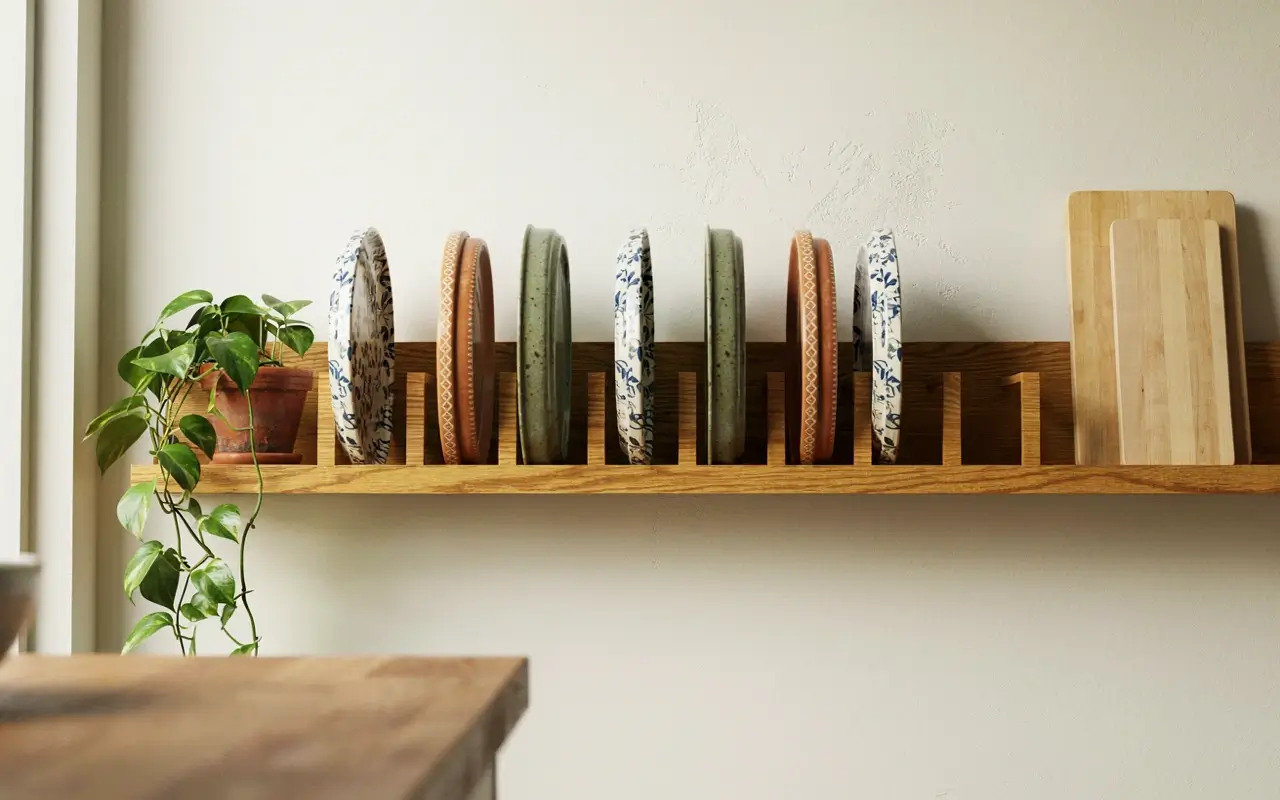
A standard flat shelf holds plates flat and stacked, which hides the pattern you actually like. A shallow grooved plate rack shelf lets you slot plates vertically so the front of each one shows, turning daily dishware into the wall’s visual focus without buying separate decor. It works especially well with patterned or colored stoneware. I’d only splurge on this build if your plates are actually worth showing off.
17. Hang an IKEA VADHOLMA Rail With S-Hooks Below the Shelf for Mugs and Utensils Without Extra Drilling
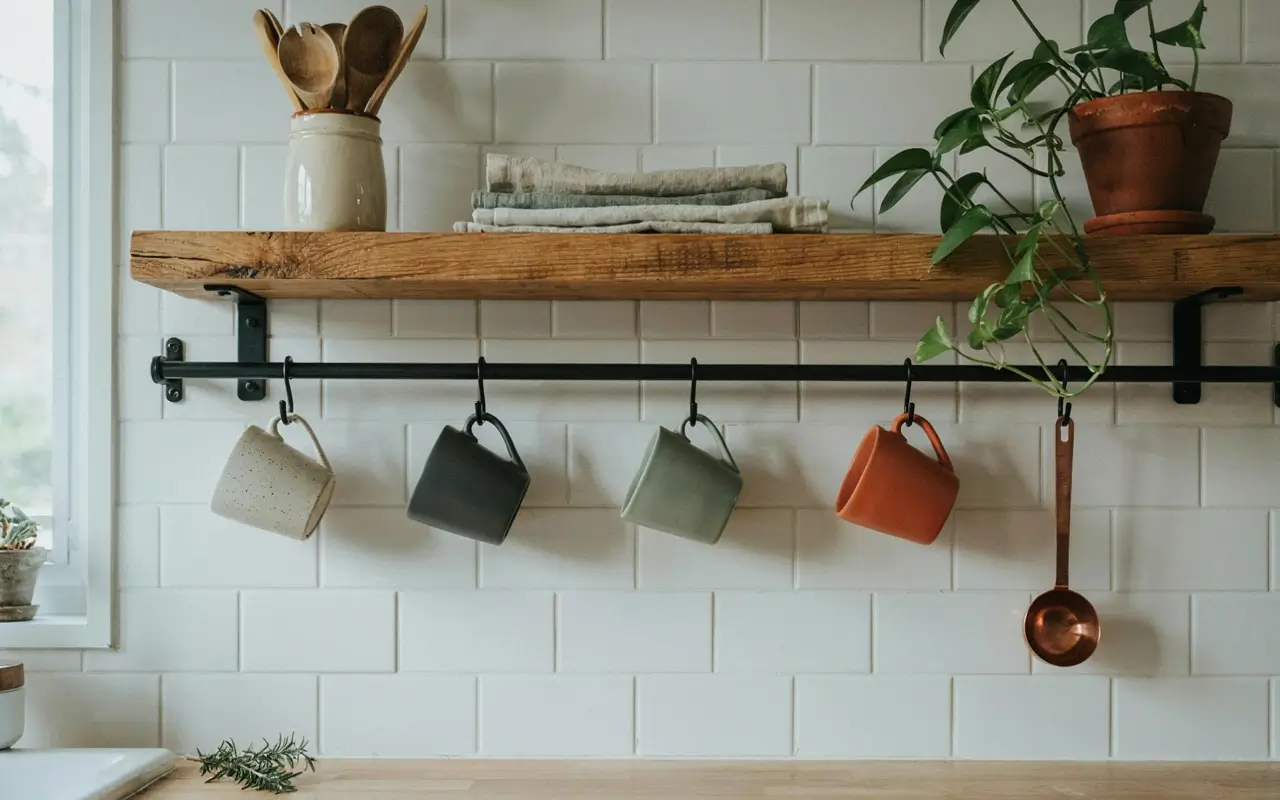
One shelf, one rail, one set of holes. Mounting a VADHOLMA-style rail directly under a floating shelf gives you a second storage layer — mugs and utensils on hooks — without a second round of drilling into the wall. It works visually because the hanging layer adds movement and height variation under an otherwise flat shelf line. Keep the hooks to five or fewer so the rail doesn’t turn into clutter.
Styling Tricks That Make Real Shelves Look Pinterest-Worthy
Material and layout get a shelf built. These six ideas are about the daily styling choices that make it photograph well and still function.
18. Paint the Wall Behind the Shelf One Shade Darker Than the Cabinets So the Wood Pops Forward
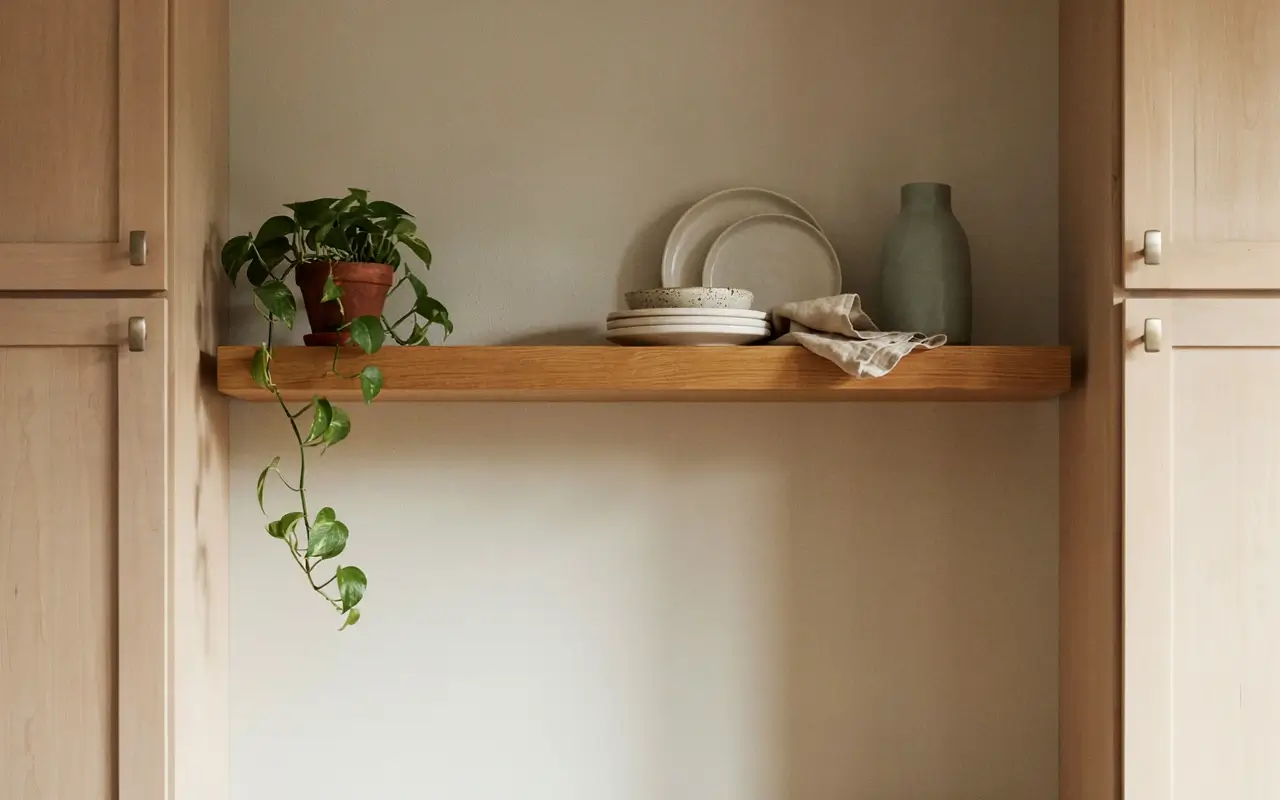
Wood shelves against a wall painted the same tone as the cabinets can visually flatten into the background. A wall color one shade darker gives the shelf a subtle backdrop to stand forward from, without introducing a whole new color into the room. This is a small, cheap change — a quart of paint — that fixes a “why doesn’t this photograph well” problem a lot of real kitchens have.
19. Leave the Top Shelf Half-Empty on Purpose So the Wall Breathes Instead of Feeling Packed
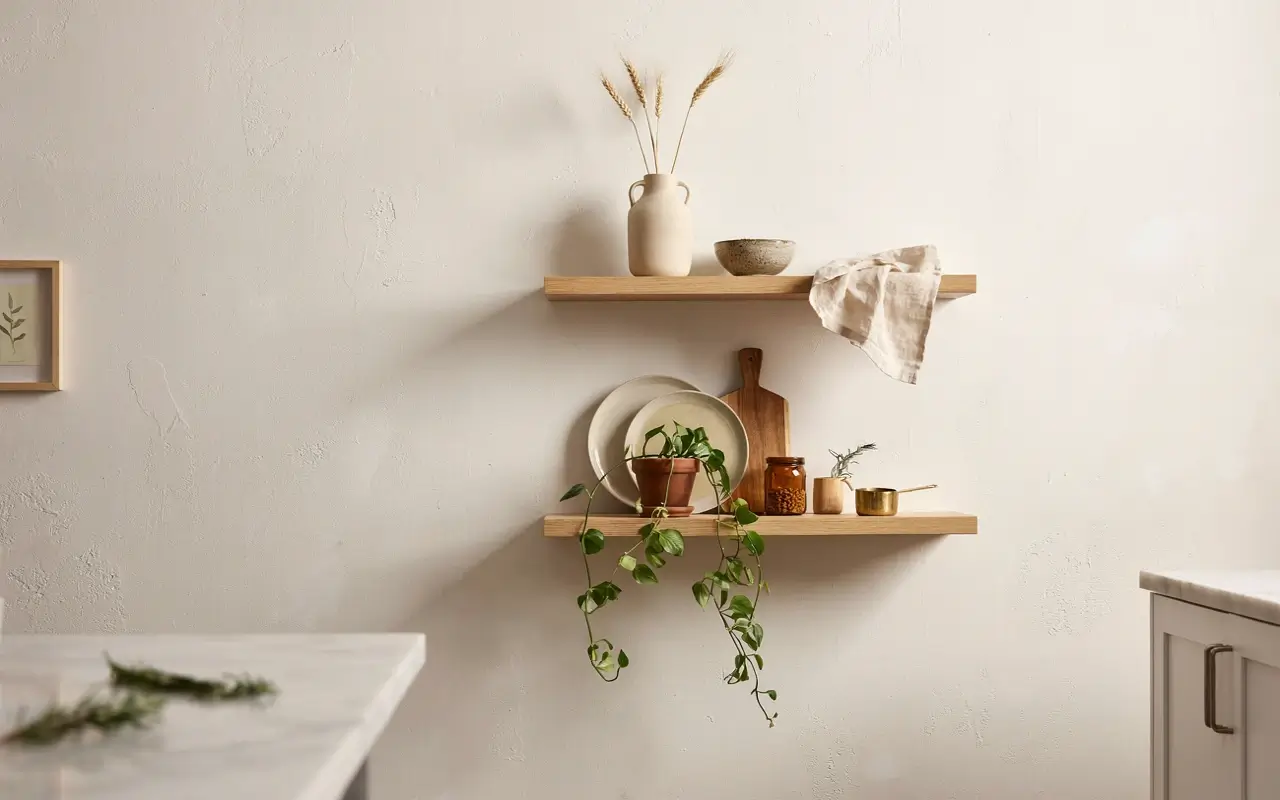
Every inch of a shelf filled with objects tips a wall into feeling cluttered rather than curated, even with nice dishware. Deliberately leaving the top shelf two-thirds full at most gives the eye a resting point and makes the fuller shelves below look intentional rather than crowded. It works because negative space is doing real design work here, not just looking empty. This is the single easiest fix for a shelf that “feels busy” in photos.
20. Install a Single Warm Pendant Over the Open Shelf Corner Instead of a Flat Overhead Flood
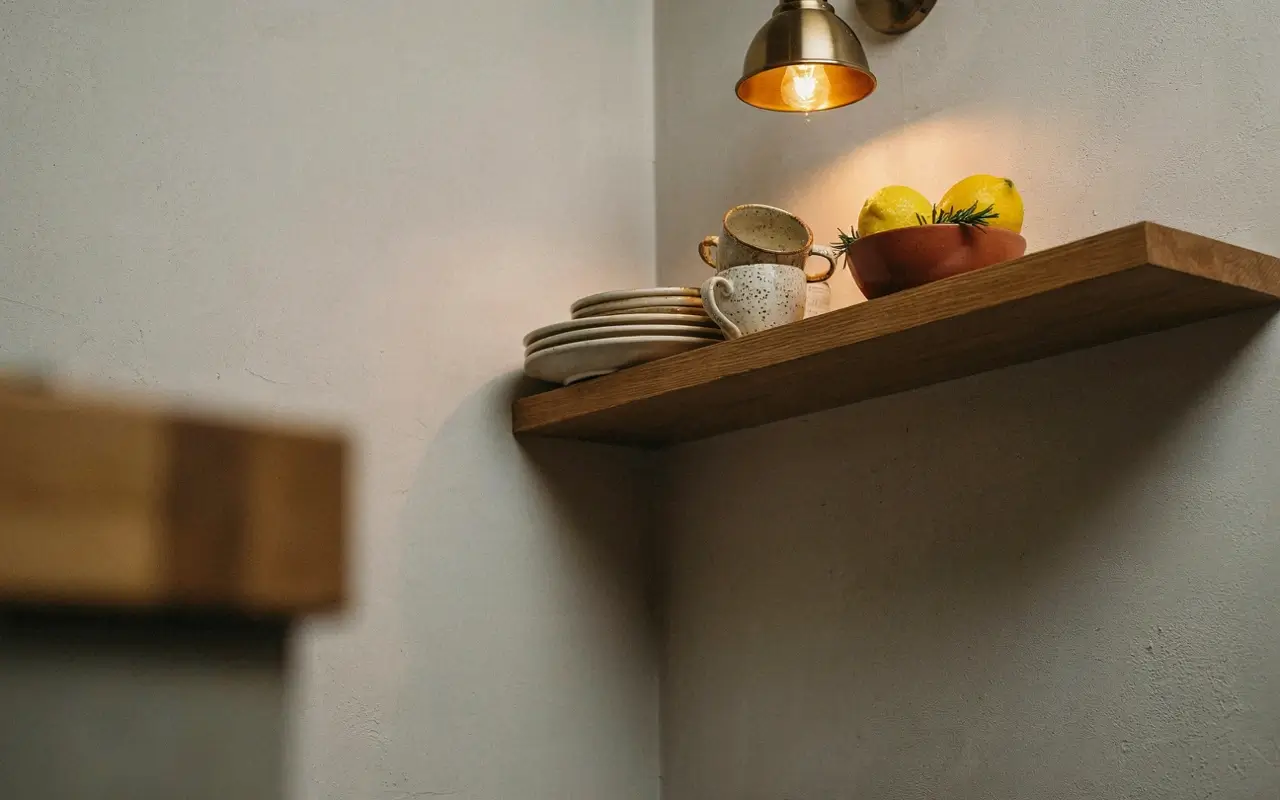
Flat overhead kitchen lighting flattens texture and color, which is exactly the opposite of what an open shelf display needs. One warm pendant angled toward the shelf corner adds shadow and depth that overhead flood lighting erases, making stoneware and wood grain read richer instead of washed out. This works especially well over a corner shelf or the end of a long run, where the light pool can stay contained.
21. Hide a Warm LED Strip Under One Floating Shelf So the Kitchen Glows Like a Small Café at Night
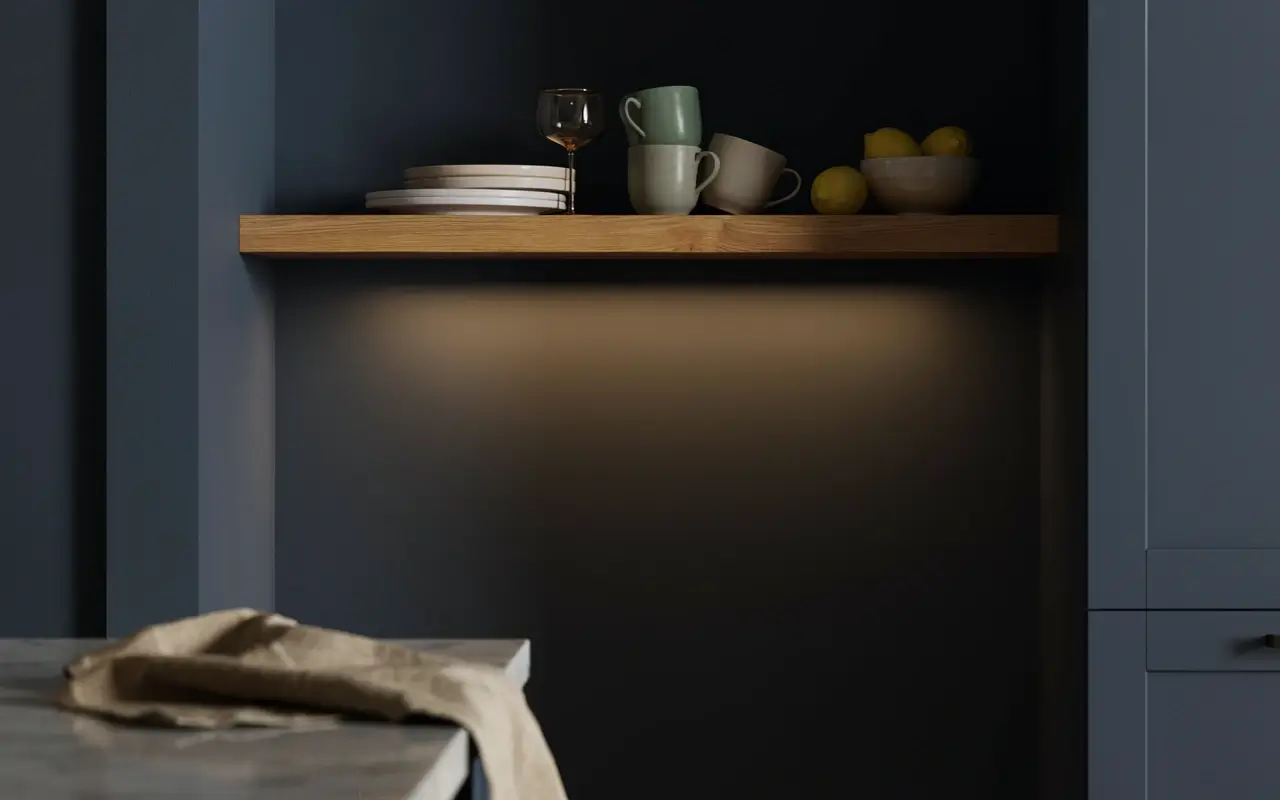
A single warm-toned LED strip tucked under the front lip of one shelf solves the evening-kitchen problem — that dim, unfinished feeling after dark — while adding a soft glow that makes the shelf the room’s focal point at night. It works because the light source stays hidden, so what you see is the effect, not the fixture. Keep the color temperature warm, not cool white, or the café feeling disappears.
22. Lay a Woven Runner Under the Open Shelf Wall So Bare Feet Land Somewhere Soft
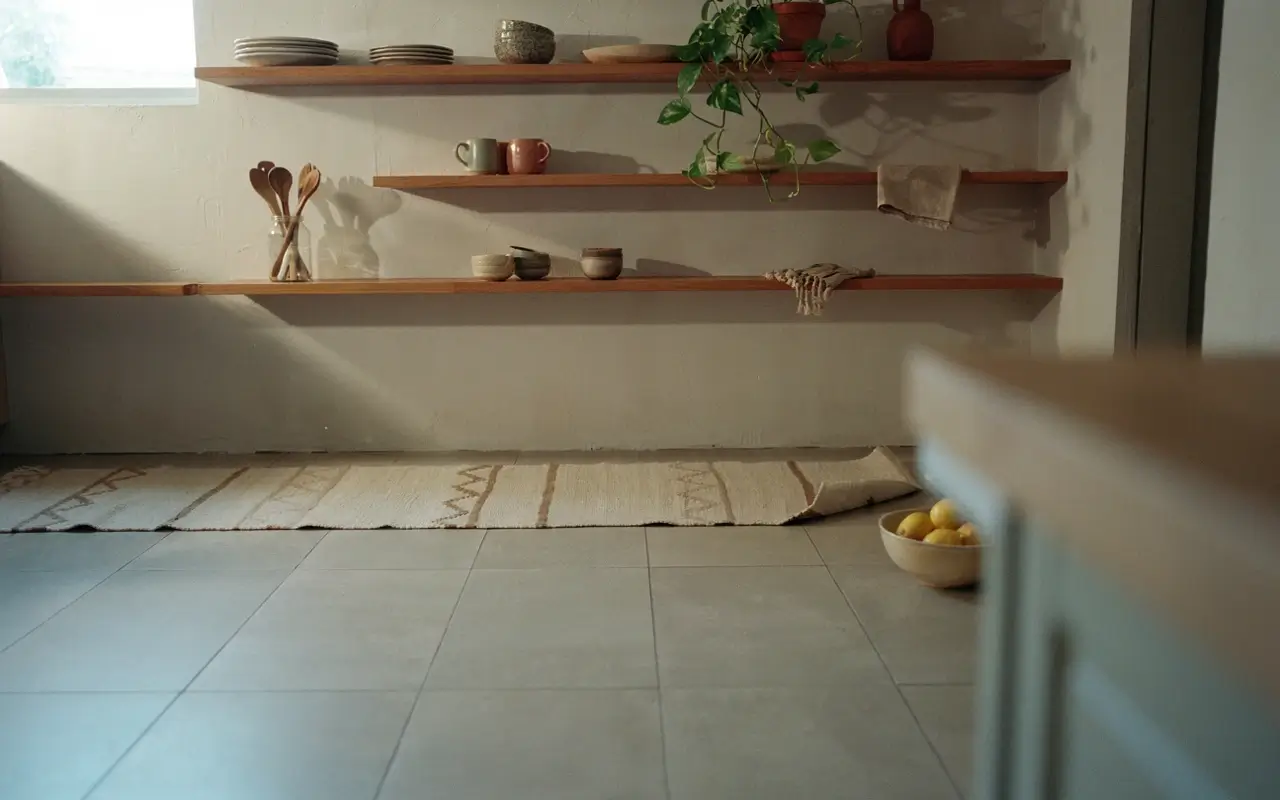
Open shelving draws the eye up, which can leave the floor beneath it feeling like an afterthought. A woven runner placed directly under the shelf wall grounds the whole vignette and gives the space a finished, designed feel from floor to shelf. It works well in kitchens with hard tile or wood flooring, where the runner adds warmth underfoot as well as visually. Keep the runner’s tone connected to the shelf wood so the whole wall reads as one composition.
23. Mix One Rattan Basket Into the Ceramic Stack So the Shelf Reads Layered, Not Matched
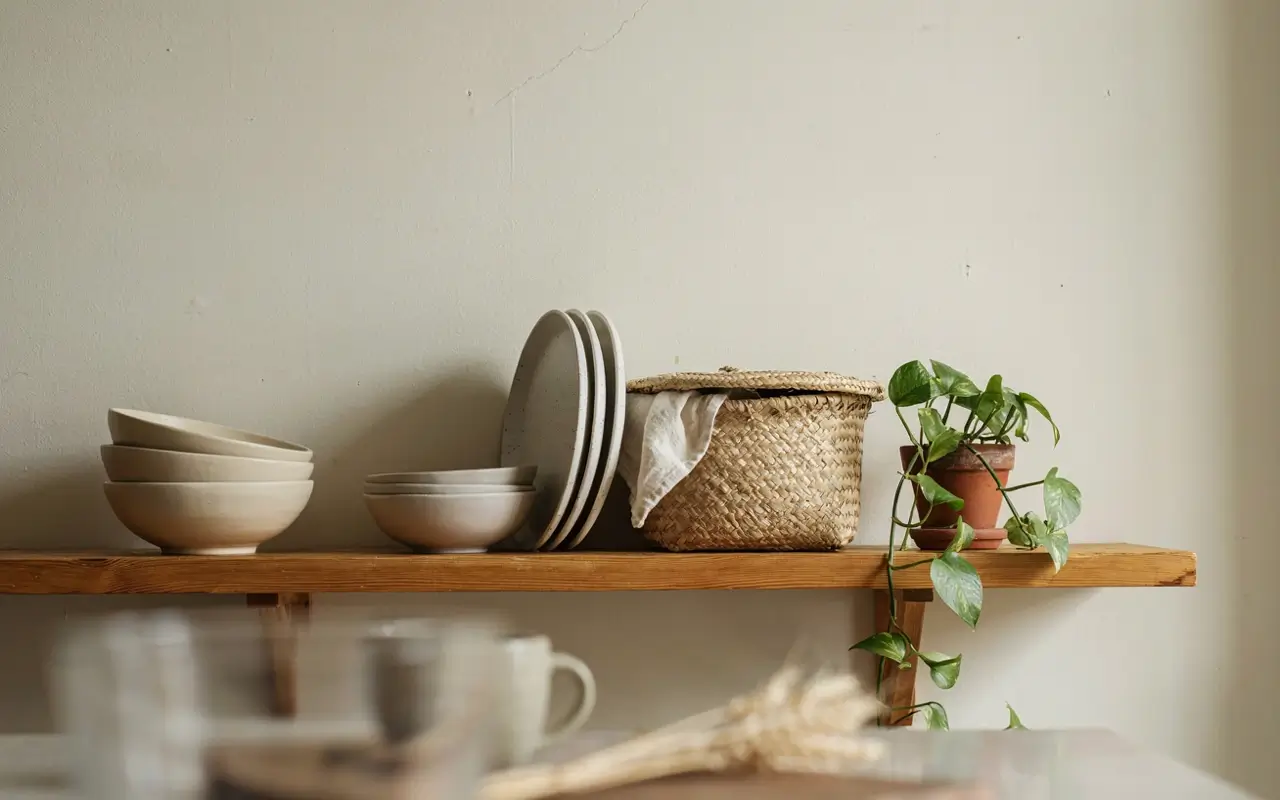
An all-ceramic shelf can start to look like a store display rather than a lived-in kitchen. Tucking one rattan or woven basket into the arrangement — holding napkins, small tools, or nothing structured at all — breaks the uniformity and adds a natural texture that ceramic alone can’t give. This works because contrast in material, not just color, is what makes a shelf photograph as “collected over time” instead of “bought as a set.”
Practical Reality Checks: Grease, Dust, and Weight
This is the part most competitor articles skip entirely. Six ideas here are about what actually happens to open shelving after the photo is taken — near a stove, under dust, and under real weight.
24. Commission One Live-Edge Walnut Shelf With Hidden West Elm Brackets as the Kitchen’s Single Statement Piece
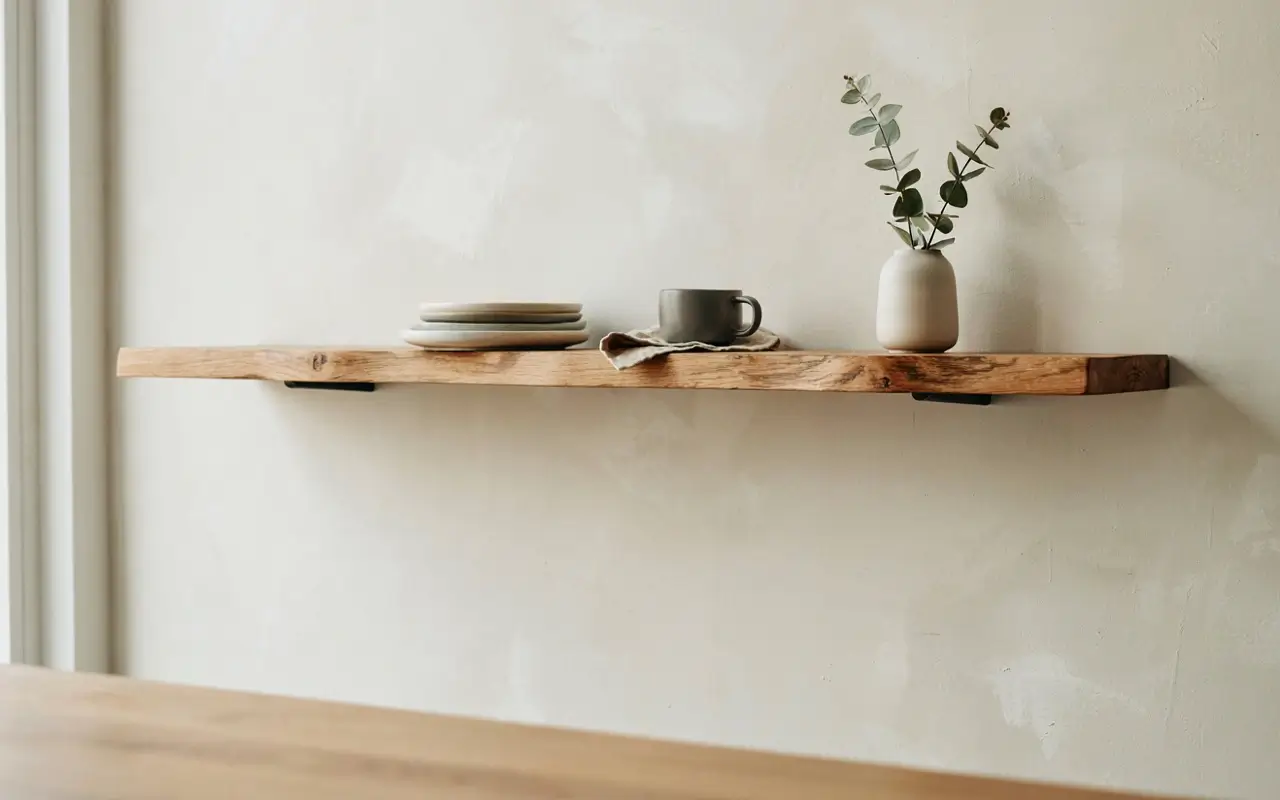
Not every shelf needs to be a splurge, but one can be. A single live-edge walnut slab mounted on West Elm’s hidden bracket hardware becomes the kitchen’s anchor piece — the one shelf that gets photographed on its own. It works because the rest of the kitchen can stay simple around it; one strong material choice does the visual heavy lifting. I’d only spend here if you plan to keep this kitchen for years, since the cost only pays off over time.
25. Build a Shelf Ladder Beside the Fridge Instead of Leaving That Sliver of Wall Empty
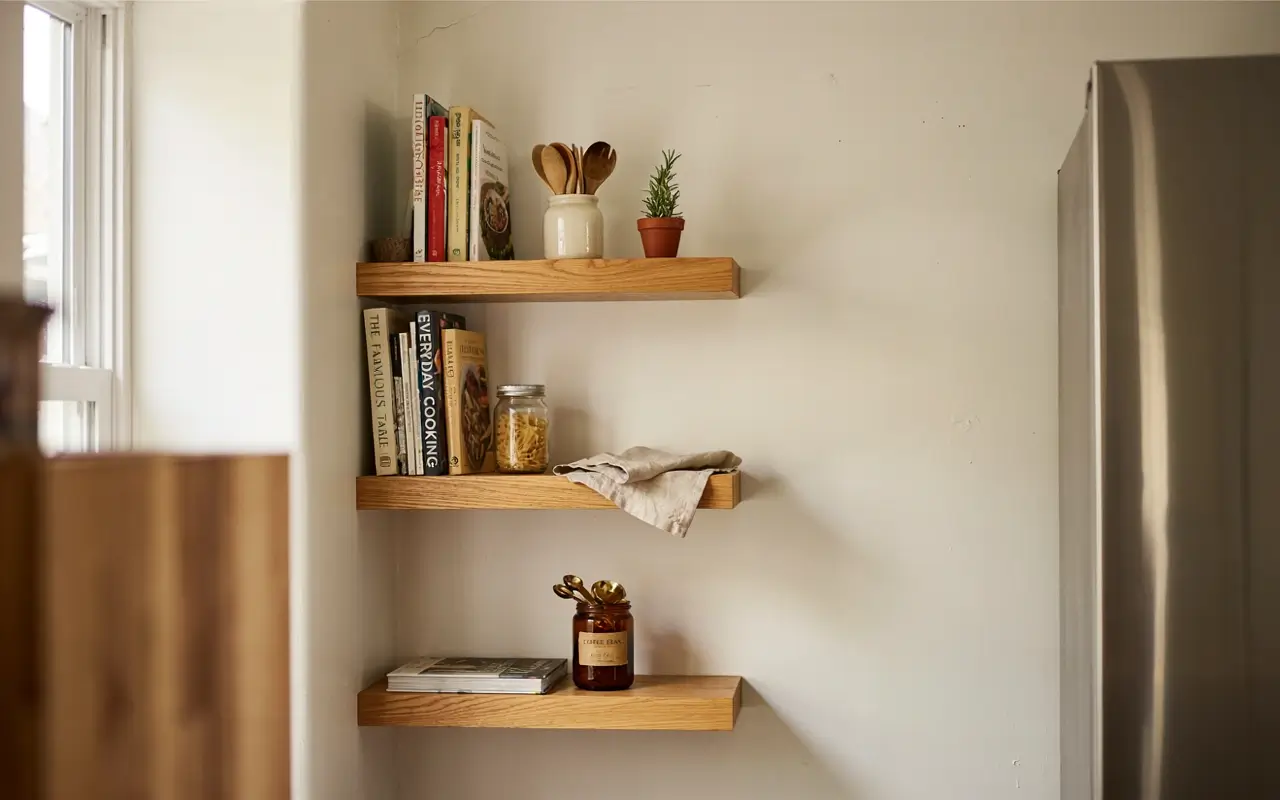
The narrow strip of wall beside a fridge is one of the most wasted spots in a kitchen, and most owners never think to shelve it. A vertical ladder of three or four narrow shelves fits that sliver exactly, giving you a spot for cookbooks, oils, or small plants without touching your main counter or backsplash wall. It works because it solves a spatial problem competitor listicles rarely photograph at all.
26. Keep Open Shelves Three Feet From the Range and Let a Closed Cabinet Handle the Splatter Zone
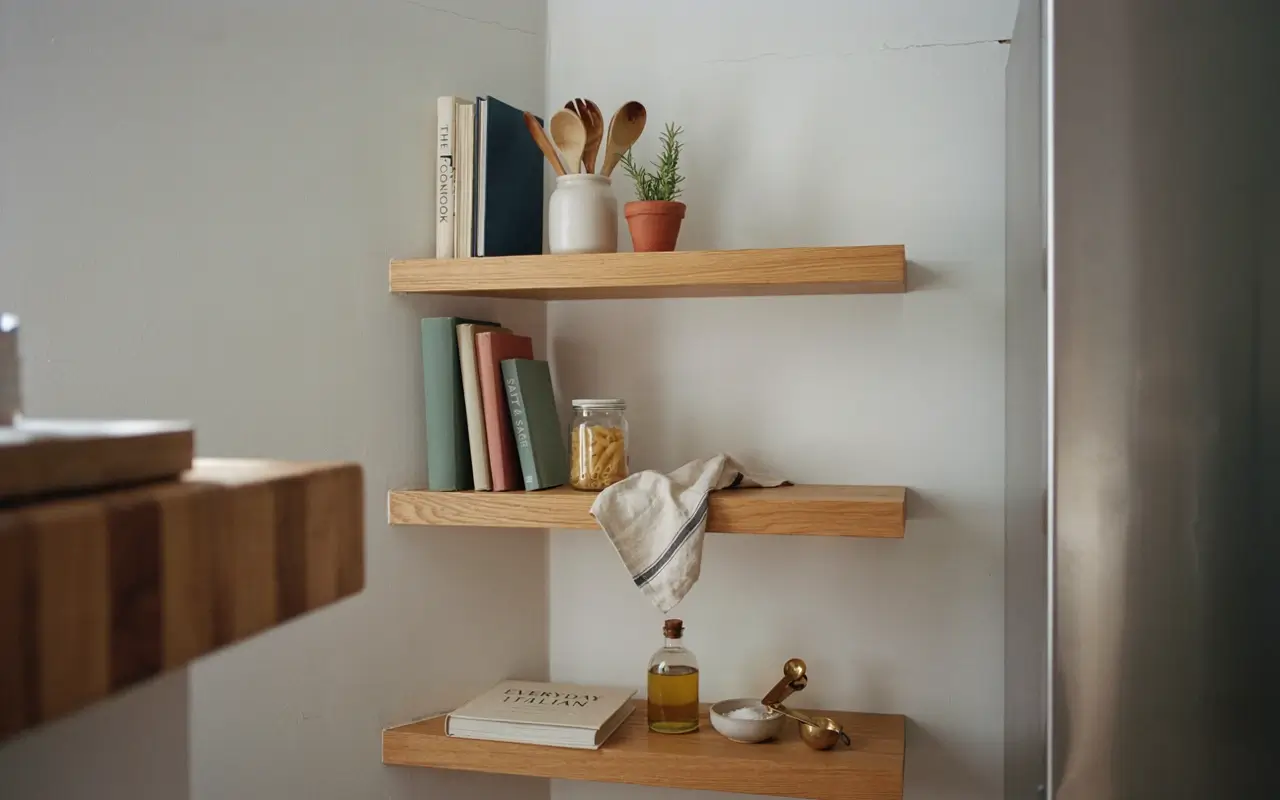
The single biggest practical failure in open shelf photos nobody talks about is grease. Anything mounted within roughly three feet of an active stovetop collects a fine film over weeks, no matter how careful you are. Keeping open shelving on the sink or prep side and reserving the space directly above and beside the range for a closed cabinet solves this before it becomes a cleaning chore. Skip open shelving directly over the stove even if the photo idea is tempting.
27. Store Everyday Dishes on the Lowest Shelf and Save the Top One for Pieces You Rinse Before Use
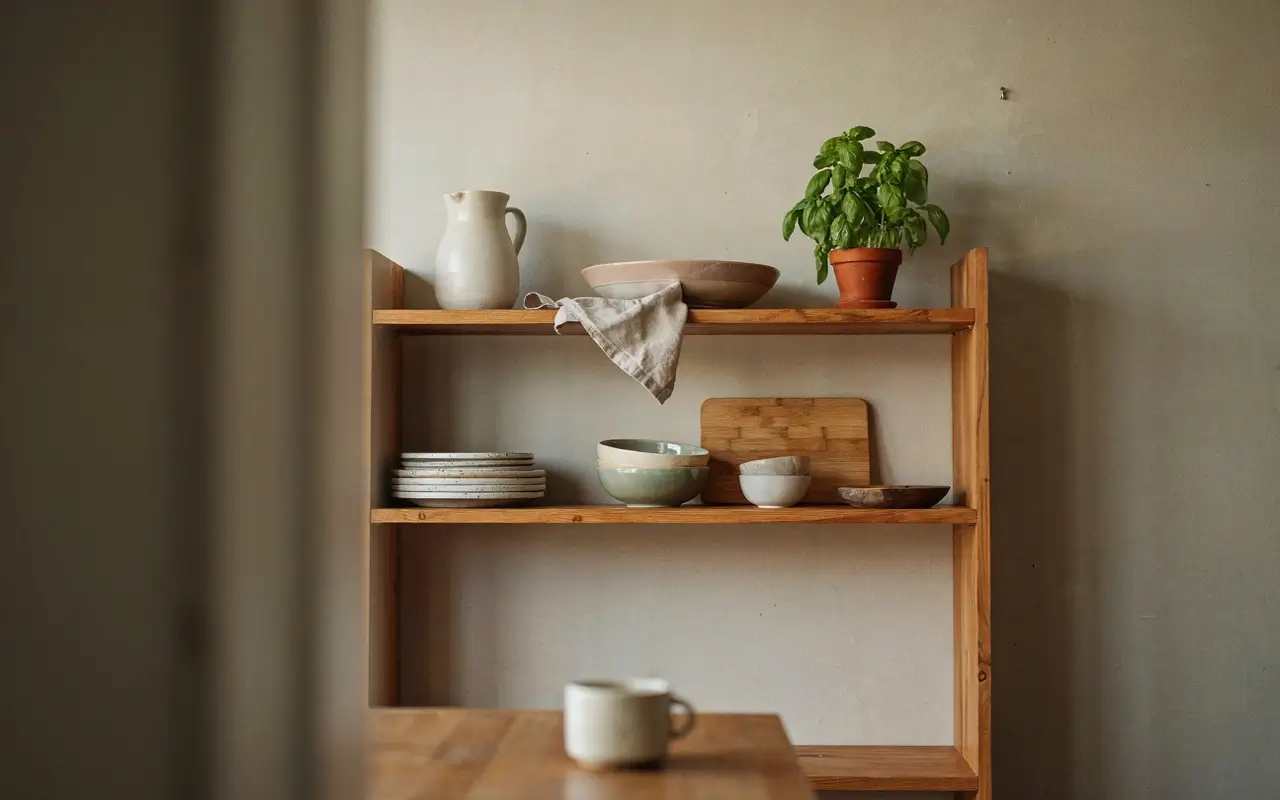
Open shelves collect a light layer of dust the same as any horizontal surface, and pretending otherwise sets people up to feel like they’re failing at upkeep. The fix is practical, not aspirational — keep daily-use dishes low, where turnover keeps them clean, and reserve the top shelf for pitchers or serving pieces you’d rinse before using anyway. This one honest habit removes most of the anxiety around open shelving and dust.
28. Anchor Heavy Stoneware Shelves Into Studs Instead of Trusting Drywall Anchors Alone
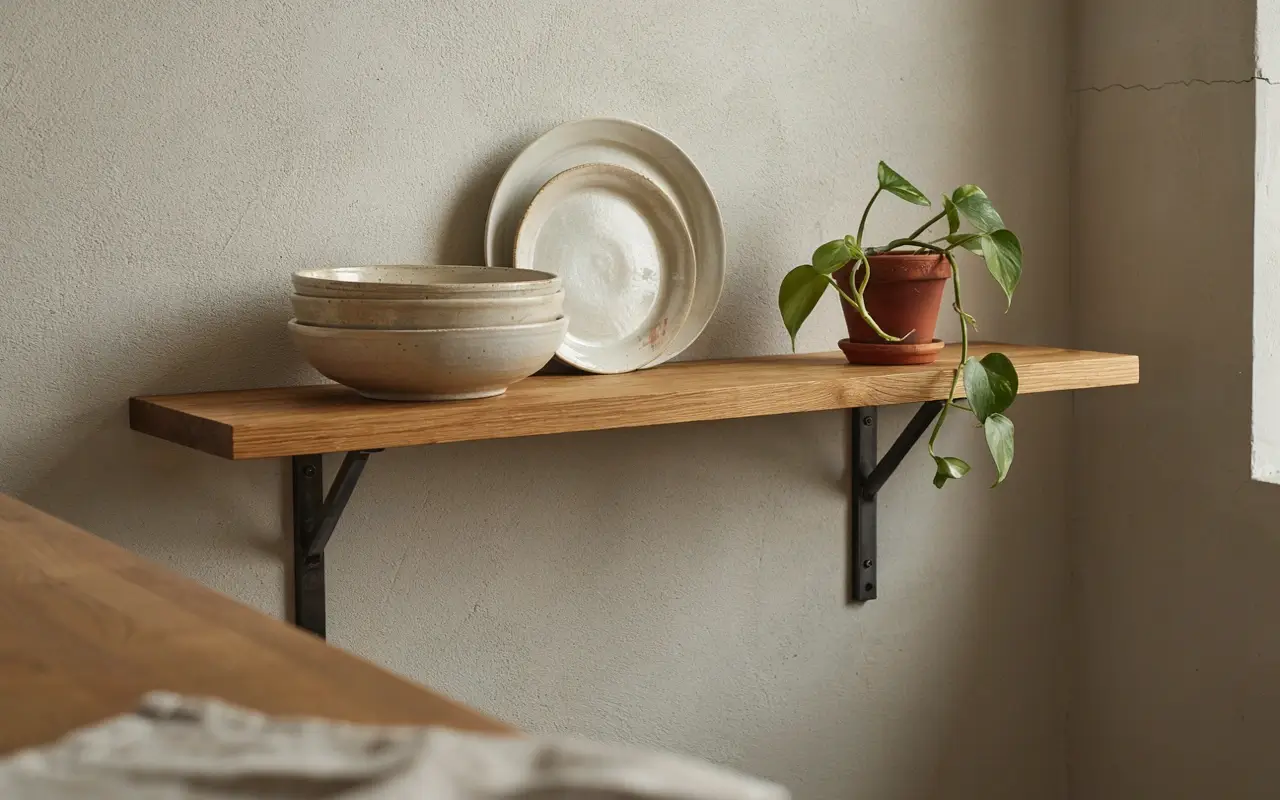
A shelf full of stacked stoneware and ceramic serving pieces can weigh more than people expect, and drywall anchors alone aren’t rated for that long-term. Locating studs and anchoring brackets directly into them, even if it means the shelf isn’t perfectly centered on the wall, is the difference between a shelf that lasts and one that eventually pulls loose. My honest caveat: if your wall studs don’t line up where you want the shelf, a mounting plate that spans two studs solves it without guesswork.
29. Choose Sealed or Painted Wood Over Raw Wood for Any Shelf Within Splatter Range of the Stove
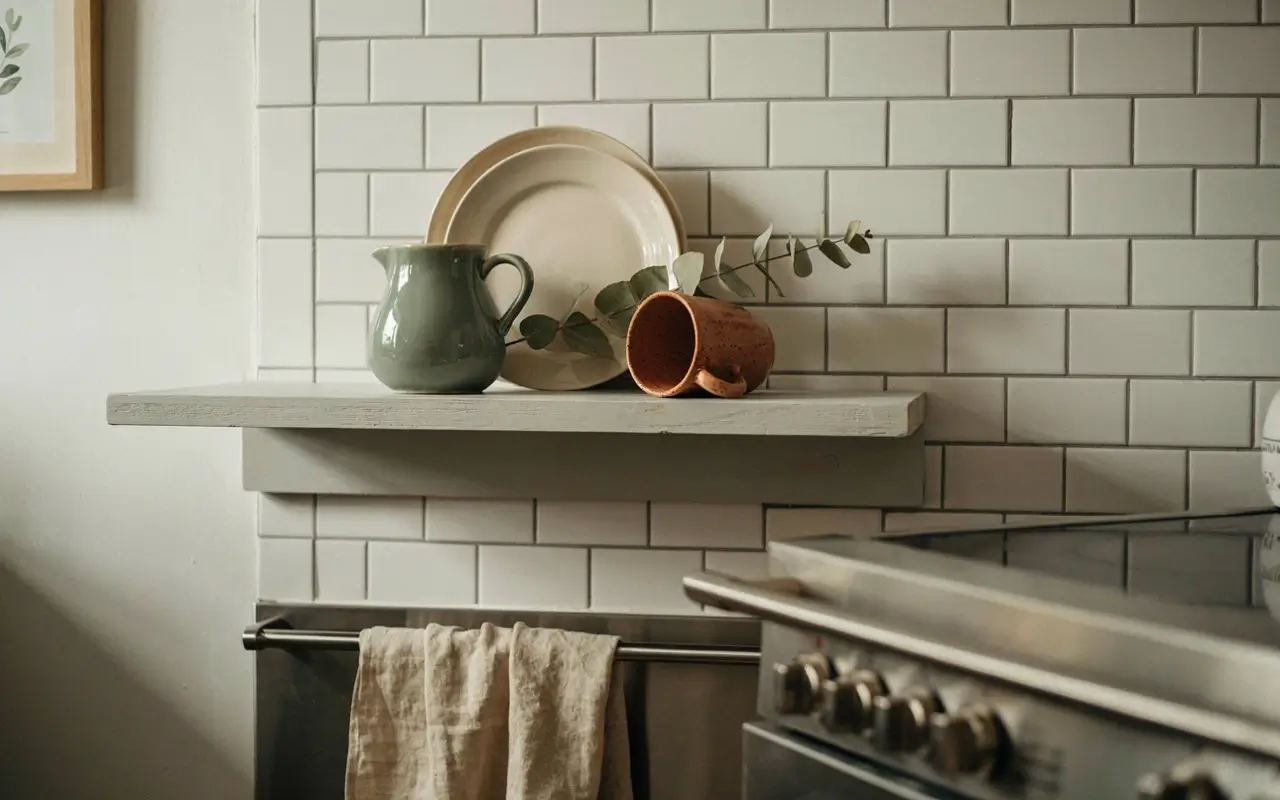
Raw, unsealed wood looks beautiful in a photo and absorbs grease and moisture in real life, which shortens its lifespan fast near any cooking zone. A sealed finish or a painted shelf holds up the same way a painted cabinet does, without losing the shelf silhouette that makes open shelving appealing in the first place. This is a small material decision competitor articles almost never mention, even though it’s the difference between a shelf that ages well and one that doesn’t.
Quick Comparison Table
| Option | Best For | Key Benefit | Limitation |
|---|---|---|---|
| Tension-rod or command-strip mount | Renters | No wall damage, fully reversible | Lower weight capacity |
| Stud-mounted floating shelf | Owners, long-term kitchens | Handles heavy stoneware safely | Requires drilling and stud-finding |
| Freestanding bakers rack | Strict no-drill rentals | Movable, no installation at all | Takes floor or counter footprint |
| Full built-in shelf unit | Renovations, splurge projects | Custom fit and maximum storage | Highest cost, least reversible |
How to Mount a Renter-Friendly Floating Shelf Safely
To mount a renter-friendly floating shelf safely, follow these steps:
- Locate at least one wall stud with a stud finder, even for lightweight brackets.
- Use small-gauge screws or rated command-style hardware rated for the shelf’s expected load.
- Test the shelf with everyday dishes for a week before adding your full collection.
Open Shelving vs Glass-Front Cabinets
Open shelving vs glass-front cabinets: open shelving is better for kitchens that want maximum visual lightness because nothing sits between the eye and the dishware. Glass-front cabinets work better when dust or grease exposure is a real concern, since the doors add a layer of protection. The key difference is upkeep — open shelves need more frequent light dusting, glass-front cabinets need less.
Voice-Search Questions People Also Ask
Is open shelving in a kitchen a bad idea?
Not inherently — it’s a bad idea directly above a stove or with no plan for dust and daily dish rotation. Away from grease zones, it works well.
Do open shelves get dusty and greasy?
Yes, especially within a few feet of a stovetop. Keeping shelves on the sink or prep side and rotating dishes reduces both issues significantly.
Can renters install open shelving without damaging walls?
Yes, using small-gauge renter-safe brackets, command-strip mounts, or a freestanding rack styled to look built-in avoids permanent wall damage entirely.
What wood tone is most popular for open kitchen shelves right now?
White oak, according to the NKBA 2026 Kitchen Trends Report, which found it the most popular wood tone among surveyed designers at 51 percent.
How much weight can a floating kitchen shelf hold?
It depends entirely on the bracket and whether it’s anchored into a stud; stud-mounted brackets hold significantly more than drywall anchors alone.
Final Reality Check
My honest scope limitation here: none of this replaces a licensed contractor’s read on your specific wall structure, especially for anything load-bearing or near plumbing and electrical lines. A design blogger’s enthusiasm for open shelving is also worth weighing against your own tolerance for visible clutter — if you already struggle to keep counters clear, open shelves may add pressure rather than solve it, and a closed-cabinet kitchen with strong styling can look just as intentional.
Open shelving isn’t a trend you either fully commit to or skip entirely. The strongest kitchens mix it — open where you want visual lightness, closed where grease, dust, or deep storage make more sense. Start with one wall, one honest look at your stove’s splatter range, and one shelf styled with dishes you actually use. The rest tends to follow once you see how it lives day to day, not just how it photographs on day one.



No Comment! Be the first one.