




17 Vintage Farmhouse Kitchen Ideas With a Modern Twist You’ll Want to Pin
If your saved folder is full of $150,000 remodels or kitchens that peaked around 2015, you’re not alone. Most “farmhouse kitchen” content shows you a finished dream or a dated trend...

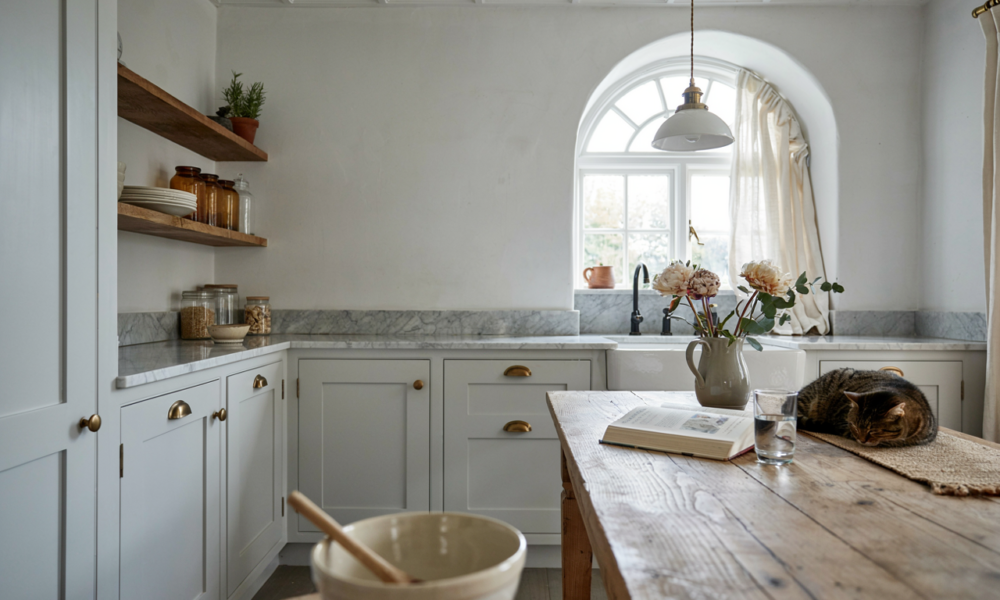
If your saved folder is full of $150,000 remodels or kitchens that peaked around 2015, you’re not alone. Most “farmhouse kitchen” content shows you a finished dream or a dated trend — never the small, real swap that gets you from one to the other.
This list works differently. Every idea below is built around one focal vignette — a sink, a shelf corner, a single fixture — because that’s what people actually save and actually copy. This works best for a partial refresh: new hardware, one furniture piece, a lighting swap, a styled corner. It won’t help if you’re hoping for a full gut renovation with new cabinet boxes or a layout change — that’s a different project with a different budget.
Vintage farmhouse kitchen ideas refer to small, targeted design choices — a fixture, a piece of furniture, a finish — that bring in old-world character without turning the whole room into a themed set. The point is one strong detail, not a full costume.
Why “Full Farmhouse” Is Fading While Vintage Details Are Surging
Here’s the part most articles skip: farmhouse as a complete kitchen style has actually fallen out of favor. Traditional style is now preferred by 14% of homeowners, second only to transitional at 25%, while farmhouse style continues to decline in popularity, according to recent kitchen trend data.
At the same time, interest in vintage pieces is climbing fast. Houzz search data shows a significant surge in vintage design interest, with searches for “vintage bathroom vanities” spiking four times year-over-year and searches for china cabinets and hutches nearly tripling. There’s also growing interest in full-room styling, with searches for “vintage kitchens” nearly doubling.
My read on that: people don’t want a themed room anymore. They want the feeling of a kitchen that’s been lived in for decades — one good piece, not a matching set. That’s a counter-intuitive shift if you grew up on all-shiplap Pinterest boards, but it’s exactly why the single-vignette approach below works better than a full makeover.
One fair point for the other side: a fully coordinated farmhouse suite — matching hardware, matching wood tones, matching everything — does read as more polished in a single photo. The trade-off is that it also ages fast and reads costume-y the moment the trend shifts. Mixing eras — one old piece against clean modern lines — tends to hold up longer because it never fully committed to a single moment in time.
1. Give the Window Wall One Deep Apron-Front Sink Worth Saving For
A shallow stainless sink under a window is fine, but it’s forgettable. Swapping in a deep apron-front farmhouse sink — the kind that sits proud of the cabinet face — gives that whole wall a single, obvious focal point without touching anything else in the room. Brands like Signature Hardware make fireclay and cast-iron apron sinks sized for standard 33- or 36-inch base cabinets, so this is a swap, not a remodel.
My read: this is the one splurge on this list actually worth saving for, because it’s the vignette that photographs best and holds up daily. I’d only splurge here if your base cabinet can accept a standard apron width without custom cutting — measure first.
Apron-front sink vs. standard drop-in sink: an apron-front sink is better for a farmhouse focal point because the exposed front panel reads as a design feature on its own. A standard drop-in works better when counter space or budget is tight and you’d rather spend on a fixture instead. The key difference is that one becomes the room’s anchor and the other stays background.
2. Swap One Antique Brass Pendant Over the Sink for Instant Character
The builder-grade flush mount or basic glass globe over most sinks does nothing for the room. Replacing just that one fixture with an oversized antique-brass or aged-bronze pendant — the kind with visible age spots or a slightly hammered finish — gives the whole wall a sense of history in about twenty minutes of electrical work.
Rejuvenation makes several vintage-style pendants sized for exactly this swap, and it’s one of the few upgrades that photographs as dramatically different from five feet back. I’d skip this if your ceiling height is under eight feet in that spot — an oversized shade needs room to hang properly.
Pendant Option Comparison
| Option | Best For | Key Benefit | Limitation |
|---|---|---|---|
| Woven rattan pendant | Small-budget refresh | Adds texture without rewiring | Can skew coastal, not vintage, in cool-toned kitchens |
| Antique brass pendant | Sink or island focal point | Reads instantly vintage | Needs enough ceiling clearance to hang low |
| Aged black pendant | Renters wanting drama | High contrast on a small budget | Can feel heavy in a very small kitchen |
3. Style a Single Open Shelf With Dishware That Doesn’t Match
One matching dinnerware set behind glass doors looks like a showroom. One open shelf holding a mismatched stack — a chipped ironstone platter, a couple of stoneware bowls, one thrifted pitcher — looks like a kitchen someone’s actually cooked in for years.
Pick one shelf, not the whole wall, so the effect stays a vignette instead of a display case. Group by color family rather than pattern so the mismatch still feels intentional. This is the exact kind of close-up corner that outperforms full-room shots on Pinterest, because it’s something a viewer can picture pulling off in an afternoon.
4. Tuck a Freestanding Glass-Front Hutch Into the Emptiest Corner
Most kitchens have one dead corner — past the fridge, near the doorway — that never earns its keep. Instead of built-in cabinetry, which is a remodel, not a refresh, bring in a secondhand glass-front hutch or china cabinet and let it live there as furniture, not fixture.
This works because it’s the single most repinned vignette in vintage farmhouse searches, and it’s fully renter-friendly since nothing gets attached to a wall. Load it with a mix of stacked plates, a few glass jars, and one empty shelf so it doesn’t read as clutter. A hutch with some paint wear or a slightly foxed mirror back adds more warmth than a pristine one.
5. Trade Cabinet Knobs for Black Cup Pulls on the Lower Row Only
New cabinet doors with plain builder knobs read flat and generic no matter what color they’re painted. Swapping just the lower-cabinet knobs for black or aged-bronze cup pulls — leaving the uppers as-is — gives the kitchen a two-toned, collected-over-time feel for the cost of a bag of hardware.
The reason this works better than replacing every pull in the kitchen: contrast reads as intentional, uniformity reads as new. Keep the upper cabinet hardware simple so the lower cup pulls stay the visual moment. It’s a Saturday-afternoon project with a screwdriver, nothing more.
6. Age One New Shelf With Weathered Oak Stain So It Looks Decades Old
Fresh pine or oak shelving always looks new for the first year no matter what you set on it. A coat of a graying stain — Minwax Weathered Oak is the specific one worth reaching for — knocks that new-lumber look out in one afternoon, giving a brand-new shelf the softer, aged tone that makes vintage styling actually believable.
The mistake most people make is styling a new shelf with old objects and wondering why it still looks staged. Age the shelf first, then style it.
To age new wood with a weathered stain, follow these steps:
- Sand the raw shelf lightly with fine-grit paper to open the grain.
- Apply the stain with a rag in the direction of the grain and wipe back excess after a few minutes.
- Let it cure fully, then seal with a matte topcoat before loading it with dishware.
7. Run a Striped Vintage Runner Down the Galley Aisle
A bare galley floor between counters just reads as a hallway, not a designed space. Laying a striped or faded vintage-style runner down the aisle — one that stops short of the cabinet toe-kicks on both sides — turns that walkway into a deliberate path instead of dead floor.
Choose a low-pile runner so it doesn’t catch on stools or cabinet doors, and size it a few inches narrower than the aisle itself so it doesn’t crowd the edges. It’s a floor idea that photographs almost as well as a full remodel, for a fraction of the cost.
8. Hide a Warm LED Strip Under One Floating Shelf So the Kitchen Glows Like a Small Café at Night
Overhead lighting alone leaves counters flat and shadowed once the sun goes down. Running a warm-toned LED light strip along the underside of one open floating shelf — hidden from direct view, aimed down at the counter — gives that one zone a soft glow that reads as ambiance rather than task lighting.
Stick to a warm color temperature, not cool white, or it undercuts the vintage feel entirely. This is a plug-in, no-electrician project that photographs beautifully in low evening light.
9. Slide a Six-Inch Pull-Out Pantry Beside the Fridge for Oils, Spices, and Tiny Jars
Most kitchens waste the narrow gap beside the fridge entirely, while spice jars and oil bottles clutter the counter instead. A slim six-inch pull-out pantry cabinet slots into that exact gap, holding oils, spices, and small jars on shallow shelves that roll out fully.
It’s a storage fix, not a decor one, but it clears counter space for the vintage vignettes elsewhere in the room to actually be seen. Most versions install without touching the surrounding cabinetry.
10. Skirt the Sink Cabinet With One Checked Linen Curtain on a Tension Rod
Open cabinet doors under an old farmhouse sink used to hide plumbing behind fabric, and the look still works — minus the mason jars and gingham cliché. A checked linen curtain hung on a spring tension rod across the sink cabinet opening softens that whole lower zone without a single tool or nail.
It comes down in seconds for renters, and it hides cleaning supplies as effectively as a cabinet door. Pick a muted check — soft blue, sage, or oatmeal — rather than a bright primary pattern, so it reads vintage instead of costume-y.
11. Lean a Vintage Cutting Board Against the Backsplash Instead of Laying It Flat
A cutting board stored flat in a drawer does nothing for the room. Propped upright against the backsplash — leaning at a slight angle behind the stove or sink — a worn wooden board with visible knife marks becomes a piece of counter decor that also happens to be useful.
This one costs nothing if you already own an old board, and it fills the awkward gap behind a faucet or range that usually sits empty. Choose a board with real wear, not a pristine one — the marks are the whole point.
12. Hang a Chipped-Paint Mirror Behind the Faucet to Bounce Window Light Across the Counter
Narrow or dim kitchens have a real problem: the counter beside the sink often feels like the darkest, smallest spot in the room. A small vintage mirror — the kind with a chipped or distressed frame, propped or hung just behind the faucet — bounces whatever window light exists back across the counter instead of absorbing it into a plain backsplash.
It’s a visual illusion trick more than a decor one: the counter reads wider and brighter in photos and in person. Pick a mirror with some age to the frame rather than a clean modern one, or the effect looks accidental instead of intentional.
13. Pull One Cane-Back Chair Up to the Island Instead of a Matching Stool Set
A full set of matching barstools looks like it came from one showroom trip, because it did. Swapping just one seat — a vintage cane-back or ladder-back chair pulled up to the island end — breaks that uniformity and gives the seating area the collected, over-time feel the rest of this list is chasing.
Keep the remaining stools simple and modern so the one vintage chair stays the visual surprise, not a mismatch. It’s an easy thrift-store find that costs less than a single new stool.
14. Swap the Faucet for Unlacquered Brass That Ages Into Its Own Patina
A chrome or brushed-nickel faucet is the fixture people notice least — and that’s the problem. An unlacquered brass faucet starts bright and gradually darkens and spots with use, developing a patina that no other finish fakes convincingly.
This is the second splurge on the list, and it’s worth it specifically because the aging is the point — you’re buying a fixture that looks better in year two than year one. The expert caveat here: unlacquered brass needs occasional light polishing if you want to slow, not stop, the darkening. Very hard water can also accelerate spotting unevenly. I’d only choose this if you’re genuinely charmed by a lived-in look, not chasing a shiny showroom finish.
15. Line One Open Shelf Back With Peel-and-Stick Vintage Wallpaper
An open shelf against a plain painted wall reads flat from a few feet away, no matter how nicely the dishware is arranged. Adding a small strip of peel-and-stick wallpaper in a faded floral or ticking-stripe print directly behind just that one shelf gives it a backdrop, the way a gallery wall gets a frame.
It’s fully renter-friendly since it comes off clean, and it only takes a strip the width of the shelf — not the whole wall.
16. Cluster a Few Ironstone Crocks at the Counter’s Quiet End
Every counter has one end that turns into a mail-and-keys dumping ground because it has no visual job. Grouping two or three vintage ironstone crocks or stoneware jars there — one holding utensils, one empty, one holding a few wooden spoons — gives that spot a reason to look intentional instead of neglected.
Keep the cluster to three pieces at most in varying heights, so it reads as a still life rather than storage overflow. It’s an easy fix for the one corner every real kitchen has.
17. Drape a Striped Grain-Sack Towel Over the Oven Handle Instead of a Plain One
The towel on the oven handle is one of the most looked-at textiles in the kitchen, and most people default to a plain white one without thinking about it. A striped grain-sack-style towel, draped so the stripe pattern shows fully rather than folded in half, adds vintage texture to a spot everyone’s eye passes constantly.
It’s one of the cheapest swaps on this entire list and one of the easiest to change out seasonally. My read: this is the kind of tiny detail that makes photographs feel warmer without anyone consciously noticing why.
Voice Search: Quick Answers
What is a vintage farmhouse kitchen?
It’s a kitchen that mixes one or two aged or antique-style pieces — a sink, a fixture, a hutch — into an otherwise clean, modern layout, rather than theming the whole room.
How do you make a farmhouse kitchen look modern, not dated?
Limit vintage details to one or two focal pieces per zone, skip shiplap and mason jars, and keep the surrounding cabinetry and finishes simple and current.
What’s the cheapest way to add farmhouse charm to a kitchen?
Swap cabinet hardware, style one open shelf with mismatched dishware, or drape a vintage textile like a grain-sack towel. All cost under $30.
Do farmhouse sinks work in small kitchens?
Yes, if the base cabinet is a standard 33- or 36-inch width. Measure the existing cabinet opening before ordering to avoid a custom cut.
Is farmhouse style still in for kitchens in 2026?
Full farmhouse theming has declined, but vintage details and pieces remain popular. The trend now favors single character pieces over whole-room farmhouse styling.



No Comment! Be the first one.