




Coffee Lovers, Rejoice! These 34 Kitchen Coffee Stations Wow
Your morning coffee deserves better than a cluttered counter corner with cords going everywhere and pods rolling off the edge every time someone reaches for the milk. That’s not a setup —...

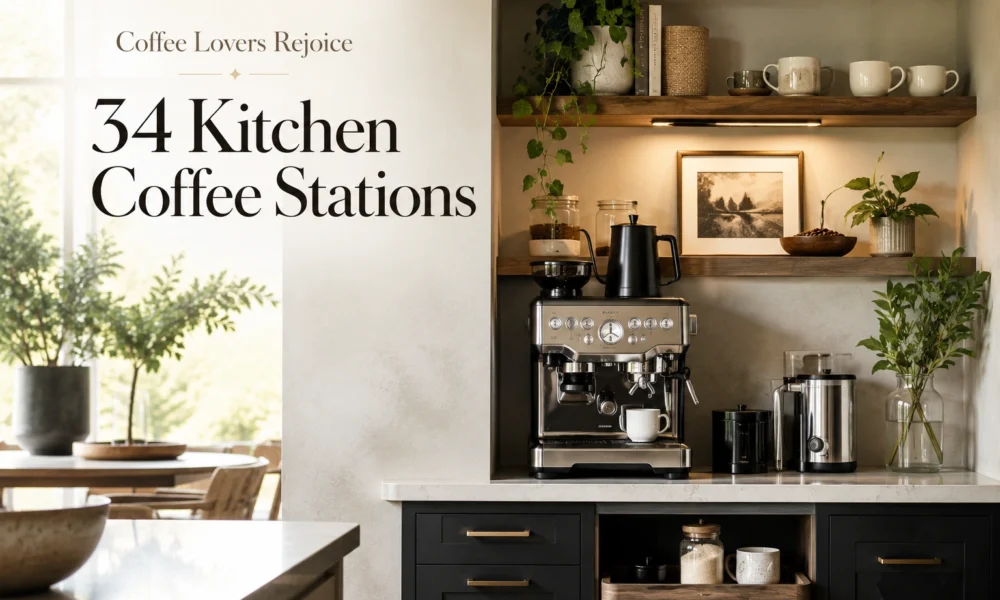
Your morning coffee deserves better than a cluttered counter corner with cords going everywhere and pods rolling off the edge every time someone reaches for the milk. That’s not a setup — that’s a traffic jam with a Keurig in it.
According to the National Coffee Association’s 2024 National Coffee Data Trends report, 83% of past-day coffee drinkers brewed at least one cup at home — up four points since January 2020. That’s a lot of home kitchens quietly demanding a dedicated coffee zone that actually holds everything.
This article covers 34 kitchen coffee station ideas pulled from real design boards, home tours, and practical small-space builds. Some cost almost nothing. Some involve a bit of IKEA assembly. A few are full built-in setups worth the splurge if you’re staying put for a while.
You’ll find something that fits your counter, your cabinet situation, and your budget — whether you rent or own.
This guide works best for kitchens with at least 18 inches of unoccupied counter or one available cabinet section. It won’t fully solve kitchens where the electrical situation requires new wiring — those cases need a licensed electrician before any station design can begin.
What Is a Kitchen Coffee Station?
A kitchen coffee station is a dedicated zone — whether a counter corner, open cabinet, rolling cart, or built-in nook — organized specifically for brewing, storing, and serving coffee. It consolidates your machine, grinder, pods, mugs, and extras like syrups or milk frothers into one functional, visually cohesive area.
What Makes a Kitchen Coffee Station Actually Work
Most people set up their coffee station around the machine. Start with the outlet instead.
A kitchen coffee station is a defined, protected zone within your kitchen — typically 18 to 48 inches of counter, cart, or cabinet space — dedicated entirely to brewing and serving coffee. According to the National Coffee Association’s 2024 report, 83% of home coffee drinkers now brew at least one cup at home daily, making dedicated kitchen coffee setups a mainstream design priority rather than a luxury feature.
Here’s the thing: the biggest reason coffee setups fall apart — stuff migrates back, pods end up in a drawer across the room, the whole area becomes a staging zone for mail — is because the station wasn’t built around how you actually move in your kitchen. The machine ends up wherever the outlet is, and everything else gets crammed in around it with no real system.
So start with the outlet. Then define the zone. Then protect the surface from everything that isn’t coffee.
Counter, Corner, and Open Shelf Coffee Station Ideas
Counter-level coffee stations are the most practical starting point for most kitchens because they require no installation. According to Houzz’s 2023 Kitchen Trends Study, open shelving above counters ranks among the most requested customizations in kitchen redesigns under $5,000 — with coffee zones consistently cited as the primary use case.
These 10 ideas work in virtually any kitchen with at least 18 inches of clear counter and one nearby outlet.
1. Floating Shelf Coffee Corner Above the Counter
![Corner Counter Coffee Nook With Wraparound Shelf Dead counter corners are an underused asset in almost every kitchen layout. A single L-shaped or wraparound shelf at 18 to 24 inches above the corner turns dead space into a natural coffee station backdrop — machine in the corner, mugs on the diagonal shelf, pods and supplies on the return. This layout also hides cords better because the corner provides a natural anchor point. It's particularly effective in galley kitchens where straight counter runs don't have natural stopping points. [IMAGE: Corner counter coffee nook with an L-shaped shelf above, espresso machine tucked into the corner, mugs arranged on both sides]](https://dizzyjournal.com/wp-content/uploads/2026/06/floating-shelf-coffee-corner-above-counter.webp)
Mount one or two floating shelves directly above your coffee machine and you immediately frame the space as a dedicated zone. The visual separation alone is enough to signal “this area is for coffee” — which matters more than you’d think for keeping it tidy week after week. Use the top shelf for mugs and the lower one for a small plant, syrup bottle, or ceramic dish. Floating shelves in 24- or 30-inch widths work cleanest above most standard machines.
2. Corner Counter Coffee Nook With Wraparound Shelf
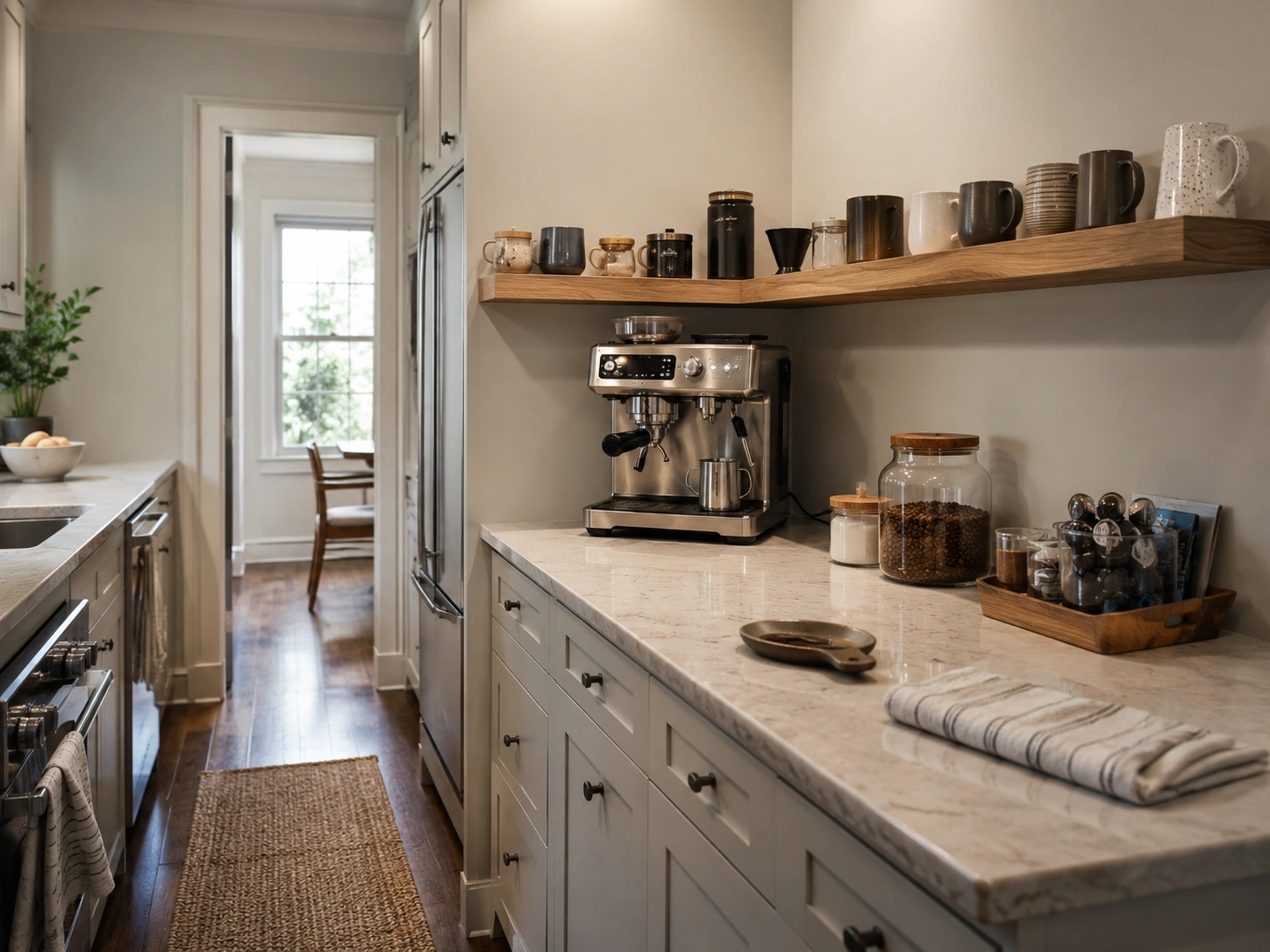
Dead counter corners are an underused asset in almost every kitchen layout. A single L-shaped or wraparound shelf at 18 to 24 inches above the corner turns dead space into a natural coffee station backdrop — machine in the corner, mugs on the diagonal shelf, pods and supplies on the return. This layout also hides cords better because the corner provides a natural anchor point. It’s particularly effective in galley kitchens where straight counter runs don’t have natural stopping points.
3. Cabinet-Top Tray Station With Under-Cabinet Lighting
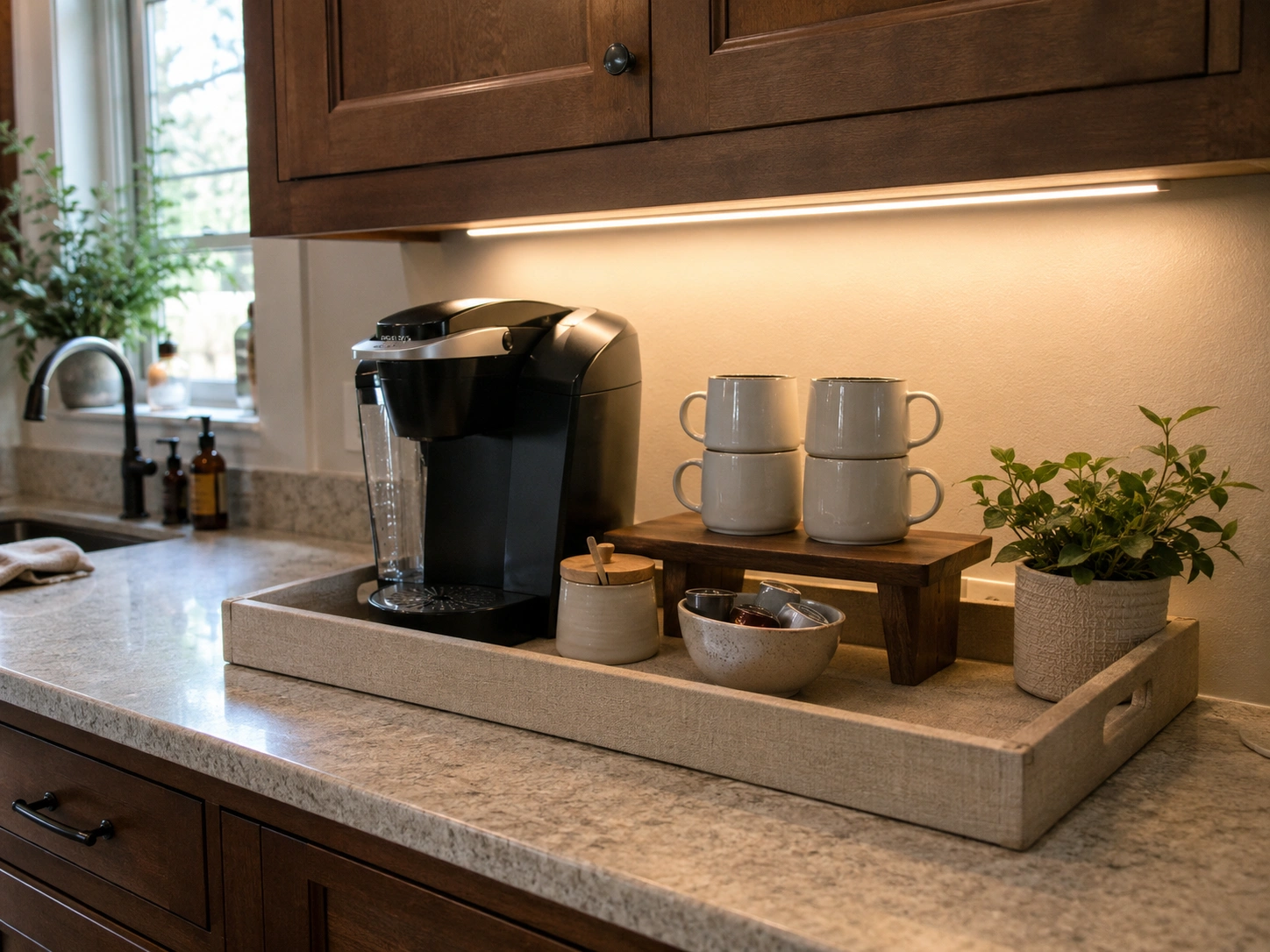
If wall mounting isn’t an option — renting, or just not ready to drill — use the underside of the cabinet above as a light source instead. A peel-and-stick LED strip installed there creates enough visual definition to turn a plain counter stretch into a dedicated zone. Place a large tray (14 × 20 inches minimum) below it, stack mugs on a small riser inside the tray, and keep the machine within the tray boundary. The tray does the design work that a shelf would otherwise do.
4. Dedicated Counter Zone With Pegboard Panel
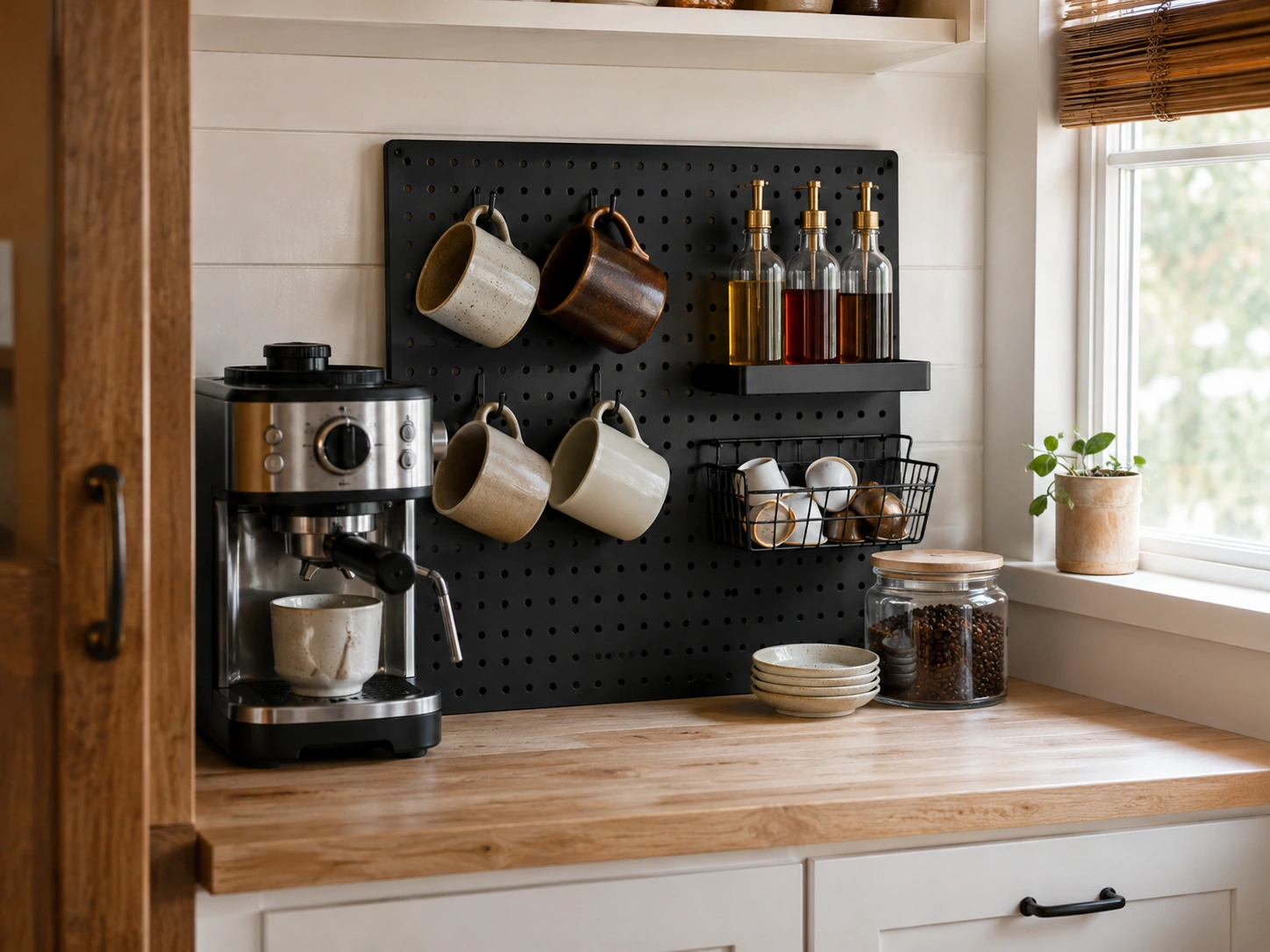
A small pegboard panel — even 24 × 24 inches — mounted to the wall or propped against the backsplash holds hooks for mugs, a small shelf for syrups, and a basket for pods. Everything stays off the counter surface except the machine itself. Pegboards in matte black or white blend cleanly into modern and farmhouse kitchens alike. For renters, freestanding pegboard frames require no wall holes at all. This is one of the highest-function, lowest-cost upgrades in this entire list.
5. Breakfast Bar End Coffee Station
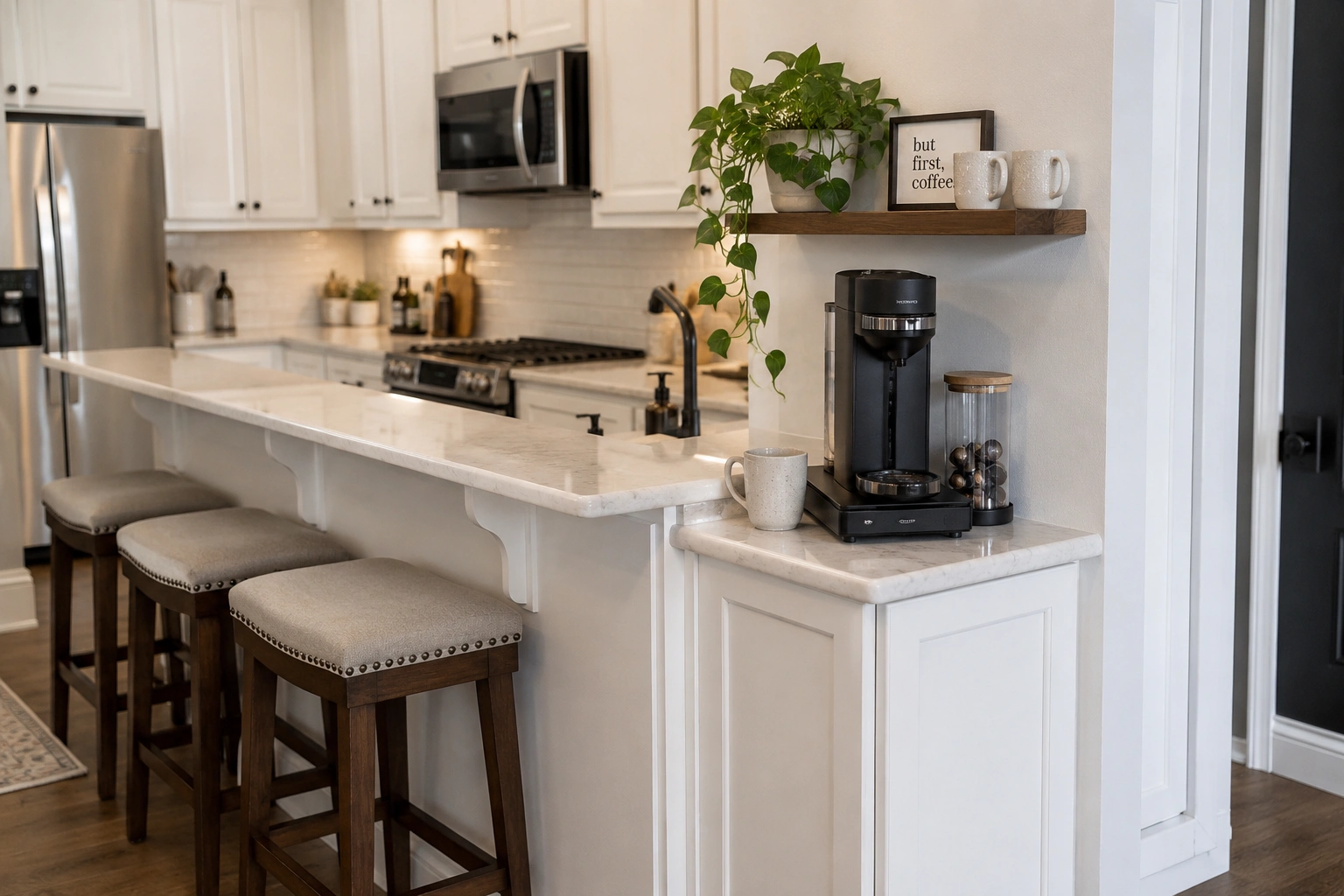
Claim the far end of your breakfast bar or kitchen peninsula as the permanent coffee zone. The end position keeps it out of the main prep area and creates a clear visual boundary between cooking space and coffee space. A 24-inch stretch at the end of a bar comfortably holds a single-serve machine, one mug, and a small pod container. Add one floating shelf above the end cap for mugs or a small trailing plant and the zone is complete.
6. Open Mug Display Wall Next to the Machine
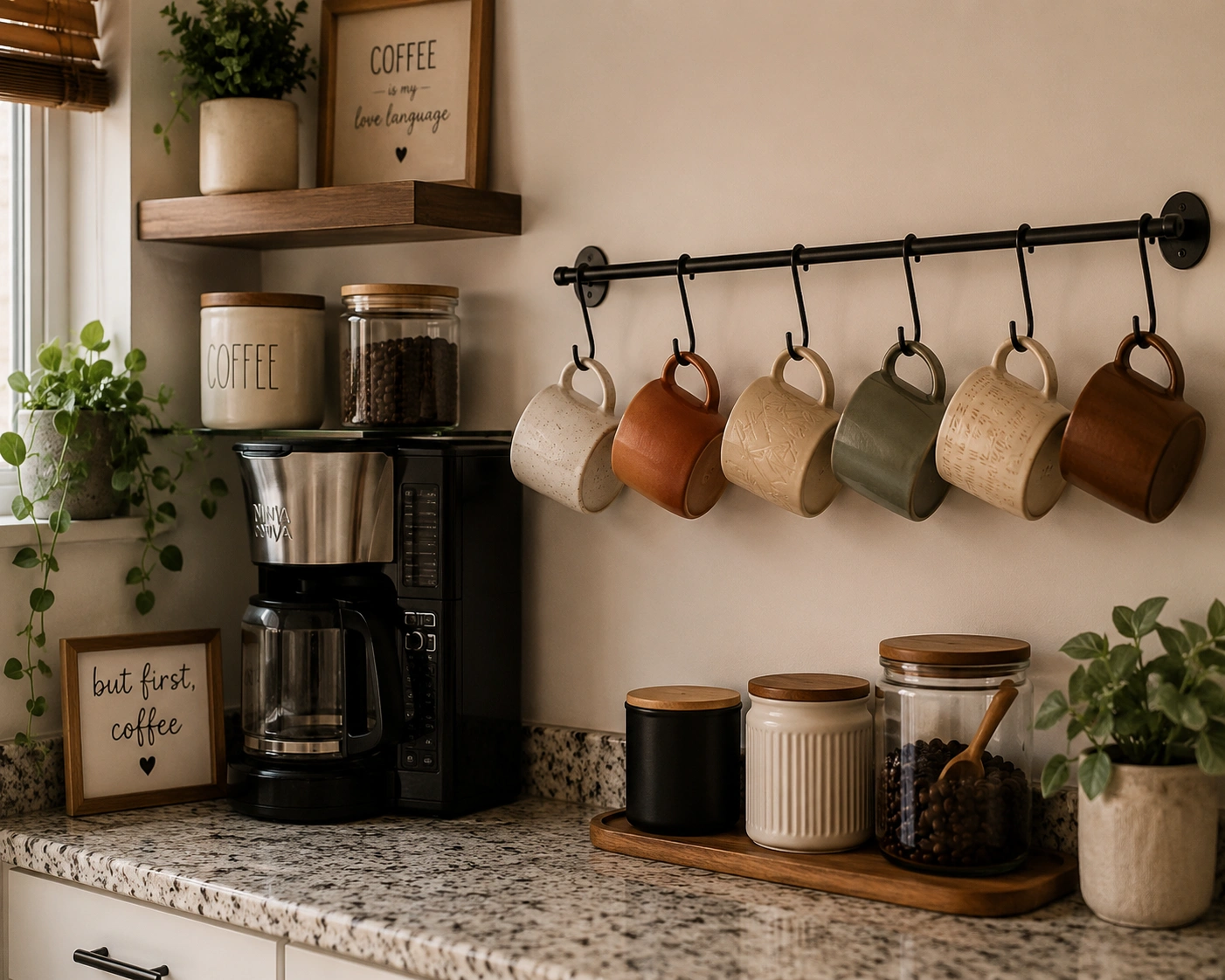
This is one of those ideas that looks like a styling move but is also deeply practical. Mount a row of hooks — S-hooks on a rail, or individual cup hooks on a small wood panel — directly beside or slightly above your machine. Hanging mugs frees up shelf space, keeps them within one-handed reach, and makes the station look intentional without adding any furniture. A grid of 6 to 8 hooks covers most households. Command strip-compatible rail systems work for renters.
7. Industrial Pipe Shelf Coffee Station
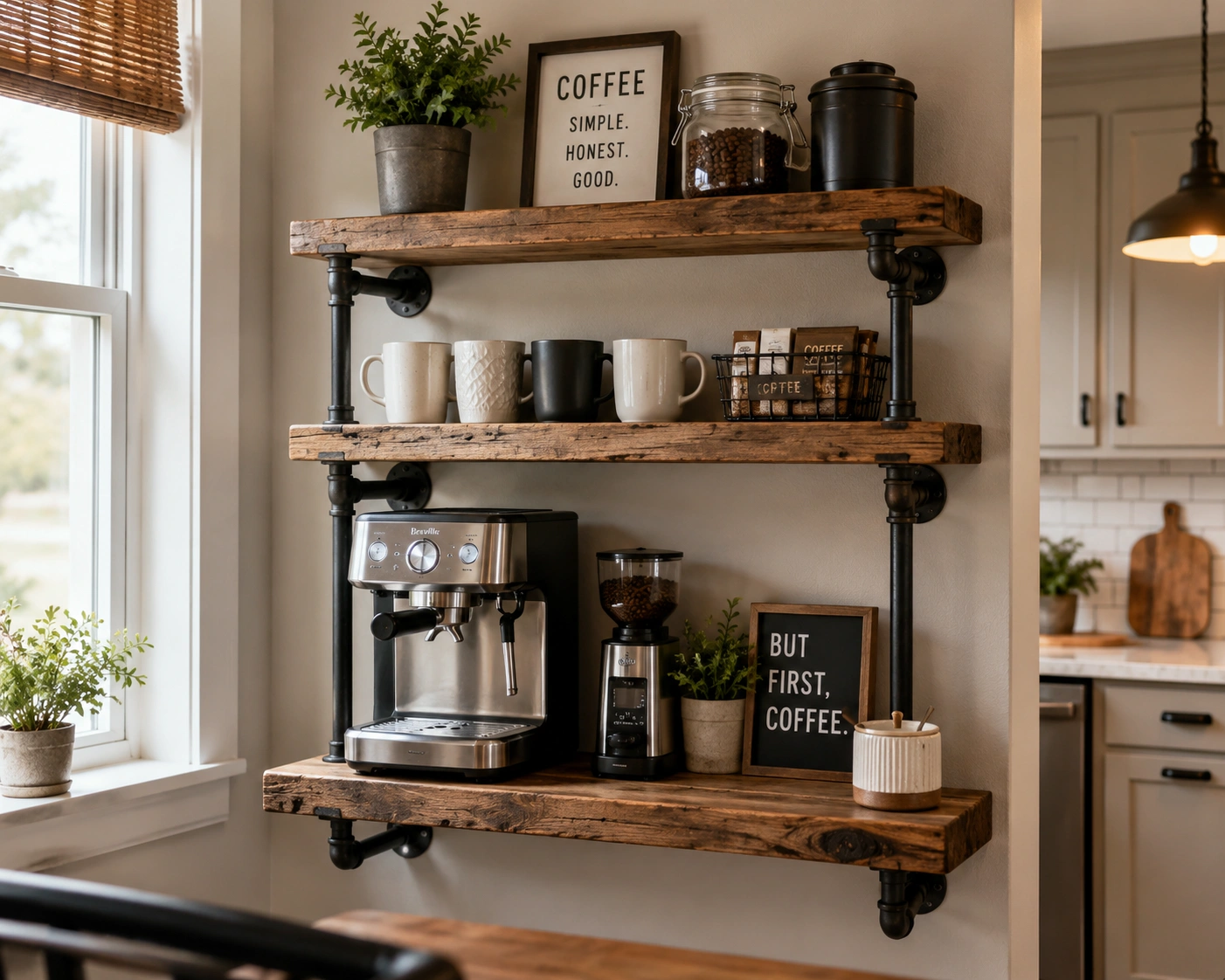
Black iron pipe shelf brackets supporting raw wood planks bring a café-supply-room energy that works especially well in farmhouse and transitional kitchens. The visual weight of the brackets frames the station even before anything is on the shelves, which is what makes it feel intentional rather than accidental. Two shelves do the job cleanly — one as the machine surface, one above for mugs and accessories. Wall mounting is required, but the cost is far below custom cabinetry.
8. Hanging Mug Rail Under a Floating Shelf
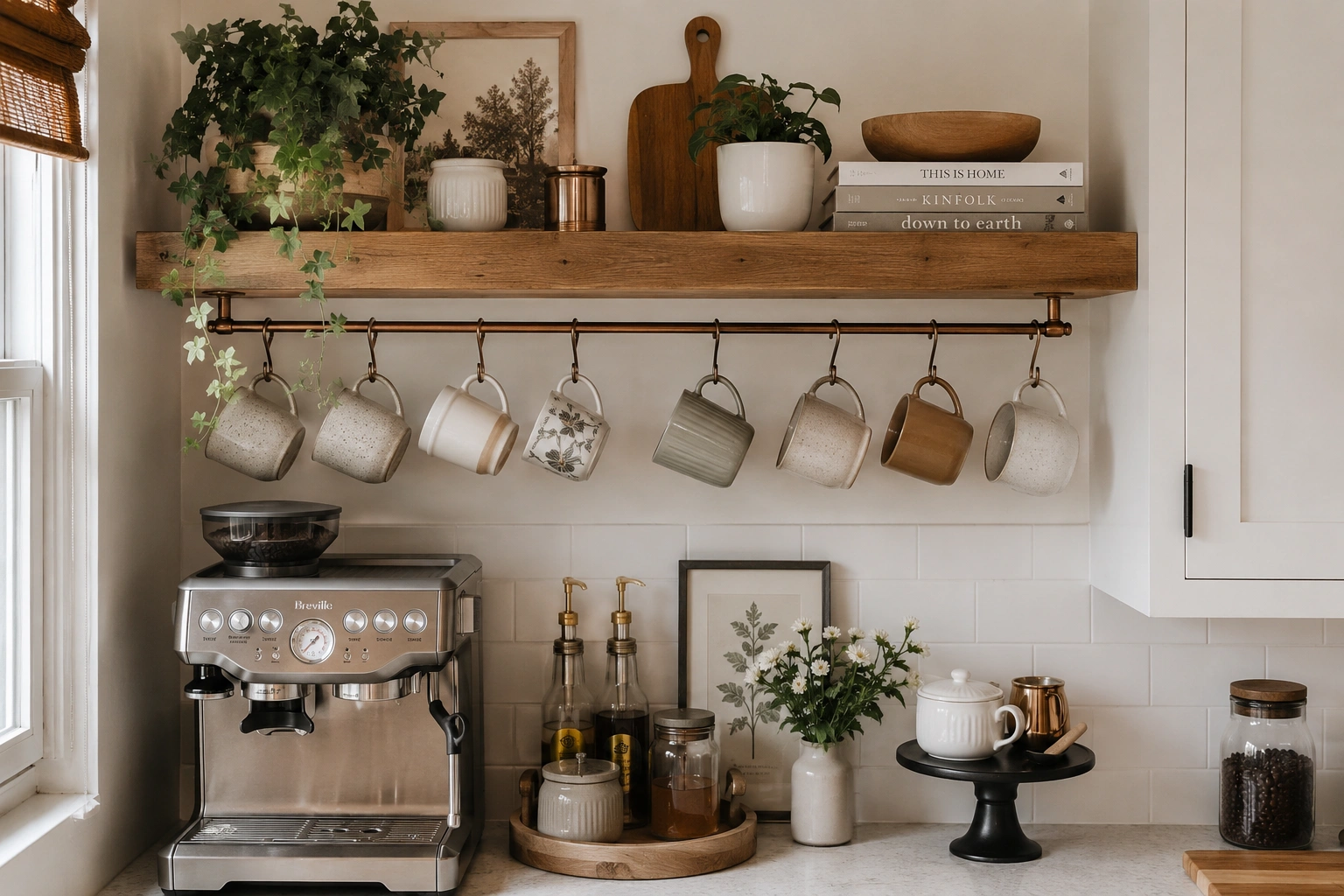
If you already have a floating shelf above your coffee machine, mount a small wooden dowel or a slim copper rail underneath it with S-hooks. Mugs hang below the shelf instead of sitting on top — which doubles the storage capacity of a single shelf without adding any bulk. This detail is more common in European kitchen design, but it’s been widely picked up in American modern eclectic and farmhouse interiors. Works best with mugs that have wide, open handles.
9. Drop Zone Ledge Shelf for a Single-Serve Machine
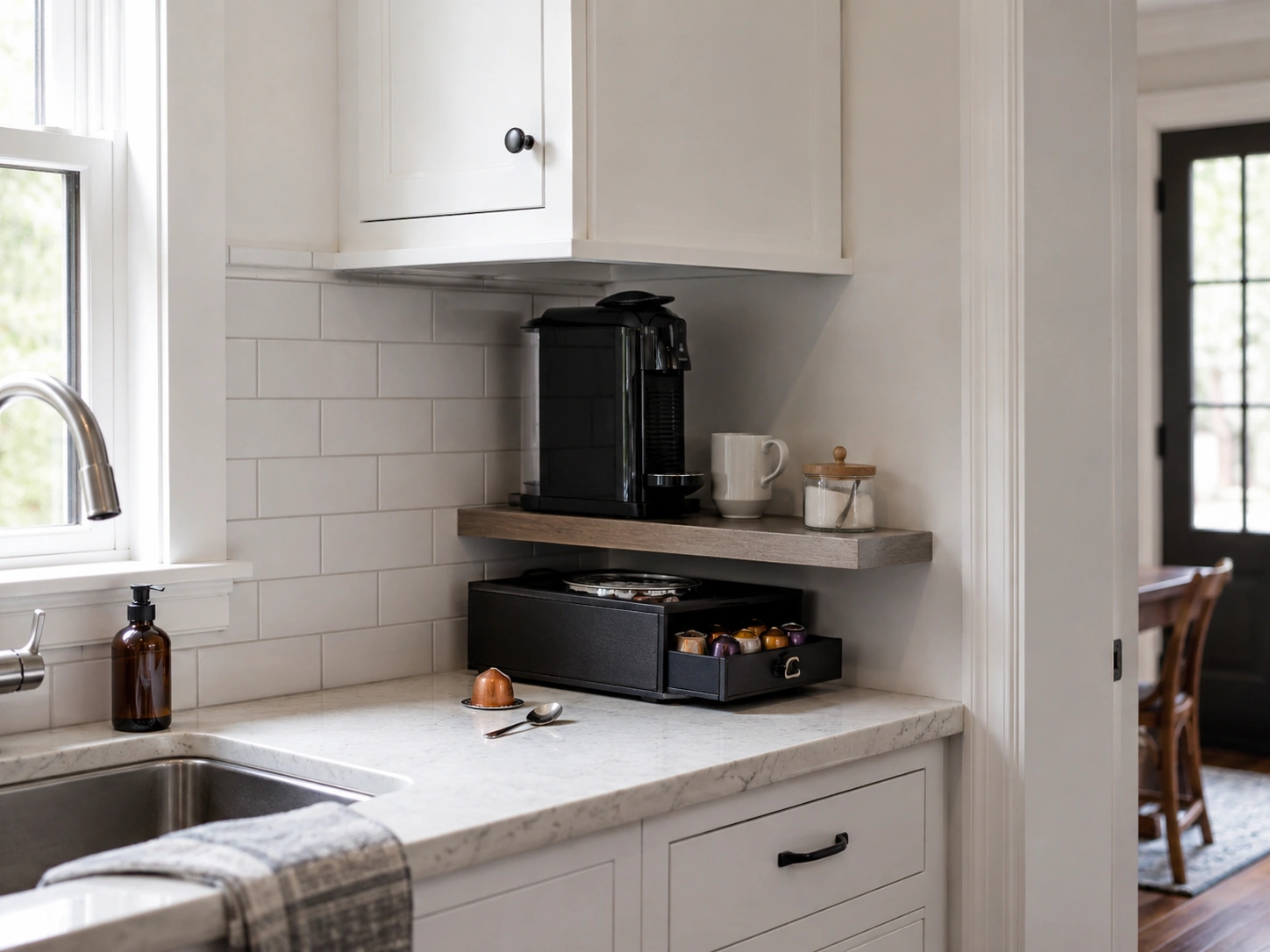
A ledge shelf — 6 to 8 inches deep, mounted at counter height — creates a narrow but defined machine zone when counter space is genuinely scarce. Slim pod machines like the Nespresso Vertuo or Essenza sit cleanly on a 6-inch ledge. Keep the pod drawer below on a small tray at the actual counter level. It’s a minimal solution. But the visual lift of getting the machine off the main surface makes the counter feel noticeably less cluttered, and that’s the actual goal.
10. Backsplash Niche Coffee Station
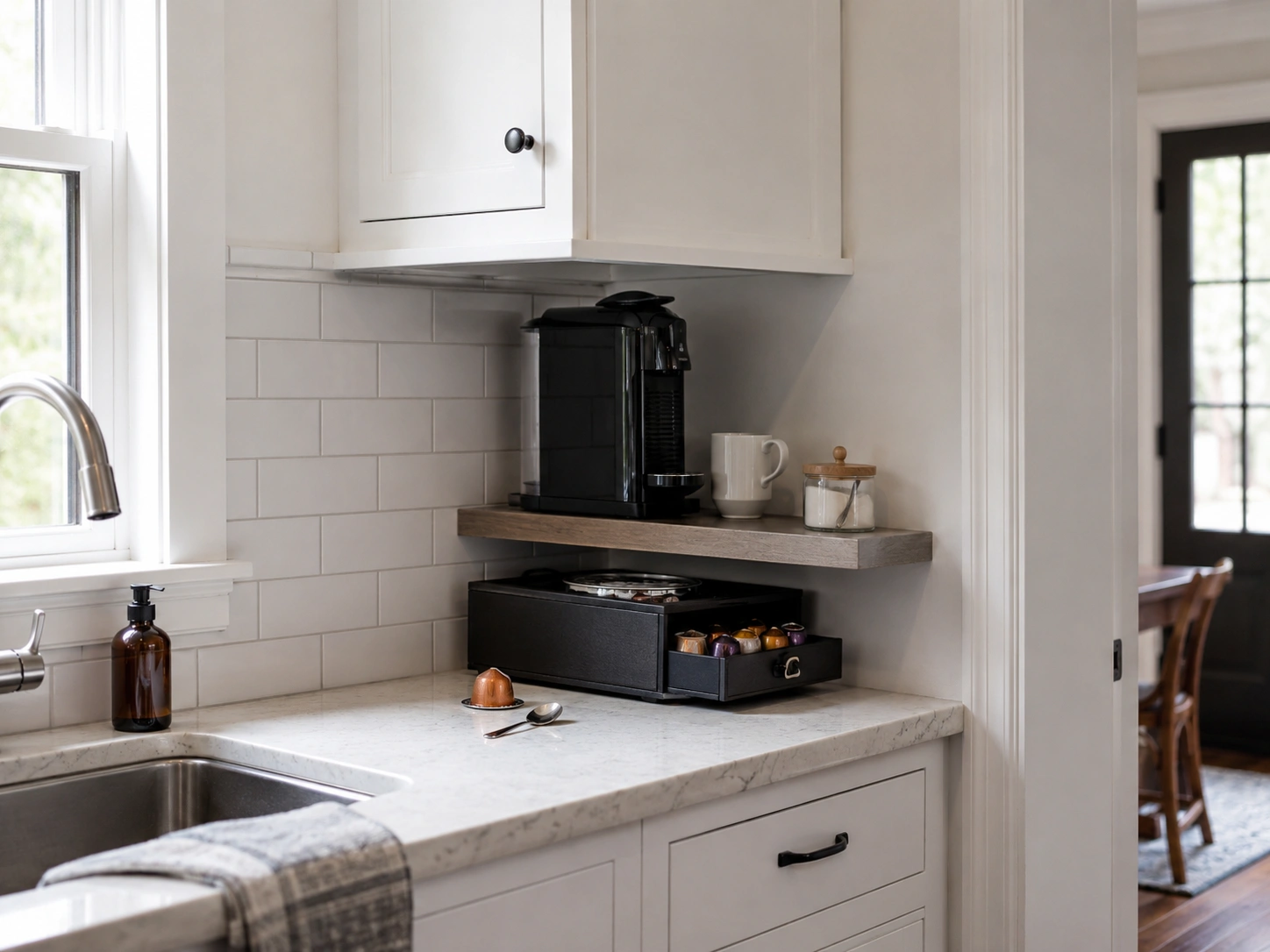
In some kitchens — particularly older construction or homes with deep walls — there are small recessed areas in the backsplash wall that are currently holding nothing useful. A niche even 6 inches deep and 24 inches wide is enough to set a machine into the wall rather than on the counter surface, creating a genuinely built-in look without renovation. Add a small shelf above the recess for mugs. When this option is available, it’s one of the cleanest solutions anywhere in this list.
Cabinet and Built-In Coffee Station Ideas
Moving coffee into the cabinet zone creates a cleaner kitchen overall — everything can close or conceal, which matters in open-plan homes where the kitchen is always visible from the living area. These ideas range from zero-cost (removing cabinet doors) to full renovation-level builds.
To set up a kitchen coffee station inside your existing cabinets, follow these steps:
- Identify the cabinet closest to a GFCI outlet, or plan to add one inside.
- Remove one set of cabinet doors or install a pull-out shelf insert at counter depth.
- Position the machine at the front edge of the shelf so it’s accessible without pulling it out.
- Add a power strip inside the cabinet for the machine, grinder, and any accessories.
- Store pods, mugs, and syrups on the shelves above or in adjacent base cabinet drawers.
11. Appliance Garage With an Interior Outlet
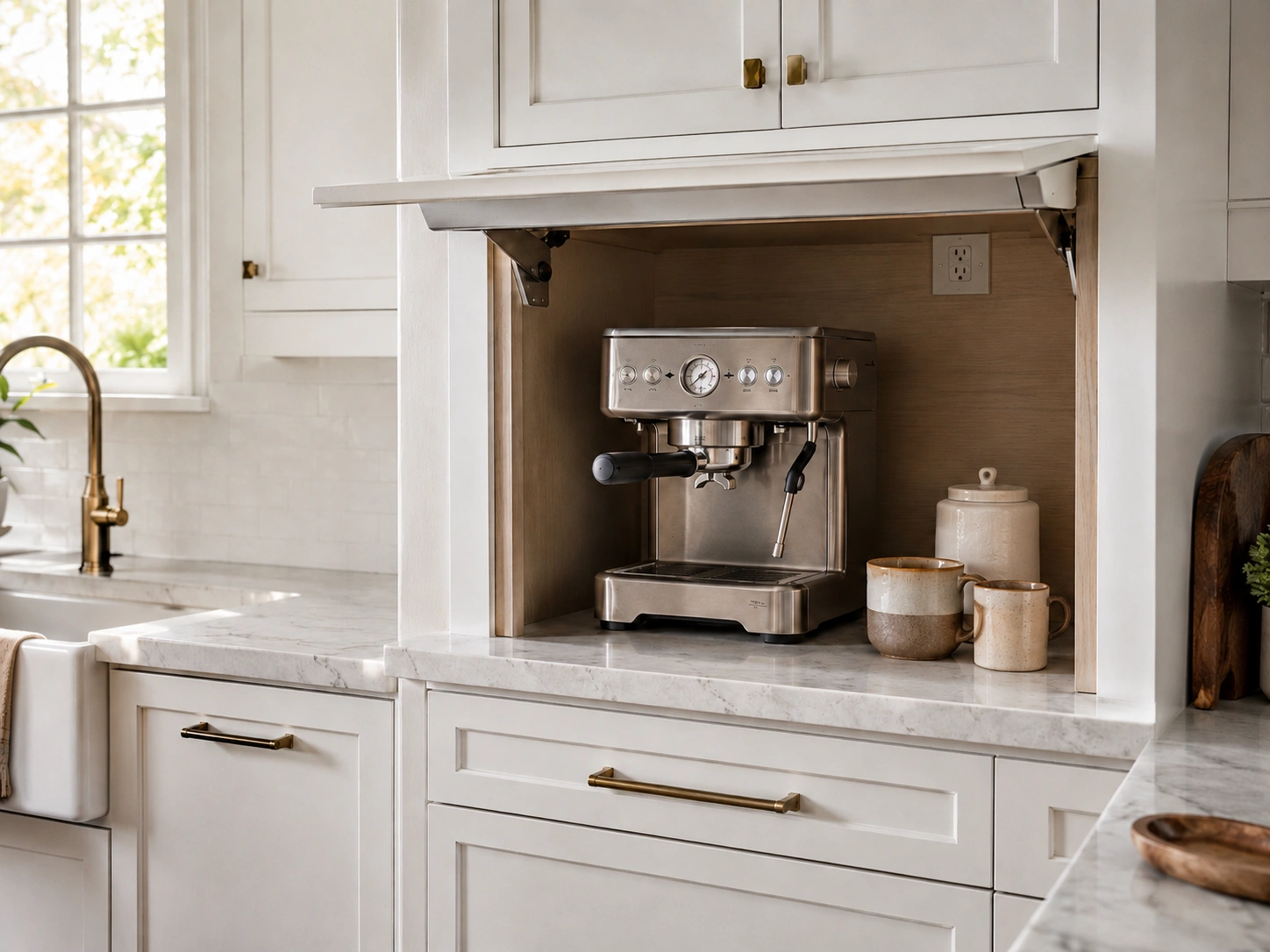
An appliance garage is a cabinet section with a roll-up or lift-up door that hides counter appliances when not in use. Add an outlet inside the garage — either during a kitchen update or as an electrician add-on — and the machine stays plugged in all the time. Open the door to brew. Close it to clean up. This is the most-pinned built-in coffee station method on Houzz and across design blogs, and it’s the only common solution that fully solves the visible-cord problem.
12. Open-Door Cabinet Coffee Station (Remove the Doors)
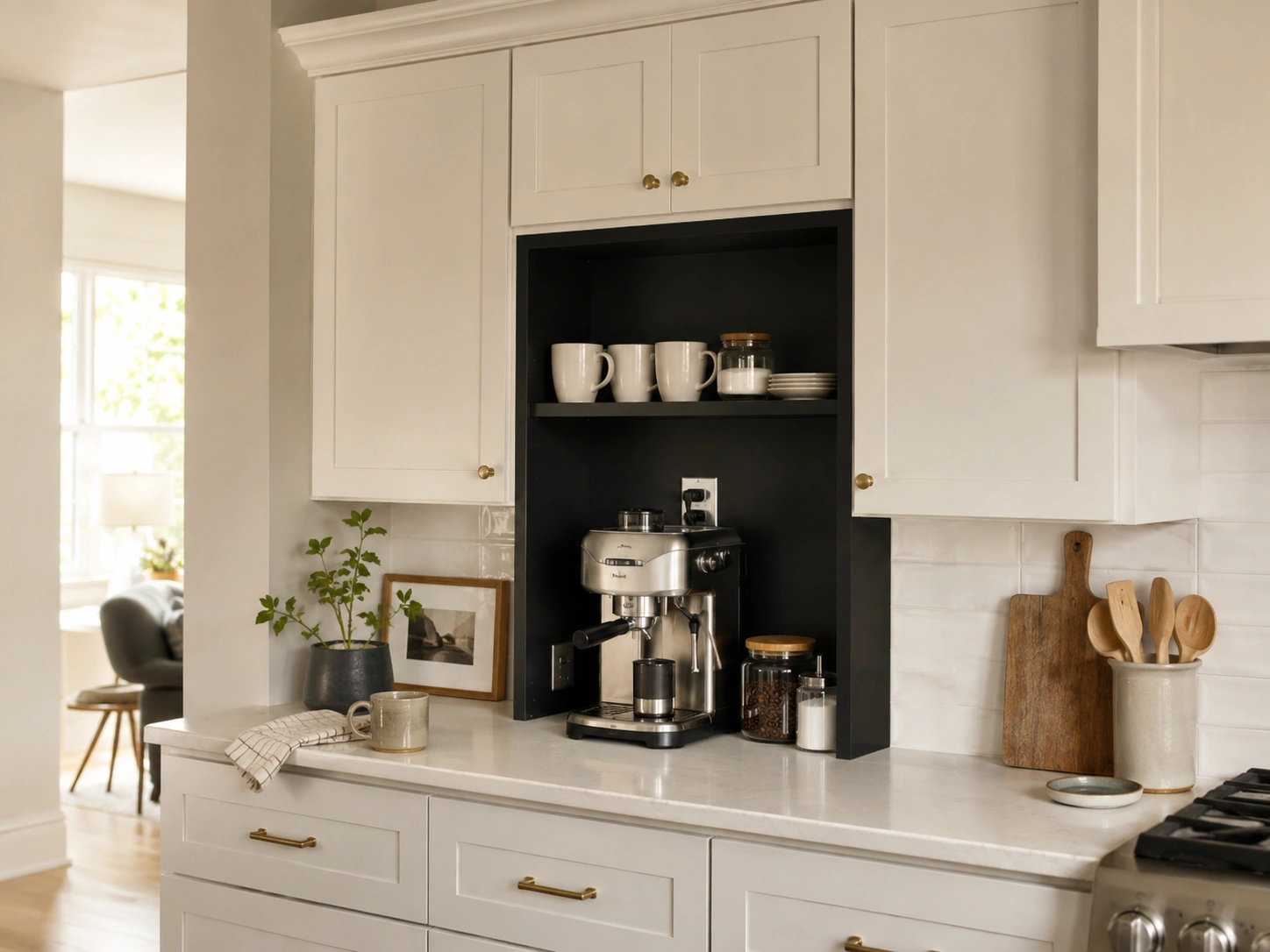
Removing one or two cabinet doors costs nothing and creates instant dedicated display space. Paint the interior back wall a contrasting color — deep navy, forest green, or matte black — and the open cabinet becomes a visual focal point rather than a storage compromise. Place the machine inside, mugs on the shelf above, and keep the doors on the surrounding cabinets for balance. This works best when the cabinet sits adjacent to an outlet. Renters: ask first, store the doors, and most landlords allow it.
13. Full Cabinet Coffee Hutch With Upper and Lower Storage
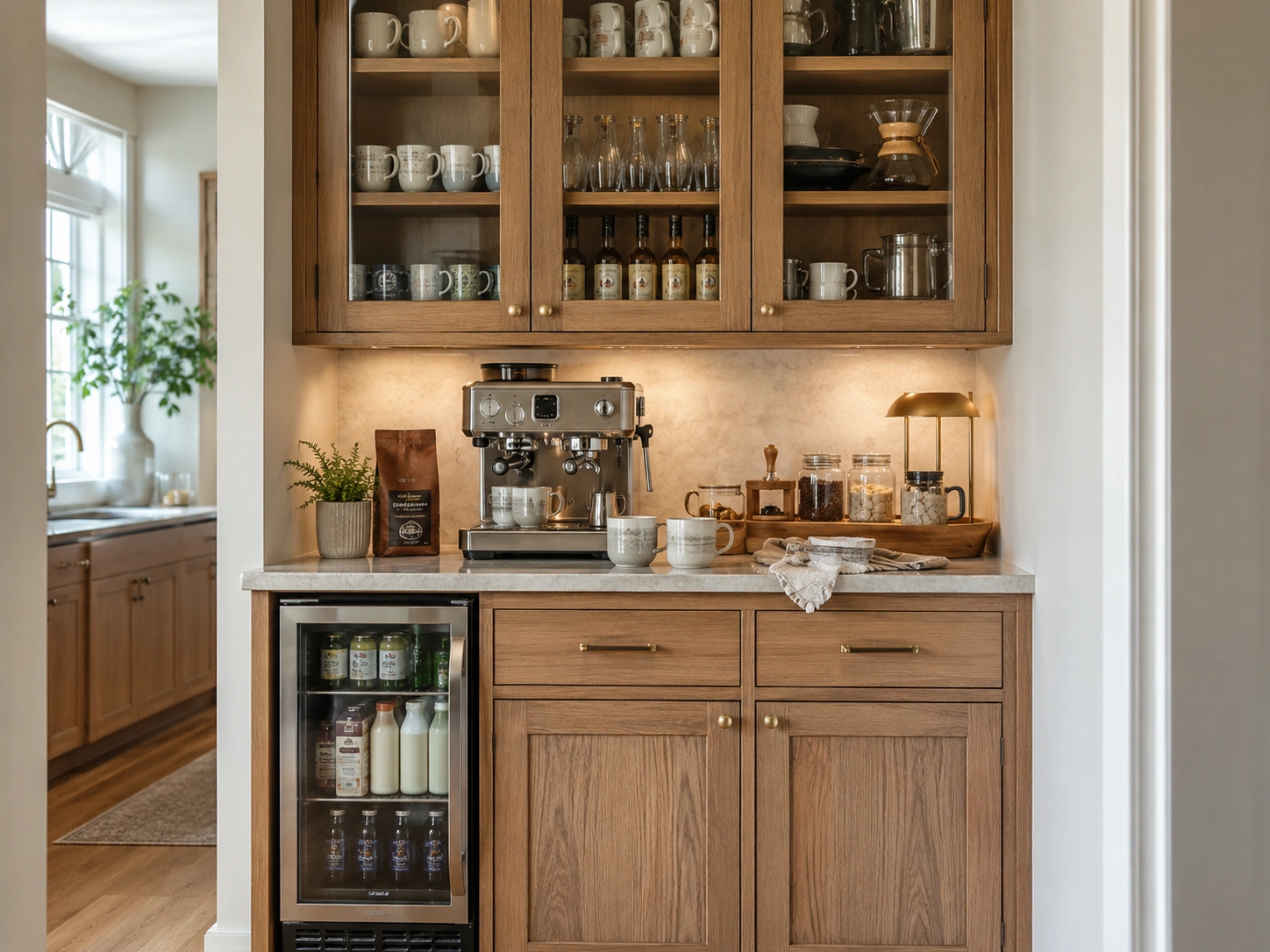
This is the version most people are pinning when they search “coffee bar ideas for kitchen.” Upper cabinets — often with glass-front doors — hold mugs, glasses, and syrups. The countertop between holds the machine. Lower cabinets handle heavier items: a mini fridge for creamer, bulk coffee storage, or an accessory drawer. It functions like a mini kitchen-within-a-kitchen. Done well, it reads exactly like a café counter. Works best as a standalone 36- to 48-inch run of cabinetry.
14. Pull-Out Drawer Pod Organizer Inside a Base Cabinet
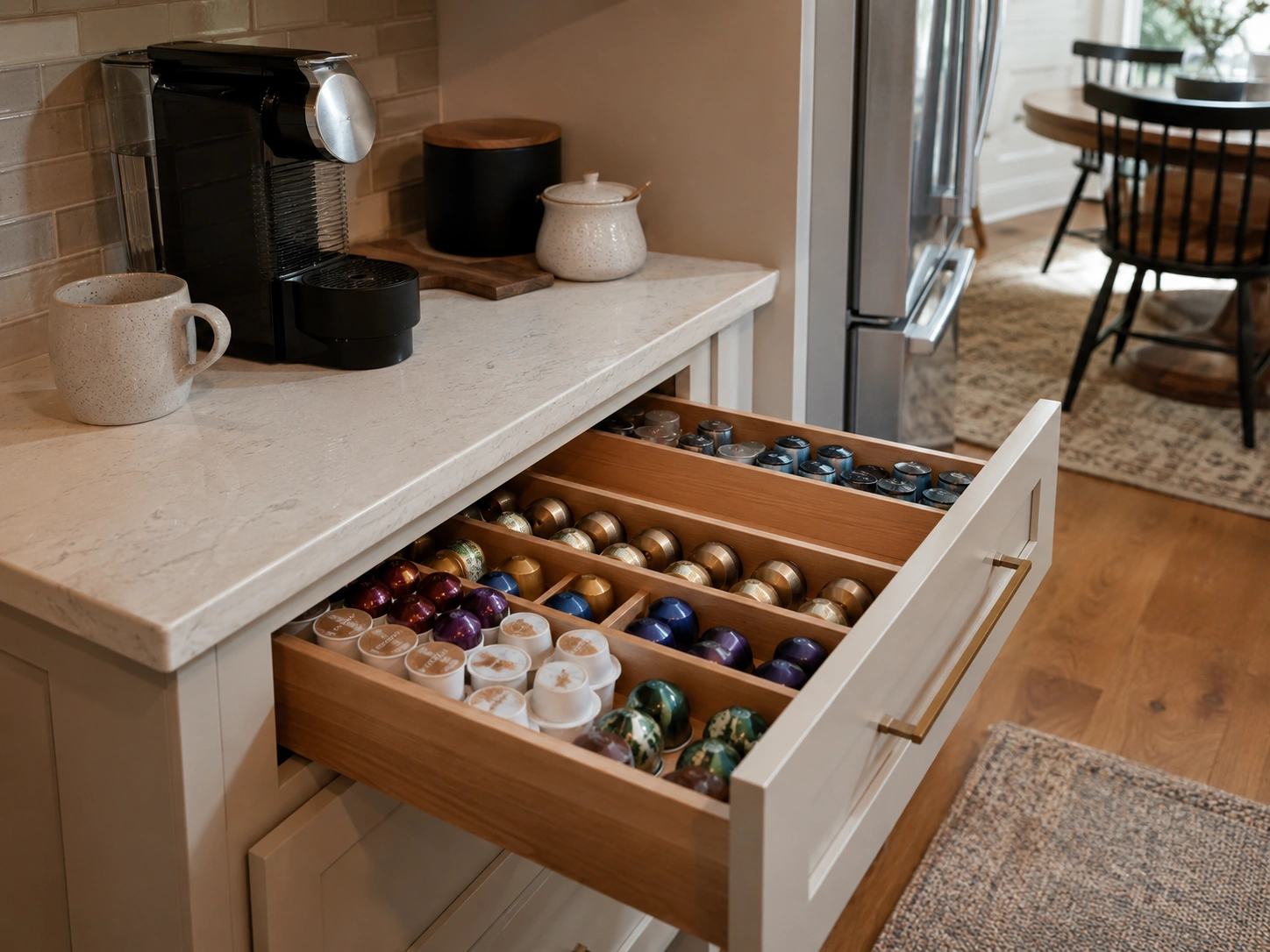
A base cabinet near the machine fitted with a pull-out drawer insert for Keurig pods, Nespresso capsules, or coffee pods keeps everything organized and completely invisible. Inserts are available at The Container Store and on Amazon for $20 to $45 and fit most standard base cabinet drawer depths. This is a finishing detail, not a full station — but it’s one of the highest-impact $30 upgrades for pod machine users whose capsules are currently living in a random mug or a junk drawer somewhere across the kitchen.
15. Lazy Susan Pod Carousel Inside a Corner Cabinet
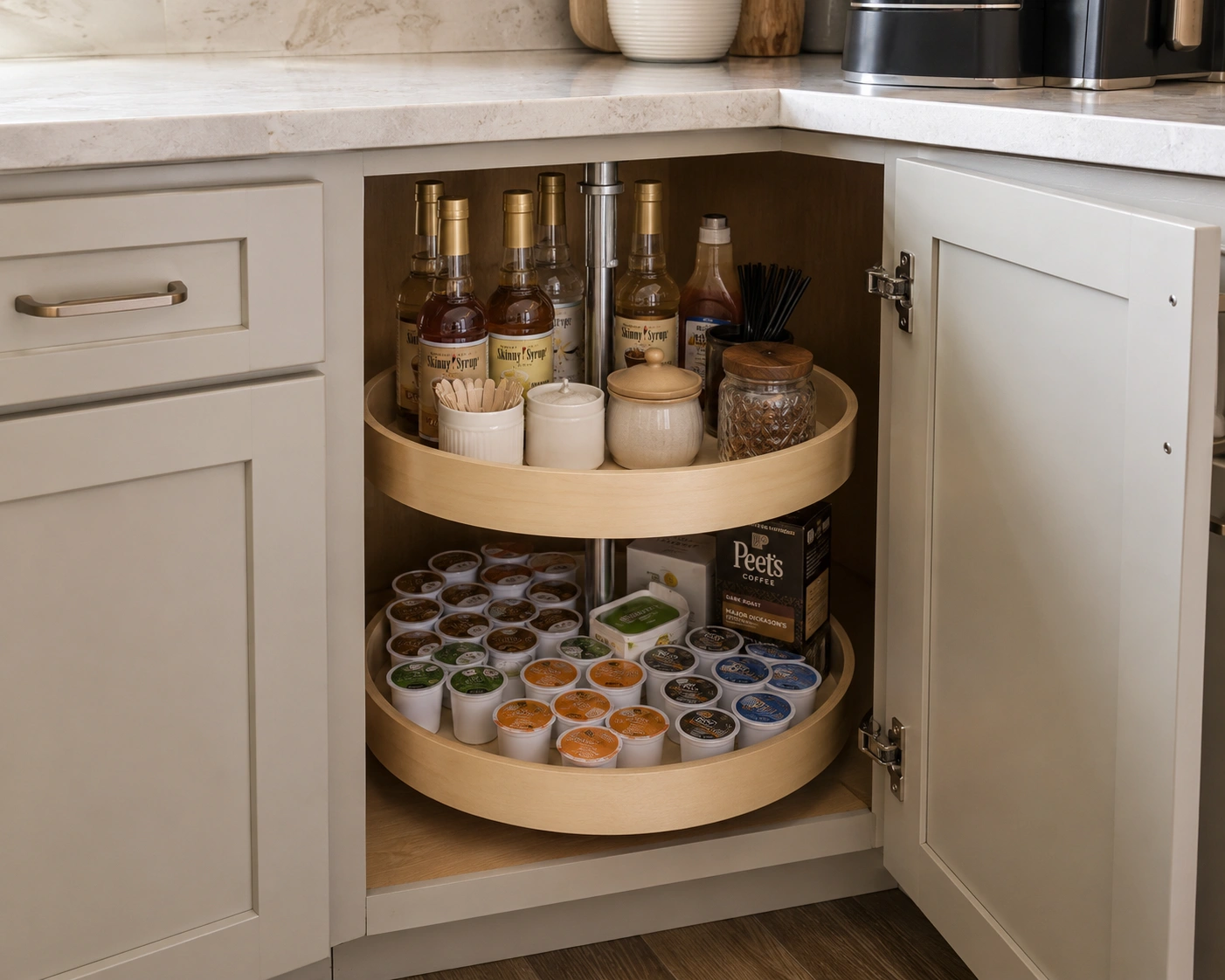
If your corner cabinet is deep and underused — and most are — a two-tier Lazy Susan insert lets you organize pods, syrups, and small accessories so they stop disappearing into the back. Two tiers give you significantly more surface area on a compact footprint. Not the most visually exciting idea on this list. Or maybe I should say it this way: the prettiest coffee station in the world stops working the moment you’re digging through a dark corner cabinet at 6 AM trying to find the right pod.
16. Built-In Espresso Niche in a Kitchen Island
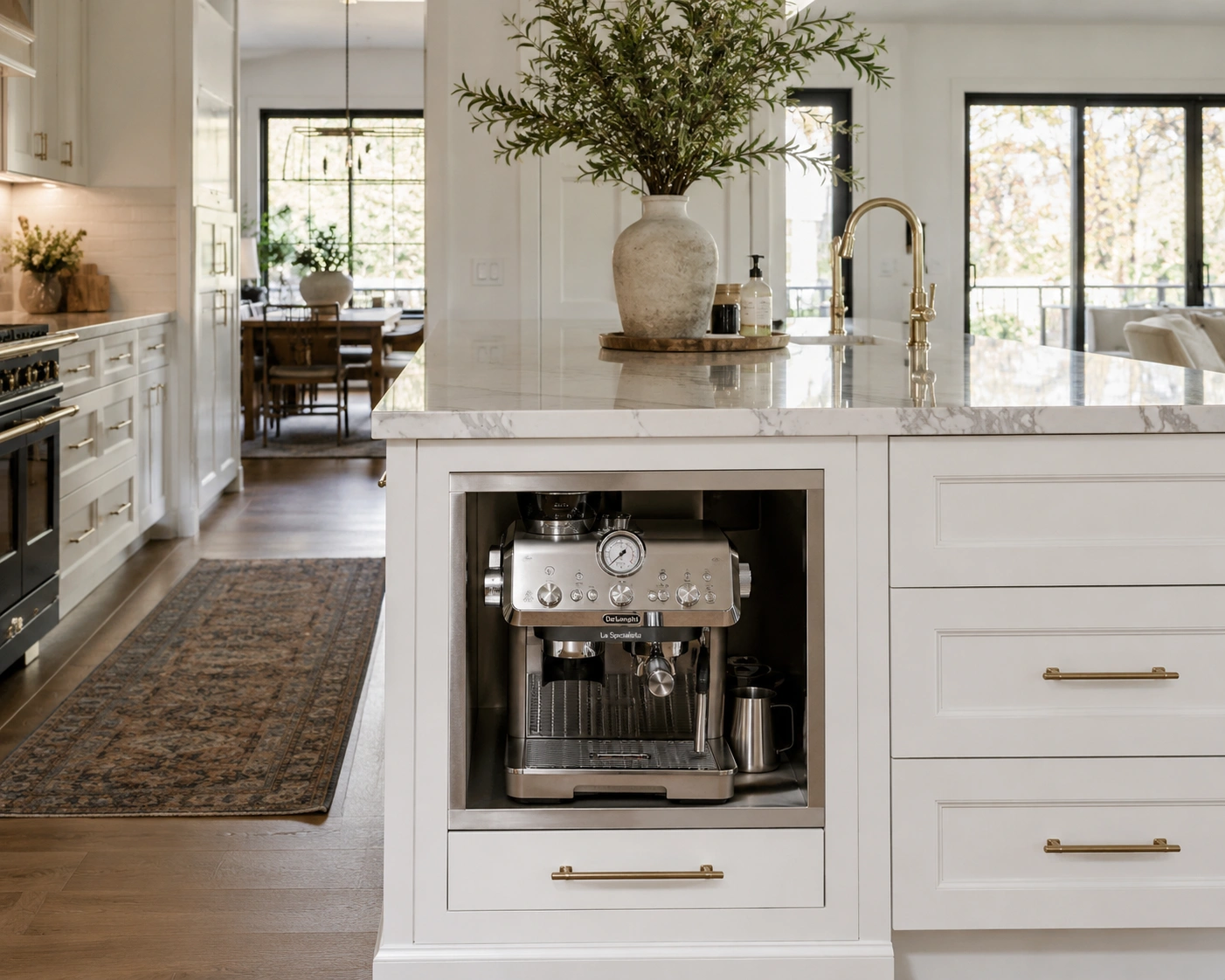
This is the splurge entry. A kitchen island with a built-in espresso machine — typically a semi-automatic like the De’Longhi La Specialista Maestro — requires both an outlet and a plumbing rough-in run into the island during renovation. The result is a fully dedicated brewing station with the entire island surface as a working area. It’s expensive to do right. But if you’re already renovating, it’s worth including — it permanently eliminates the appliance-on-counter problem and adds meaningful resale value.
17. Deep Drawer Coffee Station for Small Counters
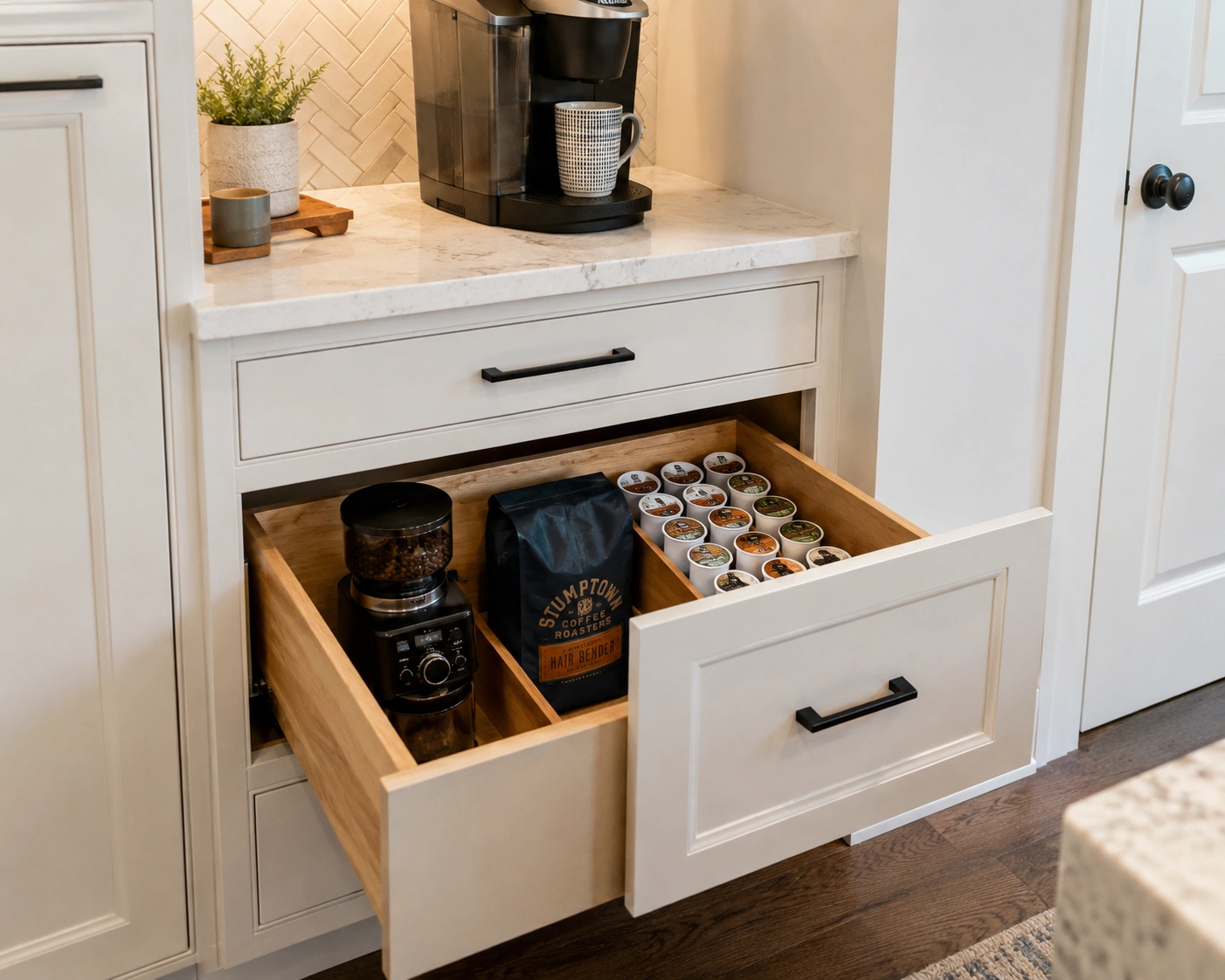
A deep drawer (10 to 12 inches tall) directly below the counter can hold a grinder, a bag of coffee beans, and organized pods without taking up any counter surface. This pairs especially well with a single-serve machine above — everything the machine needs lives in the drawer directly beneath it. Not a standard cabinet configuration, but many manufacturers offer deep drawer upgrades, and cabinet woodworkers can retrofit existing boxes for a few hundred dollars.
18. Coffee Station With a Slide-Out Tray and Hidden Grinder Storage
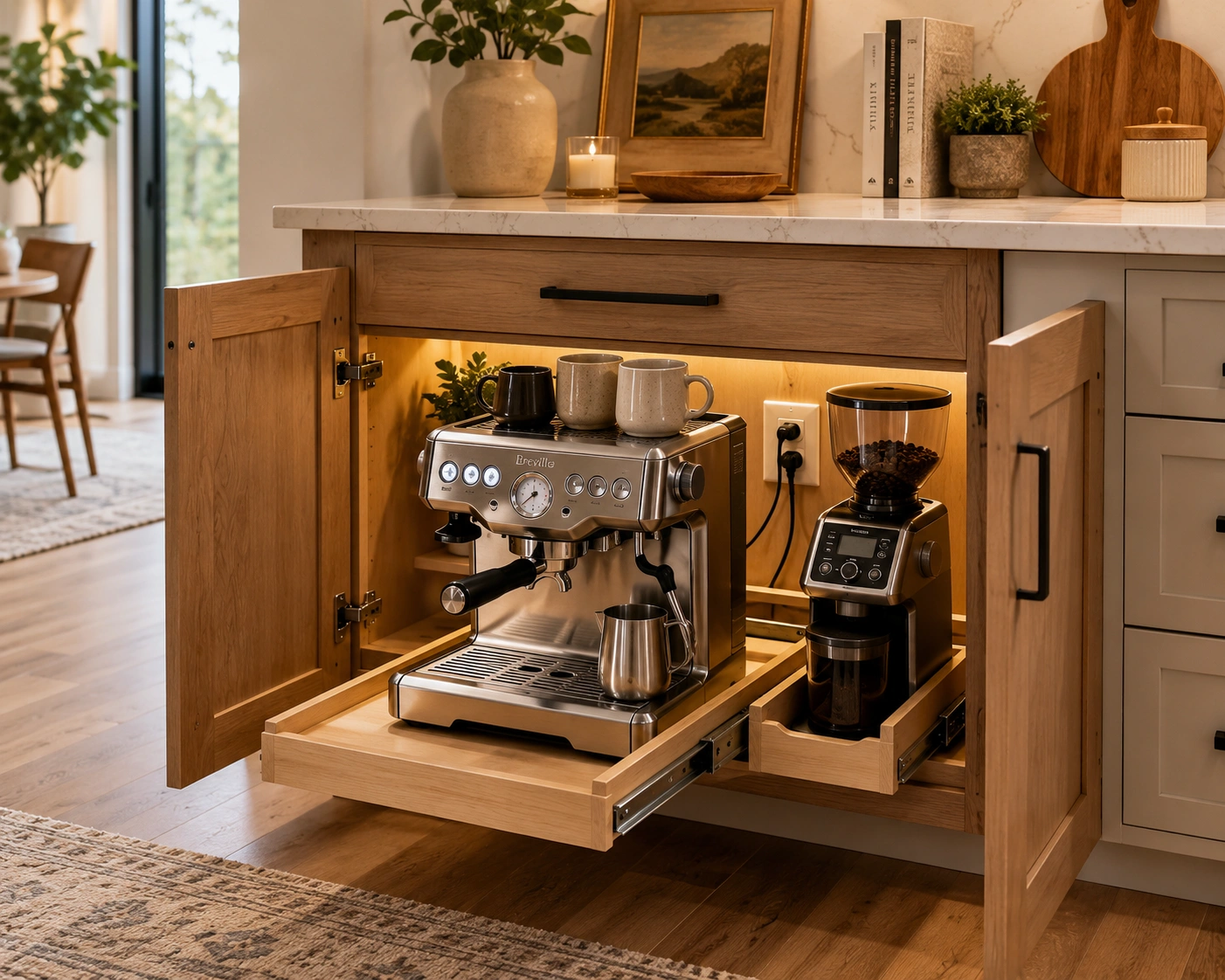
A slide-out shelf inside a base cabinet — the kind typically used for stand mixers — lets you pull the espresso machine to the front edge for use and push it back inside when done. Add a pull-out beside it for the grinder. Both stay plugged in via an interior outlet, cords stay hidden, and the counter above is completely clear. This approach is especially popular in minimalist-style kitchens where visible appliances conflict with the overall design intent.
19. Butler’s Pantry Coffee Hutch
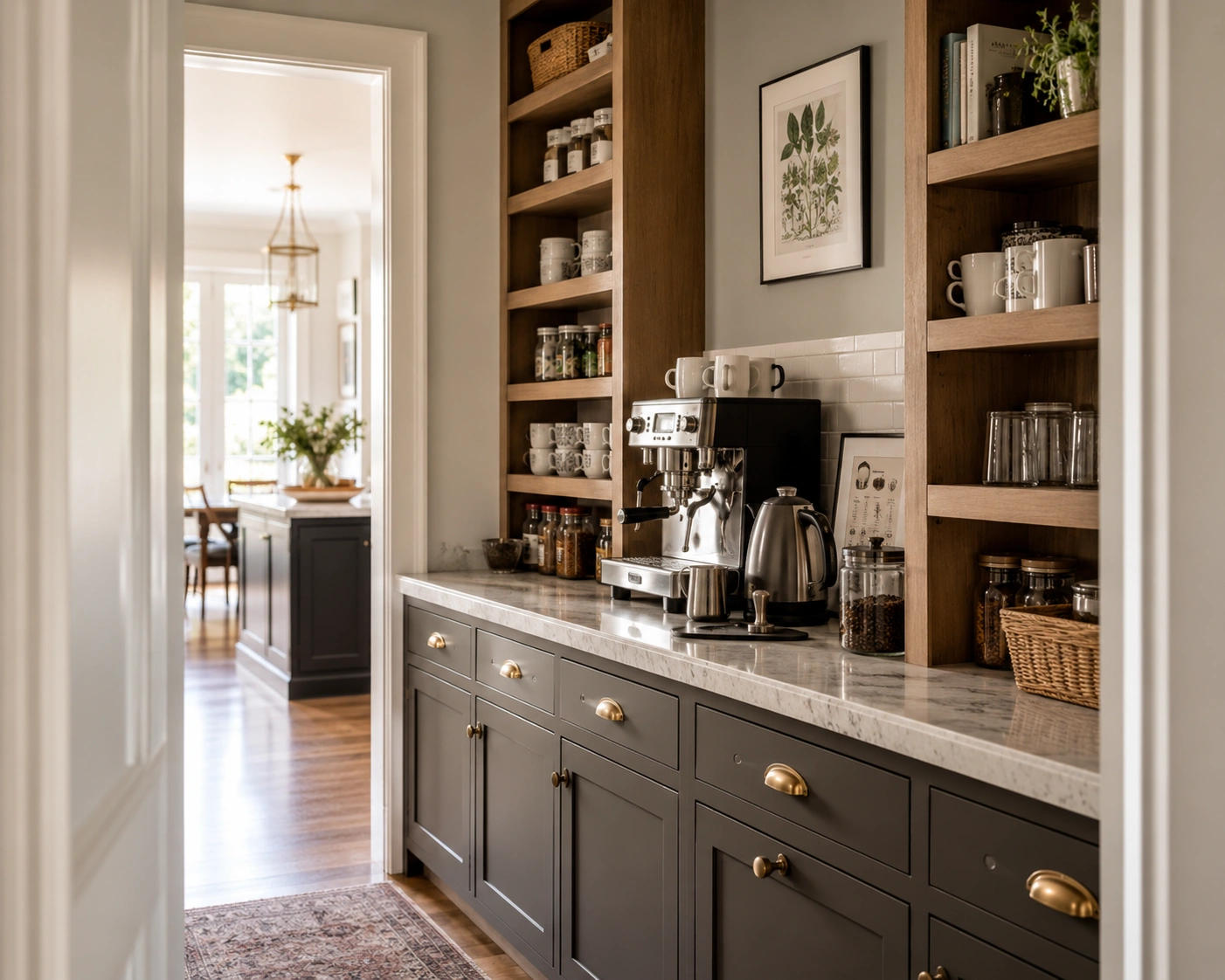
If your home has a butler’s pantry — or even a wide pantry nook between the kitchen and dining room — it’s the natural location for a full coffee station. The pantry wall absorbs visual clutter, keeps appliance noise slightly removed from conversation areas, and provides enough depth for both a machine and adjacent storage on either side. Butler’s pantry coffee hutches are among the most searched kitchen renovation features for homeowners planning a full remodel.
20. Dedicated Lower Cabinet With a Hidden Machine Bay
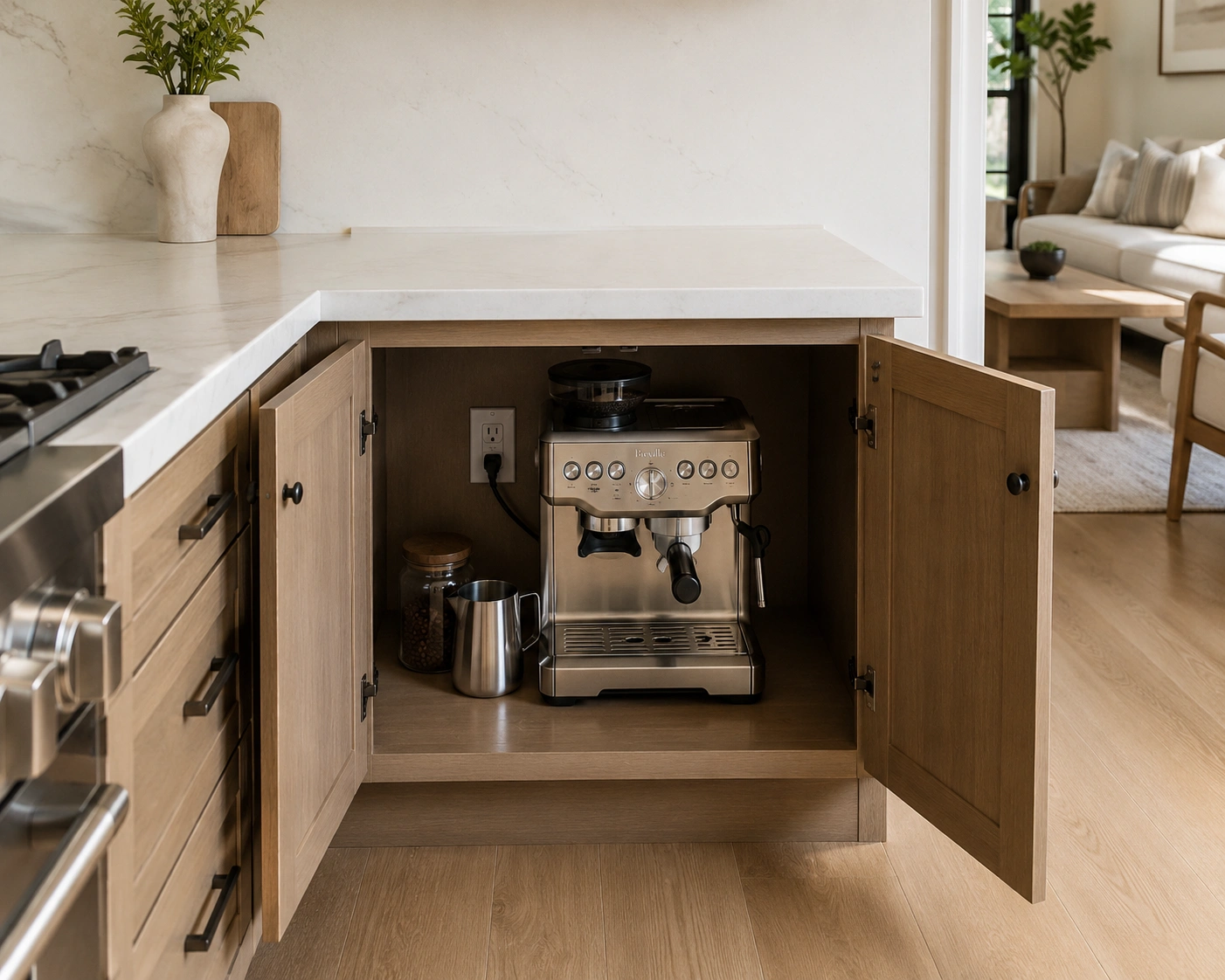
Lower-only coffee stations — where the machine lives inside a base cabinet rather than on the countertop — are a frequently overlooked option. A standard base cabinet is about 24 inches deep, which accommodates most machines without issue, and at 34 to 36 inches tall it’s perfectly accessible as a working height. An interior outlet is required. This is the right choice for households that brew a few cups a day and want minimal visual impact on an otherwise clean counter surface.
Cart, Furniture, and Renter-Friendly Coffee Station Ideas
Zero wall modifications required. These ideas move when you move, cost less than a built-in, and work in any rental or owned home — including ones where the outlet is in a less-than-ideal location.
Built-In Coffee Station vs. Freestanding Coffee Station
A built-in station integrates into cabinetry and requires an outlet inside or adjacent — it’s more permanent, cleaner-looking, and adds home value. A freestanding station (cart, hutch, or sideboard) requires no installation, can move if your layout changes, and costs significantly less upfront. Built-in works best for homeowners planning a long stay. Freestanding wins for renters and anyone still testing their kitchen layout.
21. IKEA RÅSKOG Rolling Cart Coffee Station
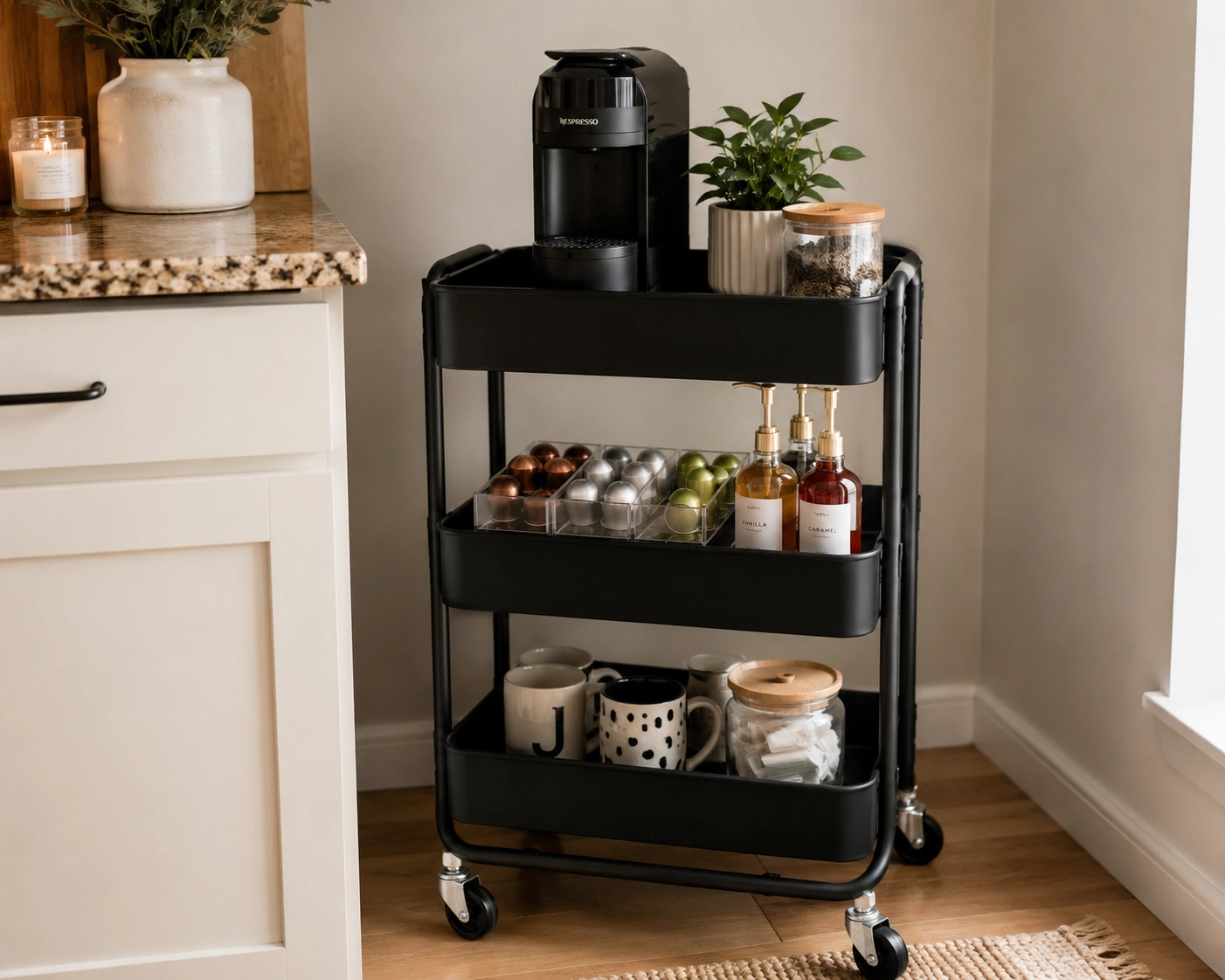
The RÅSKOG utility cart is genuinely the most-referenced renter-friendly coffee station on Pinterest and in DIY home guides — and the reason isn’t just the $35 price tag. Three tiers hold a machine on top, syrups and pod containers in the middle, and mugs or extra supplies on the bottom. It rolls wherever the outlet is. It comes in black, white, and yellow. People have been styling these as coffee carts since around 2018, and they remain one of the most practical small-kitchen solutions available.
22. Bar Cart Coffee Station
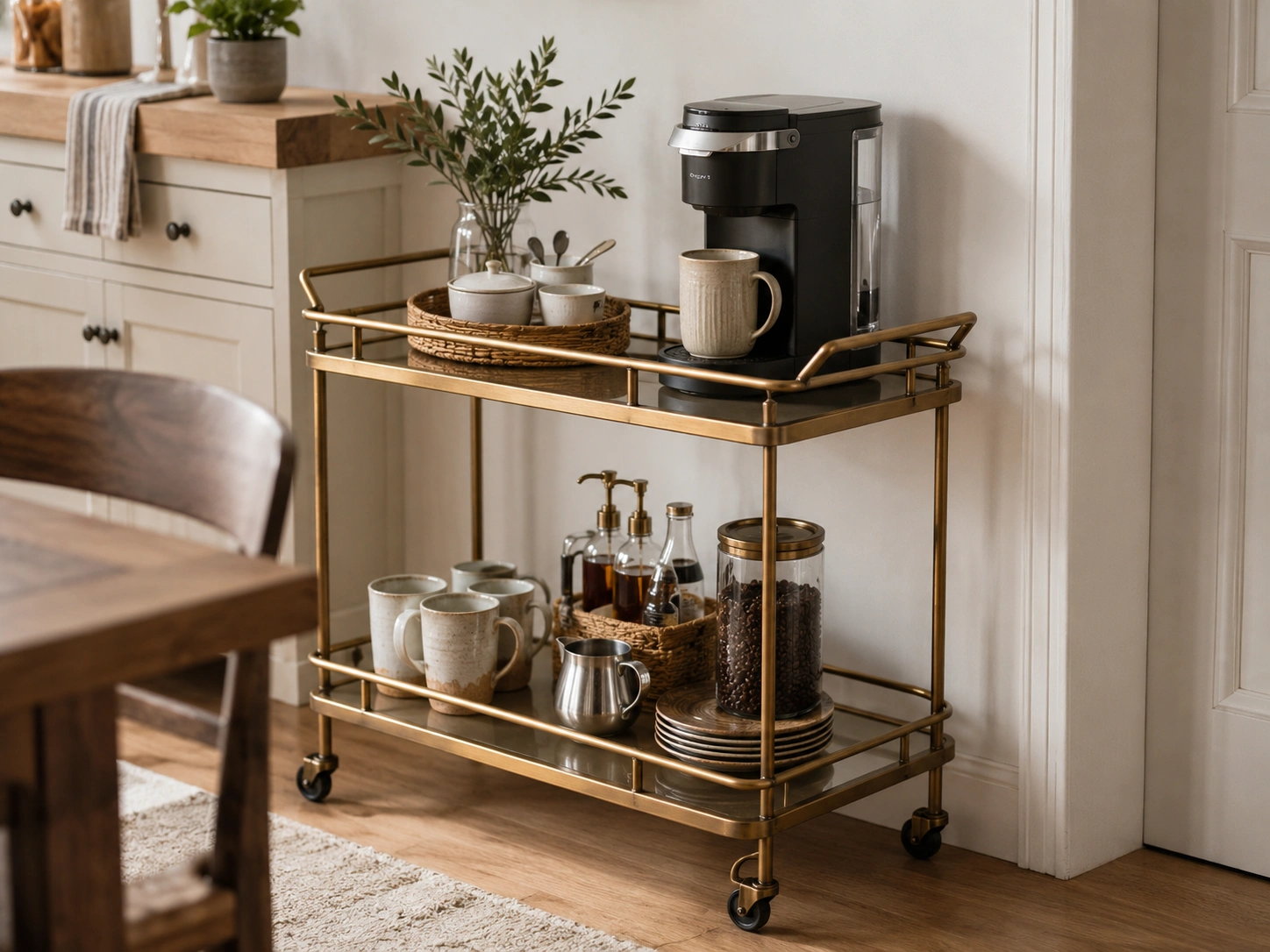
A bar cart repurposed as a coffee station works because bar carts are already designed for display — tiered, open, and available in finishes (brass, matte black, chrome, gold) that blend with kitchen and dining aesthetics. Style the top tier with the machine and a small tray; use the lower tier for mugs, a small syrup caddy, and a sealed canister for beans. Roll it out for guests. Push it back into a corner when not in use. It’s one of the easiest dual-purpose furniture swaps in home design.
23. Tiered Kitchen Cart Station
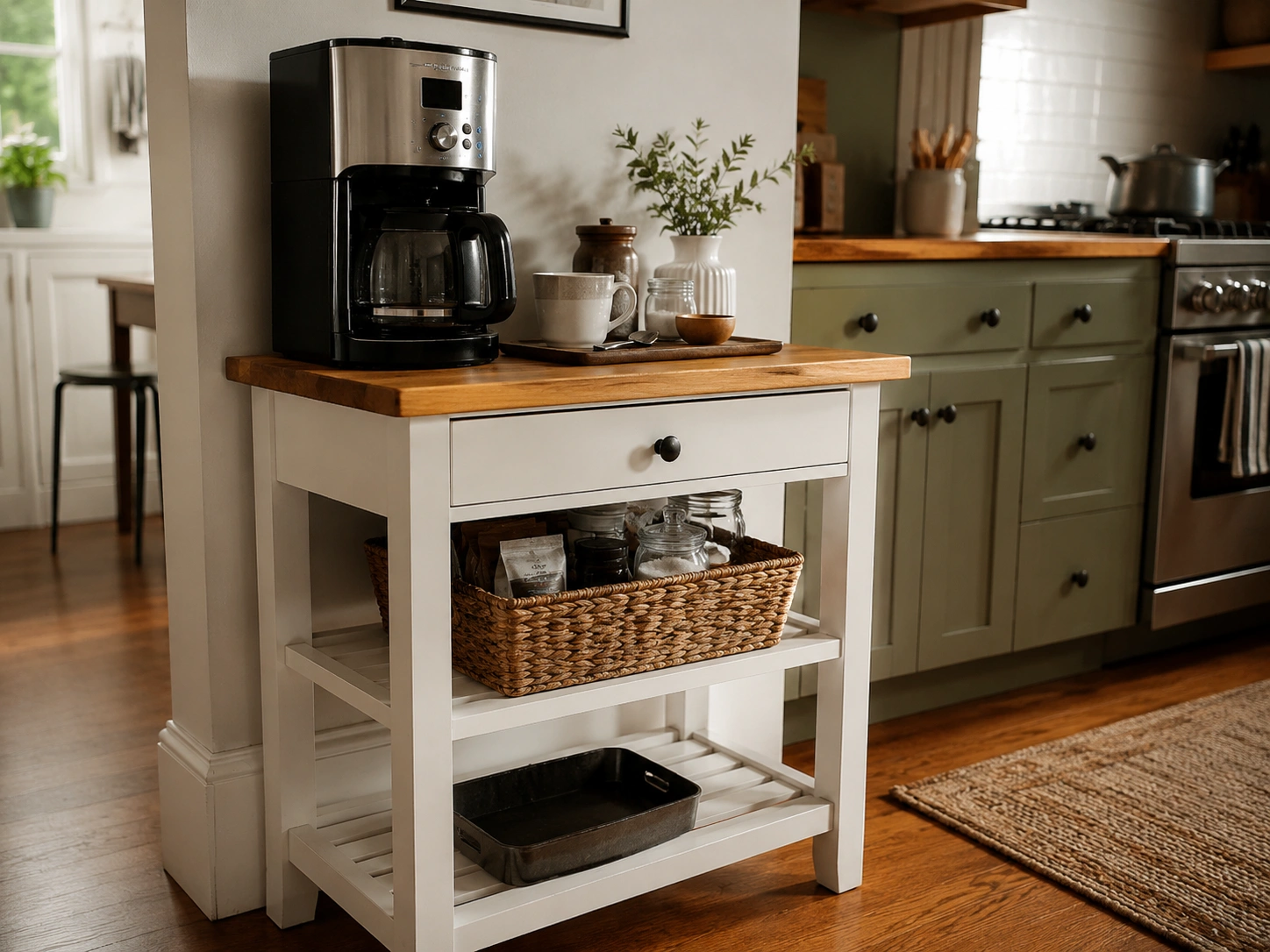
Unlike the RÅSKOG, a proper tiered kitchen cart — typically 24 to 36 inches wide — offers more surface area per tier and usually comes with a butcher block or marble top. The extra width allows the machine and a small working surface to sit side by side on the top tier rather than machine-only. Carts with drawer or cabinet storage below offer even more flexibility. This is the mid-range step between a rolling utility cart and a freestanding furniture piece.
24. Repurposed Drink Buffet or Sideboard as a Coffee Bar
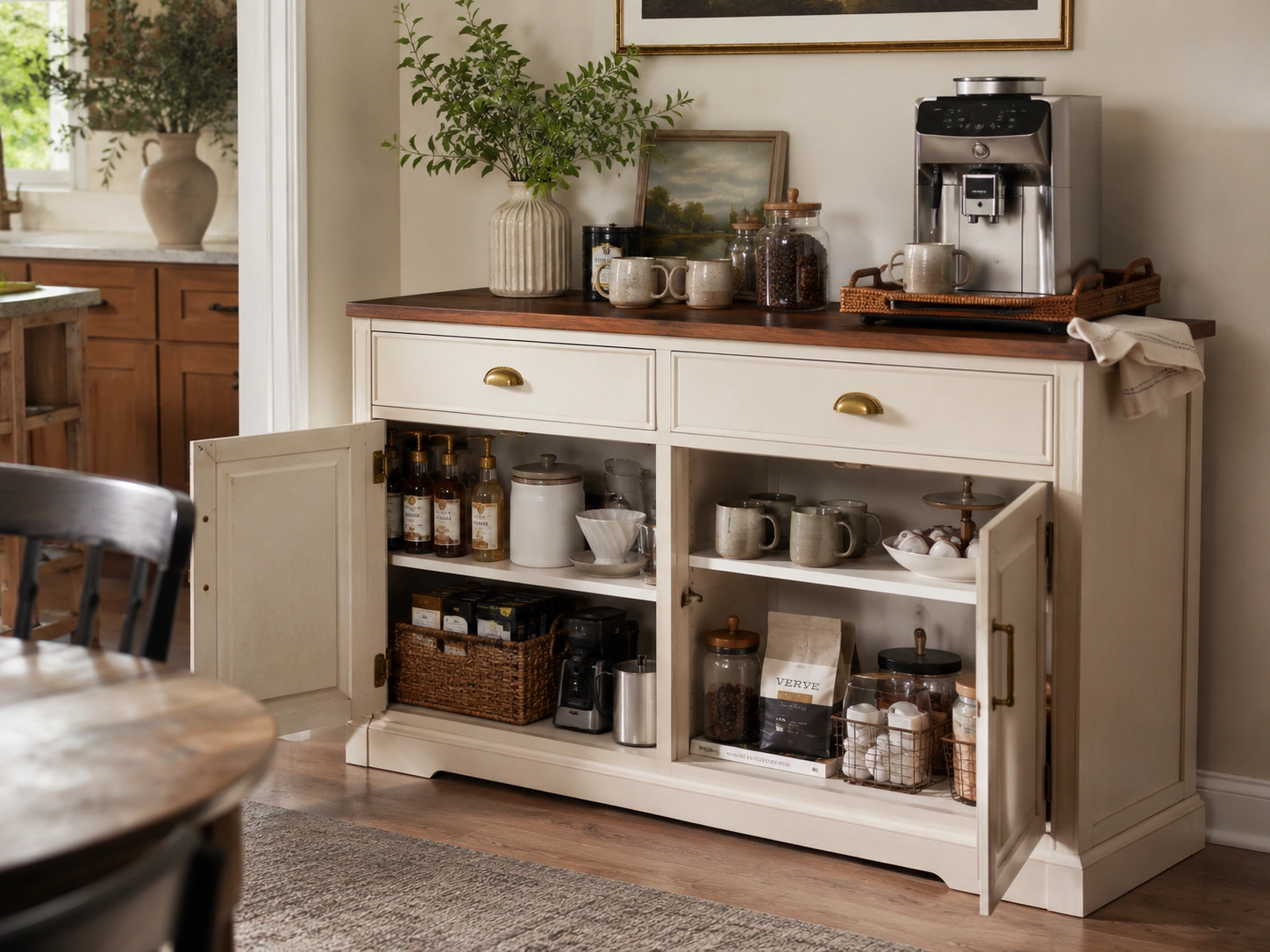
A vintage or secondhand buffet sideboard — originally intended for a dining room — makes an excellent kitchen coffee bar when placed in the kitchen or adjacent dining area. The surface sits at counter height (around 36 inches), the interior has ample storage for supplies, and the furniture quality is typically solid wood or veneer that holds up to daily use. Thrift stores, Facebook Marketplace, and IKEA frequently have sideboard options between $40 and $200 that clean up with paint and new hardware.
25. Freestanding Coffee Hutch Furniture Piece
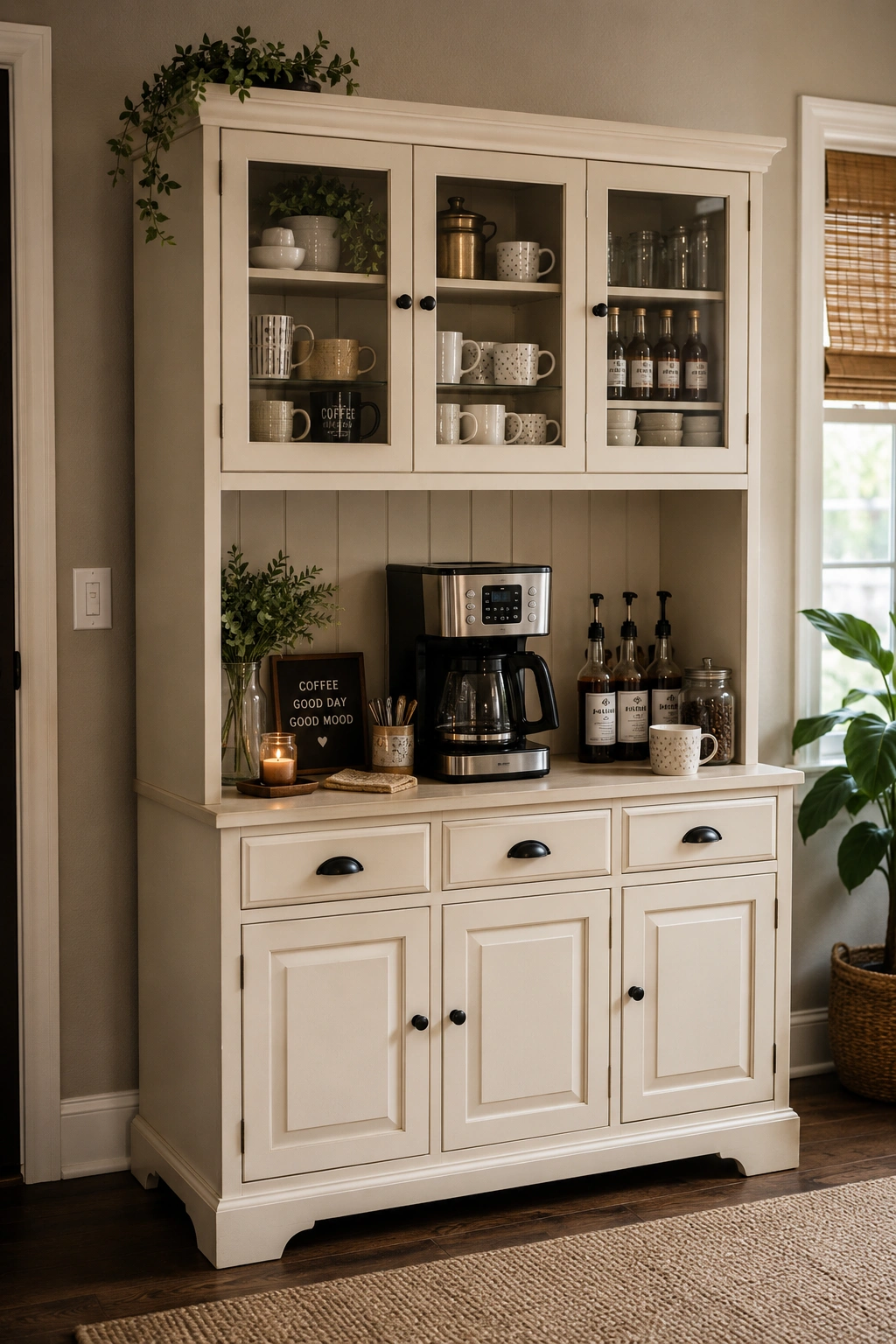
A coffee hutch is a standalone furniture unit — typically 36 to 48 inches wide — with upper open shelving or glass-front doors above and closed cabinet or drawer storage below. Unlike a repurposed sideboard, hutches are designed with display storage in mind, making them ideal for showing off mugs, canisters, and syrup bottles. They can be placed anywhere with access to a floor outlet. Wayfair, Pottery Barn, and World Market carry options from $150 to over $1,000 depending on material and size.
26. Slim Utility Cart for Narrow Kitchen Spots
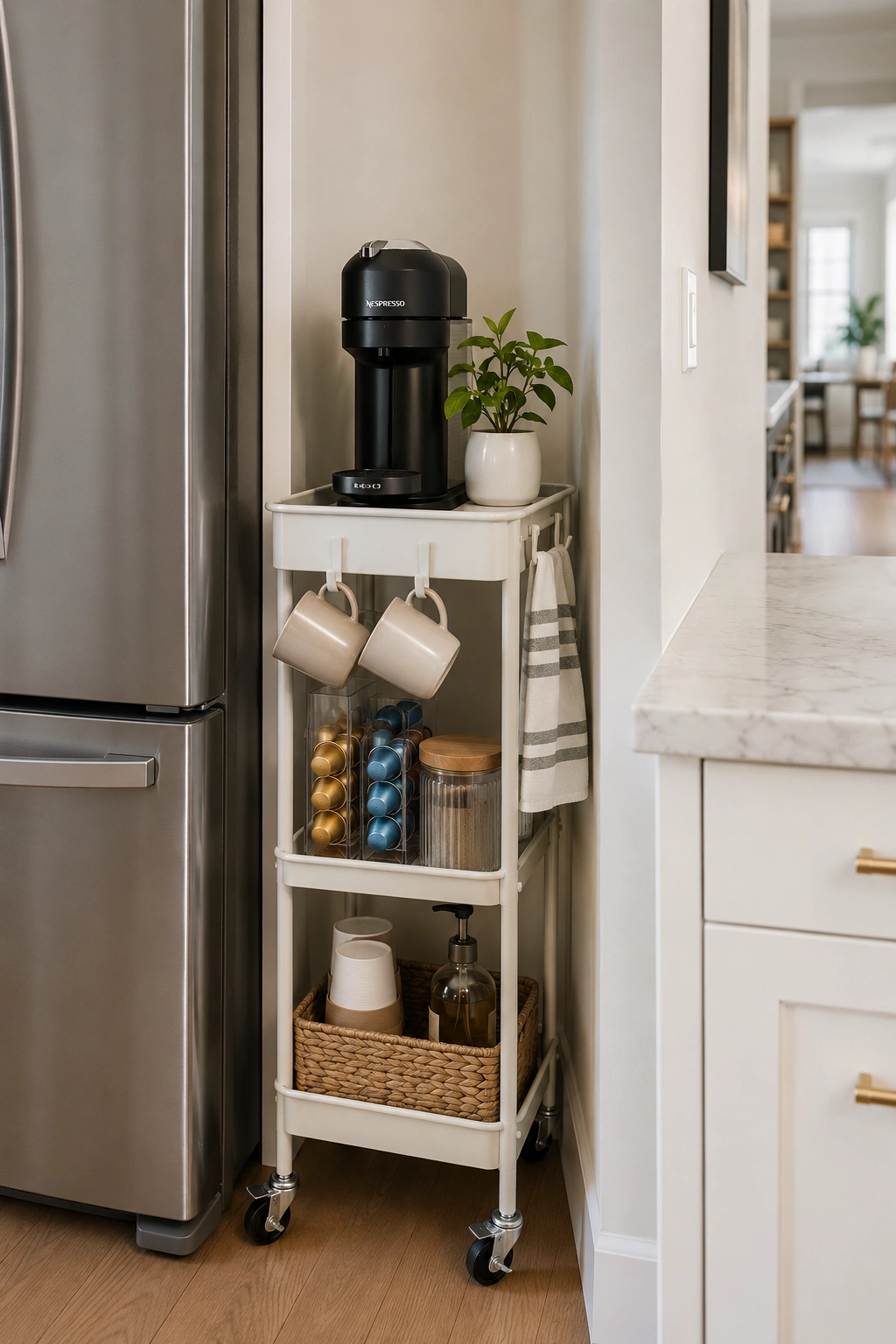
Standard kitchen carts are 24 inches wide — too wide for a kitchen that’s genuinely tight. Slim utility carts at 12 to 18 inches wide fit in spaces no other furniture option can: the narrow gap between a refrigerator and a wall, at the end of a counter run, or beside a kitchen island. A single-serve machine sits comfortably on the top tier of a 12-inch cart. Look for carts with locking wheels so the station doesn’t shift when you reach for the machine handle.
27. Repurposed TV Console or Media Cabinet as a Coffee Bar
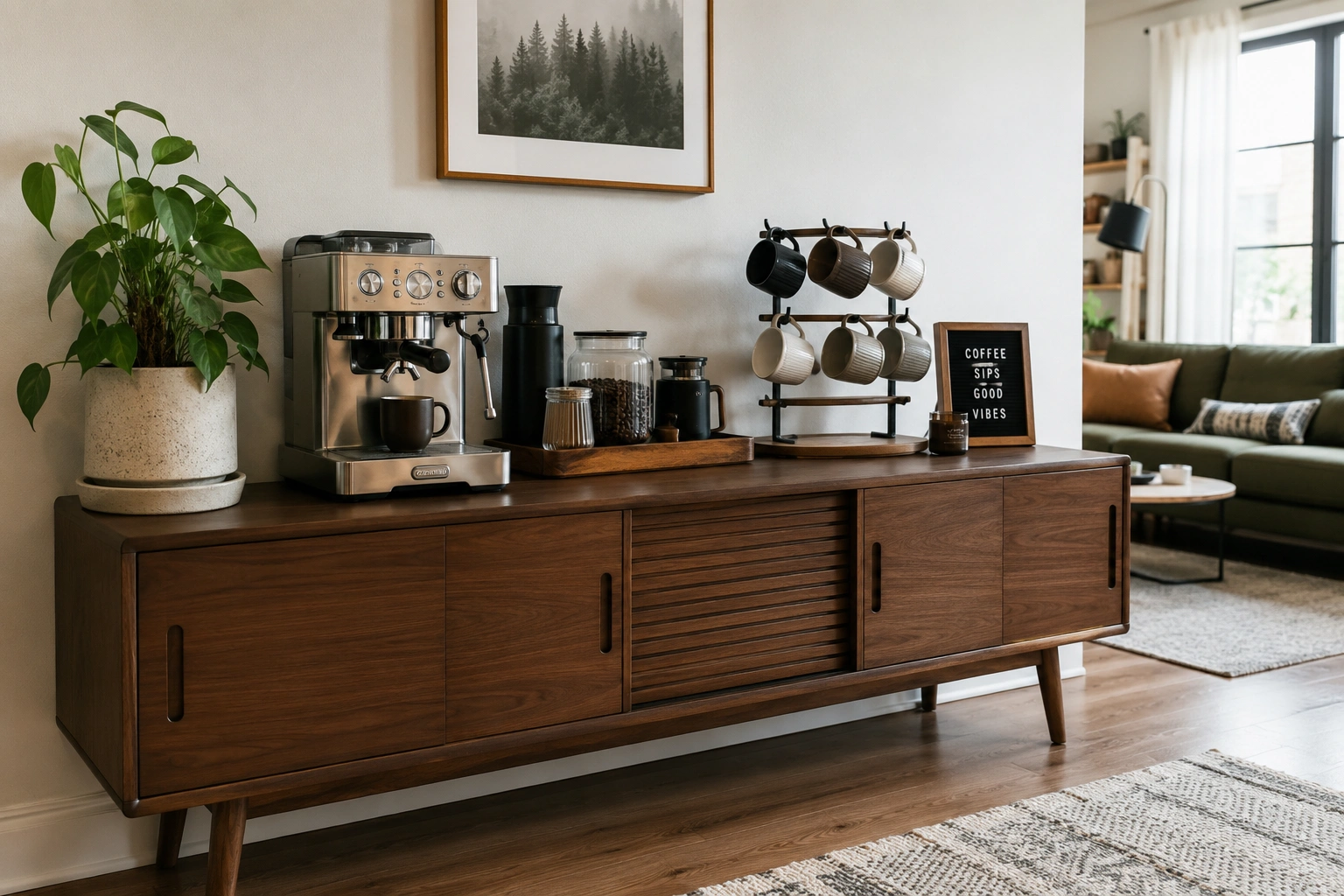
A TV console — particularly the long, low style common in mid-century modern and Scandinavian design — repurposes well as a coffee bar in a kitchen or open-plan dining area. Long enough to host a full setup, low enough to avoid blocking sightlines, and closed-front enough to hide bulk storage. In open-plan kitchens that flow into a living room, a console can anchor the kitchen side of the room without looking like a dedicated appliance zone.
Small Kitchen Coffee Station Ideas That Fit Tight Spaces
Small kitchens aren’t disqualified from a real coffee station — they’re just subject to stricter rules. Every inch needs a purpose. These seven ideas are specifically scaled for kitchens where counter space is genuinely limited and the margin for wasted square footage is close to zero.
28. Coffee Station With a Mini Fridge Below the Counter
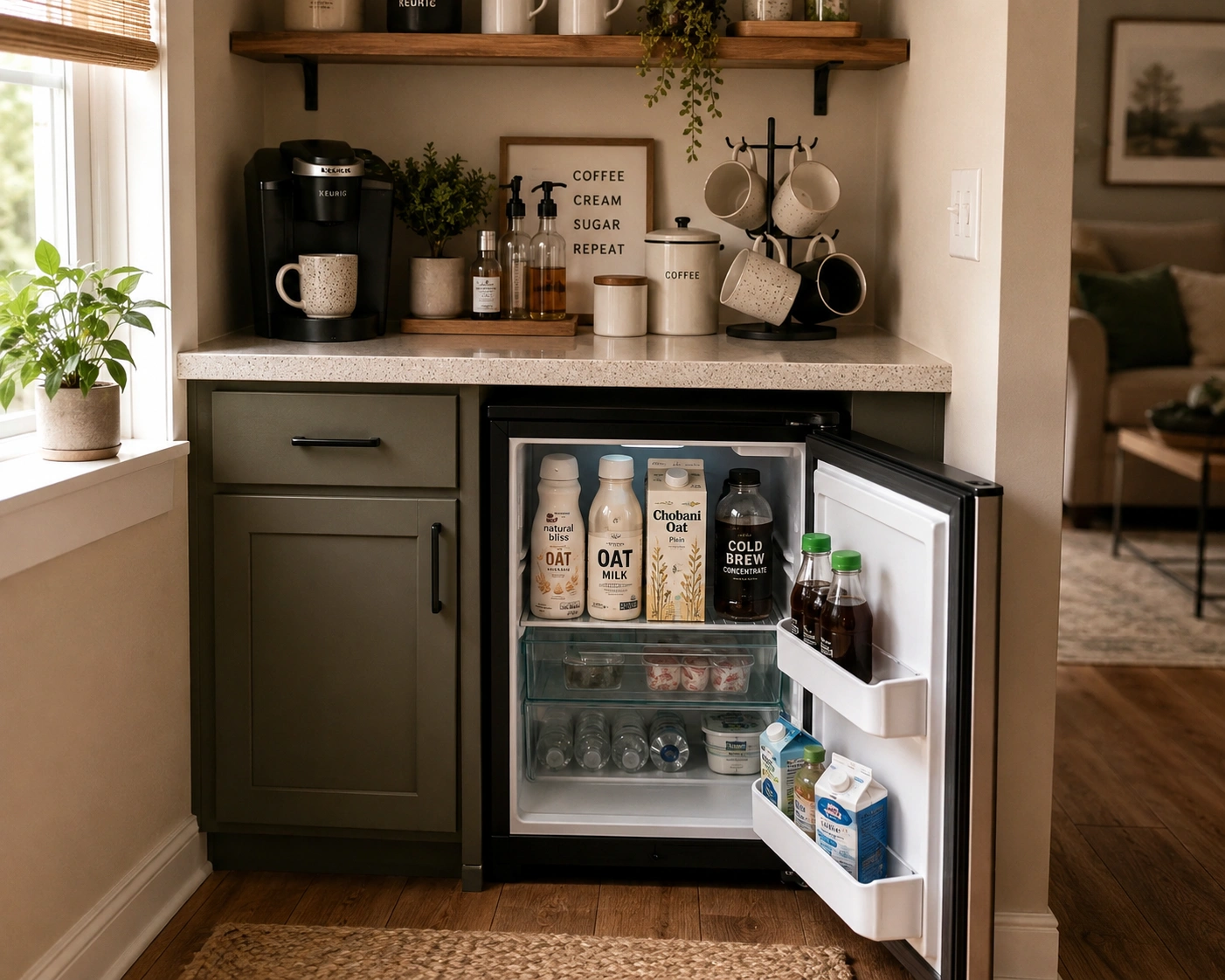
A compact under-counter mini fridge dedicated to creamer, oat milk, and cold brew concentrate eliminates the daily walk to the main refrigerator and keeps everything for the coffee process in one zone. Under-counter mini fridges at 4 to 5 cubic feet fit the same footprint as a standard base cabinet and can be freestanding beside or below the station counter. Basic models run $100 to $250. This is one of the most practically satisfying upgrades to a home coffee bar setup.
29. Magnetic Spice Strip on the Backsplash for Coffee Tools
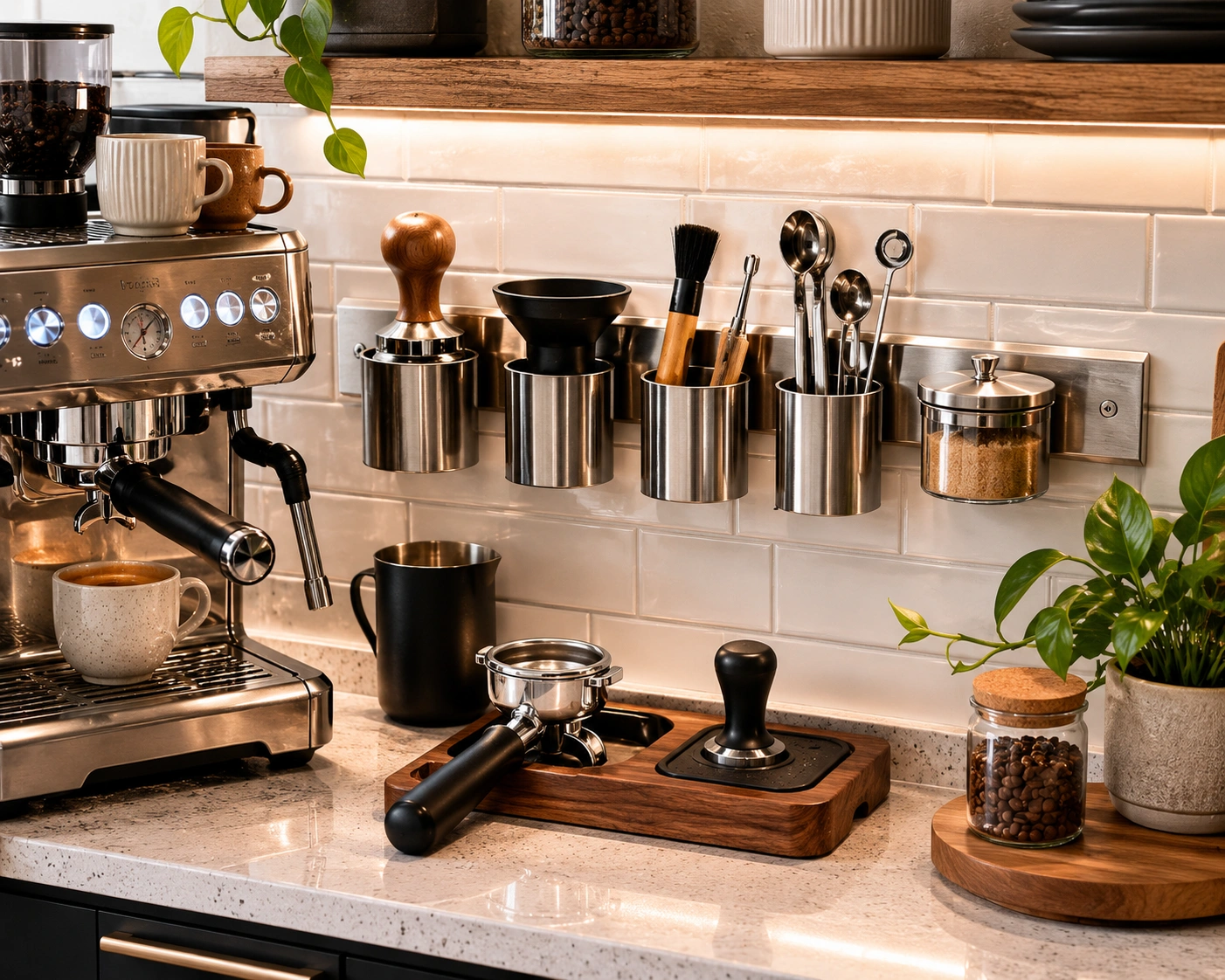
A stainless steel magnetic spice strip mounted on the backsplash holds small metal containers for espresso accessories: a tamper, dosing funnel, brush, or a lidded sugar container. Tools come off the counter entirely without disappearing into a drawer. Command strip versions exist for renters. At 12 to 18 inches, a single strip handles everything most home baristas need within arm’s reach of the machine — which means it actually gets used rather than ending up in the back of a cabinet.
30. Under-Cabinet Mug Hook Strip
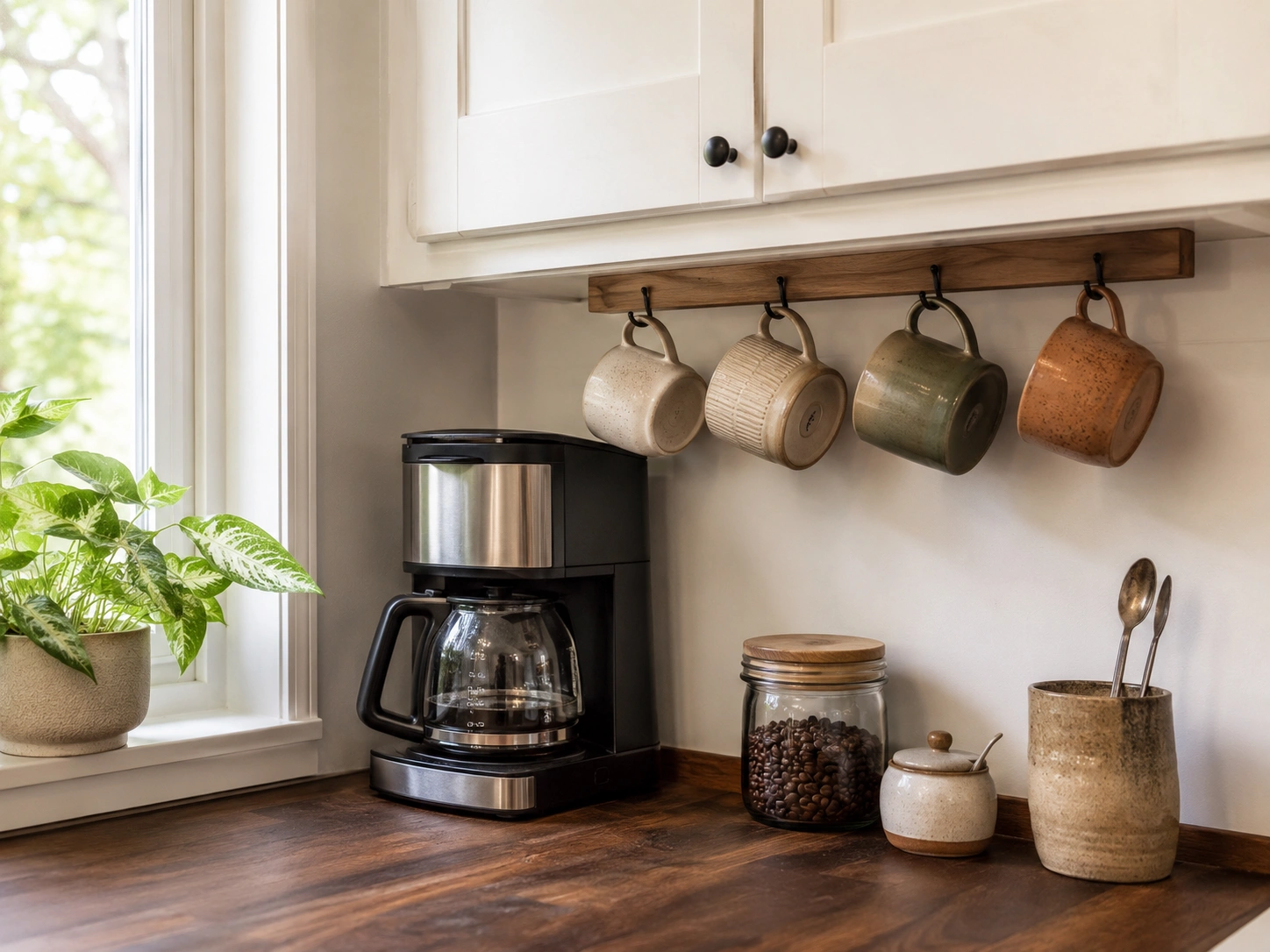
Screw a wooden rail or adhesive hook strip to the underside of the cabinet directly above your machine and hang three to five mugs from it. The mugs move off the counter or shelf entirely — they’re accessible in the air, taking up zero horizontal surface. In a tight kitchen, this single change can free up an entire shelf’s worth of functional space. Cup hook strips install in minutes with a drill or heavy-duty peel-and-stick adhesive and cost under $15.
31. Coffee Station in a Small Pantry Alcove or Nook
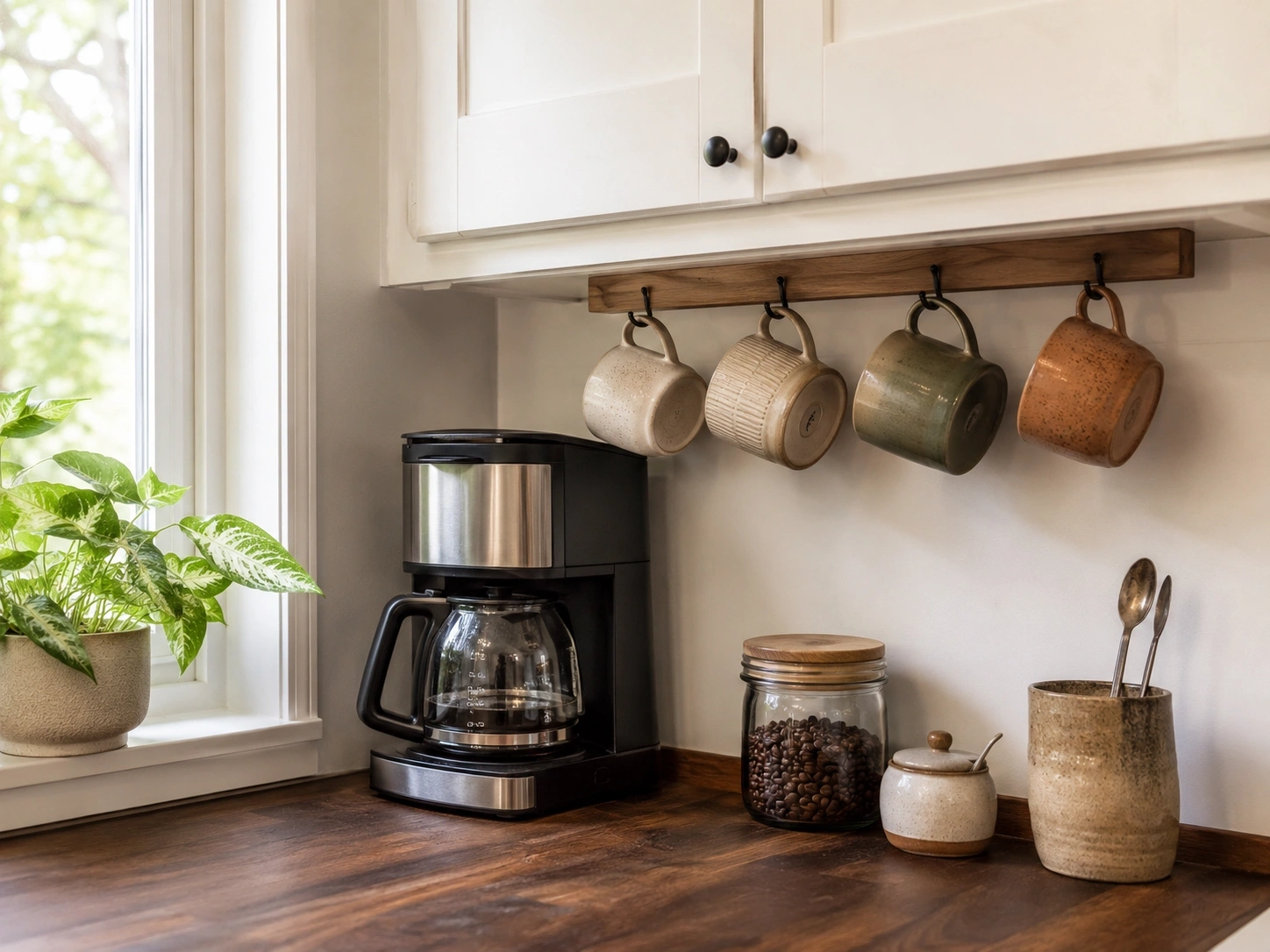
Even a shallow pantry niche — 12 to 18 inches deep and 24 inches wide — holds a slim espresso machine with a shelf above it. The walls of the nook create a natural frame that makes the setup look intentional rather than wedged in. A peel-and-stick LED strip inside the nook for under $10 gives it a finished, lit feel that reads as designed. This is especially useful in older homes with deep pantry walls or in apartments with awkward alcoves that currently hold nothing useful.
32. Dual-Purpose Wine and Coffee Rack Station
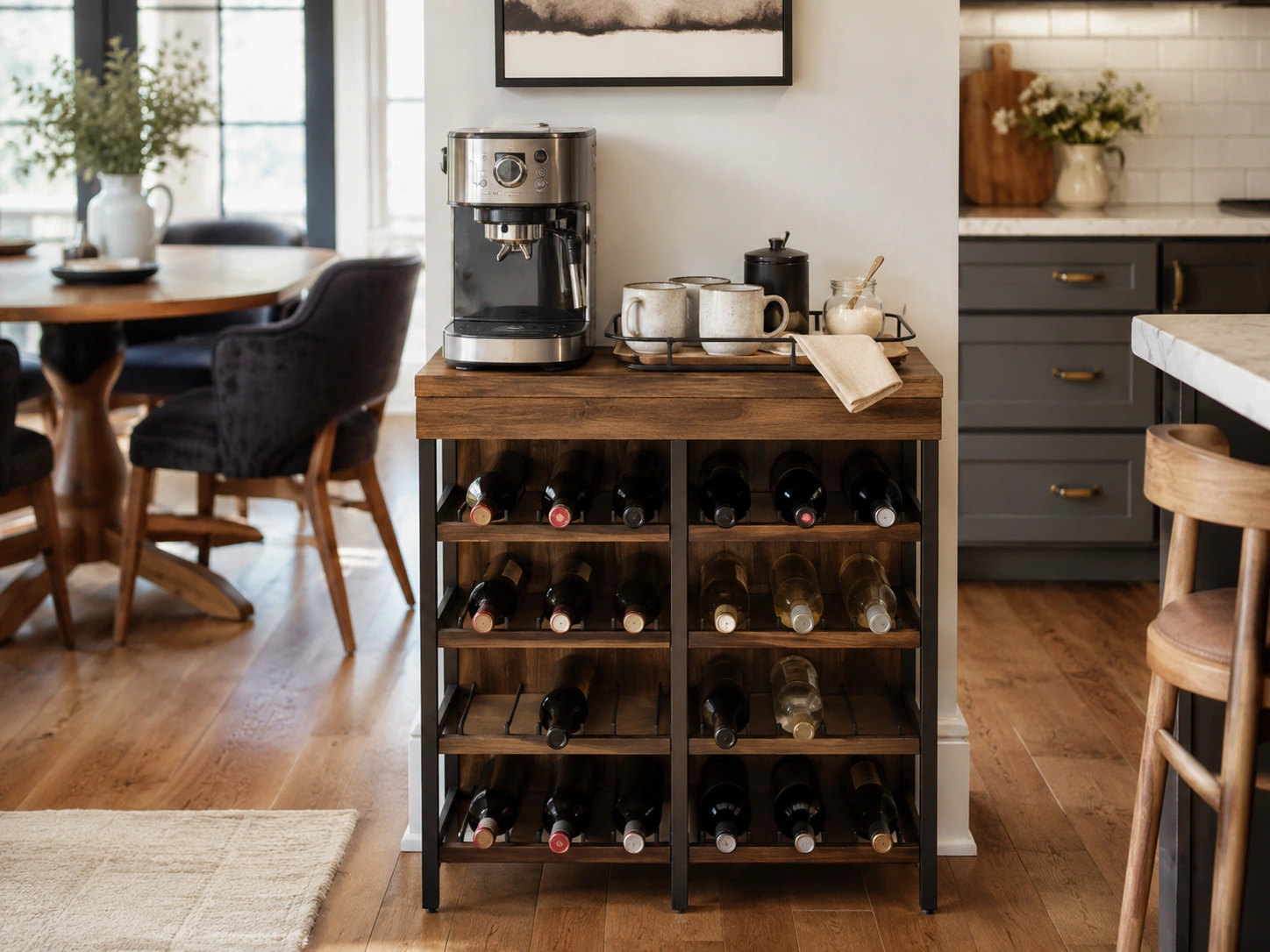
A wine rack unit — wall-mounted or freestanding — with a flat top surface makes a natural pairing for a coffee station in households that use both. Wine below, machine on top, visual combination reads as intentional and styled rather than cluttered. This works particularly well in open-plan kitchens adjacent to a dining area where a bar-style vibe is the goal. Keep the coffee side to machine, one tray, and mugs — no visible bulk supplies — or the dual-purpose idea tips into visual noise.
33. Moody Dark-Painted Cabinet Coffee Zone
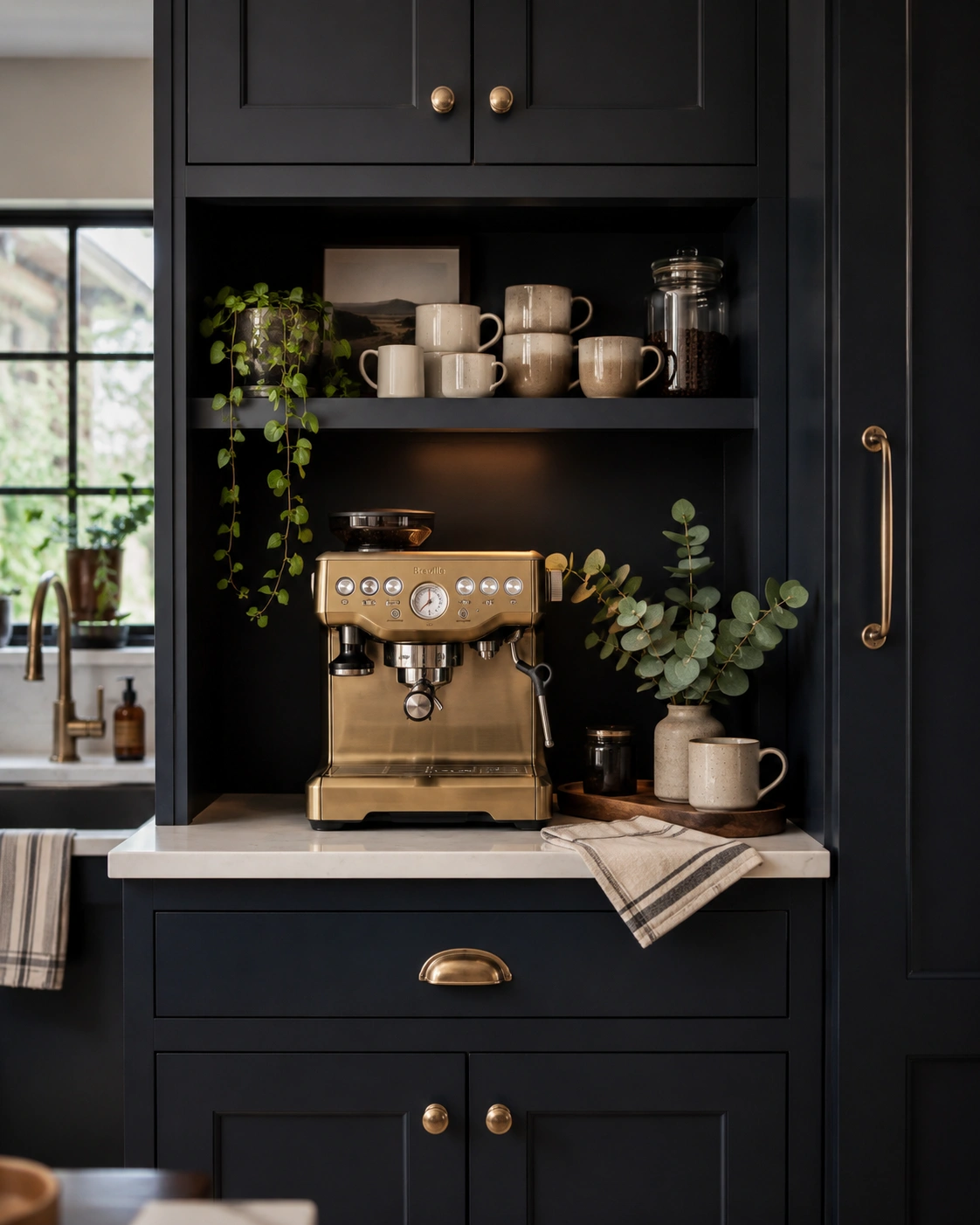
This is the design direction that’s been steadily overtaking the all-white kitchen trend — and it photographs better than almost any other idea on this list. Paint one section of cabinetry — or just the interior of an open cabinet — in midnight navy, forest green, matte black, or charcoal. Mount the machine in front of or inside it. The dark paint creates a visual anchor that makes everything in the zone look deliberate. Pair with brass hardware, a warm mug collection, and one small trailing plant.
34. Japandi-Style Minimalist Coffee Station With a Bamboo Tray
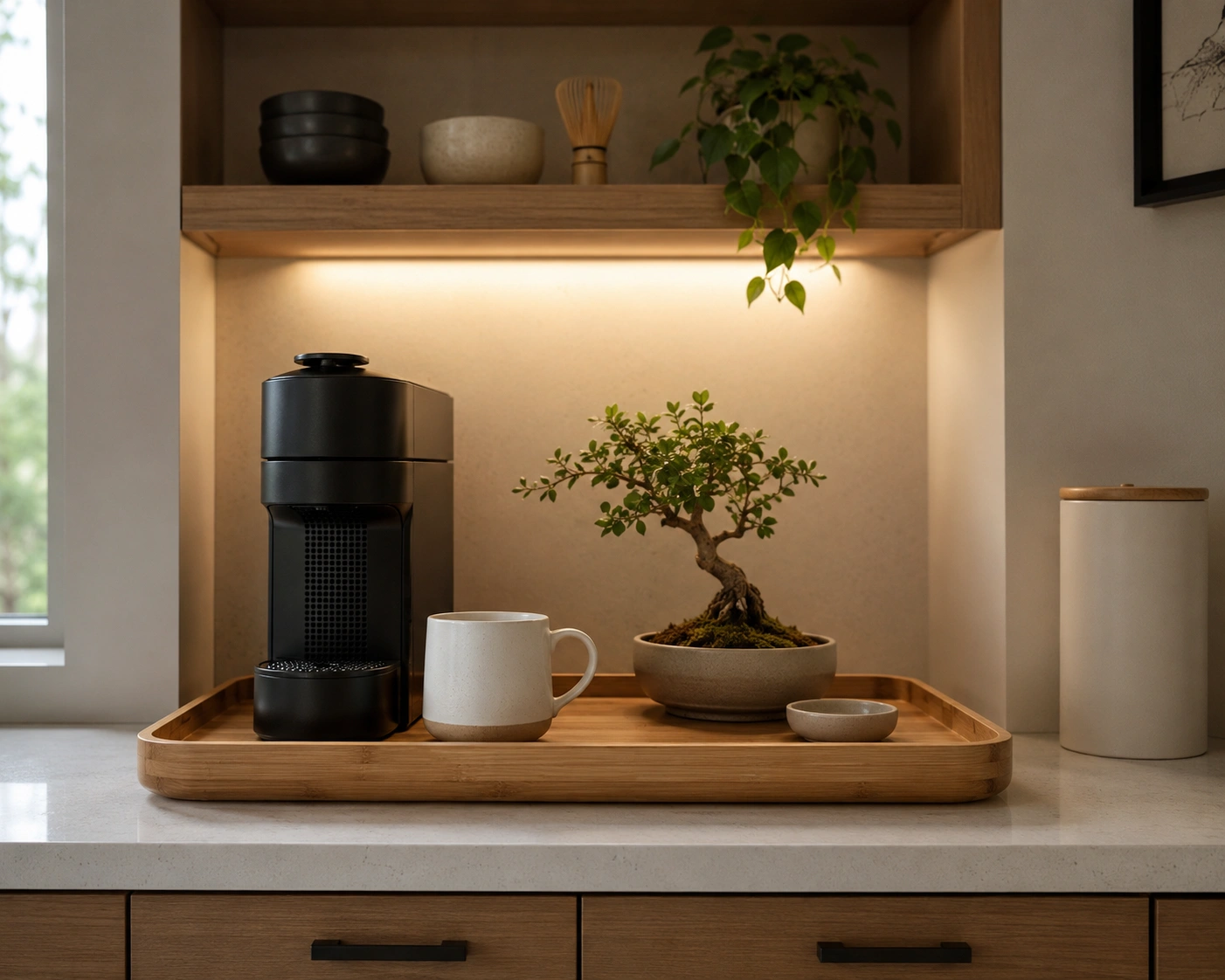
Japandi — the fusion of Japanese and Scandinavian design principles — has been one of the most consistent visual trends in kitchen and home decor for several years. Applied to a coffee station, it means: one machine, one mug, one small plant or ceramic dish, contained on a bamboo or light wood tray with nothing visible that doesn’t belong there. Everything else is stored out of sight. I’ve seen conflicting takes on whether this works for high-volume households — some say yes if the storage is disciplined, others argue it only works for one-cup-a-day setups. My read: it works for anyone who builds in hidden storage alongside the visible tray.
Quick Comparison: Which Coffee Station Type Fits Your Kitchen?
| Station Type | Best For | Key Benefit | Limitation |
|---|---|---|---|
| Counter tray setup | Renters, beginners | Zero installation, easy to restyle | Limited storage; gets reclaimed by groceries quickly |
| Floating shelves | Most kitchens with drywall studs | Customizable height, strong visual impact | Requires drilling and wall anchors |
| Appliance garage | Homeowners, minimalists | Hides machine completely; cord-free look | Needs interior outlet; costly to add retroactively |
| IKEA RÅSKOG cart | Renters, small kitchens | Mobile, budget-friendly, fully contained | Limited top-tier surface; not for large machines |
| Full cabinet hutch | Homeowners, families | Maximum storage, professional built-in look | Requires 36–48″ of dedicated floor or wall space |
One Thing Every Coffee Station Guide Gets Wrong: Electrical Planning
Look — if you’re planning a serious espresso setup, here’s what actually works before you choose a location: check your outlet before you commit to a spot.
The Breville Barista Express draws approximately 1,700 watts at peak load. The De’Longhi La Specialista Maestro pulls a comparable draw. Running either of these alongside a grinder on a standard 15-amp shared kitchen circuit can trip the breaker — not dangerously, but reliably enough to become a daily frustration. A GFCI-protected 20-amp dedicated circuit is the correct solution for any built-in espresso machine location. Pod machines like Nespresso or Keurig draw far less current, so shared circuits are fine for those.
For renter-friendly setups: your outlet placement partly determines your station location — and that’s actually fine to work with. Position the cart or tray near the existing outlet, tuck the cord, and never run extension cords across floor traffic areas.
For homeowners planning a renovation: ask your electrician to run an interior outlet inside the appliance garage or base cabinet during rough-in. Bundled with other electrical work, it typically costs $150 to $300 and permanently eliminates the visible-cord problem that no tray or decorative basket can actually solve.
Some experts argue that electrical planning is a renovation-phase-only concern. That’s valid if you’re doing a full kitchen gut. But if you’re adding a station to an existing kitchen, outlet placement is the constraint that should drive the location decision — not the other way around.
Voice Search Q&A
What’s the best kitchen coffee station for a small counter?
A slim IKEA RÅSKOG cart or a wall-mounted floating shelf keeps the machine off the main counter surface. For very tight kitchens, a narrow ledge shelf or a pull-out machine tray inside a base cabinet saves the most space without sacrificing function.
How do I hide coffee machine cords in my kitchen?
Use an appliance garage with an interior outlet, run a cable clip rail along the backsplash, or position your station near the outlet and run the cord behind a tray. An interior cabinet outlet is the cleanest permanent solution.
Should I build a coffee station in my kitchen or use a cart?
For renters or anyone who moves frequently, a cart or freestanding hutch is the better choice — no installation, goes with you. For homeowners planning to stay, a built-in cabinet setup adds permanent function and some resale value.
What do I need to set up a home coffee bar in my kitchen?
At minimum — a machine, a power source, mugs, and a defined surface area. For a complete setup: storage for pods or beans, a grinder, a tray to define the zone, and one shelf or hook system for mugs above the machine.
How wide does a kitchen coffee station need to be?
A functional single-machine station fits in as little as 18 to 24 inches of counter or shelf width. A full hutch-style setup with machine, display, and storage typically needs 36 to 48 inches to work without feeling cramped.
Ready to Build Yours?
Thirty-four ideas — and the right one for your kitchen is almost certainly a combination of two or three of them. Most coffee stations that actually hold together weren’t built in a single afternoon. They usually start as a tray and a shelf, then evolve as you figure out where things actually land and what you genuinely reach for every morning.
Start with the outlet. Define the zone. Protect the surface from everything that isn’t coffee.
Whether you’re working with 18 inches of apartment counter or a full butler’s pantry, the station that stays organized is the one that was planned around your real kitchen — not someone else’s renovation budget.




No Comment! Be the first one.