






Vietnam Jungles 2026: Trekking, Wildlife & National Parks Guide
Vietnam jungles refer to the country’s tropical and subtropical forest ecosystems, spanning lowland rainforests, montane cloud forests, and karst jungle systems across the north, centre, and...

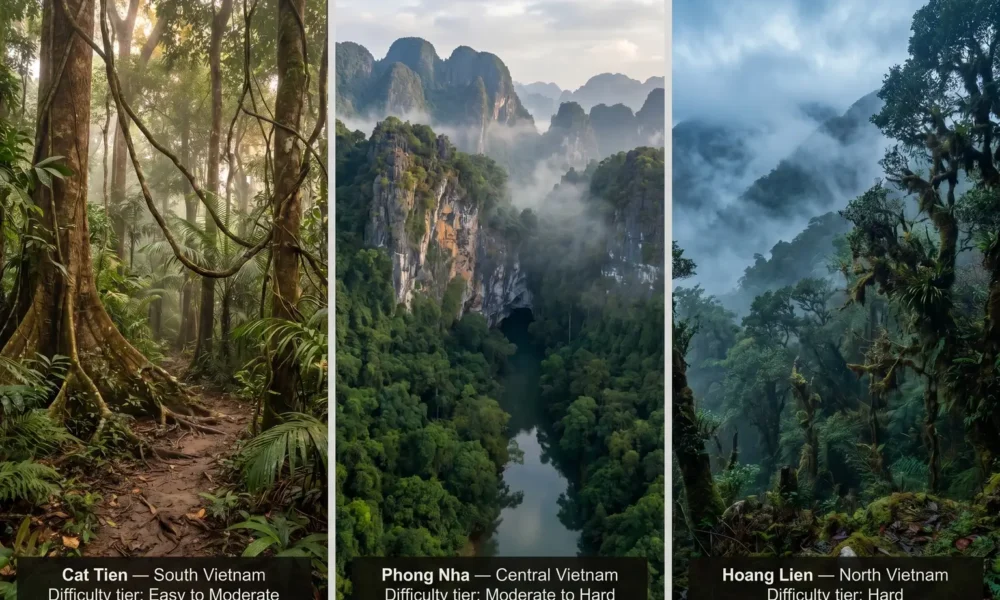
Vietnam jungles refer to the country’s tropical and subtropical forest ecosystems, spanning lowland rainforests, montane cloud forests, and karst jungle systems across the north, centre, and south. Vietnam holds one of Southeast Asia’s highest levels of forest biodiversity, with 25 native primate species and over 13,000 plant species recorded across its protected areas.
What Vietnam’s Jungles Are Actually Like — Before You Book
Here’s the thing: most “Vietnam jungle” content was written by someone who spent four hours on a day tour.
Vietnam’s forests are genuinely diverse — not just a backdrop for stock photography. The country sits at the convergence of three major biogeographic zones: the Sino-Himalayan, Sundaland, and Indochina regions. That’s what creates the unusual species density. According to a 2025 Wanderlust Magazine report, Vietnam hosts 25 primate species, five found nowhere else on earth — including the Tonkin snub-nosed monkey and Delacour’s langur — positioning it as one of Asia’s most biologically significant jungle destinations.
What most guides skip is the terrain variation. “Jungle” in Vietnam means five different things depending on where you are: dense lowland rainforest in the south, karst limestone cave systems wrapped in jungle in the centre, montane bamboo forest in the northwest, coastal buffer forest in the northeast, and high-altitude cloud forest along the Hoang Lien Son range. Each requires different gear, different guide expertise, and a different fitness baseline.
Or maybe I should say it this way: the question isn’t “should I do a jungle trek in Vietnam?” It’s “which jungle, at what level, in which month?”
The best jungles in Vietnam vary significantly by what a traveller actually wants. For multi-day wildlife trekking in the south, Cat Tien National Park is the most accessible option with established trails and lodge infrastructure. For cave-jungle adventure in the centre, Phong Nha-Ke Bang offers the most dramatic landscapes in the country. According to Vietnam’s Ministry of Natural Resources, Phong Nha-Ke Bang contains the world’s largest cave river systems alongside primary jungle that sees minimal visitor pressure outside peak season. Travellers planning a northern loop get the most out of Cuc Phuong or Hoang Lien, where primate rescue centres and cloud forest trekking respectively give genuine wildlife encounters without expedition-level logistics.
The Best Jungle Regions in Vietnam — Broken Down Honestly
Phong Nha-Ke Bang
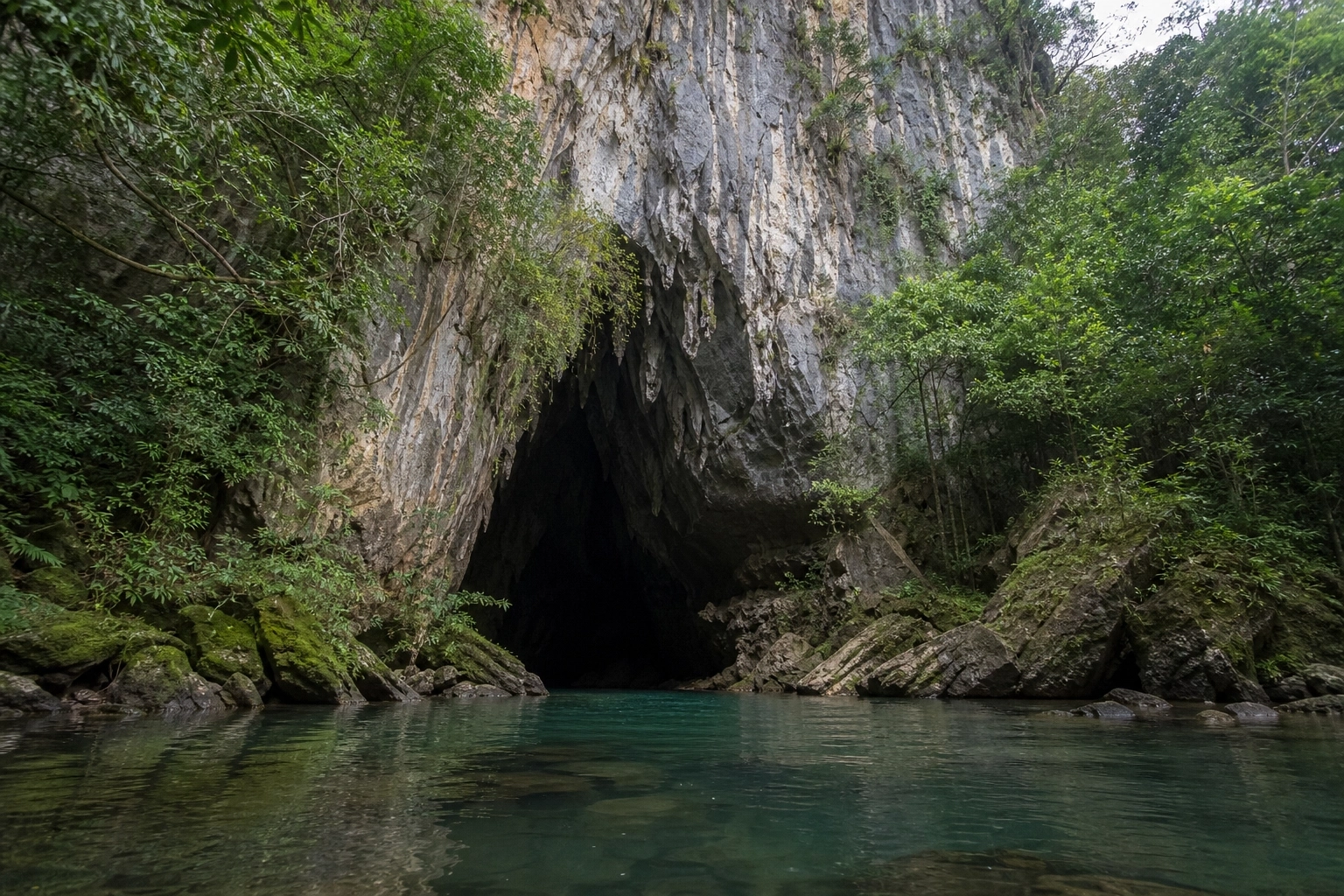
Phong Nha is the headline act. The national park covers 123,000 hectares of UNESCO-listed karst jungle and contains some of the most spectacular cave-forest terrain on earth. Oxalis Adventure runs the only permitted expeditions into Son Doong — the world’s largest cave — combining underground jungle sections with surface forest camping. It’s expensive ($3,000+ USD for the full multi-day permit) and books out a year or more in advance. If you’re reading this in May and hoping for a September slot, that slot is gone.
For travellers who haven’t planned that far ahead, Jungle Boss Tours offers far more accessible Phong Nha jungle treks at $40–$120 USD per person, covering routes through Dark Cave, Hang En (the world’s third-largest cave), and the Tu Lan cave-jungle circuit. These remain genuinely impressive — not consolation prizes.
- Difficulty range: Beginner (Dark Cave day trip) → Advanced (Son Doong, Tu Lan multi-day)
- Best for: Trekkers who want cave systems integrated with primary jungle. Nowhere else in Vietnam offers this combination at any budget point.
Cuc Phuong National Park
Vietnam’s oldest national park. Cuc Phuong is smaller than Phong Nha but denser in practical wildlife encounters — it’s home to the Endangered Primate Rescue Centre, where sightings of gibbons, langurs, and slow lorises are close to guaranteed if you arrive before 9am.
The trekking itself sits at intermediate level at its hardest. Trails are well-maintained, the highest terrain is modest, and day treks are manageable for any reasonably fit adult. Multi-day routes require a guide (mandatory inside the park) and can be arranged through the park office or through operators based in Ninh Binh.
- Difficulty range: Beginner to Intermediate
- Best for: Travellers who want verified primate encounters without expedition-level commitment
Cat Tien National Park
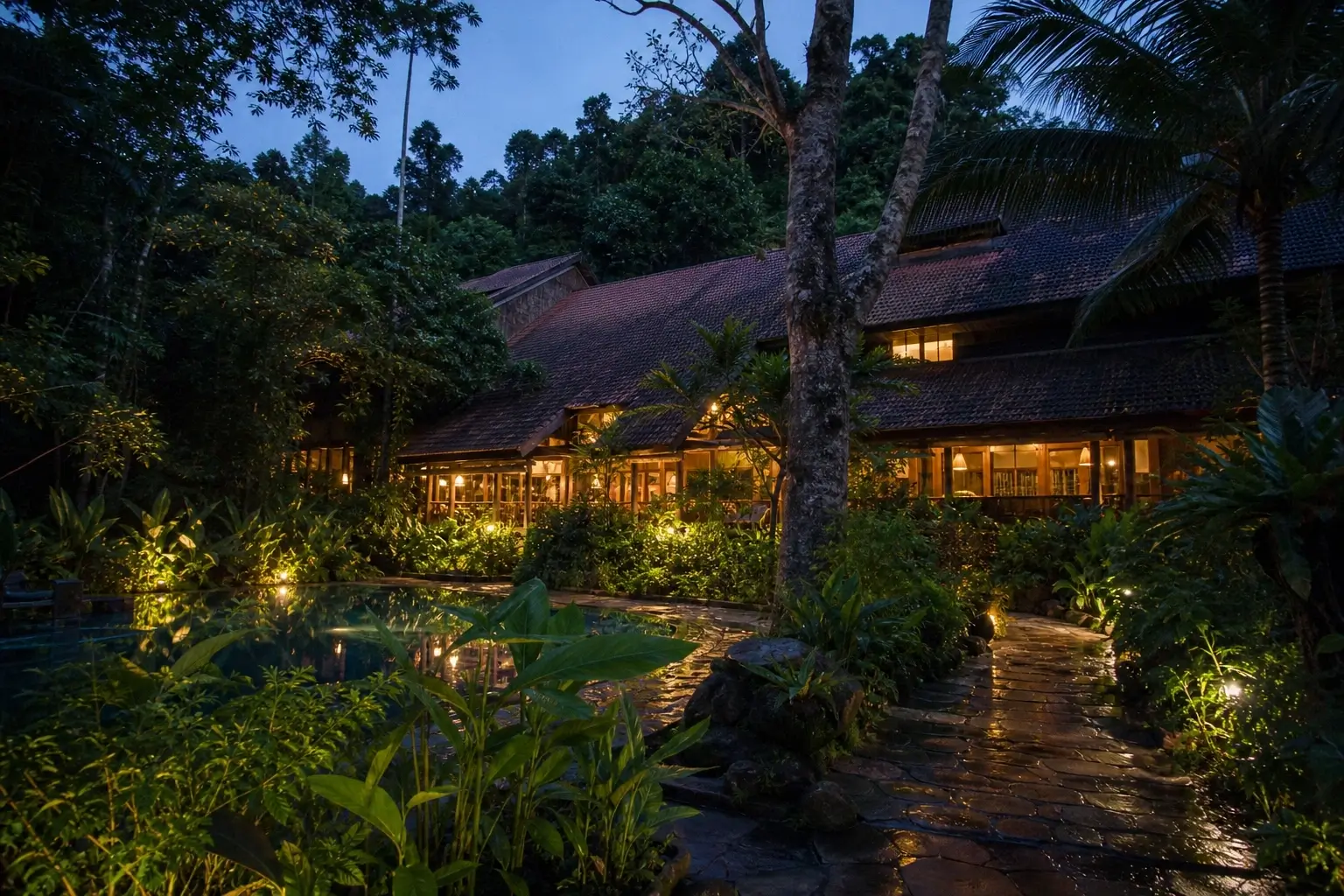
Cat Tien is the best jungle base in southern Vietnam. It sits about 150km north of Ho Chi Minh City — close enough to run as a two-night detour within a standard southern itinerary. Cat Tien Jungle Lodge operates directly inside the park and serves as the primary base for multi-day wildlife trekking. Their guides have a solid reputation for reading nocturnal animal patterns, which matters more than most tour descriptions let on.
The park holds gibbons, sun bears, banteng (wild cattle), and a significant crocodile population in its wetland sections. Sightings are real but not guaranteed. The lowland forest is dense, and large mammal encounters require early starts, patience, and a guide who knows the current active zones.
- Difficulty range: Easy to Intermediate (extended routes push into moderate)
- Best for: HCMC-based travellers; birders; anyone wanting credible wildlife without northern jungle altitude
Hoang Lien National Park
If physical challenge is the goal, Hoang Lien wins.
This is Fansipan territory — Southeast Asia’s highest peak at 3,143m — but the cloud forest sections below the summit line are worth the trip even without the climb. Trekking here is a completely different physical and visual experience from lowland jungle: cooler temperatures, mosses and ferns on every surface, bamboo corridors, and ethnic minority villages woven into the landscape in a way that feels nothing like the tourist infrastructure around Sapa town.
Guided treks from Sapa range from $30 USD (single-day guide) to $120 USD (two-night Fansipan route with accommodation). Independent navigation is technically permitted in some zones but trail markings in mist are unreliable — local guide knowledge is the practical choice, not the bureaucratic one.
- Difficulty range: Intermediate to Advanced
- Best for: Trekkers adding a mountain element to a northern itinerary; travellers already in the Sapa or Ha Giang corridor
Bach Ma National Park
Bach Ma is the most underrated entry on this list. Sitting at the ecological transition zone between northern and southern Vietnam, it holds unusual biodiversity pulled from both climate zones. The park gets a fraction of Phong Nha’s visitors, trails are clear and well-signed, and it’s a legitimate one- to two-day detour from Hue or Da Nang without rearranging a full itinerary.
Wildlife includes Edwards’s pheasants — critically endangered Vietnam endemics — and the park runs one of the country’s better specialist birding circuits. It won’t satisfy a trekker looking for physical challenge. It’s a strong, low-disruption choice for adding real jungle time to a central coast trip.
- Difficulty range: Easy to Intermediate
- Best for: Hue or Da Nang itinerary add-on; birders; travellers who want jungle without rerouting their whole trip
Quick Comparison: Vietnam Jungle Regions
| Region | Best For | Trek Difficulty | Wildlife Visibility | Avg Guide Cost (USD/day) |
|---|---|---|---|---|
| Phong Nha-Ke Bang | Cave-jungle adventure | Beginner → Advanced | Moderate (cave fauna + forest) | $40–$3,000 |
| Cuc Phuong | Primate encounters | Beginner → Intermediate | High (rescue centre) | $20–$60 |
| Cat Tien | Southern Vietnam wildlife | Easy → Intermediate | Moderate–High (nocturnal) | $30–$80 |
| Hoang Lien | Mountain jungle + altitude | Intermediate → Advanced | Low–Moderate | $30–$120 |
| Bach Ma | Day-trek + birding | Easy → Intermediate | Moderate (endemic birds) | $15–$40 |
[Option A] vs [Option B]: Phong Nha is better suited for travellers who want maximum landscape drama because the cave-jungle combination exists nowhere else in Vietnam. Cat Tien works better when the priority is accessible southern wildlife and lodge infrastructure. The key difference is location in your itinerary — not quality.
What “Difficulty Level” Actually Means in Vietnam
Most difficulty labels in Vietnamese tourism are functionally meaningless. “Moderate” can mean a 4km boardwalk trail or a 900m elevation gain through wet limestone. Here’s what each tier translates to in practice.
- Beginner — No previous trekking required. Trails are marked, mostly flat or gradual, and suitable for any healthy adult. Think: Cat Tien half-day loop, Bach Ma waterfall trail.
- Intermediate — Some previous multi-day or hilly trekking experience is genuinely helpful. Expect uneven terrain, possible river crossings, and 4–6 hour active days. Example: Cuc Phuong two-day route, Hoang Lien day treks.
- Advanced — Prior multi-day trekking in tropical or mountainous conditions assumed. Significant elevation, technical terrain, weight-bearing days, and high probability of wet or exposed conditions. Example: Son Doong via Oxalis, Tu Lan multi-day via Jungle Boss, Fansipan two-night route.
Look — if you’ve done Nepal base camp or the Borneo Headhunters Trail, “intermediate Vietnam” is nowhere near your ceiling. Push toward the Tu Lan cave-jungle circuit. It involves river swimming, cave wading, jungle camping, and full trekking days across a two- to three-day window with Jungle Boss Tours. It’s the single best intermediate-to-advanced recommendation in the country, and it’s still genuinely affordable.
Vietnam jungle trekking costs break down more predictably than most booking sites suggest. Budget treks with local operators start around $20–$40 USD per day, typically including a guide, basic meals, and simple accommodation. Mid-range guided expeditions with established operators like Jungle Boss Tours run $80–$150 USD per day with better logistics and smaller groups. Premium expeditions — Oxalis’s Son Doong multi-day in particular — reach $3,000 USD or above for the full permit and guided programme. According to Vietnam National Administration of Tourism guidelines, guided trekking is legally required in most national park core zones, meaning the “go independent to save money” path is realistically limited for any serious jungle route. The practical choice is which guide, not whether to hire one.
How to Book a Vietnam Jungle Trek
To book a Vietnam jungle trek:
- Choose your region based on difficulty level and where it sits in your itinerary (north, central, or south)
- Contact operators directly — Oxalis Adventure (Phong Nha advanced), Jungle Boss Tours (Phong Nha budget-to-mid), Cat Tien Jungle Lodge (southern base) — at least 60 days ahead for popular routes
- Confirm permit requirements, group size limits, and exactly what’s included in the daily rate
- Book accommodation at or near the park entry point — early morning starts (5–6am) are standard for wildlife visibility
- Pack for wet conditions regardless of season — Vietnam jungle floors stay humid year-round, and dry-season trails still cross active streams
[Each step is a single clear action — beginner to advanced trekkers need the same five-step sequence]
Vietnamese Jungle Wildlife: What You Can Realistically Expect
Most travellers assume the big wildlife sightings — primates, big cats, elephants — are routine in Vietnam. The data says otherwise.
Vietnam’s large mammal populations have been severely depleted by decades of hunting, habitat loss, and the wildlife trade. The Indochinese tiger is functionally extinct in-country. Elephants exist only in Yok Don National Park in very small, fragmented populations. I’ve seen conflicting data on current gibbon counts in Cat Tien — some sources cite around 20 individuals, others suggest population recovery may be cautiously progressing. My read is: treat gibbon sightings at Cat Tien as a possibility requiring a guide with current knowledge, not a guarantee.
What you can realistically see: gibbons at Cuc Phuong’s rescue centre (near-guaranteed before 9am), civets and deer on night treks at Cat Tien, hornbills and kingfishers across central and southern parks, bats in enormous volumes inside Phong Nha cave systems, and an extraordinary diversity of insects, reptiles, and amphibians in every lowland rainforest section.
Some experts argue that Vietnam’s large mammal situation makes jungle trekking here uncompetitive with Borneo or Sri Lanka. That’s a valid position for travellers whose primary metric is flagship species sightings. But if biodiversity range — particularly primates, cave fauna, endemic birds, and reptiles — is what you’re after, Vietnam’s combination of intact primary jungle and increasingly professional guide infrastructure is genuinely competitive with any Southeast Asian destination.
Best Time to Visit Each Jungle Region
This is where almost every Vietnam travel guide fails. A single “best time to visit” recommendation applied across the whole country is genuinely misleading for jungle planning — monsoon timing splits Vietnam roughly in half, and the regions operate on almost opposite seasonal rhythms.
Phong Nha — Central Vietnam
Avoid September–November. Typhoon-season flooding closes cave and jungle trails entirely and can be dangerous — not mildly inconvenient. Best window is February–August, with February to April being driest and least crowded.
Cuc Phuong — Northern Vietnam
December–April is dry season in the north. Wildlife activity peaks in dry months, trail conditions are best, and reptile and insect populations are most visible. Avoid July–August when northern humidity peaks and trails become legitimately muddy.
Cat Tien — Southern Vietnam
November–April is the dry season. This is the optimal multi-day trekking window. Wet season (May–October) doesn’t close the park, but leeches become significantly more active and trail flooding limits some deeper routes.
Hoang Lien / Sapa — Northwest Vietnam
March–May and September–November are the clearest windows. July–August brings monsoon cloud that routinely obscures the upper routes. January–February can hit sub-10°C at elevation — a gear requirement most tropical-trek packing lists don’t anticipate.
Bach Ma — Central Coast
March–August. Bach Ma records one of Vietnam’s highest annual rainfall totals — over 8,000mm per year on its northern face. Avoid October–January entirely. Even in dry season, afternoon mist is normal and can roll in quickly.
Quick note: no single month works perfectly for every region at once. If you’re planning a multi-region trip with jungle components in both north and south, March–April is the closest thing to a nationwide sweet spot — but check regional forecasts separately when booking.
FAQs
What’s the best jungle in Vietnam for first-time trekkers?
Cat Tien National Park for south-first itineraries, Cuc Phuong for travellers starting in the north. Both have reliable guide infrastructure, clear trails, and genuine wildlife encounters without requiring advanced fitness or expedition planning.
How do I find a trustworthy jungle guide in Vietnam?
Use established operators rather than informal market offers. Oxalis Adventure (Phong Nha premium), Jungle Boss Tours (Phong Nha budget-to-mid), and Cat Tien Jungle Lodge have consistent track records. For Hoang Lien, licensed Sapa agencies are the safest source.
Should I trek Vietnam’s jungles independently or with a guide?
Most national park core zones legally require a guide — so the real question is which operator, not whether to hire one. In fringe areas where independent trekking is permitted, Vietnam’s monsoon-affected trail conditions make local navigation knowledge a practical asset, not a formality.
Why does wildlife visibility vary so much between Vietnamese national parks?
Hunting pressure, habitat corridor connectivity, and enforcement consistency differ significantly. Cuc Phuong and Cat Tien have active conservation programmes and more reliable sighting conditions. Some remoter parks have lower wildlife density due to historic poaching that hasn’t fully recovered.
When should I avoid Vietnam jungle treks?
Region-specific answer: avoid Phong Nha September–November (typhoon flooding), Cat Tien May–October if leeches are a dealbreaker, and Bach Ma October–January entirely. Hoang Lien in January–February requires cold-weather layering that most tropical trekkers don’t carry.


No Comment! Be the first one.