






Main Cities in Vietnam: Official Cities, Travel Vibes, and Route Planning Guide
The Main Cities in Vietnam and What You Actually Need to Know About Them Vietnam welcomed 17.6 million international arrivals in 2024 — a 39.5% year-on-year surge that brought the country to within...

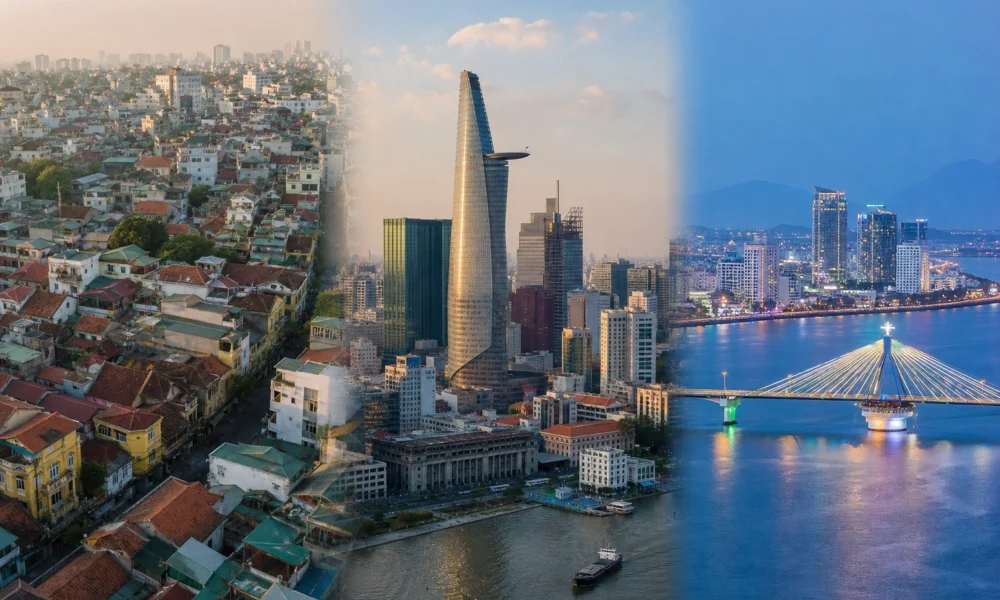
The Main Cities in Vietnam and What You Actually Need to Know About Them
Vietnam welcomed 17.6 million international arrivals in 2024 — a 39.5% year-on-year surge that brought the country to within 2.4% of its pre-pandemic 2019 peak, according to Vietnam’s General Statistics Office. Almost all of that traffic flows through a handful of urban centers. Understanding those centers — what they are administratively, what they feel like on the ground, and how they connect — is the foundation of any serious Vietnam itinerary.
What are the main cities in Vietnam? The main cities in Vietnam are the country’s largest urban centers, officially recognized under Vietnam’s tiered administrative system. As of 2025, Vietnam has 7 centrally-governed cities — Hanoi, Ho Chi Minh City, Haiphong, Can Tho, Da Nang, Hue, and Dong Nai — which report directly to the national government rather than to a provincial administration. Below this tier sit dozens of smaller provincial cities.
How Vietnam’s City System Actually Works
Vietnam isn’t structured the way most Western countries are. Cities don’t exist as independent municipalities by default — they’re carved out of a provincial system that confuses first-time researchers and trips up even experienced travel writers.
Here’s the thing: as of 2025, Vietnam recognizes 7 centrally-governed cities, a number that quietly increased when Hue was formally elevated to this status in 2025. Most travel guides — including some of the highest-ranking ones — haven’t updated their content to reflect this. That single fact is worth knowing, because it changes how you should think about Hue as a destination. It’s no longer a provincial backwater. It’s now in the same administrative tier as Da Nang and Haiphong.
Dong Nai — a largely industrial area southeast of Ho Chi Minh City — is scheduled for elevation in 2026.
Below the centrally-governed tier sit provincial cities. These include places like Nha Trang, Hoi An (technically an “ancient town,” not a city), Vung Tau, and dozens more. They matter enormously for travelers even if they don’t carry the same administrative weight.
The 7 Official Cities of Vietnam — 2025 Population Data
According to Wikipedia’s 2025 municipal data (sourced from Vietnam’s General Statistics Office), here’s where things stand:
| City | Population (2025) | Region | Centrally Governed Since |
|---|---|---|---|
| Ho Chi Minh City | ~14,000,000 | Southeast | 1976 |
| Hanoi | ~8,800,000 | Red River Delta | 1946 |
| Haiphong | ~4,664,000 | Red River Delta | 1976 |
| Dong Nai | ~4,491,000 | Southeast | 2026 (approved) |
| Can Tho | ~4,200,000 | Mekong Delta | 2004 |
| Da Nang | ~3,066,000 | South Central Coast | 1997 |
| Hue | ~1,433,000 | North Central Coast | 2025 |
Quick note: many older articles still use 2019 census numbers. That explains why you’ll see figures like “Da Nang: 1 million people” on sites that haven’t been updated. The actual 2025 figures are significantly higher following provincial mergers and boundary expansions.
What the numbers don’t tell you — and what almost every competitor article skips — is what each city feels like to be in and who it’s actually designed for.
Best Cities to Visit in Vietnam — Quick Comparison
Quick Comparison
| City | Best For | Key Benefit | Limitation |
|---|---|---|---|
| Hanoi | Culture, history, northern food | Rich Old Quarter; gateway to Ha Long Bay and Sapa | Heavy traffic; humid summers |
| Ho Chi Minh City | Urban energy, war history, southern food | Vietnam’s most connected international hub | Overwhelming for first-time visitors |
| Da Nang | Beach + city combination | Central location; closest major airport to Hoi An and Hue | Limited standalone cultural depth |
| Hue | Imperial history, Vietnamese cuisine | UNESCO citadel; authentic atmosphere; least touristy major city | Fewer nightlife and entertainment options |
| Hoi An | Slow travel, photography, lanterns | Extremely walkable ancient town; genuinely charming | Technically a town, not a city; expensive vs. the rest |
| Can Tho | Mekong Delta immersion | Floating markets; authentic river life | Long transit from Hanoi; best as a side trip |
| Nha Trang | Beach holiday, diving | Coastal resort infrastructure; Cam Ranh airport nearby | Heavily commercialized in recent years |
Travelers who’ve done Vietnam multiple times often report the same regret: they spent too many nights in Hanoi or HCMC and not enough time in the central cities. Da Nang, Hue, and Hoi An are within 100 km of each other and collectively offer more variety per square kilometer than anywhere else in the country.
Hanoi vs Ho Chi Minh City — The One Debate That Won’t Die
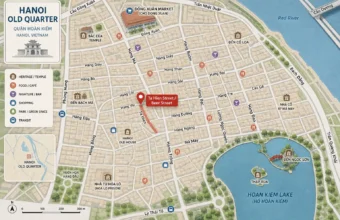
Hanoi vs Ho Chi Minh City: Hanoi suits travelers who want Vietnam’s cultural and historical depth — the Old Quarter’s 1,000-year street grid, northern-style cuisine, and proximity to UNESCO-listed Ha Long Bay. Ho Chi Minh City works better for travelers who want urban pace, war history (Cu Chi Tunnels, War Remnants Museum), and a fast connection to the Mekong Delta. The key difference is character and geography, not quality.
Some travel writers argue HCMC is “better for first-timers” because it’s more cosmopolitan and easier to navigate. That’s valid — if ease of transport and a wider international food scene are your priorities. But if you’re flying in from Europe or the Middle East and you’re building a north-to-south route, starting in Hanoi gives you a slower, more manageable entry point. The chaos ramps up as you travel south, which is actually a better way to adjust.
Or maybe I should say it this way: the real question isn’t which city is better. It’s which direction you’re traveling.
According to the Vietnam National Administration of Tourism, Tan Son Nhat International Airport (Ho Chi Minh City) handles a higher total passenger volume than Hanoi’s Noi Bai, making HCMC the more connected international gateway — especially for travelers coming from Australia, Southeast Asia, and North America. Travelers flying in from Europe will often find Hanoi has more direct routing options. An open-jaw ticket (fly into one, out of the other) typically costs the same as a return ticket and eliminates backtracking entirely.
How to Plan Your Route Through Vietnam’s Cities
The geography is the part most guides underplay.
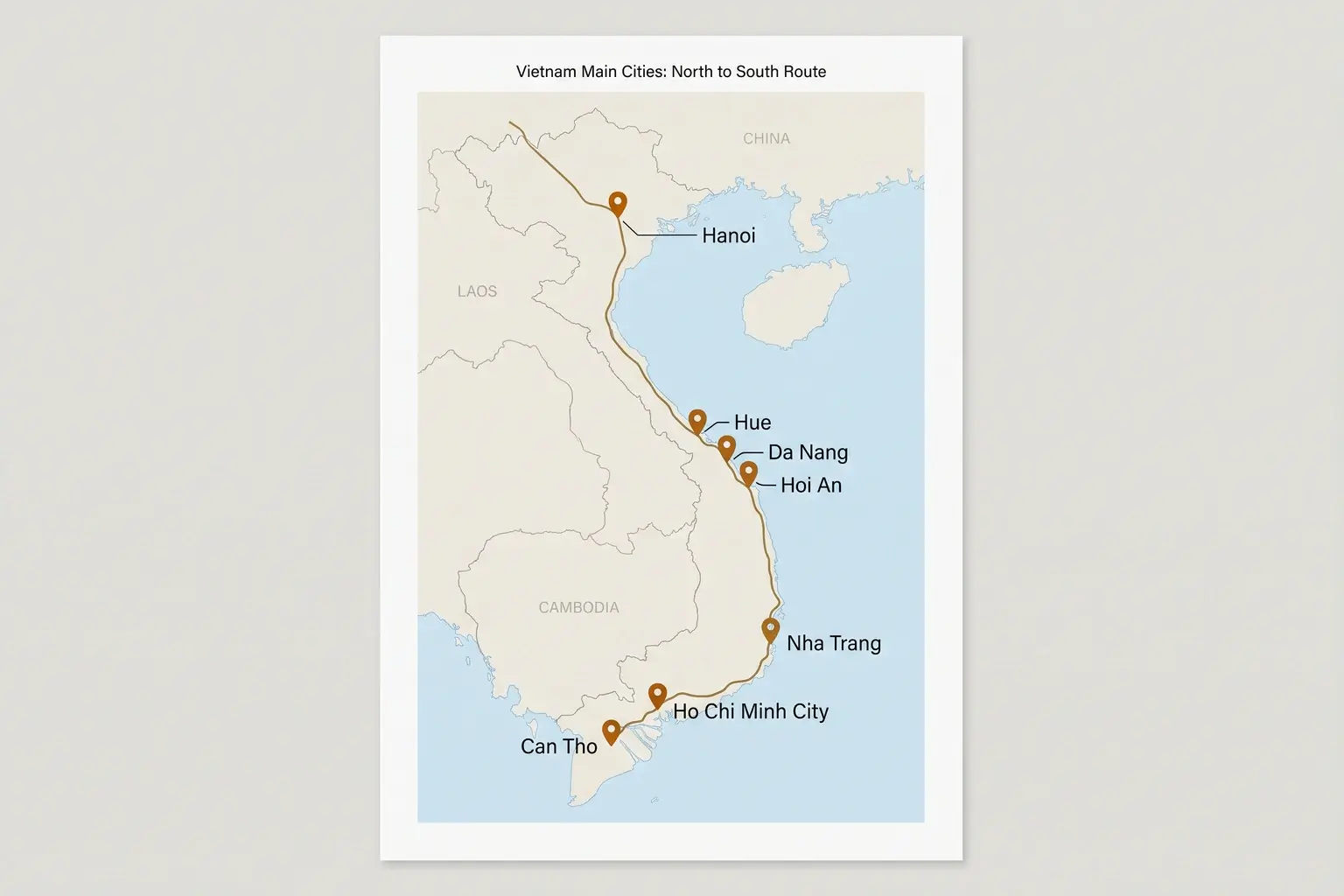
Vietnam runs roughly 1,650 km from Hanoi to Ho Chi Minh City — about the same distance as London to Athens, or New York to Miami. You cannot comfortably visit every major city in two weeks. Something has to come off the itinerary.
To build a Vietnam city route that actually works, follow these steps:
- Decide your entry and exit airports first — flying into Hanoi and out of Ho Chi Minh City (or the reverse) creates a clean linear route.
- Limit yourself to 4–5 urban stops for a 2-week trip; add one stop per additional week beyond that.
- Use Rome2Rio to compare flight vs. train vs. sleeper bus between each city pair — a Hanoi-to-Da Nang overnight train costs under $30 and saves a hotel night; the same journey by plane costs more once airport transit is factored in.
- Book city-specific day tours through Klook in advance, especially for the Hue Imperial Citadel, Hoi An lantern night, and Mekong Delta floating market tours from Can Tho — these sell out in peak season.
- Build Da Nang as a 3-city base: the city itself, Hue (1.5 hours north by train), and Hoi An (30 minutes south by taxi) can all be visited within a 3–4 day stay without moving your bags.
The Da Nang-Hue-Hoi An triangle is genuinely the most overlooked efficiency play in Vietnam travel. Most articles treat them as three separate multi-night stops. Treating Da Nang as a base slashes transit time and accommodation costs significantly.
Vietnam Airlines operates domestic routes connecting all 7 centrally-governed cities, with the Hanoi–Ho Chi Minh City corridor ranking among the busiest domestic air routes in Southeast Asia. Budget carriers VietJet Air and Bamboo Airways offer fares 30–50% lower on the same routes when booked 3–4 weeks ahead.
What Most City Guides Get Wrong
I’ve seen conflicting data across these articles — some sources still list Vietnam as having “5 centrally-governed cities,” which was accurate until Hue’s elevation in 2025. Others list Hoi An as a “city” when it’s classified as an ancient town within Quang Nam province. My read is that for travel purposes, Hoi An functions like a city on any itinerary, but calling it one in a geography context is technically wrong — and it matters if you’re trying to understand why it doesn’t have a major bus station or airport.
What most guides skip entirely is the practical insight about central Vietnam: you don’t need to choose between Da Nang, Hue, and Hoi An. You can base yourself in Da Nang and day-trip to both. The distances are short enough that it’s genuinely one of the most efficient 3-for-1 moves on any long-haul itinerary.
Look, if you’re trying to decide between adding Hue or Nha Trang to your route, here’s what actually works: Hue for cultural depth and authenticity, Nha Trang if you need beach rest days and don’t mind a more resort-heavy atmosphere. They’re not competing for the same traveler.
The counter-intuitive takeaway from the 2024 tourism data? It’s not Hanoi or HCMC that’s growing fastest. Da Nang is Vietnam’s fastest-growing tourist destination by percentage, driven by expanded flight connectivity and its proximity to two UNESCO World Heritage Sites (Hoi An Ancient Town and the My Son Sanctuary).
Frequently Asked Questions
What’s the most visited city in Vietnam?
Ho Chi Minh City receives the highest international arrivals. Tan Son Nhat International Airport is Vietnam’s busiest. Hanoi is close behind. Da Nang is the fastest-growing major tourist destination in the country by percentage growth.
How many major cities does Vietnam have?
As of 2025, Vietnam has 7 centrally-governed cities: Hanoi, Ho Chi Minh City, Haiphong, Can Tho, Da Nang, Hue (elevated 2025), and Dong Nai (approved for 2026). Below these sit dozens of smaller provincial cities.
Should I visit Hanoi or Ho Chi Minh City first?
Fly into Hanoi if you’re traveling north-to-south — it’s a gentler introduction to Vietnam. Fly into Ho Chi Minh City if you’re coming from Australia, Southeast Asia, or have direct routing from North America. An open-jaw ticket eliminates backtracking entirely.
What’s the most beautiful city in Vietnam?
Hue is widely considered Vietnam’s most aesthetically cohesive city, with its imperial citadel, royal tombs, and Perfume River all within a compact area. Hoi An rivals it for visual charm, though it’s technically an ancient town, not a city.
Is Can Tho worth visiting on a 2-week Vietnam trip?
Yes, if your trip is 12 days or longer. Can Tho’s floating markets and Mekong Delta river life show a side of Vietnam that Hanoi and HCMC simply don’t offer. It’s a 3-hour bus ride from Ho Chi Minh City and works well as a 1–2 night extension.




No Comment! Be the first one.