






First Time in Hanoi? Here’s What Actually Matters (and What You Can Skip)
Hanoi vietnam tourist experiences center on Vietnam’s capital — a layered, walkable, often chaotic city where ancient temples sit beside French colonial architecture and communist monuments....

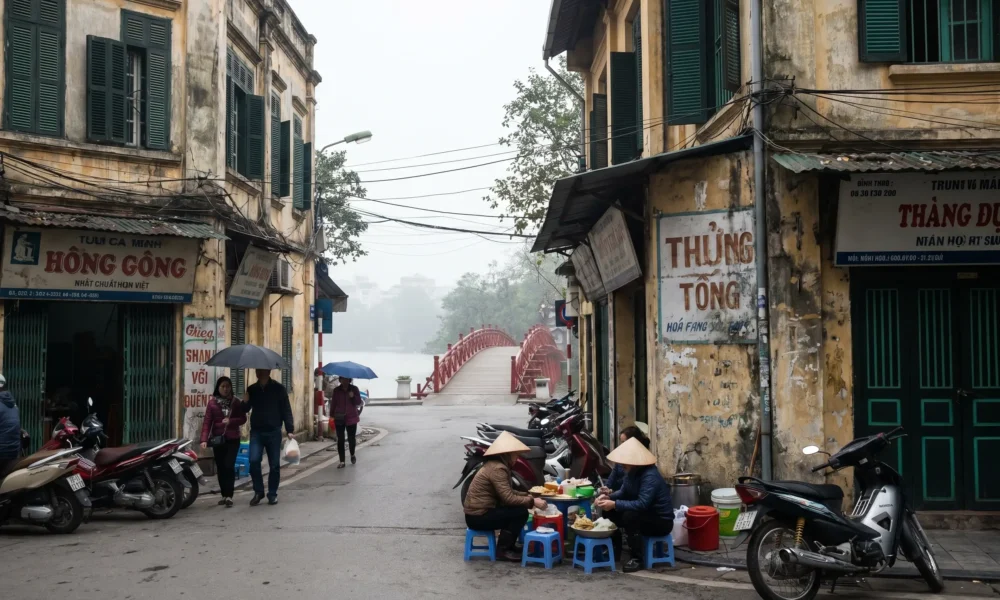
Hanoi vietnam tourist experiences center on Vietnam’s capital — a layered, walkable, often chaotic city where ancient temples sit beside French colonial architecture and communist monuments. Unlike Ho Chi Minh City’s commercial speed, Hanoi rewards patience. Most first-time visitors need 3–5 days to move through the core neighborhoods without feeling like they’re running from site to site.
What Makes Hanoi Worth the Trip (For Real This Time)
Vietnam welcomed over 12.6 million international tourists in 2023, with Hanoi accounting for approximately 4 million arrivals — a 2.5× recovery from 2022’s post-COVID numbers, according to the Vietnam National Authority of Tourism’s 2023 Annual Report. The city is genuinely back.
Here’s what that means practically: accommodation prices are higher than pre-2020 averages, the Old Quarter is crowded again, and booking popular day trips more than 72 hours ahead is no longer optional.
How many days in Hanoi is enough for a first visit? Vietnam National Authority of Tourism 2023 report, the average international tourist stays 3.2 days in Hanoi. Travelers who’ve done the trip consistently report needing at least 4 to feel unhurried across the core areas — especially if a day trip to Ninh Binh or Ha Long Bay is part of the plan.
Whether Hanoi is worth visiting over Ho Chi Minh City is a genuinely contested question. According to Lonely Planet’s 2024 Vietnam edition, Hanoi ranks higher for cultural depth and architectural variety while Ho Chi Minh City scores higher for nightlife and food diversity. For first-timers prioritizing history and atmosphere, Hanoi typically wins that comparison.
What Hanoi is actually known for goes beyond the standard checklist. The Old Quarter’s 36 historic guild streets, the street food culture built around pho and bun cha, and the city’s role as a gateway to Ha Long Bay and Ninh Binh make it a natural base for exploring northern Vietnam — not just a standalone city stop.
Most people assume Hanoi is the “less exciting” stop compared to Ho Chi Minh City. The data says otherwise: it consistently outranks its southern counterpart on cultural traveler satisfaction surveys, and its UNESCO-adjacent heritage sites see more return visitors per capita.
Best Places to Go in Hanoi, Broken Down by Neighborhood
Most Hanoi tourism guides hand you an attractions list. What they skip is the spatial logic — which neighborhood to stay in, which areas to cover in which order, and which parts of the city exist mainly for tourists rather than for Hanoi itself.
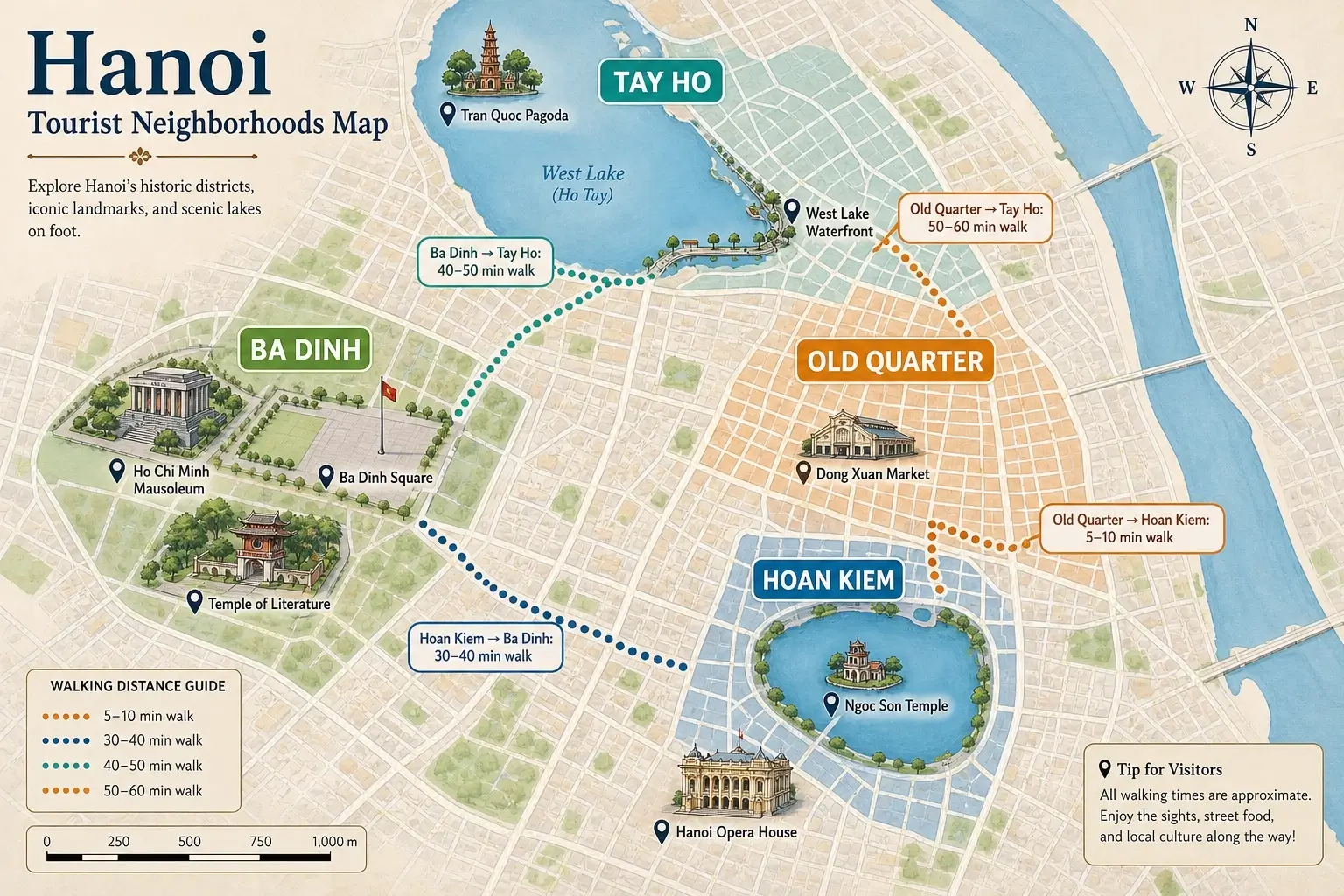
Here’s the honest breakdown.
Quick Comparison: Hanoi’s Main Tourist Neighborhoods
| Neighborhood | Best For | Key Benefit | Limitation |
|---|---|---|---|
| Old Quarter | First-time tourists | Walking distance to every major site | Noisy, touristic, inflated café prices |
| Hoan Kiem | Central base, couples | Closest to the lake and French Quarter | Limited budget accommodation options |
| Tay Ho (West Lake) | Longer stays, repeat visitors | Quieter streets, better local cafes | 20+ min from main historical sites |
| Ba Dinh | History-focused travelers | Ho Chi Minh Complex, Temple of Literature | Sparse dining and evening atmosphere |
| Dong Da | Budget travelers | Cheaper guesthouses, local neighborhood feel | Farther from the tourist core |
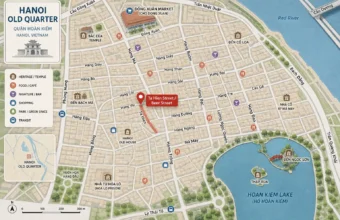
The Old Quarter
Thirty-six guild streets, each historically named for the goods once traded there — silk, paper, tin, shoes. The Old Quarter is the obvious starting point for Hanoi tourism. It’s also the most overwhelming area if you arrive without a loose plan.
Walk it. Don’t try to cover it in one session.
The best window is early morning — before 8am, when streets are clearing from overnight deliveries and before tour groups deploy. Evenings around the Dong Xuan Market area (7–9pm) carry a completely different energy and are worth a separate visit entirely.
Hoan Kiem Lake & the French Quarter
Hoan Kiem Lake is the geographic and emotional center of the city. It’s not dramatic by any measure — a lake, a small island, a red bridge, a temple. What it is, genuinely, is pleasant. Especially on weekend evenings when surrounding streets close to traffic and locals arrive in numbers. It doesn’t feel purely touristic. That matters.
The French Quarter sits south of the lake and holds the Hanoi Opera House alongside a cluster of colonial-era buildings that hold up architecturally. It’s a 20-minute walk from the Old Quarter’s core. Most guides lump these areas together — treating them as a separate half-day is better use of your time.
Tay Ho (West Lake)
Look, if you’re spending more than 4 nights in Hanoi or you’ve done the Old Quarter before, Tay Ho is where you’ll actually want to be based. It’s calmer, has specialty coffee shops that outperform anything in the tourist center, and the cycling routes around the lake are underrated by almost every travel guide.
It’s not close to the major historical sites. That’s the honest trade-off.
Hanoi Old Quarter Guide: What’s Worth Your Time and What Isn’t
The Old Quarter covers roughly 1 square kilometer. You can walk across it in 15 minutes. The “getting lost in it” mythology from travel writing is somewhat manufactured — you won’t truly get lost, but you will encounter the same three streets more than once.
Worth your time:
- Dong Xuan Market — specifically the wholesale inner section, not the tourist-facing outer stalls. Go early morning, when local vendors are buying. Real atmosphere, zero performance.
- St. Joseph’s Cathedral — two minutes off the main tourist drag. It’s photographed constantly but never truly crowded before 9am.
- Bun cha at an unmarked street stall — not a restaurant with an English menu. The real thing costs 40,000–55,000 VND and involves a short queue outside.
- Bia Hoi Corner (Hang Buom/Luong Ngoc Quyen intersection) — fresh draft beer at 10,000 VND, plastic stools, genuinely local until around 6pm when the backpacker crowd arrives.
What most visitors skip entirely — and shouldn’t:
The Bach Ma Temple on Hang Buom Street. One of the oldest temples in Hanoi, dating to the 9th century, and on a weekday morning you may be the only visitor inside. That’s rare in this neighborhood.
Or maybe I should say it this way: the most memorable experiences in Hanoi almost never come from the Top 10 list.
What most guides skip is the critical scheduling note — the Ho Chi Minh Mausoleum is closed every Monday and Friday, and shuts for approximately 2 months each year (typically September–November) for maintenance. Showing up on a closed day is among the most common first-timer frustrations in Hanoi. It’s information that appears buried or absent in most travel content.
When to Visit Hanoi: The Honest Seasonal Breakdown
Here’s the thing: every major travel site labels October–November as the “best time to visit Hanoi.” That recommendation needs context that most sites don’t provide.
October and November do offer cooler temperatures — around 19–24°C, a genuine relief after Hanoi’s July heat. But they’re also the tail end of northern Vietnam’s typhoon season. Rainfall is unpredictable and, in some years, significant.
I’ve seen conflicting data on this — some sources cite October as peak tourism season, others flag it for weather disruption risk. My read is: if your trip is weather-sensitive (Ha Long Bay cruise, outdoor cycling, Ninh Binh boat routes), target March to early April instead. Cooler, drier, and the crowds are slightly more manageable than the October surge.
Seasonal breakdown, honestly:
- March–April: Best combination of temperature (18–23°C) and low rainfall. Tet holiday (late January/early February) drives domestic tourism and should be avoided by first-timers.
- May–June: Gets hot quickly. Manageable, but outdoor afternoons become genuinely uncomfortable.
- July–August: Peak heat (35°C+), high humidity. Not recommended unless your schedule allows no alternative.
- October–November: Cooler but genuinely wet. The “best time” label is half right.
- December–February: Cool and dry — but January/February includes Tet. Prices surge, key sites close or reduce hours.
March–April vs October–November for Hanoi tourism: March to April suits travelers prioritizing outdoor day trips and reliable weather because rainfall is low and temperatures stay comfortable for walking. October to November works better for city-based sightseeing where rain doesn’t disrupt the plan. The key difference is typhoon-season tail risk in October that most travel guides simply don’t mention.
The Hanoi Opera House, Temple of Literature, and National Museum of Vietnamese History are all indoor and climate-controlled — legitimate bad-weather options regardless of when you visit. That flexibility matters more than most pre-trip planning accounts for.
How to Get Around Hanoi Without Getting Ripped Off
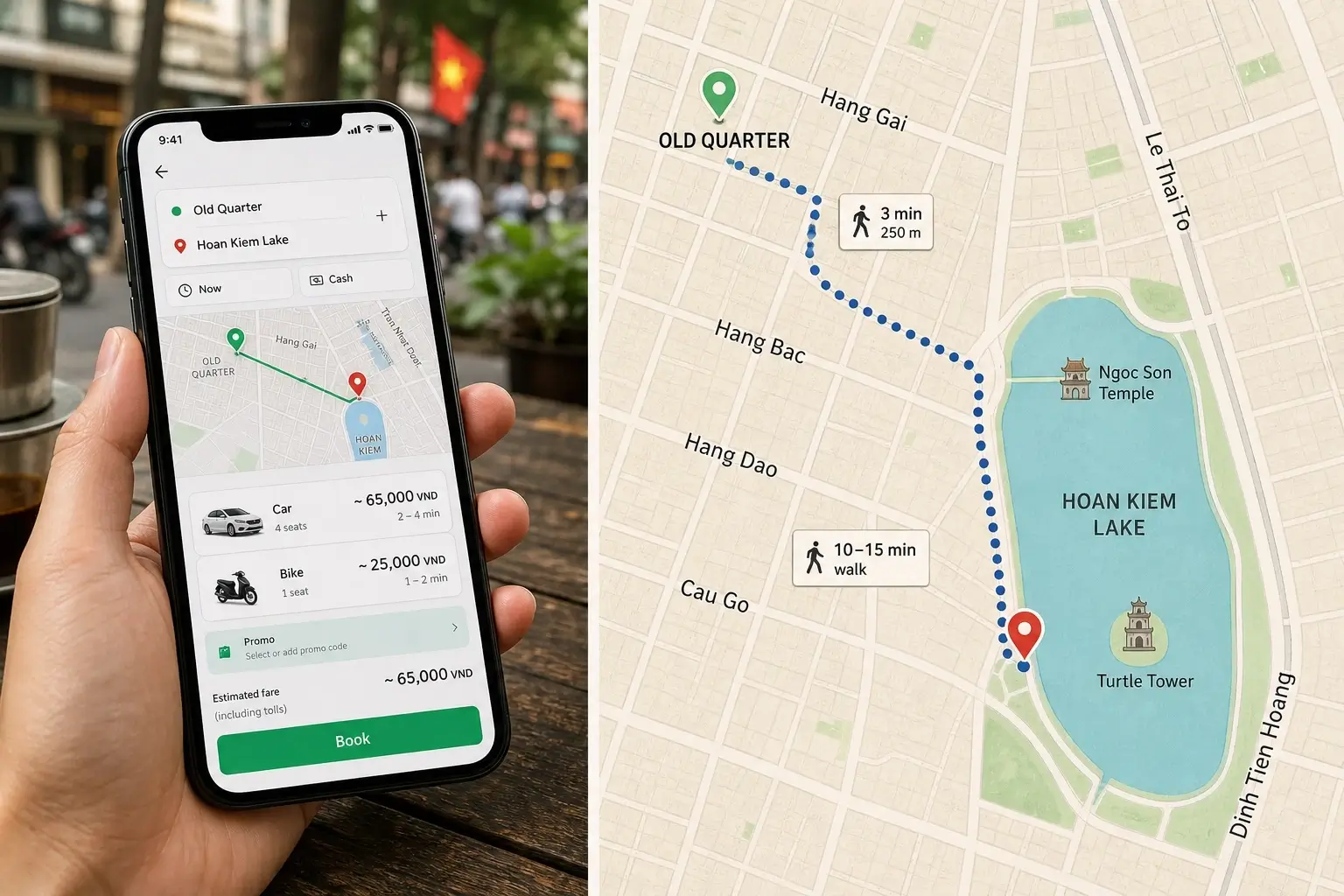
Some travel writers argue Hanoi’s metered street taxis are perfectly fine to use. That’s valid — if you’re staying at a larger hotel where staff can flag a legitimate, metered cab. If you’re navigating independently, especially from Noi Bai Airport or within the Old Quarter’s narrow streets, Grab is a categorically better option for price transparency and safety.
How To get around Hanoi without overpaying, follow these steps:
- Download the Grab app before you land — set it up at home, not at the airport.
- Save your accommodation address in Vietnamese script, copied directly from Google Maps.
- Use Grab Bike over Grab Car for short Old Quarter trips — faster in narrow streets, cheaper.
- Book all day trips through Klook, not hotel desks — prices typically run 20–40% lower with verified operators.
- Download Hanoi’s offline Google Maps before your SIM card is activated.
The Old Quarter’s street grid is genuinely confusing. Not because it’s large, but because street names change every block. Google Maps offline eliminates the problem entirely.
Quick note: Klook’s Ha Long Bay and Ninh Binh day trips include hotel pickup, English-speaking guides, and operator reviews verified by actual booking records. The hotel-desk version of the same trip often routes through the same operators at a markup. Book through Klook or directly with operators carrying recent TripAdvisor reviews — nothing in between.
Day Trips from Hanoi Worth Booking Before You Arrive
Two trips genuinely justify the logistics from Hanoi as a base: Ninh Binh and Ha Long Bay. One needs a single day. The other needs an overnight.
Ninh Binh
Ninh Binh (2 hours each way): Frequently described as “Ha Long Bay on land” — rice paddies, karst limestone peaks, and slow boat routes through Tam Coc or Trang An. A single day is sufficient for a first visit. The drive back in early evening lines up well with sunset over the fields. Book a structured day tour or rent a motorbike if you’re genuinely comfortable on one in Vietnamese traffic.
Ha Long Bay
Ha Long Bay (4+ hours each way): One-day cruises exist. Skip them. The bay is too large and the experience too good to treat as a rushed return trip. A two-day, one-night cruise on a mid-range junk boat gives you sunrise on the water and floating fishing village access that day-trippers miss entirely. Budget approximately $120–$180 USD for a reputable two-day operator through Klook.
One opinion worth pushing back on: the Vietnam Museum of Ethnology is one of the best-curated museums in all of Southeast Asia — not just Vietnam — and the majority of first-time visitors skip it because it sits outside the Old Quarter. That’s a consistent mistake. It belongs on the itinerary ahead of several sites that appear on every “must-see” list.
Answers to the Questions Hanoi Tourists Actually Ask
What’s the best time of year to visit Hanoi?
March to early April offers the most reliable conditions — temperatures around 18–23°C with low rainfall. October–November is cooler but carries weather risk most guides understate. Avoid Tet (late January/February) for a first visit.
How many days do I need in Hanoi?
Three days covers the major sites at a quick pace. Four to five days lets you add a Ninh Binh day trip or a Ha Long Bay overnight without feeling constantly behind schedule.
Should I stay in the Old Quarter or somewhere quieter?
Old Quarter for your first two nights — proximity to sites genuinely matters and everything is walkable. For stays longer than four nights, Tay Ho offers noticeably better quality of life and calmer surroundings.
How do I get from Hanoi airport to the city center?
Airport Express Bus 86 costs around 45,000 VND and takes 45–60 minutes to Hoan Kiem Lake. A Grab from the official ride-hailing zone runs approximately 250,000–350,000 VND depending on traffic. Don’t take unlicensed taxis at the arrivals exit.
Why does Hanoi feel so different from Ho Chi Minh City?
Hanoi is Vietnam’s political and cultural capital — older, more formal, architecturally layered in a way Ho Chi Minh City isn’t. The pace is slower, the historical center’s streets are narrower, and French colonial influence runs throughout the city’s fabric rather than sitting in isolated pockets.





No Comment! Be the first one.