






Vietnam’s Best Resorts in 2025: Ranked by Location, Style, and What You’ll Actually Pay
Most “best resorts in Vietnam” articles hand you a numbered list and stop there. No honest price ranges. No explanation of why Phu Quoc is a completely different experience from Da Nang....

Most “best resorts in Vietnam” articles hand you a numbered list and stop there. No honest price ranges. No explanation of why Phu Quoc is a completely different experience from Da Nang. No distinction between a spa-focused wellness retreat and a five-star beach club. You close the tab and open another one.
This guide is structured differently. Each property is placed in a category, with approximate nightly costs, honest trade-offs, and a direct answer to who it was actually built for. If you’re trying to choose between a handful of properties before booking, this is the resource that should make the final decision easier.
What “Best Resort in Vietnam” Actually Means — And Why the Question Matters
The best resorts in Vietnam are self-contained luxury properties combining accommodation, on-site dining, spa services, and recreational facilities — typically positioned along Vietnam’s 3,200-kilometre coastline or offshore islands. “Best” depends entirely on your travel style, travel group, budget range, and which destination matches your itinerary. Star rating alone tells you almost nothing useful.
Vietnam’s luxury resort market isn’t what it was a decade ago. According to IMARC Group (2025), the country’s luxury travel market reached USD 9.5 billion in 2025, projected to grow to USD 16.3 billion by 2034 — a compound annual growth rate of nearly 6%. It now competes directly with Thailand and Bali for high-spending, experience-first travelers, and on raw natural diversity, it arguably wins.
That trajectory is backed by supply numbers. According to Travel and Tour World (2025), Vietnam now has over 192,000 hotel rooms in the midscale-to-luxury tier, growing at a CAGR of 10.9% over the past decade. Approximately 60% of that supply is concentrated in coastal and island destinations — because that’s where the demand is, and it’s where the best resort options are.
What this means practically: there’s no shortage of excellent properties. The challenge is knowing which ones are excellent for your specific trip.
Vietnam’s Top Resort Regions — Which Location Fits Your Trip?
Before shortlisting any property, you need to pick a region. This is the step that virtually every competitor article skips.
To choose the right Vietnam resort region for your trip:
- Define your primary goal — beach relaxation, cultural immersion, or structured wellness recovery.
- Match that goal to the region below that specializes in it, using the destination guide as your filter.
- Calculate your realistic total daily spend: room rate plus two resort meals plus at least one spa session plus airport transfers before comparing specific properties.
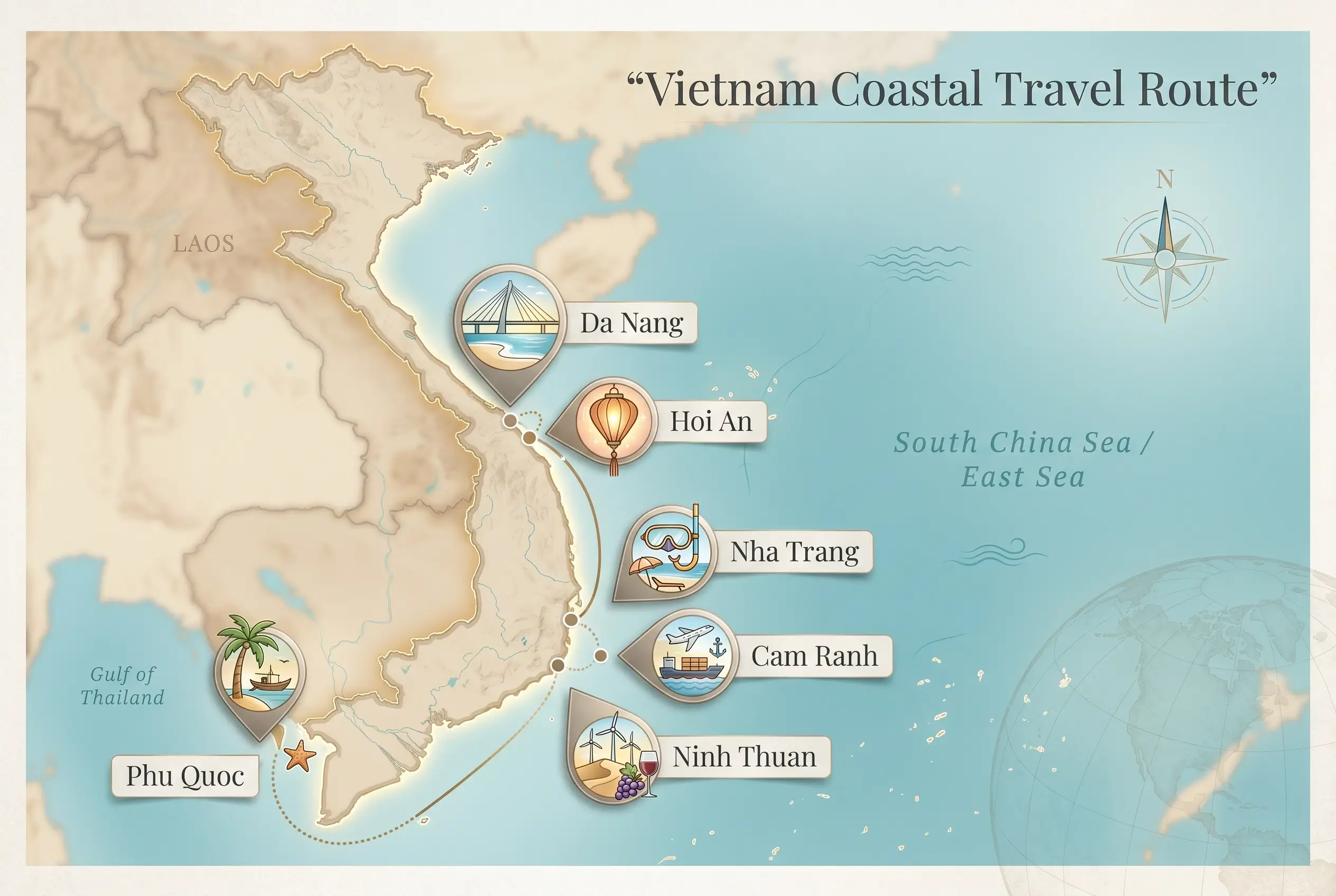
Vietnam’s best luxury resort destinations, mapped to travel style:
- Phu Quoc (South) — Vietnam’s island answer to Phuket. Clear turquoise water, a direct-flight international airport, and the densest cluster of recognizable 5-star international brands in the country: JW Marriott, InterContinental, Regent, Novotel, and more. Best for first-time luxury travelers, families, beach-focused couples.
- Da Nang / My Khe Beach (Central) — The most accessible resort destination in Vietnam by air, with direct connections from Seoul, Singapore, and Tokyo. Home to the InterContinental Danang Sun Peninsula Resort, named Best Resort in Vietnam at the DestinAsian Readers’ Choice Awards 2024 and Vietnam’s Leading Luxury Resort at the World Travel Awards 2025. Best for travelers who want flagship resort quality without giving up cultural access.
- Hoi An (Central) — Quieter, more romantic, and architecturally richer. Resorts here front Ha My and An Bang Beach, about 20 minutes from the UNESCO-listed old town. The Four Seasons The Nam Hai is the anchor luxury property. Best for couples, honeymooners, and culturally motivated travelers.
- Nha Trang (South-Central) — Vietnam’s most energetic beach city. Strong diving, island-hopping options, and one property that sits in a genuinely separate category: Six Senses Ninh Van Bay, accessible only by speedboat from the city pier. Best for active travelers and couples seeking seclusion alongside an accessible city base.
- Ninh Thuan (South-Central) — Possibly the most undervisited coastal province in Vietnam, home to Amanoi Resort inside Nui Chua National Park. Effectively zero mass tourism. Best for ultra-high-net-worth travelers for whom privacy IS the product.
- Cam Ranh (South-Central) — A quieter coastal strip between Nha Trang and Phu Quoc, anchored by Fusion Resort Cam Ranh’s all-spa-inclusive model. Best for wellness-oriented couples who want full luxury at a predictable, calculable total cost.
Vietnam’s best luxury resort regions by travel style — according to DestinAsian’s 2024 Readers’ Choice Awards and World Travel Awards 2025, Da Nang’s Son Tra Peninsula holds the country’s most decorated resort concentration. Phu Quoc leads for international brand density, with the highest number of recognizable 5-star flags on a single island. Ninh Thuan hosts the most exclusive property in the country by rate and privacy, despite being the least-known destination on this list.
The Best Luxury Resorts in Vietnam, Ranked by Category
Quick note: All nightly rates below are approximate peak-season rack rates (December–March). Shoulder season — May–June and September–October — typically delivers 20–35% lower rates with minimal weather trade-off in most southern and central locations.
Best Overall: InterContinental Danang Sun Peninsula Resort
It wins the most awards. Consistently.
Named Best Resort in Vietnam at the DestinAsian Readers’ Choice Awards 2024, Vietnam’s Leading Luxury Resort at the World Travel Awards 2025, and Asia-Pacific’s Top Beach Hotel by Now Travel Asia — the InterContinental Danang Sun Peninsula isn’t just one list’s opinion. It’s the property that keeps appearing at the top of credible, independently judged rankings, year after year.
The resort sits on the Son Tra Peninsula, designed by architect Bill Bensley across four hillside levels named Heaven, Earth, Sky, and Sea. A private cable car connects them. A private bay sits at the base. La Maison 1888, the resort’s French fine dining restaurant, holds Central Vietnam’s only Michelin star — retained for consecutive years. The property has 189 rooms, villas, and penthouses, multiple pools, and a surrounding rainforest that, rather unusually, comes with wildlife: monkeys occasionally appear on private villa balconies.
It’s not the most secluded resort on this list, and it’s not trying to be — but it’s got everything you’d want in a single flagship property.
Approximate nightly rate: USD 380–1,000+ (average rack rate approximately USD 739 per night, per Momondo aggregated data). Best for: First-time luxury travelers to Vietnam, couples wanting a complete, flagship-quality experience, travelers combining beach with cultural day trips to Hoi An.
Most Exclusive: Amanoi Resort, Ninh Thuan
Most people have never heard of Ninh Thuan. That’s the point.
Amanoi occupies 36 villas inside Nui Chua National Park, on the coast of Vinh Hy Bay. No casual day-trippers. No beach club scene. No neighboring development. The design is minimalist, the silence is structural, and the surrounding biosphere reserve does most of the aesthetic heavy lifting. Getting there requires a domestic flight to Cam Ranh or a long coastal drive from Nha Trang — another signal that this resort is built for travelers who plan ahead and value exclusion.
Look — if you’re the kind of traveler who’s already stayed at Aman properties and understands what the brand delivers, you don’t need this explained. If it’s your first time considering Aman: the brand sets the global benchmark for ultra-luxury boutique hospitality. Amanoi sits at the top of that tier within Vietnam.
Villa rates start around USD 1,000/night. Peak-season villas exceed USD 2,500. By global Aman standards, that’s mid-range. By Vietnam standards, it’s in a category of one — widely regarded as the most expensive resort in Vietnam.
There’s no DJ night on Fridays. No swim-up bar. That absence is the product.
Approximate nightly rate: USD 1,000–2,500+. Best for: Ultra-high-net-worth travelers, couples who’ve already experienced Maldives or Bali’s Six Senses properties and want something genuinely off the global tourist circuit.
Best for Couples and Honeymoons: Six Senses Ninh Van Bay
You reach Six Senses Ninh Van Bay by speedboat from Nha Trang’s city pier. The ride takes about ten minutes, and by the time you arrive at a granite-studded bay with 62 private villas scattered across hillsides and shoreline, the city is both physically and psychologically behind you.
The villas have outdoor showers, private plunge pools, and views across the bay. The spa draws heavily on traditional Vietnamese healing practices alongside evidence-based wellness programming — it’s not a service menu, it’s a recovery framework. Six Senses globally is known for this philosophy; the Ninh Van Bay property executes it with specific regional grounding.
Couples who’ve stayed here consistently place it among their top travel experiences in Asia. That’s not a promotional claim — it’s the pattern in review aggregations across TripAdvisor, Google, and Condé Nast Traveller over multiple years.
Or maybe I should say it this way: Six Senses Ninh Van Bay doesn’t just give you a nice resort. It recalibrates what you expect from a hotel stay permanently.
Approximate nightly rate: USD 600–1,400+. Best for: Honeymooners, anniversary trips, wellness-focused couples who want world-class service with genuine isolation — and who don’t need a beach club or a social scene to feel the trip was worth it.
Best All-Inclusive Value: Fusion Resort Cam Ranh
Here’s the thing: “all-inclusive” in Southeast Asia typically means a buffet and a swim-up bar.
Fusion Resort Cam Ranh is structured completely differently. Every adult guest receives a complimentary spa treatment — every single day — already built into the room rate. No per-service billing. No upselling at checkout. No mental arithmetic at the end of a relaxing week. Treatments rotate, the spa philosophy is seriously conceived, and the beachfront pool villas deliver genuine luxury aesthetics without the Aman price point.
I’ve seen conflicting data on whether the all-spa-inclusive model produces real financial savings versus à la carte properties at the same tier — some analyses suggest the room-rate premium absorbs much of the treatment value. My read is that for couples on 5–7 night stays who’d book daily treatments anyway, the savings are real and meaningful; the behavioral effect of already-included treatments also means guests use the spa more than they would if paying per session, which typically adds up to a better wellness outcome for the stay.
Cost hesitation on spa spending is real. Fusion eliminates it.
Approximate nightly rate: USD 250–500. Best for: Budget-conscious luxury travelers, wellness couples, anyone who wants five-star aesthetics with a predictable and contained total spend.
Best 5-Star Beach Resort in Phu Quoc: JW Marriott Phu Quoc Emerald Bay
The JW Marriott Phu Quoc Emerald Bay was built around a fictional narrative — the imagined campus of “Lamarck University,” a whimsical French colonial institution supposedly founded in the 1920s. The resort spans 18 buildings across 18 hectares of beachfront on Bai Kem in Phu Quoc’s quieter south.
It sounds gimmicky. It isn’t. The concept creates a genuinely walkable, architecturally surprising resort landscape — more like a small town than a hotel block. Bai Kem, consistently rated among Phu Quoc’s best beaches, provides the natural anchor.
For families, the combination of a strong kids’ club, multiple pools, direct beach access, and the full JW Marriott service infrastructure makes it the strongest choice at this tier on the island. It’s not the most intimate property on this list. Intimacy isn’t what Phu Quoc does best.
Approximate nightly rate: USD 350–750. Best for: Families with children, couples wanting a recognizable international brand experience, first-time Vietnam luxury travelers using Phu Quoc as a base.
Best for Families: Four Seasons The Nam Hai, Hoi An
The Four Seasons The Nam Hai sits between Ha My Beach and three UNESCO World Heritage Sites — Hoi An Ancient Town, Hue Imperial City, and My Son Sanctuary. It’s about 8 km from Hoi An’s old town.
The grounds have three tiered pools cascading toward the beach, a cooking academy with a working vegetable garden, approximately 4,500 coconut palms, on-site bicycle hire, and extensive water sports. The kids’ club is well-resourced and well-staffed. It’s not a resort that tolerates children — it’s genuinely designed for multi-generational travel.
For groups where adults want beach luxury and teenagers want cultural activity, the combination of Ha My Beach plus a 20-minute drive to one of the most photogenic historic towns in Southeast Asia is a structure that’s hard to match anywhere else in Vietnam.
Approximate nightly rate: USD 500–1,200+. Best for: Families with children aged 5–16, multi-generational groups, couples wanting both beach access and a UNESCO cultural base.
All-Inclusive vs. À La Carte: What Vietnam Resorts Actually Offer
This is the question most Vietnam resort guides don’t answer — yet for high-intent bookers, it often determines the final decision.
All-inclusive resorts vs. à la carte resorts in Vietnam: All-inclusive properties like Fusion Resort are better suited for wellness-focused couples on fixed budgets because daily spa access removes variable costs. À la carte properties like Six Senses and Amanoi work better when you want full control over your daily experience and are willing to spend significantly above rack rate. The key difference is how — and whether — spa access is billed.
Quick Comparison Table
| Resort Model | Best For | Key Benefit | Limitation |
|---|---|---|---|
| All-inclusive spa (Fusion) | Couples, wellness travelers | Daily treatments included, predictable total cost | Less control over treatment type and timing |
| Fully à la carte (Amanoi, Six Senses) | Ultra-luxury, privacy seekers | Complete customization, premium service tier | Final bill typically 40–60% above rack rate |
| Semi-inclusive (JW Marriott, Four Seasons) | Families, brand travelers | Known service standards, flexible daily spend | Spa and premium dining accumulate quickly |
| Boutique independent (Zannier Hotels Bai San Ho) | Honeymooners, off-trail travelers | Distinctive character, authentic local design | Smaller facility footprint |
What most resort guides skip: when comparing Vietnam five-star hotel options, the correct number to calculate is total daily spend — not just the room rate. Add two meals per day (budget USD 60–120 per person at this tier), one spa session per two nights (USD 60–100 per session), and round-trip airport transfers (USD 20–60 each way). A USD 300/night à la carte room easily becomes USD 500–600/night actual spend. A USD 280/night Fusion rate, with daily treatments already included, often comes in materially lower.
Some experts argue the all-spa-inclusive model is less suited to discerning luxury travelers who prefer to curate their own experience. That’s valid — for guests who’ll use the spa heavily regardless of inclusion and prefer to select specific practitioners and treatment sequences, Amanoi or Six Senses offer a more tailored outcome. But for most couples on a 5–7 night Vietnam stay, Fusion represents the strongest value-to-quality ratio available in the country.
What the Most Expensive Resort in Vietnam Actually Costs — And Whether It’s Worth It
The answer surprises most people. It’s not in Phu Quoc. It’s not in Da Nang.
The most expensive resort in Vietnam is Amanoi, in Ninh Thuan — a province the average international tourist hasn’t heard of — inside a national park, with no neighboring mass-market development for miles. Villa rates start at approximately USD 1,000/night. Peak-season larger villas exceed USD 2,500. By global Aman brand standards, that’s mid-range pricing.
The counter-intuitive reality: Vietnam’s ultra-luxury tier deliberately avoids Vietnam’s most famous tourist destinations. Amanoi isn’t in Hoi An because Hoi An has day-trippers and tourist shops. It’s in Ninh Thuan precisely because that’s where the wilderness is — and for the traveler willing to pay USD 1,000+/night, wilderness and privacy are the product, not a feature.
Factor in Vietnam’s low-cost domestic air connections between regions, the price of world-class Vietnamese food outside resort walls, and the sheer diversity of experiences available within a single country itinerary — the overall value case against Maldives or Bali’s comparable properties shifts in Vietnam’s favor significantly.
Five Questions Travelers Ask Before Booking a Vietnam Resort
What’s the best resort in Vietnam for a honeymoon?
Six Senses Ninh Van Bay (Nha Trang) and Amanoi (Ninh Thuan) are the two standout choices. Six Senses delivers structured wellness with water access and more activity; Amanoi delivers maximum seclusion and wilderness. Your choice depends on whether you want an immersive routine or total isolation.
How do I choose between Phu Quoc and Da Nang for a luxury beach stay?
Phu Quoc wins on beach quality and island atmosphere. Da Nang wins on convenience, cultural access, and direct flight connectivity. First-time luxury travelers tend to prefer Da Nang; repeat visitors often gravitate toward Phu Quoc’s quieter southern beaches for a second or third trip.
Should I book directly with the resort or through a platform like Booking.com?
Book direct when possible. Most luxury resorts offer room upgrades, early check-in, and complimentary inclusions unavailable through third-party platforms. Compare both rates first, then email the resort directly and explicitly ask what benefits they provide for a direct booking.
Why are Vietnam’s most exclusive resorts not in its most famous tourist areas?
Vietnam’s ultra-luxury segment is deliberately positioned away from tourist density. Amanoi sits inside a national park because its clientele pays to avoid the volume that makes Phu Quoc and Da Nang famous. Privacy is the product — not a feature attached to another product.
When is the best time to book a luxury Vietnam resort for lower prices?
Shoulder season — May through June and September through October — typically produces rates 20–35% below peak (December–March), with minimal weather penalty in most southern and central coastal destinations. For Aman-tier properties, book six months ahead for peak-season availability.





No Comment! Be the first one.