






Vietnam’s Famous Landmarks, Organized by Region and How to Actually Visit Them
Vietnam recorded 21.2 million international arrivals in 2025 — a 20.4% surge over 2024 — making it the fastest-growing tourist destination in Southeast Asia, according to the General Statistics...


Vietnam recorded 21.2 million international arrivals in 2025 — a 20.4% surge over 2024 — making it the fastest-growing tourist destination in Southeast Asia, according to the General Statistics Office of Vietnam. First-timers are flooding in. And most of them hit the same wall almost immediately: a pile of glowing “Top 10” lists with zero geographic logic attached.
Here’s the answer that actually helps: Vietnam’s landmarks divide cleanly into three geographic zones — North, Central, and South — and mapping sites to those zones before you plan anything else is the single most useful move you can make.
This guide organizes every major landmark by region, with entrance fees, opening hours, realistic visit durations, and the transit connections that link them. Use it as a planning anchor, not just inspiration.
What Are Landmarks in Vietnam?
Landmarks in Vietnam refers to the country’s most historically, culturally, and naturally significant sites — from UNESCO World Heritage properties to imperial citadels and limestone bay formations. Vietnam holds eight UNESCO-inscribed sites and dozens of nationally protected landmarks distributed across its three main travel regions: North, Central, and South.
What Most First-Timers Get Wrong Before They Even Start Planning
Vietnam is long. Absurdly so, actually — about 1,650 kilometers from the northern border to the southern tip. It’s narrower than most people expect, but that north-to-south stretch means landmarks people casually add to the same “day trip” are sometimes a two-hour flight apart.
The fix is simple: pick one anchor city per region, then build outward. Hanoi anchors the North. Da Nang (or Hue) anchors Central Vietnam. Ho Chi Minh City anchors the South. Everything in this guide clusters around those three hubs.
What most guides skip entirely is the transit layer. Budget flights, the Reunification Express train, and sleeper buses connect the regions well — but failing to understand how the cities link to each other doesn’t just complicate itinerary-building, it adds full days you probably don’t have.
One more thing worth saying plainly: Vietnam’s landmark density is highest in Central Vietnam, not in the North or South. If you only have 7–8 days, you could make a very strong case for centering your entire trip around Da Nang, Hue, and Hoi An.
Northern Vietnam Landmarks — Hanoi, Ha Long Bay, and the Limestone Country
Hoan Kiem Lake and Hanoi’s Old Quarter
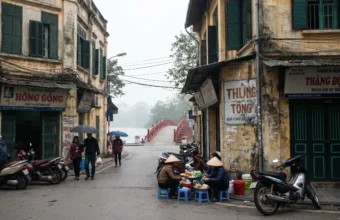
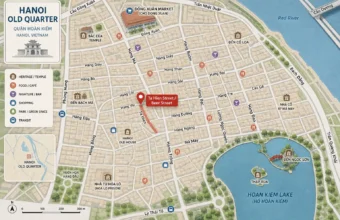
Hanoi’s Old Quarter is a 36-street medieval trading district built around a lake. For first-timers, Hoan Kiem Lake is the logical starting point — it’s central, walkable, and historically layered in a way that rewards even a short visit.
The Ngoc Son Temple sits on a small island at the lake’s northern end, connected by the red Huc Bridge. That bridge appears in so much Vietnam travel photography it’s nearly a cliché. Clichés exist for a reason.
Visitor Info — Hoan Kiem Lake & Ngoc Son Temple
- Entrance fee: Free (lake walkway); 30,000 VND (~$1.20) for Ngoc Son Temple
- Opening hours: Temple 8:00 AM – 5:00 PM daily
- Recommended visit time: 45–90 minutes
- Nearest transit: Grab motorbike or taxi from anywhere in central Hanoi; no metro access currently
The lake area closes to vehicle traffic on weekend evenings, turning the surrounding streets into a pedestrian zone. That’s actually the best time to visit. The energy shifts entirely — locals come out, street food vendors multiply, and the whole Old Quarter takes on a different character.
Temple of Literature
Vietnam’s first university, founded in 1070 during the Lý dynasty. Five consecutive courtyards, stone stelae recording doctoral graduates’ names, active cultural events inside. It’s quieter than Hoan Kiem — genuinely, noticeably quieter — and gives you a sharper sense of how seriously Vietnamese civilization structured intellectual life centuries before French colonists arrived.
Visitor Info — Temple of Literature
- Entrance fee: 30,000 VND (~$1.20)
- Opening hours: 8:00 AM – 5:00 PM (last entry 4:30 PM)
- Recommended visit time: 1–1.5 hours
- Nearest transit: 2 km southwest of Hoan Kiem; Grab ride ~15 minutes, ~35,000 VND
Ha Long Bay — UNESCO World Heritage Site
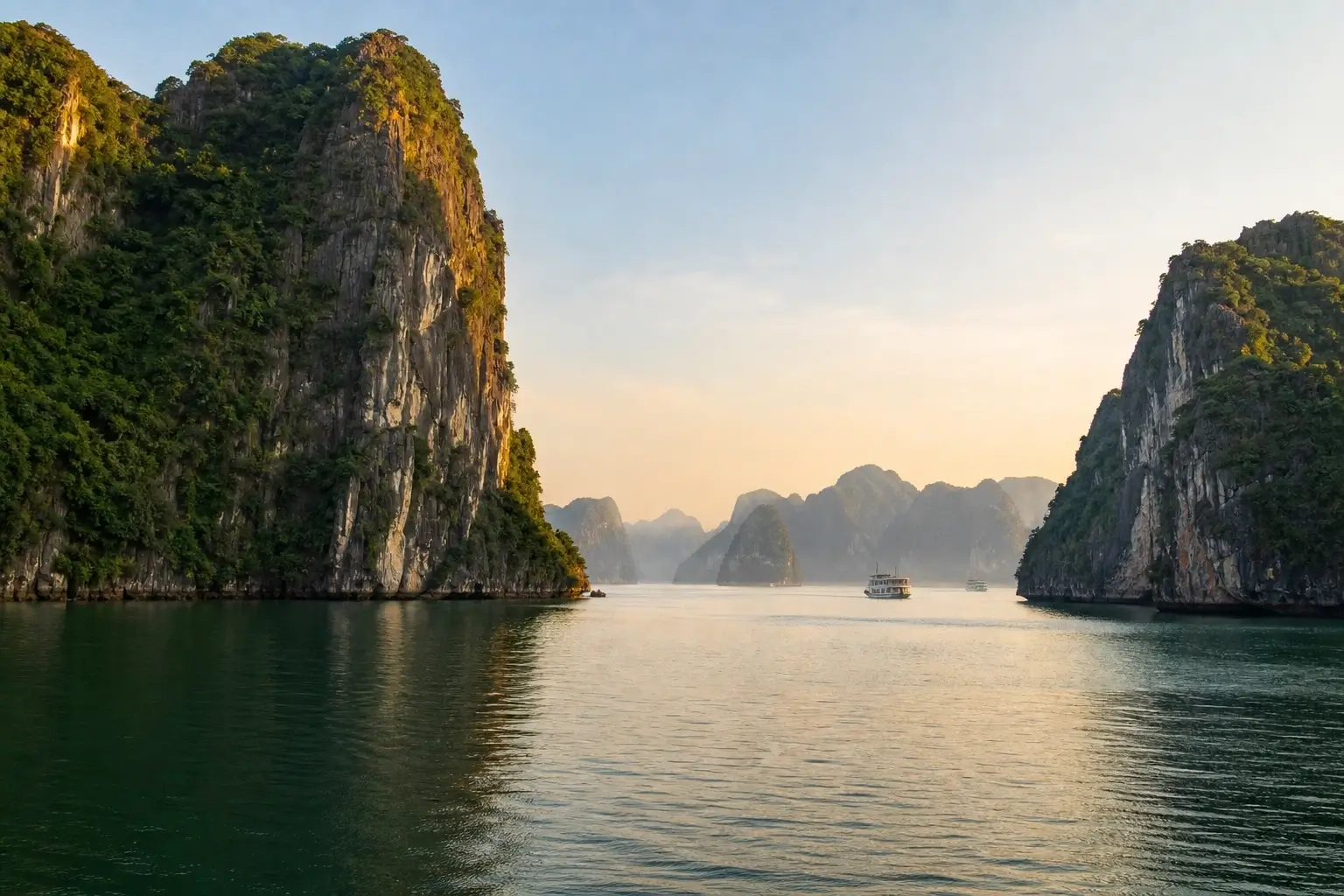
Ha Long Bay is Vietnam’s signature natural landmark. Around 1,600 limestone karst islands rise from the Gulf of Tonkin in formations that look more geological fantasy than reality. The bay has held UNESCO World Heritage status since 1994.
Day cruises exist. They’re not enough. Travelers who’ve done Ha Long Bay consistently say the overnight cruise (2 days / 1 night minimum) is what makes the difference — the sunrise over the karsts from the boat deck is one of those experiences people still talk about years later.
Visitor Info — Ha Long Bay
- Entrance fee: Included in cruise packages; bay entrance fee ~150,000 VND (~$6) sometimes listed separately
- How to get there: 3.5–4 hours by road from Hanoi; transfers typically included in cruise bookings
- Recommended duration: 2 days/1 night minimum; 3 days/2 nights for Bai Tu Long Bay (less crowded, same scenery)
- Booking: Viator and Klook both list Ha Long Bay cruises with English-speaking guides and transfers — book 2–3 weeks ahead during peak season (October–April)
Quick note: Ha Long Bay and Bai Tu Long Bay are neighboring — and often confused. Ha Long gets the crowds; Bai Tu Long Bay offers nearly identical scenery with fewer boats on the water. If you’ve already visited Ha Long once, Bai Tu Long Bay is the logical next step.
Ninh Binh — The Inland Version of Ha Long Bay
Or maybe I should say it this way: Ninh Binh is what Ha Long Bay would look like if the sea had drained away and rice paddies took its place. The same dramatic karst limestone formations, the same atmospheric mist — but here you’re navigating by rowboat through flooded valleys and cave systems instead of open water.
Trang An Scenic Landscape is the UNESCO-listed anchor (a rare mixed natural-cultural designation). Bich Dong Pagoda, carved into the cliffs nearby, is accessible by foot from the main boat docks. The whole area sits 90 kilometers south of Hanoi — close enough for a day trip, significant enough that many travelers wish they’d stayed overnight.
Visitor Info — Trang An Scenic Landscape
- Entrance fee: 200,000 VND (~$8) including boat and rower
- Opening hours: 7:00 AM – 5:00 PM daily
- Recommended visit time: 3–4 hours on-site; full day if combining with Bich Dong and Hoa Lu Ancient Capital
- How to get there: 2-hour bus from Hanoi’s Giap Bat station; or day tour via Viator/Klook from Hanoi
Central Vietnam Landmarks — Imperial Ruins, Ancient Towns, and UNESCO Density
Central Vietnam is the most landmark-dense stretch of the country. Hue and Hoi An sit roughly 120 kilometers apart. That’s close enough to treat them as a single itinerary block — 3–4 days covers both well — with Da Nang serving as the practical regional transport hub for flights, trains, and inter-city Grab rides.
The Imperial Citadel of Hue — UNESCO World Heritage Site
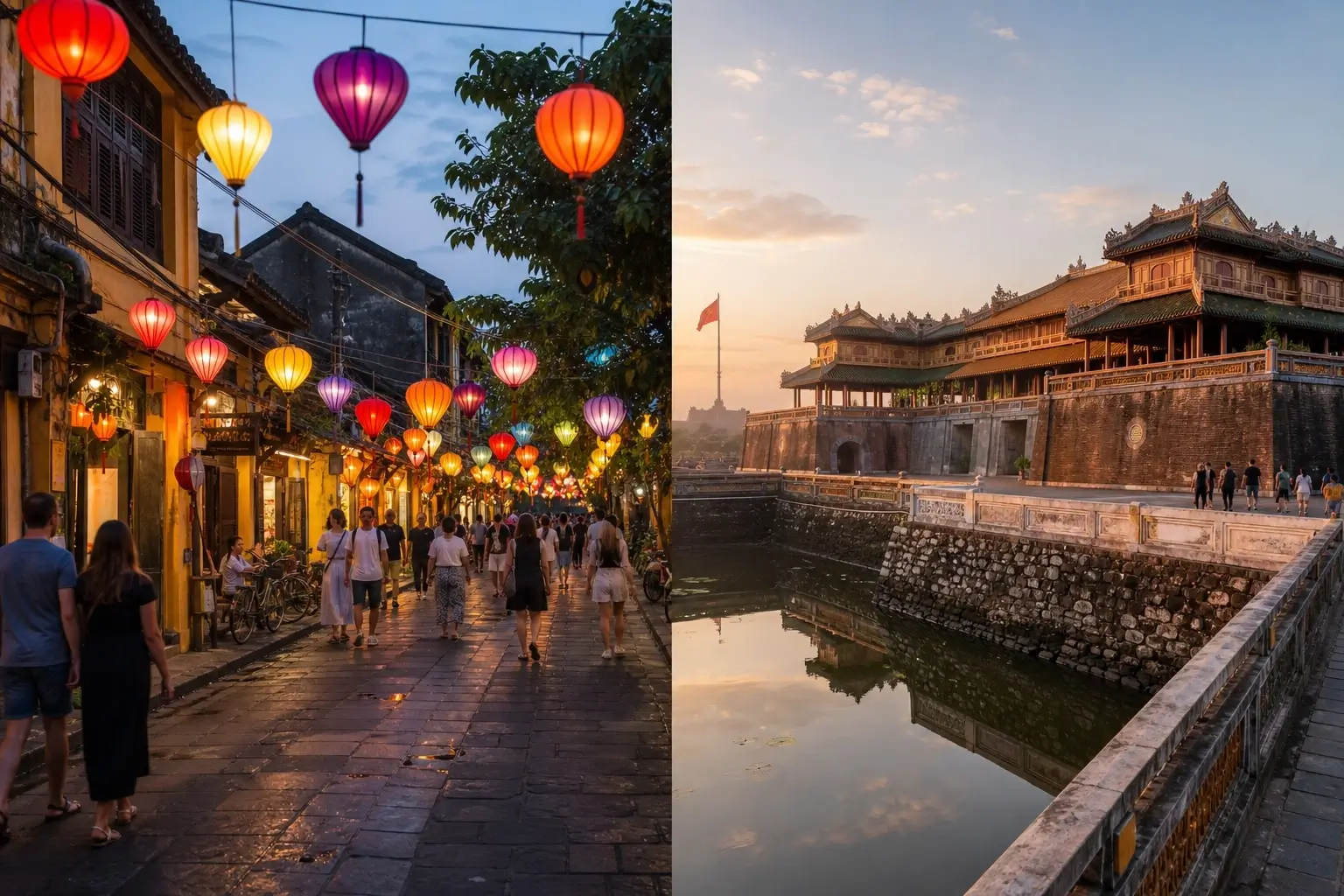
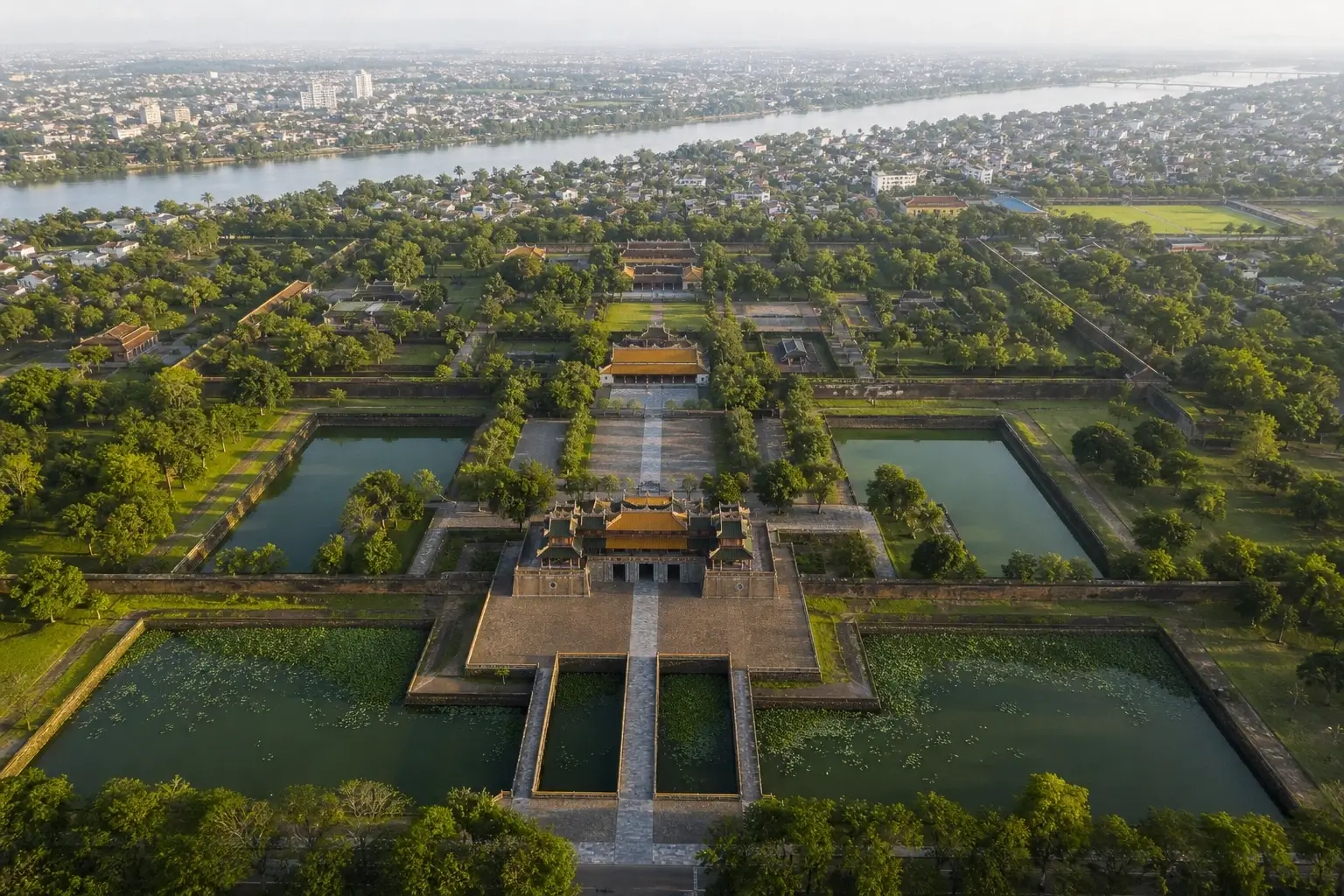
The Nguyen dynasty ruled Vietnam from Hue between 1802 and 1945. Their Imperial Citadel is a walled compound inside a moat — partially ruined by decades of conflict, which makes it more historically visceral than fully-restored equivalents elsewhere in Asia.
Plan 2–3 hours for the Citadel itself. The Forbidden Purple City section inside is smaller than Beijing’s Forbidden City but carries its own quiet weight. The surrounding royal tombs (Minh Mang, Tu Duc, Khai Dinh) are separate admissions spread across the countryside south of the city — most travelers skip one, and the consensus pick to cut is Dong Khanh.
Visitor Info — Imperial Citadel of Hue
- Entrance fee: 200,000 VND (~$8); combination tickets covering royal tombs available at the gate
- Opening hours: 6:30 AM – 5:30 PM (summer); 7:00 AM – 5:00 PM (winter)
- Recommended visit time: 2.5–3 hours for Citadel alone; full day if adding 2–3 royal tombs
- Nearest transit: Central Hue; cyclo or Grab from Hue train station (~10 min, ~40,000 VND)
Hoi An Ancient Town — UNESCO World Heritage Site
Hoi An is Vietnam’s best-preserved trading port — a 15th-to-19th-century merchant town where Japanese, Chinese, and Vietnamese architectural influences layer over each other in a composition that feels genuinely inhabited rather than reconstructed for tourism.
The Japanese Covered Bridge is the postcard image everyone recognizes. But the Fujian Chinese Assembly Hall carries more historical weight and draws lighter crowds, especially in the late afternoon when tour groups have mostly cleared out.
Visitor Info — Hoi An Ancient Town
- Entrance fee: 120,000 VND (~$5) covering 5 attraction entries; sold at Ancient Town entrance gates
- Opening hours: Ancient Town open 24/7; ticketed attractions approximately 8:00 AM – 5:30 PM
- Recommended visit time: Half-day minimum; two evenings strongly recommended to experience the lantern-lit night market atmosphere
- Booking tip: Klook sells Hoi An entry passes with attraction-combo options; useful for skip-the-line access at peak times
Look, if you’re short on time and have to choose between Hue and Hoi An, most first-timers find Hoi An more immediately satisfying. Hue rewards travelers who come with genuine historical curiosity and enough time to explore the surrounding countryside. Neither choice is wrong. They’re just different experiences.
My Son Sanctuary — UNESCO World Heritage Site
My Son is Vietnam’s equivalent of Angkor Wat — smaller, more ruined, and representing a civilization most tourists have never heard of. These are the remains of a Cham Hindu kingdom that flourished between the 4th and 14th centuries, located roughly 40 kilometers southwest of Hoi An.
Some travel writers argue My Son is overrated given the bomb damage it sustained during the Vietnam War. That’s a fair position if you’re benchmarking against Angkor in Cambodia. But if you approach it as an archaeological remnant of a sophisticated civilization with no modern descendants, it offers something Angkor doesn’t: genuine obscurity.
Visitor Info — My Son Sanctuary
- Entrance fee: 150,000 VND (~$6)
- Opening hours: 6:00 AM – 5:00 PM daily
- Recommended visit time: 2–3 hours
- How to get there: 40 km from Hoi An; group tours via Viator or Klook include transport; Grab private transfer also available (~300,000–400,000 VND one-way)
Marble Mountains — Da Nang
Five marble-and-limestone hills rising from flat coastal ground south of Da Nang. Each is named after a natural element. Thuy Son is the one worth climbing — it has a system of caves with active Buddhist shrines built inside the rock, and a viewpoint overlooking both the coastline and the city.
The elevator costs 15,000 VND each direction. Most visitors take it up, walk the cave trail and summit, then descend on foot through the stone stairways. Give it 1.5–2 hours.
Visitor Info — Marble Mountains
- Entrance fee: 40,000 VND (~$1.60); elevator 15,000 VND per direction
- Opening hours: 7:00 AM – 5:30 PM daily
- Recommended visit time: 1.5–2 hours
- Nearest transit: 9 km south of Da Nang city center; Grab ride ~20 minutes, ~60,000–80,000 VND
Southern Vietnam Landmarks — Ho Chi Minh City, the Tunnels, and the Delta
The South runs hotter and faster than the North. Ho Chi Minh City — still called Saigon by most residents — is louder, more commercially aggressive, and more architecturally layered than Hanoi. Its landmarks lean toward war history, French colonial architecture, and chaotic urban texture. None of it is passive to experience.
War Remnants Museum
The most visited museum in Vietnam. The War Remnants Museum documents the American-Vietnam War from a Vietnamese perspective — with photographs, preserved military hardware in the courtyard, and a dedicated exhibition on Agent Orange’s long-term effects on civilians and veterans.
It’s uncomfortable to walk through. It’s supposed to be.
Visitor Info — War Remnants Museum
- Entrance fee: 40,000 VND (~$1.60)
- Opening hours: 7:30 AM – 12:00 PM and 1:30 PM – 5:00 PM (closed some public holidays)
- Recommended visit time: 1.5–2.5 hours
- Nearest transit: Central District 3; Grab from anywhere in central HCMC (~10–20 minutes depending on traffic)
Cu Chi Tunnels — 60 km from Ho Chi Minh City
A network of underground tunnels used by Viet Cong guerrillas during the war — over 250 kilometers in total, spread beneath the Cu Chi district north of the city. Tourists can crawl through a shortened, widened tourist section of the original tunnels. It’s physically claustrophobic and historically dense, and those two things compound each other in a way that photographs don’t prepare you for.
Visitor Info — Cu Chi Tunnels
- Entrance fee: 110,000 VND (~$4.50) at Ben Dinh; 90,000 VND (~$3.60) at Ben Duoc (less visited, quieter)
- Opening hours: 7:00 AM – 5:00 PM daily
- Recommended visit time: 2–3 hours on-site; half-day from HCMC including transport
- How to get there: Grab to Cu Chi is logistically impractical and expensive; group tours from HCMC via Viator or Klook are the most efficient option
Notre-Dame Cathedral Basilica of Saigon
Built by French colonists between 1863 and 1880. The red-brick Romanesque façade is one of HCMC’s most photographed structures, particularly from the plaza in front. The interior has been undergoing restoration — verify current access status before planning interior photography.
Visitor Info — Notre-Dame Cathedral Basilica
- Entrance fee: Free (exterior); interior access subject to ongoing restoration
- Opening hours: Exterior viewable at any time; interior hours vary seasonally
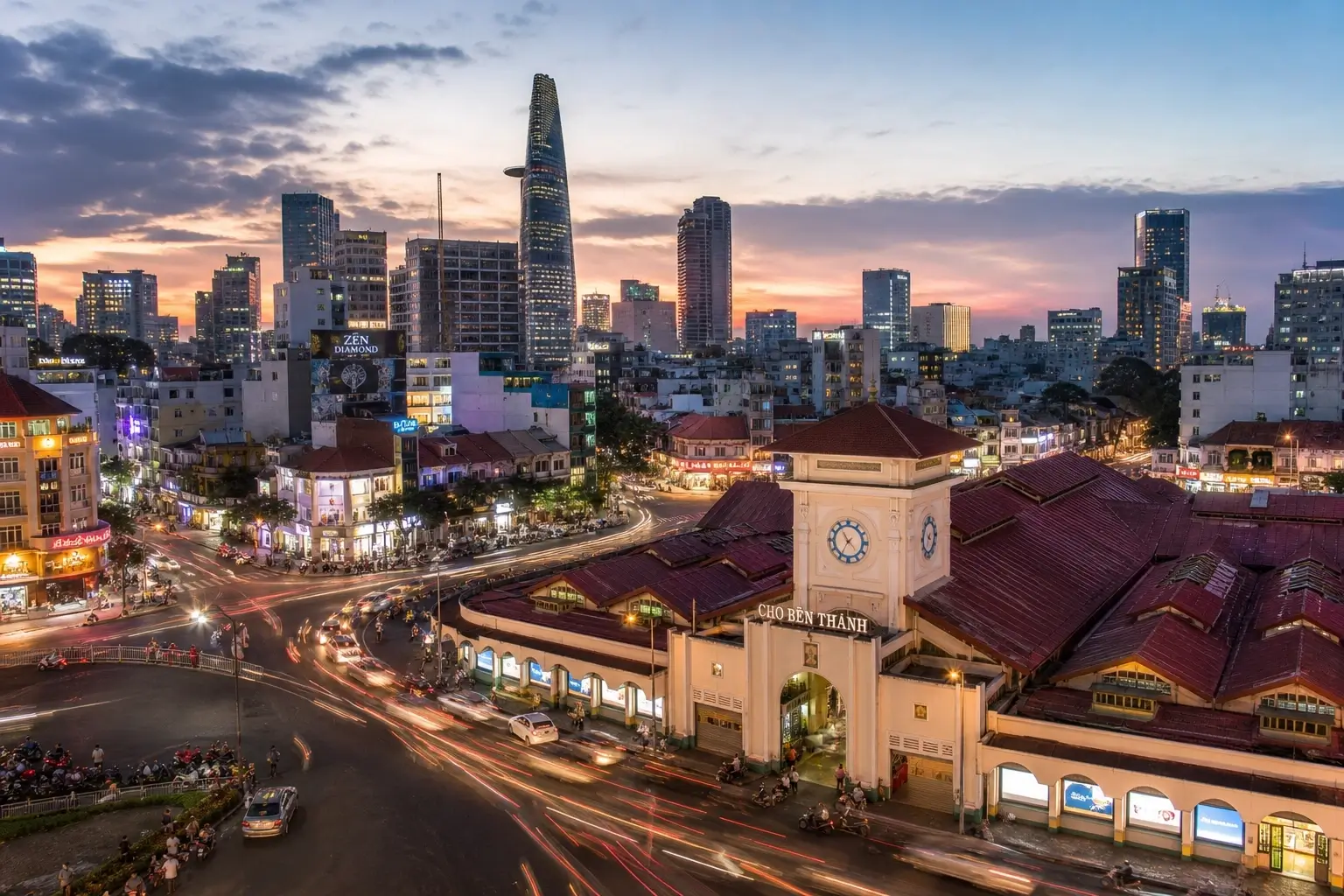
- Recommended visit time: 20–30 minutes for exterior; pair it with Ben Thanh Market (~10 minutes on foot)
- Nearest transit: Walking distance from Ben Thanh Market; Grab from central HCMC
Cai Rang Floating Market — Can Tho, Mekong Delta
The Mekong Delta isn’t a single landmark — it’s a region of canals, rice paddies, and stilted villages spreading across Vietnam’s southwestern corner. Can Tho is the practical base. The Cai Rang Floating Market, operating between roughly 5:00 and 8:00 AM, is the main draw: vendors selling produce from wooden boats, using long poles with sample goods tied at the top to signal what’s available.
I’ve seen conflicting accounts on this one — some recent travelers report Cai Rang is declining as younger vendors shift to land-based trade, while others describe it as still commercially active and worth the early wake-up. My read: it’s genuinely worth going, but get there before 7:00 AM if you want the market at full energy. After that, it winds down quickly.
Visitor Info — Cai Rang Floating Market
- Entrance fee: None; boat hire approximately 150,000–200,000 VND (~$6–8) for 2 hours
- Best time to visit: 5:00 AM – 8:00 AM (activity peaks before sunrise)
- How to get there: Can Tho is 3.5 hours from HCMC by road; budget flights available via VietJet and Bamboo; buses from HCMC’s Mien Tay station
How to Plan Your Vietnam Landmark Route — A Region-by-Region Sequence
How to plan a Vietnam landmark route as a first-timer:
- Choose entry and exit airports — Hanoi (North) and Ho Chi Minh City (South) enable a clean one-way route with no backtracking.
- Allocate time per region: 3 days North, 3–4 days Central, 3 days South covers the major landmarks in a 9–10 day minimum.
- Book inter-region transport early — Da Nang flights from Hanoi or HCMC fill up weeks ahead during peak season (October–April).
- Cluster landmarks within each region — Hue and Hoi An are 2.5 hours apart; do both in sequence before moving on.
- Use Grab for all city-level movement — it works reliably across Hanoi, Da Nang, Hoi An, and Ho Chi Minh City and removes the negotiation variable from every taxi ride.
Comparing Vietnam’s Three Landmark Regions
Not every traveler has 14 days. If you’re working with 7–10, understanding what each region does best matters more than trying to see everything.
Quick Comparison: Vietnam Landmark Regions
| Region | Best For | Signature Landmark | Limitation |
|---|---|---|---|
| North (Hanoi base) | Natural wonders, ancient history | Ha Long Bay | Greater distances between major sites |
| Central (Da Nang / Hue / Hoi An) | UNESCO density, architecture, food | Hoi An Ancient Town | Can feel saturated with tourists in peak months |
| South (HCMC base) | War history, urban culture, delta | Cu Chi Tunnels | Less scenic; intense heat and traffic |
| All Three Combined | Complete Vietnam first-timer experience | Multiple UNESCO sites | Requires 12–14 days minimum to do without rushing |
Counter-intuitive finding: most travelers overweight the South when planning, because Ho Chi Minh City’s name recognition is high globally. But Central Vietnam consistently receives the strongest satisfaction ratings from first-time visitors — particularly Hoi An. The South is best treated as a deliberate destination for travelers who specifically want its urban and war-history character, not as a fallback when Central Vietnam feels too crowded.
North vs. Central Vietnam for first-timers: North Vietnam is better suited for travelers prioritizing dramatic natural landscapes and ancient city atmosphere, because Ha Long Bay and Hanoi’s Old Quarter offer genuinely distinctive Asia experiences. Central Vietnam works better when UNESCO heritage density, food culture, and architectural variety are the priorities. The key difference is geographic compactness — Central Vietnam packs more into a smaller footprint, making it more efficient for short trips.
How Many UNESCO World Heritage Sites Does Vietnam Have?
Vietnam holds eight UNESCO World Heritage Sites — five cultural and three natural (or mixed). The cultural designations include the Complex of Hue Monuments, Hoi An Ancient Town, My Son Sanctuary, the Imperial Citadel of Thang Long in Hanoi, and the Citadel of the Ho Dynasty in Thanh Hoa province. The natural and mixed sites are Ha Long Bay, Phong Nha-Ke Bang National Park, and Trang An Scenic Landscape. According to the UNESCO World Heritage List, Vietnam has one of the highest concentrations of heritage site designations in Southeast Asia relative to its land area.
Is It Worth Visiting Both Hue and Hoi An on the Same Trip?
Yes — and it’s logistically straightforward. Hue and Hoi An are linked by the Hai Van Pass, a scenic mountain road with genuine views, and the drive takes 2.5–3 hours by car or tourist bus. Most travelers base in Da Nang (geographically between the two) or in Hoi An and treat Hue as an overnight or long day trip. According to tour operators on both Viator and Klook, the Hue–Hoi An corridor is the most-booked two-city combination in Vietnam. The cities complement each other directly: Hue is imperial and melancholic; Hoi An is mercantile and vibrant. Seeing one without the other leaves a significant gap.
Q&A: Practical Questions About Landmarks in Vietnam
What’s the best time of year to visit landmarks in Vietnam?
February through April works best for Central Vietnam — it avoids the North’s lingering winter chill and the South’s peak heat. October through March suits the South. For the North, target April through June or September through November. Avoid Central Vietnam in October–November (typhoon season); flooding can close sites.
How do I get between landmarks in Vietnam without joining a tour group?
Use Grab for all city-level movement — it’s metered, reliable, and works across Hanoi, Da Nang, Hoi An, and HCMC. For inter-city travel, budget carriers like VietJet and Bamboo Air are fast and inexpensive. The Reunification Express train is slower but scenic on the coastal stretch between Da Nang and Hue. Sleeper buses are a viable budget option for the Hanoi–Hue or Hue–Hoi An routes.
Should I book Vietnam landmark tours in advance?
For Ha Long Bay cruises and Cu Chi Tunnels — yes, especially October through April. Book 2–3 weeks ahead via Viator or Klook to secure English-speaking guides and included transfers. For most urban sites (Hoi An Ancient Town, Hue Citadel, Hanoi temples), same-day tickets at the gate are fine outside peak season.
Why do some Vietnam landmarks charge more for international visitors?
A two-tier pricing structure — lower rates for Vietnamese nationals, higher for foreign visitors — exists at some state-managed sites. It’s legal, common across Southeast Asia, and the foreign-tier price remains low by international standards. Most major landmarks, including Hoi An Ancient Town and the Hue Citadel, now apply flat rates regardless of nationality.
When should I skip a landmark rather than squeeze it in?
Skip it if you can’t give it at least half its recommended visit time. Rushing the Hue Citadel in 45 minutes or doing Ha Long Bay as a single-day trip leaves most travelers underwhelmed — not because the sites aren’t remarkable, but because the experience needs time to land. Fewer sites done properly beats a checklist sprint through all of them.




No Comment! Be the first one.