




23 Small Dining Room Hacks and Ideas That Make Every Inch Count
You love your home, but the dining room is the one space that never quite feels right. The table is too big for the floor plan, the walkway disappears the moment someone pulls a chair out, and the...

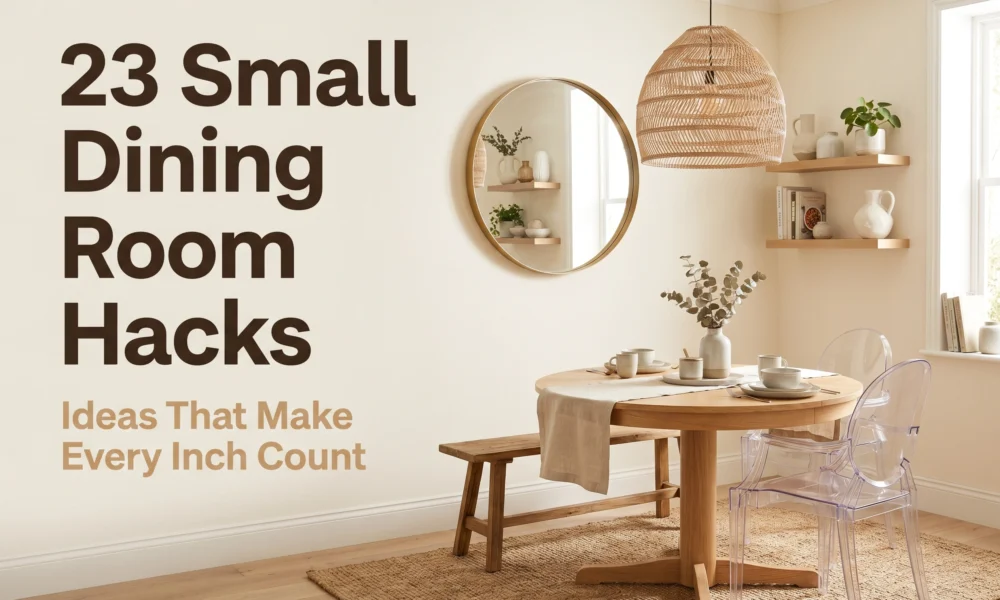
You love your home, but the dining room is the one space that never quite feels right. The table is too big for the floor plan, the walkway disappears the moment someone pulls a chair out, and the room somehow looks cluttered even when everything has been put away. That specific frustration, where a room looks wrong even when it’s clean, is exactly what these small dining room hacks and ideas are designed to fix. And yes, small space decorating ideas that work in every room start the same way: with a clear look at what is actually causing the problem instead of rearranging the same furniture for the fourth time.
None of these ideas require a renovation, a large budget, or a completely new furniture set. Most can be implemented in a single weekend, many are fully renter-friendly, and several cost under $50. The goal is not to fake a larger room; it is to create a space that feels intentional, warm, and genuinely enjoyable to sit in, no matter the square footage.
What Is the Best Table Shape for a Small Dining Room?
A round table is the best choice for most small dining rooms because it eliminates sharp corners that cut into walkways, allows people to move around the table more freely, and seats the same number of guests as a rectangular table in less usable floor space. For very narrow rooms or studio apartments, a drop-leaf table that collapses against the wall or a wall-mounted fold-down table is the most space-efficient option of all.
1. Swap Your Rectangular Table for a Round One
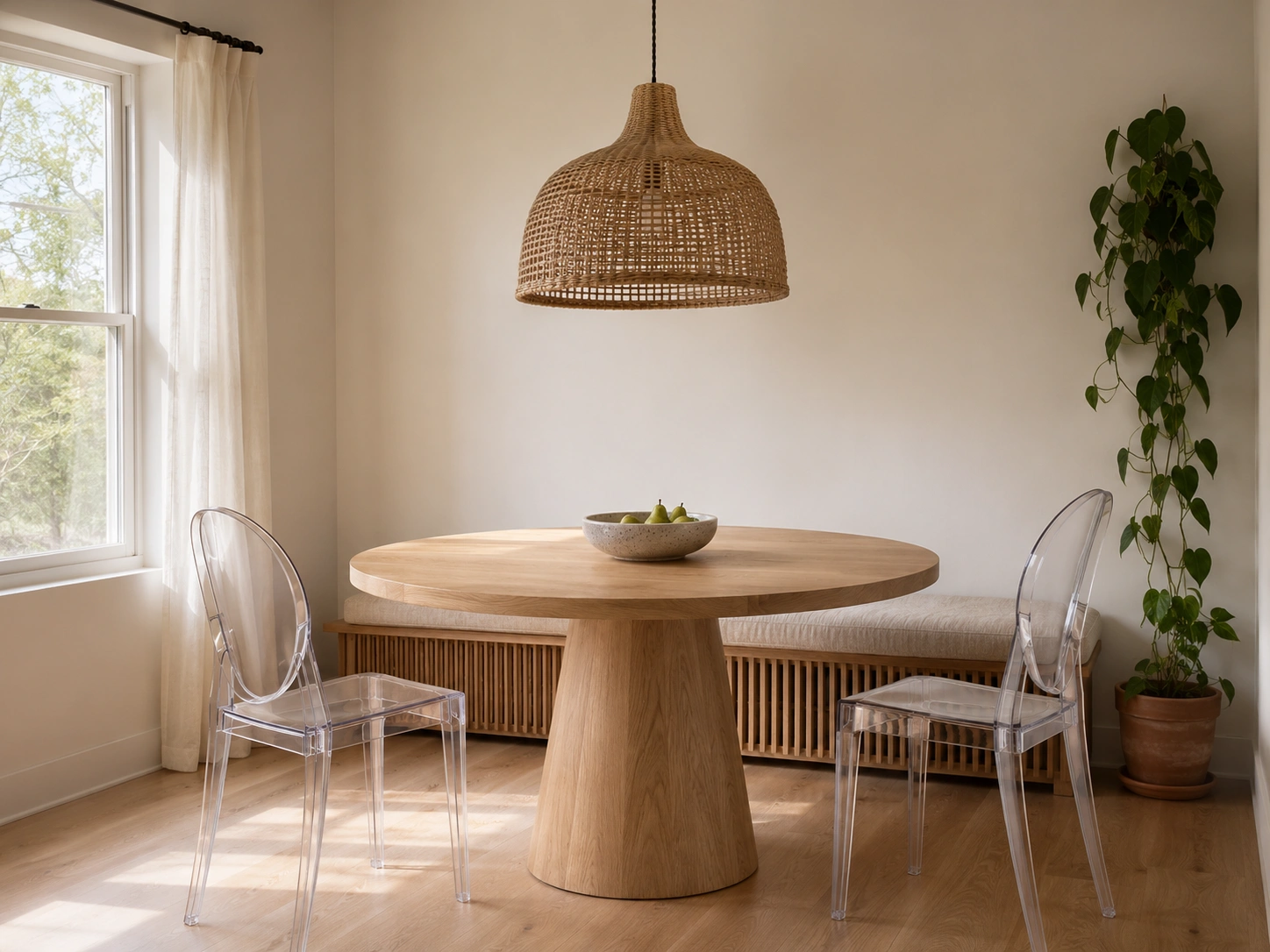
If there is one furniture swap that creates the most immediate, visible difference in a small dining room, it is ditching the rectangular table. A rectangular table claims territory at each corner, cutting into the walkway and making every chair pull a negotiation with the floor plan. A round table removes those corners entirely, which opens up the room’s perimeter and creates a far more natural flow for moving between the kitchen and the dining area. According to dining room clearance standards recommended by professional designers, 36 inches of clearance around the table is the professional minimum — a round shape makes that number achievable in significantly less floor space.
Look for a round table between 36 and 48 inches in diameter — anything smaller starts to feel too precious for daily use, anything larger defeats the purpose. A pedestal base (one central leg rather than four corner legs) frees up the floor underfoot and allows chairs to tuck in fully when the table is not in use. A light wood finish in pale oak or walnut adds warmth without visual weight. Read [how to choose the right dining table size for your space] before ordering, because even a two-inch difference matters in a compact floor plan.
2. Try a Drop-Leaf Table That Folds Flat When Not in Use
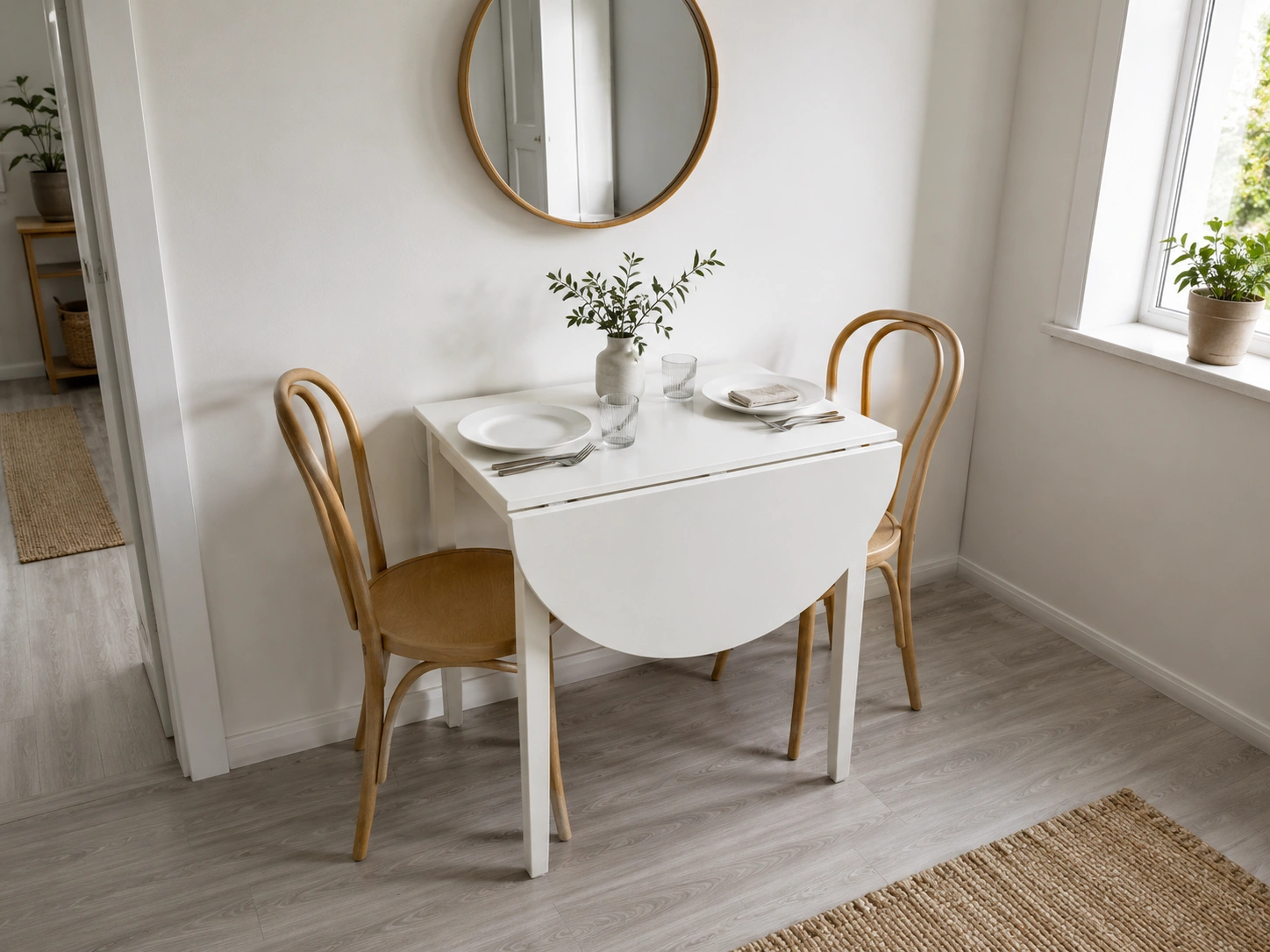
A drop-leaf table is the most underrated piece of furniture in the small-space toolkit. When both leaves are folded down, it presses almost flat against a wall and takes up a fraction of the floor space of a standard dining table. When one or both leaves are raised, it instantly becomes a proper dining surface for two, four, or more. It is a genuine shape-shifter — breakfast for one on a Tuesday morning, dinner for four on Saturday night — without anything going into storage or being carried across the room. The transition takes about three seconds.
Budget Pick: The IKEA MELLTORP is one of the most practical and affordable examples of this concept, available for under $100 and designed specifically for compact apartment use. IKEA’s small space furniture collection has several drop-leaf options across different styles and finishes. Look for versions with a simple, light-colored surface so the table blends into the wall when folded. Avoid heavy dark finishes or ornate styles — the whole point of this piece is to visually disappear when you need the floor back.
3. Mount a Fold-Down Table Directly to the Wall
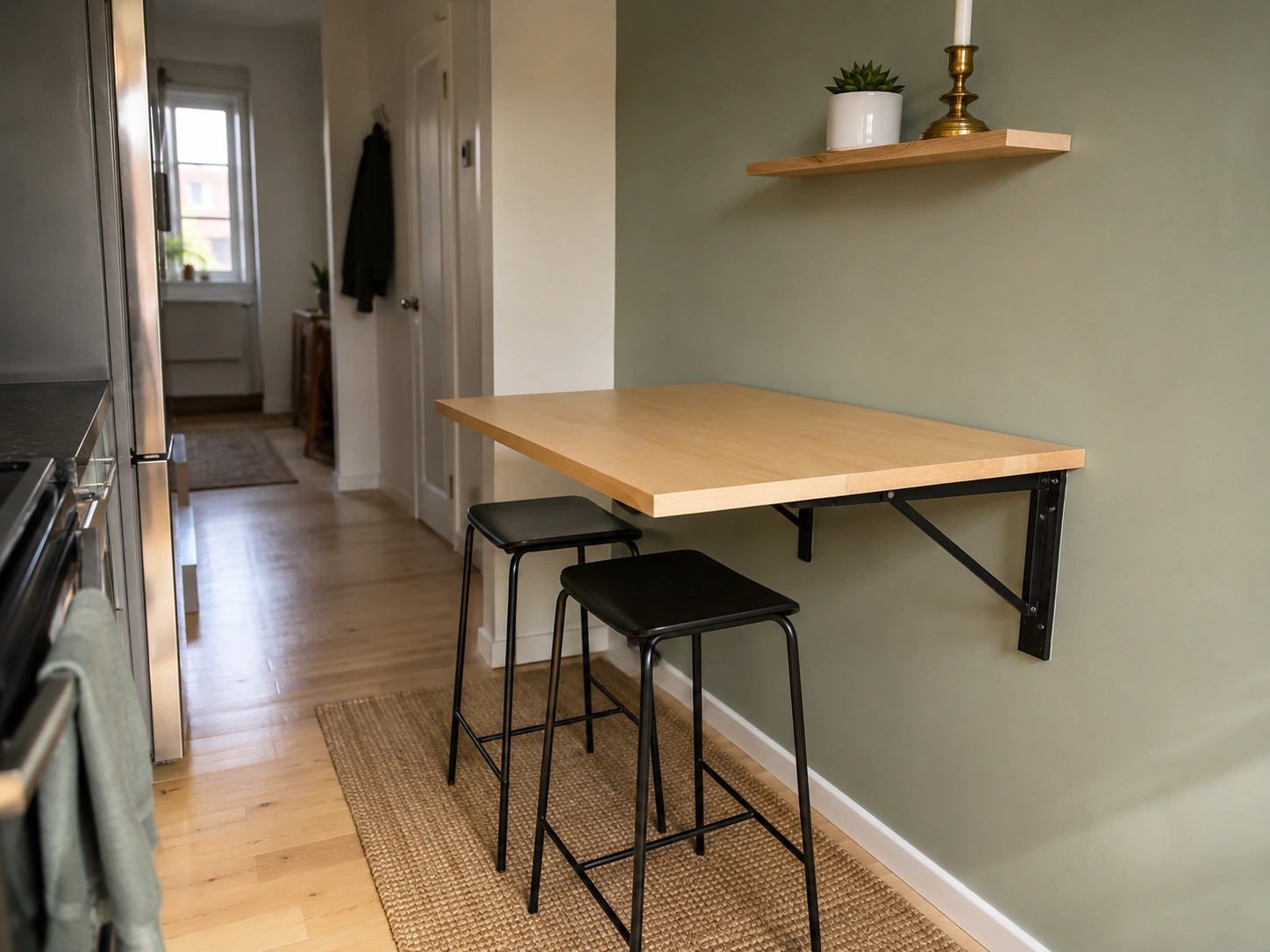
Wall-mounted fold-down tables are the most space-efficient dining option that exists — and they are genuinely renter-friendly if you mount them into a wall stud and patch the holes before you move out. Folded up, they read as nothing more than a slim wooden panel against the wall. Folded down, they provide a proper surface for eating, working, or spreading out a Saturday evening board game. The IKEA NORBERG is a consistently popular version that costs under $60 and installs in roughly an hour. Renter-Friendly: Mount into studs, use removable wall filler on move-out.
The key to making a fold-down table look intentional rather than improvised is the treatment of the wall behind it. Paint that section of wall a contrasting shade — a soft warm sage, muted clay, or even just a slightly deeper tone of the room’s main white — so the table reads as part of a designed moment rather than a DIY afterthought. Pair it with two slim bar stools that slide fully underneath when not in use, add a small floating shelf above for a plant or a candle, and the result is a compact dining nook that functions like a feature of the room, not a workaround.
4. Use a Glass or Acrylic Table to Lighten the Room
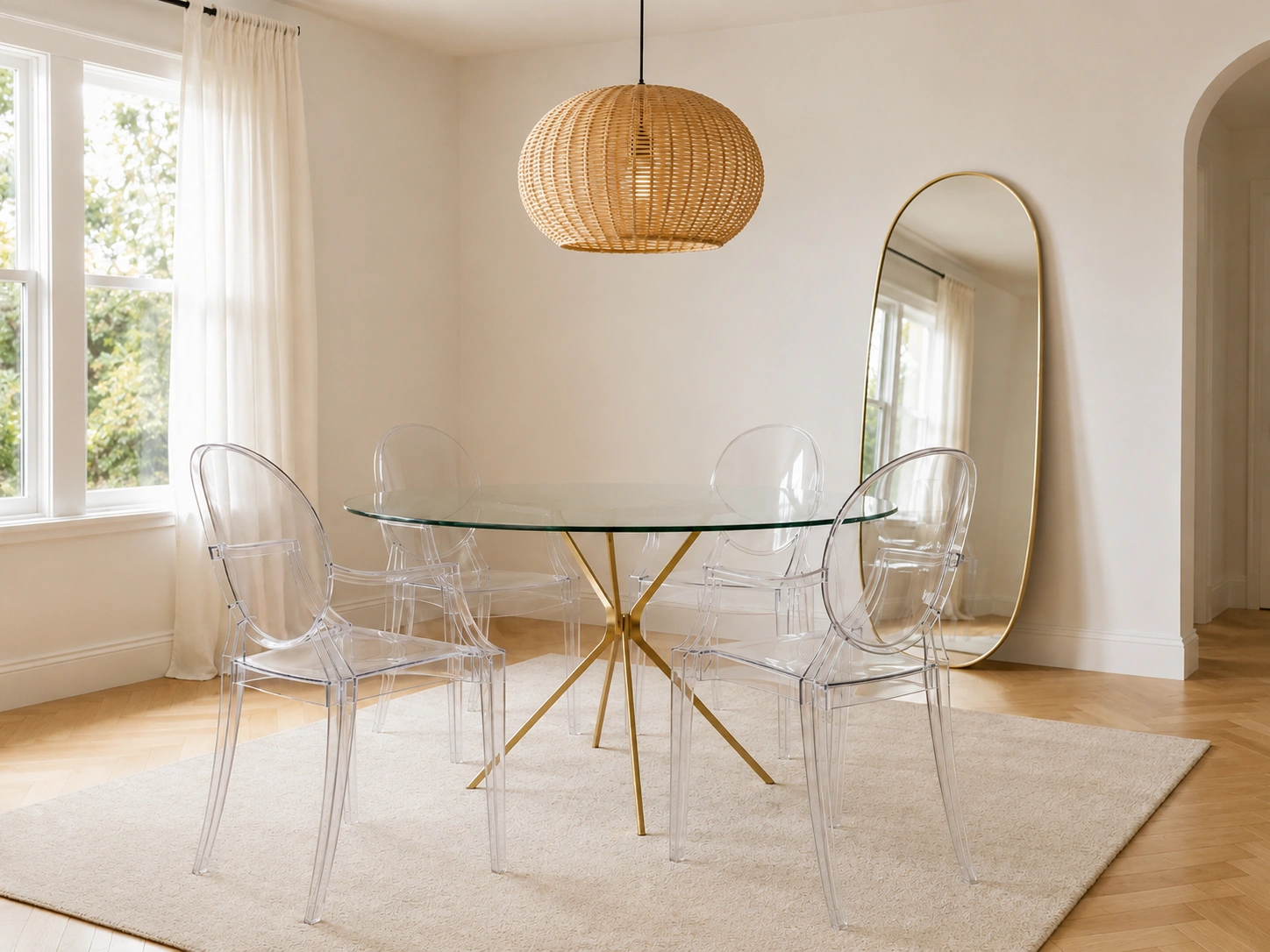
Glass and acrylic furniture have one superpower in a small dining room: they’re there without really being there. A glass-top table on slim legs lets the eye travel all the way through to the floor, which creates a sense of open space that a solid wood table simply cannot replicate. The room does not actually get bigger — but it reads as bigger, and that visual perception is often the whole goal in a compact floor plan. A round glass-top table on a single brushed-metal pedestal keeps the floor open and the composition clean without pushing the room into a cold, clinical territory.
The honest trade-off with glass and acrylic is upkeep — both surfaces show fingerprints, smudges, and water rings far more readily than wood. Keep a microfiber cloth nearby and be realistic about the wipe-down routine after most meals. If that feels like too much, a glass top on a whitewashed wood or stone base gives some of the same visual lightness without full transparency. Ghost chairs — Kartell-style acrylic seats widely available on Wayfair and Amazon between $80 and $150 each — pair beautifully with glass or acrylic and add almost zero visual mass to the room. Budget Pick: Ghost chair dupes on Amazon often run under $90 per chair.
5. Add a Bench on One Side to Free Up Floor Space
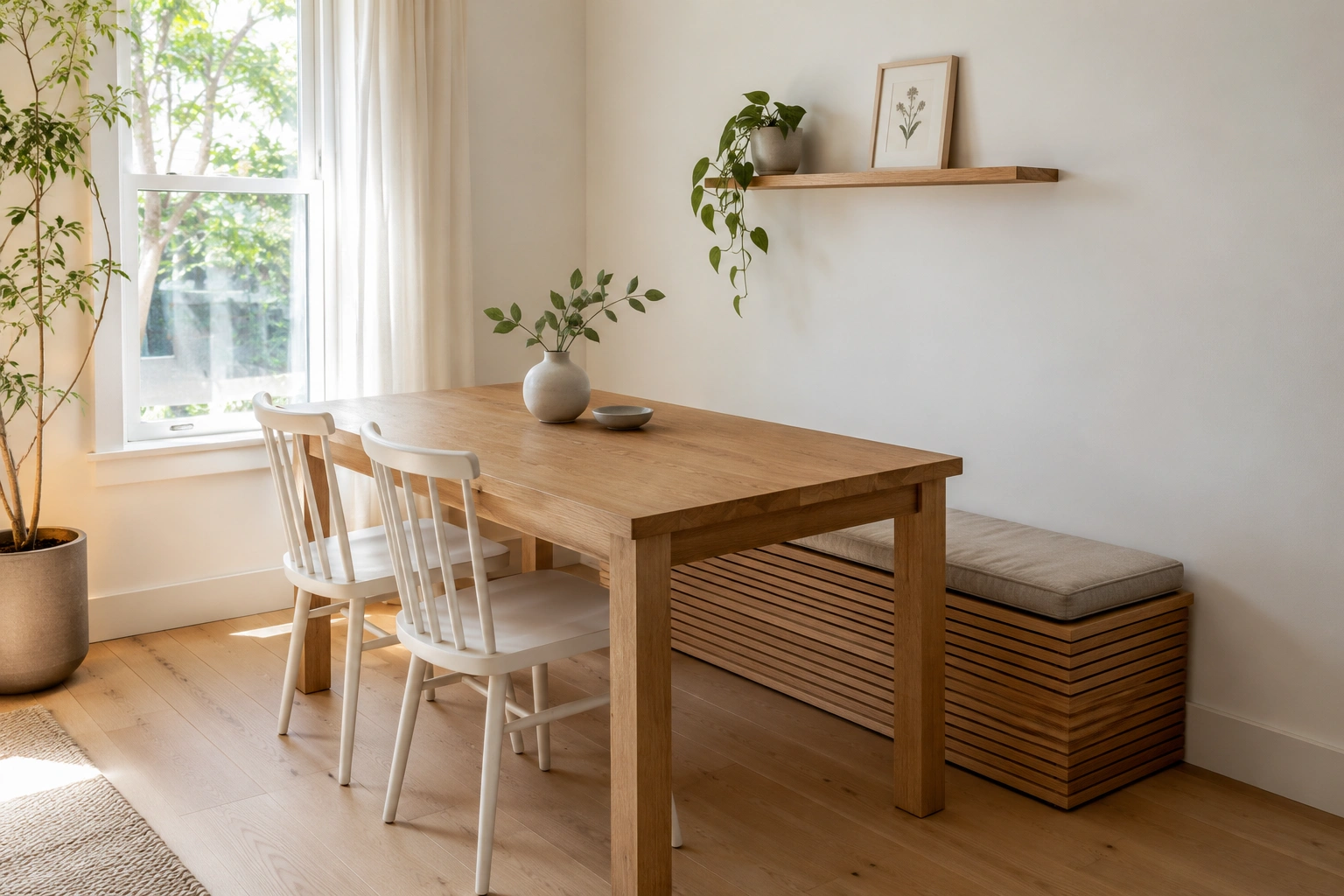
Replacing one row of chairs with a bench is one of those changes that seems minor until you actually try it. A bench slides fully under the table when not in use, recovering meaningful floor space compared to two chairs that need room to pull out and have their own footprint even when tucked in. It also seats more people than two chairs in the same linear width, which quietly gives your small dining table more hosting flexibility. Against a wall, a bench reads as intentional and almost built-in, even when it is a completely free-standing piece.
Choose a bench with a low, slim profile — anything above 18 inches in seat height starts to look heavy and dominant. A wood bench without arms or a high back keeps sight lines open across the room. Add a thin linen or cotton cushion in a neutral tone if comfort is a concern, but keep it flat so the bench still slides neatly under the table. The wall above the bench is now prime styling real estate: a narrow floating shelf, a small mirror, or a single framed print turns the bench wall into its own quiet moment. Renter-Friendly: No drilling required. A free-standing bench slides against any wall without commitment.
6. Choose Ghost Chairs for Seating That Almost Disappears
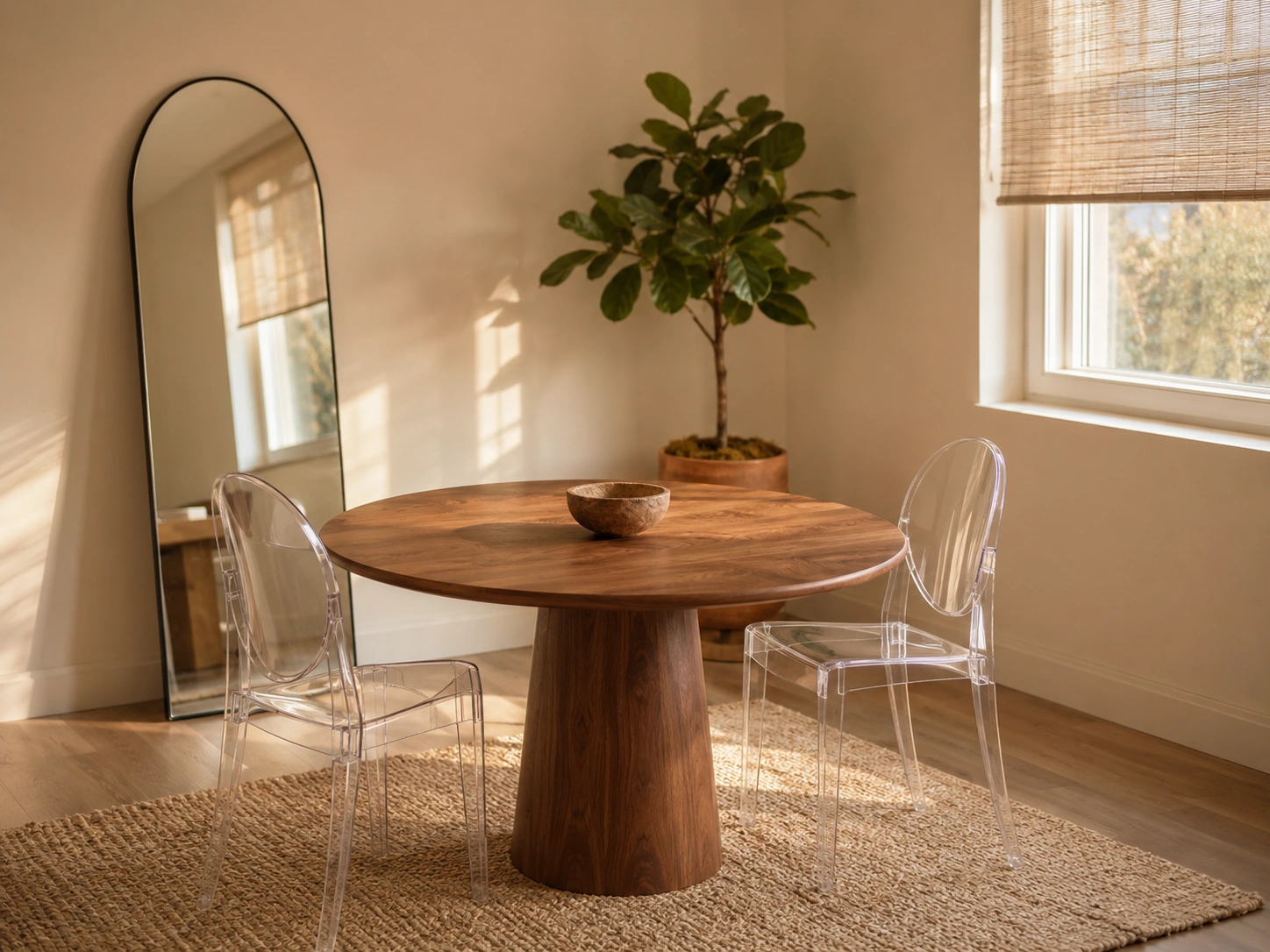
Ghost chairs are transparent polycarbonate seats originally designed by Philippe Starck, and they solve one of the most persistent small dining room problems: seating that visually crowds the room even when there is technically adequate floor space. Because the chair is fully see-through, the eye reads the floor beneath it rather than registering it as a solid object claiming territory. The room feels lighter and more open simply because there are fewer visual “stops” for the eye to land on. They come in clear, smoked, and soft blush tones — all of which work beautifully in a compact space.
The Kartell originals run around $400 to $500 per chair, but there are near-identical acrylic versions on Wayfair and Amazon for $80 to $150 each that are perfectly solid and stylish for an apartment dining setup. The honest limitation with ghost chairs is long-sit comfort — the hard acrylic is less forgiving than an upholstered seat — so they work best for households where dining chairs are not occupied for hours at a stretch. Pair them with a wood bench for material contrast, add a small flat cushion if needed, and let them do their primary job: making the room feel substantially more open without changing a single dimension. Budget Pick: Search “acrylic ghost chair” on Amazon or Wayfair — under $120 per chair.
7. Use Stackable Chairs You Can Store Away Easily
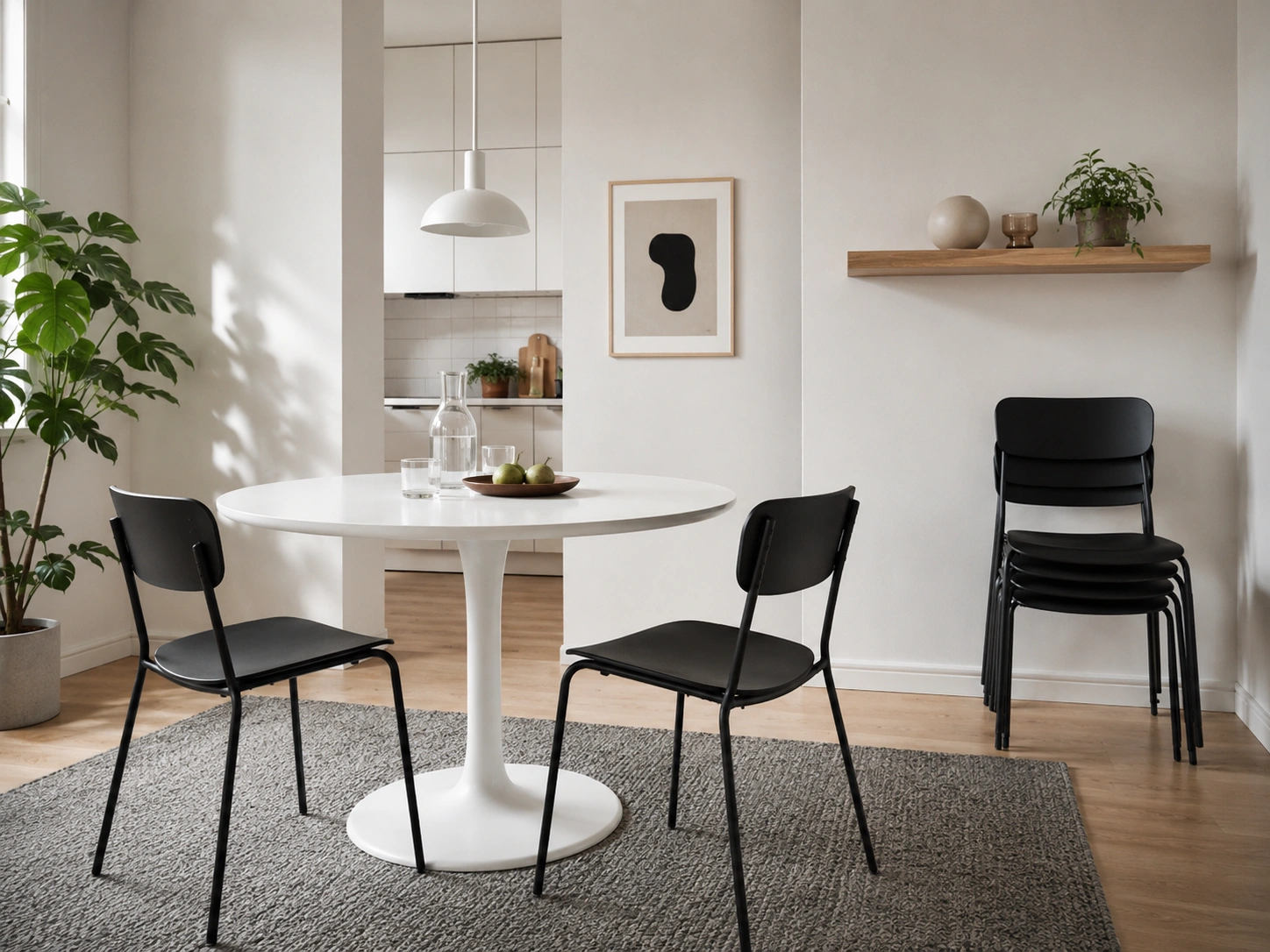
Stackable chairs are the practical person’s answer to hosting in a small dining room. Keep two out for everyday use and store the rest in a neat corner stack or a nearby closet when they are not needed. The floor stays clear on ordinary evenings, and when four or six people come over, the extra chairs appear in seconds with no assembly, no rearranging, and no drama. A set of four matching slim-profile metal or wood stackable chairs typically costs between $120 and $200 total — readily available at IKEA, Target, and most furniture retailers.
Choose a style that still looks intentional when stacked: slim matte black or matte white metal frames stack cleanly and almost read as a sculptural moment in a corner rather than a pile of furniture. Avoid plastic outdoor-style stacking chairs unless the room has a strongly casual or industrial aesthetic, because they tend to undercut the look of an otherwise styled space. These are a reliable option in any guide to [apartment decorating tips that actually work in rented spaces] precisely because they cost little, require no drilling, and move with you when you go. Renter-Friendly + Budget Pick: No commitment, no installation, and they pack into a moving van without a second thought.
8. Hang a Large Mirror to Double the Visual Space
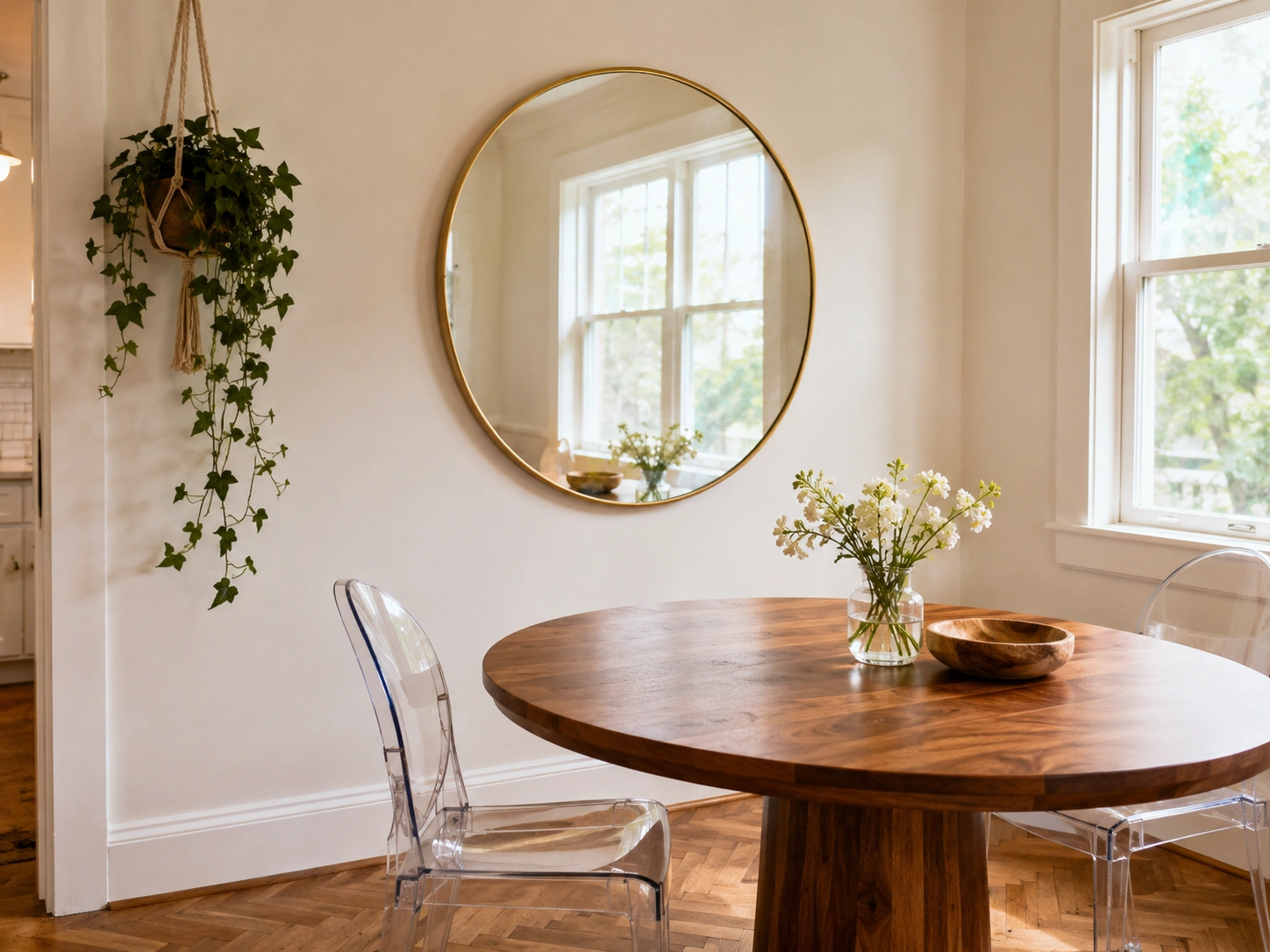
A large mirror is the closest thing to magic that exists in small-space decorating. Hung directly opposite a window, it reflects natural light back into the room and creates the strong visual impression that the wall simply is not there — that the space continues beyond it. The effect is most dramatic with a mirror at least 24 inches wide, ideally 30 to 36 inches or larger. A round mirror echoes a round table beautifully and creates a cohesive, intentional composition across the room. A rectangular mirror leaning against the wall adds height while keeping the feeling casual and unfussy. Renter-Friendly: Lean a large mirror against the wall with no hardware at all — or use adhesive strips rated for the mirror’s specific weight.
Placement matters as much as size. Center the mirror at roughly seated eye level — around 57 to 60 inches from the floor to the mirror’s center point — so it reflects the dining room from the perspective of someone actually sitting at the table. Avoid positions where the reflection captures a cluttered counter, a dark corner, or the back of another piece of furniture, because the spatial illusion only works when the reflection itself is clean, bright, and inviting. A thin brass frame, a matte black circle, or a raw wood edge all read as a design choice rather than a functional afterthought — the frame matters almost as much as the mirror itself.
9. Install a Wall-Mounted Floating Buffet for Hidden Storage
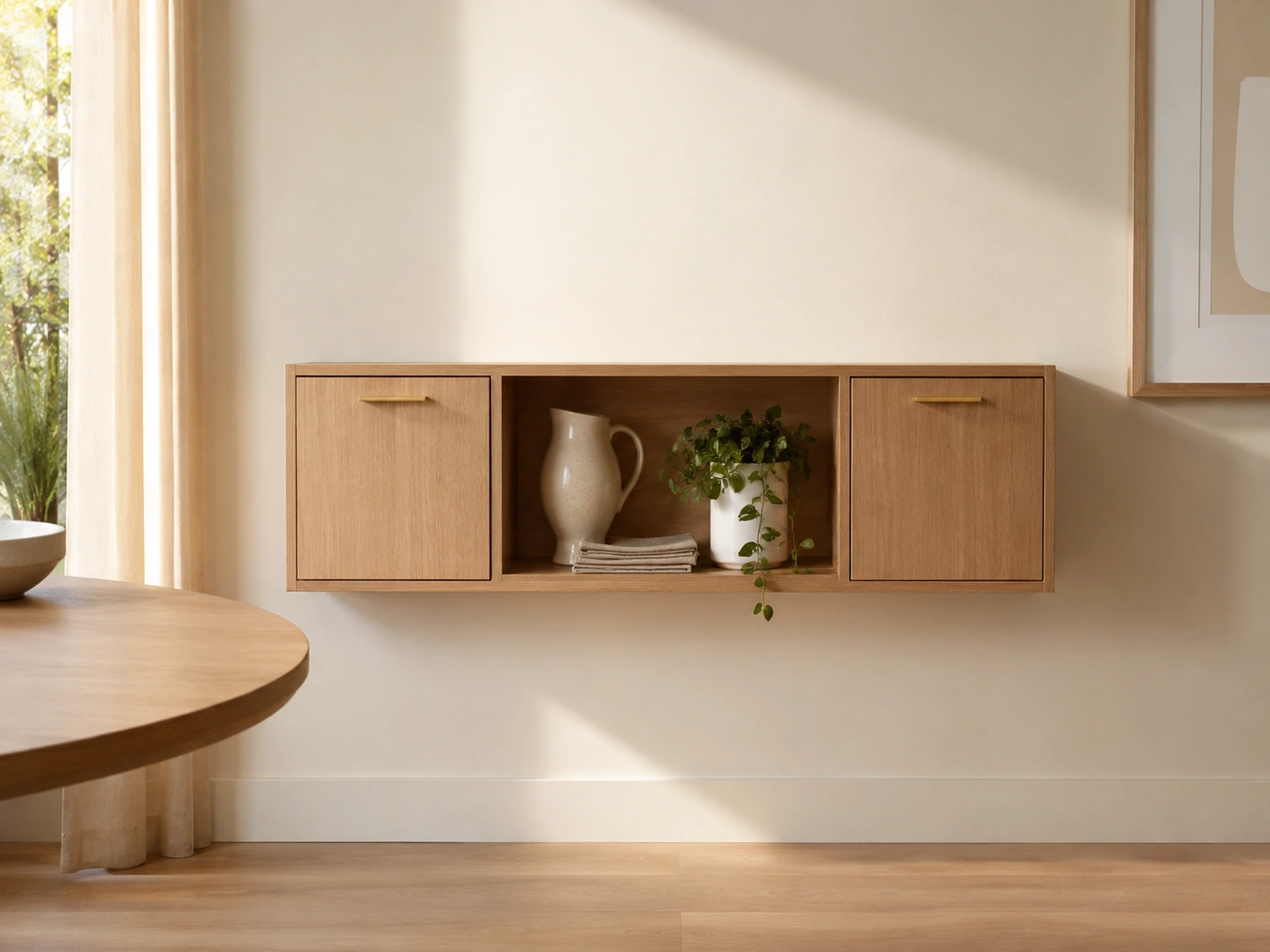
A floor-standing sideboard adds storage but also claims a full column of floor space that a small dining room can rarely afford to give up. A wall-mounted floating buffet solves this exactly — you get the storage surface, the visual breathing room, and the practical shelf space without surrendering a single square foot to the furniture. Mount it at around 36 inches from the floor so it reads as a natural, table-height extension of the room. The clear floor beneath it keeps the space feeling open even when the buffet itself is fully used, which matters enormously in a room where every square foot counts.
Use the cabinet interior for less-attractive storage — extra napkins, candles, serving pieces, the things that usually end up on the dining table itself. Keep the top surface edited down to three items or fewer: a ceramic vase, one trailing plant, or a single stacked set of simple plates. A floating buffet crammed end-to-end with objects defeats its own purpose and turns a storage solution into visual noise. For renters who cannot drill, some floating shelf systems use French cleats or furniture anchors that can be repaired on move-out with a bit of spackle and touch-up paint — worth discussing with your landlord before committing.
10. Use a Slim Bar Cart as a Mobile Sideboard
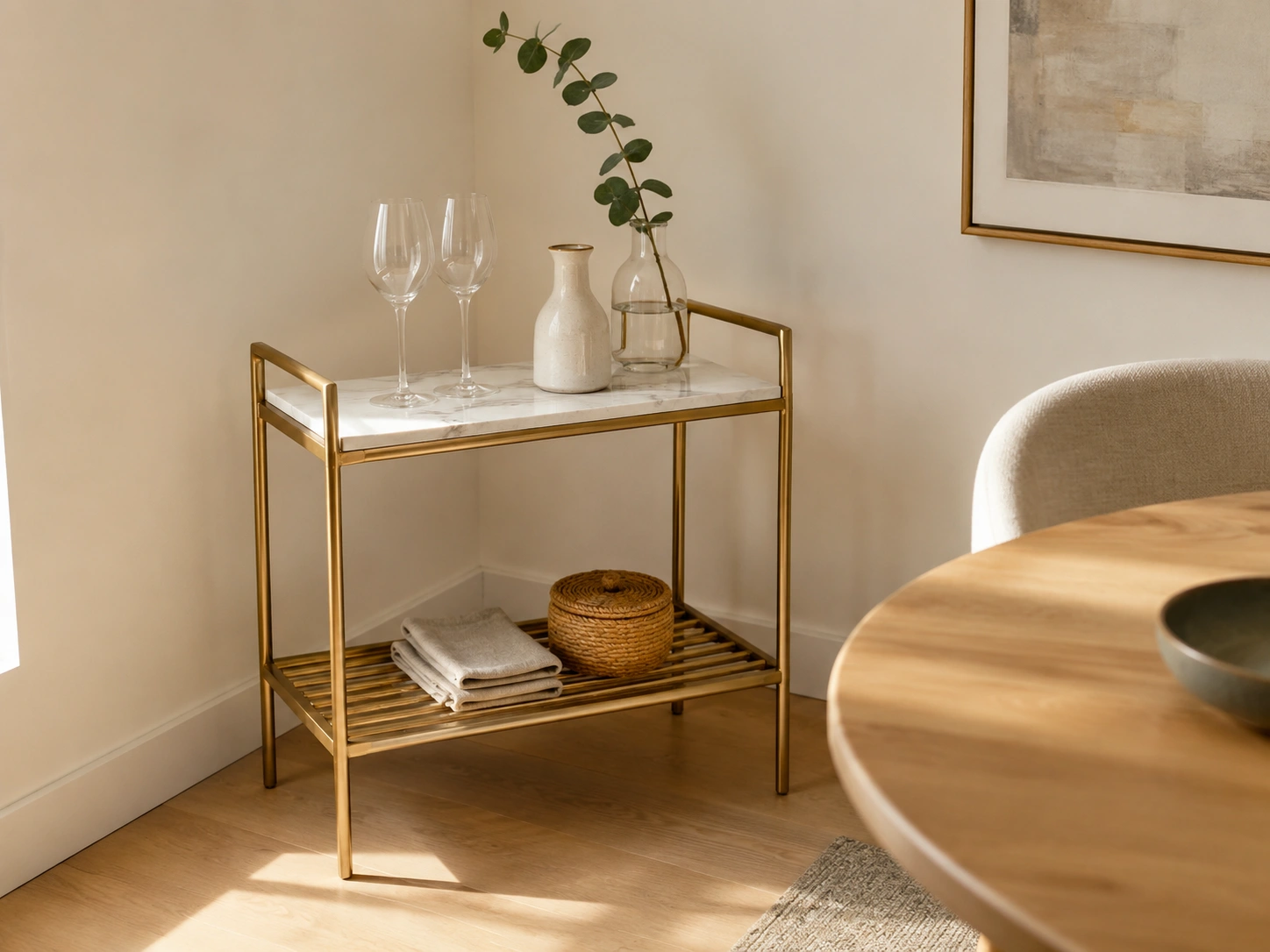
A bar cart used as a sideboard sounds almost too simple to be this effective, but it consistently earns its place in small dining rooms for one specific reason: it moves. A slim two-tiered cart on wheels gives you a mobile storage surface that rolls into a corner during ordinary evenings, slides to another room when you need the floor space completely, and doubles as a genuinely styled moment when it is in the dining room. It functions as a drinks station, a serving surface, a candle and plant stand, and a tidy home for the napkins, placemats, and miscellaneous dining room items that would otherwise pile up on the table itself.
Look for a cart with two or three tiers, a footprint no wider than 24 to 26 inches, and wheels with a locking mechanism so it stays put during a meal. Brushed gold and matte black are the most popular finishes right now and both work comfortably in warm neutral, modern, or Scandinavian-inspired dining rooms. Style it with purpose: a ceramic pitcher, two glasses, a stem of greenery, and one small basket for napkins. A styled bar cart reads as a design choice; an overstuffed one reads as a dumping ground. Budget Pick: Target’s Threshold collection has slim bar cart options under $80, and the Studio McGee line within Target is a strong choice for the Pinterest aesthetic this room is going for.
11. Add Floating Shelves Instead of a Bulky Hutch
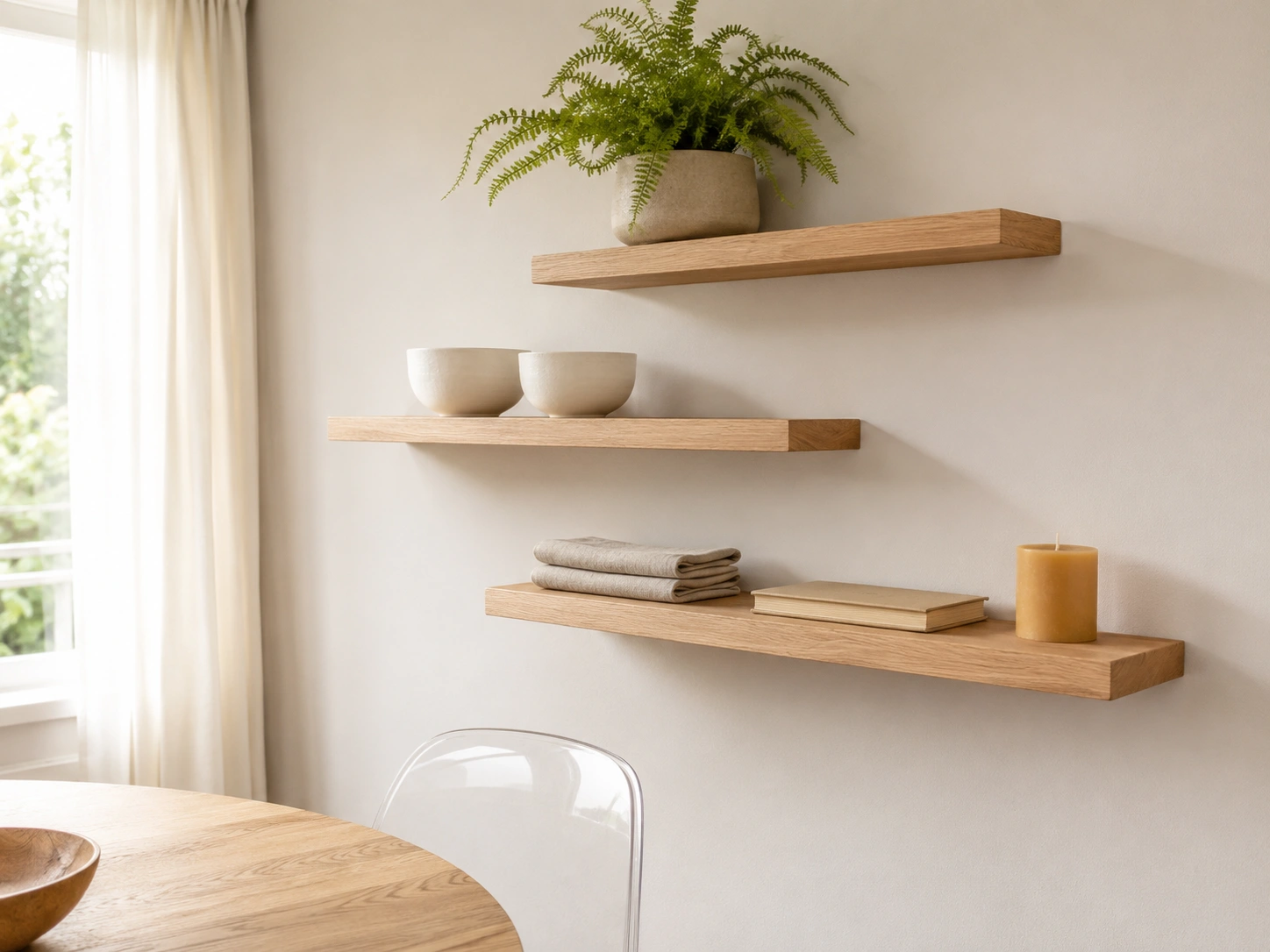
A hutch is a beautiful piece of furniture in a room with floor space to spare. In a small dining room, a tall hutch claims a full column of wall space, visually compresses the ceiling, and creates a heavy, enclosed feeling that makes the room read darker and more cramped than it actually is. Floating shelves give you the vertical storage and display potential of a hutch with none of that weight. The walls stay light, the floor stays fully open, and the room keeps breathing. IKEA’s small space furniture collection includes several affordable floating shelf systems that install cleanly and hold a meaningful amount of display and storage weight.
Mount floating shelves at 60 to 72 inches from the floor — high enough to clear head space comfortably but low enough to access daily items without a step stool. Leave significant negative space between items; a shelf styled at about 60% full looks curated and intentional, a shelf packed edge to edge looks like overflow storage even when every individual item is attractive. Mix textures deliberately — a ceramic piece beside a woven basket beside a small fern — and keep the color palette tight: two or three tones maximum. Renter-Friendly: Most floating shelves require only two or three small wall screws, easily patched on move-out.
12. Go Dark on One Accent Wall for Cozy Drama
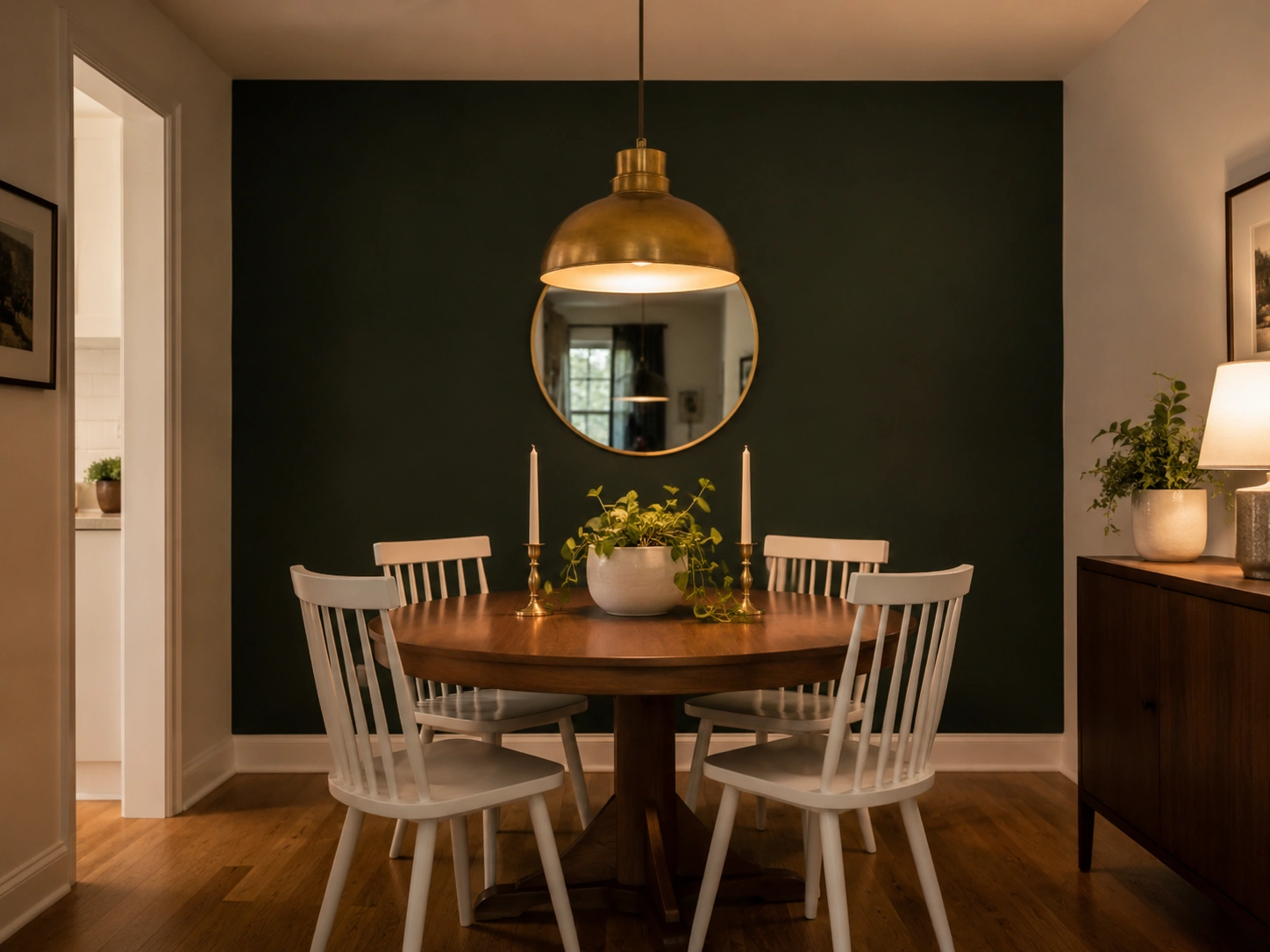
The counterintuitive truth about painting a small dining room wall dark is that it makes the room feel more intentional and atmospheric, not smaller. A deep forest green, warm charcoal, or rich terracotta on a single accent wall creates dimension and drama that pulls the eye into the room rather than making the walls feel like they are pressing in. When the remaining three walls stay light, the room still reads as airy — but now the dining area has a focal point that feels deliberately designed rather than accidentally decorated. This is the difference between a room that looks styled and one that merely looks furnished.
Choose a paint finish in eggshell or satin rather than flat — both reflect a small amount of light and clean more easily, which matters in a dining room where splashes happen. Anchor the dark wall with a round mirror in a warm metal frame (gold and brass pop especially well against deep greens) and hang your pendant low enough to fill the center of the visual composition. If you are renting, peel-and-stick removable wallpaper in a deep tone achieves a nearly identical effect without permanence — the quality of the best options has improved dramatically and is genuinely difficult to distinguish from painted walls at a glance. Renter-Friendly: Peel-and-stick removable wallpaper causes no wall damage on removal.
13. Keep the Full Palette Light and Monochromatic
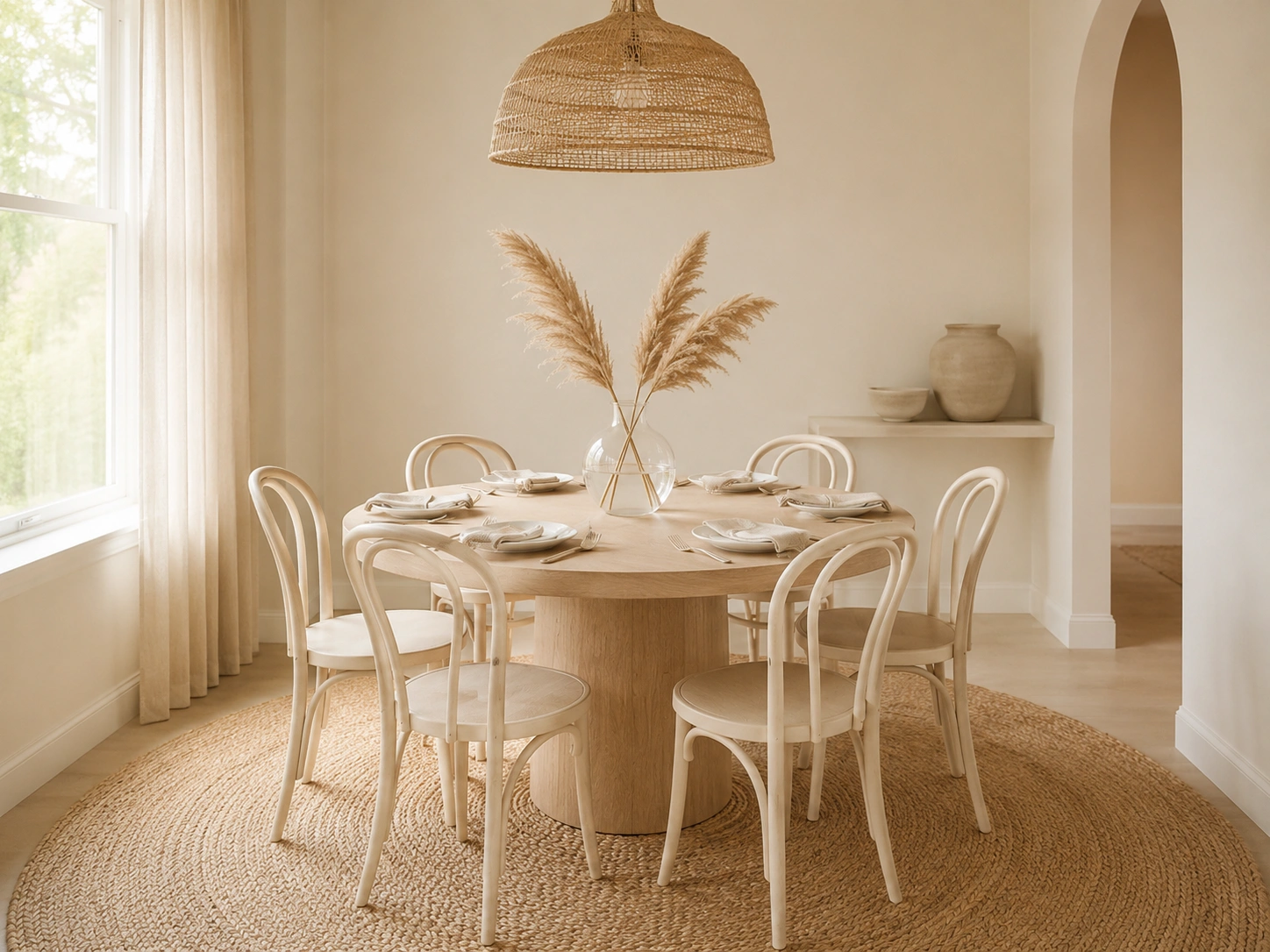
Going monochromatic does not mean boring — it means letting texture and tone do the visual work that color contrast usually handles. In a small dining room, a tight palette of cream, warm white, and natural linen removes visual noise entirely. The room stops feeling fractured and starts feeling like one cohesive, breathing space. The eye moves smoothly across surfaces rather than jumping between contrasting colors, which creates the perception of more space without moving a single piece of furniture. It is one of the quietest and most consistently effective tricks in the small-space playbook.
The key to keeping a monochromatic palette from feeling flat is layering textures deliberately. A jute rug, a linen cushion, a ceramic vase, a woven pendant shade, and a raw wood tabletop can all exist within the same warm neutral range and still feel rich and interesting. Bring in one subtle material contrast — the natural warmth of rattan against the smooth cool of ceramic, or the roughness of dried pampas against a polished table surface — and the room will feel styled without feeling busy. Avoid cool grays or stark white in this palette; the warmth of cream and sand is what makes it feel cozy rather than clinical. Budget Pick: Cream and linen accessories are widely available in Target’s Studio McGee collection and throughout IKEA’s textile range.
14. Hang Your Pendant Light Lower Than You Think
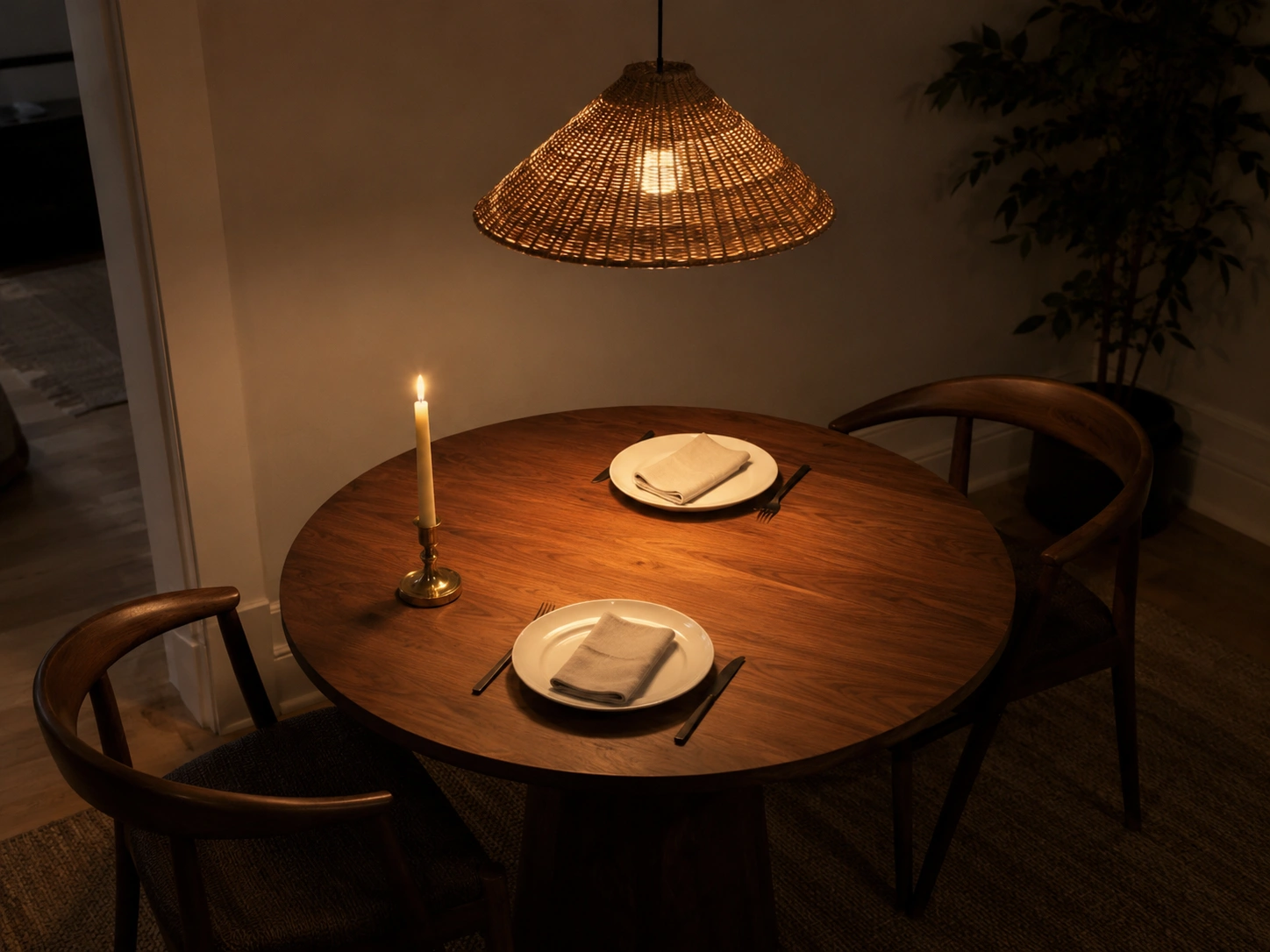
The height at which a pendant hangs over a dining table is one of the most consistently misunderstood details in small-space decorating — and getting it wrong makes the room feel flat, institutional, and under-designed. The accepted guideline is 28 to 34 inches above the tabletop. Most people hang the pendant too high, which pushes the light upward toward the ceiling and removes the intimate, pool-of-light quality that makes a dining table feel like a destination worth sitting at. In a small room specifically, a pendant at the correct height visually anchors the dining area and gives the whole room a clear, warm center of gravity.
A large, wide pendant shade — woven rattan, a linen drum, or matte ceramic — creates more warmth and presence at the right height than a small pendant floating too far above the table. In a compact dining room, a pendant that feels slightly large for the space is almost always the right call: it creates a sense of scale and intention that a modest fixture never quite achieves. If hardwiring a new pendant is not an option (and for approximately 36% of U.S. households who rent, according to the U.S. Census Bureau, it often is not), a swag-style plug-in pendant solves the problem with no electrician required. Renter-Friendly + Budget Pick: Plug-in swag pendants are available on Amazon for $40 to $90.
15. Add a Dimmer Switch for Instant Evening Atmosphere
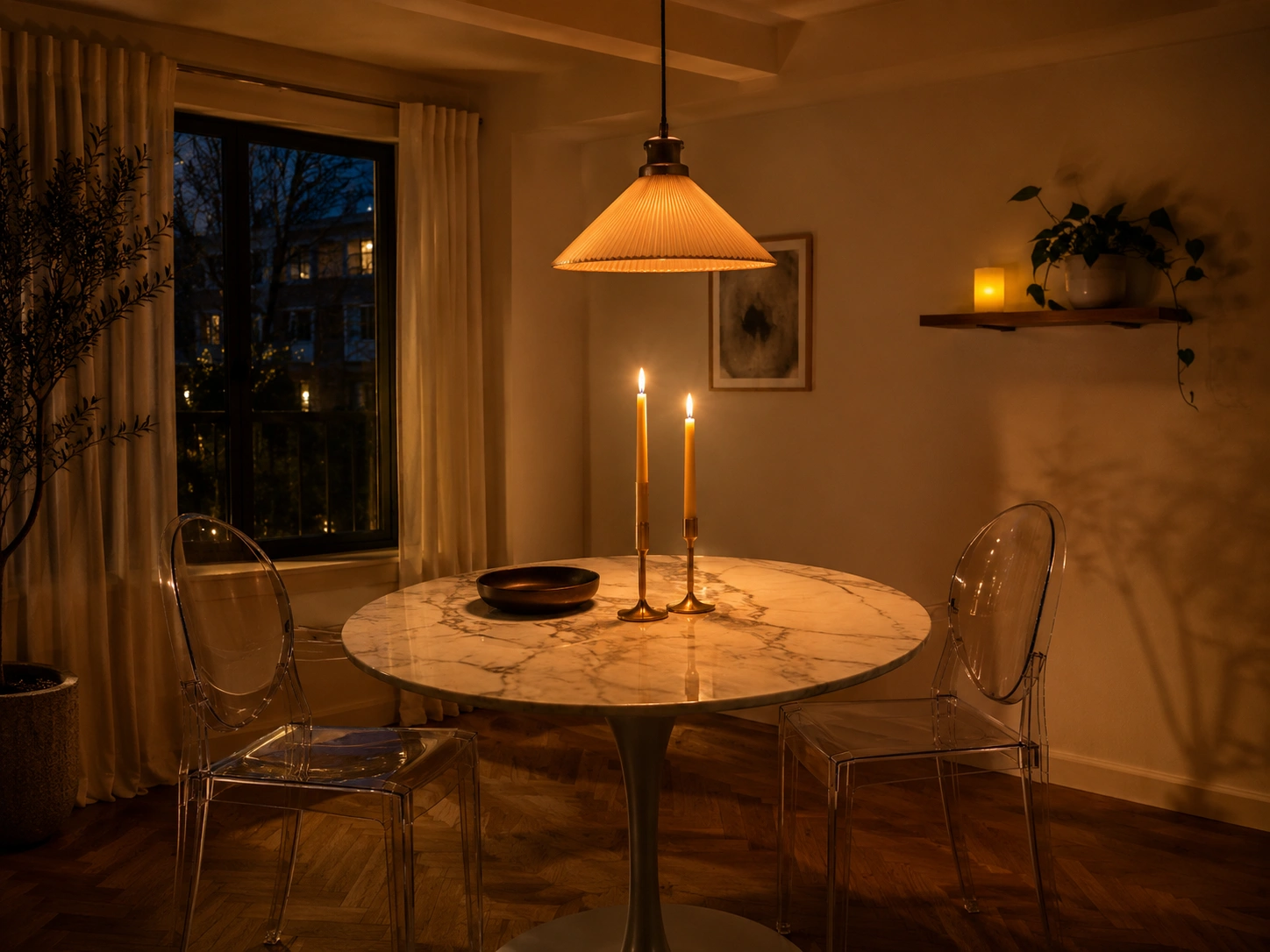
A dimmer switch is a $15 to $25 hardware store investment that transforms the evening atmosphere in a small dining room more than almost any piece of furniture or decor ever could. Overhead lights at full brightness flatten a room and make it feel clinical. Drop them to 40 or 50 percent and suddenly the room has depth, warmth, and shadow — the relaxed, intimate quality that makes dinner feel like an event rather than a task. It is genuinely the fastest single upgrade in this entire list. Most dimmer switches are compatible with LED bulbs; just confirm the bulb packaging says “dimmable” before purchasing and installing.
For renters, a smart plug-in dimmer — Lutron makes a well-reviewed option that plugs directly into the outlet and controls a lamp — achieves the same effect for table or floor lamps without touching any wall wiring at all. Combine a dimmed overhead fixture with two candles at the table center and a battery-operated warm LED candle on a shelf nearby, and the small dining room shifts from an ordinary weeknight space into somewhere you actually want to linger. This layered lighting combination — dimmed pendant, candles on the table, a warm ambient lamp in the corner — is exactly what makes those beautifully lit small dining room photos on Pinterest look so effortlessly inviting. Budget Pick + Renter-Friendly: Plug-in smart dimmer adapters require no electrical work, no landlord permission.
16. Define the Dining Zone With a Properly Sized Area Rug
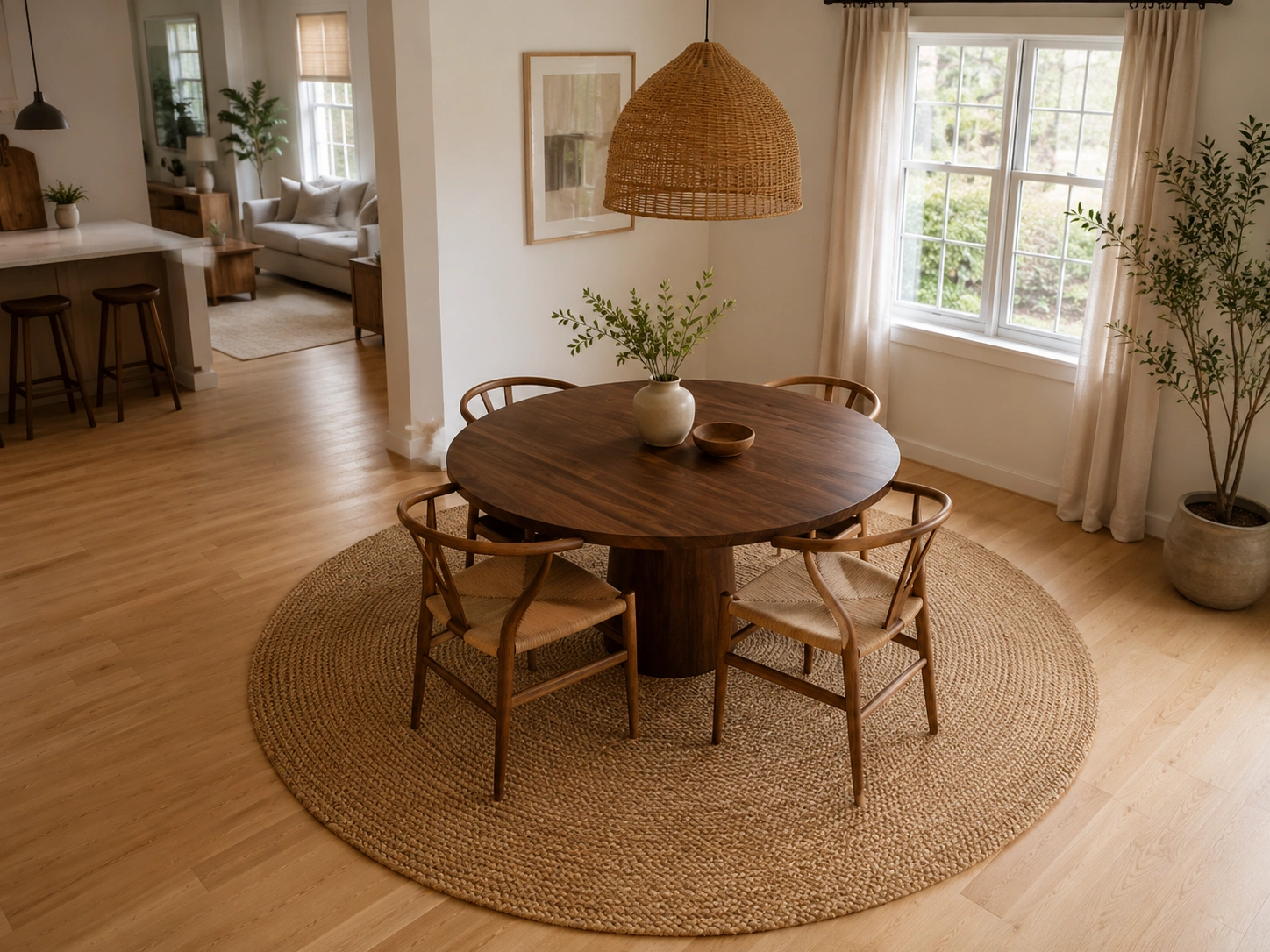
An area rug under a dining table does two things simultaneously: it visually defines the dining area as its own distinct destination within a larger open-plan space, and it adds texture, warmth, and acoustic softness that makes the whole setup feel more finished and deliberate. In an apartment where the kitchen, living, and dining areas blur together, a rug is often the only visual boundary that tells the eye “this is the dining space” — which makes the entire layout feel more intentional and organized rather than like furniture that happened to land in a particular spot. Size is where most people go wrong: the rug must be generous enough that chair legs remain on it when pulled out for sitting.
For a round table, a round rug in a 6 to 8-foot diameter works for most four-person setups. For a rectangular table, extend the rug at least 24 inches beyond each end of the table. Natural fibers — jute, sisal, and cotton flatweave — are well suited to dining rooms because they clean easily, do not trap crumbs the way pile rugs do, and have an organic texture that photographs warmly. Avoid high-pile or shag rugs under dining tables: they are nearly impossible to maintain and the chair legs will catch on the pile every time someone sits down. Budget Pick: A 6×6 jute round rug at Target or IKEA typically runs $60 to $120.
17. Use Floor-to-Ceiling Curtains to Add Visual Height
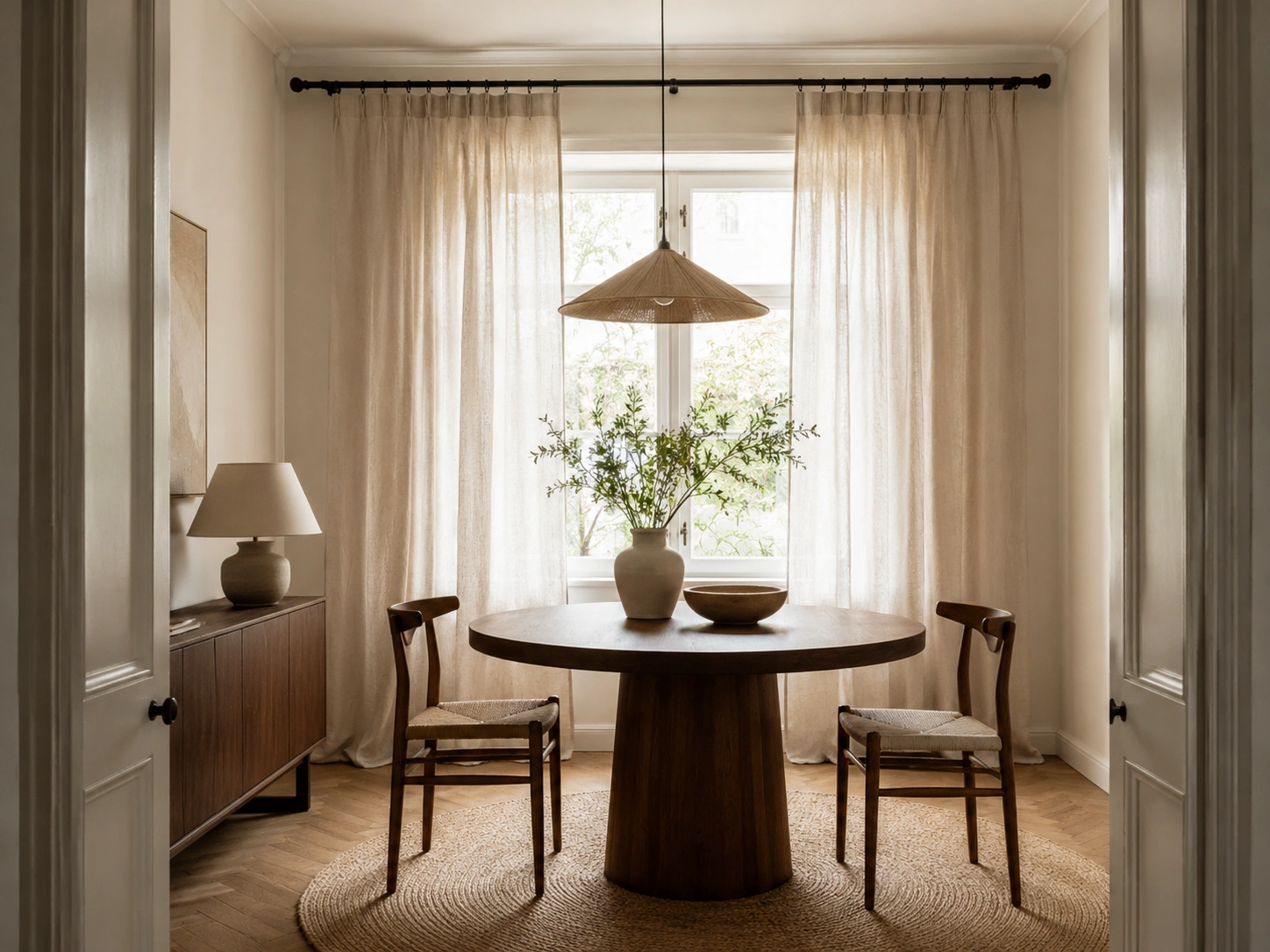
Curtains hung at ceiling height rather than window frame height add a significant sense of vertical space to any room — and in a small dining room where the ceiling can already feel low, this single change creates an impression of upward openness that almost nothing else replicates. Mount the curtain rod as close to the ceiling line as possible (or directly on the ceiling) and let the panels fall all the way to the floor. When the eye follows the fabric in one long, unbroken vertical line from ceiling to floor, it registers the full ceiling height naturally rather than fixating on the room’s width constraints. Renter-Friendly: Tension rods and removable adhesive curtain rod brackets require zero drilling.
Choose lightweight, semi-sheer fabrics — linen, cotton gauze, or a linen-cotton blend — that allow natural light to filter through softly. Heavy blackout curtains make a small dining room feel enclosed and dim, which is the opposite of the goal here. Also important: mount the rod at least 6 to 8 inches wider than the window frame on each side so the curtain panels stack off the glass entirely when open. This maximizes the incoming light and makes the window appear meaningfully wider than its actual frame dimensions. Ivory, warm white, and natural sand tones are the most versatile choices and work in nearly every dining room palette.
18. Turn a Window Corner Into a Cozy Dining Nook
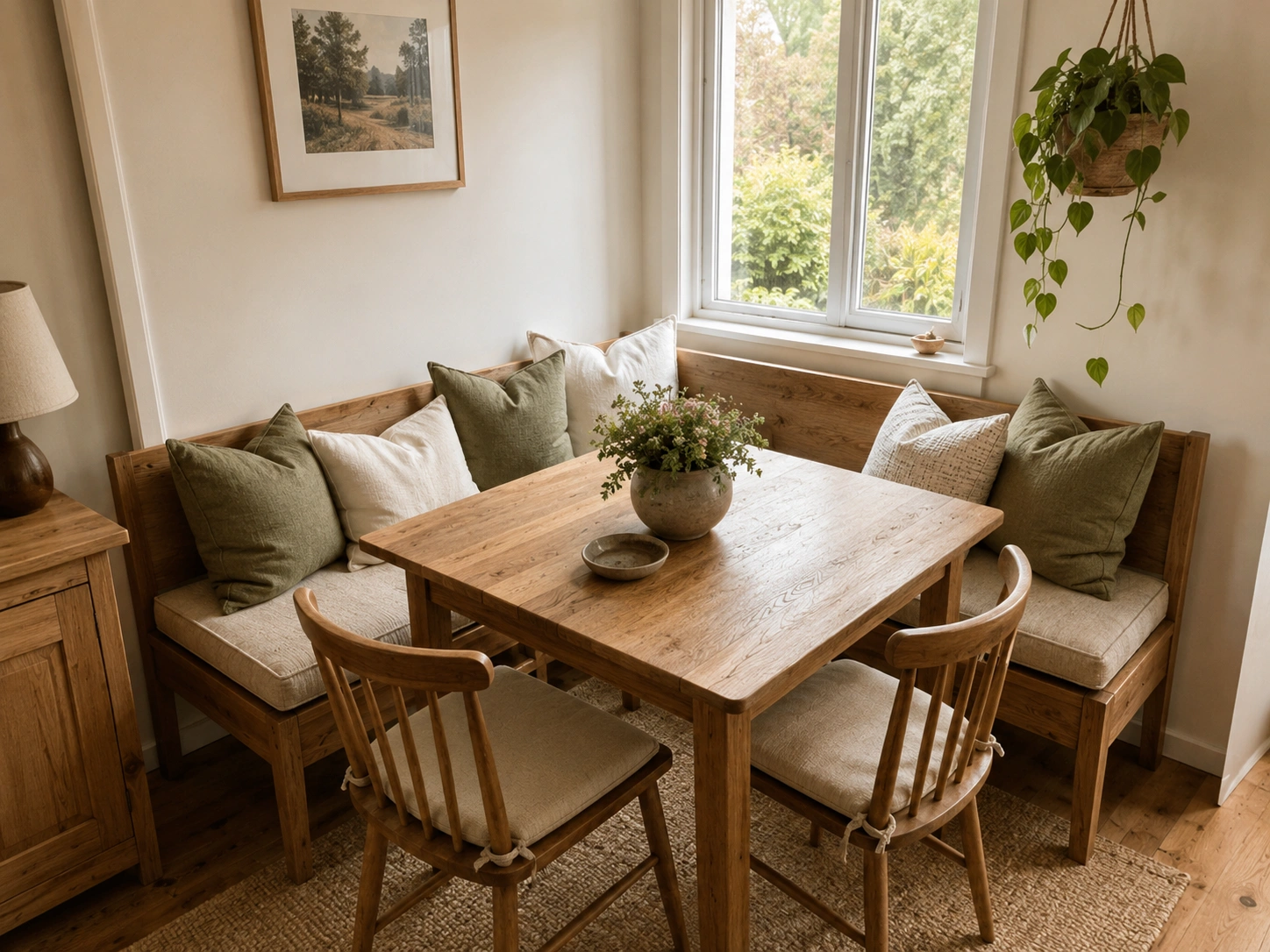
A corner that currently holds a forgotten lamp, an awkward chair, or nothing at all can often be transformed into the most charming space in the entire apartment. A window corner dining nook — two benches arranged in an L with a small table pushed into the corner between them — creates an enclosed, intimate feeling that reads as cozy rather than cramped because the window keeps the view open and the light pouring in. The bench cushions, a few throw pillows, and a simple square table turn what was a dead zone into the kind of spot people naturally gravitate toward and want to settle into. This is the corner that gets saved on Pinterest.
The nook does not need to be custom-built to look intentional. Two freestanding benches placed in an L with a square table between them achieve the same visual result without any carpentry. Look for solid wood storage benches where the seat lifts to reveal interior space — the hollow interior doubles as concealed storage for placemats, tablecloths, and other dining room items that typically have no natural home. Add throw pillows in a textured linen or boucle fabric and a small trailing plant hung from a ceiling hook in the corner of the window, and the composition instantly looks like a feature the room was designed around. Budget Pick: Two IKEA SKOGSTA or ÄPPLARÖ benches can create a nook setup for under $150 total.
19. Mix Seating Styles for a Curated, Intentional Look
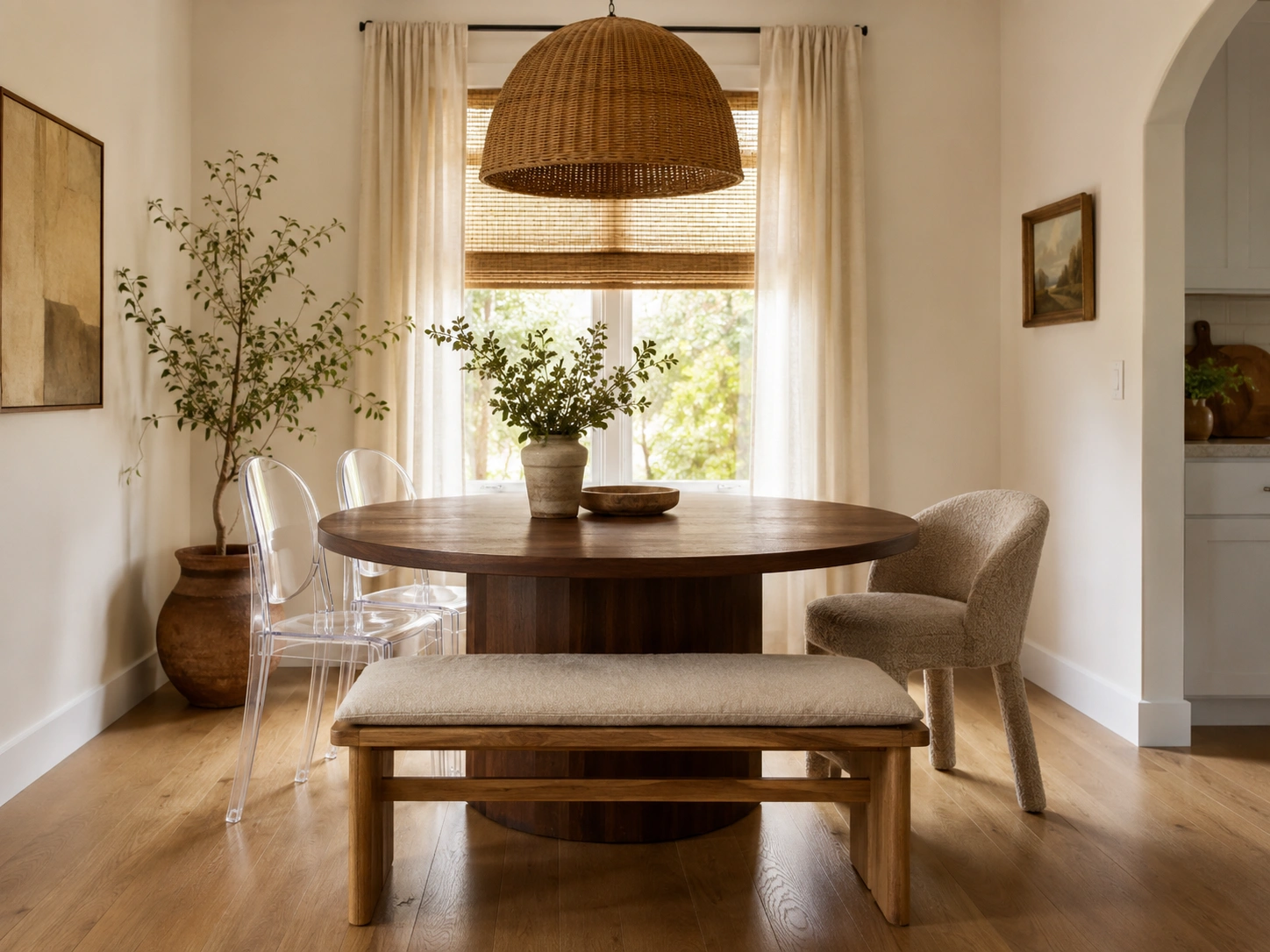
Matching dining chair sets look tidy in a catalog — but in a small dining room, they can make the seating arrangement feel rigid and monotonous. Mixing seating styles is both a legitimate interior design approach and a practical one. Swapping two chairs for a bench recovers floor space while adding a surface that seats more people in the same width. Adding two ghost chairs alongside one wooden chair builds cohesion through material contrast without visual heaviness. Placing one upholstered statement chair creates a focal point that makes the whole arrangement feel considered. The result looks like deliberate choices, not like furniture that ended up in the same room by default.
The rule for making mixed seating work is to keep one design element consistent across all pieces — finish tone, material family, or overall scale. All pieces in natural wood tones with different shapes: works. All pieces in the same scale without mixing drastically oversized and undersized: works. All pieces within the same two-color range: works. The mix should read as a curated edit, not a collection of spare furniture from different eras. Start by introducing a third piece that differs from the existing two — a bench, a ghost chair, or a single upholstered seat — and assess the composition before going further. When it lands right, it looks effortless. When it is overdone, it looks chaotic: err toward restraint.
20. Add Plants and Greenery Without Cluttering the Table
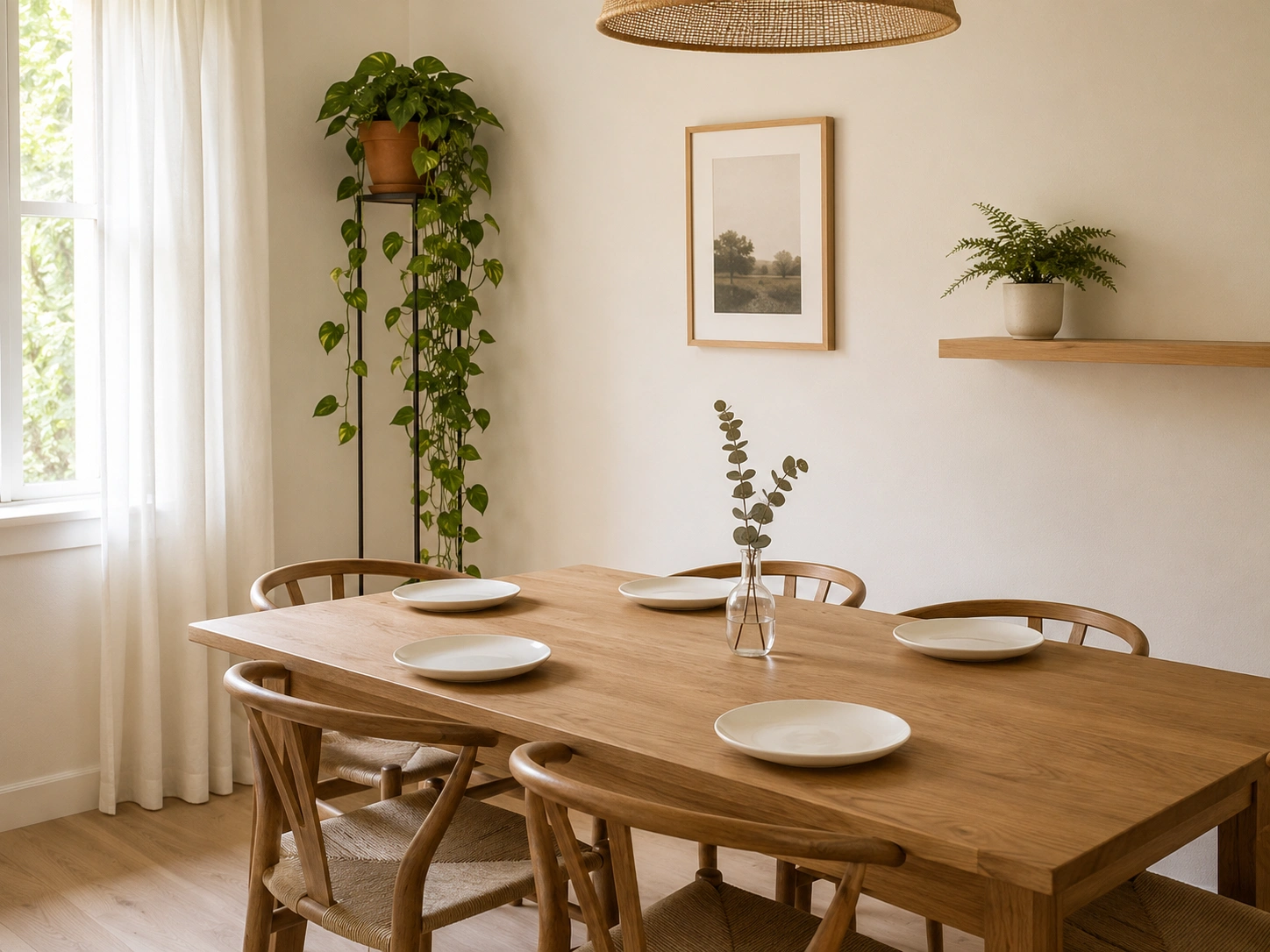
Plants make a dining room feel alive in a way that almost no other decor element matches — but the mistake most people make is placing the plant directly on the dining table, where it competes with every meal, every candle, and every centerpiece attempt that follows. Think vertically and peripherally instead. A tall trailing pothos on a slim plant stand in the corner of the room adds organic life at eye level without claiming any table or counter surface. A small compact fern on a floating shelf brings green into the wall composition. The table itself stays clear, functional, and ready for actual use.
For the table, a single stem of eucalyptus in a slim glass bud vase — or three dried pampas stems in a minimal ceramic vase — is enough to add an organic moment without blocking sight lines or making every meal feel like eating around an obstacle. The goal is to suggest nature, not to replicate a greenhouse. Choose plants that genuinely thrive in lower light if your dining room does not receive strong direct sun: pothos, snake plants, ZZ plants, and most ferns handle the indirect, filtered light that most apartment dining rooms naturally get. Budget Pick: A trailing pothos from a local nursery or IKEA typically costs $8 to $15 and is nearly indestructible, which matters.
21. Use the Wall for Functional Decor With a Hook Rail or Pegboard
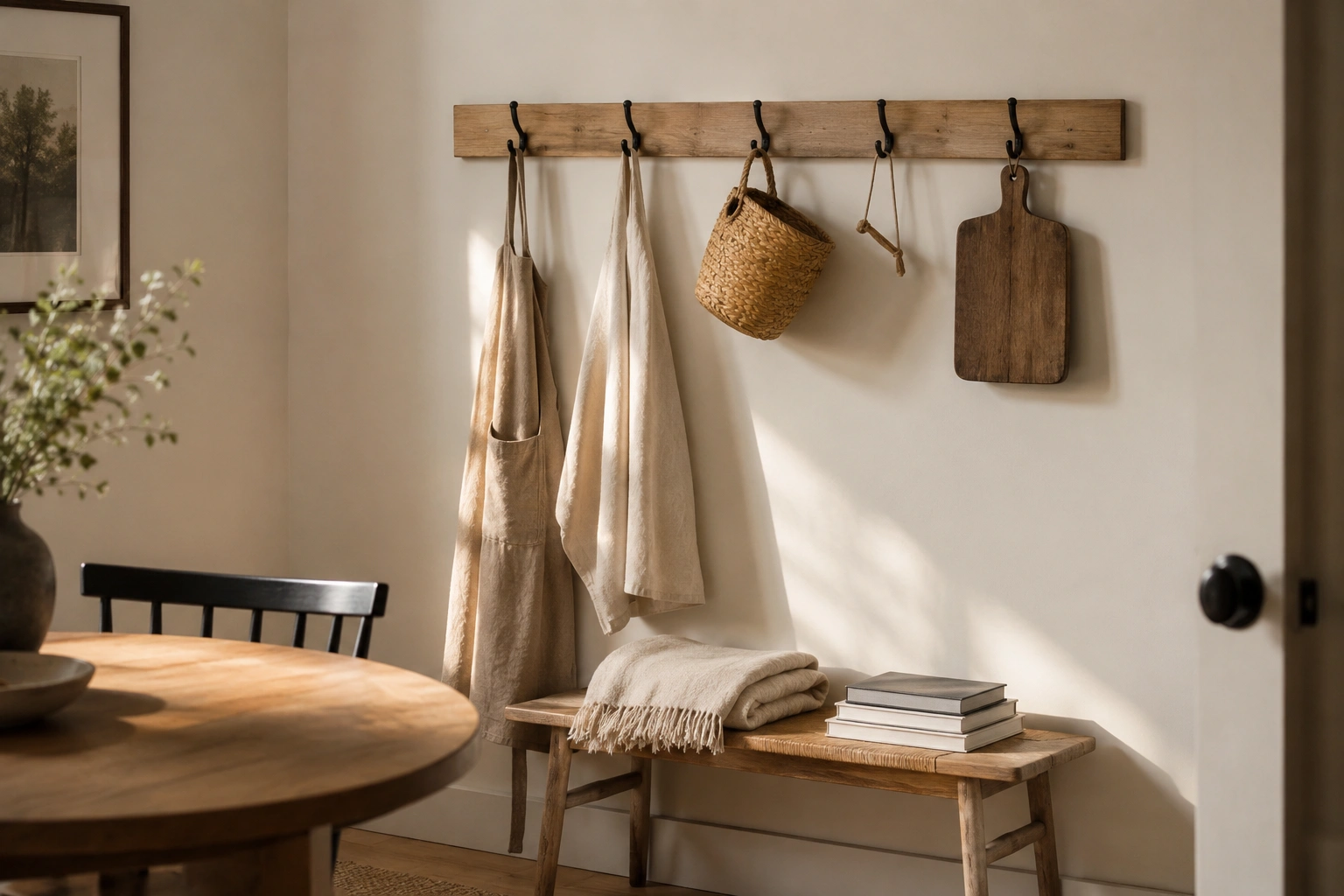
Wall space is the most overlooked resource in a small dining room, and a simple hook rail or narrow pegboard can turn a blank wall section into a functional storage moment that also happens to look genuinely styled. A Shaker-style hook rail in light oak or painted white works in almost any aesthetic and holds aprons, woven baskets, small bags, or frequently used kitchen linens without claiming any floor space at all. A pegboard offers even more flexibility — add small shelves, hooks, and holders wherever they are needed and rearrange them as storage needs change over time. Both mount with a few screws and patch cleanly on move-out. Renter-Friendly: Small screw holes fill with basic spackle in minutes.
The styling principle is intentionality: what goes on the wall hooks should be items that are both useful and visually attractive. A linen apron, a simple woven basket, and a vintage-style wooden board are the right kind of items for this wall. Avoid using the hook rail as a catch-all for bulky winter coats, reusable grocery bags in poor condition, or anything utilitarian and visually unappealing — in a small dining room, the hook wall is essentially a piece of decor. Keep it edited to three to five items maximum, chosen for both function and form. A small botanical print or a dried herb bundle hung beside the rail softens the composition and makes the whole wall feel considered. Budget Pick: Basic Shaker hook rails are available at IKEA and Target from $15 to $30.
22. Layer Candles and Ambient Lighting for Evening Dining
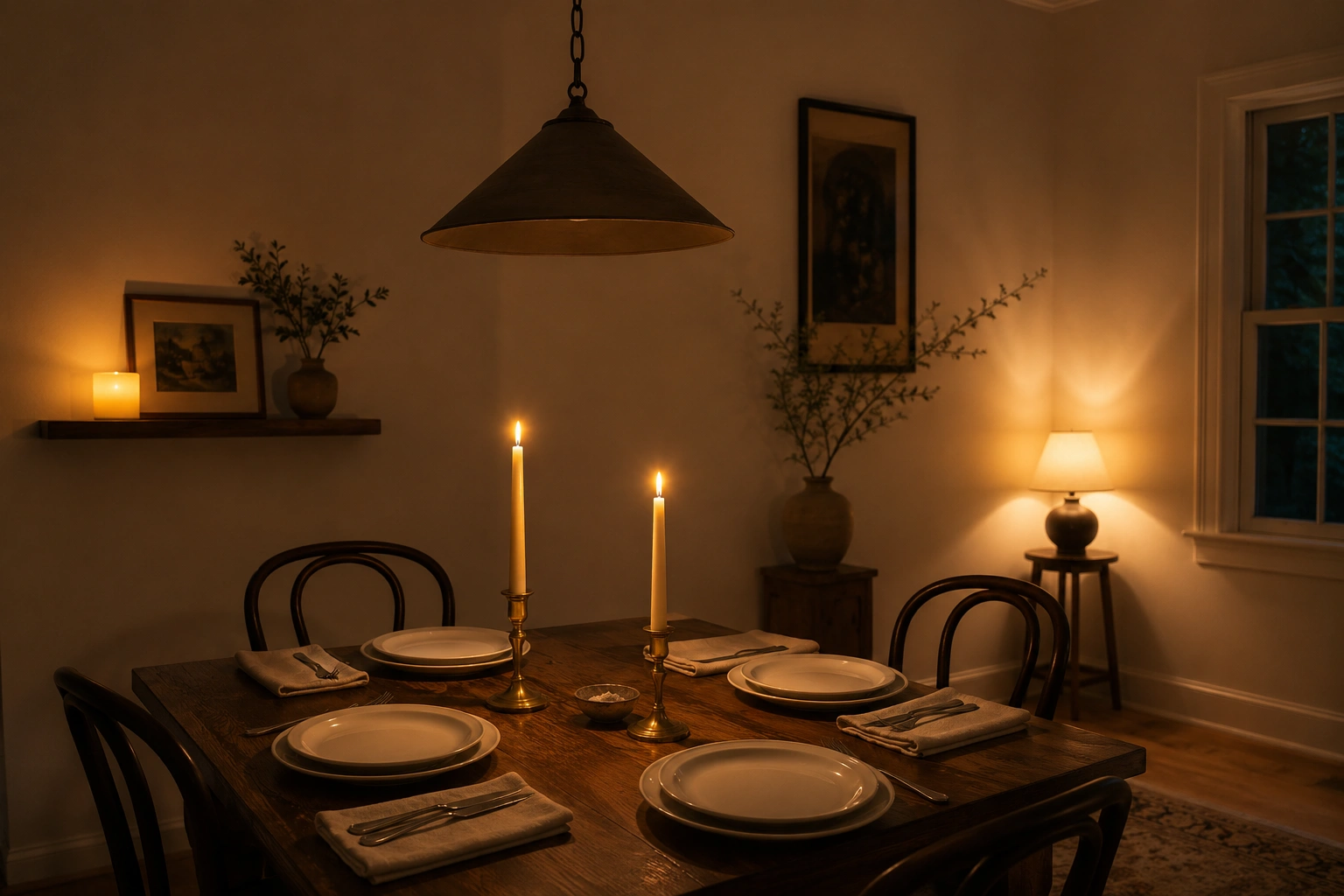
Overhead lighting at full brightness turns a small dining room into a space you want to leave quickly. Layered candlelight turns the same room into a place you want to stay in for hours. Two or three candles at the dining table center are enough to shift the evening mood entirely — the flickering warmth, the amber glow, and the way candlelight naturally softens a room’s hard edges and scale all contribute to an atmosphere that overhead fixtures simply cannot create on their own. This layered lighting approach is exactly what makes those beautifully lit small dining room photos on Pinterest look so effortlessly warm and inviting: it is not a professional photography setup. It is just light at the right temperature, in the right places.
Use candles at varying heights for visual interest — one tall taper in a simple brass holder alongside two shorter votives creates a more dynamic composition than three identical candles in a single row. Add a battery-operated warm LED candle on a shelf or side surface for continuous ambient glow without fire management. The Lumabase brand makes convincingly flickering options in a genuinely warm tone. Combine them with a dimmed pendant overhead and a small table lamp in the corner, and the small dining room that felt ordinary at 6pm becomes the kind of space you are still sitting in at 10pm without quite knowing why. Budget Pick + Renter-Friendly: Battery-operated LED candles at Target run $8 to $15 each, require no installation.
23. Embrace the Awkward Shape and Design Around It
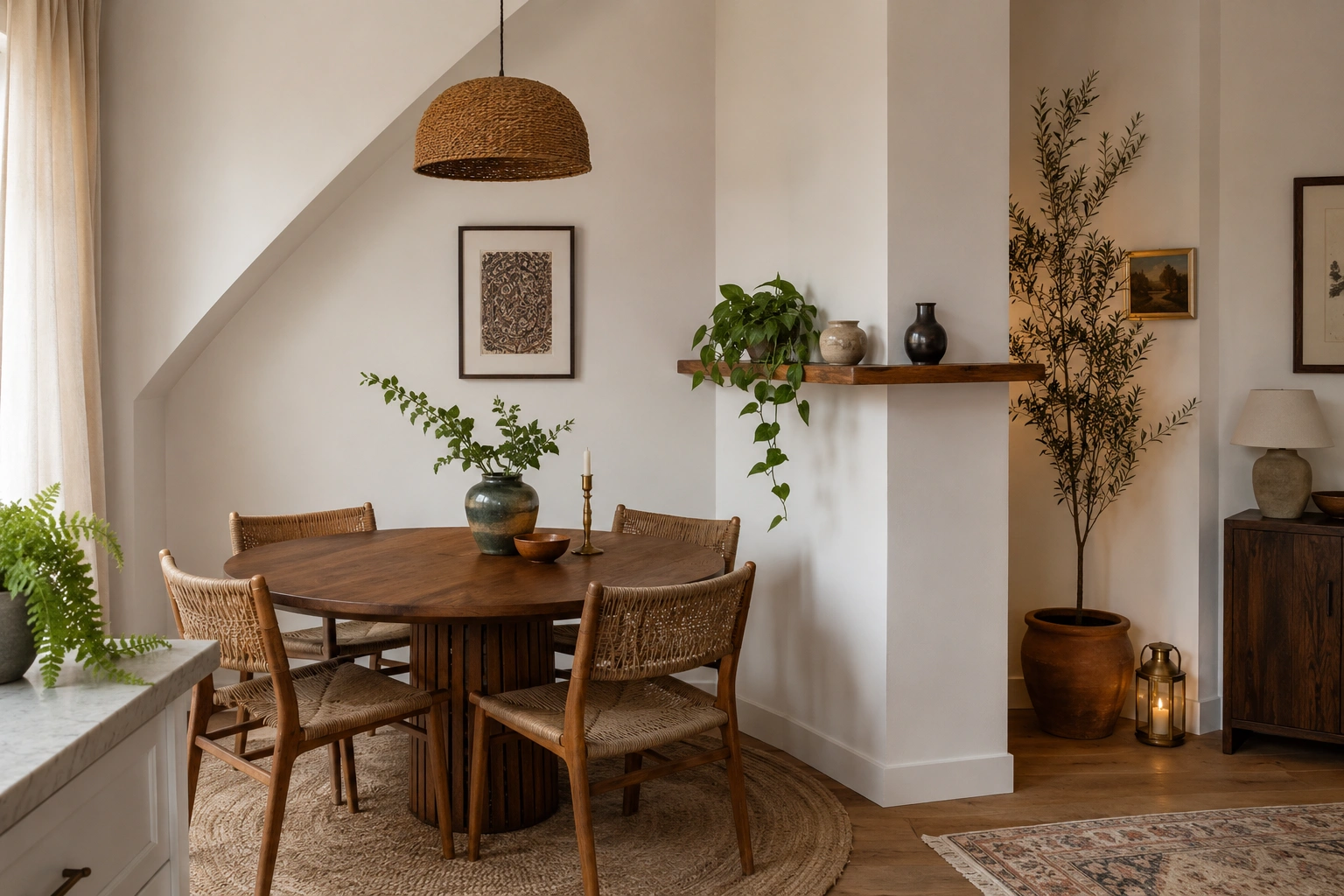
Every small dining room has at least one awkward feature: a column that juts into the room, a doorway that makes furniture placement nearly impossible, a recessed wall that creates a dead corner nobody knows what to do with. The conventional response is to fight these features — to keep rearranging furniture until the awkward element disappears. A more effective approach is to stop resisting and start designing around the shape as though it were always part of the plan. A column becomes a surface for a trailing plant shelf. A recessed wall becomes a natural nook. An angled corner becomes the room’s defining feature moment rather than its biggest frustration.
The mindset shift from “this room is working against me” to “this room has a specific personality I need to lean into” is where the most effective small-space designs come from. Rooms that look styled and intentional rarely start with perfect proportions — they start with someone who decided to design with the constraints rather than around them. Map your awkward feature first: decide whether it becomes a storage moment, a display surface, a visual anchor, or a framed zone of negative space. Then build the rest of the room outward from that single decision. Occasionally the most memorable dining rooms are built entirely around a quirk nobody else would have known how to use. [small space decorating ideas that work in every room] follow this same principle: the constraint is the starting point, not the obstacle.
FAQs
Can I still have a buffet or sideboard in a small dining room?
Yes, opt for a wall-mounted floating version rather than a floor-standing piece. A floating buffet provides the same storage and display surface without claiming any floor space. Keep the top styled with three items or fewer so it reads as intentional rather than cluttered.
Should I use an area rug in a small dining room?
Yes, and size it generously. The rug must extend at least 18 to 24 inches beyond each chair leg so chairs remain on the rug when pulled out for sitting. A rug that is too small actually makes the room feel more cramped, not less, so it is worth investing in the right size.
Is it okay to hang a chandelier in a small dining room with low ceilings?
Choose a flush-mount or semi-flush version instead of a full chandelier with a long chain drop. A wide, low-profile pendant shade creates equally strong visual impact without lowering the perceived ceiling height. Avoid anything that hangs below the 28 to 34-inch-above-table guideline.
What colors make a small dining room look bigger?
Warm whites, soft creams, and light sand tones read as most open. A monochromatic palette — keeping walls, furniture, and textiles within the same warm-neutral family — creates visual continuity that the eye reads as spacious. Avoid sharp color contrast between walls and large furniture pieces.
How do I add storage to a small dining room without making it feel more cluttered?
Go vertical and wall-mounted: floating shelves, a wall-mounted buffet, and a hook rail keep everything off the floor. Keep surfaces edited — aim for 60% full at most. A bar cart on wheels adds flexible, movable storage without permanently occupying any floor space.



No Comment! Be the first one.