






A Viable Business Isn’t Built on Gut Feeling: Here’s How to Actually Test Yours
A viable business is one that can sustain its operations, cover its costs, and generate consistent profit over time — not just on paper, but under real market conditions. Viability is not the same as...


A viable business is one that can sustain its operations, cover its costs, and generate consistent profit over time — not just on paper, but under real market conditions. Viability is not the same as having a good idea. It’s measurable confirmation that an idea has a commercial home.
That distinction matters far more than most pre-launch founders recognize.
According to CB Insights’ post-mortem analysis of over 100 failed startups, 42% collapsed specifically because there was no market need — not because the founder lacked passion, worked insufficient hours, or had poor product execution. The commercial foundation simply wasn’t there. And according to LendingTree’s April 2026 analysis of U.S. Bureau of Labor Statistics Business Employment Dynamics data, 22.1% of new private-sector businesses fail within their first year — roughly 600 closures every single day.
These figures aren’t here to discourage you. They exist to show you exactly which questions to answer before you go all in.
What “A Viable Business” Actually Means
A viable business refers to a venture capable of sustaining its operations, generating revenue that covers costs and compensation, and adapting to market shifts over the long term. Viability is distinct from feasibility: feasibility asks whether a business can be built; viability asks whether it should — and whether it will last.
The word “viable” comes from the Latin vita — life. A viable business isn’t just alive. It can survive on its own.
Practically, this means: you could have a technically feasible product — one that works, that people say they want, that you’ve built cleanly — and still have a business that isn’t viable. If the market is too small, if margins collapse under real pricing, or if customer acquisition costs outrun customer lifetime value, the venture bleeds out regardless of product quality. The mechanism of failure is slow, and it’s almost always traceable to questions that weren’t asked before launch.
What most people searching for “a viable business” actually need is a scoring method, not a definition. That’s what the framework below provides.
A viable business is one capable of generating consistent profit, sustaining operations long-term, and adapting to market changes without continuous capital injection. According to CB Insights’ post-mortem analysis of over 100 startups, 42% failed due to no market need — the core risk that viability testing is designed to surface. Passing a structured viability assessment means confirming real paying demand exists before meaningful time and capital are committed.
Viability and feasibility address different questions and should not be conflated. A business is feasible if it’s operationally possible to build and launch; it’s viable if it can survive, pay its team, and grow in the market. According to LendingTree’s 2026 BLS analysis, 22.1% of new businesses close within year one — a rate that drops substantially among founders who conduct structured viability checks before launch. Testing viability first prevents feasibility work from being wasted on a commercially unworkable concept.
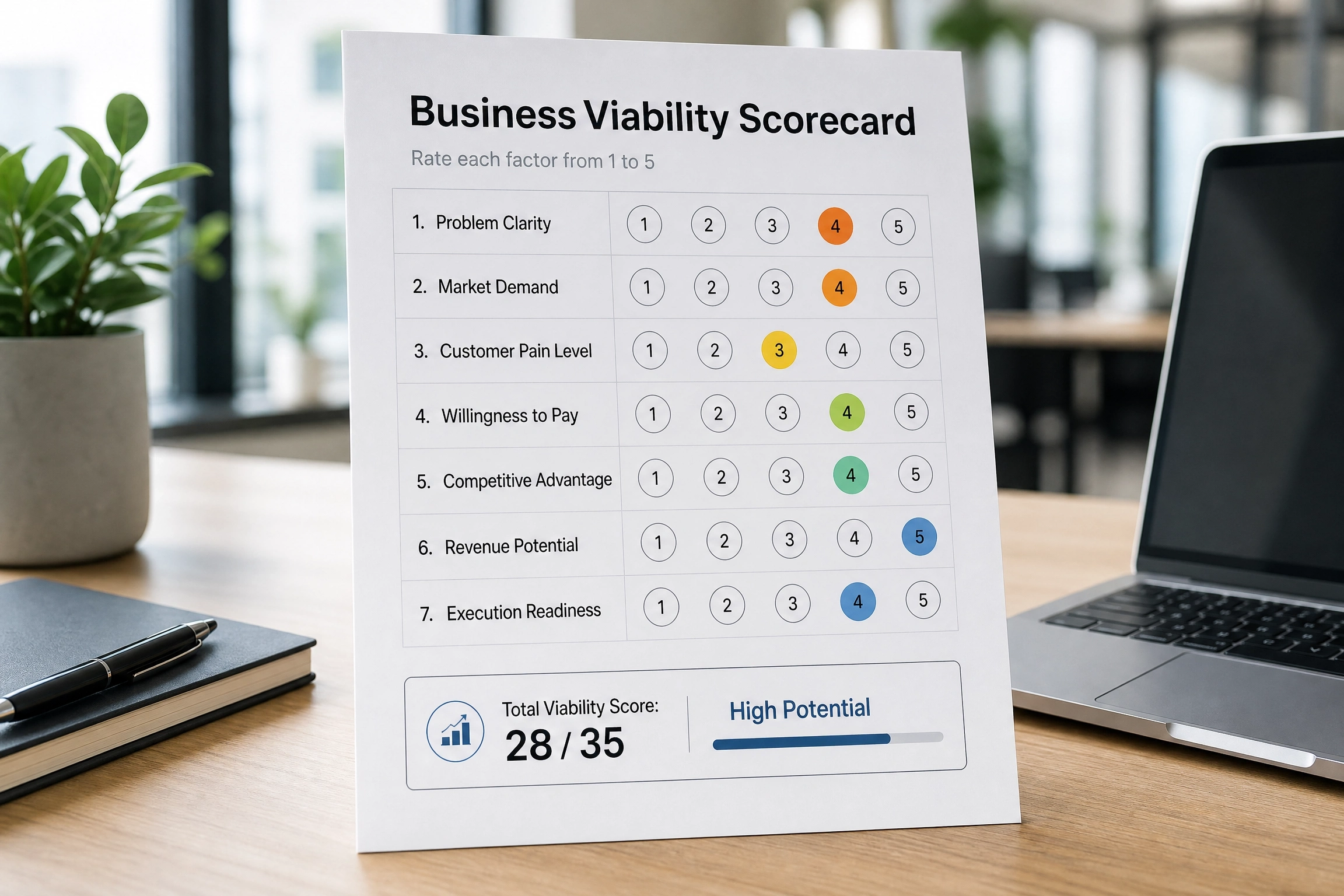
The 7 Factors That Make a Business Truly Viable
Here’s the thing: listing viability factors isn’t enough. What separates founders who survive from those who don’t is actually scoring each factor honestly — before spending real money or leaving stable income.
No single metric makes a business viable or inviable. Viability is composite. Missing one factor is manageable; missing three is a launch you should delay.
Factor 1: Proven Market Demand — Not Just Enthusiasm
People saying “that’s a great idea” is not market demand. People already paying to solve the problem your business addresses is.
Real demand means money is currently changing hands — even for an imperfect existing solution — in the space you plan to enter. Google Trends, Reddit community threads, keyword search volume, and direct competitor revenue signals all give you evidence before you spend anything.
If you can’t name your buyer, don’t know what they’re currently paying, and haven’t spoken directly to three of them — you’re not testing viability, you’re projecting it. The Lean Canvas by Ash Maurya is one of the sharpest pre-launch tools available specifically because the “Customer Segments” and “Early Adopters” blocks force you to get specific about who pays and why, not who might pay in some optimistic version of the future.
Factor 2: A Revenue Model You Can Explain in One Sentence
Can you explain, right now, how the business makes money — in a single sentence?
If the answer contains conditionals (“first we build an audience, then we figure out monetization”), that’s not a revenue model. That’s a growth strategy with an unpaid bill at the end. Clean models are direct: per-unit product sales, subscription fees, service retainers, licensing agreements, or referral commissions. Each has a radically different cash flow profile and time-to-breakeven, and knowing which one you’re operating means knowing how long your runway actually needs to be.
Factor 3: Unit Economics That Hold Under Honest Numbers
This is where most early-stage founders check out. That’s the mistake.
Unit economics answers one question: does a single sale generate profit after accounting for the cost to produce it and the cost to acquire the customer who bought it? If your Customer Acquisition Cost (CAC) exceeds your Customer Lifetime Value (LTV), then scaling the business accelerates losses, not profits. Growth, in that scenario, is a faster route to failure.
You don’t need an accounting background to model this. You need three numbers: average selling price, variable cost per sale, and a rough estimate of what it costs to bring in one customer. LivePlan — a business planning and financial forecasting tool — lets founders build this baseline without finance training. Run the numbers before you’re emotionally committed to making them look good.
Factor 4: A Market Large Enough to Support Real Goals
Some markets are genuinely too small to sustain a business, even with flawless execution.
Total Addressable Market (TAM), Serviceable Addressable Market (SAM), and Serviceable Obtainable Market (SOM) are the standard sizing frameworks. For early-stage founders, SOM is the most critical figure — the realistic share of the market you could reasonably capture within two to three years. Take your minimum annual revenue target. Divide it by your average transaction value. That’s how many customers you need per year. Does your target market actually contain that many paying buyers, at that price point?
Most practitioners suggest a viable niche business needs a TAM of at least $10–50M to support meaningful long-term growth. That range varies by model, but it’s a reasonable first filter.
Factor 5: Differentiation That Survives Competitive Pressure
Some experts argue that early-stage businesses can compete on price. That’s valid in commodity markets with established scale advantages. For a pre-launch founder without volume, competing on price is almost always a race to the bottom — one where larger, better-capitalized incumbents always win.
What you need instead is a differentiation point that’s either genuinely difficult to replicate, deeply relevant to an underserved segment, or tied to a specific delivery experience only your operation can provide. It needs to fit in one sentence. If it takes three sentences to explain why you’re different, you haven’t found the point yet.
Or maybe I should say it this way: if your differentiation point wouldn’t be immediately obvious to your ideal customer before they read any copy about you, it isn’t a viable competitive edge — it’s a positioning problem waiting to surface.
If you can’t name it, won’t charge enough for it, and don’t have evidence that customers care about it — it’s not differentiation. It’s a feature someone else already offers.
Factor 6: Operational Feasibility — For You, Right Now
Here’s the factor every other viability framework ignores.
A business might be commercially viable and still be operationally impossible for you to execute given your current time, capital, skills, and support structure. The relevant question isn’t whether someone could run this business. It’s whether you can, with what you have, starting in the next 90 days. That includes your available hours per week, your personal runway before you need income, your skill gaps, and specifically who you’d need to hire or partner with to close those gaps.
SCORE — the SBA-affiliated mentorship network that has worked with over 11 million entrepreneurs — offers free sessions, in-person or virtual, that address exactly this question. A seasoned mentor will tell you things a business plan template never will.
Factor 7: A Defined Path to Profitability
Vague optimism is not a timeline.
A viable business has an honest estimate — rough, but testable — of when it will cover its full costs. Six months, eighteen months, three years: the specific number is less critical than the fact that it exists and has been run against your actual revenue assumptions. “Eventually, once we scale” isn’t a path to profitability. It’s a holding statement for a question you haven’t answered yet.
The BLS data consistently shows that businesses surviving past year five plan their break-even timeline before they need it — not after cash pressure forces the conversation.
Viable vs. Feasible: The Distinction That Saves Founders from Expensive Mistakes
Most founders conflate these two assessments. They operate on different timelines and answer different questions.
Viable vs. feasible: a viable business can sustain operations and generate profit over time; a feasible business is practically possible to build and launch. Viability concerns long-term commercial sustainability. Feasibility concerns execution readiness with current resources. A feasible business that isn’t viable will open — and then close. Test viability first, feasibility second.
Quick Comparison
| Option | Best For | Key Benefit | Limitation |
|---|---|---|---|
| Viable Business Assessment | Founders deciding whether to commit capital long-term | Confirms market demand and sustainable unit economics before launch | Doesn’t confirm whether you personally can execute it |
| Feasible Business Assessment | Founders planning near-term launch execution | Confirms operational possibility with existing resources and skills | Doesn’t confirm whether the business should exist in that market |
| Both Assessments Together | Pre-launch go/no-go decisions with real money at stake | Complete risk picture — commercial and operational — before committing | Requires sustained honest self-scoring, which many founders resist |
Run viability first. If the business isn’t commercially viable, the feasibility assessment is irrelevant — you’d be optimizing how to build something the market doesn’t need.
Viable and feasible are sequential filters, not synonyms. Feasibility confirms a business can be built; viability confirms it should be, and will survive market conditions once launched. A business that passes feasibility but fails viability will open and then close — sometimes slowly, sometimes fast. According to the U.S. Bureau of Labor Statistics, 65.3% of businesses fail by their tenth year, a rate substantially driven by insufficient viability testing before capital is deployed.
How to Test Your Business Viability in 5 Steps
How To test whether you have a viable business, follow these steps:
- Define your customer — name one specific buyer type and their core unsolved problem
- Write your revenue model — one sentence explaining exactly how money enters the business
- Calculate unit economics — estimate selling price minus variable cost minus customer acquisition cost
- Size your market — confirm your SOM supports your minimum annual revenue target
- Set a break-even date — identify the specific month you expect all operating costs to be covered
Each step should take under 30 minutes using a Lean Canvas or a basic spreadsheet. If you can’t complete step one with specificity, stop — the remaining steps only add false precision to an unstated assumption.
When Your Business Fails the Viability Test: What To Do Next
This is what most viability content won’t include.
If you run through these 7 factors and your idea doesn’t hold up, that’s not failure — that’s intelligence you acquired before it was expensive. The most common gaps founders find are a market that’s too small, unit economics that collapse under honest pricing, or differentiation that dissolves under a real competitive scan.
I’ve seen conflicting data on which failure factor is most dangerous — CB Insights points to market demand (42%), while other post-mortem analyses emphasize capital mismanagement at around 29%. My read is that market demand failures are more dangerous, because they’re the hardest to fix mid-launch. Capital problems can be addressed with better planning before the business opens. Absent demand requires a pivot, and pivots mid-launch cost twice as much as pivots made before a single dollar was committed.
Look, if you’ve just run this assessment and found a gap, here’s what actually works:
- If market demand is weak: Pivot the customer segment before pivoting the product. The solution may be sound; the audience may be wrong. Find the customer who has the problem most acutely, not most broadly.
- If unit economics are negative: Raise your price first. Reduce the cost structure second. Change the acquisition channel third. In that exact order. Most founders resist raising prices out of fear rather than market evidence — but underpricing a viable concept is one of the fastest routes to running it into the ground.
- If the market is too small: Look for adjacent markets. A niche that can’t sustain a standalone business may be a viable segment within a larger platform or a bundled service offering. Small market + adjacency often equals a viable niche; small market alone often doesn’t.
Running this test at all — honestly — puts you ahead of most founders who skip straight to execution.
5 Questions Founders Ask About Building a Viable Business
What’s the best way to know if my business idea is viable?
Run it through a structured 7-factor framework: market demand, unit economics, revenue model, market size, differentiation, operational feasibility, and a defined break-even timeline. A strong score across all seven gives you a commercial foundation worth building on.
How do I build a viable business with limited capital?
Validate demand before spending anything. Use pre-orders, a Lean Canvas, or a minimum viable product to confirm real buyers exist at your target price. Capital constraints create strategic discipline — for early-stage founders, that discipline is often an advantage, not a liability.
Should I write a business plan before testing viability?
No, viability testing comes first. A business plan answers how you’ll execute. Viability testing answers whether you should. Jumping to execution planning before testing commercial viability is one of the most common — and expensive — mistakes pre-launch founders make.
Why does a business fail even when the idea seems solid?
Because idea quality and market reality are different things. According to CB Insights’ post-mortem analysis of failed startups, 42% failed due to no market need — not poor execution or insufficient effort. An idea can be technically sound and commercially unviable at the same time.
When should I stop testing and actually launch?
When you’ve confirmed that at least one specific customer type will pay your target price, your unit economics are positive at realistic volume, and you have enough personal runway to reach your estimated break-even date. You don’t need certainty. You need enough evidence to make the risk rational.







No Comment! Be the first one.