






Hawaiian Shirts at Work: The Honest Industry-by-Industry Answer
Are Hawaiian shirts business casual? Hawaiian shirts qualify as business casual when the print is muted or small-scale, the fit is tailored rather than boxy, the shirt is tucked in, and it’s...

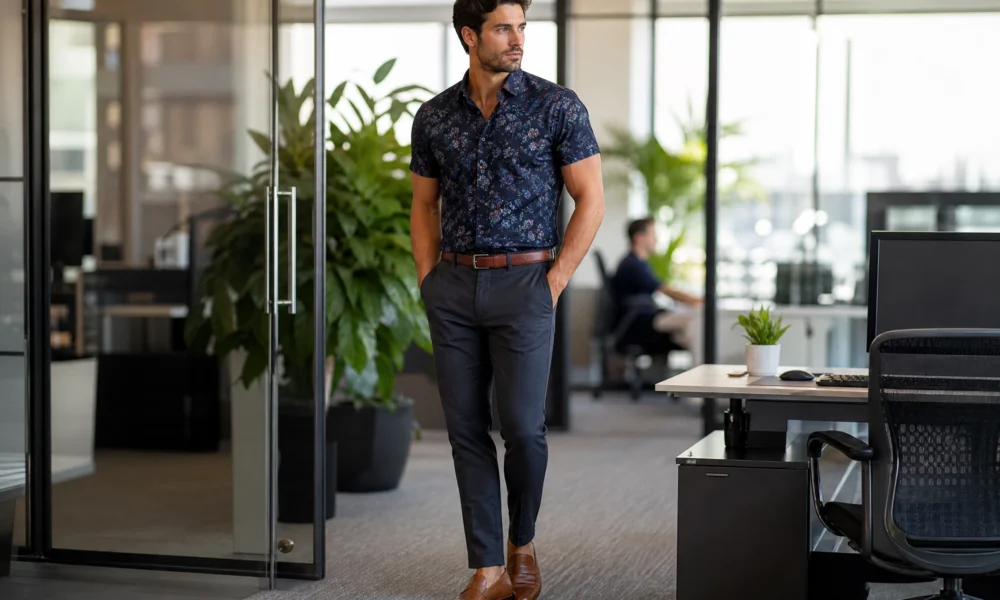
Are Hawaiian shirts business casual? Hawaiian shirts qualify as business casual when the print is muted or small-scale, the fit is tailored rather than boxy, the shirt is tucked in, and it’s paired with dress trousers and leather footwear. They do not qualify in environments with strict professional standards — finance, law, or formal corporate roles — regardless of how they’re styled.
Hawaiian shirts can be business casual, but only under specific conditions. The print must be muted or small-scale, the fit tailored, and the pairing intentional. According to Monster’s January 2025 workplace survey, 63% of offices with a dress code describe it as business casual — making this a genuinely common real-world question.
Whether a Hawaiian shirt works at the office depends entirely on your industry. Tech and creative agencies are the most permissive — Hawaiian shirts are often on the more formal end in those settings. Finance and legal roles remain conservative regardless of what the written dress code says. Industry context outweighs any styling rule.
Styling a Hawaiian shirt for business casual comes down to three variables: print scale, fit, and pairing. According to Gallup’s workplace attire data, 41% of U.S. workers dress business casual daily — most of them are navigating this exact question without a reliable answer. A muted print, tailored trousers, and leather shoes will clear the bar in most offices.
What “Business Casual” Actually Means in 2025
Business casual is a range, not a rule.
It runs from “polished but comfortable” at one end to “jeans are fine if they’re clean and dark” at the other. According to Gallup, about 41% of U.S. workers dress in business casual on a typical workday — making it the most common office standard in the country, and also the most inconsistently applied.
A product designer at a Seattle startup and a compliance officer at a Chicago insurance firm can both work under “business casual” policies while inhabiting completely different dress realities. One wears a Patagonia vest. The other would raise eyebrows in a patterned shirt. Same label. Different worlds.
What defines business casual in your workplace is your company’s actual culture — not the phrase in the employee handbook.
That’s the real test.
So when someone asks whether Hawaiian shirts are business casual, there’s no honest single yes-or-no that covers everyone. The right question is: which Hawaiian shirts, for which workplaces, styled how?
The Direct Answer — Yes, Under These Specific Conditions
Yes. Hawaiian shirts can be business casual.
Here’s the thing: most people framing this question are thinking about the shirt category. The answer lives in the shirt execution.
A large-scale neon hibiscus print on a boxy, untucked shirt over cargo pants — that’s not business casual under any reasonable definition. A small geometric floral in navy and white, slim-fitted, tucked cleanly into charcoal chinos with leather loafers — that clears the bar in most offices without debate.
Or maybe I should say it this way: a Hawaiian shirt doesn’t automatically mean casual, any more than a button-down automatically means formal. Construction decides it.
If it’s not fitting well and it’s not paired with the right trousers, it won’t read as professional regardless of the brand.
Most guides stop here and call it done. The problem is, “it depends on your workplace” is technically true and practically useless. So here’s what it actually depends on.
Industry-by-Industry Breakdown — What Most Guides Skip
This is the section every competitor article avoids writing.
Tech and Startups
Tech and Startups — Almost always yes. This is the most Hawaiian-shirt-friendly professional context. In many tech offices, a fitted aloha shirt with tailored trousers is actually on the more dressed-up end of what people wear day to day. If your company is under 200 people and nobody owns a tie, wear the shirt.
Creative Agencies and Design Studios
Creative Agencies and Design Studios — Yes, with real range. Bold prints often signal creativity here rather than unprofessionalism. You have more pattern freedom than in most industries. The caveat: client-facing days shift the calculus. When the meeting involves outside people, read the room — your internal norms and your client’s expectations may not match.
Marketing, Media, and PR
Marketing, Media, and PR — Usually yes. Personality in dress is often a net positive in these environments. A tasteful Hawaiian shirt reads as confident and self-aware. On the desk, it’s almost always fine. In front of a client, apply the same judgment you’d give any bold clothing choice.
Healthcare
Healthcare (non-clinical administrative roles) — Sometimes. Administrative healthcare roles can be flexible. Clinical-adjacent positions — even pure admin — tend to lean conservative regardless of what the written policy says. When uncertain, choose a subdued pattern and pair it strictly.
Finance and Banking
Finance and Banking — Rarely. I’ve seen conflicting takes on this — some sources argue that younger fintech firms are exceptions, and for engineering or backend roles, they’re right. My read: if you’re client-facing in traditional finance, skip the Hawaiian shirt entirely. If you’re a backend developer at a fintech startup with open seating and no dress culture to speak of, a refined aloha shirt is almost certainly fine.
Legal
Legal — No, with narrow exceptions. Traditional law firms don’t accommodate Hawaiian shirts regardless of print quality or styling. Small boutique firms or in-house legal roles at casual companies are the narrow exception. If you’re facing a hearing or a client, there’s no version of this shirt that belongs in the room.

Quick Comparison
| Shirt Type | Best For | Key Benefit | Limitation |
|---|---|---|---|
| Subdued floral (navy, white, earth tones) | Most business casual offices | Reads intentional, not costumey | Still too casual in finance/law |
| Bold tropical print (bright, large scale) | Creative, tech, startup environments | Strong personality, distinctive | Out of place in conservative settings |
| Minimal or tonal aloha print | Strict business casual environments | Works in nearly any casual office | Loses some of the Hawaiian shirt identity |
| Fitted Reyn Spooner–style aloha | Client-facing mid-level casual roles | Refined enough for real meetings | Higher price point |
Subdued vs. bold Hawaiian shirts: A subdued print — small florals, muted tones, geometric patterns — is better suited for business casual offices because it reads as intentional and polished. A bold print works in creative and tech environments. The key difference is pattern scale and color intensity, not the shirt style itself.
How to Style a Hawaiian Shirt for the Office
The exact checklist. Not vague advice.
To style a Hawaiian shirt for a business casual office:
- Choose a shirt with a muted or small-scale print — avoid neon, oversized, or novelty patterns.
- Confirm the fit: not boxy, not tight. Slim or tailored cut.
- Tuck it in fully — or use a polished half-tuck in creative environments only.
- Pair with tailored chinos or dress trousers — not jeans, not cargo pants.
- Wear clean leather shoes or loafers — not sneakers, not sandals.
- Add a solid-color blazer in navy, charcoal, or tan if the setting leans stricter.
Fabric matters more than most guides admit. Cotton and linen drape cleanly and communicate quality. A synthetic polyester print with a slight sheen reads resort, not office. Reyn Spooner has been making refined, professionally appropriate aloha shirts since 1956 — their product is the clearest real-world example of what “office-appropriate Hawaiian shirt” actually looks like. Tommy Bahama sits in an upscale-resort lane that translates well to most business casual environments. For stricter offices, Bonobos offers fitted tropical prints that sit closer to a standard dress shirt than a traditional aloha cut, which bridges the gap without forcing the question.
Quick note: The tuck isn’t optional in most offices. An untucked Hawaiian shirt says “I just got back from Cancún.” Tucked says “I dressed with intention.” That difference does real reputational work.
Keep accessories minimal. A leather watch, a belt that matches the shoe tone. The shirt already has presence — competing with it is a mistake.
Hawaiian Shirts on Zoom and Hybrid Work Calls
Nobody’s writing about this. But for hybrid workers, it’s the more frequent real-world context.
Hawaiian shirts hold up surprisingly well on camera. Bold patterns register cleanly against neutral backgrounds, and a distinctive shirt signals engagement — you’re not calling in on autopilot from a gray t-shirt. According to Gallup’s data, 41% of U.S. workers dress business casual even in hybrid arrangements, meaning the same judgment that applies in person carries to the screen.
The practical rule: internal calls, any well-fitted Hawaiian shirt is fine. For external client calls, apply your industry’s in-person standard. If you’d skip the Hawaiian shirt for a client meeting in the office, skip it on camera too.
One wrinkle nobody mentions: a bold Hawaiian shirt against a busy or virtual background looks visually chaotic. Keep the background clean or use a solid blur. The shirt is doing work — don’t add noise behind it.
Look — if you’re in a hybrid setup where Thursday is your in-office day and your dress code is loosely business casual, here’s what actually works: wear the Hawaiian shirt in person first. If nobody reacts, you’ve passed the real vibe check. The Zoom version takes care of itself after that.
Prints and Styling Choices That Will Undermine the Outfit
Not every Hawaiian shirt belongs in an office. Some patterns read as costume regardless of what trousers and shoes surround them.
Skip these in business casual settings:
- Large-scale repeating patterns where the print repeat exceeds 6–8 inches across
- High-contrast neon combinations: hot pink with lime green, electric blue with orange
- Novelty prints — surfboards, cartoon pineapples, skulls, pop culture graphics
- Anything with a synthetic sheen or visibly cheap polyester drape
- Fully open camp-collar construction worn chest-open — that’s resort, not office
One opinion some readers push back on: I’d argue that a fully untucked Hawaiian shirt is never business casual, even with tailored trousers and leather shoes. The untucked silhouette cancels whatever formality the rest of the outfit was building. Some say that’s too rigid for creative environments. The counterargument stands: business casual means looking professional at a glance, and untucked aloha shirts don’t reliably do that. I’ll stand on it.
What most guides skip entirely: some aloha prints reference genuine Hawaiian and Pacific Islander cultural motifs. Wearing those in a workplace context raises a question beyond dress code — it’s a judgment call worth making consciously, not just a styling consideration.
FAQs
Can I wear a Hawaiian shirt to a business casual office?
Yes, if the print is subdued or small-scale, the shirt fits properly, and you pair it with tailored chinos and leather shoes. Avoid neon patterns and tuck it in.
What’s the best Hawaiian shirt brand for the office?
Reyn Spooner makes the most office-appropriate aloha shirts — refined prints, quality fabric, and a tailored fit. For stricter offices, Bonobos offers tropical prints that sit closer to a standard dress shirt.
Should I tuck in a Hawaiian shirt for work?
Yes, tucked Hawaiian shirt signals intentional dressing. A half-tuck can work in creative environments, but fully untucked reads too casual in almost any professional context.
How do I make a Hawaiian shirt look professional?
Pair it with slim or tailored chinos, add leather shoes, and layer a neutral blazer if your setting leans stricter. Choose a muted or small-scale print. Keep accessories minimal.
When should I avoid wearing a Hawaiian shirt to work?
Skip it for client presentations, job interviews, or any role in traditional finance, law, or formal healthcare — regardless of how refined the specific shirt is.





No Comment! Be the first one.