






Jeans and a Polo at the Office: Does This Outfit Actually Make the Cut?
Jeans and a polo shirt clear the business casual bar. Not because the combination is risk-free, but because it meets the two core requirements of the dress code: a collared shirt and non-distressed...

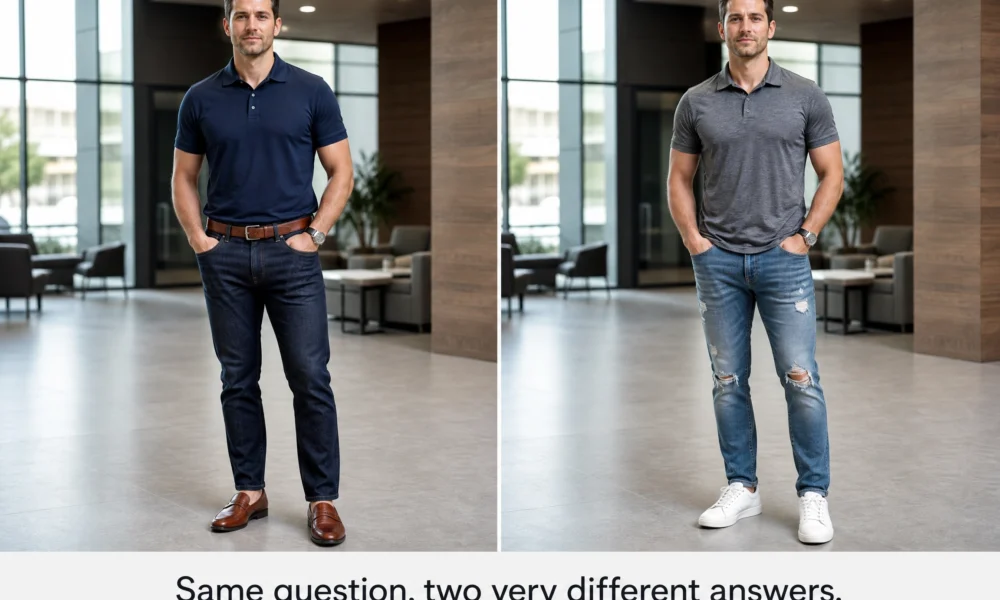
Jeans and a polo shirt clear the business casual bar. Not because the combination is risk-free, but because it meets the two core requirements of the dress code: a collared shirt and non-distressed denim. What pushes it from “technically permitted” to “clearly appropriate” is how precisely those two pieces are executed together.
Whether jeans and a polo count as business casual depends on how the combination reads as a single unit, not whether each piece earns its own passing grade. Dark, undistressed denim in a slim cut paired with a solid piqué polo and leather shoes will pass in most modern offices — but the execution carries more weight than either piece alone. Both conditions have to be met simultaneously.
Definition: Are jeans and a polo business casual? Jeans and a polo shirt qualify as business casual when dark indigo or black denim replaces faded or distressed jeans, and a solid piqué polo is worn tucked with leather footwear. The combination sits at the lower end of the business casual range — not the middle — meaning the details can’t be careless.
According to a 2023 Gallup poll, 41% of U.S. workers now wear business casual attire to the office, making it the single most common workplace dress code in America — and only 3% still dress business professional. That shift has widened the definition of what passes. It hasn’t made execution optional. The outfit can work; it can’t coast.
Why Business Casual No Longer Has One Fixed Answer
Here’s the thing: business casual was never a standardized code. It surfaced in the early 1990s as a more relaxed alternative to formal office dress, and companies have been defining it differently ever since. High-end consulting firms set the floor at dress trousers and a blazer. Tech offices call a polo and dark jeans perfectly appropriate. The spectrum is genuinely wide — and where a jeans-and-polo outfit lands inside it depends almost entirely on how it’s assembled.
According to most workplace dress guidance, the minimum threshold for business casual is a collared shirt paired with undistressed denim. A polo covers the collared-shirt requirement. Dark jeans cover the denim condition. Together, the combination clears the floor — but only when both conditions are met simultaneously, not when one piece barely qualifies.
If you’re not sure whether it’ll work and you don’t have time to buy anything new, that’s the calculation worth making: not whether the polo is allowed in isolation, not whether jeans exist somewhere on the business casual spectrum — but whether this combination, in this execution, will read as intentional to the people in that room.
Jeans and a polo sit near the bottom of the business casual range. Not outside it.
The Pass/Fail Checklist: 6 Factors That Decide This Outfit
Most style guides evaluate jeans and polos as separate wardrobe items. That’s why the specific question — does this combo work together? — keeps going unanswered. The outfit functions as a single unit, and six interacting factors determine whether it passes or falls short.
To wear jeans and a polo as business casual:
- Choose dark indigo or black jeans — no fading, distressing, or visible wear.
- Select a solid piqué polo — no athletic branding or logos larger than a coin.
- Confirm the fit through the shoulders; loose or boxy silhouettes read casual.
- Tuck the polo in for a straight hem; semi-tuck works for a curved hem.
- Wear leather or clean suede shoes — loafers, derbies, or Chelsea boots.
- Add a simple leather belt matching your shoe color.
The wash carries more weight than anything else on this list. A Levi’s 511 or 512 in dark indigo or black reads as a deliberate choice. The exact same cut in stonewash or medium blue reads as whatever happened to be clean. Dark wash signals intentionality. Faded denim signals that you didn’t decide.
The polo fabric matters second. Piqué cotton — the textured weave in classic Ralph Lauren or Lacoste polos — reads more formal than jersey knit. Jersey is athletic fabric. Piqué is dress-adjacent fabric. Solid navy, white, or charcoal gives you the widest range of environments where this combo works. Avoid anything with moisture-wicking panels or visible performance branding.
Shoes are the fastest signal in the room. Dark jeans and a polo with Johnston & Murphy leather loafers reads dressed-up. The exact same outfit with clean white athletic sneakers reads dressed-down. The shoe tips the entire perceived formality of the combination — often more than the shirt does.
Quick note: the belt gets overlooked. A mismatched or casual belt undermines the rest of the outfit. Brown leather with tan or brown shoes; black leather with black or dark brown shoes. Simple hardware, no statement buckle. It closes the loop.
Industry Context: Where This Combo Works and Where It Doesn’t
The same outfit lands differently depending on the industry. A dark-jeans-and-polo combination is unremarkable in a tech startup. It raises eyebrows at a regional law firm. That’s not a contradiction — it’s just workplace culture in practice, and it matters more than any general rule.
Polo and jeans vs. chinos and a button-down: Chinos with a tucked button-down sit higher in the business casual range and carry more margin for small execution errors. Jeans and a polo can reach the same tier but require tighter precision on fit, wash, and footwear. The key difference is how much the combination demands from you.
Quick Comparison
| Industry | Passes Business Casual? | Key Requirement | Where It Fails |
|---|---|---|---|
| Tech / Startups | ✅ Yes | Clean polo, dark jeans | Rarely — this is standard dress |
| Real Estate / Sales | ✅ Yes | Solid polo, leather shoes required | Athletic branding on the polo |
| Marketing / Creative | ✅ Yes | Wide color and style latitude | Low bar — most clean combos pass |
| Finance / Banking | ⚠️ Borderline | Blazer required over the polo | Falls below their floor without a blazer |
| Law / Consulting | ❌ No | Blazer is the minimum floor | Jeans read as informal in these cultures |
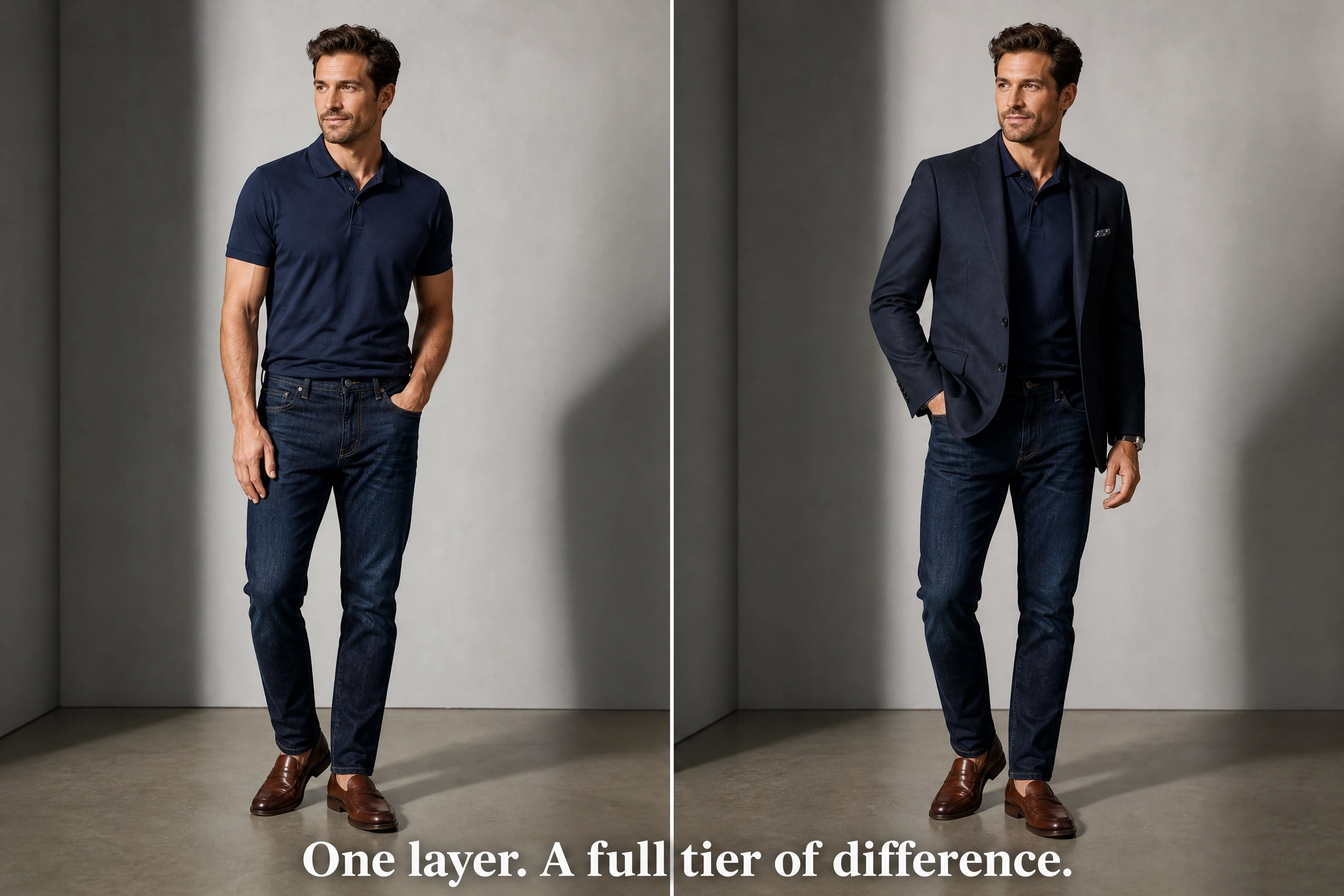
Look — if you’re walking into a finance or law interview and this is all you have, here’s what actually works: add a well-fitted navy or charcoal blazer over the polo. That single layer moves the outfit from “lower business casual” to “solid business casual,” even with dark jeans underneath. The blazer does what the polo alone cannot.
How to Build This Outfit Correctly
The polo should be piqué cotton, solid in color — navy, white, charcoal, or light blue. Ralph Lauren and Lacoste are the benchmark not because of price, but because their cuts are designed to fit across the chest and shoulders without bunching or going boxy. Skip any polo with visible moisture-wicking language on the label, athletic branding, or a logo bigger than a coin. These details don’t “read” as casual to you — but they do to the room.
The jeans: slim-fit or straight-cut, dark indigo or black, no visible wear. Levi’s 511 (slimmer leg) and 512 (tapered) in dark wash are the most reliable reference points across price ranges. The fit should follow the leg without gripping it — neither painted-on nor relaxed.
Shoes close the read. Cole Haan or Johnston & Murphy leather loafers, a clean leather derby shoe, or Chelsea boots all work reliably. White leather sneakers pass in creative and tech environments where they’ve already been normalized. Athletic sneakers don’t pass anywhere business casual applies.
What Most Style Guides Skip Entirely
Grooming and posture carry roughly 30% of how a borderline outfit is perceived — and almost no published style guide acknowledges this.
I’ve seen conflicting takes on exactly how much physical bearing shifts the read. Some argue clothes are the only variable a hiring manager actively evaluates; others argue that grooming resolves any doubt that clothes alone create. My read — or maybe I should say it this way: when the outfit sits at the lower edge of business casual, being well-groomed is what tips the perception from “underdressed” to “intentional.” The clothes didn’t change. The signal did.
One more thing worth addressing directly. Some style advisors argue polos are inherently too casual for any professional environment, and that a button-down oxford shirt is always the safer call. That’s valid advice for conservative industries — if you’re walking into a regional bank branch or a traditional accounting firm, a button-down is the lower-risk choice. But here’s the view I’d push back on: a tucked polo is a stronger business casual signal than a button-down worn untucked. The tucked polo signals a deliberate, specific choice. The untucked OCBD often just signals that you didn’t decide. What’s being read either way is the intentionality — not the exact garment.
FAQs
What’s the best type of jeans to wear for a business casual office?
Dark indigo or black slim-fit jeans with no distressing or fading. Levi’s 511 or 512 in dark wash is the reliable benchmark. The closer the silhouette to a dress trouser, the stronger the professional signal.
How do I know if my specific office actually accepts jeans as business casual?
Watch what managers — not entry-level employees — wear on a regular Tuesday. If managers wear dark jeans unprompted, denim is normalized. If only junior staff do, check with HR before assuming you’re covered.
Should I tuck in my polo for a business casual environment?
Yes, if the hem is straight. A semi-tuck works if the hem is curved. An untucked polo with a straight hem reads as casual, not business casual — the tuck is doing real formality work here.
Why does shoe choice matter so much when pairing jeans with a polo?
Because footwear delivers the fastest signal about intent. Clean leather loafers read dressed-up. The same outfit with athletic sneakers reads dressed-down. Shoes tip the entire outfit’s perceived formality more than any other single element.
When should I add a blazer over jeans and a polo?
Any time the environment is conservative, the stakes are high — interview, first day, client meeting — or you’re genuinely unsure. A navy or charcoal blazer adds a full tier of formality to the combo and removes almost all risk.





No Comment! Be the first one.