



Refried Beans at 110°F: Why the Cafeteria Manager Can’t Just Call the Repair Technician
When a busy cafeteria runs a special, it serves a featured high-volume dish, like refried beans, held at temperature in a hot water unit. The food safety rule: if that item’s internal...

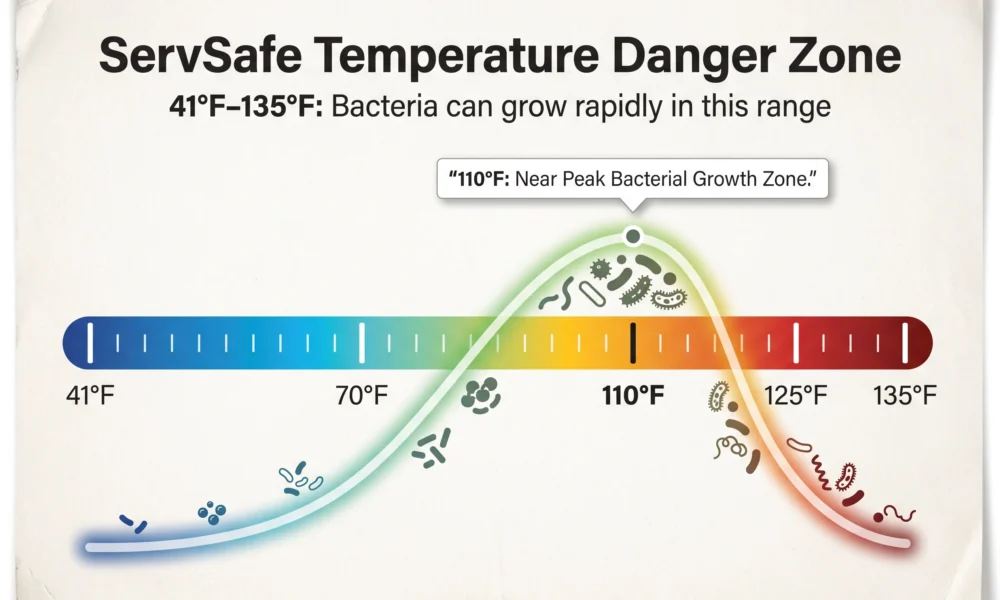
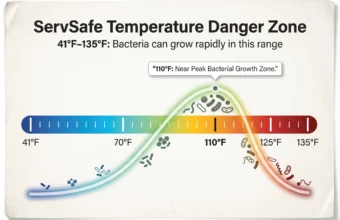
When a busy cafeteria runs a special, it serves a featured high-volume dish, like refried beans, held at temperature in a hot water unit. The food safety rule: if that item’s internal temperature drops below 135°F, it has entered the ServSafe temperature danger zone (41°F–135°F), regardless of what any equipment indicator shows. The 135°F threshold is a Critical Control Point. An indicator light’s green status is not.
What This Scenario Is Actually Testing
If you’ve landed here after hitting a paywall on Chegg or seeing “C” on Gauthmath with no reasoning attached, you’re in the right place. The answer is C. But a letter alone earns zero partial credit on an exam — and zero credibility in a real kitchen.
Here’s the thing: this question isn’t about beans. It tests whether you can distinguish between monitoring equipment status and monitoring food safety outcomes — which is the operational core of HACCP-based management. Those aren’t the same variable, and this scenario is constructed specifically to see whether you’ll treat them as if they are.
The green light is a trap. It’s there to check whether you’ve convinced yourself that a functioning indicator isn’t the same as a verified CCP — and if you haven’t internalized that yet, the scenario will catch you.
When a busy cafeteria runs a special on items like refried beans, hot-holding units must keep food at or above 135°F per FDA Food Code requirements. If a manager’s probe thermometer reads 110°F — even when the dispenser indicator appears normal — the food has crossed a critical threshold. According to the FDA HACCP framework, corrective action must target the food itself first, not the equipment.
Why 110°F Is Genuinely Dangerous — Not a Technical Footnote
Bacteria don’t check indicator lights.
At 110°F, refried beans sit near the warmest, most biologically active range inside the temperature danger zone (41°F–135°F). Pathogens like Staphylococcus aureus and Bacillus cereus can double roughly every 20 minutes at that temperature when nutrients and moisture are present — and dense, starchy beans are about as favorable a growth medium as pathogens encounter in commercial kitchens.
There’s a structural reason large-batch foods carry extra risk here: they heat and cool from the outside in. A hot water dispenser warms the holding container’s exterior. The center of a cold or cooling mass of refried beans can lag well behind the surface temperature — which is why internal probe thermometer readings are the only valid Critical Control Point (CCP) measurement. Exterior equipment readings tell you nothing about the biological reality inside the container.
According to FoodHandler.com (2025), foodborne illnesses in U.S. foodservice operations rose nearly 25% in 2024 compared to the prior year, with hospitalizations and deaths more than doubling — and temperature monitoring failures in institutional kitchens cited as a leading contributing factor. The refried beans scenario, in other words, isn’t an abstract test question designed to frustrate students. It’s a documented failure pattern.
Most people assume that functioning equipment equals safe food. The data says otherwise.
Why “Have the Dispenser Serviced” Is the Wrong Answer — and Why It Feels Right
Option B is the most defensible wrong answer on this question.
The logic appears airtight on its face: the dispenser is designed to keep the beans hot, the beans aren’t hot, the dispenser must be the problem, so fix the dispenser. That chain of reasoning works perfectly for maintenance scheduling. It fails completely as a food safety corrective action — because it addresses the root cause while leaving the active hazard untouched.
HACCP Principle 5 defines corrective action as the steps taken to eliminate the immediate hazard to the consumer. Not to diagnose equipment failure. Not to schedule a service visit. To remove the biological risk from the consumer’s path. Servicing the dispenser doesn’t do that. The beans are still at 110°F. Customers are still eating them.
Customers don’t eat the dispenser. They eat the beans.
Option B vs. Option C — the key distinction:
Option B (service the dispenser) addresses equipment failure but leaves potentially unsafe food in active service. Option C (remove beans, reheat to 165°F, return to hot-holding above 135°F) eliminates the biological hazard and then allows service to resume on verified food. Option B treats the dispenser as the CCP; Option C correctly treats internal food temperature as the CCP. That’s the entire difference.
Quick Comparison
| Action | Best For | Key Benefit | Limitation |
|---|---|---|---|
| Trust indicator, continue serving | No valid scenario | None | Leaves danger-zone food in active service |
| Service the dispenser only (Option B) | Long-term equipment maintenance | Repairs the heating unit | Doesn’t address beans already at 110°F |
| Remove beans, reheat to 165°F (Option C) | Immediate HACCP corrective action | Eliminates the biological hazard | Temporary service interruption required |
| Monitor more frequently | Minor fluctuations above 135°F | Minimal operational disruption | Completely inappropriate when food is already in danger zone |
What HACCP Requires the Manager to Actually Do
HACCP (Hazard Analysis Critical Control Points) is the FDA’s seven-principle framework governing food safety decisions in professional foodservice. Principle 5 — Corrective Action — is the one at work in this scenario, and it has a precise operational meaning.
To apply HACCP corrective action when hot-held food falls below 135°F:
- Remove the food from service immediately — stop all customer access to it.
- Probe internal food temperature with a calibrated thermometer to confirm the reading.
- If food has been in the danger zone for fewer than 4 hours, reheat to an internal temperature of 165°F within 2 hours.
- Return the food to hot-holding above 135°F and verify with a second probe reading before resuming service.
- Document the incident — time discovered, temperature reading, corrective action taken, and which staff member handled it.
Servicing the dispenser is a valid and necessary follow-up step. It’s just step six — after the food hazard is resolved and the documentation is complete.
The FDA’s HACCP framework requires corrective action to address the actual food safety hazard first, not only its cause. In a cafeteria hot-holding scenario, beans reading 110°F must be removed and reheated to 165°F before returning to hot-holding above 135°F. According to ServSafe certification standards, a calibrated probe thermometer — not a visual indicator — is the only accepted method of CCP temperature verification for hot-holding operations.
The Green Light Trap: Why Visual Indicators Aren’t a Valid CCP Measurement
Or maybe I should say it this way: the indicator light isn’t wrong. It just answers a completely different question than food safety requires.
A hot water dispenser indicator reports equipment status — specifically, whether the heating element has reached a threshold water temperature. It doesn’t know how densely the beans are packed. It doesn’t know whether the holding container is making full thermal contact with the water. It doesn’t know whether the food entered service at 165°F or at a lower temperature, or how long it’s been cooling from the center outward. It simply cannot.
Look, if you’re managing a cafeteria and your only daily temperature verification is a glance at a green light, you don’t have a monitoring system. You have a proxy measurement standing in for a real one.
What most guides skip is this: ServSafe explicitly designates probe thermometer readings as the required monitoring method for hot-holding CCPs — not visual cues, not behavioral signals, not equipment status indicators. The probe is the monitoring step. Without daily, documented internal food temperature readings, there’s no valid CCP verification happening in that kitchen — regardless of how many lights are green.
I’ve seen conflicting interpretations of whether temperature log documentation is legally required versus strongly recommended — some state and local health codes mandate written records as a condition of licensure, while others treat them as best practice. My read is that the legal floor varies by jurisdiction, but the ServSafe standard is unambiguous: probe-verified readings are the only accepted evidence of CCP compliance.
Some instructors frame this scenario as pure manager negligence — they didn’t monitor, so they failed. That’s valid for accountability purposes. But the more durable operational lesson is that equipment indicators and food safety outcomes are fundamentally different data streams, and any HACCP plan that collapses them into the same monitoring step has a design flaw, not just a negligent operator.
Quick note: If your cafeteria’s current HACCP plan lists an indicator light as the designated CCP monitoring mechanism for hot-holding, that plan needs revision — not just better manager habits.
Frequently Asked Questions
What is the correct answer when a busy cafeteria runs a special and the refried beans measure 110°F?
The correct answer is C. The manager should remove the beans from service and reheat them to an internal temperature of 165°F before returning them to hot-holding above 135°F. Servicing the dispenser alone leaves a food safety hazard in active service.
Why is 110°F dangerous for refried beans in a cafeteria hot-holding unit?
110°F falls inside the ServSafe temperature danger zone (41°F–135°F), where pathogens like Staphylococcus aureus multiply rapidly. Dense, moist foods like refried beans can harbor unsafe bacterial counts if held at that temperature for two or more hours.
Why is “have the dispenser serviced” the wrong corrective action in this scenario?
HACCP Principle 5 requires eliminating the immediate hazard to the consumer first. Servicing the dispenser addresses the equipment failure but does nothing for the beans already at 110°F and accessible to customers — which is the actual food safety problem.
What temperature must reheated cafeteria food reach before returning to hot-holding service?
Per ServSafe and FDA Food Code standards, reheated food must reach an internal temperature of 165°F within 2 hours before being returned to hot-holding, where it must remain at or above 135°F.
Should cafeteria managers check hot water dispenser temperatures daily?
Yes, using a calibrated probe thermometer inserted into the food, not by reading indicator lights. ServSafe recommends verifying hot-held food temperatures at least every two hours during service and logging those readings as part of a documented HACCP monitoring plan.

No Comment! Be the first one.