




22 L-Shaped Kitchen Layout Ideas Organized by Kitchen Size and Lifestyle
You’ve scrolled through enough “L-shaped kitchen ideas” boards to know the problem — gorgeous photos, zero context. Nobody tells you whether that waterfall island fits a 9×10...

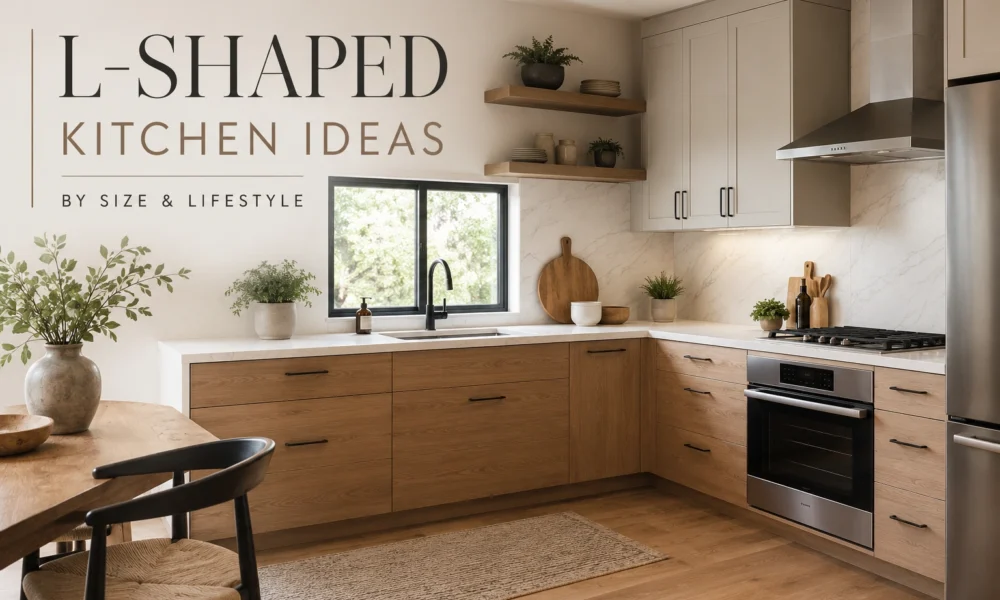
You’ve scrolled through enough “L-shaped kitchen ideas” boards to know the problem — gorgeous photos, zero context. Nobody tells you whether that waterfall island fits a 9×10 galley corner or only works in a 200-square-foot open-concept build. This list fixes that. Every idea below is grouped by the kitchen you actually have — small apartment, island-ready, peninsula instead, narrow galley, open-concept, or blessed with a corner window — so you can skip straight to the section that matches your square footage.
This works best for homeowners and first-time renovators who already know their kitchen’s rough dimensions and want layout logic, not just inspiration. It won’t help if you’re working with a U-shaped or one-wall kitchen, since the L shape’s whole advantage comes from its two open sides.
L shape kitchen layouts refers to a kitchen built along two perpendicular walls or cabinet runs, forming an L with one open corner. That open corner is what makes the layout flexible — it’s where you can add an island, build out a peninsula, or simply leave extra walking room, depending on your square footage.
The L shape isn’t just popular because it photographs well. The National Kitchen & Bath Association’s 2019 industry survey found designers chose the L-shaped layout for 62% of kitchen projects, far ahead of U-shaped layouts at 21% (NKBA / Woodworking Network, 2019). My read on why: it’s the rare layout that scales. A smaller L-shaped kitchen can actually outperform a larger one day-to-day, because the shorter distance between the sink, stove, and fridge keeps the work triangle tight instead of turning meal prep into a walk.
One expert caveat worth knowing before you fall in love with any layout below: a kitchen that looks flawless in a photo can still fail in yours if plumbing and gas lines aren’t already running to that wall. Moving either one adds real cost, sometimes more than the cabinets themselves — confirm this before you commit to a layout change, not after.
Small L-Shaped Kitchen Layouts That Don’t Waste an Inch
This is the category most “small L-shaped kitchen ideas” searches are really asking about, and it’s where most competitor pages quietly default to a luxury kitchen anyway. These four ideas are sized for an apartment-scale footprint, roughly 9×10 to 10×10.
1. Tuck a 24-Inch Two-Burner Range Into the Short Leg So a 9×10 Galley Corner Still Cooks Like a Real Kitchen
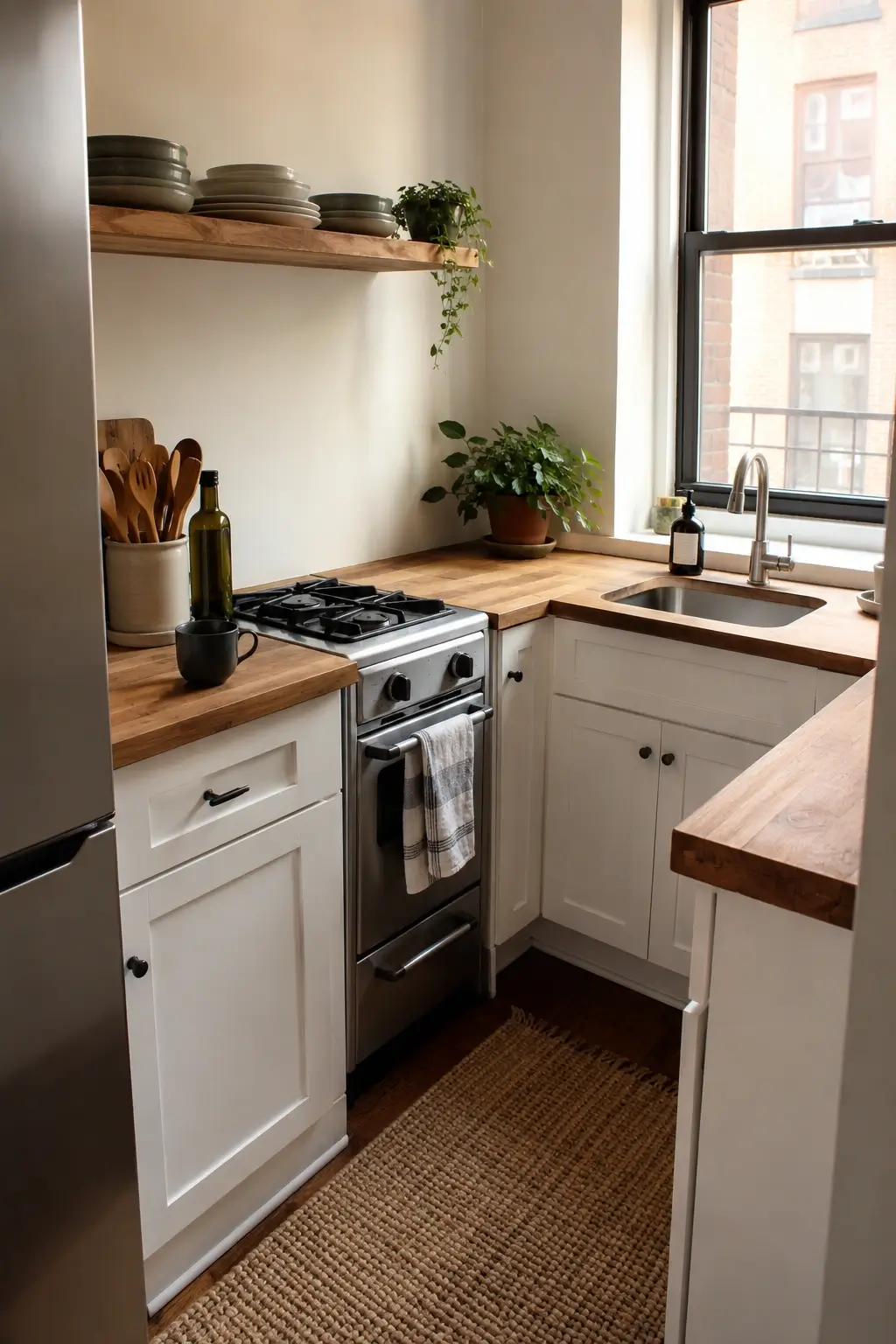
Most small L-shaped kitchens get stuck with a standard 30-inch range that eats the only straight run they have. Swap it for a slim 24-inch two-burner model with the oven stacked below, and you get back nearly six inches of usable counter on either side — real space in a 9×10 footprint.
My read is this works best for galley-tight apartment kitchens where the short leg is barely four feet wide. Add one open shelf above the range for everyday plates instead of bulky upper cabinets, and the whole corner breathes. It still looks lived-in, not staged — a dish towel slung over the oven handle, a coffee mug waiting on the counter.
2. Swap Upper Cabinets for Open Oak Shelves on the Short Wall So a Tiny L Feels Twice as Wide
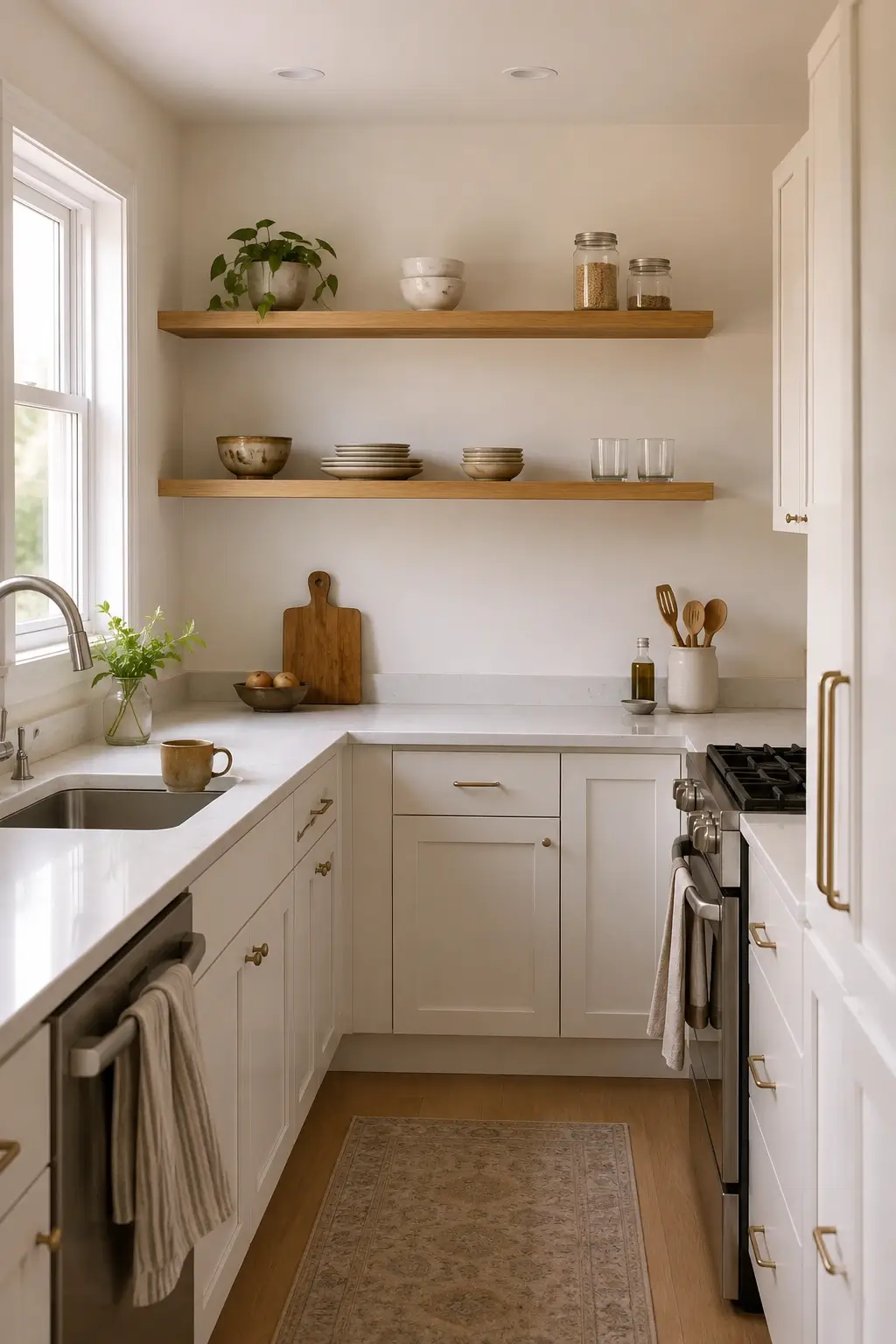
Upper cabinets on the short wall of a small L can box in the whole corner, especially when the ceiling sits at standard height. Pull them off and replace them with two open oak shelves instead, spaced with breathing room between them.
Why it works is simple: sightlines stretch further when the wall isn’t stacked with boxy cabinet doors, so the room reads larger both in photos and in person. Style it with stacked everyday bowls and a couple of glass jars — not packed tight, just enough that it looks used. Leave one stack slightly uneven, the way it actually sits after a real morning.
3. Run a Slim Rolling Cart Where an Island Won’t Fit So You Still Get Extra Counter on Prep Nights
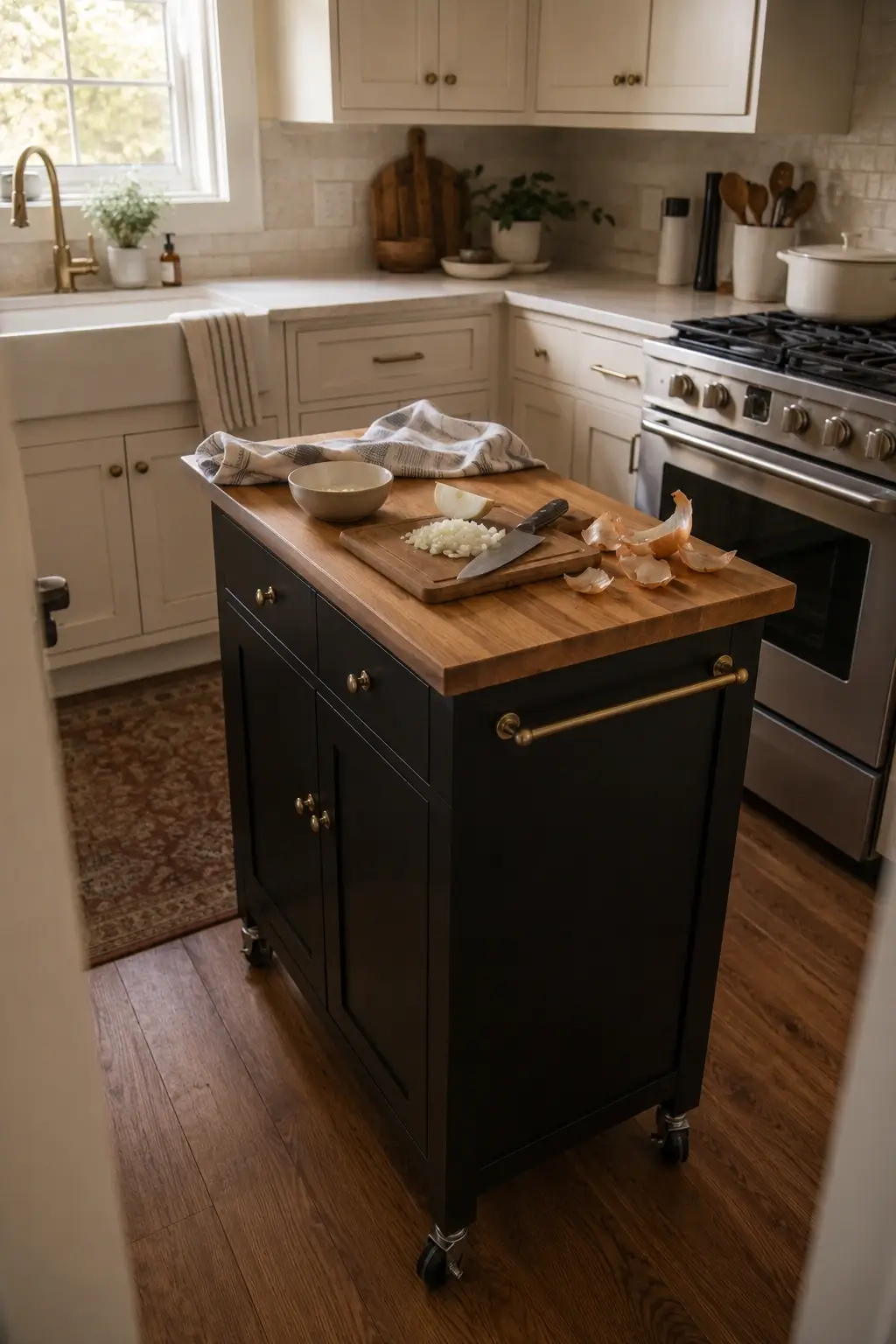
A small L-shaped kitchen usually can’t fit a real island, but that doesn’t mean you’re stuck with zero extra counter. Park a narrow rolling cart with locking wheels in the open mouth of the L — wide enough to chop on, narrow enough to roll out of the way.
This is the move I’d recommend over a built-in island for anything under 100 square feet. It gives you prep space on demand without permanently shrinking the walking aisle. Top it in butcher block with simple brass cart hardware, and let it look mid-use — a cutting board out, a few onion skins not yet swept away.
4. Mount a Fold-Down Counter Flap at the L’s Inside Corner for a Renter-Friendly Breakfast Spot
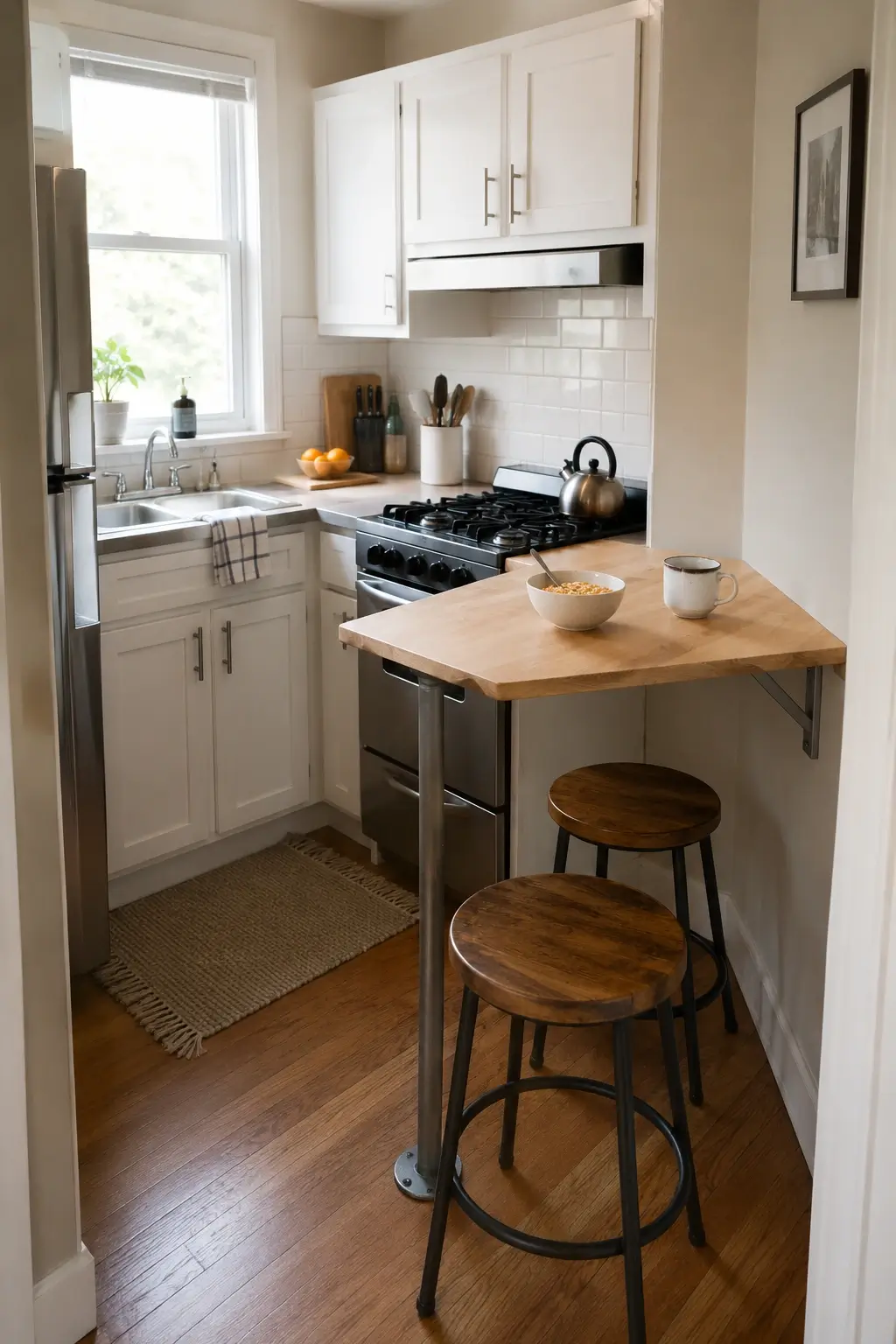
There’s rarely room for a table in a tiny rental L-shaped kitchen, and most renters can’t justify a permanent built-in anyway. A hinged fold-down counter flap at the inside corner of the L, supported by a simple folding leg, solves both problems without touching the lease terms.
It doubles as a breakfast bar when it’s up and disappears flat against the wall when it’s not, which is exactly why it works for rentals — nothing here requires drilling into structure beyond a hinge bracket. Tuck two stools underneath when it’s folded down. Leave one stool pulled out, a cereal bowl still sitting mid-breakfast.
L-Shaped Kitchens With an Island
This is the second-biggest Pinterest cluster around this keyword, and it’s also where most kitchens are wrongly sized for what they’re trying to fit. As a rule of thumb, an island needs roughly 42 inches of clearance on every side to actually function — under that, you’re better off with the peninsula ideas in the next section. If you’re shopping appliances for this layout, panel-ready refrigerators, KitchenAid makes a well-known line, let the fridge disappear into the cabinetry instead of breaking up the L’s sightline.
5. Center a 4-Foot Waterfall Island in the L’s Open Mouth So the Work Triangle Stays Tight
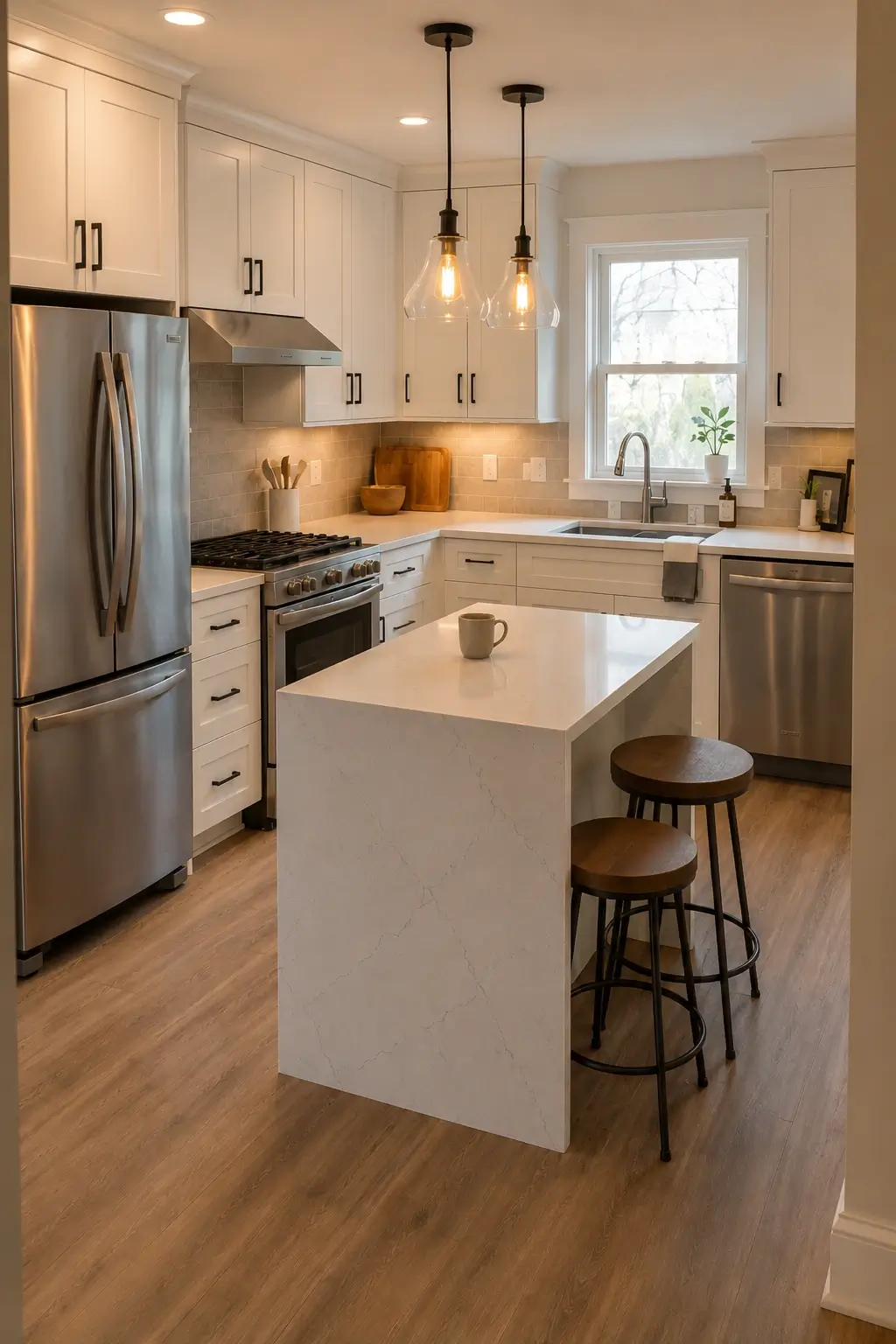
Islands placed too far from the cabinetry stretch the work triangle into an actual hike between sink, stove, and fridge. Center a compact 4-foot waterfall-edge island directly in the open mouth of the L instead, close enough to both legs that none of the three points feel far apart.
I’d only splurge on the waterfall edge here if the kitchen is at least 10×12 — anything smaller and the island crowds the walking aisle no matter how nice the quartz looks. Add two stools on the open side for casual seating. One stool sits pulled halfway out, like someone just stepped away mid-coffee.
6. Add a Narrow 30-Inch Rolling Island With Locking Wheels for a Small L That Needs Flexible Prep Space
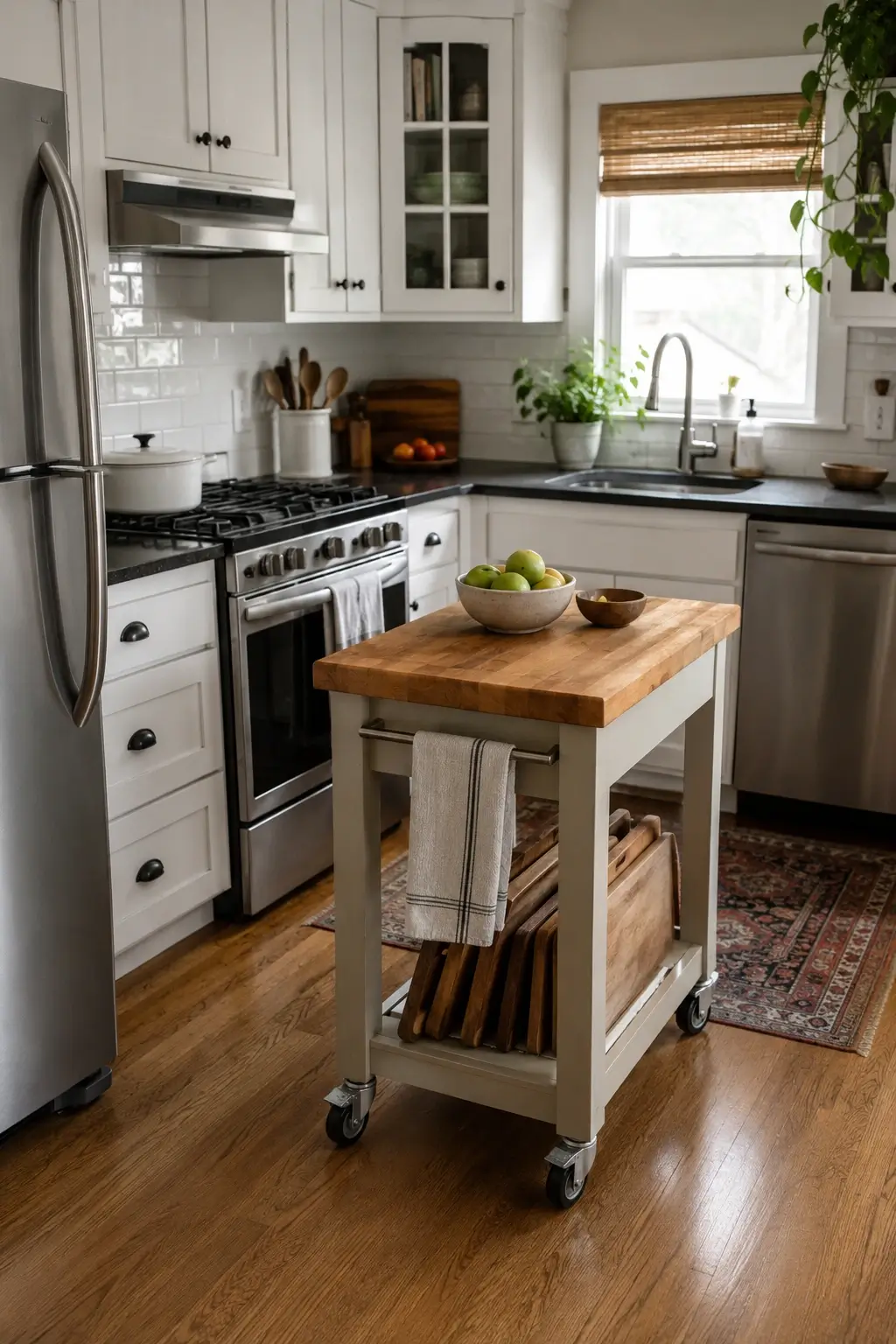
Some L-shaped kitchens sit right on the edge of “big enough for an island” without quite clearing it. A narrow 30-inch rolling island with locking caster wheels and a butcher block top gives you island function without permanently committing the floor space.
Why this beats a fixed island here: it rolls into the open corner for prep, then rolls back against the wall for cooking and cleanup when the aisle needs to stay clear. Add one open shelf underneath for cutting boards. Leave the wheels slightly turned, like it just got pushed aside after dinner.
7. Drop a Single Row of Brass Pendants Over the Island So the Eye Lands There First
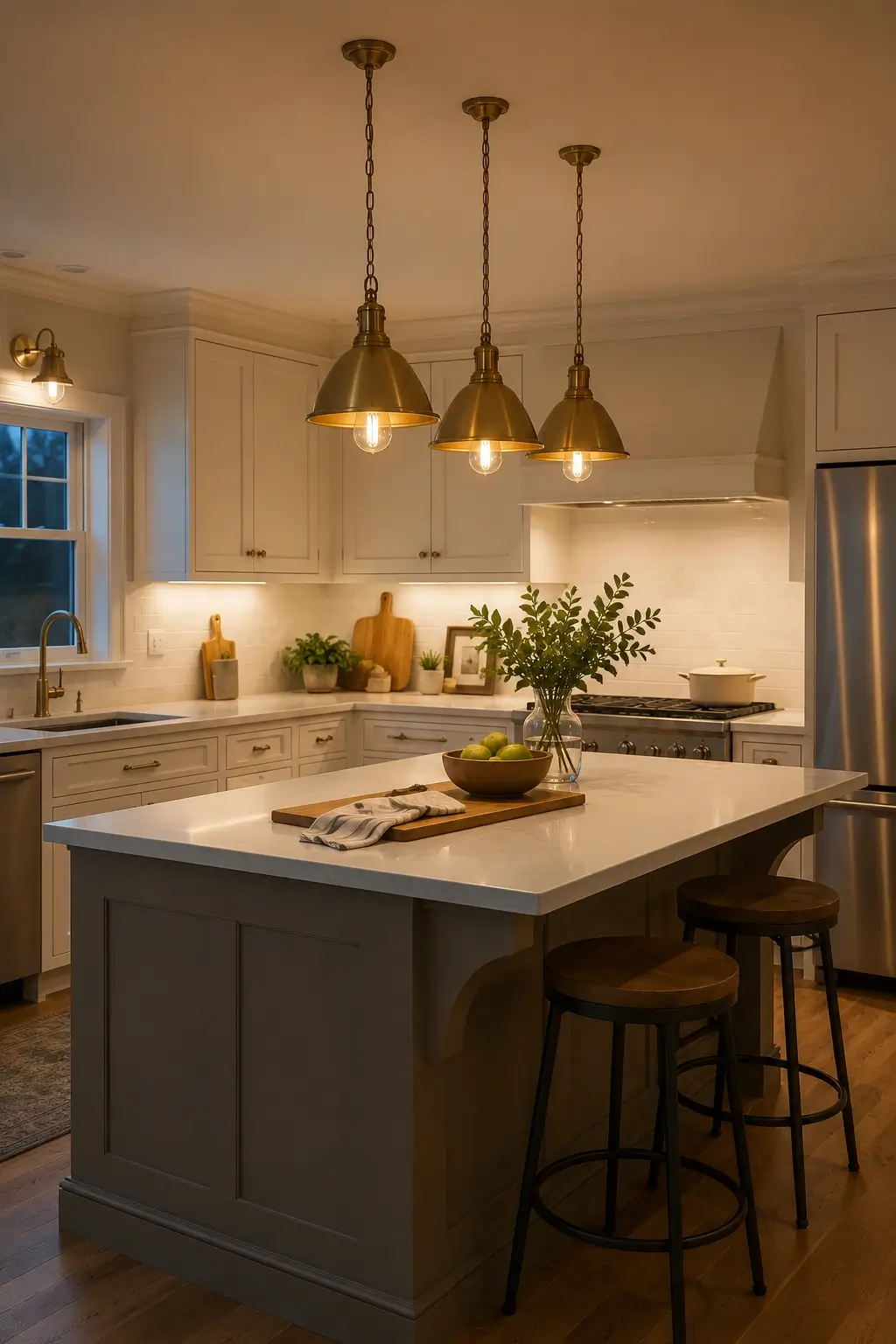
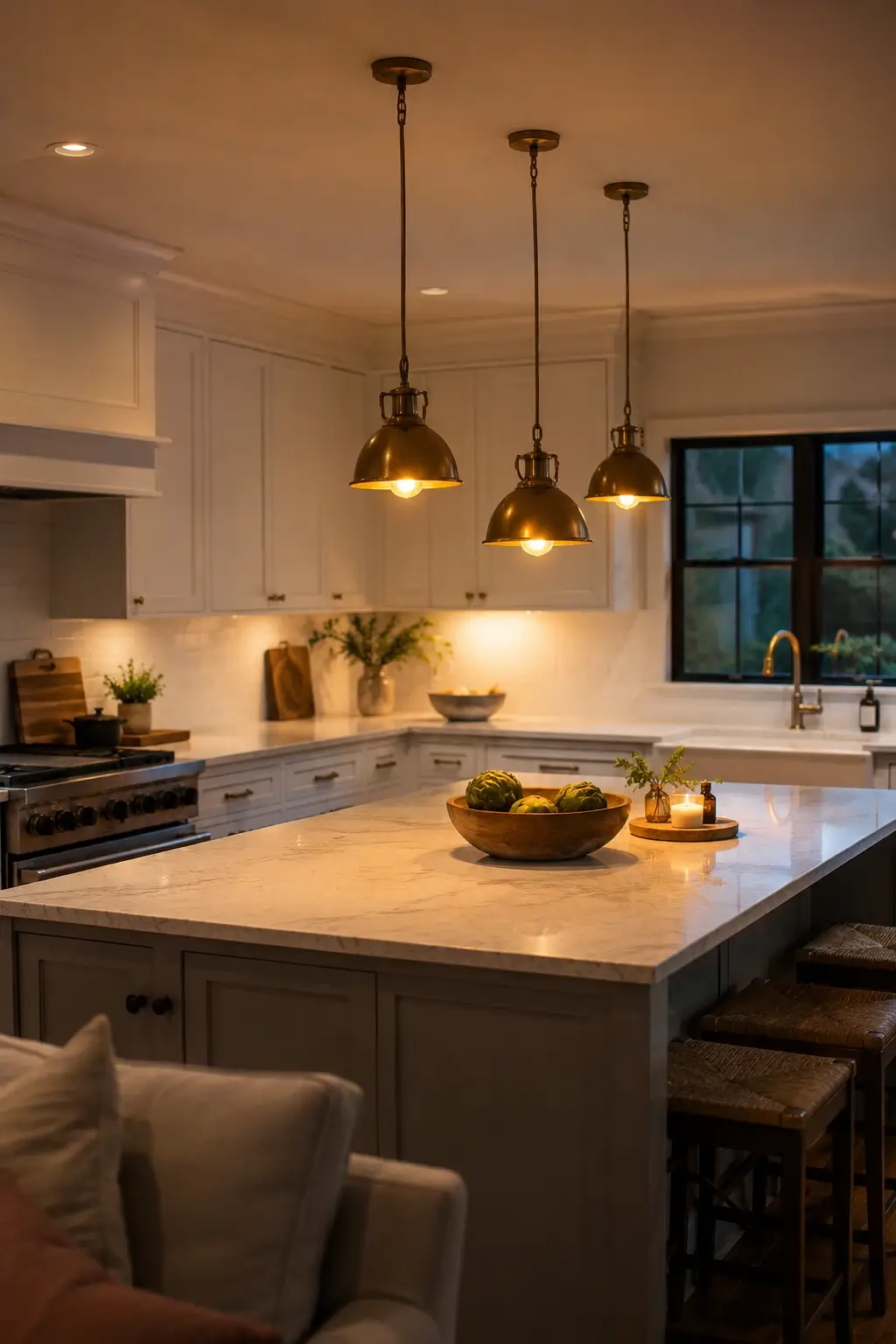
In an open L-shaped kitchen, an island can visually disappear into a busy room if nothing draws attention to it. Hang three brass pendant lights in a tight, even cluster directly over the island instead of one centered fixture.
This is one of the most repeated patterns across L-shaped kitchen Pinterest boards for a reason — it works. The cluster pulls the eye to the island first, which anchors the whole layout visually before you even register the cabinets. Use a warm bulb tone, not stark white. Let one pendant sit a touch lower than the others, the way it looks when it’s hand-installed instead of factory-perfect.
8. Build Open Shelving Into One Island End for Cookbooks and Bowls Within Arm’s Reach of the Stove
Island end panels usually sit blank, a flat slab of cabinetry doing nothing but looking finished. Build two open shelves into the end facing the stove instead, sized for cookbooks and mixing bowls.
This is a function-over-decoration move: everything you’d normally cross the kitchen for stays within a single step of where it’s actually used. Style it with oak shelving and a few mismatched cookbook spines — not color-coordinated, just real. Leave one cookbook open to a recipe, the way it looks mid-cook rather than mid-photoshoot.
L-Shaped Kitchens With a Peninsula
Some designers will tell you an island always beats a peninsula because it offers prep space on all four sides — and in a large kitchen, they’re right. But in anything under roughly 200 square feet, that all-sides clearance requirement is exactly what makes an island hard to fit. That’s where a peninsula earns its keep: it only needs open access on one side, which makes it the more realistic choice for most real-home L-shaped kitchens.
9. Extend the Short Leg Into a Peninsula With Two Counter Stools So the Kitchen Gains Seating Without Losing Floor Space\
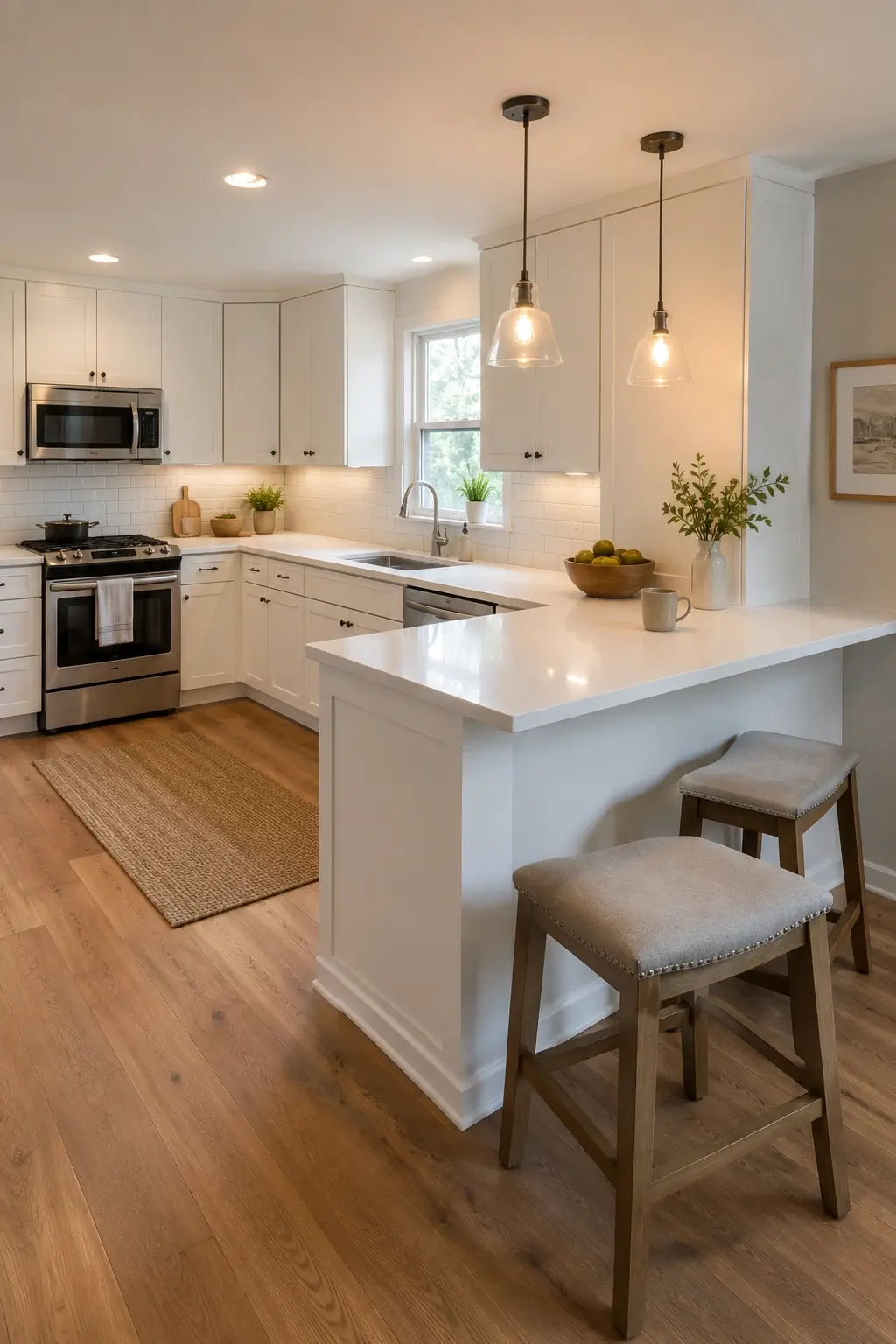
Small-to-medium L-shaped kitchens often want island-style seating without having the clearance an island actually demands on every side. Extend the short leg’s counter outward into a peninsula instead, open on one side only, with two stools tucked underneath.
Island vs peninsula, in short: an island is better for larger kitchens because it needs open walking space on all four sides to function. A peninsula works better when square footage is tighter, since it only needs clearance on one open side. The key difference is clearance, not style. Leave one stool pushed in and one pulled out, like the kitchen’s mid-conversation.
10. Drop the Peninsula Counter Six Inches Lower Than the Cook Side So Kids Can Do Homework While Dinner Cooks
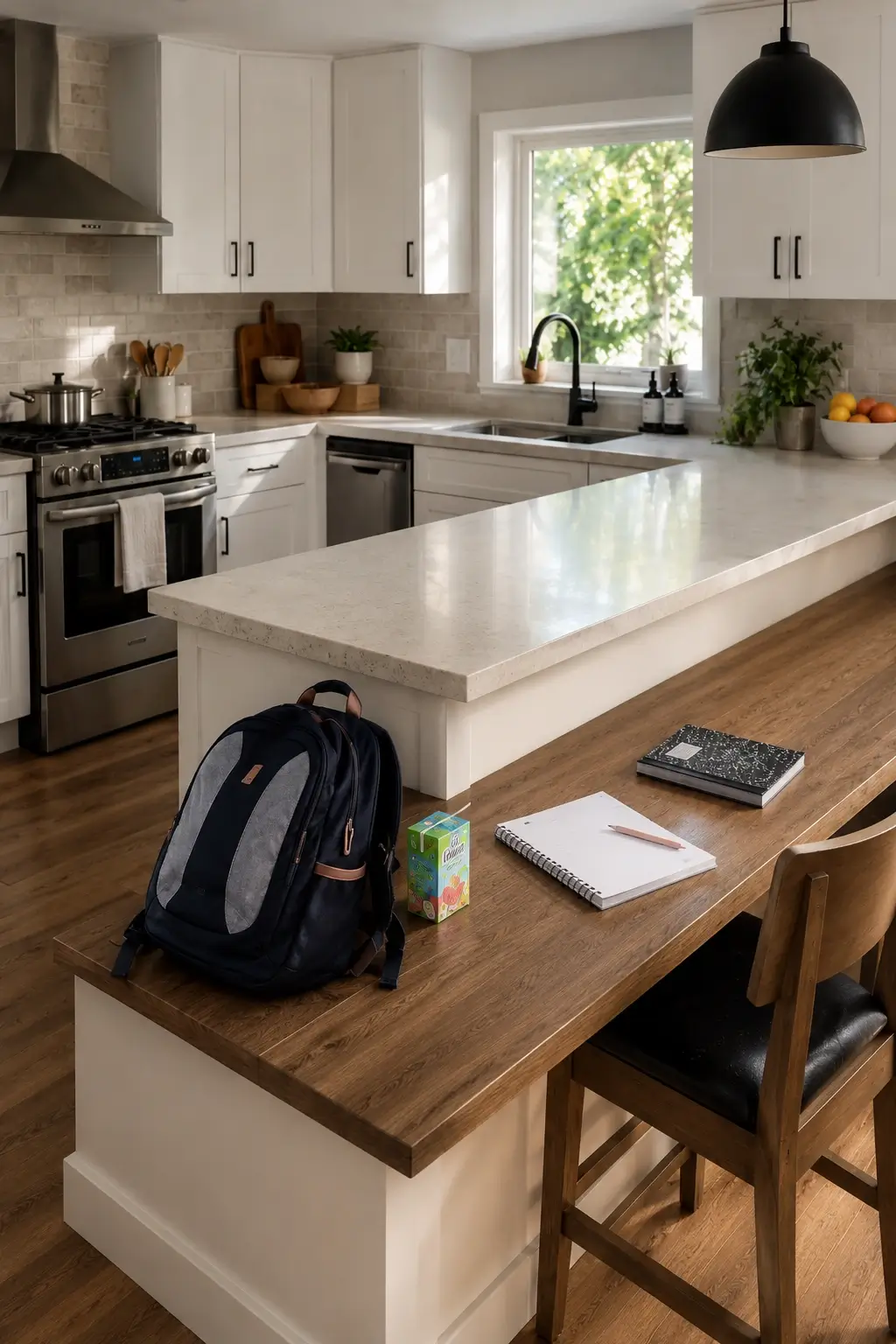
A single-height peninsula puts kids or guests right at counter level facing a hot stove edge, which isn’t ideal and isn’t especially comfortable for long stretches either. Step the seating side down six inches, like a built-in table ledge attached to the main counter.
This creates a genuinely separate homework or laptop zone from the cook side, with a safer sightline for anyone working in the kitchen. Use a two-tone surface — warm wood on the lower ledge, quartz or laminate on the cook side. Leave a backpack and a juice box sitting on the ledge, the way it actually gets used on a weeknight.
11. Run a Waterfall Quartz Edge Down the Peninsula’s Open Side for a Built-In Look Without a Full Island Budget
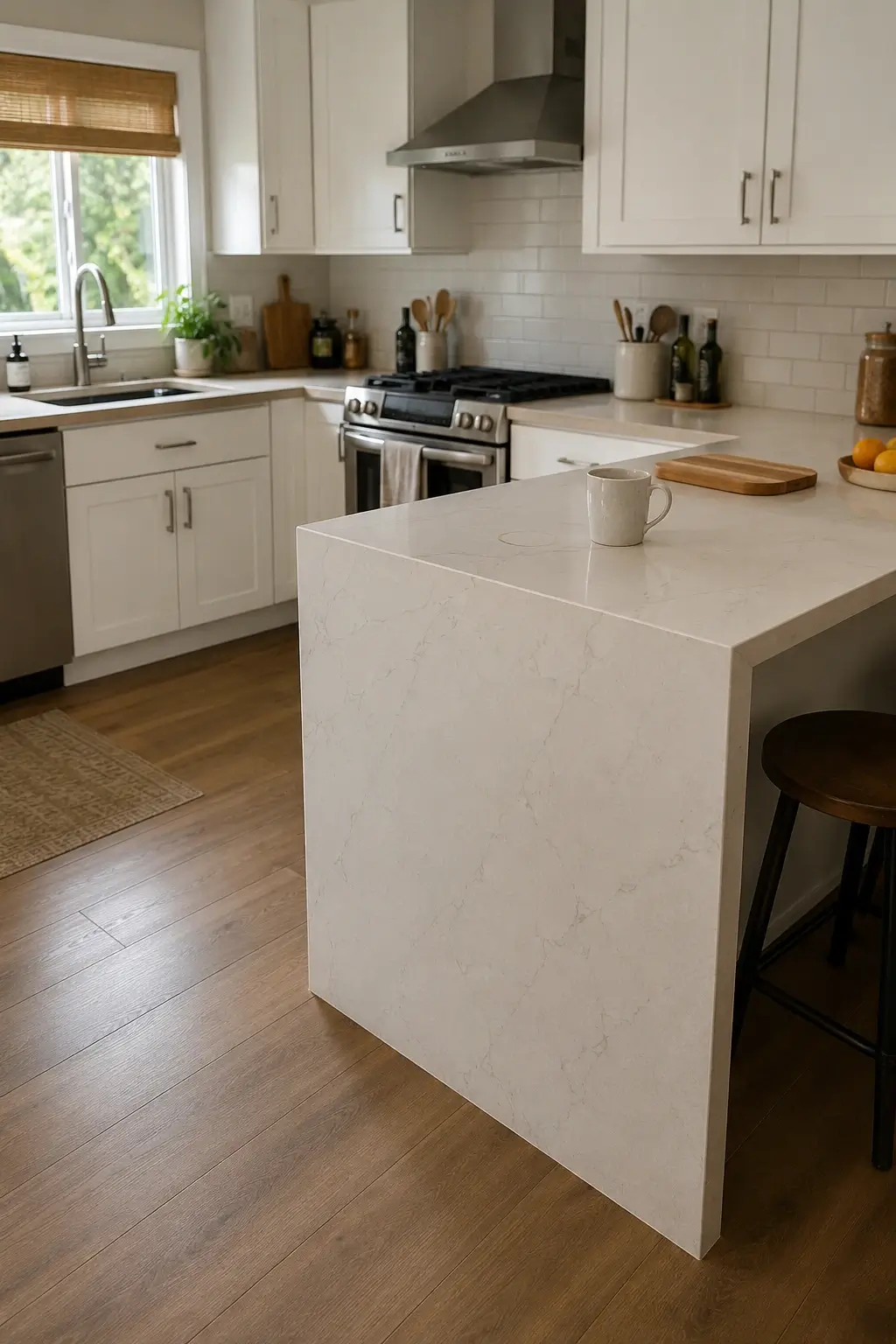
Peninsulas can end up looking like an afterthought — just a counter that stops at a square edge. Wrap the open end in a waterfall quartz edge, the same detail you’d see on a full island, to finish it properly.
I’d only splurge here because it’s one panel, not the four sides a full island would require, so the cost stays reasonable while the visual payoff is nearly identical. It gives the peninsula a built-in, intentional look instead of a leftover-counter look. Leave a faint mug ring on the surface, just enough to look real.
12. Face the Peninsula’s Outer Panel With Vertical Shiplap So the Open Side Reads as Finished as the Cabinets
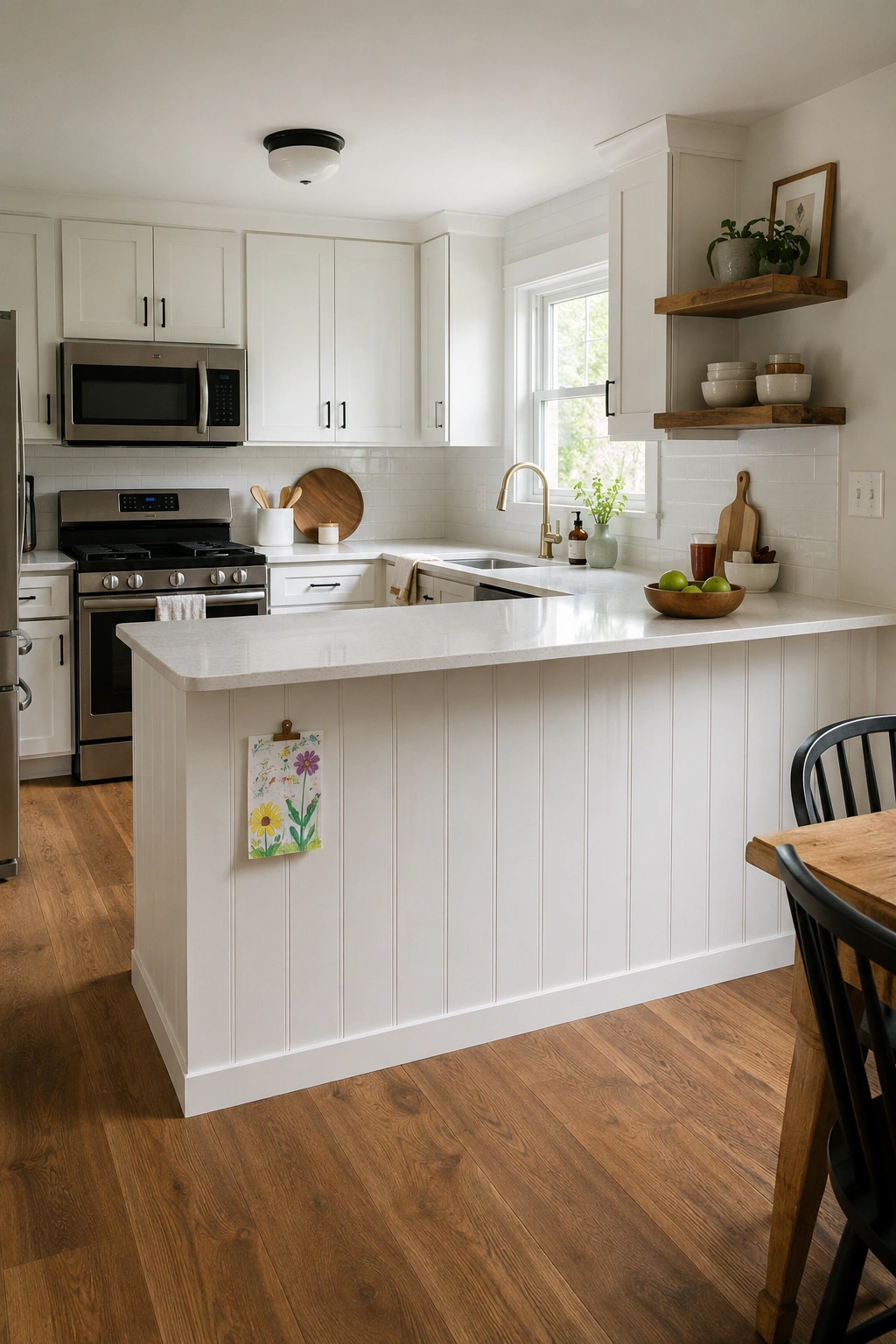
Budget renovations often skip finishing the peninsula’s back panel, leaving plain MDF facing the living room or dining area — which is, ironically, the side guests see most. Clad it in vertical shiplap instead, painted to match the lower cabinets.
This is one of the cheapest material upgrades on this list relative to impact, because it finishes the kitchen’s most visible side without touching the cabinetry budget at all. Keep the paint identical to the lower cabinets for cohesion. A magnet-clipped piece of kids’ artwork on the panel is optional, but it’s exactly the kind of detail that makes a rental kitchen feel like home.
Narrow and Galley-Style L-Shaped Kitchens
A narrow L-shaped kitchen isn’t a downgrade from an island layout — it’s a different design problem entirely, one that’s mostly about breaking up a long sightline rather than adding furniture.
13. Paint the Tall Pantry Wall One Shade Darker Than the Counter Run So a Narrow L Stops Feeling Like a Hallway
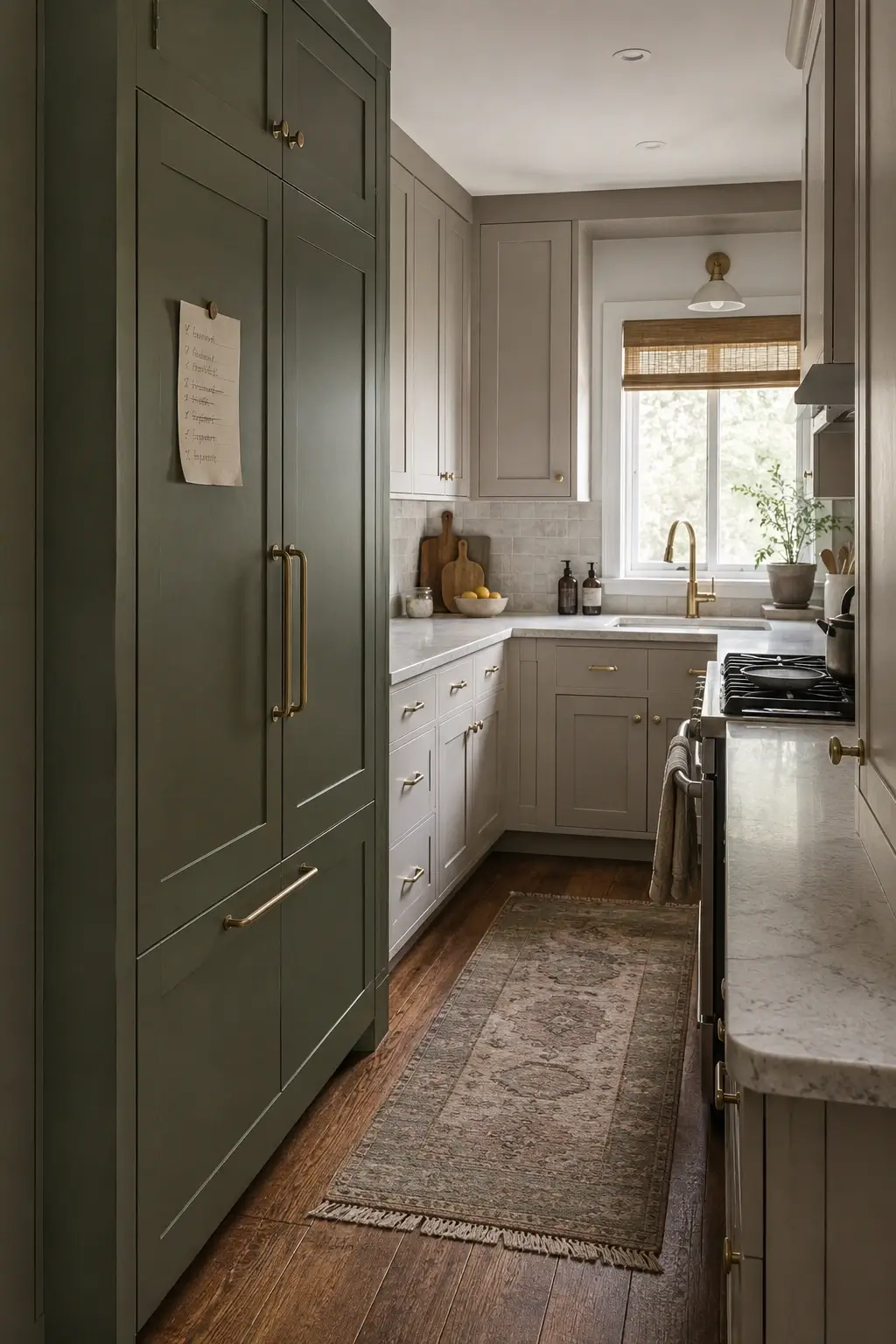
A narrow L-shaped kitchen with a tall pantry wall can start to feel like a corridor you walk through rather than a room you cook in. Paint just that pantry wall one or two shades darker than the rest of the cabinetry — sage against a soft greige run, for example.
The contrast breaks up the long sightline instead of letting one wall blur straight into the next, which makes the room feel zoned instead of tunnel-like. Use a matte finish with brass pulls that pop against the darker tone. Leave a grocery list pinned to the pantry door, half-checked off.
14. Run a Vintage Runner Down the Galley Aisle So the Floor Feels Like a Designed Path, Not a Hallway
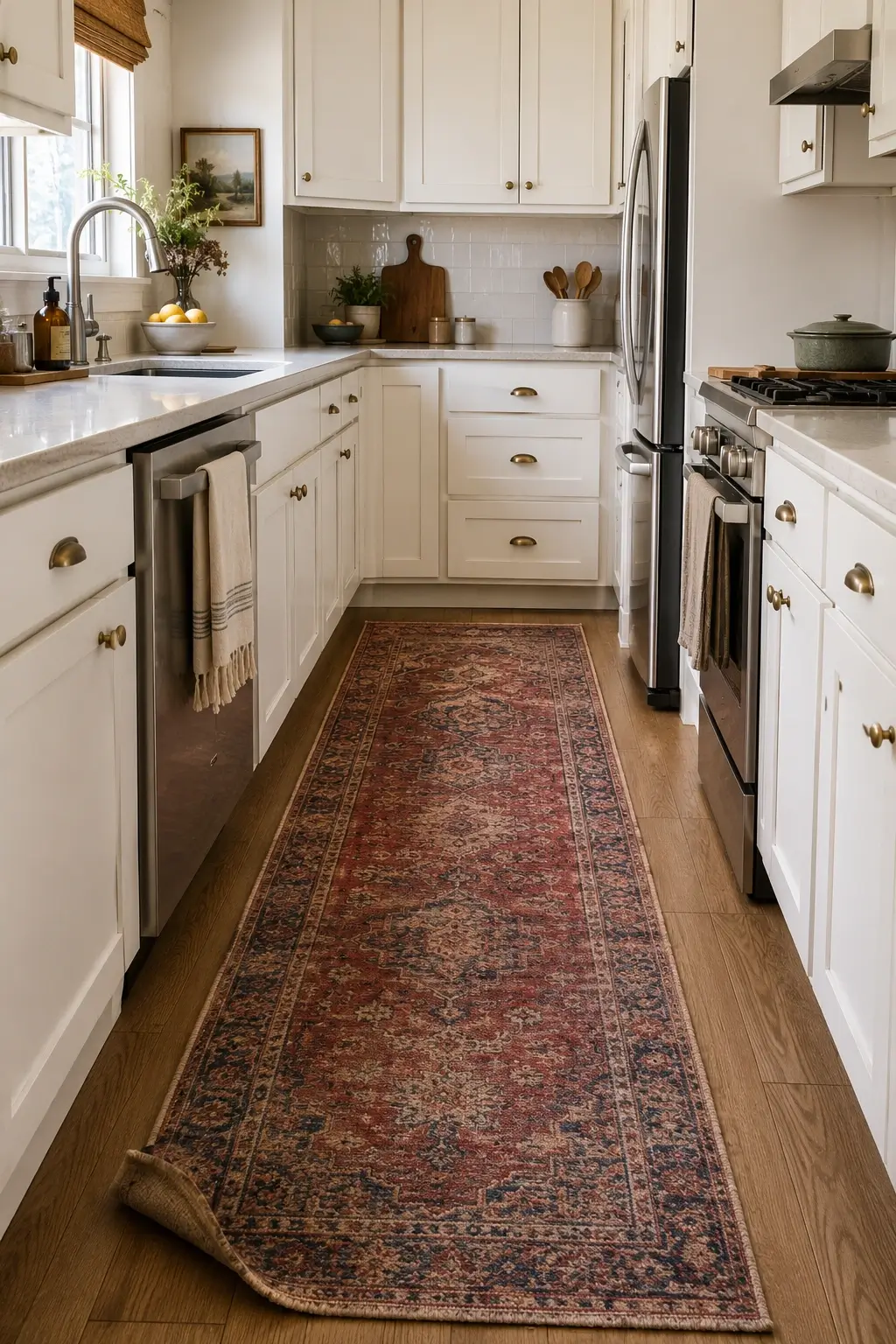
A narrow L-shaped aisle almost always reads as a walkway first, kitchen second. Lay a vintage-style runner rug down the full length of it, in a faded pattern rather than anything that looks brand new.
A patterned floor signals “designed space” instead of “hallway,” and it’s one of the fastest, cheapest, fully renter-friendly upgrades on this entire list — no tools required. Choose faded reds or blues with a worn-in look. Let one corner curl slightly from foot traffic, the way real runners actually sit after a year of use.
15. Slide a Six-Inch Pull-Out Pantry Beside the Fridge for Oils, Spices, and Tiny Jars
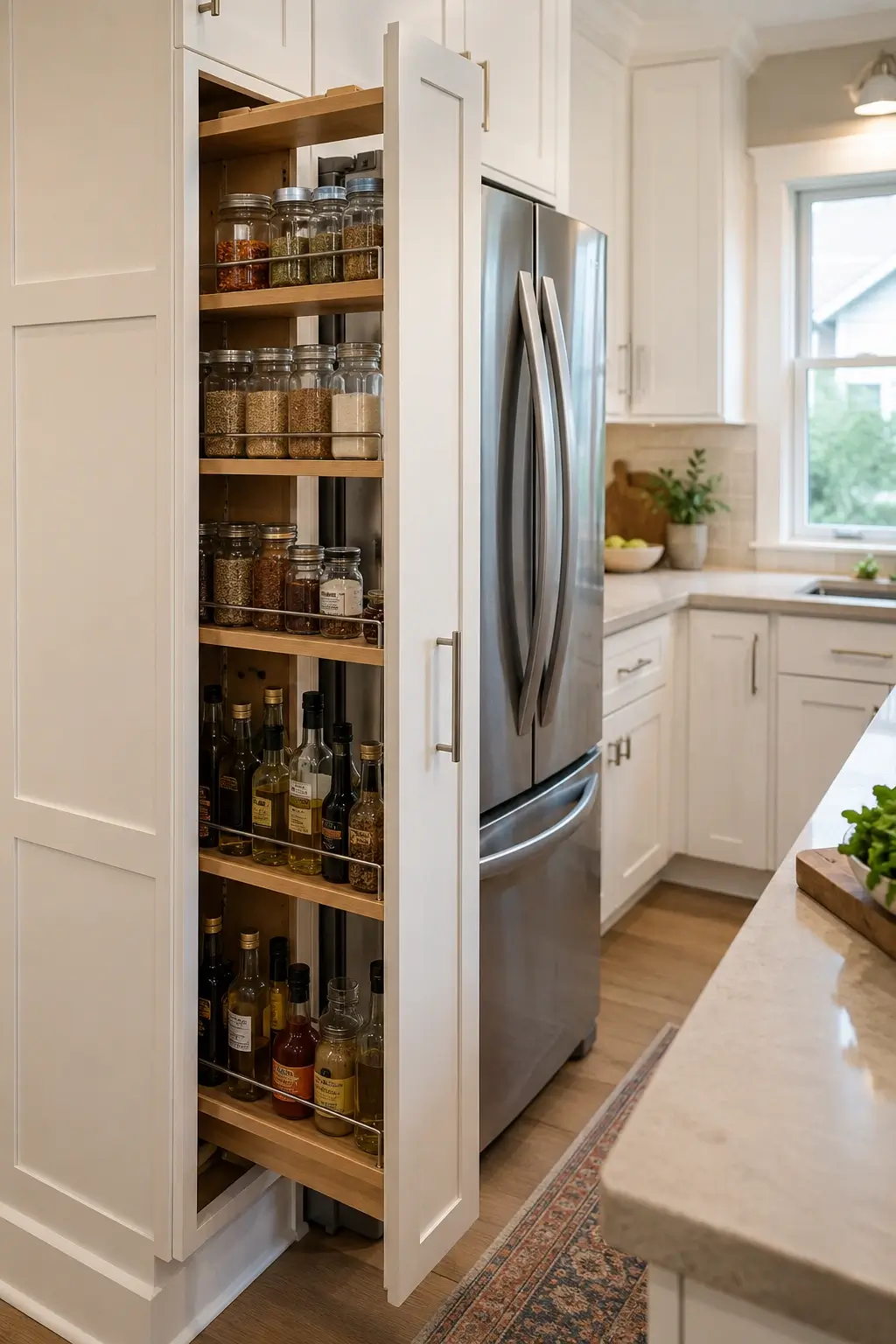
Narrow L-shaped kitchens almost always have one dead sliver of space wedged beside the fridge, just wide enough to be useless as-is. A six-inch pull-out pantry cabinet, IKEA’s SEKTION line has a budget-friendly version built for exactly this gap, slots right into that space.
It turns wasted inches into real storage for oils, spices, and the small jars that otherwise pile up on the counter. Style the inside with labeled glass jars visible when it’s pulled open, so it doubles as a small moment of order in a narrow space. Leave one jar slightly tilted, mid-use rather than perfectly aligned.
16. Hang a Single Floating Shelf Over the Sink Run With a Warm LED Strip Underneath So the Galley Glows Like a Small Café at Night
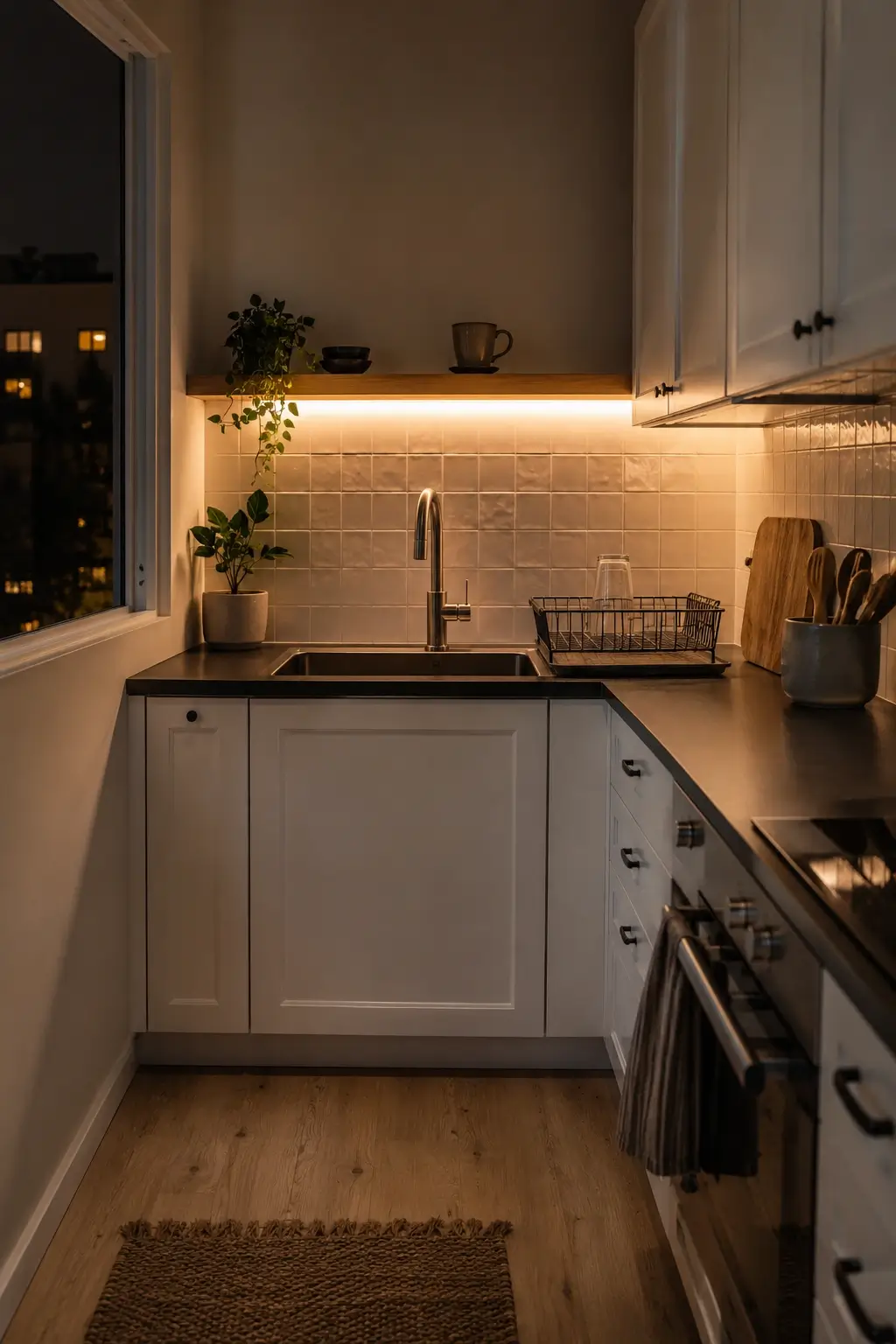
Narrow galley L-shaped kitchens often rely on one flat, overhead light source that feels clinical once the sun goes down. Mount a single floating shelf above the sink run and tuck a warm LED strip underneath it.
The under-shelf glow softens the whole aisle without a full electrical rewire, and it’s realistically a one-afternoon project for most renters or first-time DIYers. Use a warm white temperature, never a cool blue tone, or the café feeling disappears entirely. Leave one glass left out to dry on the rack, catching the light from above.
Open-Concept L-Shaped Layouts
An L-shaped kitchen does some of its best work in an open floor plan, mostly because the two open sides of the L naturally face outward into the rest of the home rather than boxing the cook into a closed room.
17. Angle the L So the Short Leg Faces the Living Room for a Sightline That Keeps the Cook in Every Conversation
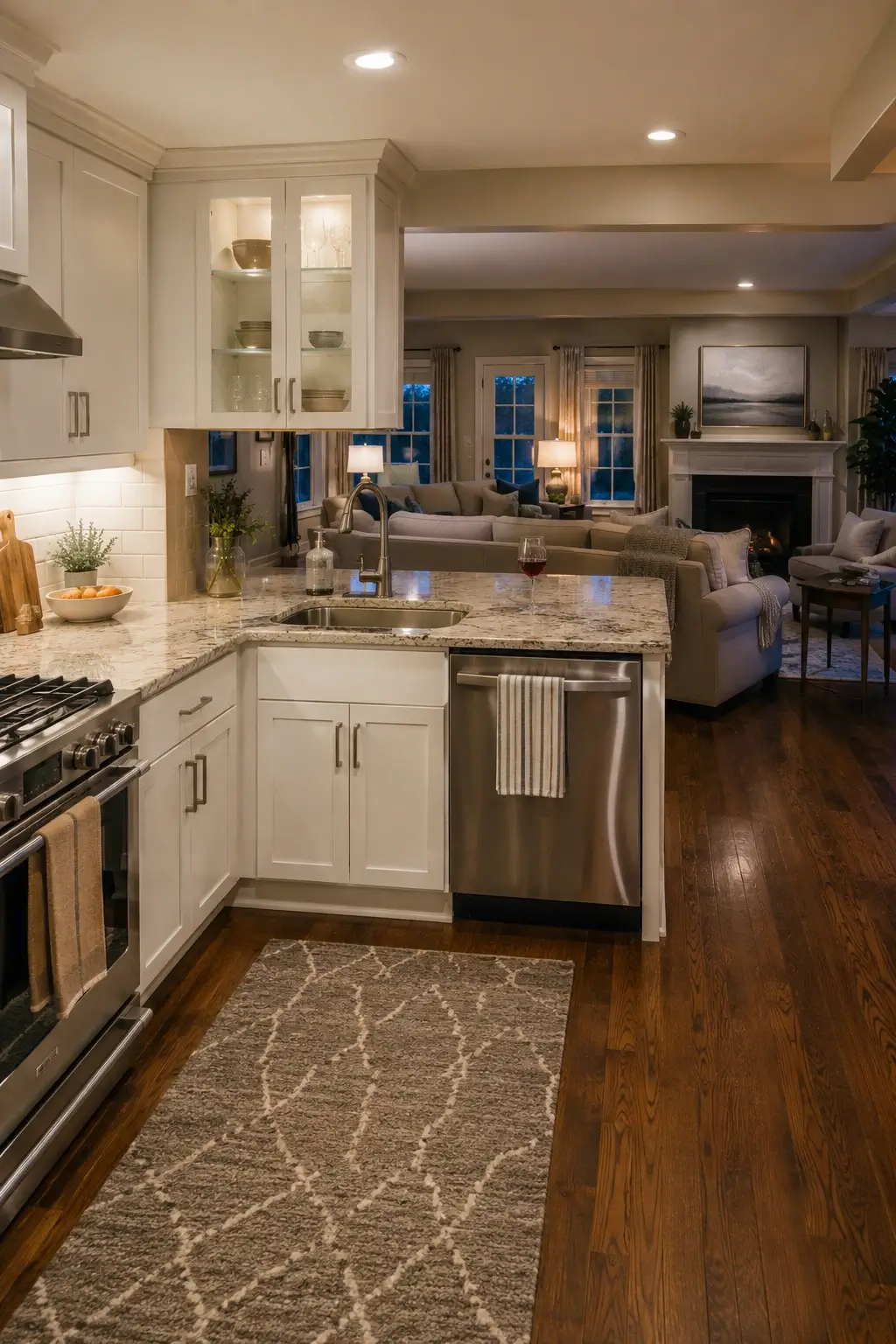
In an open-concept home, a poorly oriented L can quietly turn the cook’s back to every guest in the room. When the layout allows it, point the short leg’s sink or prep run toward the living space instead of toward a blank wall.
This keeps sightlines open in both directions, which is the actual reason open-concept L-shaped kitchens consistently outperform closed galley layouts for entertaining — it’s not the finishes doing the work, it’s the orientation. Lower the upper cabinet height on that leg to protect the view further. Leave a glass of wine sitting within easy reach of the sink.
18. Match the Island Stools to the Living Room’s Accent Color So the Open-Concept L Reads as One Designed Room
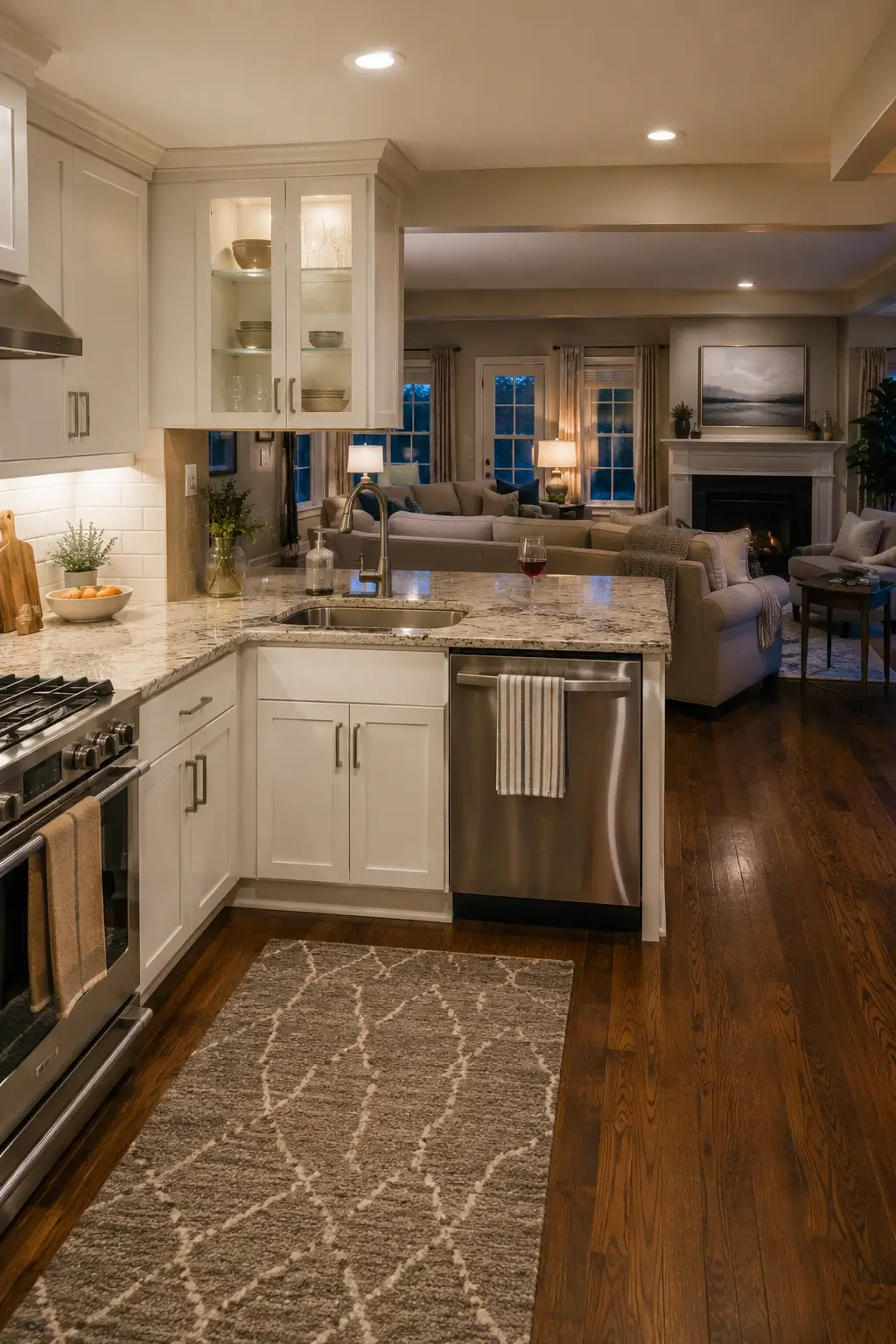
Open-concept kitchens can visually split from the adjoining living room when every finish is chosen in isolation, even if each room looks fine on its own. Pick one accent color already present in the living room, a sage cushion or a rust throw pillow, and repeat it on the island stools.
This ties the two rooms together with one cheap, fully reversible swap instead of a repaint or a furniture overhaul. Choose woven or rattan stool frames to keep the tone warm rather than matchy. Leave one stool angled slightly out, as if someone just stood up to grab something from the living room.
19. Use Two-Tone Cabinets, Dark Lower and Light Upper, So the L Anchors the Open Floor Plan Without Closing It In
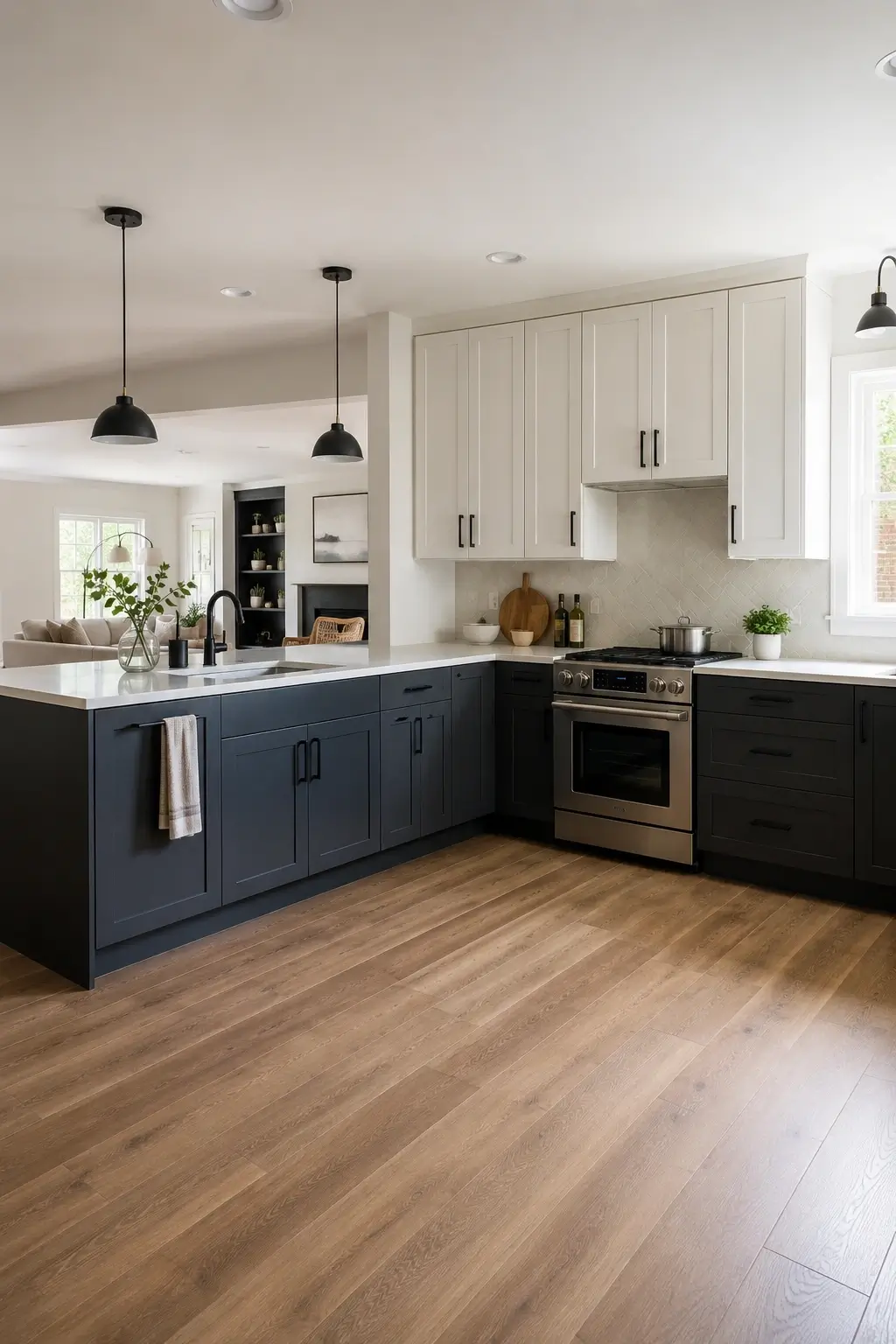
In a large open room, an all-light or all-dark L-shaped kitchen can either disappear into the space or feel disproportionately heavy. Pair dark lower cabinets, charcoal or deep green, with light upper cabinets or open shelving above.
The dark base grounds the kitchen as its own clearly defined zone, while the light top keeps natural light and sightlines traveling through the rest of the open room instead of stopping at the kitchen wall. Tie the two tones together with consistent brass or matte black hardware. Leave a dish towel draped casually over a lower cabinet handle.
Corner-Window L-Shaped Kitchens
A corner window above the sink is one of the most repeated visual patterns in L-shaped kitchen photos, and for good reason — it’s usually where the kitchen’s two legs naturally meet.
20. Center the Apron-Front Sink Under the Corner Window So Dish Duty Comes With a View
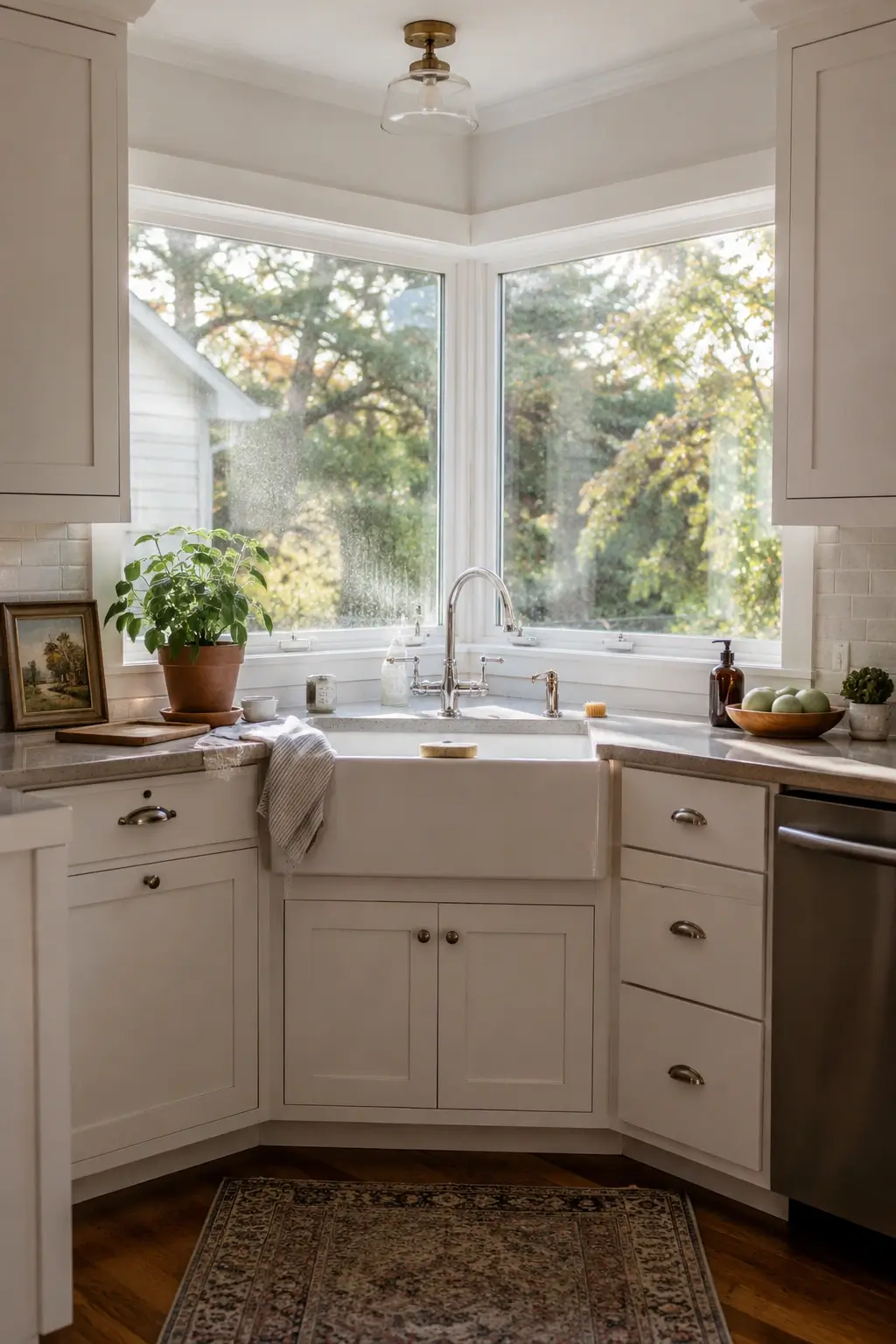
Corner windows often end up blocked by upper cabinets or sit awkwardly off-center from the sink below them, which wastes the one architectural feature most kitchens don’t have. Position an apron-front sink, Kohler’s workstation styles are a popular fit here, directly under the window, centered on the glass rather than on the cabinet run.
It turns the least-favorite kitchen task into arguably the best seat in the room, and apron-front sinks read as a finished, intentional choice rather than a builder-grade swap. Use a simple white or fireclay apron front. Leave a sponge resting on the sink edge, the window slightly steamed from hot water.
21. Skip Upper Cabinets on the Window Wall and Add a Single Floating Shelf So Natural Light Reaches the Whole Corner
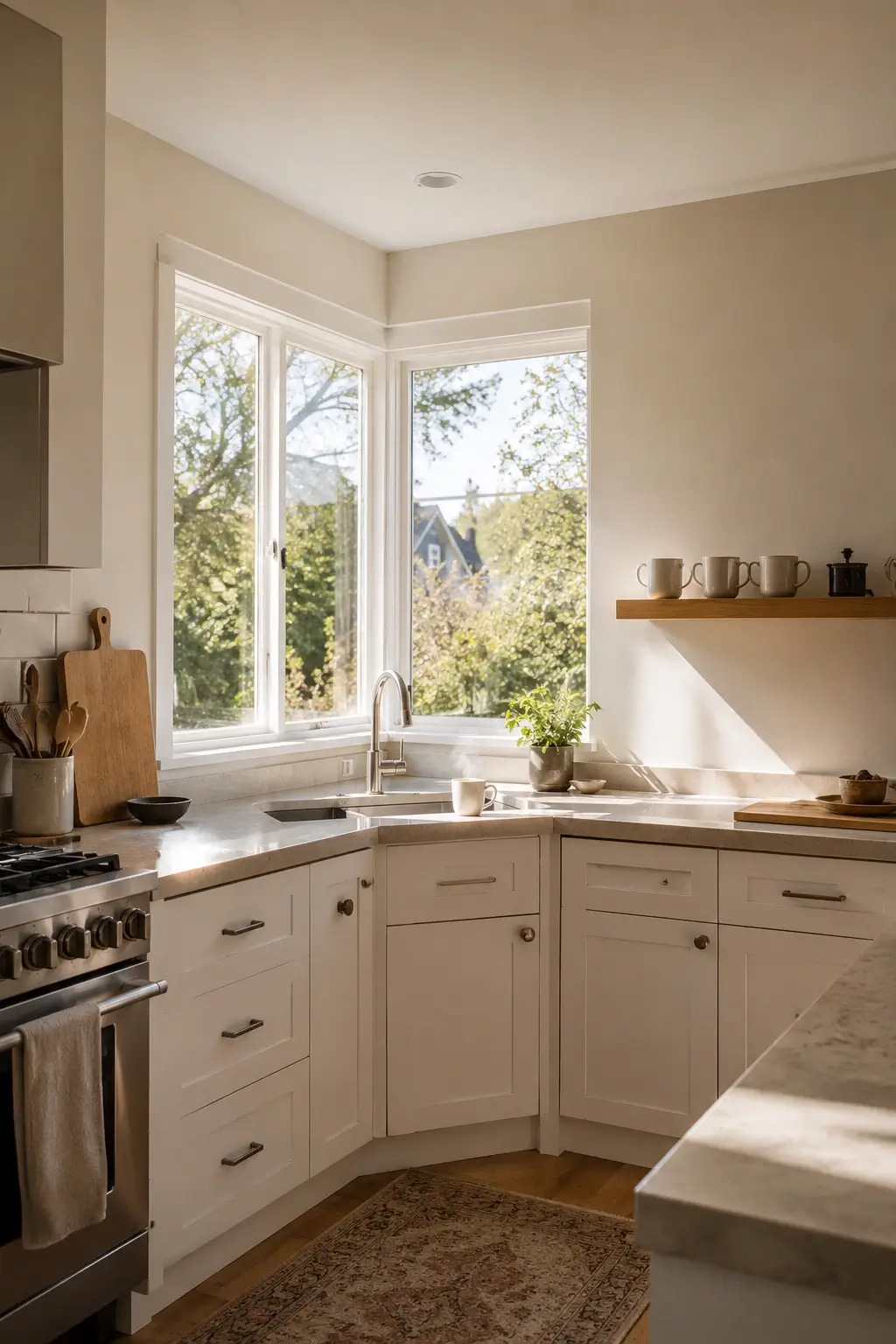
Upper cabinets flanking a corner window often block half the light the window was originally meant to bring in, which defeats the point of having it there. Leave the wall around the window cabinet-free and add one floating shelf below sill height instead.
The corner stays genuinely bright all day, and the open wall makes even a small corner-window kitchen feel noticeably larger, both in photos and walking through it. Style the shelf with a few everyday mugs, nothing decorative-only. Let morning light catch the steam rising off a coffee mug left on the counter below.
22. Frame the Corner Window With a Simple Café Curtain on a Brass Rod for Privacy That Doesn’t Block the Light
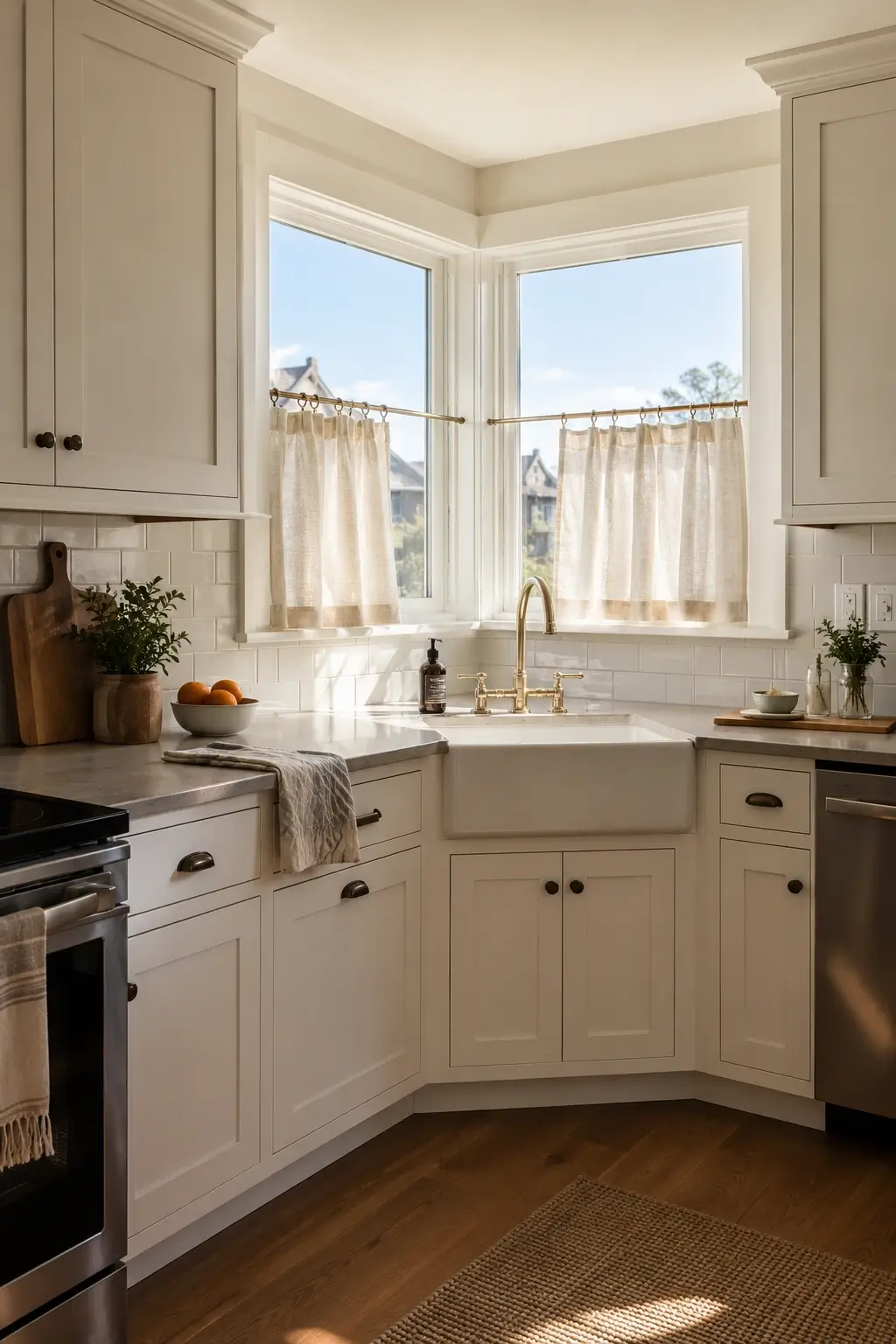
Ground-floor or street-facing corner windows need some privacy, but a full-length curtain defeats the entire reason the window’s there in the first place. Hang a half-length café curtain on a slim brass rod, covering only the lower half of the glass.
This blocks sightlines from the yard or street at counter height while keeping the upper window fully open to sky and natural light, which is the balance most corner-window kitchens are actually trying to strike. Use a simple linen or cotton fabric with no heavy pattern. Leave the curtain pushed slightly to one side, like it’s mid-use rather than freshly hung for a photo.
Quick Comparison: Choosing Your L-Shaped Layout
| Option | Best For | Key Benefit | Limitation |
|---|---|---|---|
| Island | Kitchens roughly 10×12 or larger | Prep space and seating on all sides | Needs 42+ inches of clearance all around |
| Peninsula | Small to medium kitchens | Seating without needing extra clearance | Only accessible from one open side |
| Galley L (no island/peninsula) | Narrow or apartment kitchens | Maximizes walking room and storage | Less casual seating space |
| Open-concept L | Larger open floor plans | Keeps the cook connected to the living space | Needs careful sightline planning |
To plan an L-shaped kitchen layout that actually fits your space, follow these steps:
- Measure both legs of the L and note exactly where plumbing and gas lines already run.
- Mark your sink, stove, and fridge positions with tape on the floor and physically walk the triangle between them.
- Decide between an island, a peninsula, or neither based on how much clearance is left once that walk feels comfortable, not cramped.
This article covers layout and styling choices, not structural engineering. Confirm load-bearing walls and existing plumbing runs with a licensed contractor before committing to any layout change, especially one involving moving a sink or range.
Voice Search Q&A
What is the most space-efficient L-shaped kitchen layout?
A galley-style L without an island, paired with a runner rug and open shelving, typically works best for kitchens under 100 square feet.
Can a small L-shaped kitchen fit an island?
Yes, if there’s at least 42 inches of clearance on all sides, usually starting around a 10×12 footprint. Smaller kitchens often do better with a peninsula instead.
Is a peninsula better than an island for a small kitchen?
Often yes. A peninsula only needs clearance on one open side, while an island needs walking room on all four, making it the easier fit for smaller L-shaped kitchens.
What’s the ideal size for an L-shaped kitchen with an island?
Most designers recommend at least 10×12 feet so the island doesn’t crowd the work triangle between the sink, stove, and fridge.
Do L-shaped kitchens need an island or peninsula at all?
No, Plenty of narrow or apartment L-shaped kitchens function well with neither, relying instead on smart storage and a clear walking aisle.
Final Thought
An L-shaped kitchen earns its popularity honestly — flexible enough to hold an island in a big open floor plan, or stay lean and functional in a 9×10 apartment corner. The real trick isn’t finding the prettiest version online, it’s matching the layout to your actual square footage and how you cook day to day. Start with your measurements, not the photo you fell in love with, and the right ideas on this list will tell you which ones are genuinely yours to borrow.



No Comment! Be the first one.