




23 Cozy Earthy Living Room Ideas That Feel Warm, Layered, and Inviting
You have the neutral sofa. You added a chunky knit throw, bought a few houseplants in plain plastic pots, and maybe even painted a wall a “warm beige” that dried into something closer to...

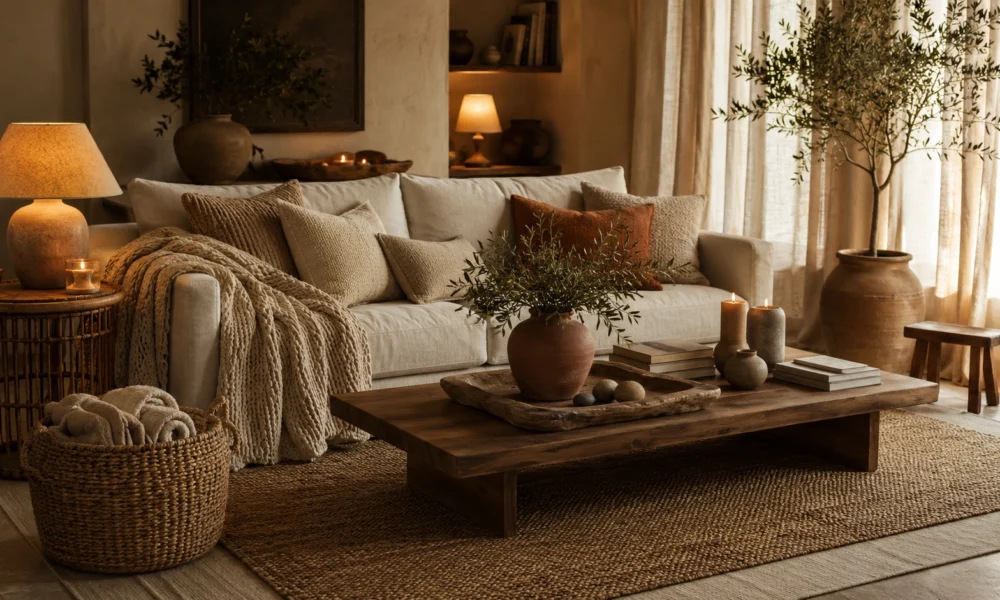
You have the neutral sofa. You added a chunky knit throw, bought a few houseplants in plain plastic pots, and maybe even painted a wall a “warm beige” that dried into something closer to cool gray. The room still feels flat — a little staged, a little cold — and you can’t quite name what’s missing. That gap between the living room you have and the one you keep saving on Pinterest has a real explanation, and it’s simpler to fix than you think.
A cozy earthy living room isn’t built by adding more things. It’s built by understanding which materials, textures, and light sources work together — and in what order they need to be layered. The 23 ideas below go beyond “add some natural elements.” Each one tells you exactly which material to use, where to place it, and why it produces the warm, grounded feeling you’re after. Every idea works on furniture you already own, in a rental apartment, on a real budget.
What Makes a Living Room Feel Earthy and Cozy?
An earthy living room relies on four things working together: a warm neutral color palette (terracotta, camel, sage, linen), natural materials (jute, rattan, linen, raw wood), layered textures (woven rug + chunky throw + ceramic vase), and warm lamp lighting instead of harsh overhead light. Nail all four and the cozy feeling appears almost automatically.
A Quick Earth Tone Palette Primer
Earth tones divide into two groups: warm earth tones (terracotta, rust, camel, amber, burnt sienna, golden ochre) and cool earth tones (sage green, clay, dusty mauve, mushroom taupe). Both groups layer together naturally because — as Havenly lead designer Toussaint Derby noted in a verified 2025 article — all earth tones share a brown pigment at their base, which is exactly what gives them that cocooning, grounded quality when combined. The easiest palette for beginners: pick one warm tone as your dominant color, one cool tone as your secondary, and use cream or warm white as the neutral connector between them.
23 Cozy Earthy Living Room Ideas
1. Layer a Jute Rug Over a Flat-Weave Base
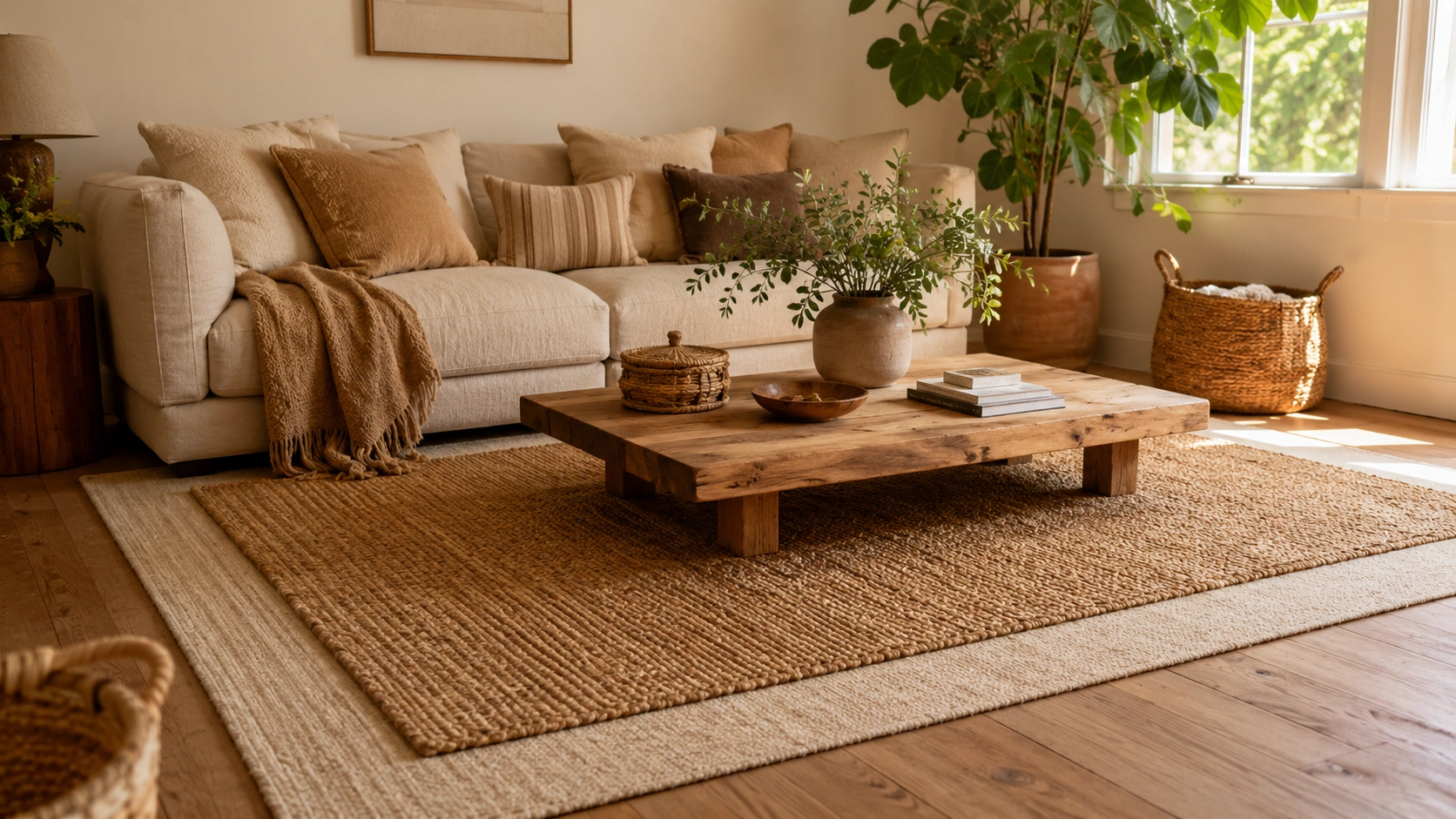
The gap between a flat room and a truly layered one often starts at the floor. Placing a natural jute rug on top of a low-pile flat-weave base creates immediate texture and visual depth — something a single rug simply can’t deliver on its own. The jute’s coarse, woven surface catches light differently than the smooth layer underneath, giving the floor a gathered, well-traveled quality that reads as warmth rather than decoration. It’s the single highest-return floor move in earthy decor.
For sizing, position the jute rug so the flat-weave base shows around the edges — 3 to 4 inches on each side is the sweet spot. IKEA’s SINDAL jute rug (around $49) is a reliable, budget-friendly choice that layers cleanly over a neutral cotton dhurrie or thin wool flat-weave. Keep both rugs within the same warm tonal family — oatmeal, sand, and tan all work together — so they read as cohesive rather than competing. Pairing a cool gray base rug with a warm jute top kills the earthy feeling immediately.
2. Swap Your Throw Pillows for Linen and Boucle
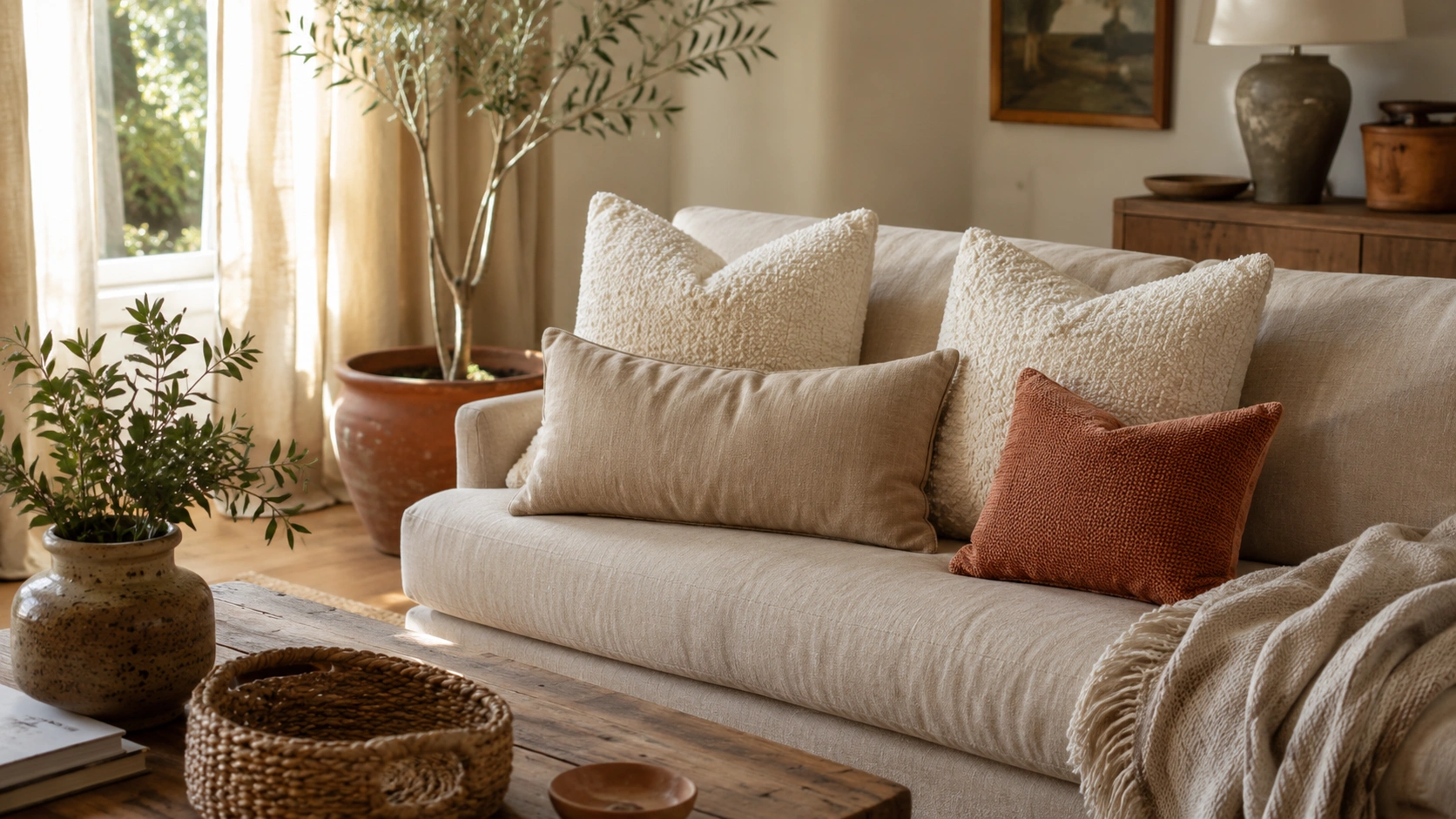
Throw pillows are one of the fastest ways to completely change the feeling of a sofa — but only if you’re working with the right fabrics. Linen has a natural, slightly rumpled texture that reads as lived-in and relaxed rather than stiff or decorative. Boucle — that loopy, nubby fabric you’ve been seeing on every earthy inspo board — adds a cloudlike warmth that photographs beautifully and feels incredible to lean against. Together, these two materials create instant depth on even the most basic neutral sofa.
The arrangement matters almost as much as the fabric. Start with two larger boucle square pillows (22×22″) in cream or warm white at the back of the sofa, then layer a flax-colored linen lumbar pillow in front. Add one textured accent pillow in muted terracotta or sage to introduce your earth tone color. H&M Home and Amazon both carry linen and boucle pillow covers in this range for $15–$35 each — making this one of the lowest-cost, highest-impact swaps in a living room refresh.
3. Build a Terracotta, Sage, and Cream Color Palette
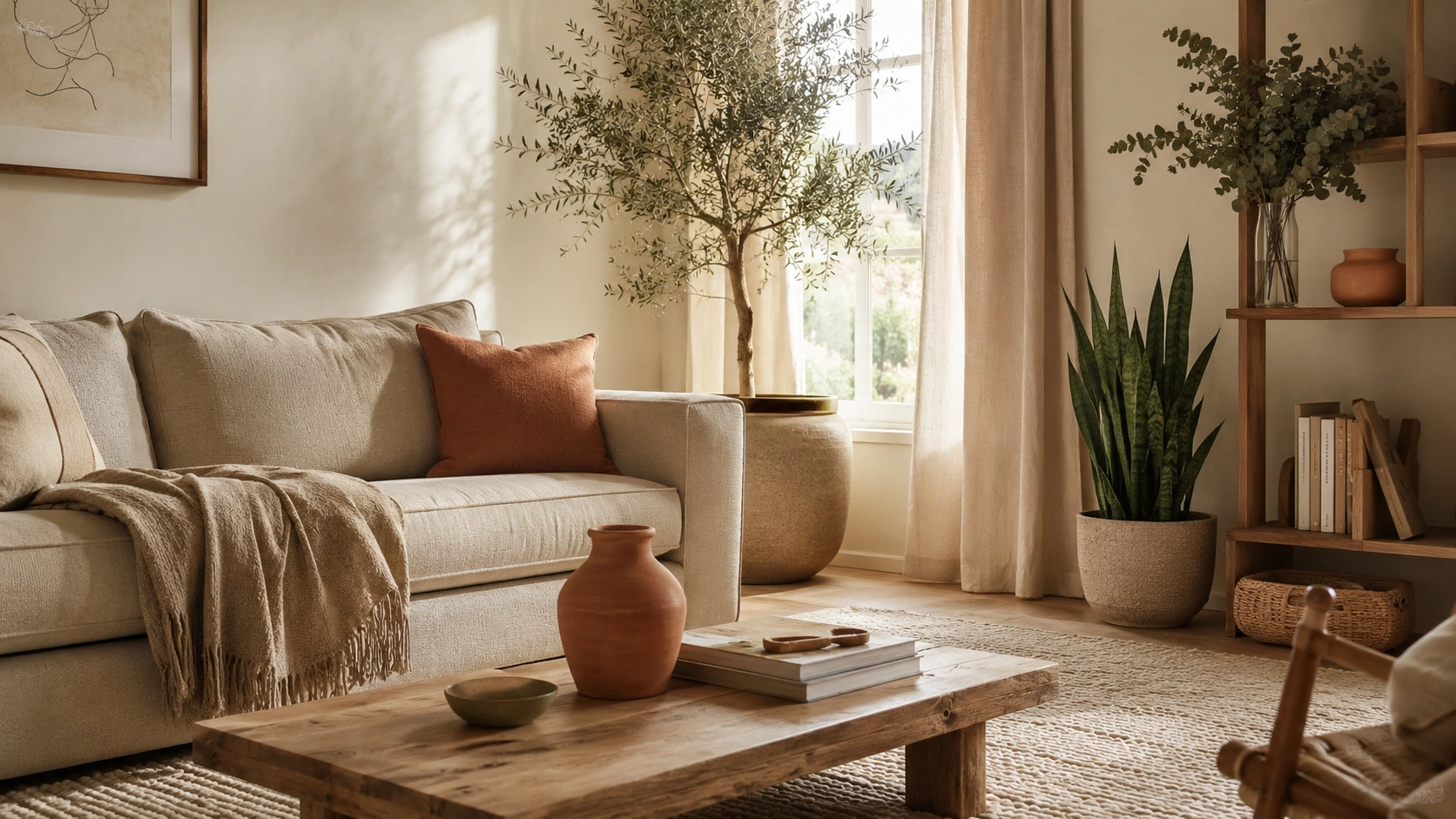
If you’re starting a room from scratch — or trying to fix one that feels perpetually off — this three-color combination is the most forgiving earthy palette a beginner can work with. Terracotta is warm, grounding, and unmistakably earthy. Sage reads as natural and calm without going full green. Cream ties both together without the coldness of bright white. Used in roughly a 10-30-60 split (terracotta as the accent, sage as the secondary, cream as the dominant), this palette creates a room that feels complete, balanced, and genuinely warm throughout.
You don’t need to repaint a single wall to activate this palette. Introduce terracotta through a ceramic vase, a throw pillow, or a small pot on a shelf. Bring in sage through a plant — an olive tree, a snake plant in a tan ceramic, or even a bundle of dried eucalyptus. Let cream or warm off-white carry through your sofa, curtains, and rug. The three tones read as a cohesive palette even when scattered across different materials and varying heights throughout the room.
4. Style Your Coffee Table with Natural Found Objects
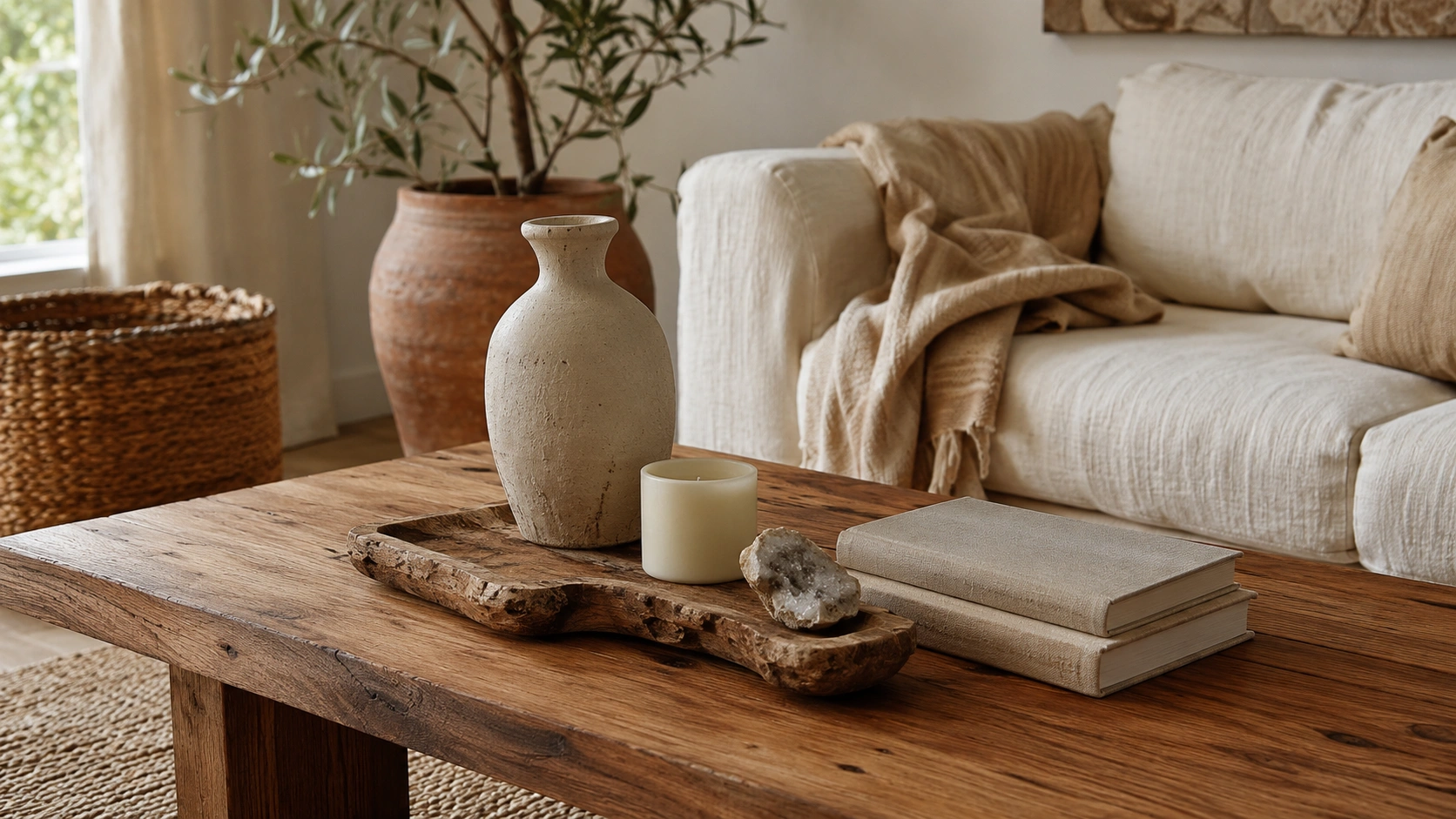
A coffee table styled with natural objects immediately signals that your room has an earthy point of view — and the key is contrast, not uniformity. The classic earthy vignette pairs something rough with something smooth: a raw-edged wooden tray beside a polished ceramic bud vase, or a cluster of smooth river stones next to a linen-spined book stack. That contrast between rough and refined textures is what creates the curated-but-natural quality you see in the photographs you keep saving and pinning.
Limit yourself to three to five objects and vary the height within the arrangement — this is what prevents it from reading as a retail display. A tall ceramic vase, a short candle, a stack of two or three books, a small plant, and one natural object (a piece of driftwood, a worn wooden bowl, or a small geode) is a complete composition. McGee & Co.’s Ethel Vase is a beautiful aspirational reference, but a well-placed $8 thrifted ceramic achieves the same visual effect in the right grouping.
5. Add Warm Amber Lamp Lighting in Every Corner
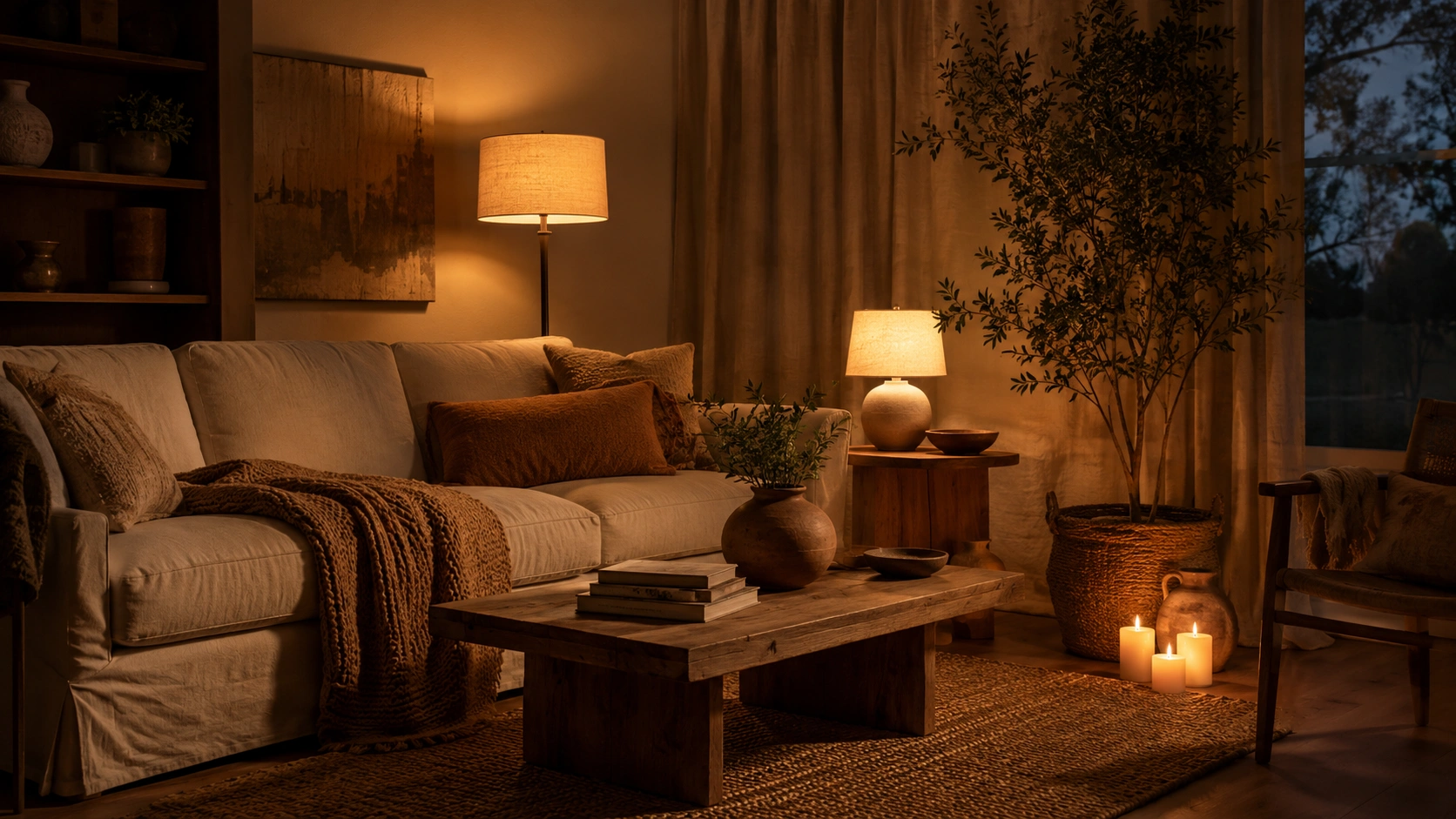
Lighting is probably the most underestimated tool in an earthy living room — and it explains why a room can still look cold after you’ve added all the right things. Overhead lighting, especially cool white or daylight bulbs, flattens texture completely. It removes the shadows that make a woven rug look dimensional, a chunky throw look cozy, and a terracotta vase look warm. Warm amber lamps (look for bulbs labeled 2200K–2700K) restore all of that shadow, depth, and texture that overhead light was canceling out.
The goal is at least three sources of warm light at different heights: a floor lamp behind or beside the sofa, a table lamp on a side table, and either a small plug-in sconce or a cluster of candles at low level near the floor. You don’t need expensive fixtures — IKEA’s floor lamps paired with an amber Edison-style bulb do exactly what a $400 designer lamp does. Keep the overhead light switched off in the evenings and you’ll notice within ten minutes how dramatically different the entire room feels.
6. Use a Chunky Knit Throw as Your Texture Anchor
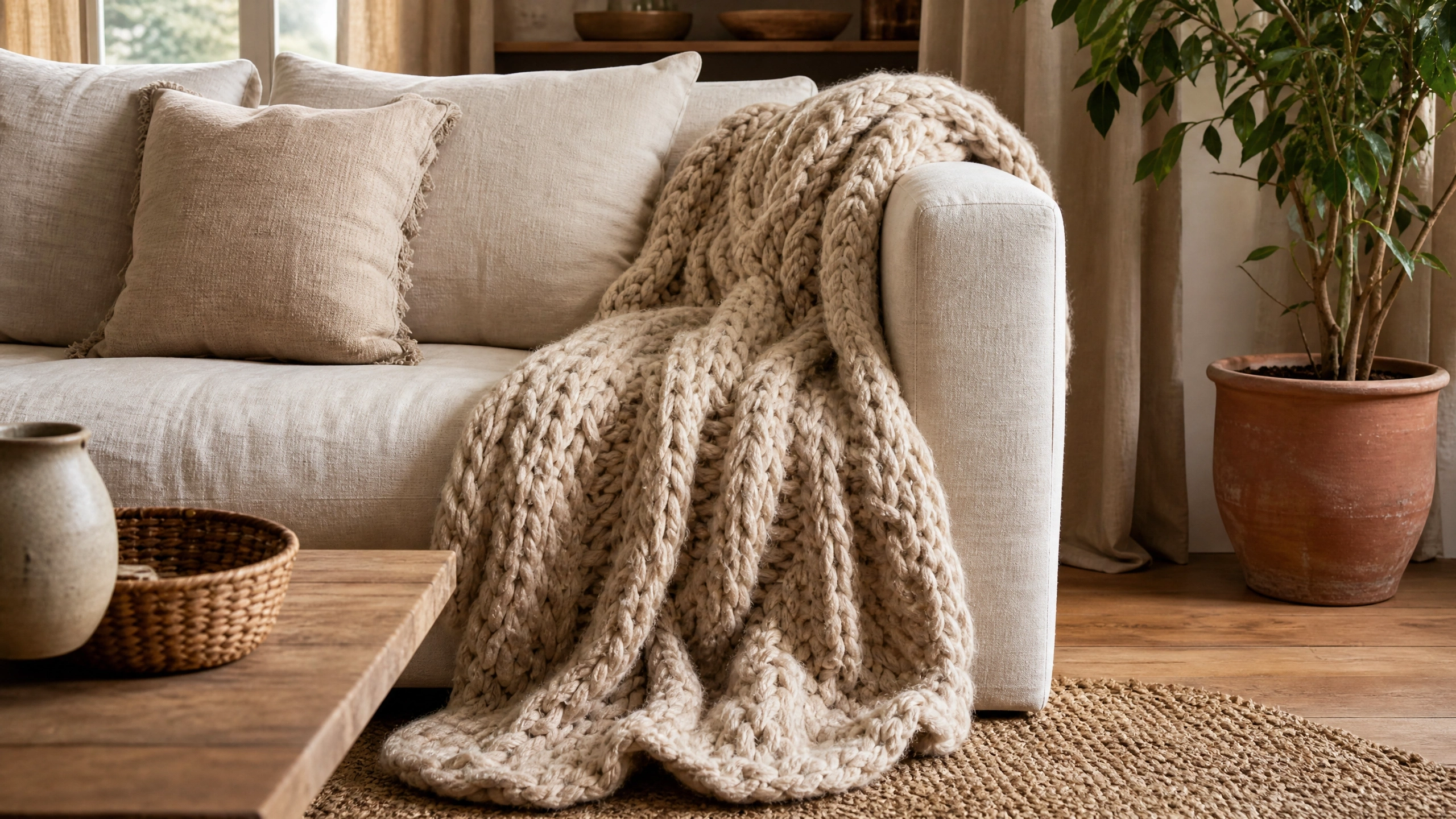
Not all throws do the same earthy work. A thin fleece or microfiber blanket may be warm, but it reads as flat and adds nothing visually. A chunky knit throw — specifically one with visible, oversized loops or a thick cable-knit pattern — adds the kind of tactile drama that makes a sofa look lived-in and inviting in photographs and in real life. Think of it as your texture anchor: the piece that sets “cozy” as the visual language of the entire room before anything else is added.
Drape it casually rather than folding it neat and square. The most intentional-looking placement is a loose, relaxed fold over one sofa arm, with the bottom edge slightly pooling on the cushion or rug. Natural fiber knits — wool, cotton, and linen blends — photograph the best and age beautifully. Color-wise, stick to warm camel, oatmeal, cream, or muted terracotta. Amazon and H&M Home both carry chunky cotton knit throws in this earthy range for $25–$45, making this one of the best budget entries into a layered room.
7. Bring In a Tall Olive Tree or Fiddle Leaf Fig
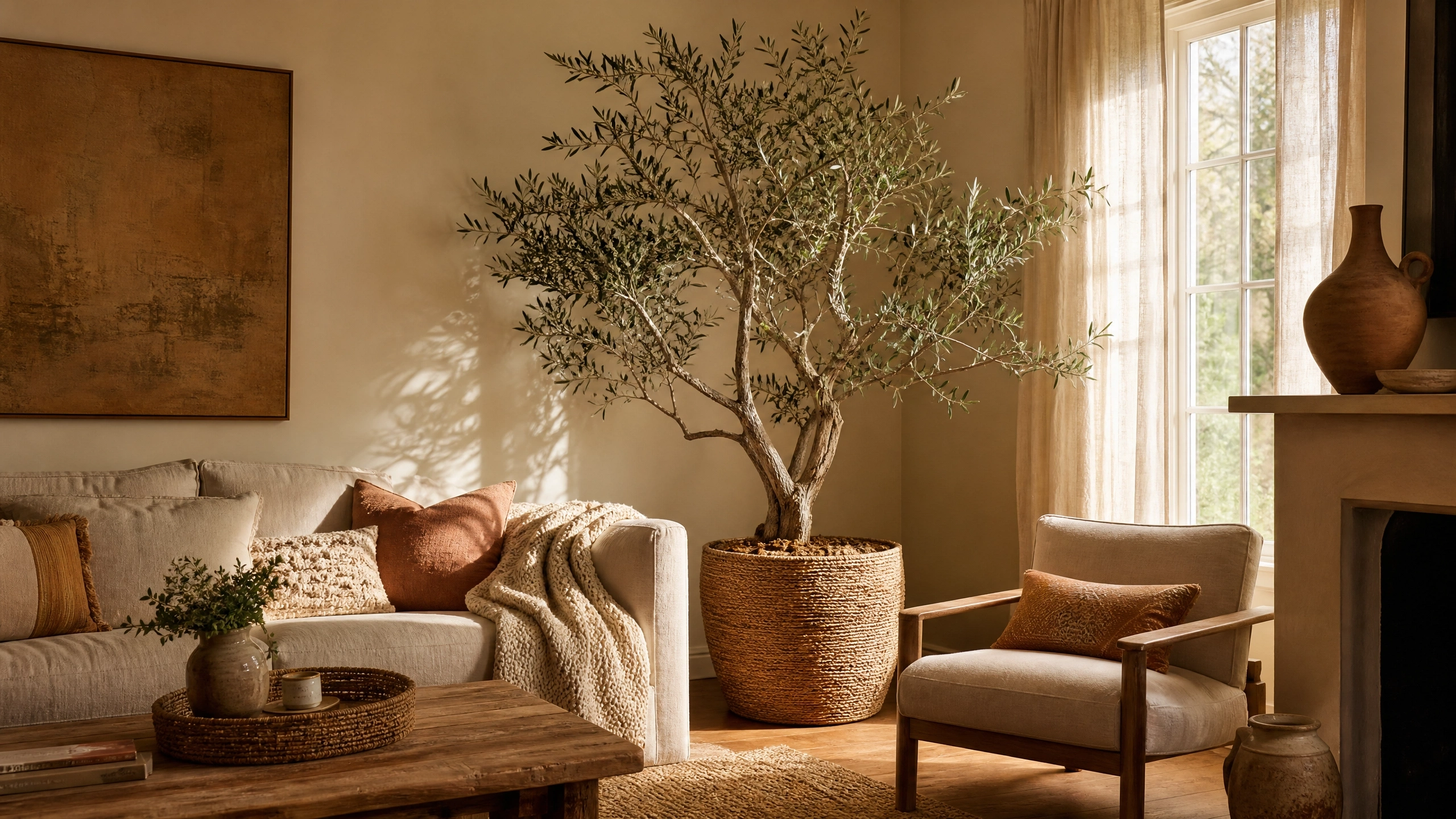
No plant variety contributes to an earthy room the way a tall statement tree does. A potted olive tree — with its gnarled silver-gray branches, dusty green leaves, and naturally imperfect silhouette — adds organic height, movement, and a quietly ancient Mediterranean warmth that no throw pillow can replicate. A fiddle leaf fig brings the same kind of presence with its large, waxy, deeply veined leaves. Either one placed near a bright window corner becomes the room’s most alive, grounding element and immediately shifts how the entire space reads.
The pot matters as much as the plant. A terracotta planter, a speckled neutral ceramic, or a woven seagrass basket wrap transforms even a plain nursery container into a visual layer. For renters and those new to plants, a high-quality faux olive tree — look for ones with realistic twisted branches rather than stiff, obviously plastic versions — achieves the same height and silhouette without watering anxiety. Place it in the corner where two walls meet, beside a sofa arm or behind a reading chair, to anchor that vertical space and add warmth where it was previously empty.
8. Try a Warm Walnut or Oak Coffee Table
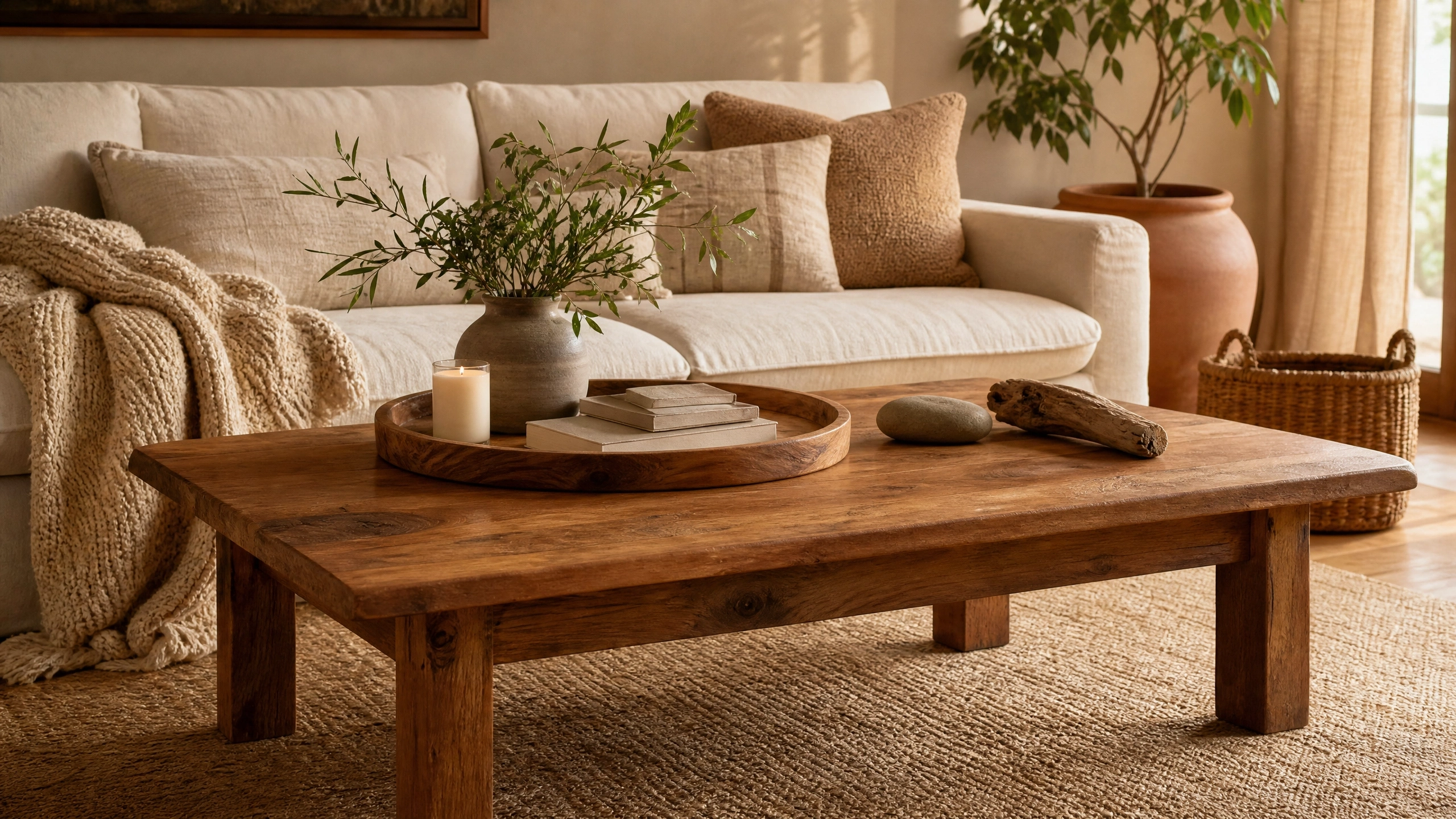
The material of your coffee table has an outsized effect on how earthy and warm a room feels — and nothing does more work here than walnut or oak. Walnut’s deep, chocolate-brown tones and natural grain variation add immediate richness to the center of the room. Oak in a warm honey or lightly whitewashed finish reads as lighter but still distinctly natural. Either creates a visual anchor that wood-look MDF or glass simply cannot deliver — natural wood grain is earthy shorthand that works across every style and budget level.
If replacing your coffee table isn’t feasible right now, a large wooden tray placed on top of an existing neutral table brings in the same warm-wood energy at a fraction of the cost. McGee & Co.’s Harvey resawn oak coffee table is a gorgeous aspirational reference; for a more immediate budget, IKEA’s LISTERBY and similar warm-toned options start under $150. When shopping secondhand — which is absolutely worth doing here — look specifically for pieces with visible grain rather than painted or lacquered finishes that block the natural texture entirely.
9. Add a Woven Rattan Side Table or Accent Piece
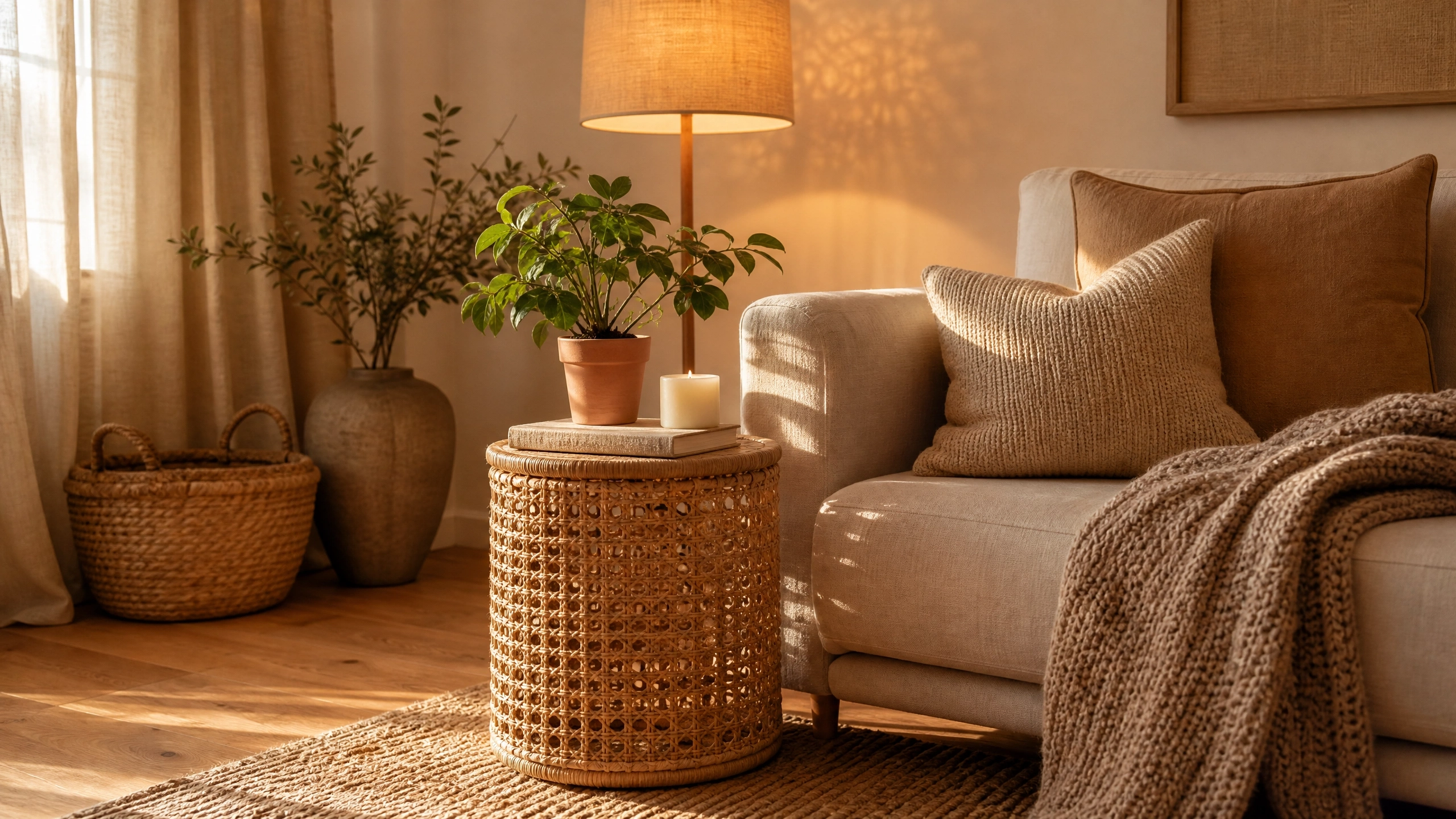
Rattan photographs warm and lives warm — and a woven rattan side table is one of the fastest ways to introduce organic texture without replacing any furniture. Even a single rattan piece — a drum-shaped side table, a woven tray table, a wicker accent stool — introduces a handcrafted, organic quality that plastic and metal equivalents simply don’t have. Rattan’s loose weave casts small shadows and catches warm lamp light in a way that adds depth to an empty corner, making it work as both functional furniture and a deliberate layer of visual warmth.
Place a rattan side table beside a sofa arm, next to a reading chair, or in a corner behind a floor lamp. Style it simply: a small terracotta pot, a short candle, and one or two books is all the surface needs. IKEA’s rattan and seagrass accent tables sit under $80 and hold up well with everyday use. In a smaller apartment with limited floor space, a rattan tray table is the most flexible option — it doubles as occasional seating, a plant stand, or extra surface area whenever you need it.
10. Use Linen Curtains in Oatmeal, Stone, or Warm White
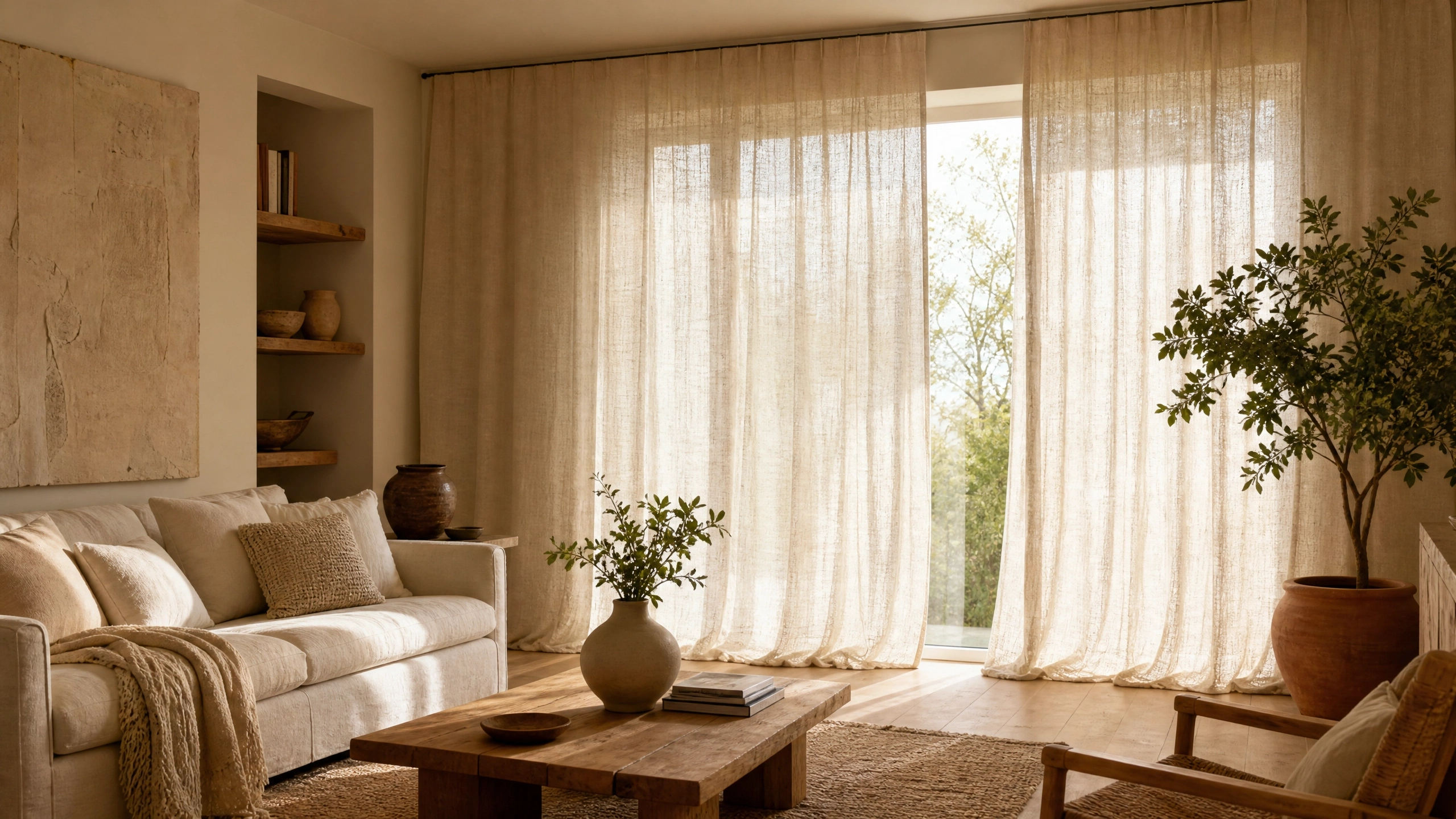
Curtains cover more visual square footage than almost any other single element in a room, and the fabric and color you choose has a proportional impact on how warm or cold the space feels overall. Linen curtains in oatmeal, stone, or warm white filter light softly rather than blocking it, creating a gentle, diffused glow that makes the whole room feel golden during daylight hours. That soft filtered quality is one of the core building blocks of a cozy earthy living room that actually feels different from a standard neutral space.
Hang the curtain rod as close to the ceiling as possible and let the panels just brush the floor — this makes the ceiling feel higher and the room airier even in compact apartments. Skip stiff, structured curtains with a neat, tailored hem; the slightly imperfect, relaxed drape of natural linen is part of the visual appeal. H&M Home and Amazon’s linen-look curtain panels in oatmeal or stone tones start around $25–$40 per panel and achieve the same diffused warmth as much more expensive options. Light filtration is the goal here, not blackout.
11. Create an Earthy Gallery Wall with Botanical Art
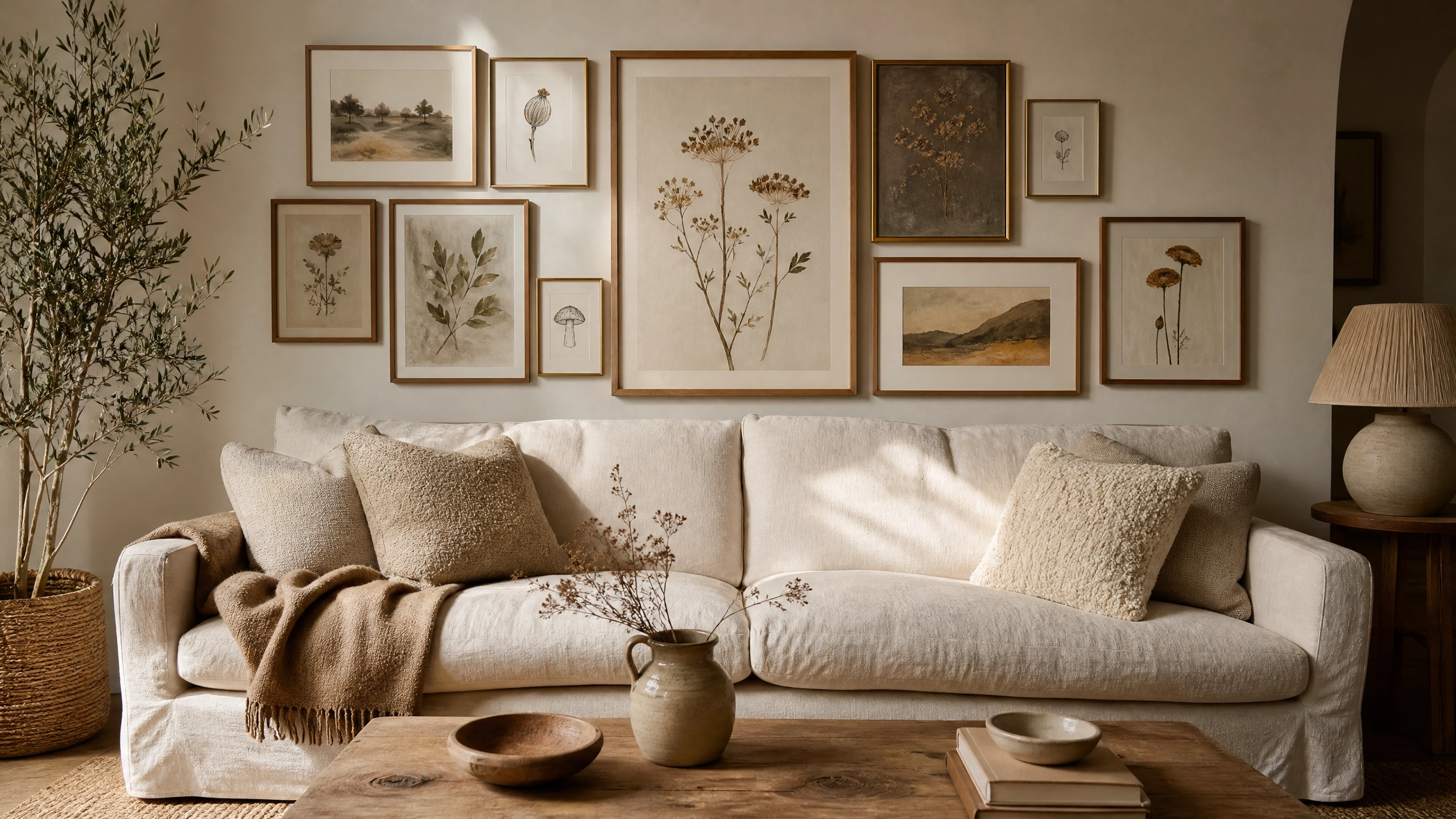
A gallery wall doesn’t need bright color or trendy typography to feel interesting. One built from botanical prints, abstract nature studies, warm watercolor landscapes, or simple line drawings in natural subject matter — seeds, mushrooms, dried flowers, branches — creates a quiet organic focal point that reinforces the room’s grounded feeling without overwhelming it. The key is staying within a warm, muted tonal range for both the artwork and the frames: warm wood, raw brass, or simple cream matte are the right containers for this kind of earthy arrangement.
Keep the wall grouping tighter than you might expect. Gallery walls with large gaps between frames read as unfinished; closer spacing reads as intentional. Aim for 2–3 inches between frames. Mix sizes deliberately — a larger 18×24″ botanical print anchoring the left or center, flanked by smaller 5×7″ and 8×10″ prints — to create natural visual rhythm. Society6 and Etsy carry a wide range of downloadable botanical and earthy prints for $5–$15 that you can print locally and frame with inexpensive frames from IKEA or a thrift store.
12. Style Shelves with Terracotta Pots and Ceramic Vases
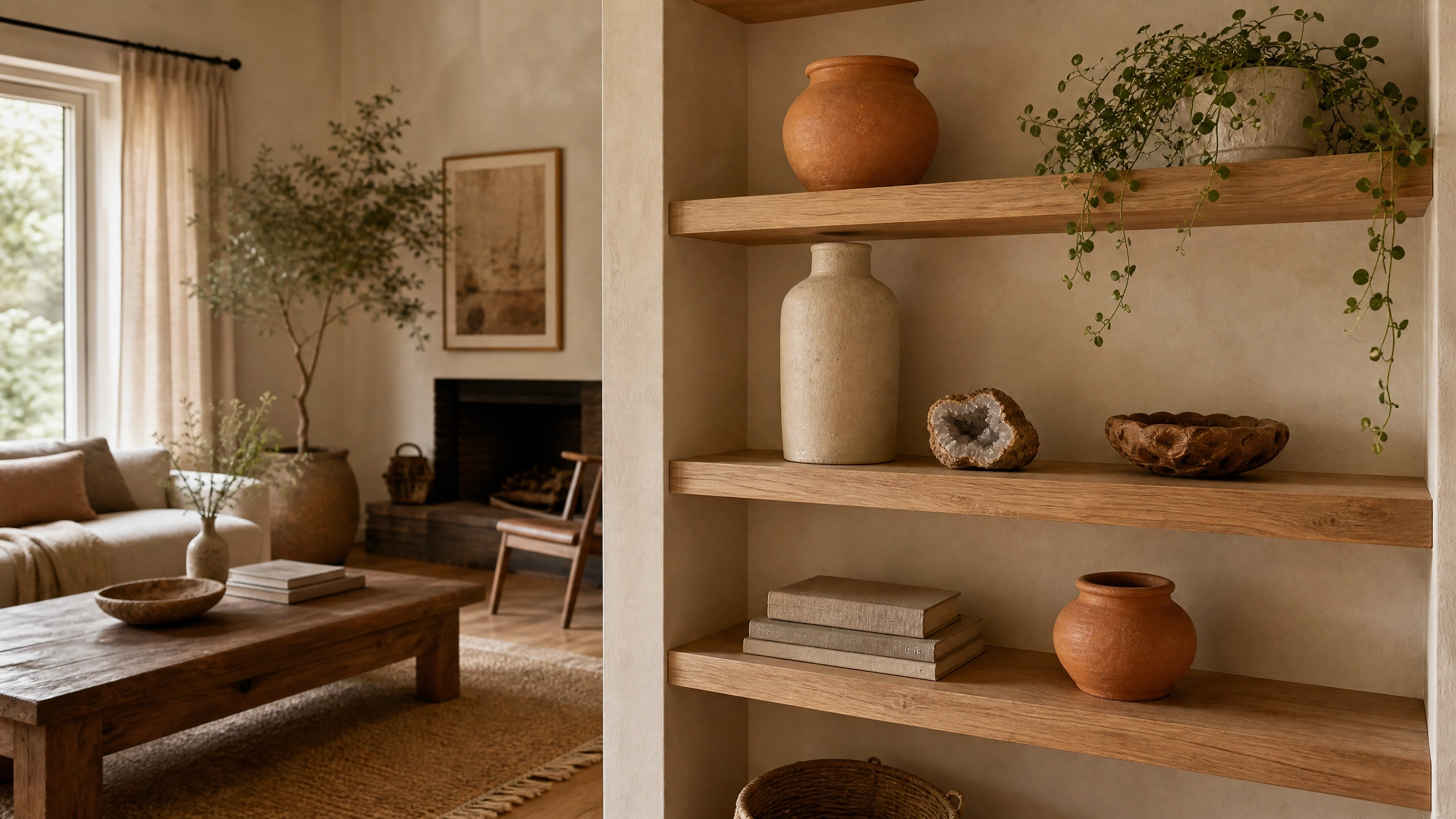
Shelves filled with just books and a few random objects tend to feel crowded but still somehow flat. Shelves styled with terracotta pots, matte ceramic vases, and natural small objects feel collected, warm, and purposeful — the difference is material intentionality. Each terracotta pot introduces a clay-orange tone that reinforces the earthy palette, while the unglazed or matte surface absorbs light softly rather than reflecting it. That non-reflective quality is what makes terracotta feel organic and warm rather than staged and decorative.
The trick is ruthless editing. Three well-chosen objects on a shelf read better than twelve random ones. A reliable earthy shelf grouping: one tall ceramic vase (or a small potted trailing plant), one shorter textured pot, and one organic object like a small geode, a wooden sculpture, or a pinecone bowl. Vary the heights deliberately. Amazon’s home section has terracotta-style ceramics in the $12–$30 range — but garden centers, which almost everyone overlooks, are often the best source for actual unglazed terracotta pots at $3–$8 each.
13. Add a Vintage Kilim or Patterned Jute Area Rug
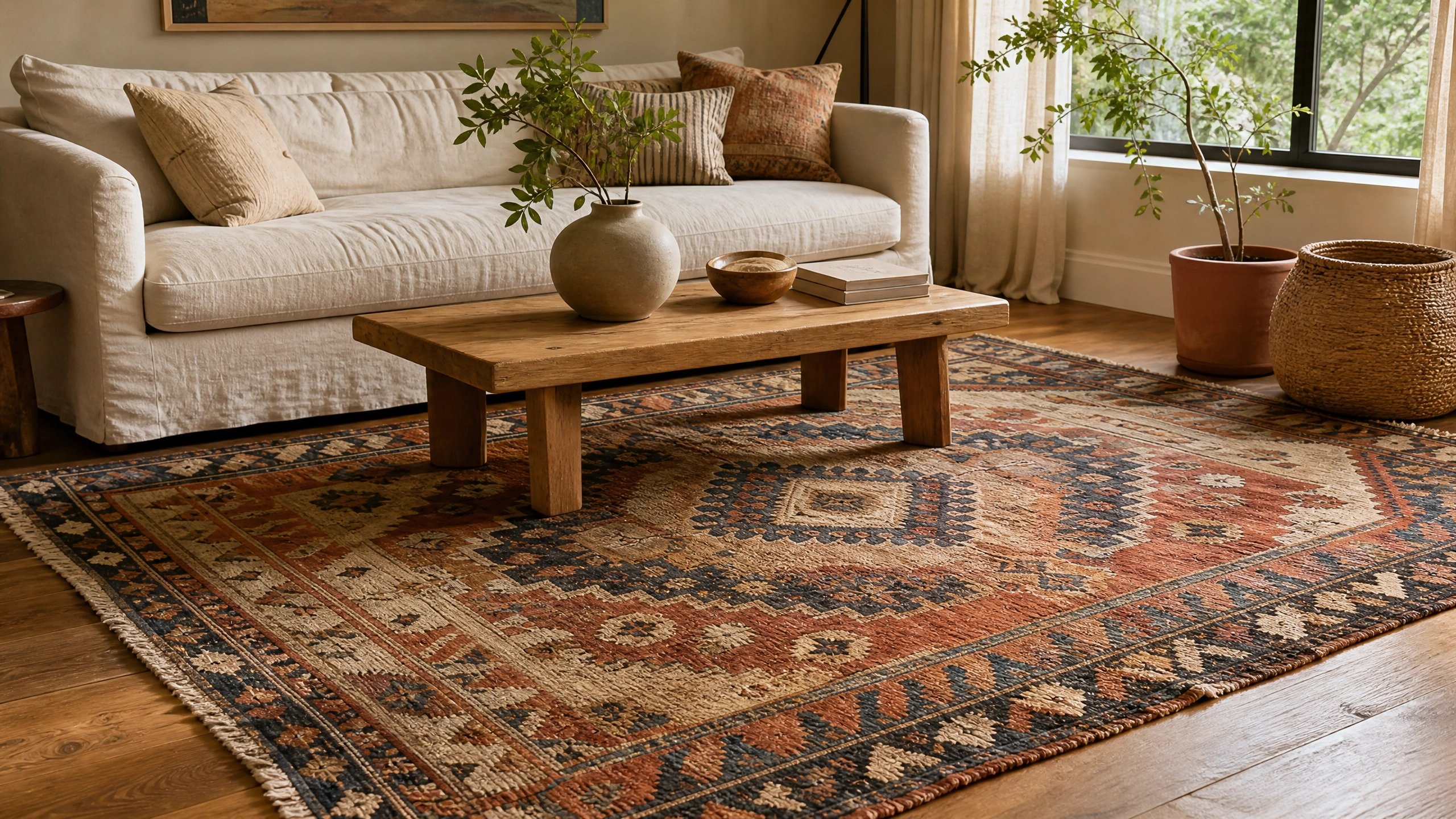
A solid-colored jute rug is earthy and grounded — but a vintage kilim or patterned jute area rug introduces color, pattern, and history to the floor in a way that gives the room an entirely different quality. A well-chosen kilim with faded terracotta, rust, cream, and navy in a geometric or tribal pattern becomes the most visually interesting object in the room while still landing firmly within an earthy, organic palette. The worn, slightly imperfect quality of a vintage textile adds decades of visual character in a single afternoon.
Real vintage kilims can be found on Etsy, Facebook Marketplace, or local antique shops for $40–$200 depending on size and condition — and the uneven, faded look of a well-used rug is an asset in an earthy room, not a flaw. If vintage isn’t accessible, machine-made kilim-style or distressed jute rugs from Amazon or H&M Home replicate the patterned quality at a lower price point. Layer this rug directly on wood floors or tile — no base rug needed when the surface pattern is already doing the textural work on its own.
14. Use a Raw-Edge Wood Shelf or Floating Ledge
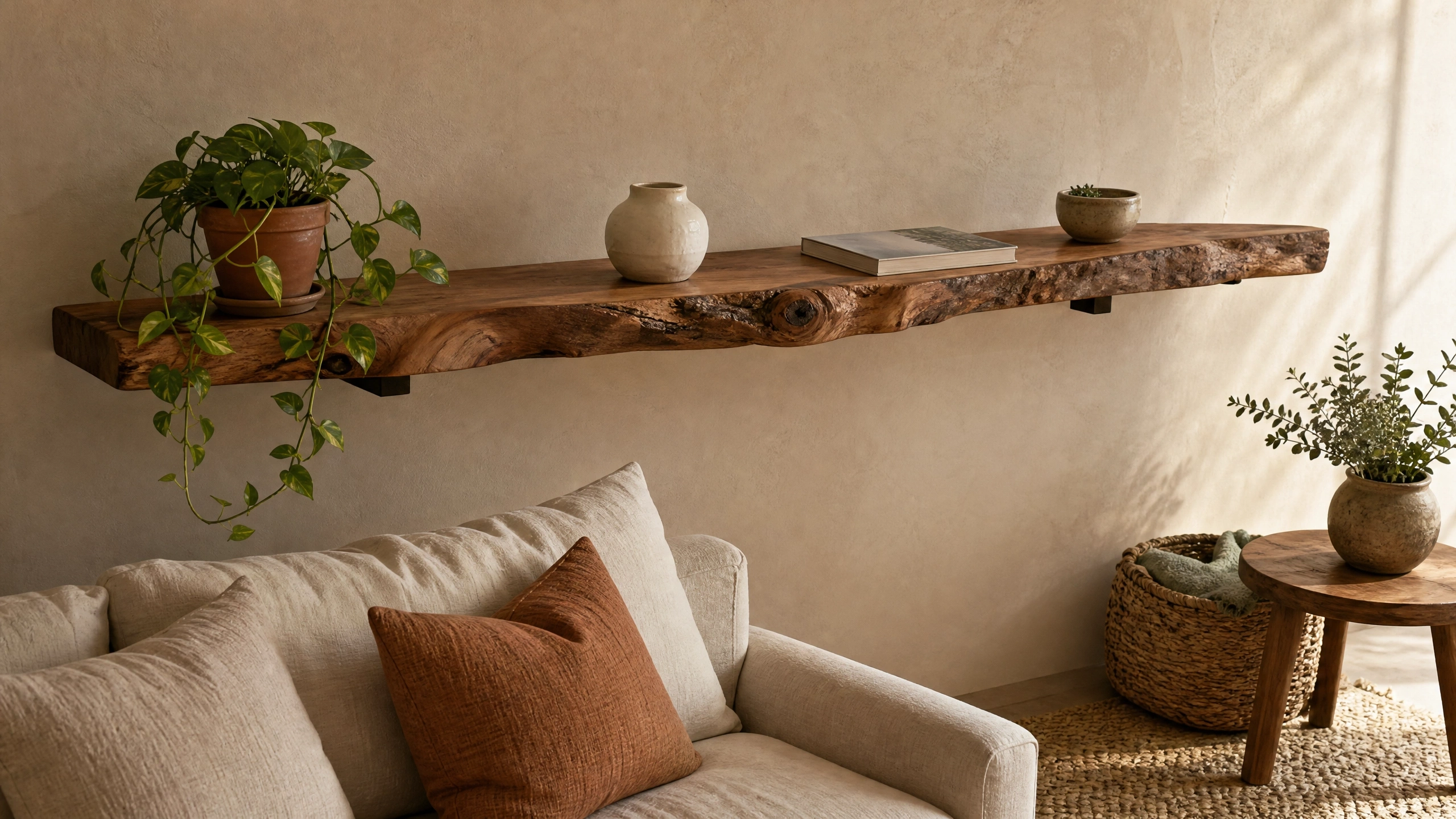
Raw-edge wood — shelves or boards that retain the natural, irregular edge of the tree they came from — is one of the most striking earthy elements you can introduce to a living room wall. A single floating live-edge shelf, styled with a trailing plant, a small ceramic, and one book laid flat, becomes a wall feature that reads like something from a design shoot. The organic, imperfect edge of the wood creates all the visual interest — it reads as nature inserted directly into the room, not furniture placed against a wall.
For renters, floating shelves that use standard wall anchors are viable and removable without major damage when properly installed. Etsy sellers offer live-edge wood shelf slabs in a range of sizes and tones for $30–$90, or you can find raw-edge boards at a local lumber yard and mount them on simple bracket hardware. Keep the styling minimal: three to five objects maximum, with a trailing pothos or small succulent positioned at one end so the green softens the raw wood edge naturally. The goal is for it to look like something grew into the shelf over time.
15. Mix Three Textures on Your Sofa: Linen, Velvet, and Woven
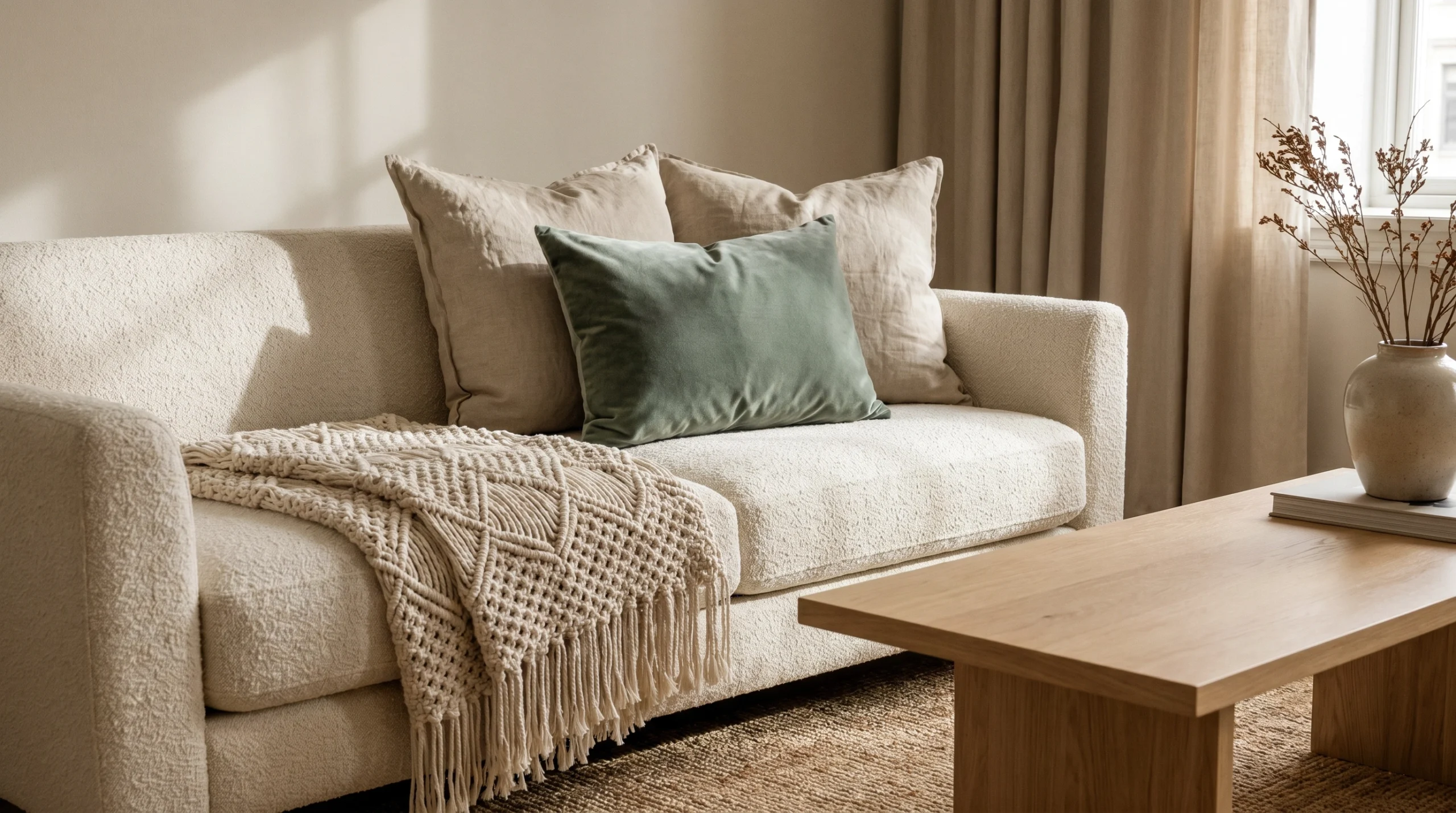
The reason some sofas look styled and layered while others look like they just arrived from the showroom floor comes down almost entirely to texture variety. Limiting yourself to one fabric type — even a beautiful one — reads as flat. Mixing three textures on the sofa creates visual richness that’s instinctively satisfying. The specific combination that works best in an earthy room: a linen or linen-blend throw pillow for its natural, slightly rumpled quality, a velvet pillow in a muted earth tone like deep sage or aged terracotta for its light-reflective depth, and a woven or macramé accent for rough, organic contrast.
Pair two larger linen or boucle pillows at the back with a single velvet accent pillow in front, and finish with a loosely draped woven throw across one arm. The linen provides the neutral base; the velvet introduces tone and a slight sheen; the woven piece provides the earthy, organic contrast that ties all three back to natural materials. This arrangement works on any sofa color — gray, cream, camel, even dark charcoal — because the texture contrast creates warmth regardless of the background color behind it.
16. Introduce a Stone or Concrete Candle Grouping
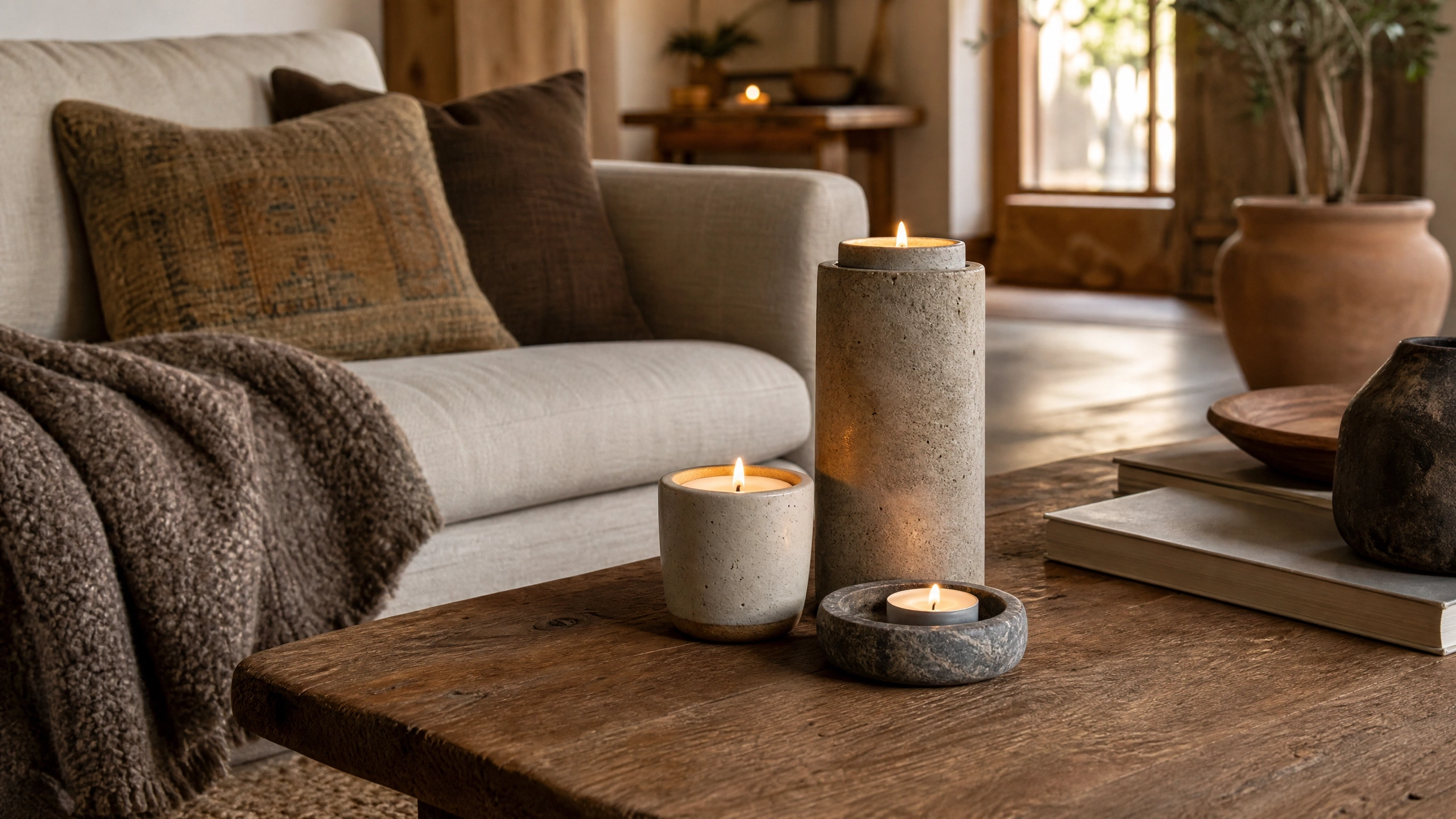
Candles do two things in a living room simultaneously: they provide warm ambient light, and they add a decorative object through the vessel alone. In an earthy room, the vessel is everything. A glass jar candle or plastic-wrapped pillar reads as generic; a candle in a stone, concrete, or raw ceramic holder adds a tactile, grounded quality to whatever surface it sits on. Stone and concrete hold heat slightly differently than other materials, and their cool, dense texture creates an interesting visual contrast against warm woven fabrics and wood surfaces nearby.
Group three candles of varying heights on a coffee table, a console, or a wide windowsill — a set of three works better than one or two because it creates a clustered arrangement that reads as intentional rather than incidental. Look for concrete pillar candle holders, a small soapstone dish, or a set of unglazed ceramic tealight holders; TJ Maxx, HomeGoods, and Amazon all carry these in the $12–$25 range. Combine one tall, one medium, and one short. The grouping should feel assembled one piece at a time, not purchased as a matching set.
17. Create a Cozy Reading Corner with Earthy Layers
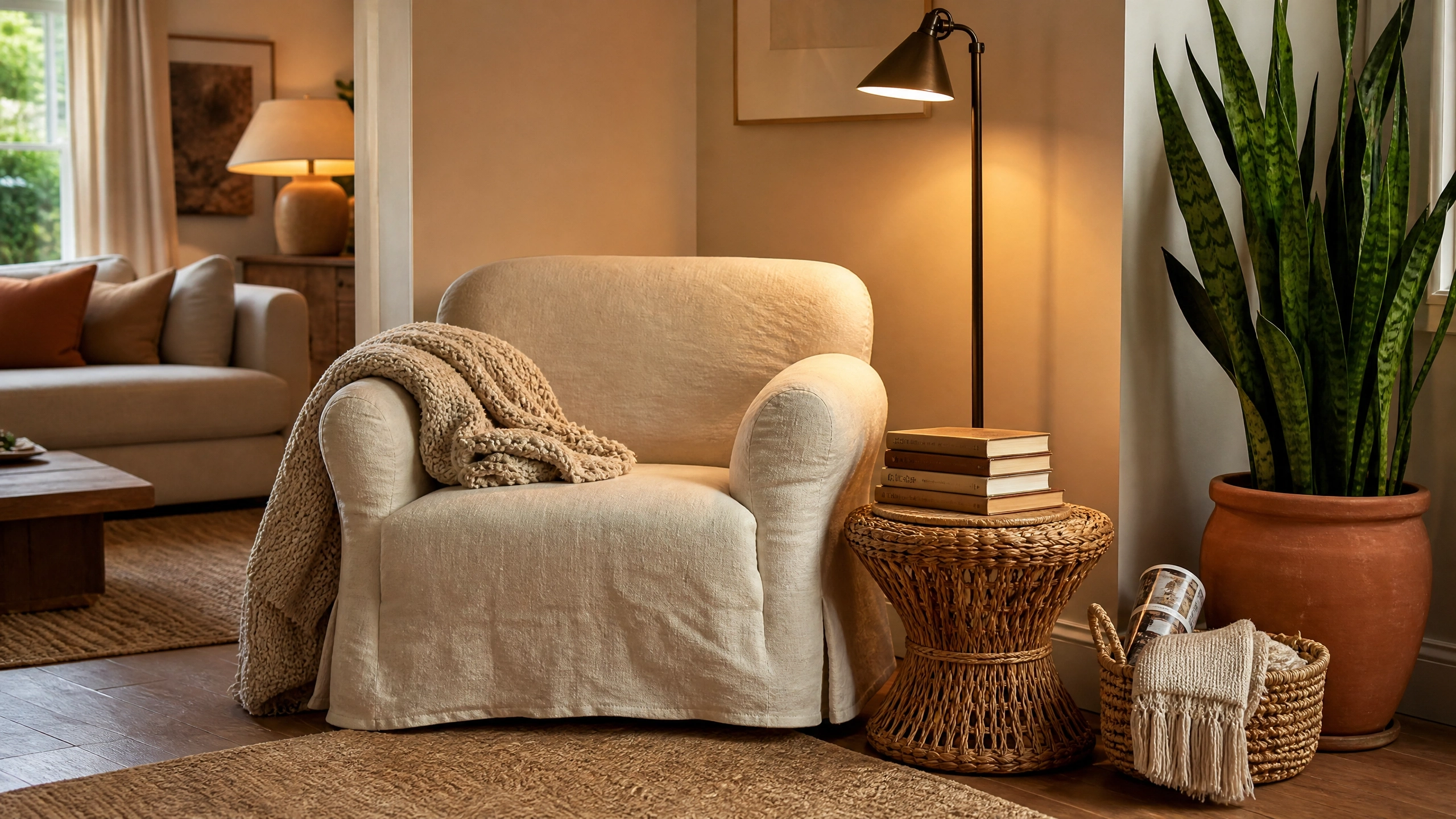
A cozy reading corner doesn’t require a dedicated room or a bay window — it requires a specific combination of elements placed in a corner with enough intention to feel separated from the main sofa setup. The base is a comfortable chair: a curved armchair, a worn leather seat, or a linen slipcovered chair in camel or cream. Add a floor lamp directly beside it for that warm, specific overhead glow. Place a small rattan side table within arm’s reach and fold a chunky knit throw over one arm of the chair. That’s the structure.
The earthy details are what transform a corner into a destination. A small woven basket on the floor holding a few rolled magazines or a spare throw. A potted snake plant in a terracotta pot at one side, adding height and organic color. A stack of books on the side table, covers facing out. None of this requires a large budget — a thrifted armchair from Facebook Marketplace ($30–$80), a $49 IKEA floor lamp with an amber bulb, and a few textile layers you already own can produce a reading corner that looks curated and intentional from the first moment you sit in it.
18. Add Dried Pampas Grass or Eucalyptus in a Tall Vase
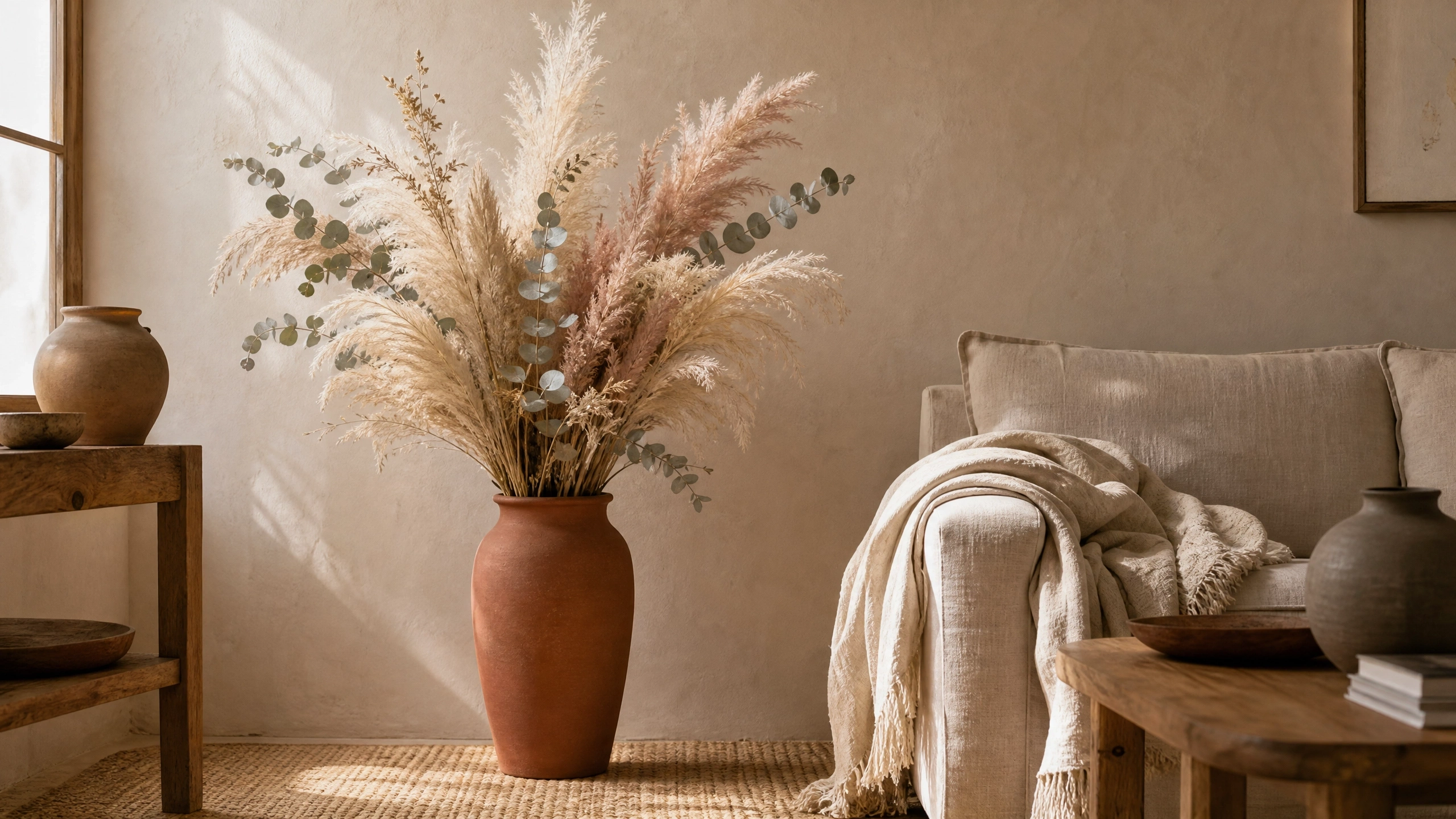
Dried botanicals are a smart solution for earthy rooms because they deliver organic height and texture without requiring sunlight, regular watering, or a green thumb. Pampas grass — with its feathery, cream-to-blush plumes — in a tall matte stone or terracotta vase adds soft, romantic movement that photographs warmly and looks completely different from artificial flowers. Dried eucalyptus works similarly: its silvery-green color brings a cool earthy note that balances warm tones elsewhere without clashing with the overall palette or reading as out of place.
For placement, a single tall vase of pampas grass in a corner — ideally 3 to 4 feet in total height, plumes included — functions as a natural sculptural element that softens a stark wall without requiring a gallery arrangement. A concrete or matte terracotta vase from Amazon or HomeGoods in the $18–$35 range works beautifully for this. Dried pampas grass itself is available from Amazon, Etsy, or a florist supply shop — a bunch of 5–10 stems usually runs $15–$30 and lasts for years with minimal care. Style it loose and slightly imperfect; a too-neat arrangement reads as artificial.
19. Use Warm Browns, Camel, and Olive as Your Base Trio
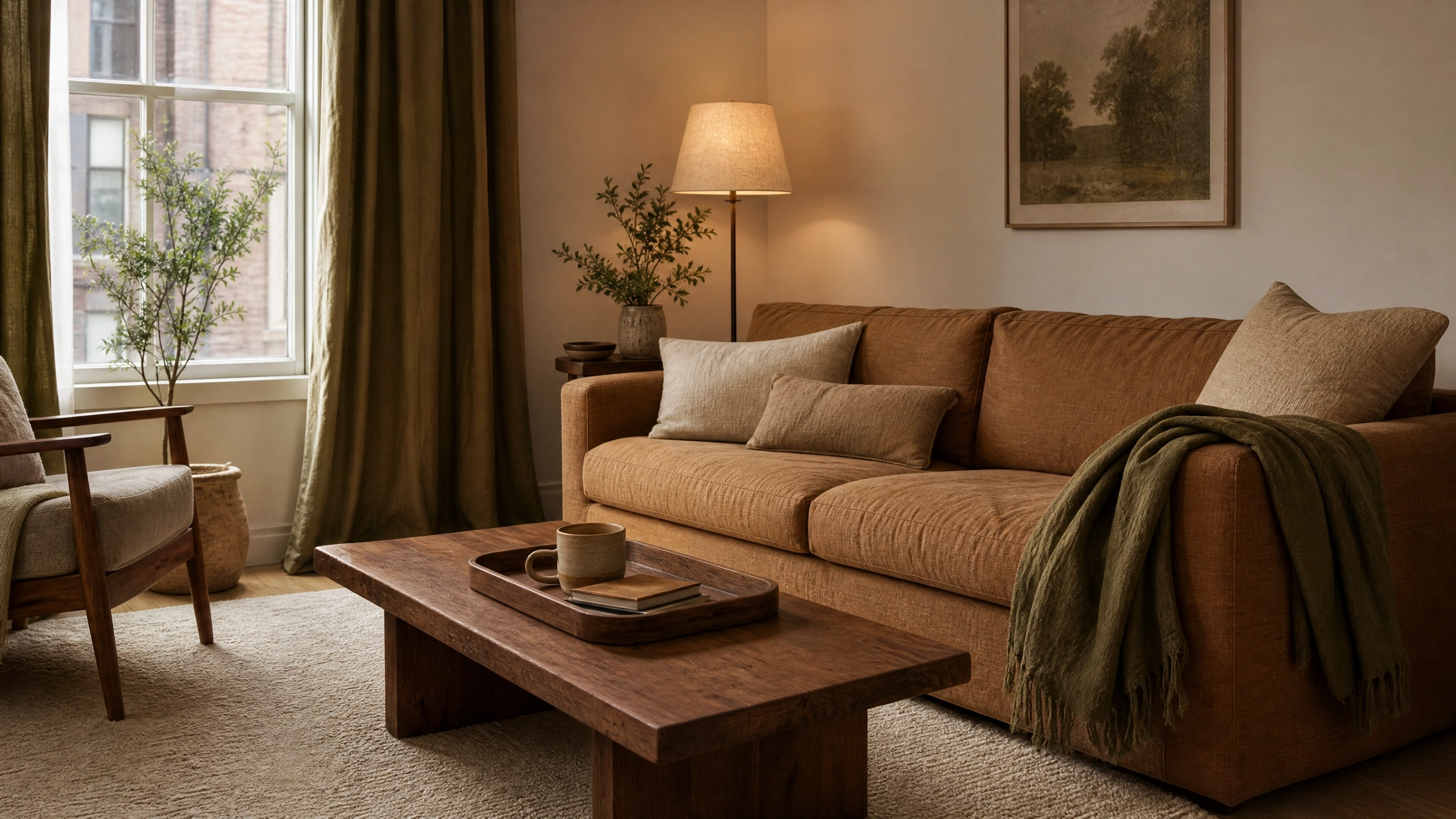
If the terracotta-sage-cream palette feels too bold or too specific for what you already have in your room, this quieter trio is the alternative. Warm brown, camel, and olive are all deeply neutral colors — none reads as a strong accent — but together they produce a layered, tonal warmth that feels rich without being loud. Think a camel-colored sofa, a warm brown wood coffee table, olive curtains or a small olive throw, and a cream or oatmeal rug tying the floor together. Every piece is neutral individually; together they create an enveloping warmth that’s hard to name but immediately felt.
This palette works particularly well in rental spaces where the walls are white or off-white and can’t be changed — the tonal warmth of the furnishings effectively warms the room without touching a single painted surface. Adding warm lamp lighting in the evenings shifts the whites on the wall to a soft amber glow that completes the earthy picture entirely. It’s also one of the easiest palettes to build gradually: start with a camel throw pillow, add a warm brown wood tray, fold in an olive plant — each piece reads as intentional the moment the trio logic is in place.
20. Try a Shearling or Faux Sheepskin Accent Chair
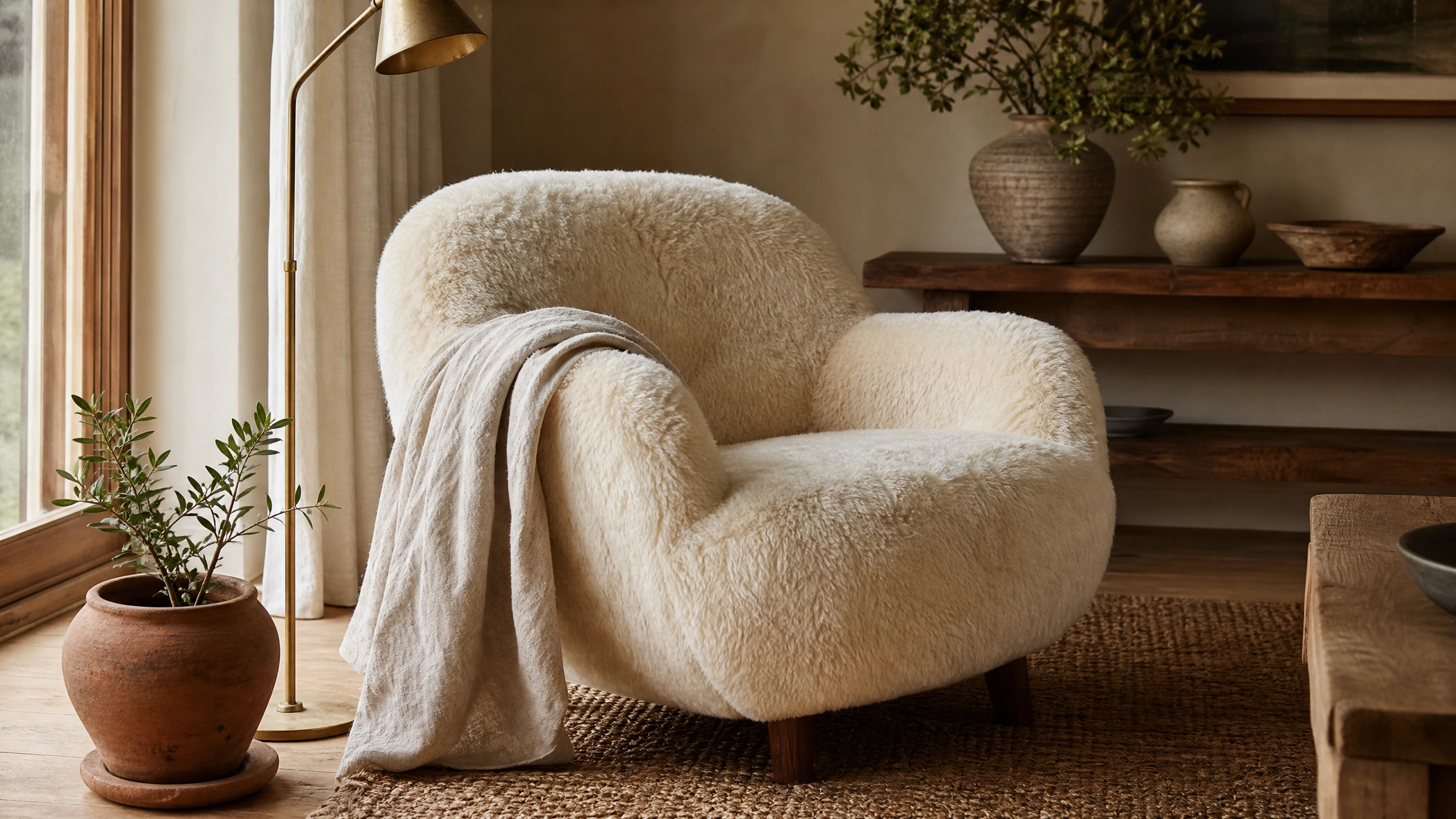
Few single pieces do more cozy, earthy work per square foot than a shearling or faux sheepskin accent chair. The dense, fluffy texture is immediately inviting and tactile — it looks like it should be touched, which is exactly the quality that makes earthy rooms feel warm rather than designed. A shearling chair in cream, ivory, or warm sand works in almost any corner: beside a reading lamp, across from the sofa as a conversational seat, or pulled beside a console table as a layered accent. It reads as sculptural and soft at the same time, and it photographs like a dream.
Genuine shearling chairs are an investment ($300–$800+), but faux sheepskin versions from Amazon or H&M Home achieve the same fluffy, organic visual effect for $80–$200. The key is choosing a version with a dense, natural-looking pile — avoid anything that reads as obviously synthetic or strikingly bright white. Ivory, warm off-white, and a pale camel all serve the earthy cozy look well. Place it on a woven rug, drape a small linen throw over one arm, and set a terracotta pot on the floor beside it for a corner vignette that looks effortless and fully styled.
21. Style a Mantle or Console as an Earthy Vignette
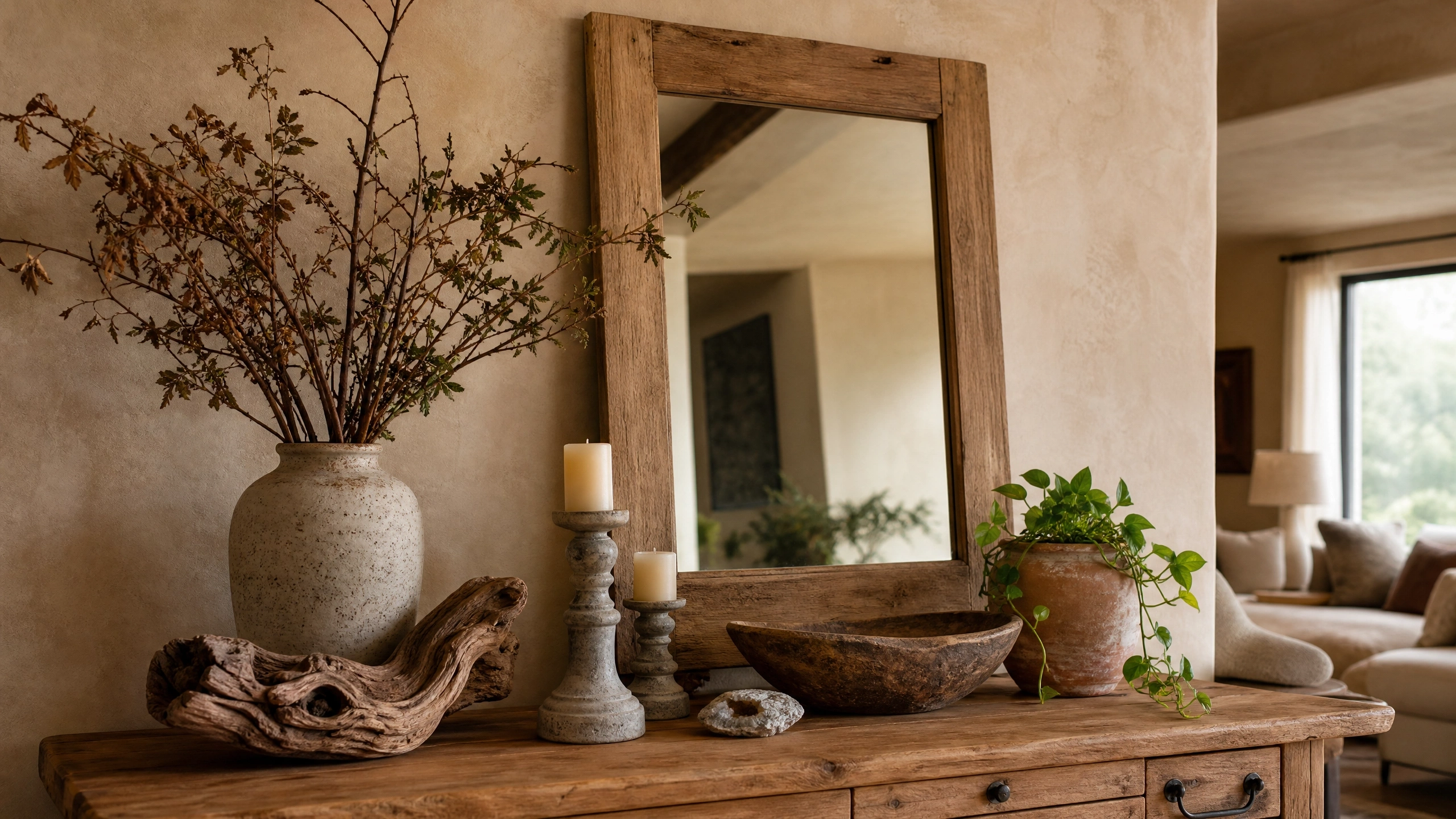
A mantlepiece or console table styled as an earthy vignette is one of the most visually satisfying arrangements in a living room — and it follows a structure that works reliably every time. Start with a large element at the back center: a tall ceramic vase, a piece of sculptural driftwood, a mirror in a raw wood frame, or an oversized botanical print leaned casually against the wall. Layer smaller elements in front and to the sides, deliberately varying heights and textures. Finish with one or two trailing plants, a candle grouping, and a single organic object — a small geode, a wooden sphere, a smooth river stone.
The vignette should feel gathered, not purchased as a matching set. Mix old and new pieces with intention: a thrifted terracotta pot beside a new ceramics-style vase, a worn wooden bowl alongside a fresh candle in a stone holder. Asymmetry is your friend — keep the arrangement slightly unbalanced rather than perfectly mirrored, which makes it feel lived-in and naturally collected rather than display-case neat. When the console starts to feel cluttered, remove two things rather than adding one more. A vignette with breathing room always photographs better than a fully loaded surface.
22. Use a Woven or Seagrass Storage Basket as Decor
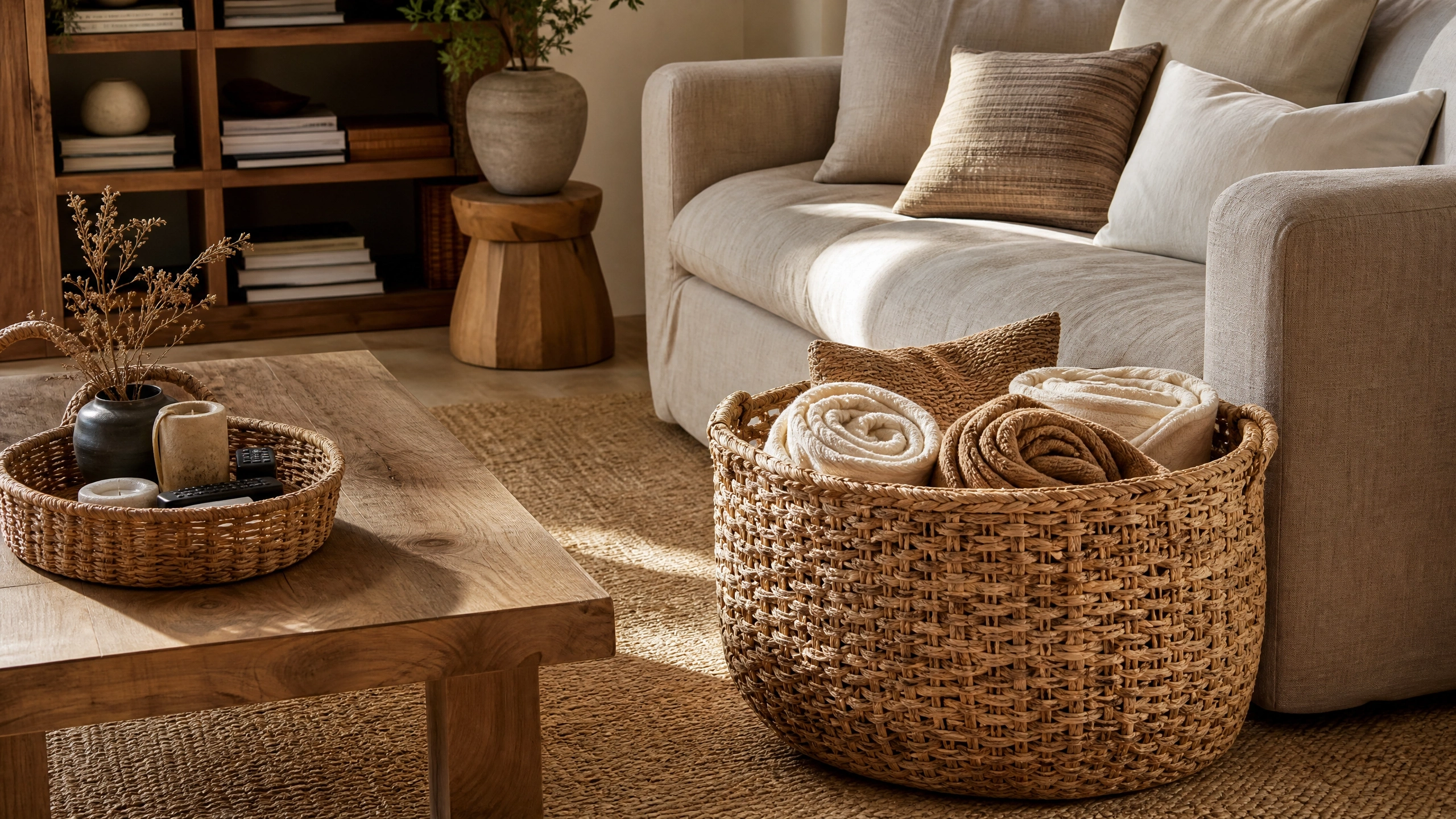
One thing that consistently separates a styled earthy room from a functional-but-bland one is storage that doubles as texture. A large woven seagrass or water hyacinth basket — the kind you’d use to hold blankets, extra pillows, or firewood — reads as earthy decor while also solving a real storage problem. Its open weave casts small shadows, its natural beige-to-tan color reinforces the warm palette, and its rounded, organic shape adds softness to a room full of rectangular furniture and straight horizontal lines. It’s form and function doing the same job.
Place a large floor basket beside the sofa to hold rolled-up throws, or beside a bookshelf to corral books and magazines. IKEA carries seagrass and woven baskets starting around $8–$25 that do this job well. A smaller woven basket on a coffee table or shelf can hold remotes, small candles, or dried botanicals. The woven texture reads the same as rattan and jute — natural, handmade-feeling, and grounding — which is why it functions as both storage and a deliberate earthy visual layer at the same time.
23. Finish the Room with Candlelight and Warm-Toned Bulbs
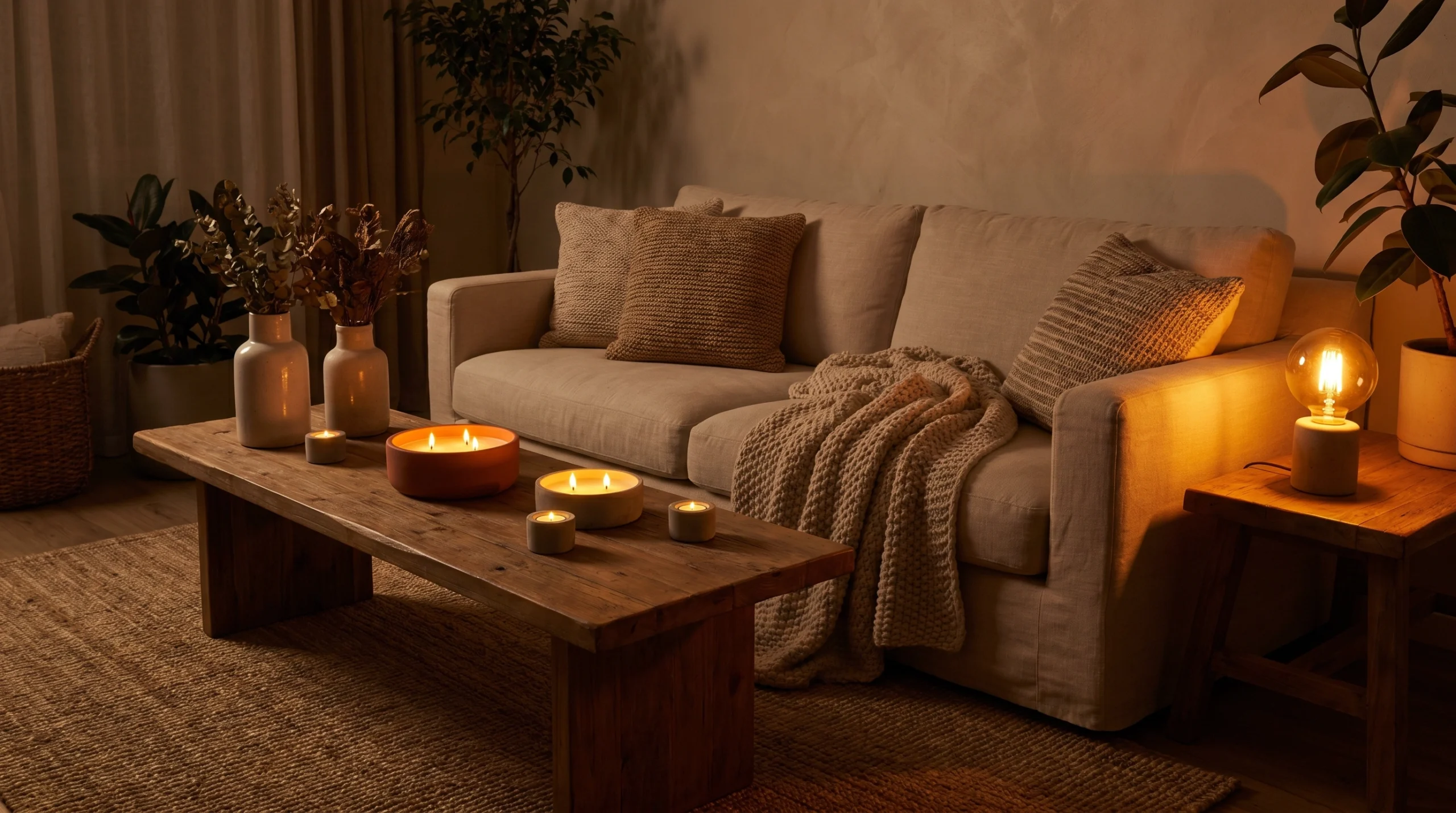
The last layer of an earthy living room isn’t something you place — it’s something you turn on. After the rugs, throws, ceramics, and plants are in position, the quality of your evening lighting determines whether the room actually feels cozy or just looks like it should. A combination of warm-toned Edison bulbs in table lamps (aim for 2200K–2700K on the color temperature scale) and actual candlelight — pillar candles, tealights in concrete holders, or a single wide-wick candle on the coffee table — creates a layered glow that no overhead fixture can replicate, no matter how many rugs you own.
Turn off the ceiling light entirely in the evenings. This one habit, more than any single purchase, transforms the atmosphere of a room. The shadows created by low, warm lamp sources make your woven textures look dimensional, your wood surfaces look richer, and your earthy palette look warm rather than beige. A three-wick soy candle in a terracotta or stone vessel, grouped with a low table lamp at sofa height, creates the golden-hour glow that earthy living room photographs always have — and it costs almost nothing to achieve once the lamps are already in place.
Renter-Friendly Earthy Living Room: No Permanent Changes Required
Every single idea in this article is completely renter-friendly — no painting, no drilling beyond standard picture hooks, no permanent fixture changes required. The earthy cozy look is built entirely from portable layers: rugs that sit on the floor, textiles that drape over furniture, plants that stand in corners, lamps that plug into existing outlets, and baskets that carry their own visual weight without touching a wall. The one thing renters often overlook is that layering across different heights — floor, sofa, shelf, corner — creates architectural interest that compensates for plain white walls and generic overhead light. Work with what you have. Layer on top of it. The earthy warmth comes from the materials themselves, not from the apartment.
Budget Earthy Living Room Starter Kit
You can begin building a warm, layered earthy living room for under $250 total. These five items, each under $50, deliver the highest immediate visual impact regardless of your starting point:
- Jute rug — IKEA SINDAL, ~$49. Introduces natural floor texture instantly and works over any existing flooring surface.
- Chunky knit throw in camel or oatmeal — Amazon or H&M Home, $25–$45. Adds the tactile warmth and lived-in quality that thin, flat blankets cannot achieve.
- Two linen pillow covers in flax or warm cream — $15–$20 each, Amazon or H&M Home. Replaces synthetic pillow covers with the natural, slightly rumpled fabric that earthy rooms depend on.
- One terracotta pot with a trailing pothos or small plant — $8–$15 at a garden center or grocery store. Introduces the clay-orange tone and organic life that anchors an earthy palette immediately.
- One warm amber Edison bulb for an existing lamp — 2200K, ~$8. Instantly shifts the room from flat overhead light to warm, shadowed ambiance. This is the cheapest item on the list and, arguably, the most impactful single change you can make.
FAQs
Can I make my living room look earthy if I rent and can’t paint the walls?
Yes — every earthy design layer (rugs, textiles, plants, lamps, baskets, ceramics) is portable and requires no wall painting. Warm lamp lighting in the evenings effectively neutralizes plain white walls by washing them in a soft amber glow that reads as intentional warmth.
What is the best sofa color for an earthy living room?
Camel, cream, warm gray, and linen-tone sofas all work well as a neutral base. If your sofa is a cooler gray or charcoal, layer warm-toned pillows and a camel throw heavily — the warm textiles shift the visual temperature of the sofa color more than you’d expect.
How many textures should I use without it looking cluttered?
Three to five is the sweet spot. A woven rug, a linen pillow, a chunky throw, a rattan side table, and a ceramic vase is five textures that work together without overwhelming a room. Beyond five, edit rather than add.
What is the easiest and cheapest way to start an earthy living room?
Swap one overhead bulb for a warm amber Edison bulb in an existing table lamp, add a $25 chunky knit throw in camel or oatmeal, and set one terracotta pot with a plant in a corner. Three changes, under $50 total, immediate visual difference.
Do earthy living rooms work in small apartments?
They actually work better in small spaces than heavily patterned or maximalist styles because a warm, tonal palette makes a tight room feel cozy rather than cramped. Keep furniture scaled to the room, choose one large rug over multiple small ones, and use vertical height — tall plants, floating shelves — to draw the eye upward.




No Comment! Be the first one.