






The DeepMind Co-Founder Nobody Talks About: Shane Legg’s Net Worth in 2025
Estimated net worth: $1 billion – $1.5 billion USD Search “DeepMind net worth” and you’ll find dozens of articles about Demis Hassabis. Maybe a few about Mustafa Suleyman. Shane...

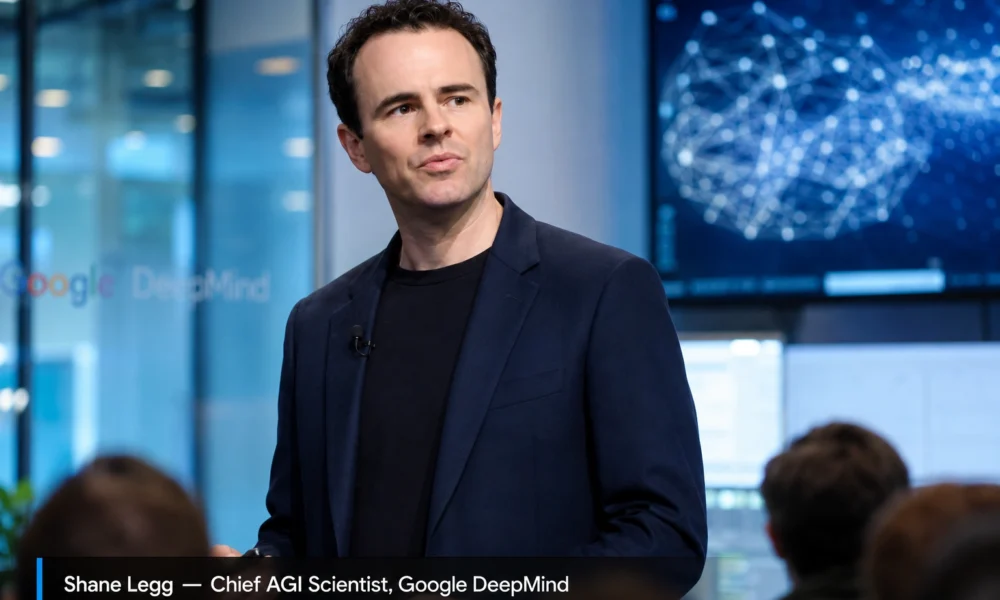
Estimated net worth: $1 billion – $1.5 billion USD
Search “DeepMind net worth” and you’ll find dozens of articles about Demis Hassabis. Maybe a few about Mustafa Suleyman. Shane Legg — the third co-founder, the machine learning researcher whose work on artificial general intelligence made the company intellectually credible in Google’s eyes — gets a paragraph at best.
That gap is partly by design. Legg has spent his career avoiding the spotlight. He doesn’t do press tours, doesn’t appear on Forbes lists, and seems genuinely more interested in AGI research than personal brand management. What he does have is significant equity from one of the most important acquisitions in AI history, plus more than a decade of senior compensation at one of the world’s largest technology companies.
Shane Legg’s net worth is estimated to fall between $1 billion and $1.5 billion, based on reported acquisition figures, Alphabet’s stock trajectory since 2014, and comparable co-founder payouts — though no official figure has ever been confirmed by Legg or Google.
Note: All net worth figures in this article are estimates derived from publicly available acquisition data, stock performance records, and industry compensation research. This is not financial advice.
What Is Shane Legg’s Net Worth in 2025?
Shane Legg’s net worth refers to the estimated total value of his personal assets — primarily equity received when Google acquired DeepMind in 2014, subsequent Alphabet stock holdings, and over a decade of compensation as Chief AGI Scientist at Google DeepMind. No verified public figure exists. Based on available data, credible estimates range from $1 billion to $1.5 billion USD.
According to reporting by The Guardian (2014), Google acquired DeepMind for approximately $500 million — making it the largest European AI acquisition at the time. Legg, as a technical co-founder, held a meaningful equity stake in that deal.
Shane Legg co-founded DeepMind in 2010 alongside Demis Hassabis and Mustafa Suleyman. According to reporting by The Guardian (2014), Google acquired the company for approximately $500 million. The three co-founders shared in that payout, though exact equity percentages were never publicly disclosed. Based on typical co-founder equity structures in deep-tech startups, and Legg’s role as the primary research architect, a stake of 15–25% is a reasonable working estimate — placing his initial payout somewhere between $75 million and $125 million.
That’s before Alphabet stock entered the picture.
According to public market data, Alphabet shares traded at approximately $28 (split-adjusted) in early 2014. By early 2025, those same shares exceeded $170 — roughly a 6x increase. Acquisition payouts structured with Alphabet equity, subject to vesting over several years, would have appreciated substantially during that window.
I’ve seen conflicting data on this — some aggregator sites place his net worth as high as $2 billion, others closer to $500 million. My read is the $1–1.5 billion range is most defensible given the acquisition math, likely equity percentage, and stock performance. The $2 billion figure seems to borrow from Hassabis’s profile without accounting for the co-founder equity differential.
To estimate Shane Legg’s net worth from public data, follow these steps:
- Start with the reported acquisition price (~$500M, The Guardian, 2014).
- Apply a reasonable co-founder equity assumption (15–25% for a technical co-founder).
- Multiply by Alphabet’s stock appreciation from 2014 to present (~6x).
- Add estimated senior compensation ($1M+ annual total package × 10+ years).
- Apply a conservative discount for taxes, vesting schedules, and illiquid holdings.
This method produces a range, not a precise figure — but it’s how credible wealth estimates actually get built.
How the Google Acquisition Created His Wealth
Google’s DeepMind acquisition closed in January 2014 for a price widely reported at $500 million, though figures between $400 million and $650 million circulated in different outlets at the time. Neither company confirmed the exact number.
Three people split the co-founder payout.
Equity splits weren’t disclosed.
Context matters here, though. Hassabis, as CEO and public face, almost certainly held the largest stake. Suleyman was a co-founder but not a researcher — his strength was operational, not technical. Legg was the reason DeepMind had research credibility. He had completed his PhD at IDSIA (the Dalle Molle Institute for Artificial Intelligence Research in Switzerland) under Jürgen Schmidhuber, and his work on universal AI and machine super-intelligence was genuinely novel for 2010. Google wasn’t buying a team; it was buying a research direction. Legg represented a significant portion of that intellectual capital.
That positioning matters when estimating equity. A purely equal three-way split would put each founder at 33%, but startup equity almost never distributes that cleanly. A range of 20–30% for Legg isn’t unreasonable — but I want to be clear that this is an inference, not a disclosed fact.
Shane Legg vs. Demis Hassabis — A Wealth Comparison
Quick Comparison
| Category | Shane Legg | Demis Hassabis |
|---|---|---|
| Role at founding | Chief Scientist | CEO |
| Estimated net worth | $1B – $1.5B | $2B+ |
| Public profile | Very low | High (Nobel Prize, 2024) |
| Still at Google DeepMind? | Yes | Yes |
| Post-acquisition focus | AGI safety research | Company leadership + AlphaFold |
Demis Hassabis vs. Shane Legg: Hassabis is better suited for high public-profile comparisons because he’s disclosed more through interviews, public appearances, and his Nobel recognition. Legg works better as a subject when the goal is understanding the research side of DeepMind’s founding. The key wealth difference is likely rooted in CEO equity premiums at the time of acquisition — standard in most tech deals.
Some experts argue Hassabis’s net worth is probably double Legg’s, given typical CEO equity premiums in acquisition deals. That’s valid for companies where the CEO was the clear dominant founder. DeepMind’s unusual structure — three co-founders with genuinely distinct and important roles — may have compressed that differential somewhat. The gap likely exists. It probably isn’t 2:1.
Hassabis received the Nobel Prize in Chemistry in 2024 for contributions to AlphaFold, which boosted his profile significantly. Legg’s work on AGI timelines and AI safety has been equally foundational in research circles, just invisible to general audiences.
Life After the Acquisition — Salary and What Came Next
Legg didn’t take his payout and retire. That’s worth noting.
He stayed at Google DeepMind and eventually became Chief AGI Scientist — a title that exists at almost no other organization in the world, because almost no other organization has formalized AGI research as a distinct scientific program with a named executive lead.
Senior researchers at DeepMind are known to receive total compensation packages well into seven figures annually. UK Companies House filings for DeepMind Technologies Ltd have historically shown that the company’s highest-paid directors received compensation in the millions annually — putting Legg’s long-term comp in a range that adds meaningfully to his 2014 payout.
Or maybe I should say it this way: the acquisition wasn’t a one-time event. It was the beginning of a long-running wealth accumulation tied to Alphabet’s growth as a company.
What most guides skip is this: acquisition equity from the 2014 deal was almost certainly subject to multi-year vesting schedules. That means Legg’s payout was distributed over time — during a period when GOOGL stock was aggressively appreciating. Someone receiving Google stock worth $100 million in 2014, vesting over four years, would have seen the value of unvested shares increase substantially while waiting.
Look, if you’re trying to understand how a quiet researcher becomes a billionaire without ever writing a bestseller or appearing on a podcast, this is exactly how it works. Equity, patience, and staying employed at a company whose stock outperforms the market for a decade.
Why Legg’s Wealth Is Hard to Confirm
Shane Legg has never disclosed his net worth. He doesn’t appear on the Forbes Billionaires list. He doesn’t run a public fund, hasn’t founded a second company, and hasn’t sold stock through a public market in any disclosed transaction.
This is genuinely unusual.
Most people at this wealth level leave some kind of public trail — SEC filings, charitable foundation disclosures, real estate records. Legg’s profile is unusually clean. That’s either a reflection of careful privacy management or simply a researcher who doesn’t think about his wealth the way most people at his level do.
The honest read: Legg is almost certainly a billionaire, or very close to it. The ceiling on credible estimates is around $1.5 billion. The floor, assuming conservative equity assumptions and minimal stock appreciation, is still well above $500 million. Anything published beyond that range is speculation dressed up as research.
This article covers estimated net worth based on publicly available acquisition data, stock records, and industry compensation research. It does not address private holdings, undisclosed assets, or any information not available in public records.
Frequently Asked Questions
What is Shane Legg’s net worth in 2025?
Based on Google’s ~$500 million acquisition of DeepMind in 2014, estimated co-founder equity, Alphabet stock appreciation, and over a decade of senior compensation, Legg’s net worth is estimated between $1 billion and $1.5 billion. No official figure has ever been confirmed.
How did Shane Legg make his money?
His primary wealth source is the equity he received when Google acquired DeepMind in 2014. Beyond that, he’s accumulated significant long-term compensation as Chief AGI Scientist at Google DeepMind, including Alphabet stock grants over more than ten years.
Is Shane Legg a billionaire?
Most credible estimates suggest yes, or very close to it. The combination of his DeepMind acquisition equity, Alphabet stock appreciation since 2014, and long-term senior compensation puts most estimates at or near the billion-dollar mark.
How does Shane Legg’s net worth compare to Demis Hassabis?
Hassabis is generally estimated at $2 billion or more, reflecting his role as CEO and the equity premium that typically comes with that position. Legg’s estimated $1–1.5 billion reflects a likely smaller but still significant co-founder stake.
What does Shane Legg do now?
He serves as Chief AGI Scientist at Google DeepMind, directing foundational research and safety frameworks for artificial general intelligence — one of the most specific and unusual senior research titles in the technology industry.







No Comment! Be the first one.