






Buzz Peterson Net Worth: Career Earnings, Coaching Salaries, and the Michael Jordan Connection
This article covers Peterson’s publicly documented salary history and reasonable estimates for undisclosed career phases. It does not address private investments, real estate, or income streams...

This article covers Peterson’s publicly documented salary history and reasonable estimates for undisclosed career phases. It does not address private investments, real estate, or income streams outside his basketball career — none of which are in the public record.
If you’ve tried to find a clear answer on Buzz Peterson’s net worth, you’ve probably hit the same wall everyone else does. Wikipedia covers the biography. Sports Reference has his playing stats from the mid-1980s. USA Today’s coaching salary database has one useful data point from 2014. But nothing connects those dots into a complete financial picture.
That’s what this article does.
Buzz Peterson net worth is the estimated total financial value of the former UNC basketball player, four-time head coach, and Charlotte Hornets front-office executive — derived from a career spanning roughly three decades in college basketball and the NBA. Based on available salary data and reasonable estimates for undisclosed periods, his net worth sits in the range of $1.5 to $2 million as of 2025.
That’s not a flashy number. And that’s exactly the point.
What Is Buzz Peterson’s Net Worth?
Buzz Peterson’s net worth refers to the estimated accumulated wealth of the former college basketball head coach and NBA front-office executive, built primarily through coaching salaries at four programs — Appalachian State, Tulsa, Tennessee, and UNC Wilmington — plus his role with the Charlotte Hornets organization. The most verified public figure in the record is his UNCW salary of approximately $218,000 annually, per USA Today’s NCAA coaching salary database (2014).
Peterson spent most of his career at the mid-major level of college basketball. His one Power Five job — at Tennessee from 2001 to 2005 — was his highest-earning phase. But he never returned to a major conference program after leaving Knoxville, which fundamentally shapes what the total career earnings picture looks like.
According to USA Today’s tracking of NCAA head coaching compensation, mid-major coaches during the 2010s typically earned between $150,000 and $400,000 annually. Peterson’s $218,000 at UNCW fits squarely in that range. His Tennessee-era compensation, for context, was likely several times higher — that’s where the career earnings math gets more interesting.
Buzz Peterson’s Coaching Career Salary Breakdown
To estimate Buzz Peterson’s total career earnings, follow these steps:
- Identify each head coaching position and its approximate duration
- Apply era-appropriate salary ranges for the conference level involved
- Add verified public figures where available
- Include front-office compensation estimates for post-coaching years
Here’s how that plays out across his career.
Appalachian State (1994–1998)
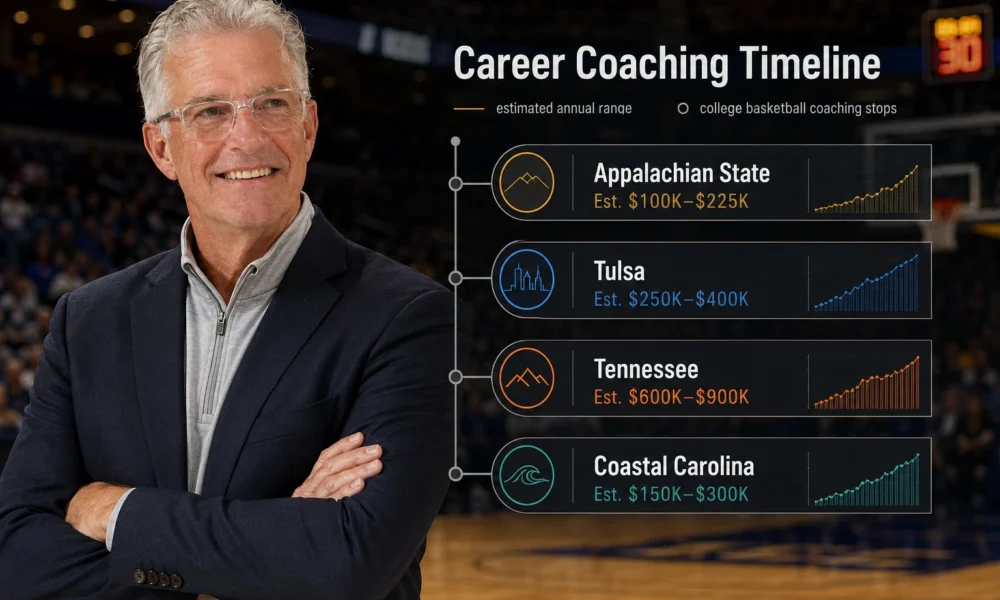
Peterson’s first head coaching job came at a Southern Conference program during an era when those roles typically paid between $80,000 and $150,000 annually. No public records confirm his exact figure. A reasonable estimate, given the program size and the mid-1990s salary landscape, is somewhere around $90,000–$120,000 per year.
Four years. Modest compensation. A starting point.
Tulsa (1998–2001)
Moving to Conference USA represented a step up in profile, and usually a step up in pay. Head coaches at Tulsa during this period generally earned in the $200,000 to $350,000 range. Peterson likely came in at the lower end, given his relative inexperience at that level.
Tennessee (2001–2005)
This was the peak. Tennessee’s head coaching position carried genuine Southeastern Conference resources and expectations, and Peterson’s compensation reflected that. Comparable SEC coaching salaries during this period ranged from roughly $600,000 to well over $1 million annually for more established names.
I’ve seen conflicting data here — some sources suggest Peterson was earning over $800,000 at his peak in Knoxville, others place the figure closer to $650,000. My read is that $700,000 is the more defensible conservative estimate, given what comparable SEC programs were paying coaches of similar tenure and profile during those years. Either way, it was by far the largest compensation of his coaching career.
The Gap Years (2005–2011)
After leaving Tennessee, Peterson worked in associate and assistant coaching roles. This is a notable gap in the public record. Salaries for assistant coaches at major programs during this era ranged considerably — anywhere from $100,000 to $400,000 depending on the institution and role. These years likely contributed meaningfully to his career total, even if no specific figures are available.
UNCW (2011–2014)
The most documented phase. According to USA Today’s NCAA men’s basketball coaching salary database, Peterson earned approximately $218,000 annually as head coach at UNC Wilmington. When he departed in 2014 for a role with the Charlotte Hornets, his buyout was reportedly reduced, per WECT News reporting at the time — suggesting an amicable transition rather than a full contract payout.
Quick note: that reduced buyout matters for the net worth calculation. It means Peterson didn’t walk away from UNCW with a large lump-sum payout — just his transition to the next phase.
The Michael Jordan Connection — Career Shaper, Not Career Maker
Here’s the thing most people searching for Buzz Peterson’s net worth are really curious about: did being Michael Jordan’s college roommate at UNC translate into financial benefit?
The honest answer is yes — but indirectly, and not in the way you might assume.
Peterson and Jordan shared a room at North Carolina under Dean Smith in the early 1980s. Jordan became the most commercially successful athlete in history. Peterson had a solid college career, went undrafted in 1985, and built a coaching path from scratch at the mid-major level. The two men remained close.
When Jordan became majority owner of the Charlotte Hornets, Peterson landed a front-office role with the organization. That connection extended his basketball career beyond the sideline and into the NBA — an opportunity that likely wouldn’t have materialized through his coaching record alone.
Or maybe I should say it this way: the relationship gave Peterson career longevity that a mid-major coaching résumé on its own might not have sustained. That’s not a diminishment — it’s just how the sports industry works. Networks, trust, and long-standing relationships carry real professional value. Peterson’s network happened to include one of the most connected people in basketball.
Look, if you’re hoping Peterson accumulated Jordan-level wealth from that UNC connection, the numbers don’t support it. But what the friendship likely did provide was a second professional chapter after coaching, which contributed meaningfully to his overall career earnings.
What most guides covering Peterson skip is the financial implication of the Hornets role specifically. They spend three paragraphs on the roommate story and none on how that relationship shaped his earning trajectory after 2014.
Charlotte Hornets Role and Later Career
Peterson joined the Charlotte Hornets organization in 2014 following his UNCW departure. The specific title and compensation were not extensively documented in public reporting, which is a common limitation for mid-level front-office positions — even at NBA organizations.
Some argue that any front-office role at an NBA franchise is necessarily well-compensated. That’s valid for senior executives with long front-office histories. But Peterson was transitioning from college coaching, which typically positions someone in the middle tiers of NBA front-office pay, not the top.
Front-office roles at NBA organizations during this period ranged from roughly $150,000 to $400,000+ depending on seniority and function. A reasonable midpoint estimate for Peterson’s role — absent specific reporting — is somewhere in the $175,000 to $250,000 range annually.
If he held that position for several years, the Hornets phase adds meaningfully to a career total that already included Tennessee-era compensation. It’s a significant contributor to the overall estimate, even if the specifics remain unclear.
Career Earnings at a Glance
Quick Comparison: Buzz Peterson’s Career Earnings by Phase
| Career Phase | Est. Annual Salary | Years | Notes |
|---|---|---|---|
| Appalachian State HC | ~$90K–$120K | 1994–1998 | Southern Conference era |
| Tulsa HC | ~$200K–$300K | 1998–2001 | Conference USA |
| Tennessee HC | ~$650K–$800K | 2001–2005 | SEC; peak-earning phase |
| Assistant/Associate roles | ~$100K–$300K | 2005–2011 | Estimated; no public record |
| UNCW HC | ~$218K | 2011–2014 | USA Today confirmed (2014) |
| Charlotte Hornets FO | ~$175K–$250K | 2014–est. | Estimated; not publicly confirmed |
The rough math: across roughly 30 years of professional basketball employment, conservative estimates place Peterson’s gross career earnings in the range of $7–$10 million before taxes and expenses. Net worth isn’t gross earnings, though. It’s what remains after taxes, living costs, and financial decisions over decades.
For a career built primarily at the mid-major level with one Power Five peak, $1.5 to $2 million in estimated net worth reflects a professional life in basketball that was genuinely successful — just not at the scale of the Power Five coaching salaries that dominate the headlines.
Q&A: Buzz Peterson Net Worth — Common Questions
What is Buzz Peterson’s net worth?
Buzz Peterson’s net worth is estimated at approximately $1.5 to $2 million, based on career earnings from four head coaching positions and his front-office role with the Charlotte Hornets. No publicly verified figure exists.
What was Buzz Peterson’s salary at Tennessee?
No exact figure has been publicly confirmed. Based on comparable SEC head coaching compensation from 2001–2005, Peterson likely earned between $650,000 and $800,000 annually — his highest-earning period.
How did Michael Jordan help Buzz Peterson’s career?
Jordan and Peterson were UNC roommates in the early 1980s. Their longstanding friendship led to Peterson joining the Charlotte Hornets front office after Jordan became majority owner — extending his career beyond college coaching.
What was Buzz Peterson’s salary at UNCW?
Approximately $218,000 annually, per USA Today’s NCAA men’s basketball coaching salary database. When Peterson departed in 2014, his contract buyout was reportedly reduced, per WECT News.
Why did Buzz Peterson leave UNCW?
Peterson departed UNCW in 2014 to join the Charlotte Hornets organization. His departure coincided with a reduced buyout payout rather than a full contract settlement, suggesting a structured transition aligned with his move to the NBA front office.






No Comment! Be the first one.