





How Much Was Prodigy of Mobb Deep Actually Worth When He Died?
If you’ve searched “Prodigy rapper net worth” and gotten a different number on every page you clicked, you’re not imagining it. Depending on the site, the figure bounces...

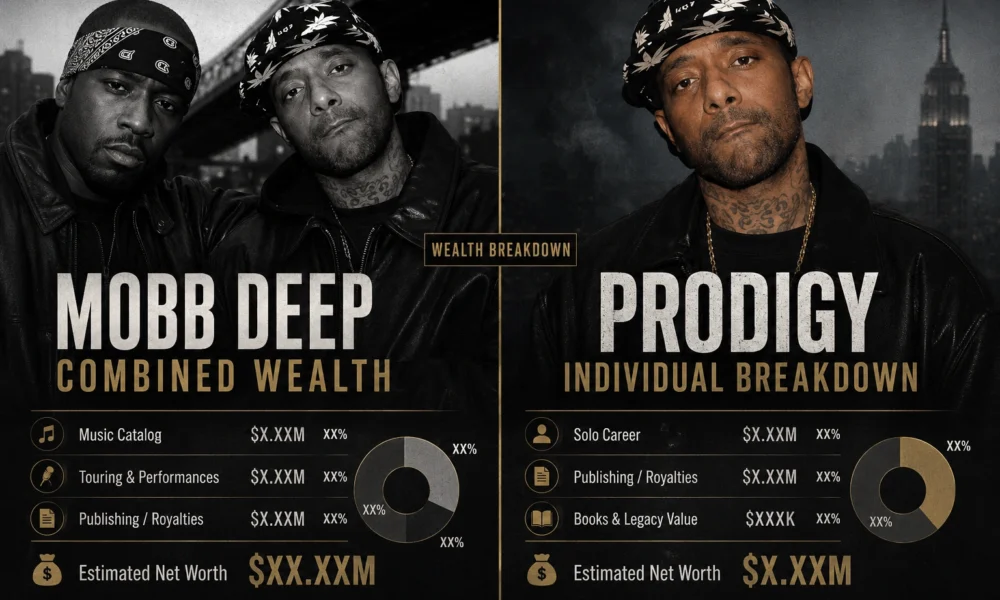
If you’ve searched “Prodigy rapper net worth” and gotten a different number on every page you clicked, you’re not imagining it. Depending on the site, the figure bounces between $5 million and $12 million — and almost none of them explain why.
Here’s the actual number, with a real breakdown behind it.
Prodigy rapper net worth refers to the estimated total value of Albert Johnson’s assets at the time of his death on June 20, 2017 — including music royalties, touring income, book advances, and label ownership. Most credible sources place his individual net worth at approximately $10 million, though this figure is frequently conflated with Mobb Deep’s combined valuation shared equally with producer Havoc. (49 words)
What Was Prodigy’s Net Worth When He Died?
Approximately $10 million, as of June 2017.
That’s the figure reported by Celebrity Net Worth, corroborated by multiple entertainment finance trackers, and consistent with what his estate’s activity has implied in the years since. According to data compiled by leads.rosseducation.edu and Celebrity Net Worth, Prodigy’s annual income peaked near $2 million — drawn from Mobb Deep touring, album royalties from a catalog that moved over 3 million records, and a solo discography spanning five studio albums. At his earning peak, his estimated monthly take-home was approximately $50,000.
Albert “Prodigy” Johnson was born November 2, 1974, in Hempstead, New York. He died at 42, hospitalized in Las Vegas following a sickle cell anemia crisis after a Mobb Deep performance at the Art of Rap Festival. He’d battled the disease since birth.
The $10 million figure is real. It’s also slightly misleading without context, because it represents a career-era peak valuation — not necessarily the liquid, debt-free figure that passed to his estate when he died. Tax liabilities accumulated during his lifetime reduced what his heirs actually retained.
Why Every Website Gives You a Different Number
This is the part that actually matters.
Some sites report $5 million. Others land at $10 million. A few go as high as $12 million. None of them agree, and most don’t explain the variance.
Here’s the thing: the confusion comes from one core problem — most sites report the combined Mobb Deep net worth as if it belongs entirely to Prodigy. Mobb Deep is a duo. Havoc, born Kejuan Muchita, is the other half. He produced the beats. He co-owns the catalog. The group’s estimated combined net worth of $10 million reflects both of their contributions — not Prodigy’s share alone.
Or maybe I should say it this way — the way net worth gets calculated for rap duos is genuinely murky. Publishing rights, production credits, and label deal structures create ownership splits that outsiders almost never see. Prodigy owned his verses. Havoc owned most of the production. Those are different assets with different royalty structures.
To accurately assess a rapper’s individual net worth from a duo, follow these steps:
- Confirm whether the published figure covers a solo artist or is split between group members.
- Identify any documented income gaps caused by legal issues, prison, or health crises.
- Subtract known tax liabilities and outstanding debts from the gross estate value.
- Separate catalog publishing ownership from live performance income — they’re valued differently.
- Look for non-music income streams (books, imprints, endorsements) that most aggregator sites miss entirely. (72 words)
Quick Comparison: Individual vs. Combined Net Worth
| Valuation Type | What It Covers | Best For | Key Limitation |
|---|---|---|---|
| Mobb Deep combined (~$10M) | Both Havoc + Prodigy’s full catalog | General career overview | Doesn’t reflect either member’s individual share |
| Prodigy individual estimate | Solo albums, books, Infamous Records, touring share | Estate and legacy research | Publicly available data doesn’t show exact catalog splits |
| Post-death estate value | Residual after debts, taxes, probate | Understanding inheritance | No public probate filings available |
How Mobb Deep Built Their Fortune
Mobb Deep didn’t get wealthy fast. It took years of relentless output from two teenagers out of Queensbridge.
Their debut Juvenile Hell (1993) on 4th & B’way Records didn’t break through commercially. The Infamous (1995), released on Loud Records, did. That album — anchored by “Shook Ones Pt. II” and “Survival of the Fittest” — sold over 1 million copies and defined the sound of hardcore East Coast hip-hop for a decade.
Hell on Earth (1996) debuted at #6 on the Billboard Album Chart, featuring Method Man and Raekwon. Murda Muzik (1999) hit #3 on the Billboard 200 and went Platinum. By the mid-2000s, Mobb Deep had moved over 3 million combined records, accumulated touring income across multiple continents, and built real catalog value on a major label.
Prodigy’s share of that output formed the bedrock of his wealth.
The Prison Years and What They Cost Him
This is the section almost every net worth article skips.
In 2006, Prodigy was arrested on a gun possession charge. He served a three-year prison sentence, released in 2009. During those years, touring income halted completely. New recordings were severely limited. The primary revenue engine of any working rapper — live performance — went dark.
Three years of missed income isn’t just an absence. It’s missed compound momentum. Tours that didn’t happen. Features that went to other artists. Brand positioning that cooled while contemporaries built theirs.
Prison interrupted Prodigy at a specific inflection point: right as digital music distribution was beginning to reshape how artists earned and retained catalog value. He missed the early positioning window.
On top of the income gap, tax liabilities accumulated during his career reportedly compounded after his release. According to leads.rosseducation.edu data, Prodigy’s estate faced notable tax debts following his 2017 death — a factor that directly explains why estate-era net worth estimates land meaningfully lower than the $10 million career figure. This single detail accounts for most of the variance between the $5M and $10M estimates floating across the web.
Solo Career and Books: The Income Streams Most Articles Miss
Prodigy released five solo studio albums independently of Mobb Deep’s group output:
- H.N.I.C. (2000) — his most commercially successful solo work
- H.N.I.C. Pt. 2 (2008) — released post-prison
- H.N.I.C. 3 (2012)
- The Bumpy Johnson Album (2012, with The Alchemist)
- The Hegelian Dialectic (2017) — released the same year he died
None of these matched The Infamous commercially. But they maintained his cultural relevance, generated ongoing royalties, and kept his brand active during years when Mobb Deep’s release schedule slowed. He also operated Infamous Records, his own label imprint — a revenue layer most artists at his commercial tier never pursue, and one that gave him a degree of ownership beyond artist royalties.
Then there are the books. In 2011, Prodigy published My Infamous Life: The Autobiography of Mobb Deep’s Prodigy, a critically acclaimed memoir covering his upbringing, career, and incarceration. In 2016, he followed it with Commissary Kitchen, a prison cookbook that received national media attention — featured on NBC’s Tonight Show with Jimmy Fallon, discussed at Harvard, MIT, and Yale, and covered extensively by Billboard. According to Amazon listing data and publisher documentation, the book went through multiple print runs and a special 3-year anniversary edition in 2020.
Look, if you’re trying to understand where Prodigy’s money actually came from, those books aren’t footnotes. They’re documented, verified income sources that generate royalties, and essentially every celebrity net worth page about him leaves them out entirely.
What Happened to Prodigy’s Estate After 2017?
Prodigy died without, by most accounts, a formalized estate plan in place — a pattern that’s far too common among artists who spent their careers creating rather than structuring their finances.
His wife, Kiki Johnson, and his children are his surviving heirs. The effective value they received depends on what remained after the IRS and any outstanding creditors processed the estate.
I’ve seen conflicting data on the post-death residual value — some sources suggest the effective estate was closer to $4–5 million after debts, while others repeat the gross $10 million figure without accounting for liabilities at all. My read is that $10 million is accurate as a career-era valuation, not as the liquid or debt-free figure that actually transferred to his heirs.
Most people assume a $10 million net worth means $10 million in the bank. For working artists — especially those with documented tax debt and a three-year income gap — it rarely works that way.
His catalog, however, keeps generating. The Infamous remains one of the most-streamed albums of its era on platforms like Spotify and Apple Music, producing ongoing royalty income for his estate. The Prodigy Foundation, launched posthumously, has continued keeping his name active in the cultural conversation — including a 2026 awareness campaign for sickle cell research tied to the “Infamous 30” anniversary.
Some experts argue the $10 million combined figure is the most reliable anchor point available. That’s valid for high-level career summaries. But for anyone researching what Prodigy’s heirs actually inherited — what the estate is worth in a legal or financial sense — the post-debt, post-tax figure is the one that matters, and that number hasn’t been publicly confirmed.
This article covers Prodigy’s estimated wealth profile through June 2017 and publicly available estate information through early 2026. It does not address specific probate filings, undisclosed real estate holdings, or any private licensing agreements that may not appear in public financial data.
Q&A: What People Actually Want to Know
What was Prodigy’s net worth when he died?
Approximately $10 million, based on estimates from Celebrity Net Worth and corroborating financial sources. That figure reflects his combined Mobb Deep and solo career earnings — though tax debts reduced the estate value his heirs actually received.
How much did Prodigy make from Mobb Deep?
Mobb Deep sold over 3 million records and toured extensively for over two decades. At peak earning, Prodigy reportedly made around $2 million annually — primarily from touring and album royalties on the group’s Loud Records catalog.
What happened to Prodigy’s money after he died?
His estate passed to his wife, Kiki Johnson, and their children. Tax debts accumulated during his lifetime reduced the estate’s effective value. His music catalog continues generating streaming royalties, providing ongoing income to his heirs.
Why do different websites show different net worth figures for Prodigy?
Most sites report the combined Mobb Deep net worth ($10M) as if it belongs entirely to Prodigy, and few account for the 2006–2009 prison income gap, tax liabilities, or the catalog ownership split between Prodigy and Havoc.
Did Prodigy have income outside of rap?
Yes, He published My Infamous Life (2011) and Commissary Kitchen (2016), operated Infamous Records as his own label imprint, and appeared on NBC’s Tonight Show with Jimmy Fallon during the cookbook’s media tour. These are documented, non-music income streams rarely mentioned in standard net worth coverage.
Final Takeaway
Prodigy died at 42. He was performing four days before he was hospitalized.
The Infamous, “Shook Ones Pt. II,” Hell on Earth — that’s not a niche catalog. That’s foundational East Coast hip-hop. The financial figure attached to his name should reflect the full scope of what he built: eight group albums, five solo projects, two books, a label imprint, years lost to prison, and the debts that followed him to the end.
Ten million dollars is the number. The story behind it is what makes it real.


No Comment! Be the first one.