




27 Natural Stone Backsplash Ideas That Make Your Kitchen Feel Custom and Cozy
You’ve saved the same thirty pins. You’ve walked a showroom floor and left more confused than when you went in. You’ve Googled “best backsplash for white cabinets” and...

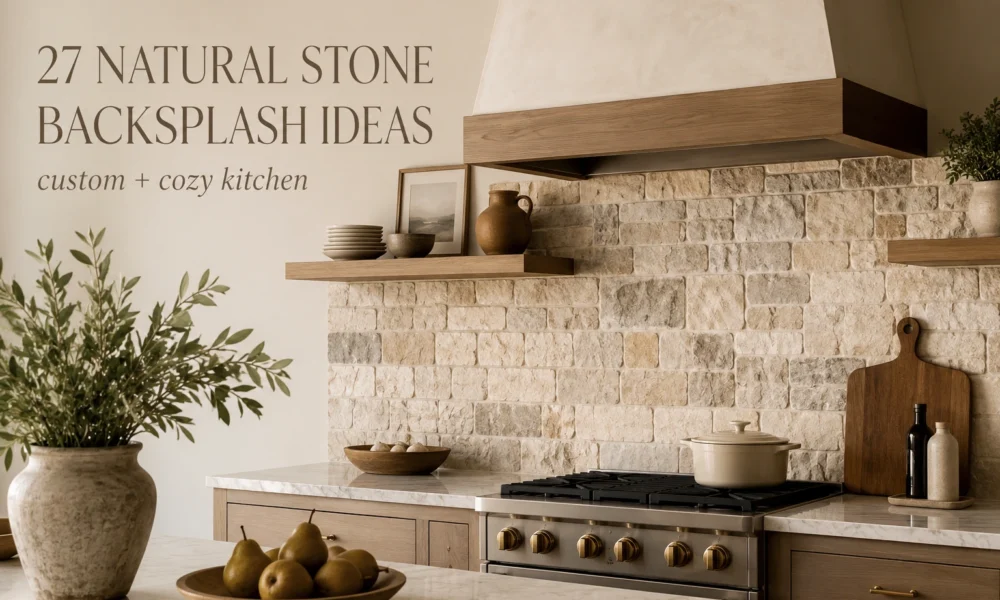
You’ve saved the same thirty pins. You’ve walked a showroom floor and left more confused than when you went in. You’ve Googled “best backsplash for white cabinets” and gotten advice so generic it could apply to literally any material that’s ever existed.
Natural stone backsplashes aren’t confusing because they’re complicated. They’re confusing because nobody takes the time to tell you which stone actually fits your specific kitchen, your cabinet color, and the amount of maintenance you’re realistically willing to do.
This guide fixes that. These 27 ideas are sorted by stone type — marble, travertine, quartzite, slate, limestone, stacked ledger stone, and river rock — so you can skip straight to the section matching what you’re actually building, not just what photographs well.
According to the 2025 U.S. Houzz Kitchen Trends Study, 86% of homeowners replace their backsplash during kitchen renovations. Getting that one decision right the first time matters.
What Are Natural Stone Backsplash Ideas?
Natural stone backsplash ideas refer to backsplash installations using real quarried stone — marble, travertine, quartzite, slate, limestone, or river rock — rather than ceramic, porcelain, or engineered substitutes. Each stone type carries a distinct hardness level, maintenance requirement, and aesthetic range, which is why choosing by stone type rather than appearance alone tends to produce better long-term results in kitchens.
Marble Backsplash Ideas for Real Kitchens
If marble is the direction you’re leaning, the most common mistake isn’t choosing the wrong slab — it’s choosing the wrong finish. Polished marble is what most people picture, but honed marble (matte surface) hides fingerprints and water spots significantly better in an active kitchen environment.
Or maybe I should say it this way: if marble is going anywhere near your sink or range, honed almost always outperforms polished in daily use — regardless of how much better polished looks in a showroom.
Homeowners searching for marble backsplash kitchen ideas are typically comparing Carrara versus Calacatta. Both need annual sealing. The practical distinction: Calacatta has bolder, more dramatic veining and costs more per square foot, while Carrara is softer in tone and more widely available at accessible mid-range price points before fabrication.
1. White Carrara Marble Subway Tiles With Dark Grout
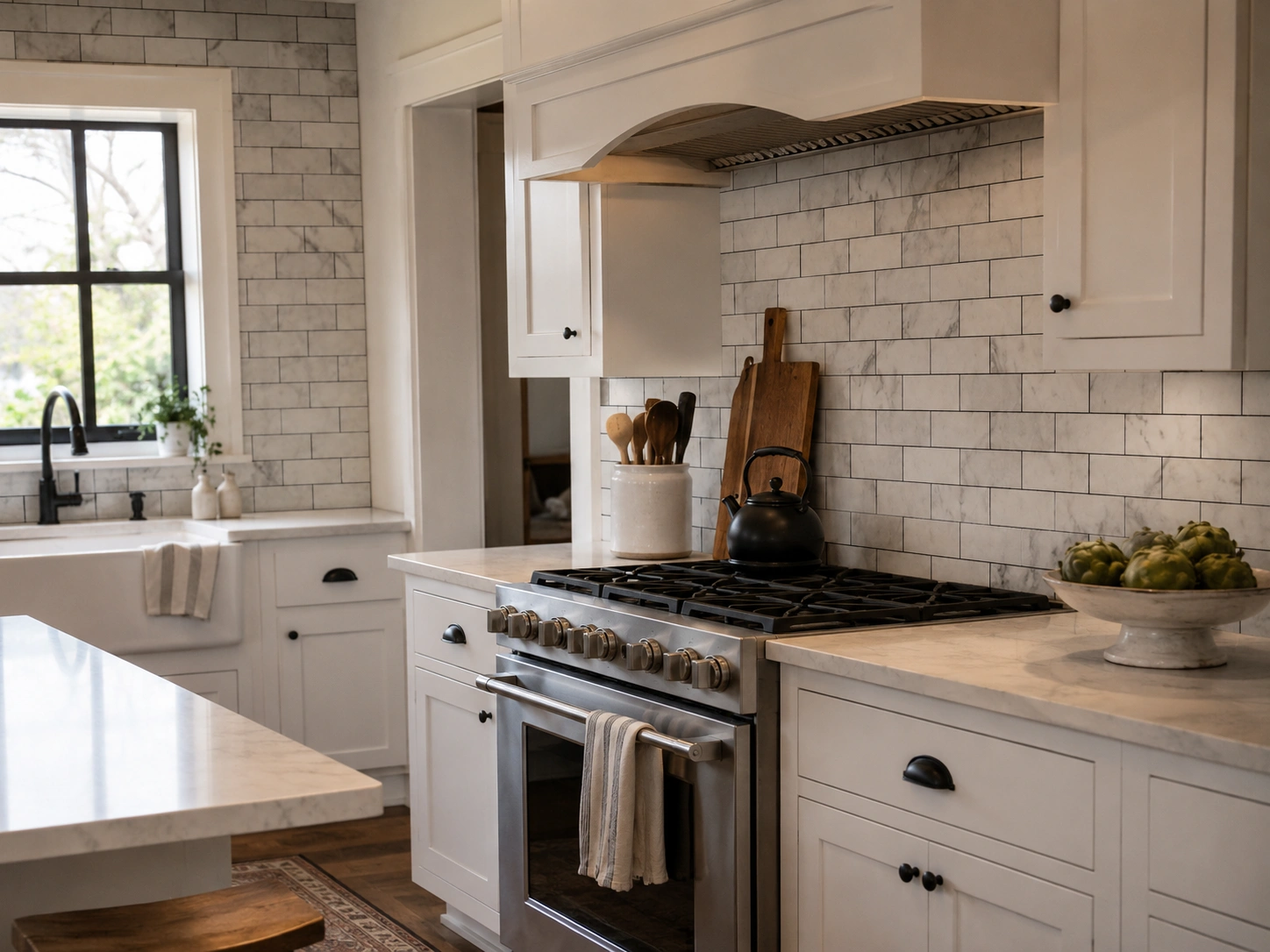
Classic 3×6-inch Carrara subway tiles become considerably more interesting with warm charcoal grout instead of the default white. The contrast sharpens the tile grid, functions as grime camouflage, and adds visual depth that white-on-white grout never achieves. This format works in modern farmhouse, transitional, and classic European kitchen layouts equally well. Pair with brushed nickel or matte black hardware for maximum contrast against the soft white stone.
2. Full-Height Calacatta Marble Slab From Counter to Ceiling
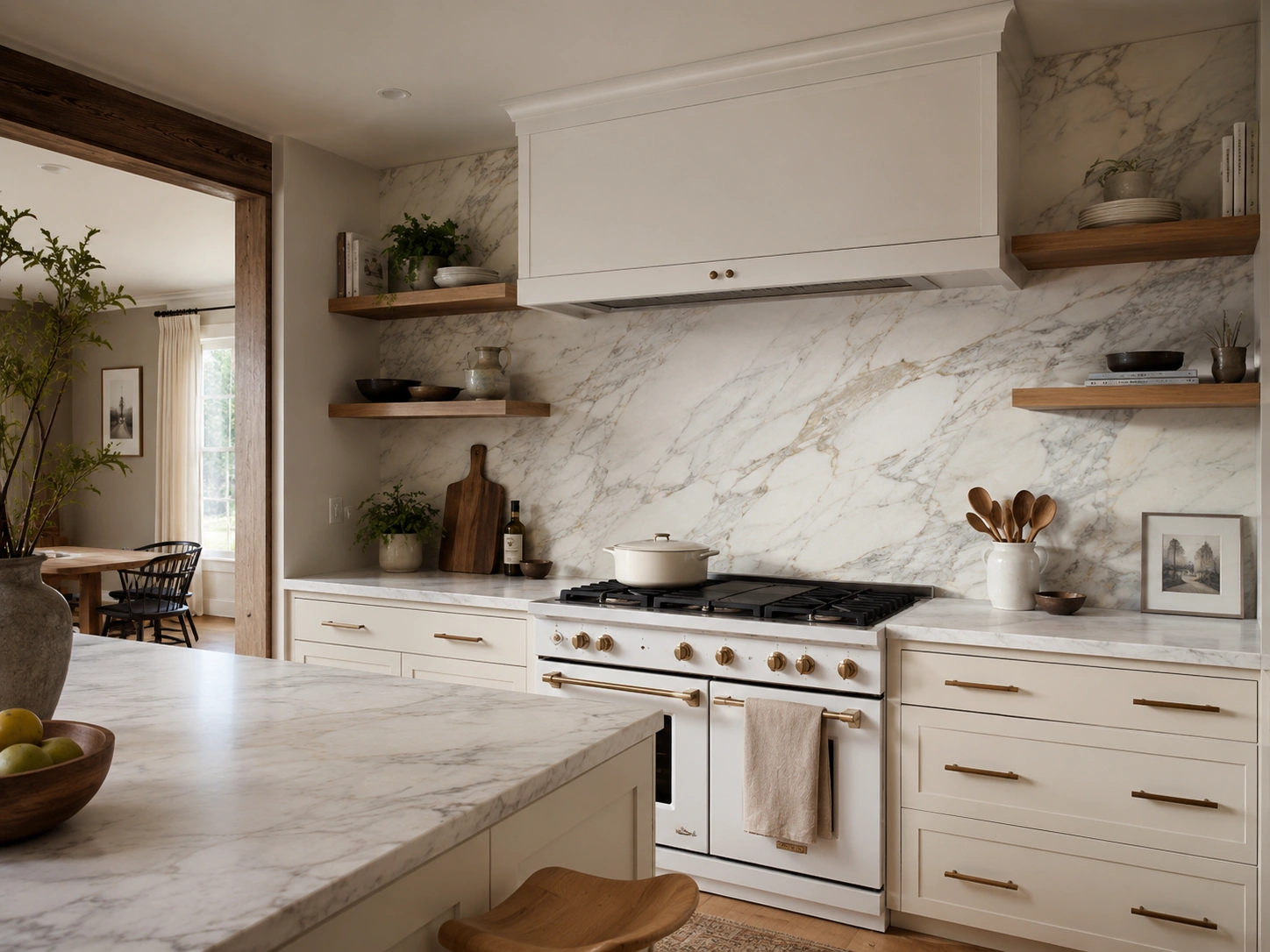
A continuous Calacatta slab from countertop to ceiling — no grout lines, no tile breaks — is the renovation move most likely to make a kitchen feel genuinely custom-built. According to the 2025 U.S. Houzz Kitchen Trends Study, 67% of homeowners now extend their backsplash all the way to the upper cabinets or range hood, up 5 points year over year. A matched slab is the natural high-end expression of that trend.
3. Honed Black Marble for a Moody Range Wall
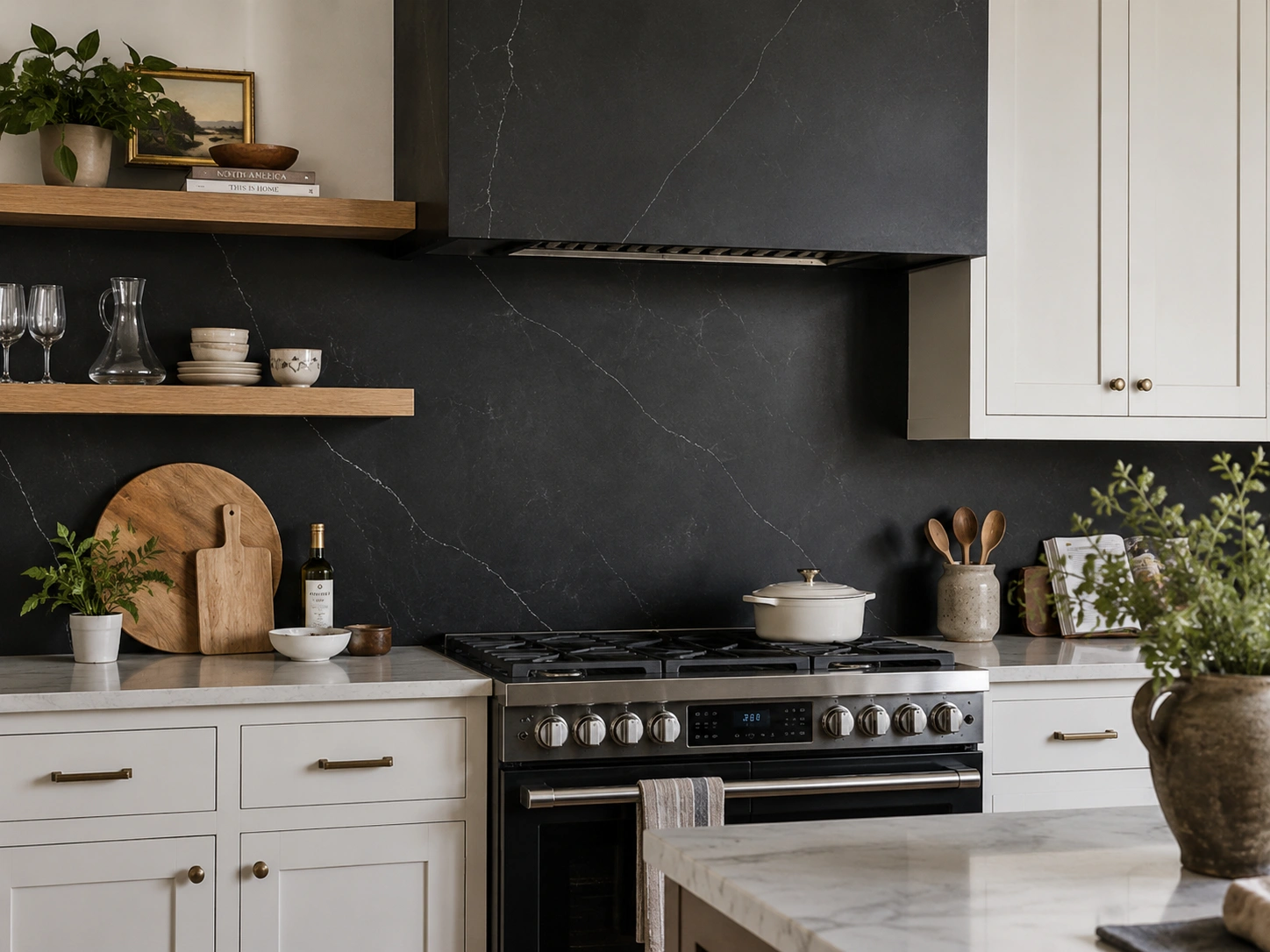
Nero Marquina — deep black marble veined in white — in a honed finish transforms a range wall into a proper focal point. Honed black marble conceals fingerprints and light water spotting far better than polished does, which matters immediately behind an active cooking surface. Pair with white upper cabinets and natural wood floating shelves for a contrast ratio that reads intentional rather than heavy.
4. Marble Herringbone Mosaic Tiles Behind the Sink
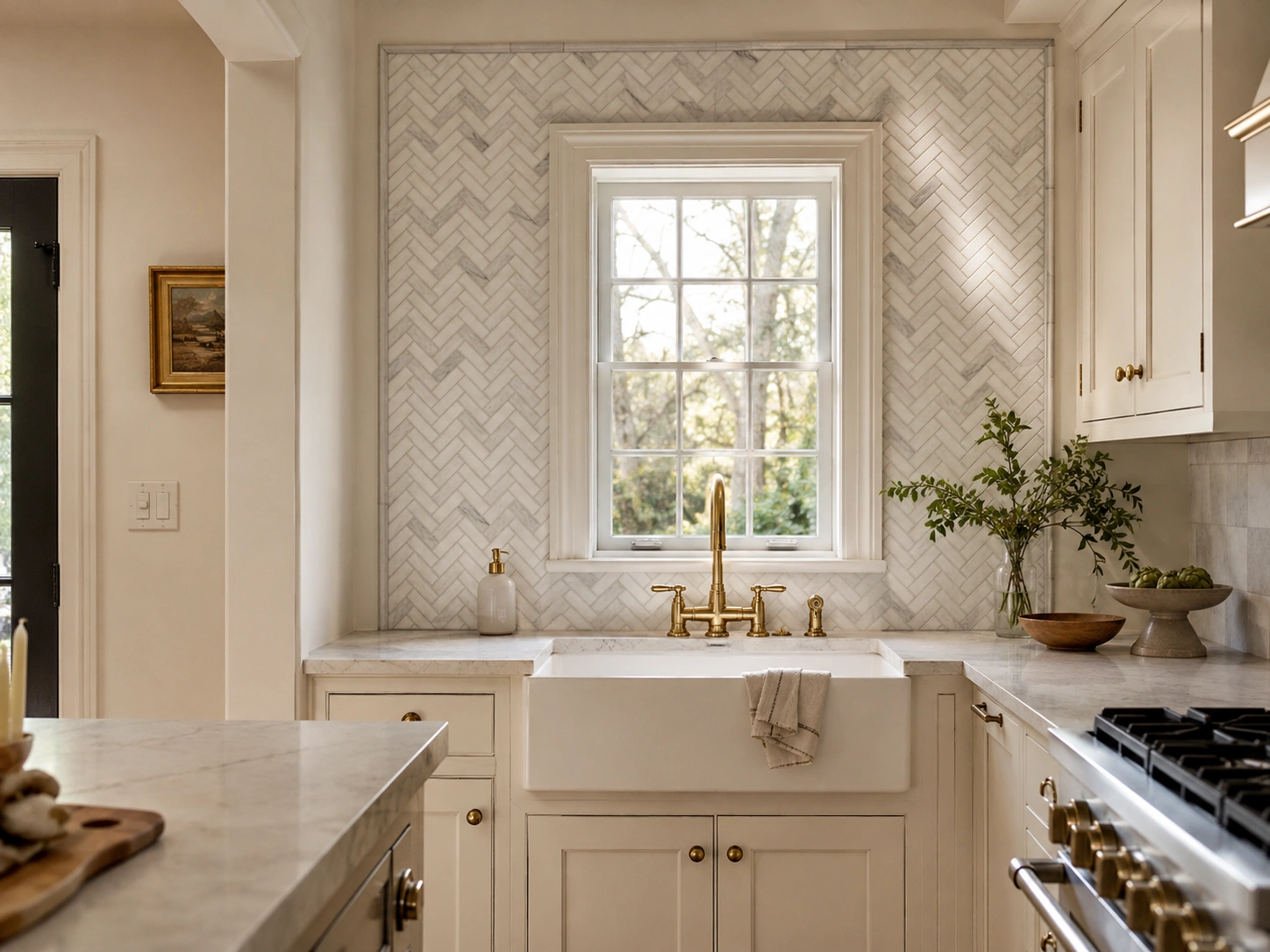
Herringbone pattern catches directional light at an angle that flat subway tile doesn’t — an actual advantage behind a sink where window light is naturally working in your favor. The 1×3-inch scale reads more delicate and classical; the 2×4-inch reads more contemporary and bold. MSI Surfaces carries several white marble herringbone mosaics in both sizes. This pattern works best as a contained sink panel rather than running the full kitchen width.
5. Pencil-Trim Bordered Marble for a Traditional Kitchen
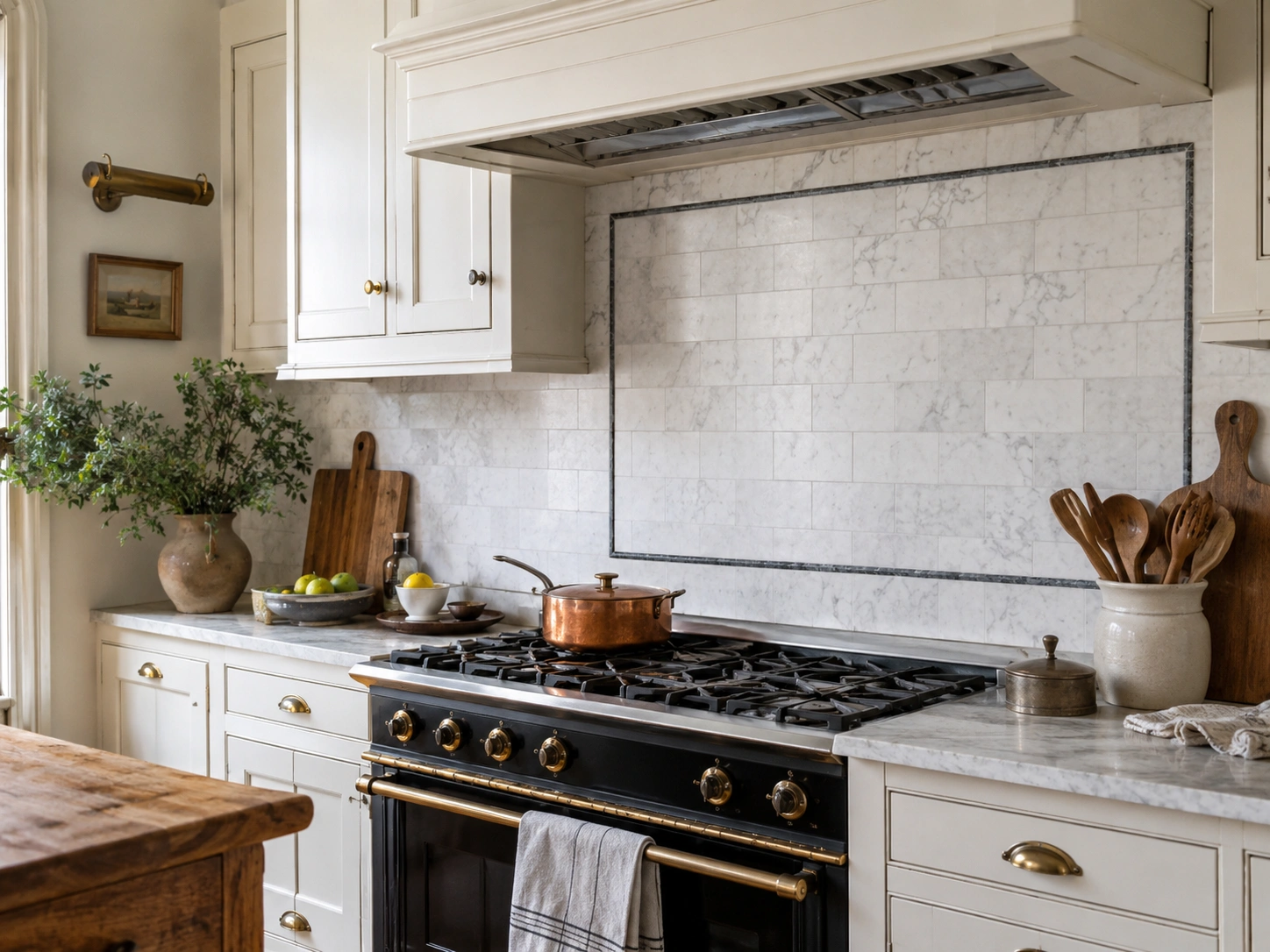
A pencil liner — a thin stone border strip — framing a marble field tile gives the backsplash a finished, intentional quality rarely seen in standard renovations. It’s common in pre-war New York apartments and French country kitchens for good reason: it makes a typical tile installation look genuinely designed. Bedrosians Tile & Stone carries marble pencil liner strips in white and dark grey that pair directly with their field tile collections.
Travertine Backsplash Ideas That Age Well
Travertine is the stone type most people overlook in favor of marble — and it’s arguably more forgiving in a kitchen. The natural surface variation in travertine means small chips and minor inconsistencies blend in rather than stand out. It’s warmer in tone than most marbles and pairs better with wood, brass, and terracotta than cooler stones do.
Quick note: filled travertine (voids smoothed with grout or stone filler before installation) is the kitchen-appropriate choice. Unfilled travertine looks more organically interesting but requires more consistent sealing to keep grease out of the natural surface holes.
Travertine backsplash ideas work best when the stone is sealed before installation and re-sealed annually in kitchen environments. Travertine is naturally porous — small holes called voids can trap moisture and cooking grease without proper treatment. Filled travertine has a smoother, easier-to-clean surface and is the more practical choice for kitchen backsplashes compared to unfilled.
6. Tumbled Cream Travertine Subway Tiles for a Farmhouse Kitchen
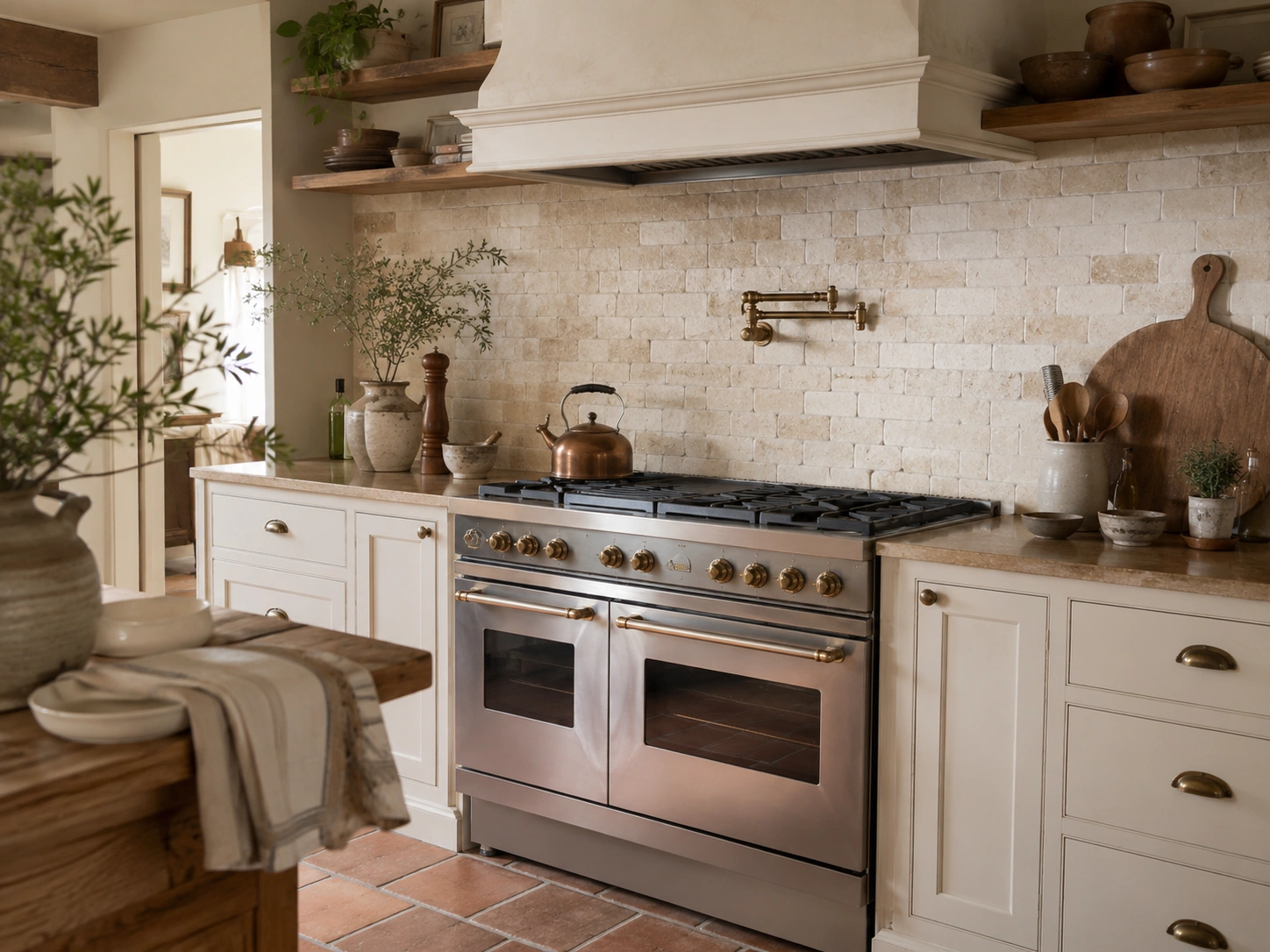
Tumbled travertine has rounded edges and a slightly worn surface that looks less like new tile and more like something that’s been there for decades — which is the entire point in a farmhouse kitchen. The cream-and-ivory color range flatters warm wood tones, terracotta floors, and antique brass hardware equally. Minor chips and natural surface variation are part of the character here, not a maintenance problem waiting to happen.
7. Travertine Hexagon Mosaic for an Earthy, Bohemian Kitchen
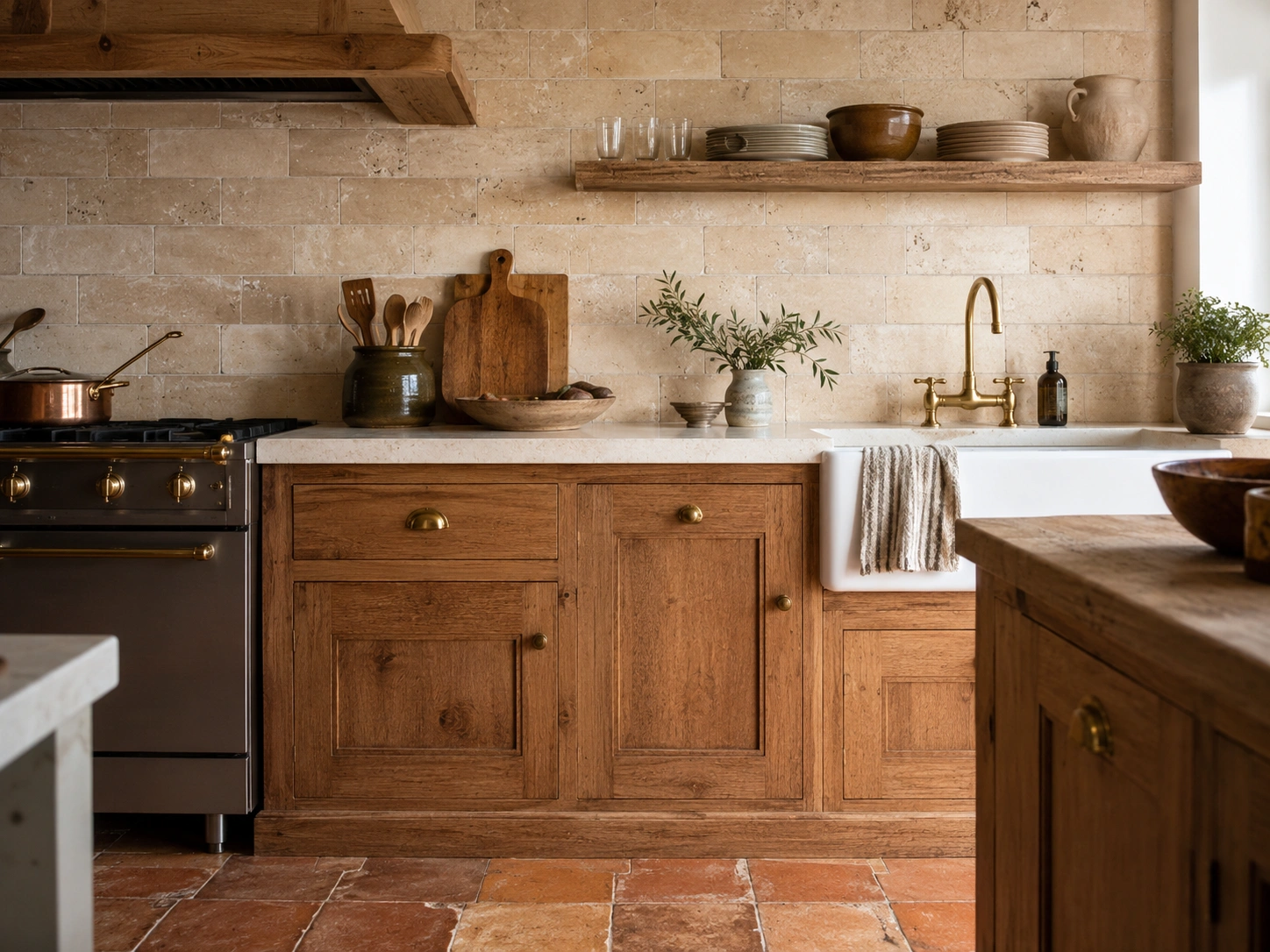
Travertine hex tiles bring texture without committing to bold color — neutral enough for almost any cabinet tone, visually interesting enough not to need anything else on the wall. The earthy modern aesthetic driving Pinterest kitchen boards for the past two years lands particularly well with travertine hex. Bedrosians Tile & Stone carries both 2-inch and 4-inch formats. The smaller scale reads intricate; the larger reads bolder and more distinctly contemporary.
8. Split-Face Travertine for a Textured, Spa-Influenced Range Wall
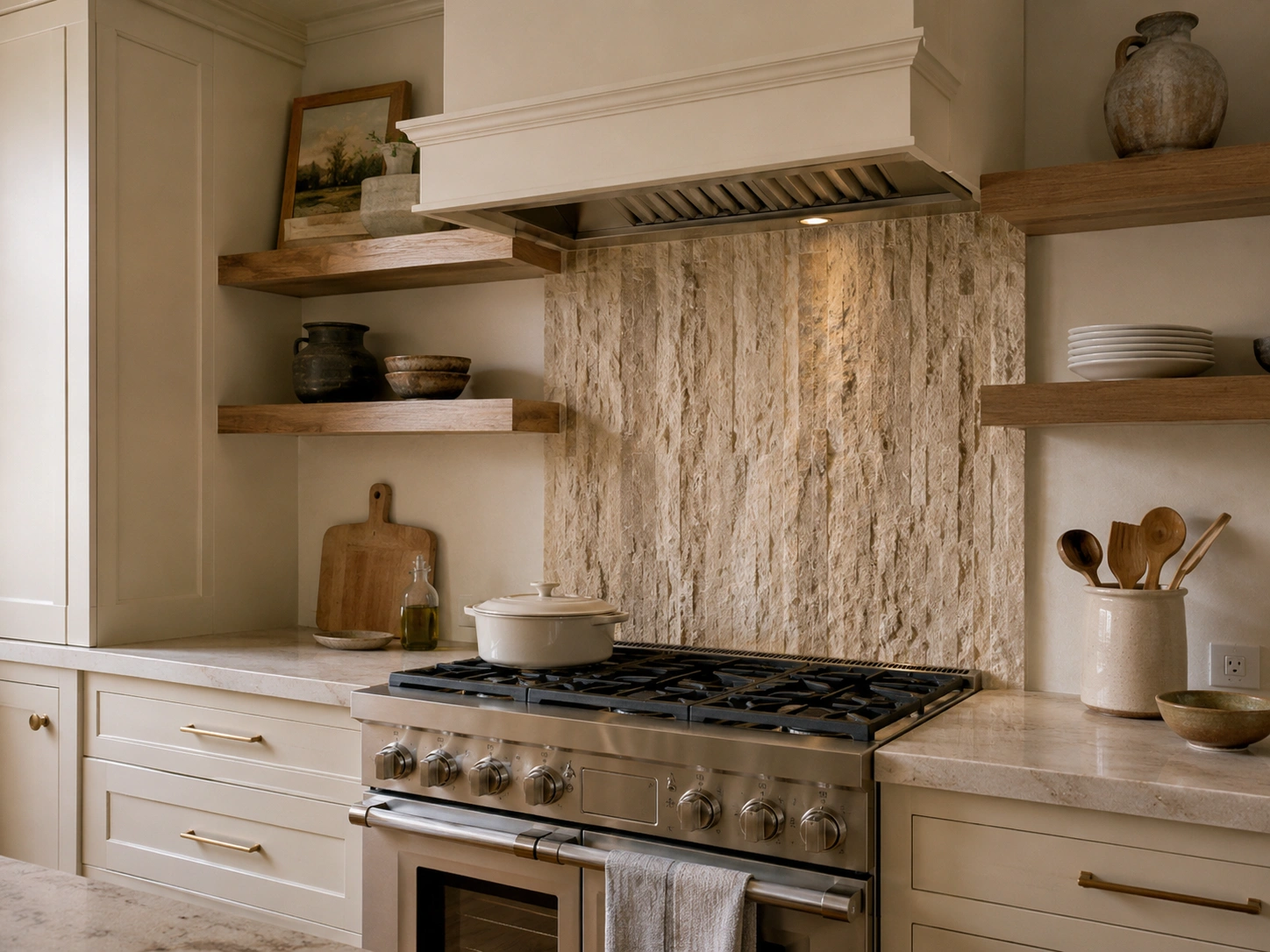
Split-face travertine is cut along the stone’s natural cleavage plane, exposing the raw, layered interior. The result is a deeply dimensional surface with natural light-and-shadow variation no polished tile can replicate. Seal thoroughly before installation — the textured surface will trap cooking residue without consistent protection. Use it exclusively as a range wall accent panel rather than across the full backsplash run.
9. Vein-Cut Travertine Tiles Laid Vertically for a Taller Kitchen
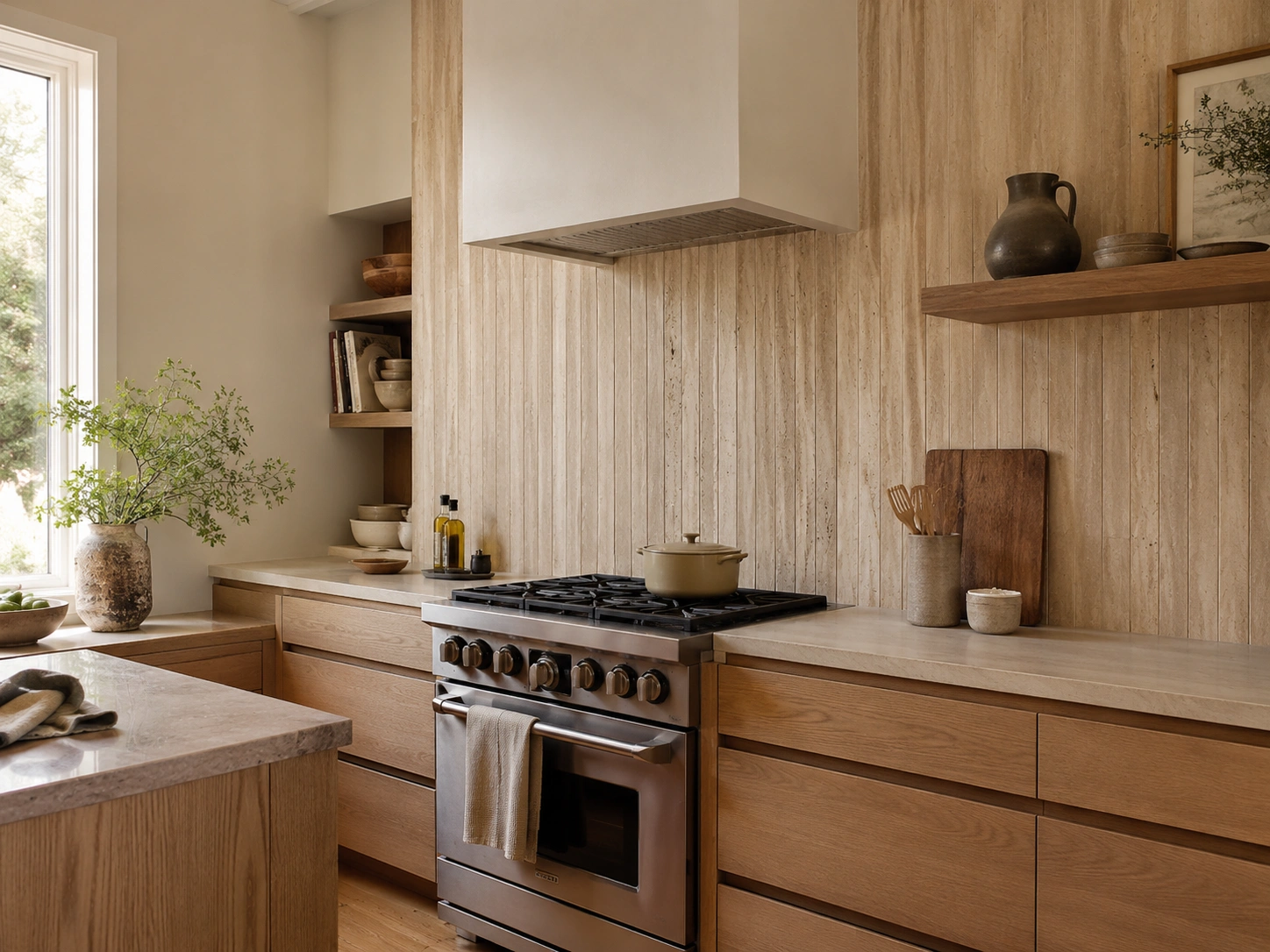
Most travertine is cross-cut, giving a random organic pattern. Vein-cut travertine is sliced parallel to the stone’s veining, revealing long, linear streaks that look almost like wood grain. Laid vertically, these tiles draw the eye upward and make standard ceiling heights feel more generous. Most guests won’t consciously notice the distinction — but they’ll feel the room read taller and more architectural than it actually is.
Quartzite Backsplash Ideas for White and Light Cabinets
Here’s the thing: quartzite gets confused with quartz constantly. They’re not the same material. Quartz is engineered stone. Quartzite is a naturally occurring metamorphic rock — harder than marble, resistant to etching, and available in softer organic color ranges than granite typically offers.
Quick Comparison: Natural Stone Backsplash Options
| Stone Type | Best For | Key Benefit | Limitation |
|---|---|---|---|
| Marble | Modern farmhouse, traditional, transitional | Elegant veining; high-end look | Etches from acid; needs annual sealing |
| Travertine | Mediterranean, farmhouse, boho | Warm tone; ages gracefully | Porous; voids need filling before install |
| Quartzite | White cabinet kitchens, transitional | Harder than marble; resists etching | Higher cost; limited local supply in some markets |
| Slate | Industrial, cabin, rustic | Matte finish; minimal sealing needed | Limited color range; edges chip over time |
| Limestone | Parisian, Mediterranean, transitional | Soft, understated elegance | Softest natural option; careful sealing required |
10. White Quartzite Slab Matched to the Countertop
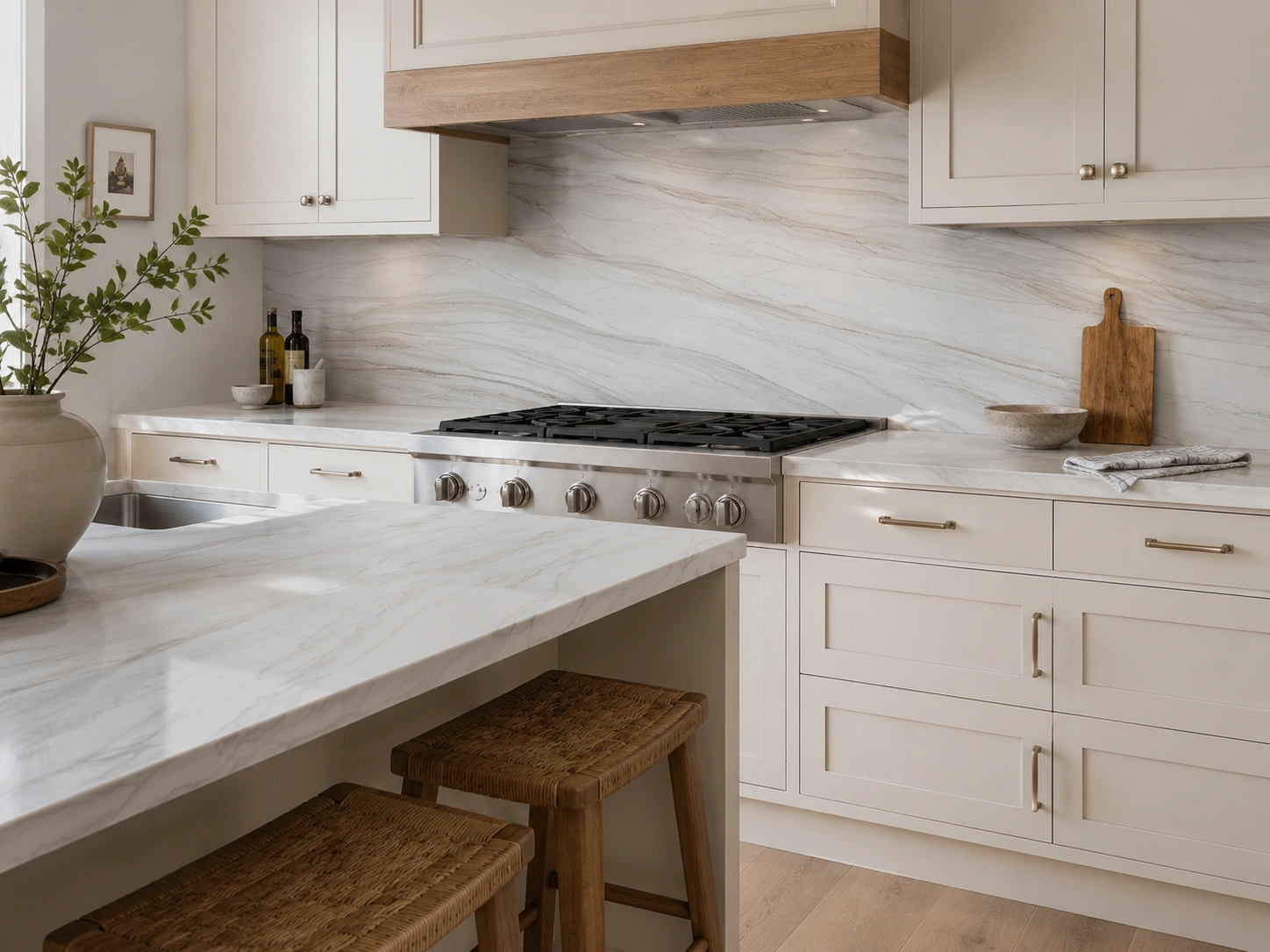
Matching the backsplash slab to the countertop — same stone, continuous veining running from horizontal to vertical — is the single highest-impact upgrade in a natural stone kitchen. White Macaubas and Mont Blanc quartzite are the most popular options for this treatment. The seamlessness eliminates grout lines and makes a standard kitchen layout feel custom-built. Best executed by a professional fabricator who can flow-match or bookmatch the slabs.
11. Grey Quartzite Mosaic Tiles With Brass Hardware Accents
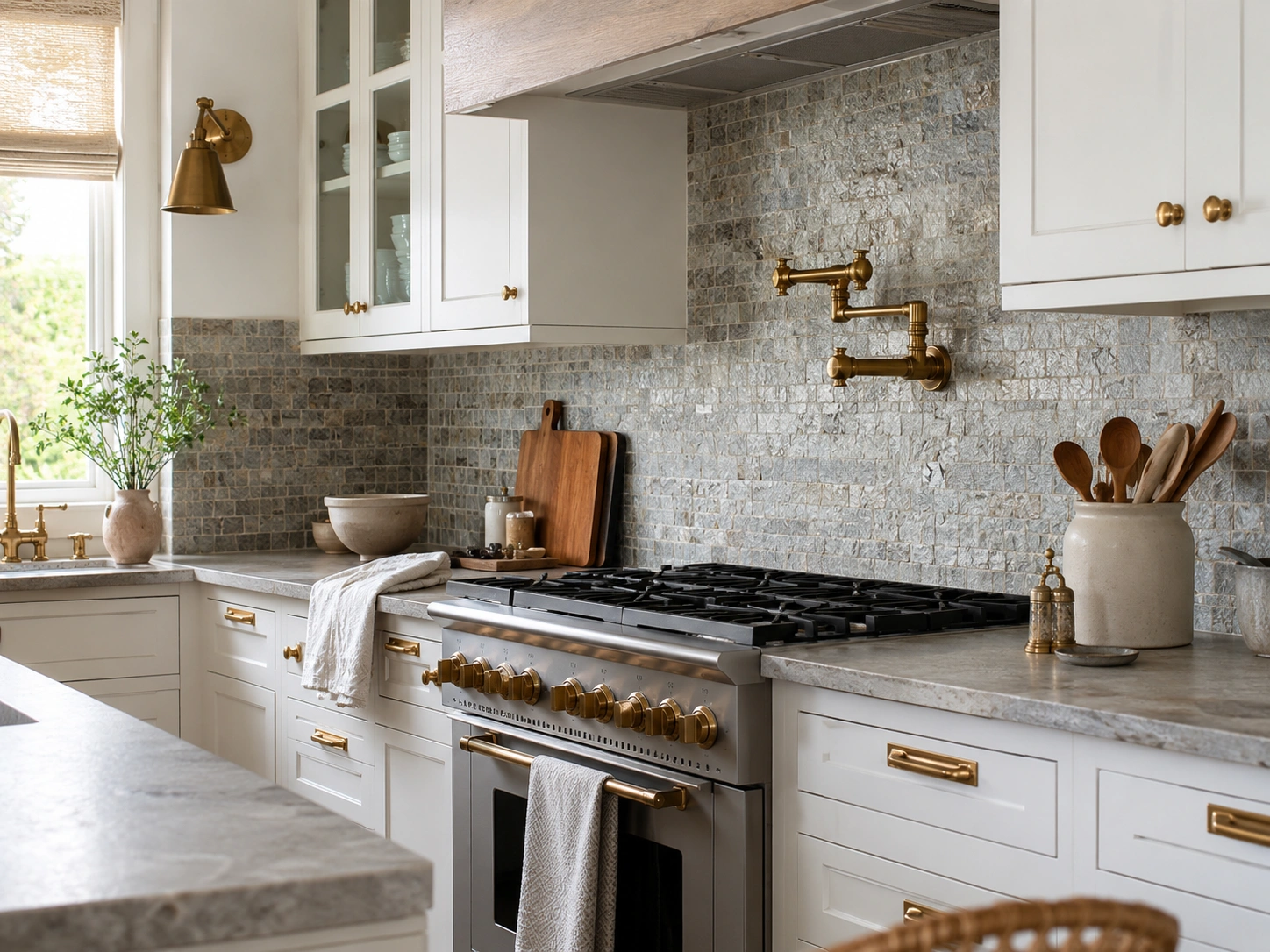
Grey quartzite mosaic tiles read warmer than porcelain grey because natural stone carries tonal variation that engineered tile can’t authentically replicate. The irregular grey and warm gold tones within the stone pair naturally with unlacquered or aged brass hardware. The warmth of the metal bridges the cool stone and creates a contrast that reads more expensive than the material cost alone would suggest at any scale.
12. Sea Pearl Quartzite for a Coastal Kitchen
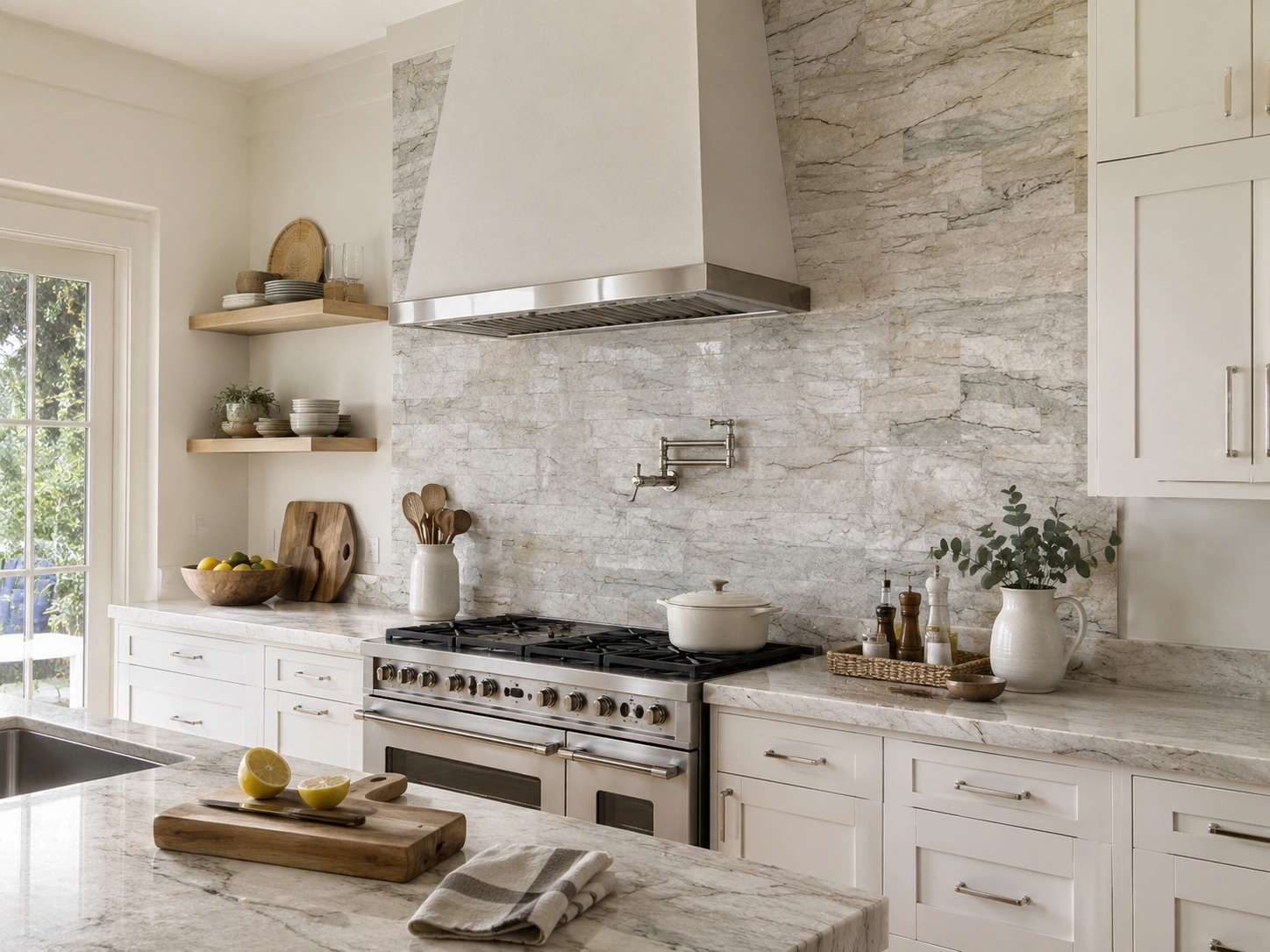
Sea Pearl is a quartzite variety with soft green, grey, and white tones that carry a subtle iridescent quality. It reads neutral from a distance and quietly coastal up close — distinctive without being trend-specific. Pair with white shaker cabinets, brushed chrome or polished nickel fixtures, and linen-toned walls. MSI Surfaces carries Sea Pearl in mosaic format. It works equally well in a beach house and a standard suburban transitional kitchen.
13. Quartzite Ledger Panels for a Dramatic Accent Wall
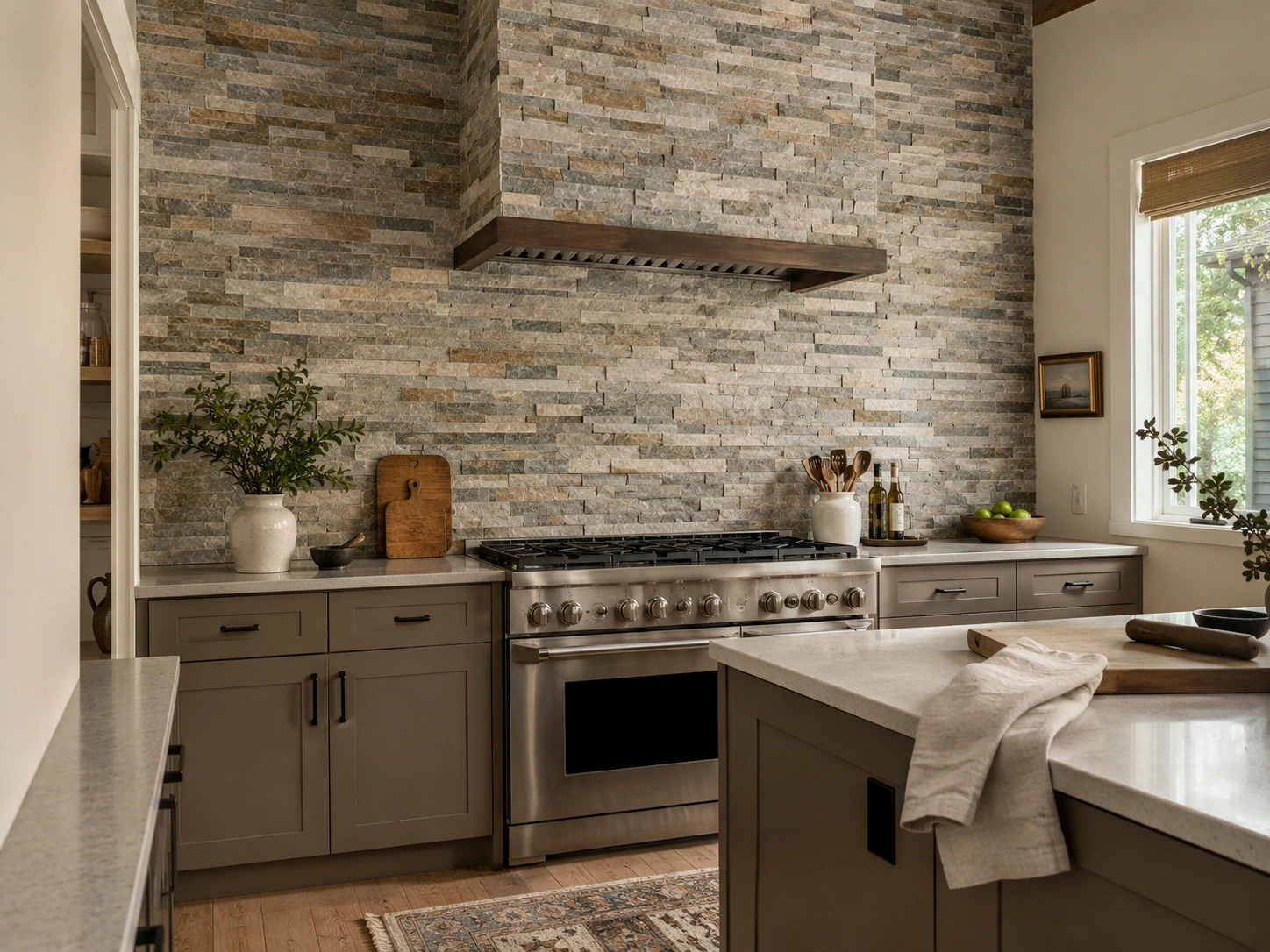
Quartzite ledger panels — horizontal stone strips pre-mounted on mesh backing — stack floor-to-ceiling into one of the most architecturally dramatic kitchen backsplash statements possible. Quartzite’s hardness makes it significantly more chip-resistant than travertine or limestone ledger alternatives, a practical advantage in a kitchen environment. The Pebble Tile Shop carries quartzite ledger options in both linear and random-stack patterns suited to this type of installation.
Slate, Soapstone, and Limestone Backsplash Ideas
What most backsplash guides skip: slate, soapstone, and limestone are the most under-recommended options in the natural stone category — and in kitchens where low maintenance matters more than prestige, they often outperform marble and travertine in real daily use.
I’ve seen conflicting data on soapstone’s market position — some industry sources categorize it as a specialty niche product; others flag it as a rising category in premium kitchen renovations. My read: it’s genuinely underused and worth serious consideration for homeowners who want the look of natural stone without annual sealing requirements.
How to Choose the Right Natural Stone for Your Kitchen Backsplash
- Identify your cabinet tone — warm or cool determines which stone families work.
- Decide on a finish — honed (matte) for lower maintenance; polished for high gloss.
- Order samples of your top two stone types and live with them for 48 hours in actual kitchen light.
- Assess your sealing commitment — marble and travertine need annual sealing; slate and soapstone need little to none.
- Confirm stone availability in large-format or slab if you’re planning a full-height installation before contacting a fabricator.
14. Charcoal Slate Tiles for an Industrial Farmhouse Kitchen
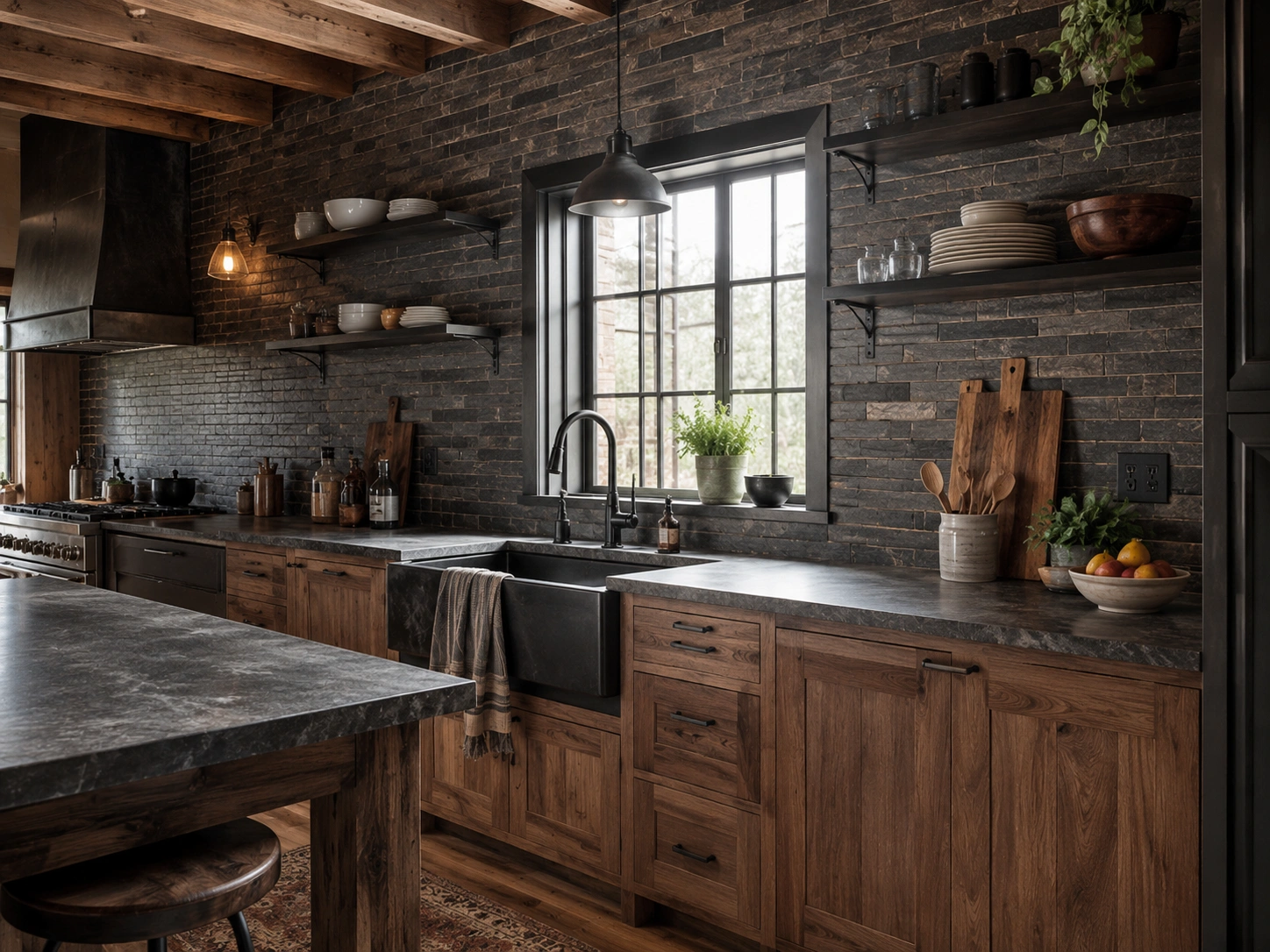
Natural slate in charcoal-grey has a matte, slightly cleft surface that no porcelain convincingly replicates up close. It fits industrial farmhouse kitchens — black metal open shelving, apron-front sinks, exposed ceiling joists — better than polished stone ever would. Slate also runs in a more accessible price range: typically $4–$8 per square foot versus $15–$30 for marble. It requires little to no sealing, which immediately separates it from most other natural stone options.
15. Multi-Color Natural Slate for a Rich, Earthy Statement
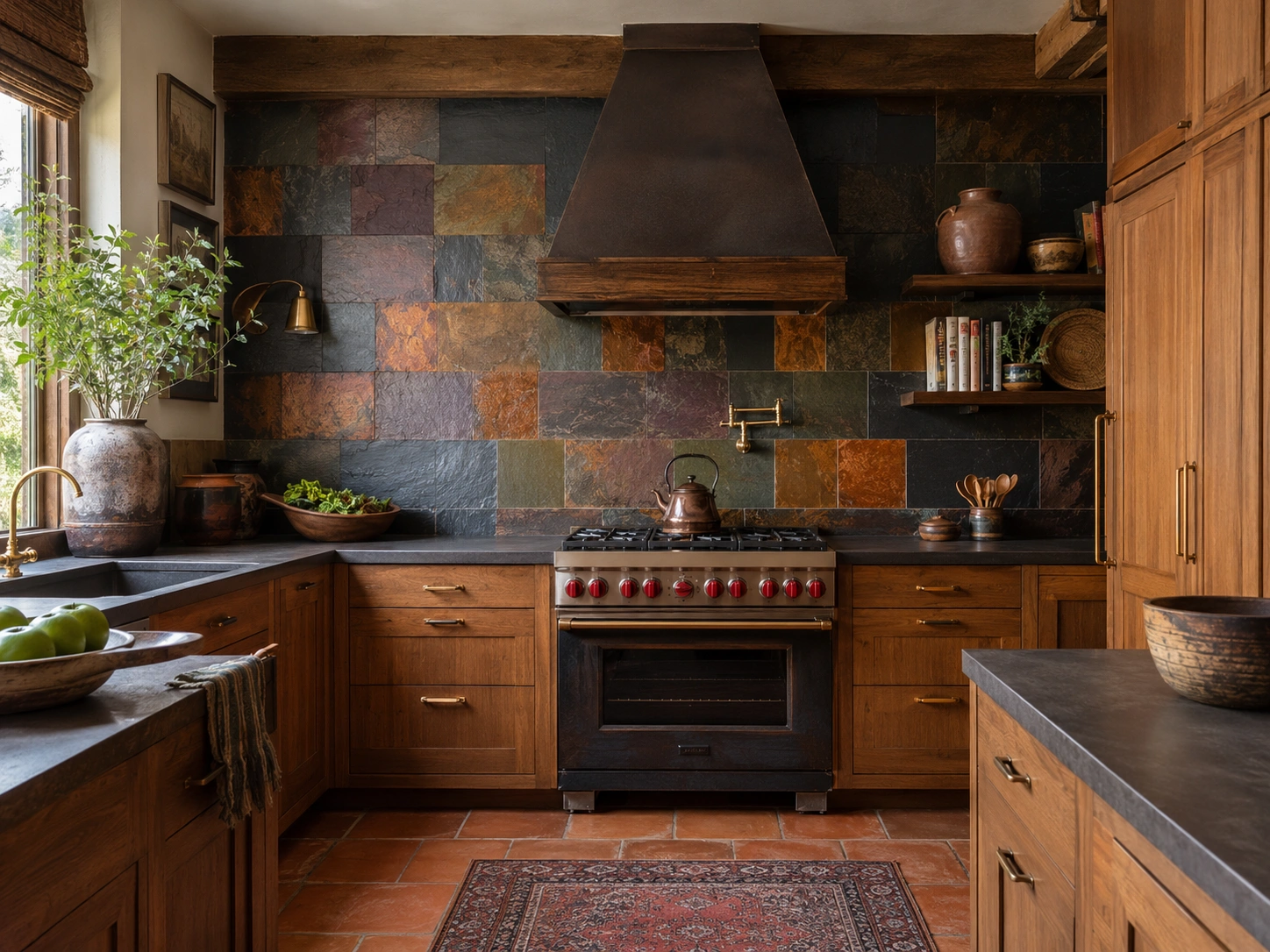
Multi-color slate combines charcoal, copper, rust, green, and plum tones in a single tile — creating a backsplash that looks site-specific rather than showroom-selected. The earthy color range pairs with warm wood cabinetry, terracotta floors, and burnished brass hardware in ways that more uniform stones struggle to match. It’s a strong direction for eclectic or globally-influenced kitchens where predictable neutrals would feel underwhelmingly quiet.
16. Honed Soapstone Backsplash for a Craftsman or Historic Kitchen
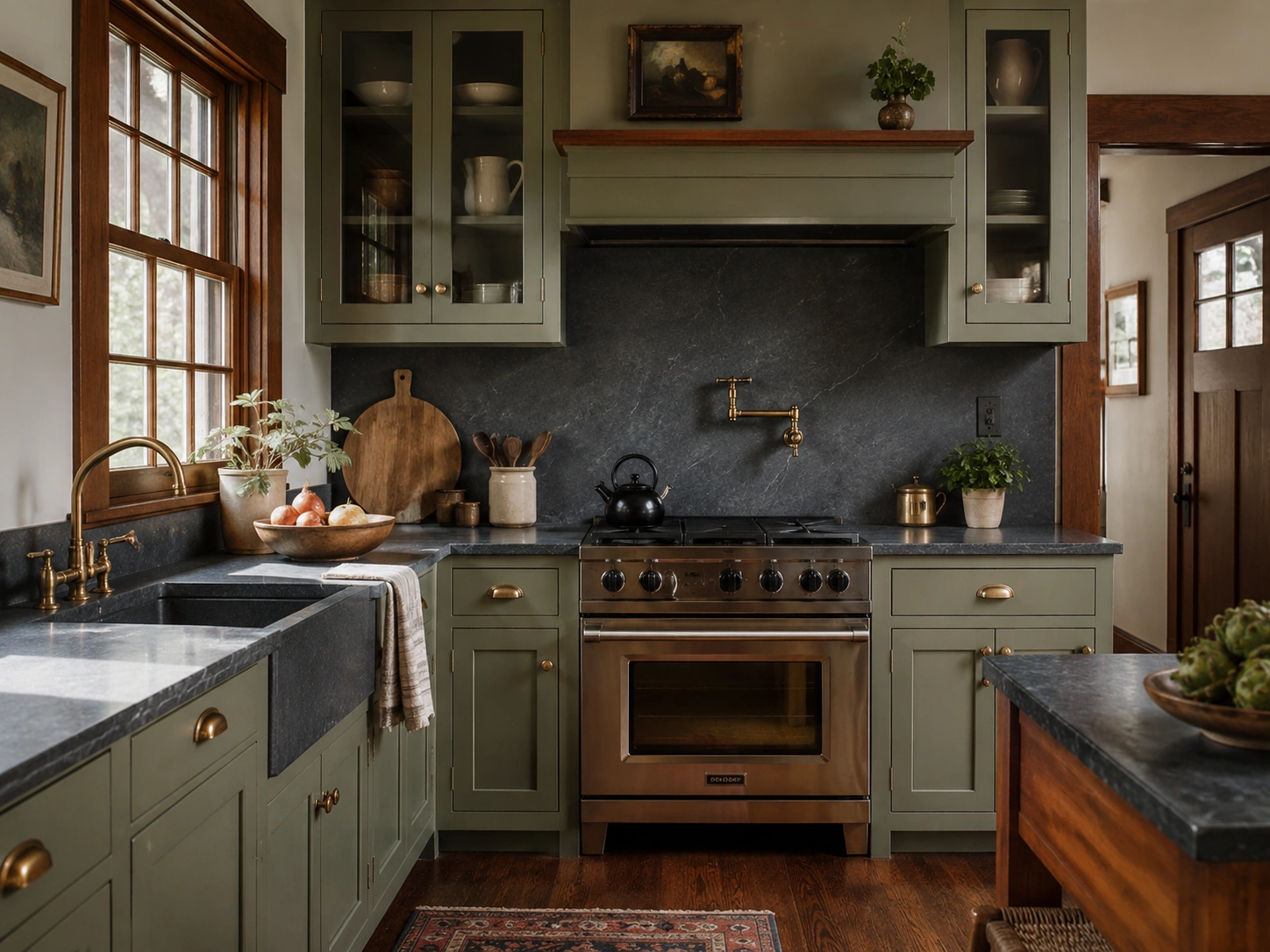
Soapstone is naturally non-porous — it doesn’t need sealing, putting it immediately ahead of marble and travertine for a low-maintenance kitchen. Its dark grey, softly veined surface looks polished but feels warm and slightly satiny to the touch. It performs best in Craftsman Revival or historic renovation kitchens. Pair with forest-green or deep navy cabinetry and aged brass hardware for a palette that photographs beautifully and actually improves with age.
17. French Limestone Tiles for a Parisian Kitchen Aesthetic
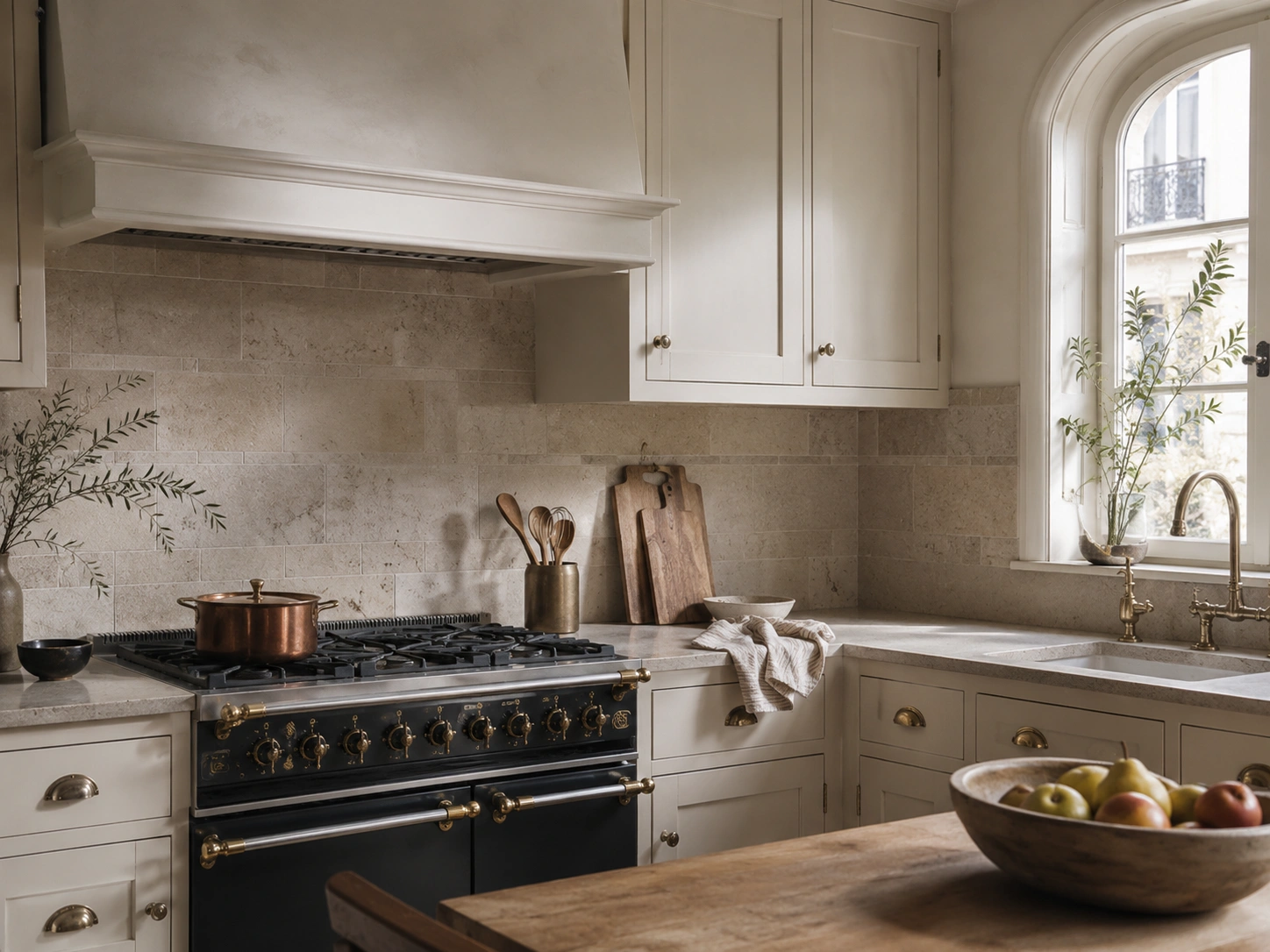
French limestone — Jura Grey, Burgundy limestone, or Saint-Marc — has a quiet, chalky elegance that sits between travertine (too rustic) and marble (too grand) in tone and mood. It doesn’t announce luxury; it suggests it. Works best in kitchens with muted palettes: warm whites, linen tones, aged brass. Sealed and maintained, it handles kitchen use reasonably well. Skip this stone if annual maintenance isn’t something you’ll realistically follow through on.
18. Jerusalem Gold Limestone for a Warm Mediterranean Kitchen
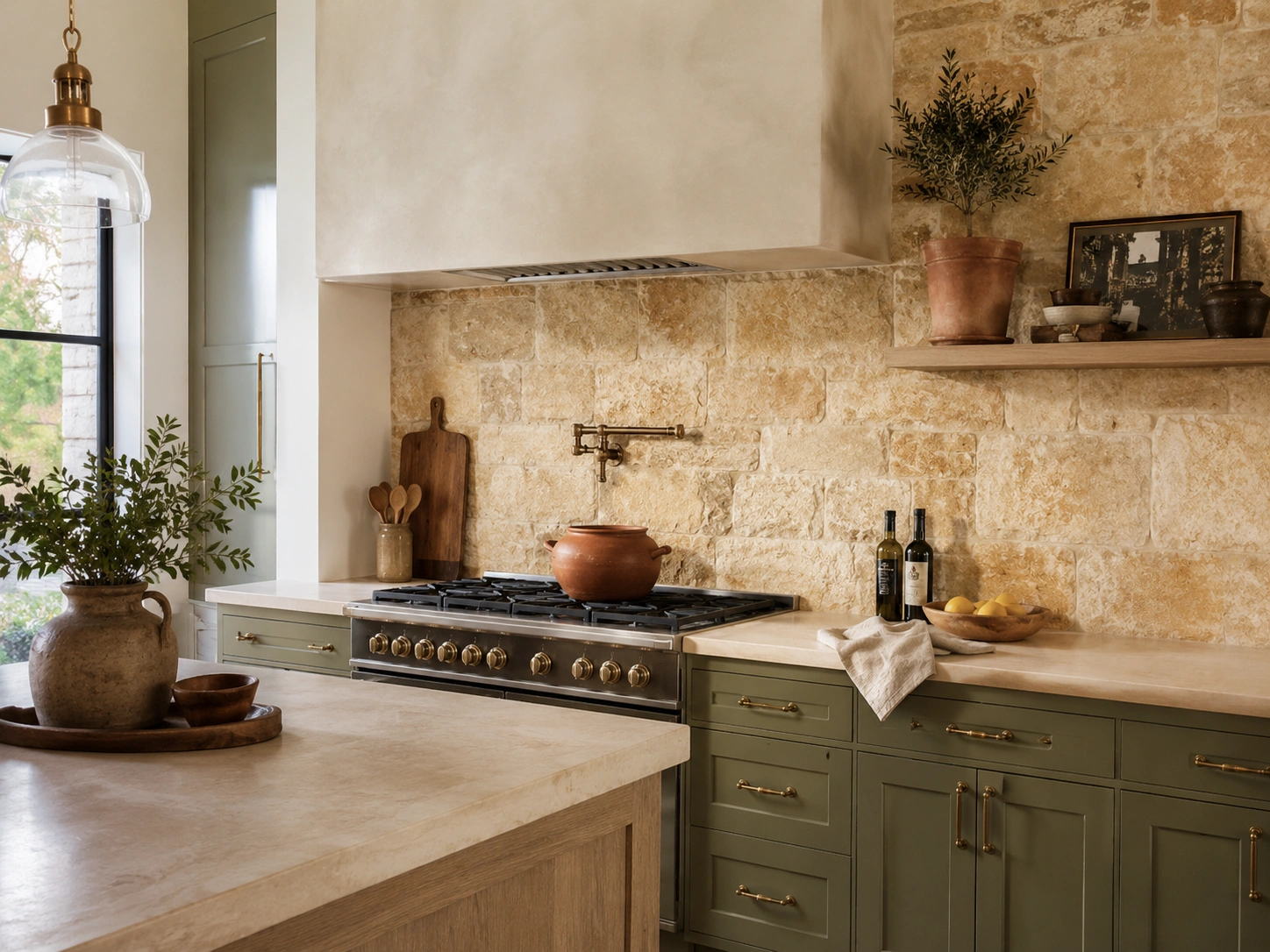
Jerusalem limestone — also sold as Jerusalem Gold — is a honey-toned stone with subtle fossil inclusions that create organic, non-repeating surface patterns. It’s been standard in Mediterranean and Tuscan-style kitchens for decades but translates well into contemporary spaces with warm wood, terracotta, and olive or sage cabinetry. Less trend-driven than marble, which is arguably its biggest advantage: it won’t look dated five years from now.
Stacked Stone and Ledger Panel Ideas for Maximum Visual Impact
Ledger stone panels come pre-mounted on mesh sheets and install similarly to large-format tile — which makes them accessible for a confident DIY homeowner as well as a professional tile installer. The texture and depth they create is something flat tile simply can’t replicate.
Look — if you’re weighing ledger stone against standard tile and your goal is a kitchen that reads genuinely custom in photographs, ledger stone wins. It’s one of the few materials where real-life texture actually photographs better than flat tile does. That’s not common.
19. Floor-to-Ceiling Stacked Stone Behind the Range Hood
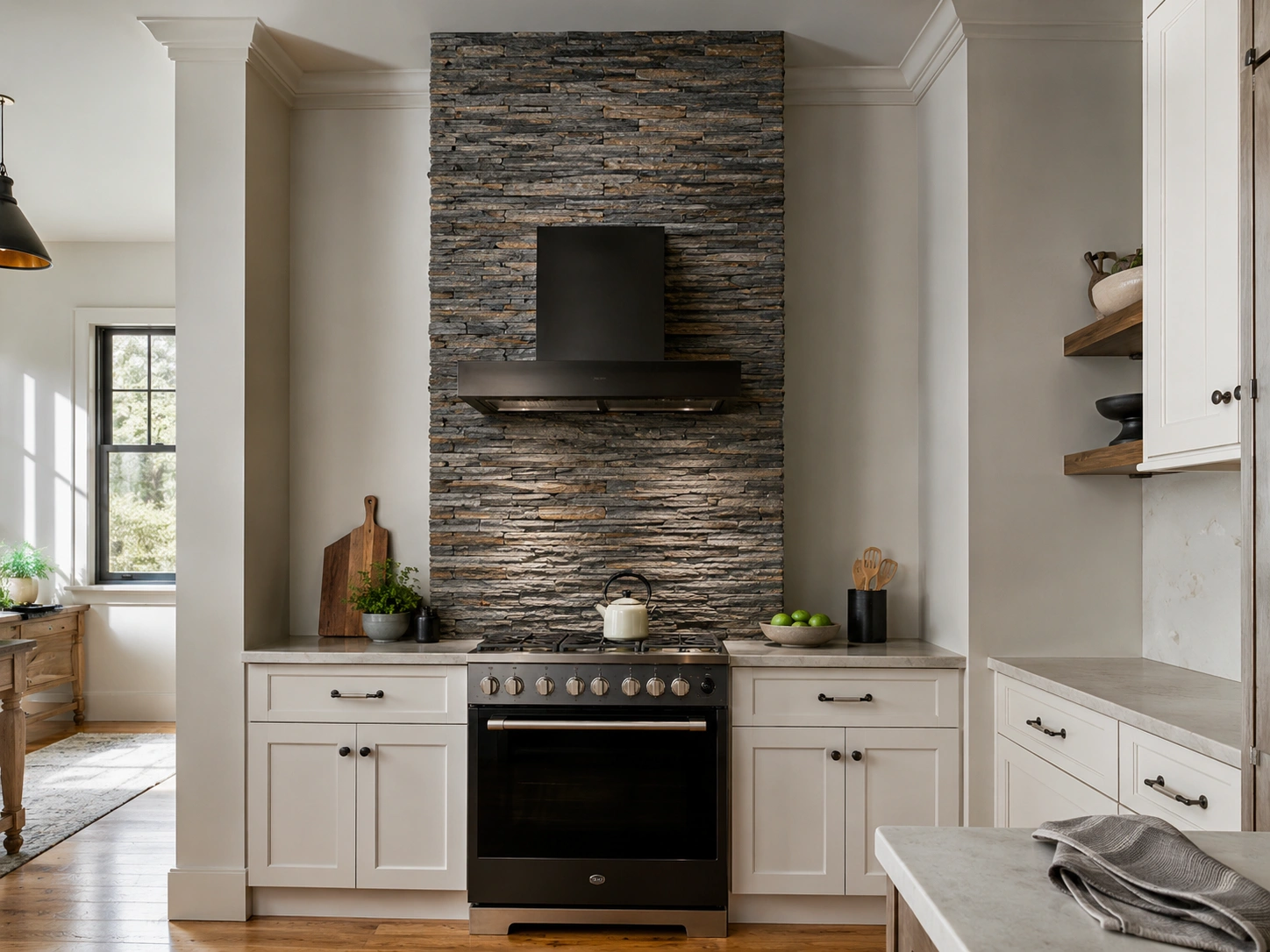
A column of stacked ledger stone running floor-to-ceiling alongside the range and range hood is one of the most dramatically distinctive moves in kitchen design that doesn’t require structural changes. The vertical stacking draws the eye upward and makes standard ceiling heights feel genuinely more generous. Use quartzite or slate ledger panels — stones with enough horizontal linear texture that the stacking reads architectural rather than heavy.
20. A Thin Ledger Strip as a Horizontal Accent Band
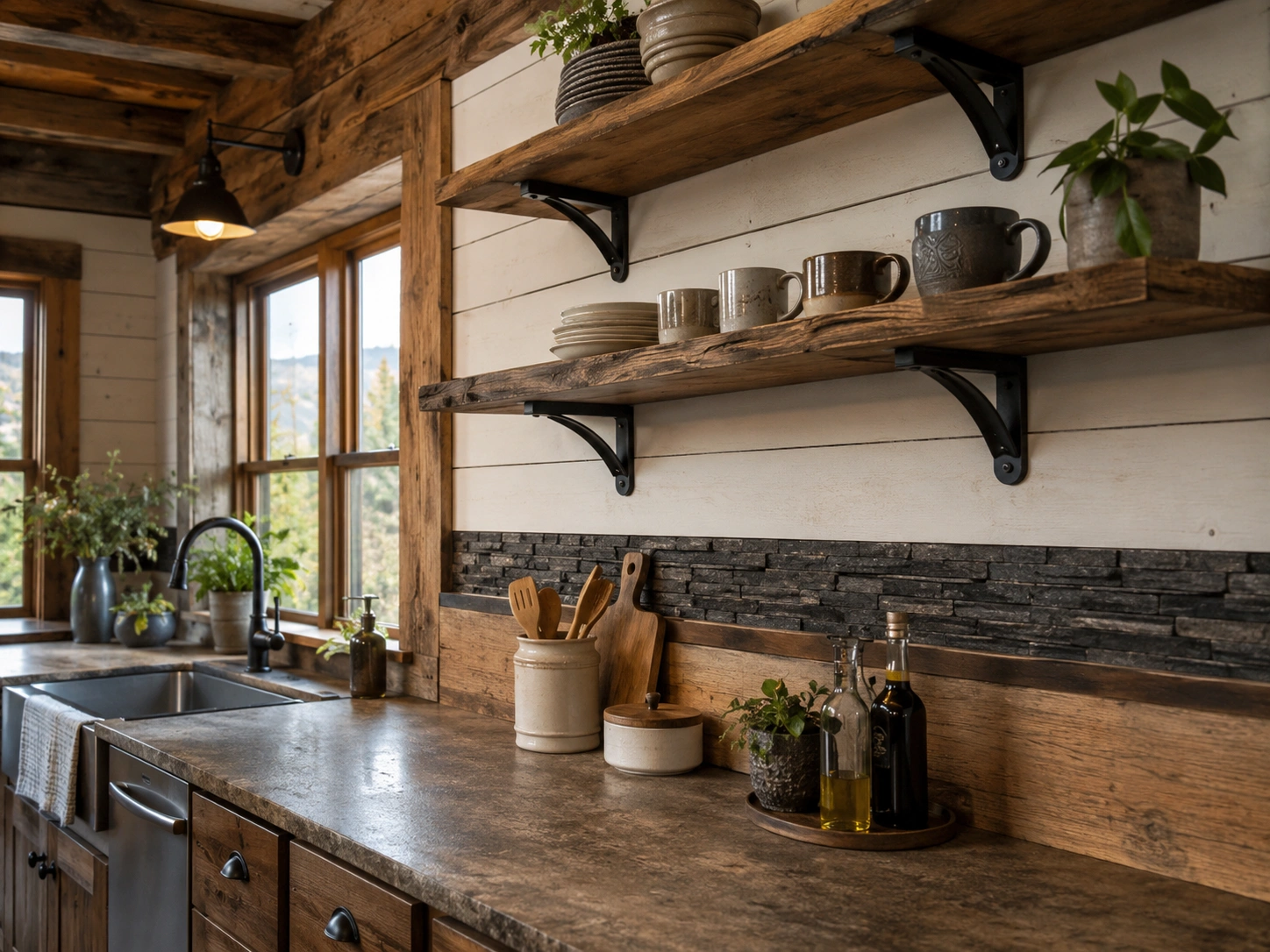
Rather than a full stone backsplash, a thin horizontal band of stacked ledger stone — running between the counter surface and a painted or shiplap wall above — creates a textured accent that reads custom without full coverage commitment. It’s a practical solution for kitchens with limited stone budget or homeowners who want texture without visual dominance. The Pebble Tile Shop carries narrow-cut ledger panels suited to this accent application.
21. Stacked Slate Ledger Panels for Cabin and Mountain-Modern Kitchens
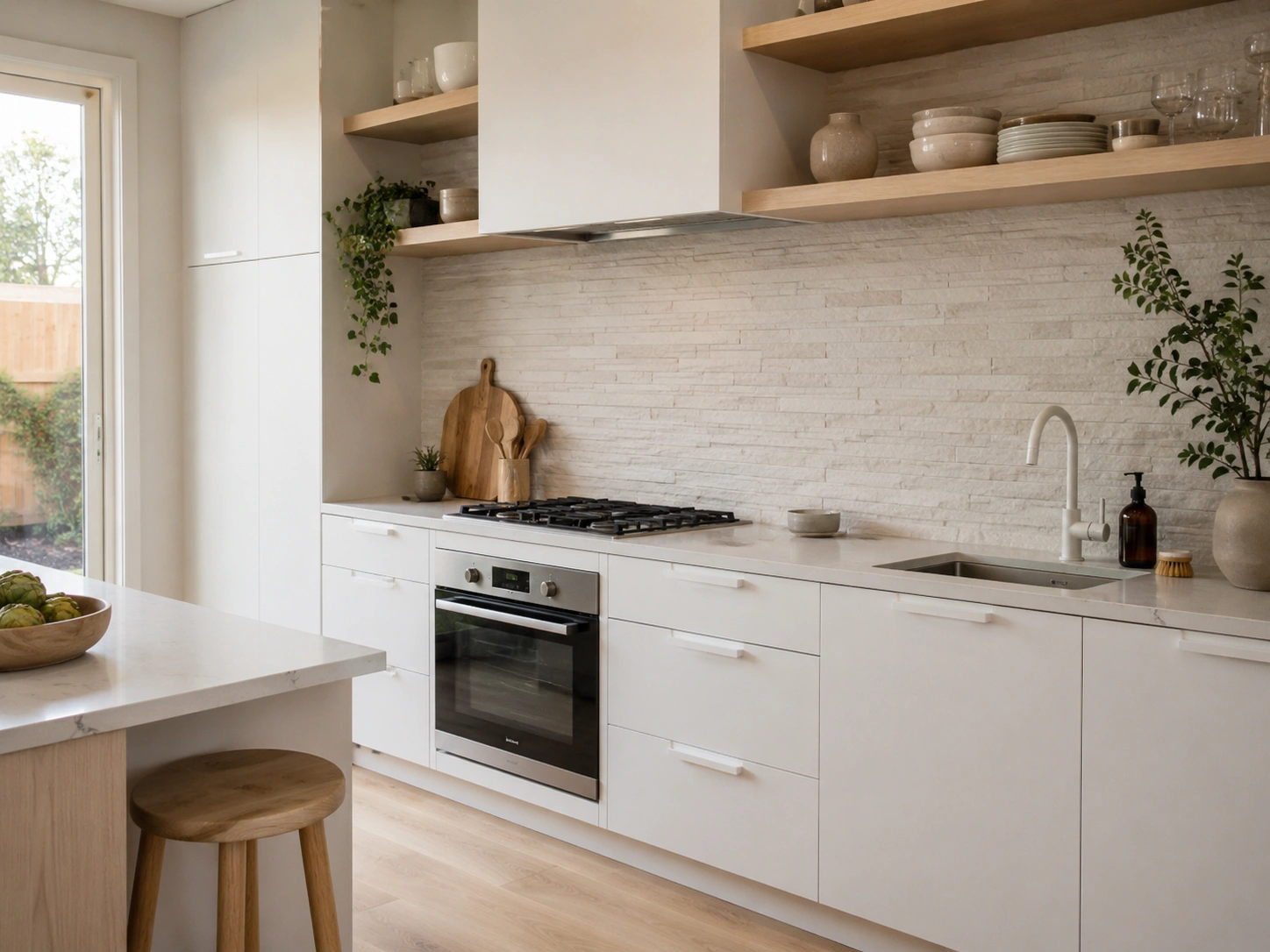
Dark stacked slate has an organic, handcrafted quality that fits cabin and mountain-modern kitchens without looking resort-adjacent. Paired with log accents, raw wood floating shelves, and black iron hardware, it reads intentional rather than rustic-by-default. Seal the slate before installation — the textured surface will trap cooking residue in an active cooking zone without consistent protection. Expect to re-seal every 12–18 months near the range.
22. Light Ledger Stone in a White Scandinavian Kitchen for Subtle Texture
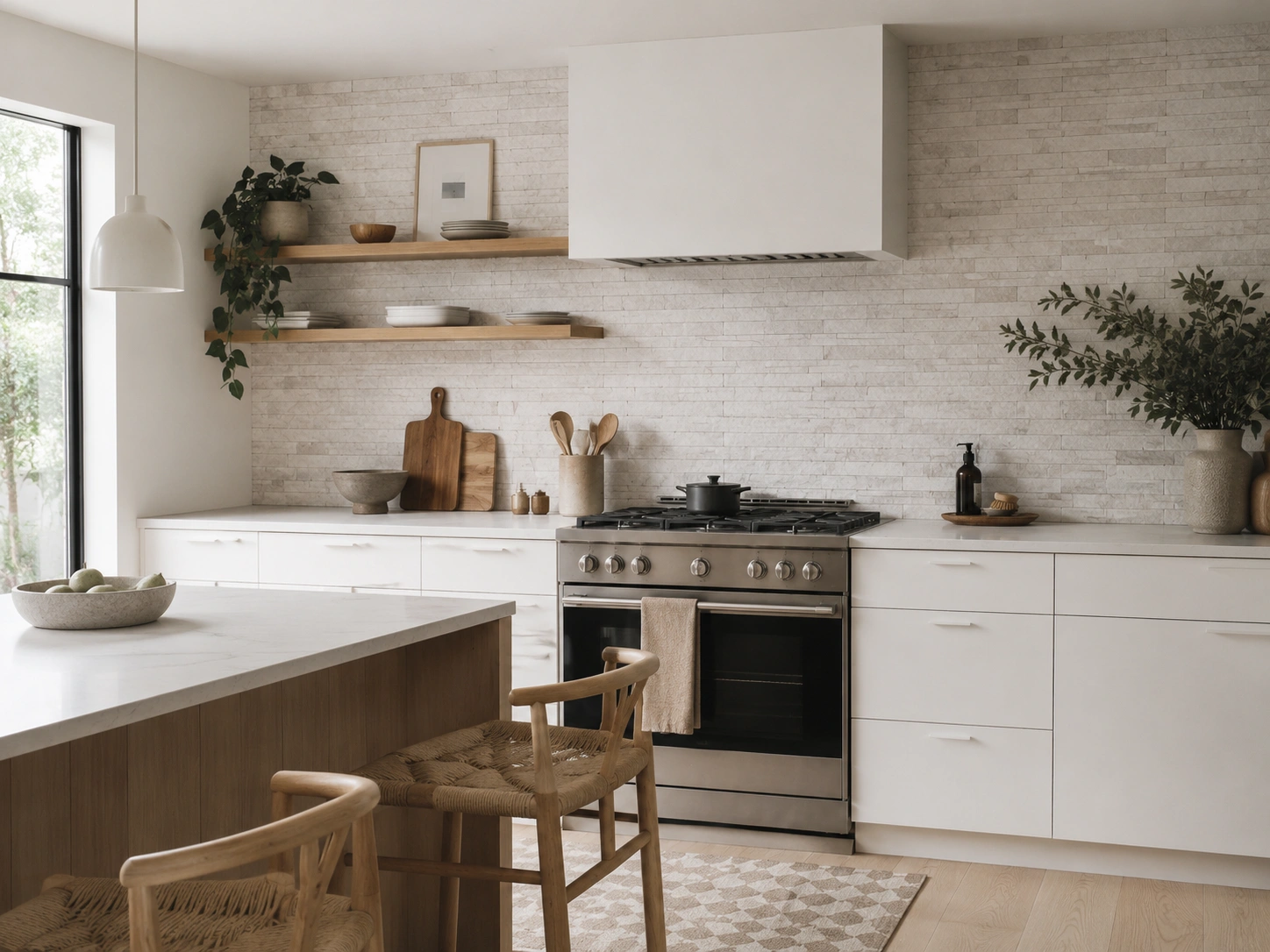
Stacked stone doesn’t have to read rustic. A pale grey quartzite or cream travertine ledger panel with a precise, tightly consistent linear cut brings tactile depth to a white Scandinavian kitchen without adding visual noise. The key is selecting stone with a controlled horizontal cut — architectural, not outdoorsy. MSI Surfaces carries lighter-toned ledger options suited to this direction. Pair with white oak accents and matte white hardware.
River Rock, Pebble, and Stone Mosaic Backsplash Ideas
River rock tiles vs. flat stone mosaic tiles: River rock pebble tiles best suit accent panels, sink walls, or organic-style kitchens where texture is the primary design goal — the dimensional surface requires more grout and ongoing maintenance than a flat mosaic. Flat stone mosaic tiles work better as full backsplash runs: they’re easier to clean, more visually consistent across a large area, and more versatile across kitchen styles. Surface complexity is the key functional difference.
23. River Rock Pebble Mosaic Sheets Behind the Sink
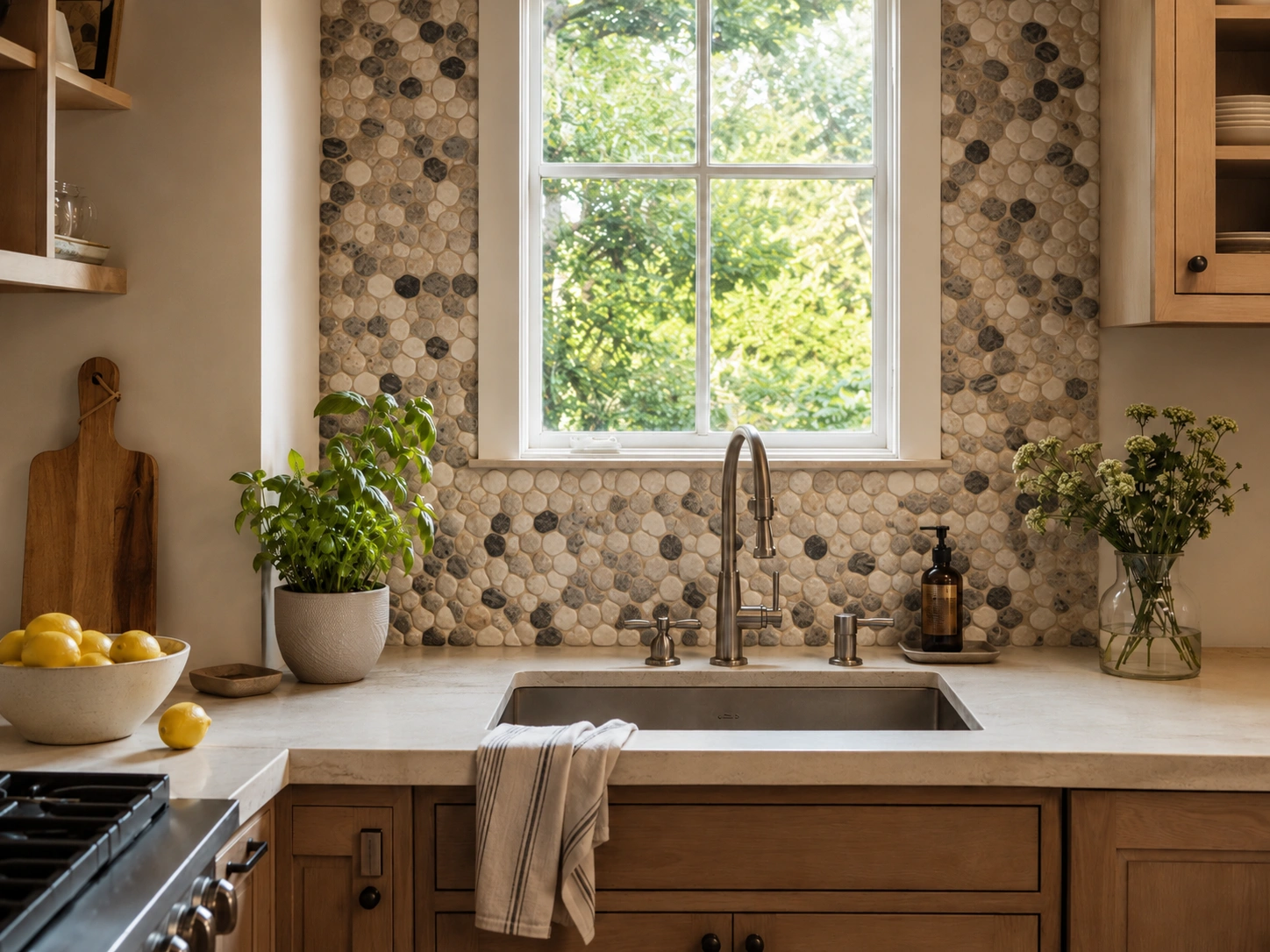
River rock pebble tiles come pre-mounted on mesh sheets in cream, grey, charcoal, and multi-color combinations. Installed behind the sink — framed by a simpler wall on either side — they bring an organic, garden-adjacent quality no flat tile quite replicates. The Pebble Tile Shop specializes in river pebble mosaic options not commonly found in big-box stores. Seal the grout lines thoroughly; the irregular surface holds moisture more than a flat backsplash does.
24. Oval River Pebble Tiles as a Refined Sink Accent
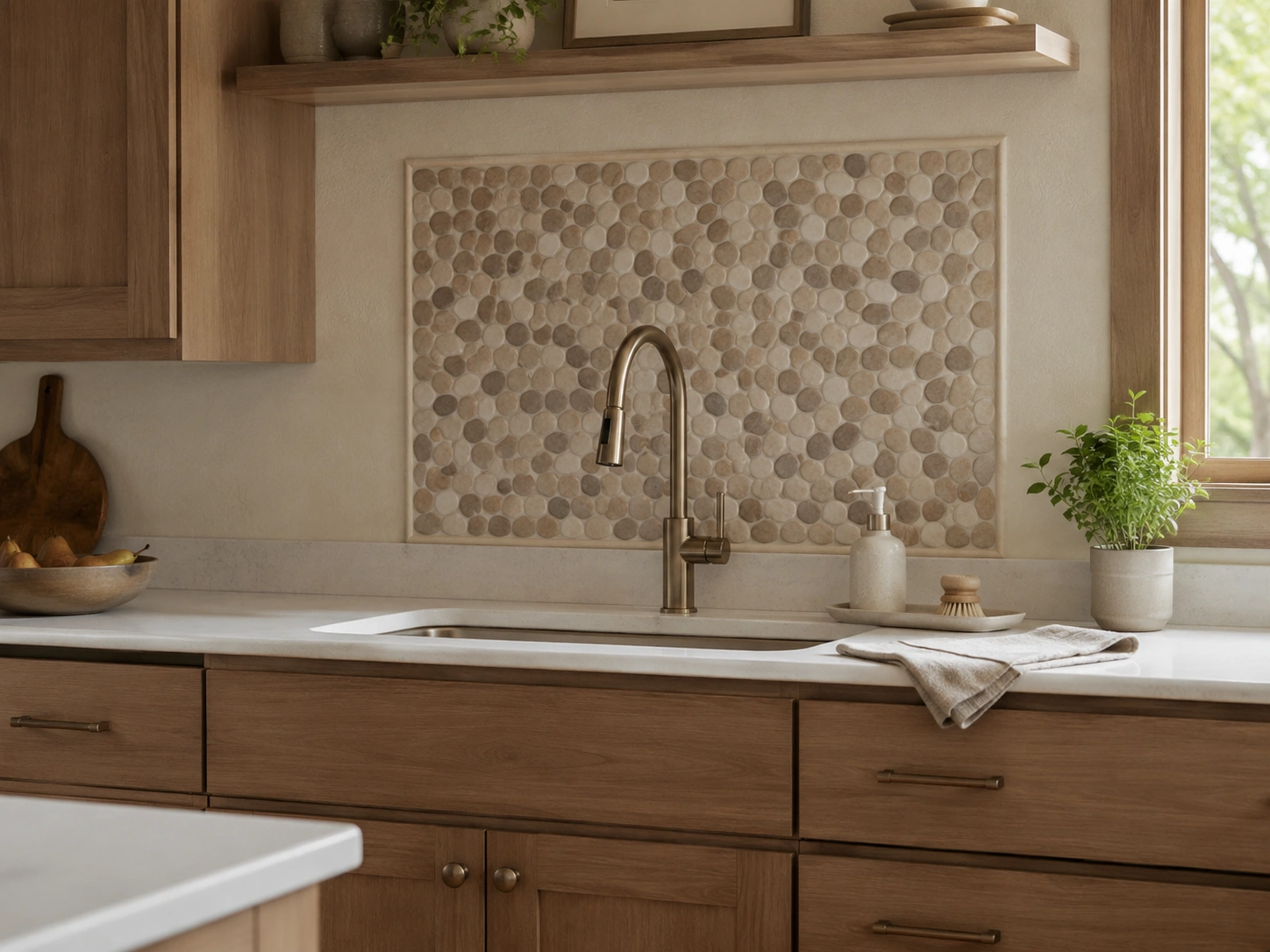
Oval river pebbles are flatter and more uniform than round pebbles, creating a smoother, more deliberate version of the pebble backsplash — less rustic, more considered. Use them as a contained sink panel rather than a full kitchen run. It limits visual complexity and keeps cleaning realistic over time. Frame the panel with a thin stone or marble border strip to define the edges and make the treatment read as intentional.
25. Mixed Stone Mosaic for a High-End Focal Panel
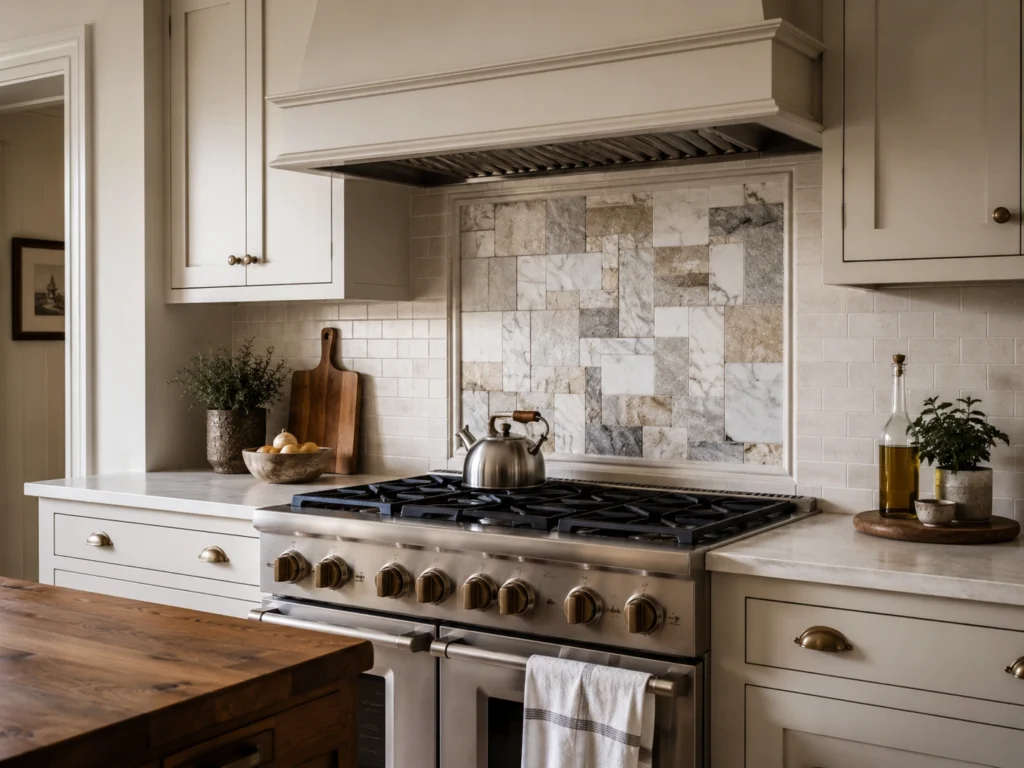
Mixed stone mosaic sheets — combining white marble, grey quartzite, and cream travertine in a single tile — look curated rather than mass-produced. The natural material variation prevents the repetitive quality that single-stone mosaics can develop across a long wall run. Install them as a focal panel behind the range, framed by a simpler field tile elsewhere, so the complexity reads purposeful rather than overwhelming.
26. Travertine Herringbone Mosaic for a Warm Transitional Kitchen
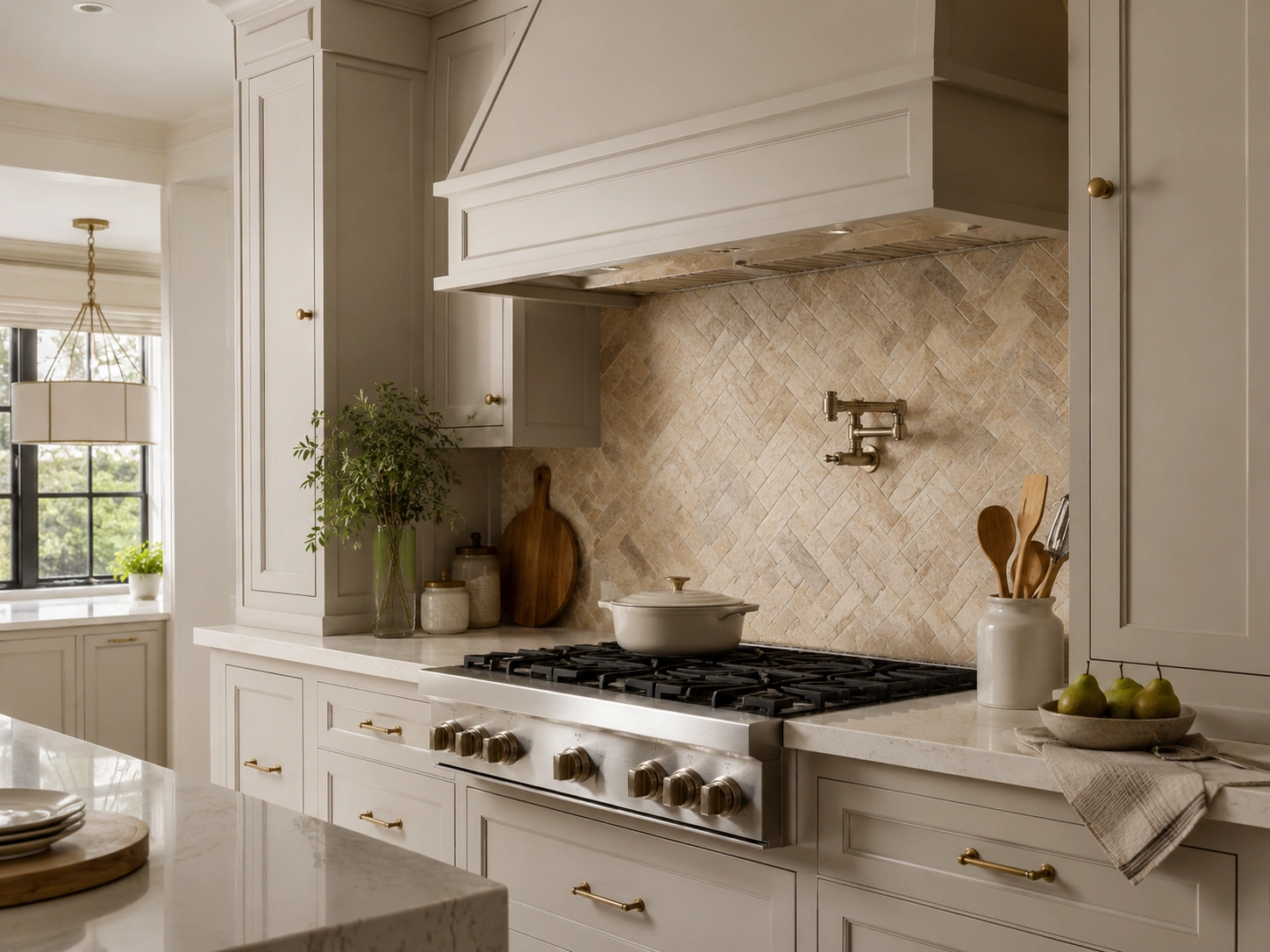
Travertine herringbone reads differently than marble herringbone — warmer, more artisanal, less formal. The cream-to-gold tone range works particularly well with greige or warm white cabinets and aged brass hardware. It’s a strong direction for transitional kitchens wanting texture and warmth without committing to a full farmhouse or rustic aesthetic. Bedrosians Tile & Stone carries travertine herringbone options in small and large formats at accessible price points.
27. Full-Height Natural Stone Slab From Counter to Ceiling — The 2025–2026 Direction
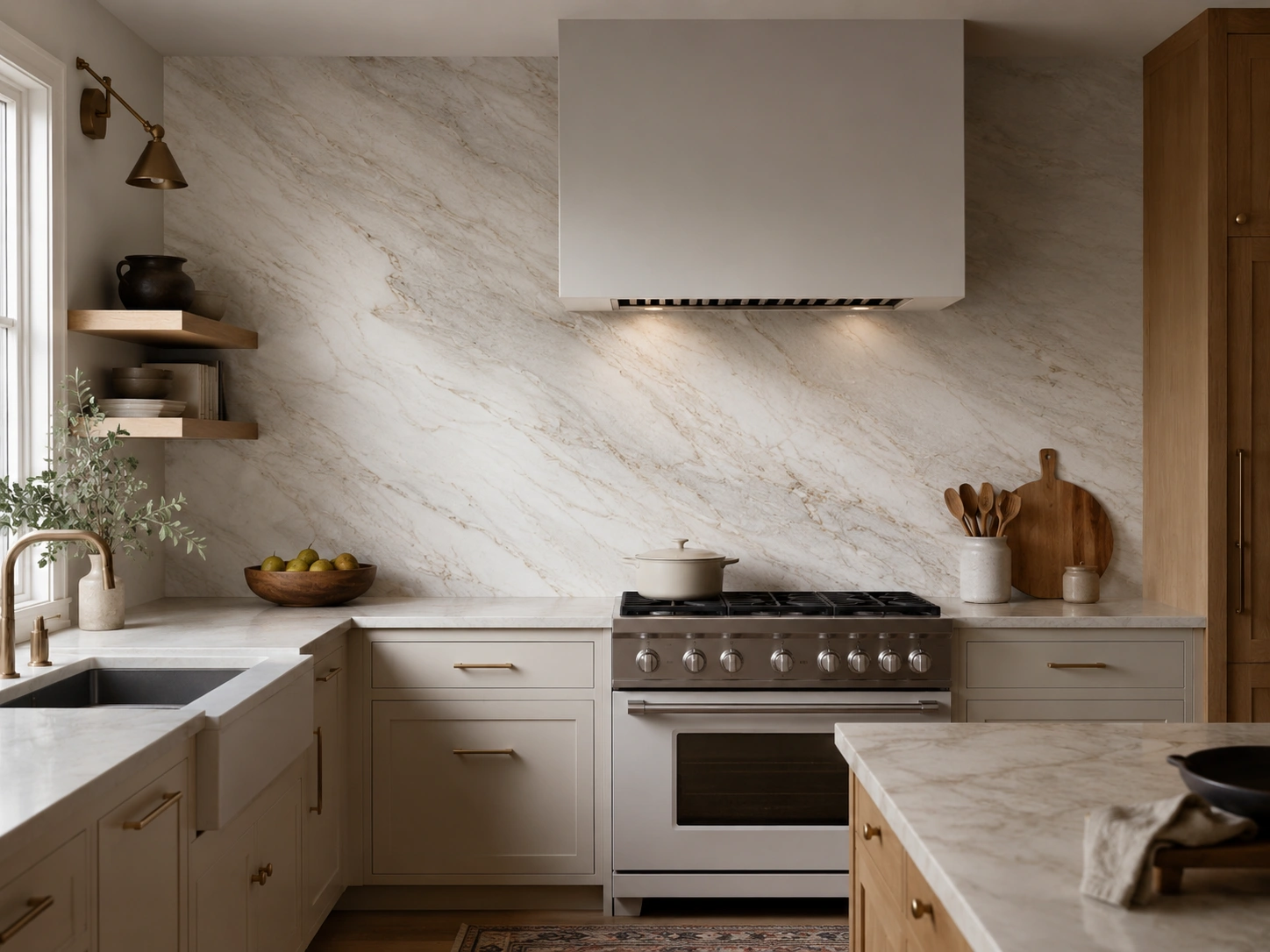
The clearest shift in kitchen design right now is the move from a standard 18-inch backsplash tile strip to a full-height slab running counter to ceiling. According to the 2025 U.S. Houzz Kitchen Trends Study, 67% of homeowners now extend their backsplash all the way to the upper cabinets or range hood — up 5 points year over year. One continuous slab. No tile breaks. No grout grid. Just stone, wall to ceiling.
Which Stone Works for Your Kitchen Style? A Decision Guide
Some designers argue that high-quality porcelain stone lookalikes — large-format porcelain with printed stone patterns — have effectively closed the gap with natural stone aesthetics. That’s valid for budget renovations or rental properties where maintenance is a genuine constraint. But if you’re spending $5,000 or more on a kitchen refresh, the tactile authenticity and long-term patina of real stone is something engineered tile still doesn’t replicate convincingly at close range.
This guide covers residential kitchen backsplashes in standard wall applications. It does not address outdoor kitchen installations, floor-to-wall stone cladding in commercial spaces, or steam-intensive cooking environments where sealing requirements change significantly.
| Kitchen Style | Best Stone Match | Why It Works |
|---|---|---|
| Modern Farmhouse | Carrara marble subway or tumbled travertine | Warm, familiar format; flatters wood tones and brass |
| Transitional | Quartzite slab or grey quartzite mosaic | Versatile tone, cleaner veining, minimal pattern complexity |
| Mediterranean | Travertine or Jerusalem limestone | Earthy warmth, natural pore variation, ages authentically |
| Industrial / Modern | Charcoal slate or honed black marble | Matte surface, raw texture, no decorative ornament |
| Scandinavian / Minimal | Light quartzite ledger or limestone | Tactile depth without color or pattern noise |
| Craftsman / Historic | Soapstone or multi-color slate | Period-appropriate tone, lowest maintenance of any option |
| Coastal / Beachy | Sea Pearl quartzite | Subtle iridescence, reads neutral from a distance |
| Boho / Eclectic | Travertine hex or river rock pebble | Organic texture, natural variation, relaxed quality |
Voice Search Q&A
What’s the best natural stone for a kitchen backsplash?
Quartzite is the most durable option. Marble is the most prestigious but requires consistent sealing. Travertine is warmest in tone and most forgiving of wear. The right choice depends on your cabinet color, maintenance willingness, and available budget.
How do I choose between marble and travertine for my kitchen?
Choose marble for crisp veining and a polished look. Choose travertine if your kitchen runs warm in tone — wood cabinets, brass hardware, earthy floors — and you want a stone that ages gracefully rather than demanding perfection to look good.
Should I seal a natural stone backsplash?
Yes, for most stones. Marble and travertine need sealing before installation and annually in kitchen environments. Slate and soapstone are naturally denser and require little to no sealing. Always confirm sealing requirements with your stone supplier before ordering.
Why does my quartzite look different from the sample I ordered?
Natural stone varies from slab to slab. Your sample came from one section; the installed tiles come from different sections of the same quarry pull. This is normal and expected — it’s also what makes natural stone look genuinely custom rather than machine-printed.
When should I extend my backsplash all the way to the ceiling?
When you have a strong focal wall — typically behind the range or range hood — and want to maximize the visual impact of a premium stone. Full-height backsplashes work best with slabs or large-format tile; smaller mosaics can read visually busy when extended that high.
Conclusion
Natural stone doesn’t come with a universal right answer — which is exactly why understanding the real differences between stone types matters before you walk into a showroom.
Marble wants consistent care. Travertine rewards warmth and patience. Quartzite is the hardest-working stone in the category. Slate and soapstone do their best work quietly, in kitchens that don’t need to announce themselves.
Order samples. Live with them for 48 hours under your actual kitchen light. What looks right on a screen — or in this article — will look different on your wall. That 48-hour test has saved more renovation regrets than any amount of research.



No Comment! Be the first one.