







Starting a home health care business takes more than caregiving experience and good intentions. State licensing timelines. CMS enrollment windows. Certificate of Need laws that can add a year before you’re eligible to even apply. The distance between “I want to start an agency” and “I’m legally open and accepting my first patient” is wider than most guides will tell you, and that’s exactly what this one fills in.
According to the U.S. Bureau of Labor Statistics, demand for home health and personal care aides is projected to grow 17% from 2024 to 2034, one of the fastest rates of any occupation, with approximately 739,800 new job openings expected annually. The market is real. The question is whether your agency will be built correctly to meet it.
This guide covers: the complete startup steps, a clear medical vs. non-medical comparison, real cost ranges, state-by-state licensing data for Illinois, Texas, Michigan, Virginia, Wisconsin, Missouri, Louisiana, and Alabama, Medicare certification, and how to get your first referrals.
This guide is written for entrepreneurs launching independently, not through a franchise model. It does not cover hospice agency startup, which follows a separate CMS certification track.
What Is a Home Health Care Business?
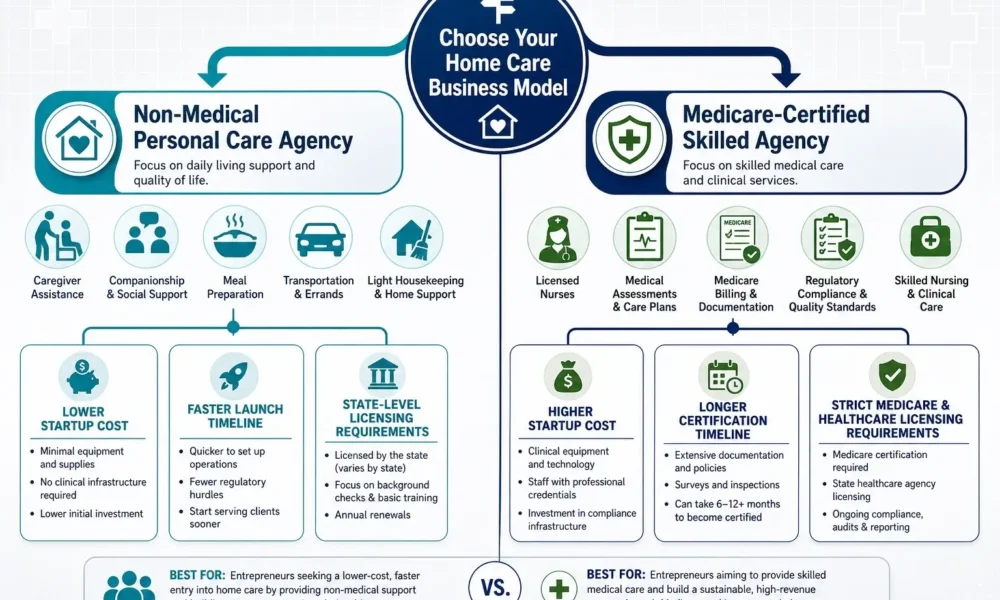
A home health care business is an agency that delivers medical or non-medical care services to clients inside their own homes. Medical (skilled) agencies provide nursing, therapy, and physician-ordered services. Non-medical agencies offer personal care, companionship, and daily living assistance. The type you choose determines your licensing path, startup cost, and how you’ll get paid.
Choose Your Agency Model Before You Do Anything Else
This is the step most aspiring owners skip. It costs them months.
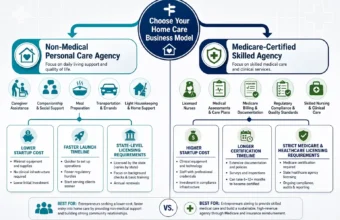
A skilled medical home health agency operates under physician orders, requires a licensed clinical director (typically an RN), must meet CMS Conditions of Participation (CoPs), and needs Medicare certification before it can bill the federal government. A non-medical personal care agency provides bathing assistance, meal prep, transportation, and companionship, no physician orders required, no OASIS assessments, no clinical oversight mandate in most states.
The startup roadmap is completely different for each model.
Here’s the thing: if you’re planning to bill Medicare, you need to budget 6–12 months before you receive your first reimbursement check. Most new agency owners, even experienced RNs, don’t account for that gap, and it creates a cash-flow problem that takes down otherwise well-run agencies in their first year.
Quick Comparison: Medical vs. Non-Medical Home Health Agency
| Category | Skilled Medical Agency | Non-Medical Personal Care Agency |
|---|---|---|
| Best For | RNs, PTs, OTs with clinical team in place | Entrepreneurs entering with lower capital |
| Key Benefit | Medicare/Medicaid eligible; higher revenue per patient | Faster to launch; significantly lower regulatory burden |
| Limitation | CMS certification adds 6–12 months before first Medicare bill | Cannot bill Medicare; limited to private pay or Medicaid waiver programs |
| Startup Cost Range | $150,000–$350,000 | $40,000–$80,000 |
| State License Required | Yes, all states | Yes, approximately 35–37 states |
| CON Law Risk | High, applies to home health in many CON states | Lower, personal care often exempt or on separate track |
Some experts argue the skilled model is always the better long-term play because Medicare reimbursement rates are higher. That’s valid once you’re operational. But if you don’t have $150,000+ in startup capital, a licensed RN for your clinical director role, and the runway to survive 6–12 months without revenue, the non-medical path isn’t a compromise, it’s the correct starting point.
How to Start a Home Health Care Business: The Core Steps
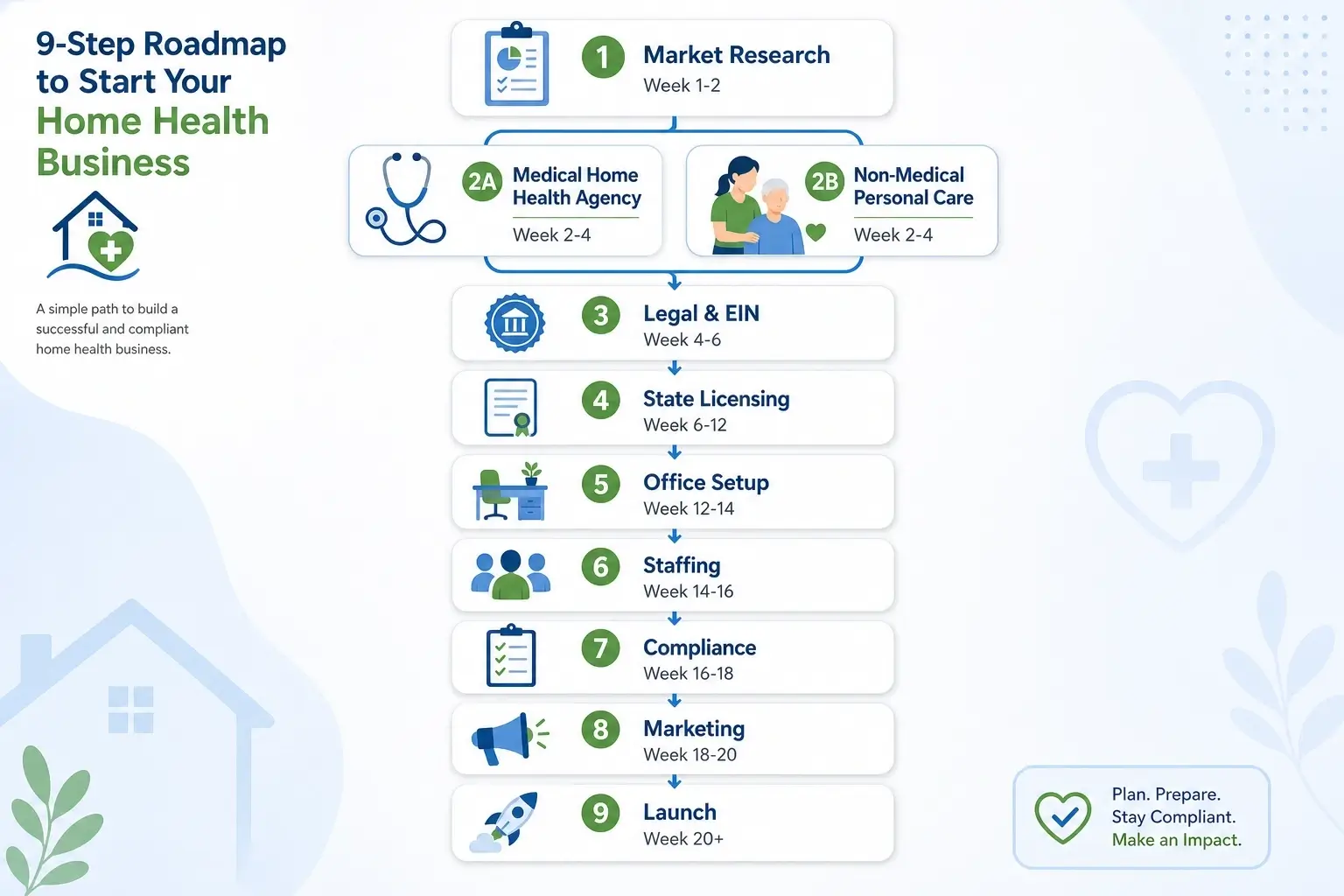
How to start a home health care business, follow these steps:
- Select your agency model: medical (skilled) or non-medical personal care
- Form your business entity (LLC) and obtain an EIN from the IRS
- Research your state’s licensing body and CON requirements
- Draft your policies and procedures manual to state specifications
- Apply for your state home care or home health license
- Obtain required insurance: general liability, professional liability, workers’ comp
- Enroll in Medicare via NPI → PECOS → accreditation (skilled agencies only)
- Hire and credential your clinical or caregiving staff
- Set up scheduling, billing, and EMR software before accepting patients
Step 1: Nail Down Your Entity Structure
Form an LLC in most cases. It separates your personal liability from the business, offers pass-through taxation, and can be registered in every state without complexity. A PLLC (Professional LLC) may be required if a licensed clinician is the sole owner, requirements vary by state. Check with a healthcare attorney before filing.
Obtain your Employer Identification Number (EIN) from the IRS at IRS.gov immediately after formation. You’ll need it for every step that follows: bank accounts, state licensing, payroll setup, and Medicare enrollment.
Step 2: Build a Real Business Plan (Not a Template)
Generic business plan templates miss the most critical inputs for a home health agency: your state’s payer mix, the local competitive landscape, and a cash-flow projection that accounts for the Medicare certification lag. A solid plan isn’t bureaucracy, it’s what keeps you solvent in month seven when you’re certified but still waiting on your first CMS reimbursement.
Your plan should include a clear service scope, target geography, staffing model, financial projections for 24 months, and a referral source strategy. This document will also be reviewed by lenders, investors, and in some states, accreditation bodies.
Step 3: Research Licensing and CON Laws for Your State
Licensing is the longest pole in the tent.
Or maybe I should say it this way: licensing isn’t a task you schedule, it’s a timeline you build everything else around.
Some states process home health licenses in 60 days. Others take six months. And in Certificate of Need (CON) states, which we’ll cover in detail below, you may need regulatory market approval before you can even submit a license application. In those states, the CON process itself can take 120 days to over a year, depending on whether competitors file objections.
Step 4: Write Your Policies and Procedures Manual
Every state requires this document as part of the license application. Don’t pull a generic template off the internet and submit it as-is. Illinois, Michigan, Wisconsin, and Virginia all have specifically defined sections required in the P&P manual. Agencies that submit incomplete or mismatched P&P documentation are among the most common first-submission rejections across every state licensing office.
The manual defines how your agency operates, how complaints are handled, how care plans are developed, and how staff are supervised. For Medicare-certified agencies, it must also align with the CMS Conditions of Participation.
Step 5: Apply for Your State License
Submit your application to the appropriate state Department of Health (or equivalent body). Include: completed application forms, P&P manual, proof of insurance, owner background check clearances, facility information, and any required fees.
Quick note: submit everything the first time. Incomplete applications don’t just get rejected, they reset your timeline. In high-volume state offices, a resubmission can add 60–90 days.
Step 6: Secure Your Insurance Package
You need at minimum: general liability insurance, professional liability (malpractice) insurance, and workers’ compensation once you hire staff. Many hospital discharge planners and referral partners won’t send patients to an agency that can’t produce a certificate of insurance immediately.
Budget $2,000–$8,000 annually depending on your agency type, patient census, and state. Cyber liability coverage is increasingly required by managed care organizations, particularly for agencies using electronic health records.
Step 7: Medicare Enrollment (Skilled Agencies Only)
This is the step no one explains clearly enough.
Look, if you’re launching a skilled agency and planning to bill Medicare, here’s what actually happens: First, obtain your National Provider Identifier (NPI) through the NPPES system at nppes.cms.hhs.gov. Then enroll through PECOS (Provider Enrollment, Chain, and Ownership System). Then pursue accreditation, CHAP (Community Health Accreditation Partner) is the most widely used accreditor for new agencies because it provides Medicare “deemed status,” allowing you to bypass a direct state survey in most circumstances. The Joint Commission and ACHC are the main alternatives.
The current Medicare PDGM base rate for a 30-day payment period is $2,038.13, with an update expected in January 2026, according to CMS. That’s your revenue reference point per patient period.
Most people assume Medicare enrollment is a 30-day process. The combined NPI registration, PECOS enrollment, accreditation survey, and CMS approval typically takes a minimum of 6 months, and in high-volume states like Texas or Illinois, closer to 12.
Step 8: Hire Your Team
For skilled medical agencies, most states require a named clinical director (typically an RN) on the license application itself, meaning you can’t hire after approval. You need that person in place before you submit.
For non-medical agencies, caregiver requirements vary significantly by state. Some require completion of a state-approved HHA training program (75 hours is a common minimum) even for personal care workers. Background checks are mandatory in all 50 states for anyone entering patient homes.
Step 9: Set Up Your Software
You can’t run a home health agency on spreadsheets and text messages. WellSky (formerly ClearCare) is the most widely adopted scheduling and billing platform for personal care and non-medical agencies, strong on caregiver matching, family communication portals, and Medicaid billing. For Medicare-certified skilled agencies, MatrixCare is built specifically around home health CoPs documentation, OASIS assessments, and PDGM billing workflows.
Expect to budget $200–$600/month for scheduling software and $400–$1,000/month for a full clinical EMR with billing capabilities at a small agency.
Home Health Agency Startup Costs: What You’ll Actually Spend
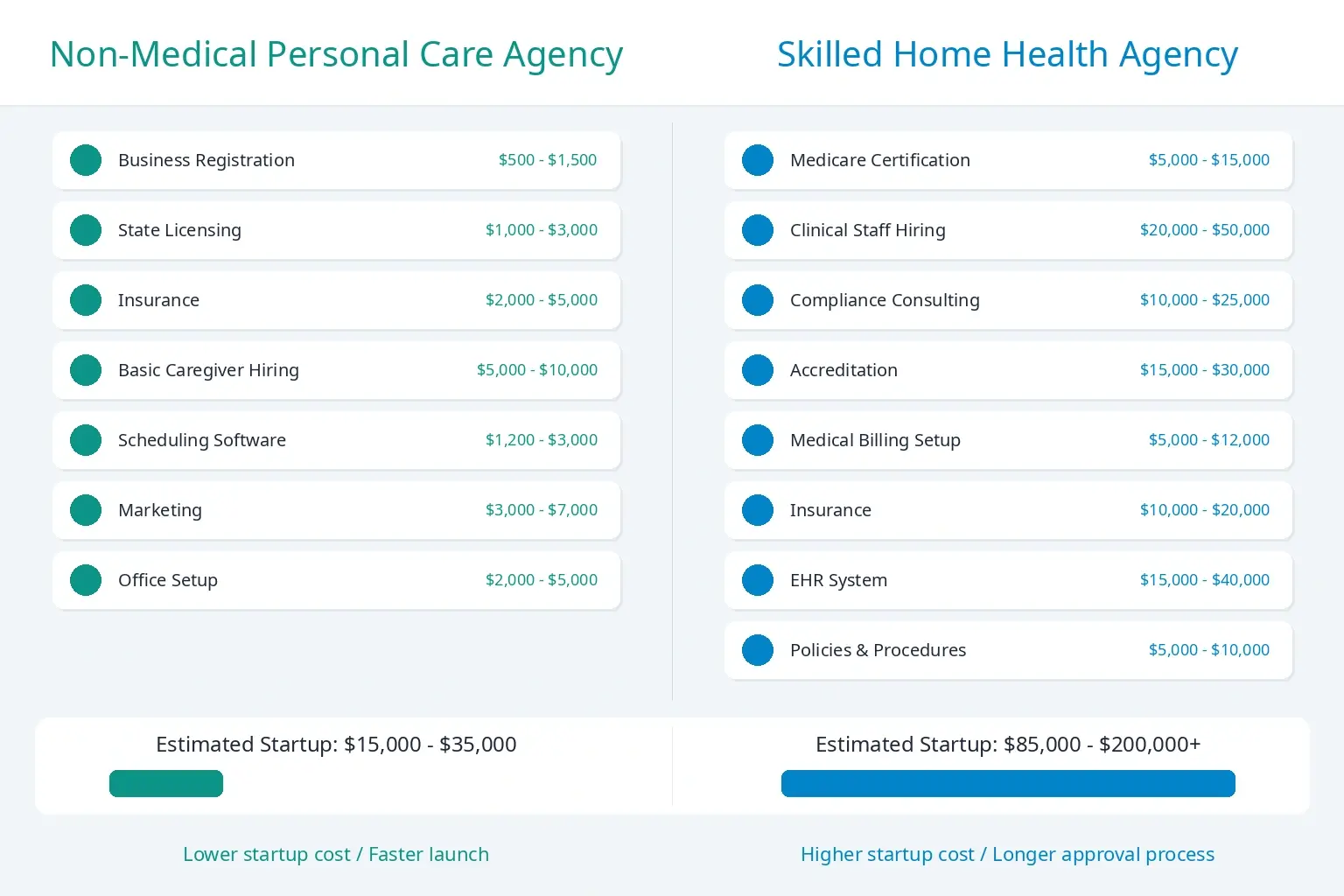
I’ve seen conflicting data on startup costs, some sources say $40,000 is realistic, others insist you need $250,000 minimum. My read is that both figures are accurate depending on which model you’re launching and which state you’re in. Here’s the honest breakdown:
| Cost Category | Non-Medical Agency | Skilled Medical Agency |
|---|---|---|
| State licensing fees | $200–$2,500 | $500–$5,000+ |
| Legal/business formation | $500–$2,000 | $2,000–$8,000 |
| Insurance (annual) | $1,500–$4,000 | $2,500–$8,000 |
| Software/EMR (annual) | $2,400–$7,200 | $4,800–$12,000 |
| Staff wages (first 90 days) | $15,000–$30,000 | $30,000–$90,000 |
| Office setup | $0–$10,000 | $5,000–$20,000 |
| Marketing (first 6 months) | $2,000–$8,000 | $3,000–$12,000 |
| CON application (if applicable) | $0–$5,000 | $0–$15,000+ |
| Total Estimated Range | $40,000–$80,000 | $150,000–$350,000 |
The biggest wildcard isn’t staffing or software, it’s whether your state requires a CON and whether a competitor files a formal objection to your application. That scenario alone can add $15,000+ in legal fees and 6–12 months to your timeline before you’ve treated a single patient.
Note: This guide does not cover SBA loan applications or home health agency financing. Consult a financial advisor and review SBA.gov’s healthcare lending programs for funding options.
State-by-State Licensing Requirements: IL, TX, MI, VA, WI, MO, LA, AL
What most competitor articles miss completely is the fact that each state has a different licensing body, different processing timeline, different fee range, and, critically, different rules about whether CON laws apply to home health agencies specifically.
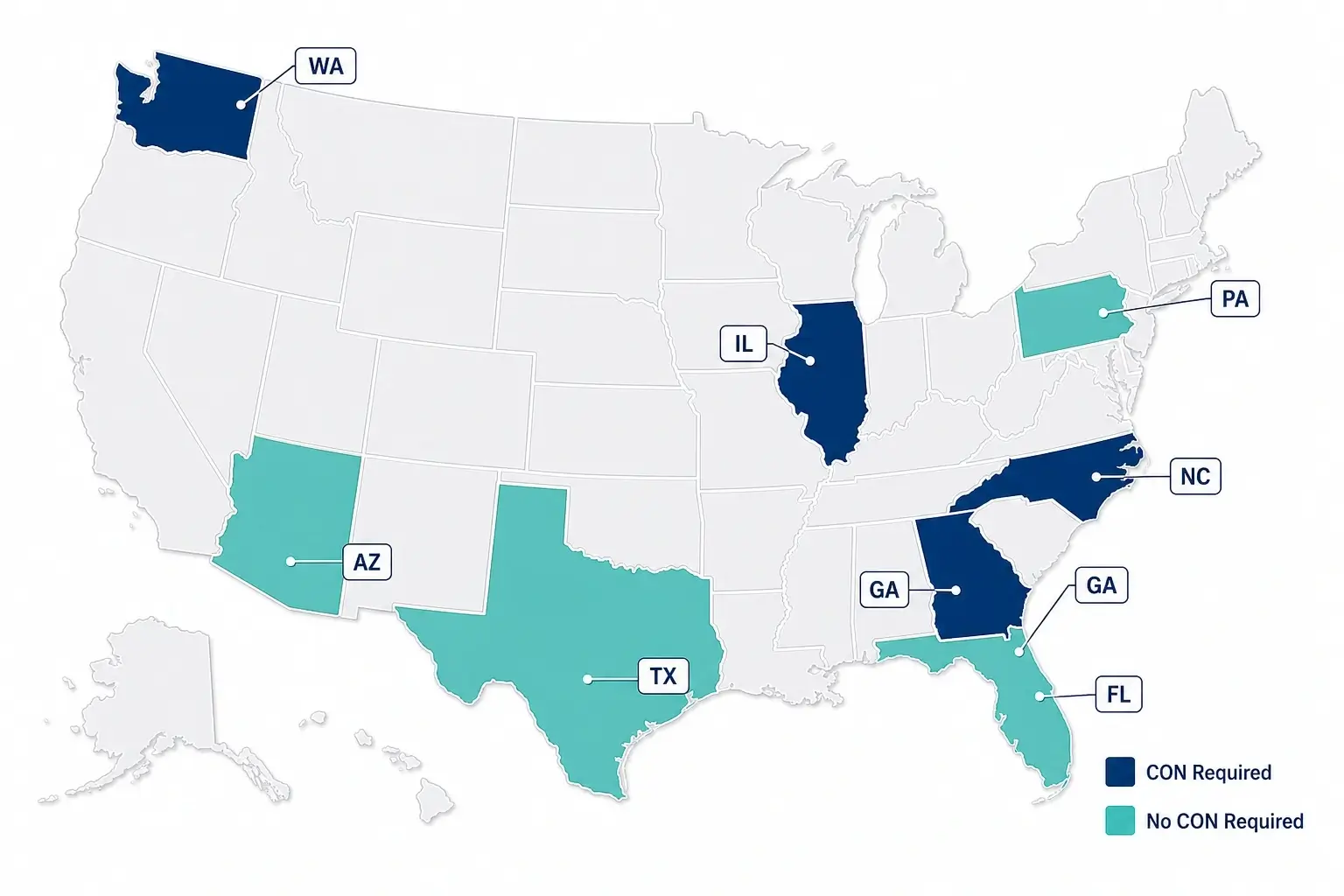
| State | Licensing Body | CON Required for Home Health? | Est. License Fee | Est. Timeline |
|---|---|---|---|---|
| Texas | HHSC | No | $750–$2,500 | 60–120 days |
| Illinois | IDPH | Yes | $500–$1,500 | 90–210 days |
| Michigan | LARA | Yes | $500–$1,000 | 90–150 days |
| Virginia | VDH | No | $400–$1,500 | 90–150 days |
| Wisconsin | DHS | No (limited exemptions apply) | $300–$1,000 | 60–120 days |
| Missouri | DHSS | No | $500–$2,000 | 90–150 days |
| Louisiana | LDH | Yes | $1,000–$3,000 | 120–365+ days |
| Alabama | ADPH | Yes | $500–$2,500 | 120–365+ days |
Fee and timeline estimates are based on publicly available state DOH data as of early 2025. Verify current requirements directly with each state’s licensing agency before applying, as these change.
CON states deserve a separate conversation. Alabama, Illinois, Louisiana, and Michigan all operate CON programs that apply to home health agencies. In these states, you must demonstrate an unmet community need in your service area before the state will approve your license application. The CON review involves a public comment period, potential hearings, and the possibility that existing agencies in your area file formal objections. Budget additional time and attorney fees if you’re entering a CON state, especially in Louisiana and Alabama, where the process is among the most contested in the country.
Texas, by contrast, has no CON requirement for home health, processes applications faster, and charges lower fees. It’s one of the most accessible states for new agency formation, which is reflected in the high search volume for “how to open home health agency in Texas.”
How to Get Clients for Your Home Health Agency
No referrals, no agency. This step gets treated as an afterthought in most startup guides.
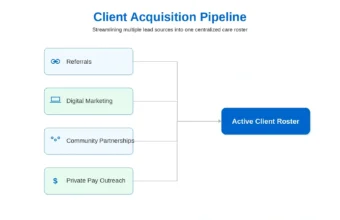
For skilled agencies, your highest-value referral sources are hospital discharge planners and case managers at skilled nursing facilities. Build those relationships before your license arrives. Show up. Introduce yourself. Drop off your credentials packet. By the time your CMS certification clears, you want to already be on their radar, because their first question when you call will be: “Have we met?”
For non-medical personal care agencies, the referral ecosystem looks different: elder law attorneys, geriatric care managers, senior center directors, assisted living social workers, and primary care physicians with aging patient panels.
Google Business Profile is free, ranks in local map results, and is how a genuinely surprising number of families first find a home care agency when searching “home care near me.” Set it up on day one, don’t wait until you feel fully operational.
What most new agency owners underestimate is how long it takes to get from your first referral to a stable census of 10–15 active clients. Budget for 3–6 months of near-zero revenue even after licensure. The agencies that survive year one are the ones who started building referral relationships while waiting for their license, not after.
Voice Search & Frequently Asked Questions
What’s the best state to start a home health care business in?
Texas, Virginia, and Wisconsin are commonly recommended for new agencies due to lower licensing fees, no CON requirements, and faster processing timelines. CON states like Alabama, Louisiana, and Illinois require more startup capital and legal preparation.
How much does it cost to start a home health care business?
Non-medical personal care agencies typically cost $40,000–$80,000 to launch. Medicare-certified skilled home health agencies run $150,000–$350,000, primarily due to clinical staffing, software, and the revenue gap during the 6–12 month Medicare certification process.
How do I get a home health care license in my state?
Apply through your state’s Department of Health with a completed application, policies and procedures manual, proof of insurance, and owner background checks. In CON states, including Alabama, Illinois, Louisiana, and Michigan, you must obtain Certificate of Need approval first.
Should I start a medical or non-medical home health agency?
Start non-medical if your startup capital is under $100,000 or you don’t have a licensed clinical director in place. Pursue the skilled medical model if you’re an RN with clinical staffing available and want access to Medicare billing and higher per-patient revenue.
When should I hire staff for my home health care business?
For skilled agencies, hire your clinical director before submitting your license application, most states require a named RN on the application itself. For non-medical agencies, hire caregivers only after your license is approved and you have a confirmed first client.


No Comment! Be the first one.