






How to Get Clients for Your Home Health Care Agency Without Depending on One Referral Source
You’ve got trained caregivers. You’ve got your licenses. You might even have a website. But the phone isn’t ringing the way it should, and one quiet week from a hospital discharge...

You’ve got trained caregivers. You’ve got your licenses. You might even have a website. But the phone isn’t ringing the way it should, and one quiet week from a hospital discharge planner you’ve been counting on has turned into a real cash flow problem.
That’s the situation more agency owners face than they’ll admit out loud.
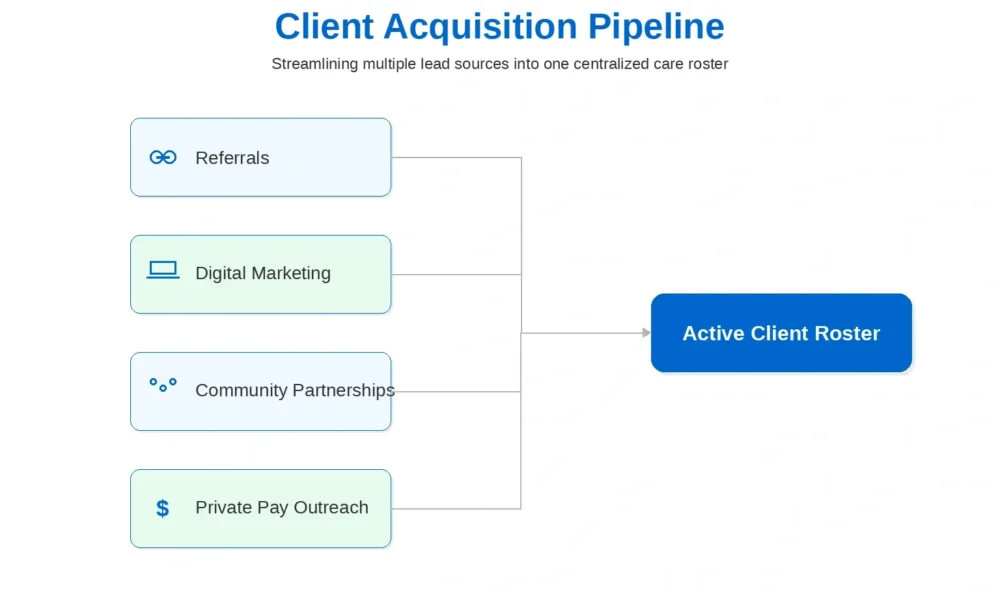
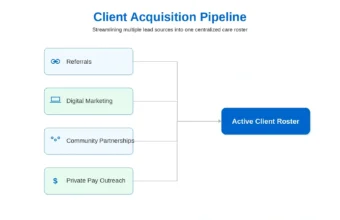
Getting clients for a home health care agency isn’t about doing one thing really well. It’s about building a system, one with enough channels that losing any single source doesn’t put your business at risk. This guide lays out exactly how to do that.
What “Getting Clients” Actually Means for a Home Health Agency
Getting clients for home health care means systematically building referral relationships and marketing channels that produce a consistent flow of qualified prospects, rather than depending on a single discharge planner or word-of-mouth call to keep your schedule full. A stable client pipeline combines professional referrals, digital visibility, and a clearly differentiated agency brand.
That single idea matters more than it sounds. Most agencies collapse their entire client acquisition strategy into one bucket: referrals from one hospital social worker, or one SNF liaison they met at a lunch. When that relationship cools, the agency scrambles.
According to a 2024 U.S. Home Care Market Report from ResearchAndMarkets.com, 31% of all home health referrals in the U.S. originate from hospitals — making hospital discharge planners the most concentrated single channel in the industry. That stat cuts both ways. It tells you exactly where to focus energy. It also tells you that any agency treating hospitals as its only source is one personnel change away from a crisis.
The agencies that grow steadily treat client acquisition the same way a solid investor treats a portfolio: diversified, tracked, and regularly rebalanced.
Home health agencies get clients primarily through three channels: professional referrals from hospital discharge planners and SNF social workers, digital inquiries from families searching locally on Google, and outreach to non-hospital referral sources such as elder law attorneys and geriatric care managers. According to ResearchAndMarkets.com (2024), hospitals alone account for 31% of home health referrals — underscoring why relationship-based outreach remains the backbone of most agency growth strategies, even as digital channels grow in importance.
How to Build a Hospital and SNF Referral System That Doesn’t Stall After Visit One
This is where most agencies get stuck. They show up at the hospital with a brochure, leave it at the nurses’ station, and assume that counts as relationship-building.
It doesn’t.
Hospital discharge planners and SNF social workers are managing impossible caseloads. They don’t remember the brochure. What they remember is the agency rep who showed up consistently, solved a problem for them, and made their job easier, not harder.
Here’s a concrete outreach cadence:
- Visit 1: Introduce yourself, ask about their referral process, and this is the part most people skip: ask what kinds of cases they struggle most to place. Listen. Don’t pitch.
- Visit 2 (10–14 days later): Bring something useful: a one-page overview of your specialty services (Alzheimer’s care, bilingual aides, live-in coverage). Remind them of what you discussed.
- Visit 3 (2–3 weeks after that): Follow up on any case you helped with or any question you left open. Ask if there’s anything pending you can take. Now you’re a resource, not a vendor.
After that? Monthly check-ins. Brief. Consistent. Low pressure.
The agencies that crack this market aren’t necessarily the biggest, they’re the most reliable. Discharge planners refer to agencies they trust to answer the phone at 5pm on a Friday and handle the case without drama.
What most guides skip: the emotional dynamic of the relationship. A discharge planner who refers a client to your agency is staking their own professional reputation on you. They need to trust that you’ll deliver before they’ll take that risk even once.
To build a home health referral system from hospital sources, follow these steps:
- Map your top 10 target facilities within your service radius
- Identify the specific discharge planner or social worker at each facility
- Schedule in-person introductory visits — not phone calls
- Log every contact in a CRM or referral tracking tool
- Return on a consistent schedule: every 10–14 days initially, then monthly
Some experts argue that digital marketing is replacing referral relationships in home care. That’s valid for large franchise systems with national ad budgets. But if you’re running a local agency with 5–30 clients, the discharge planner in your zip code is still your most efficient growth channel — by a wide margin.
The most effective home health discharge planner outreach follows a structured, multi-visit cadence rather than a single brochure drop. Agencies that build reliable referral volume typically complete three in-person visits before asking for a referral — focusing the first visit entirely on understanding the planner’s case challenges. According to industry practitioners, consistency and reliability (answering calls promptly, handling complex placements without escalating problems back to the planner) matter more than any marketing material.
How to Get Private Pay Home Care Clients Through Digital Marketing
Private pay clients are different. Nobody refers them the same way a hospital refers a Medicare case. They find you — or they find your competitor — on Google. That’s the whole game.
Look — if you’ve built a website but you’re getting zero inquiries, here’s what actually works: the problem is almost never the website design. It’s that Google doesn’t know who you are or where you operate.
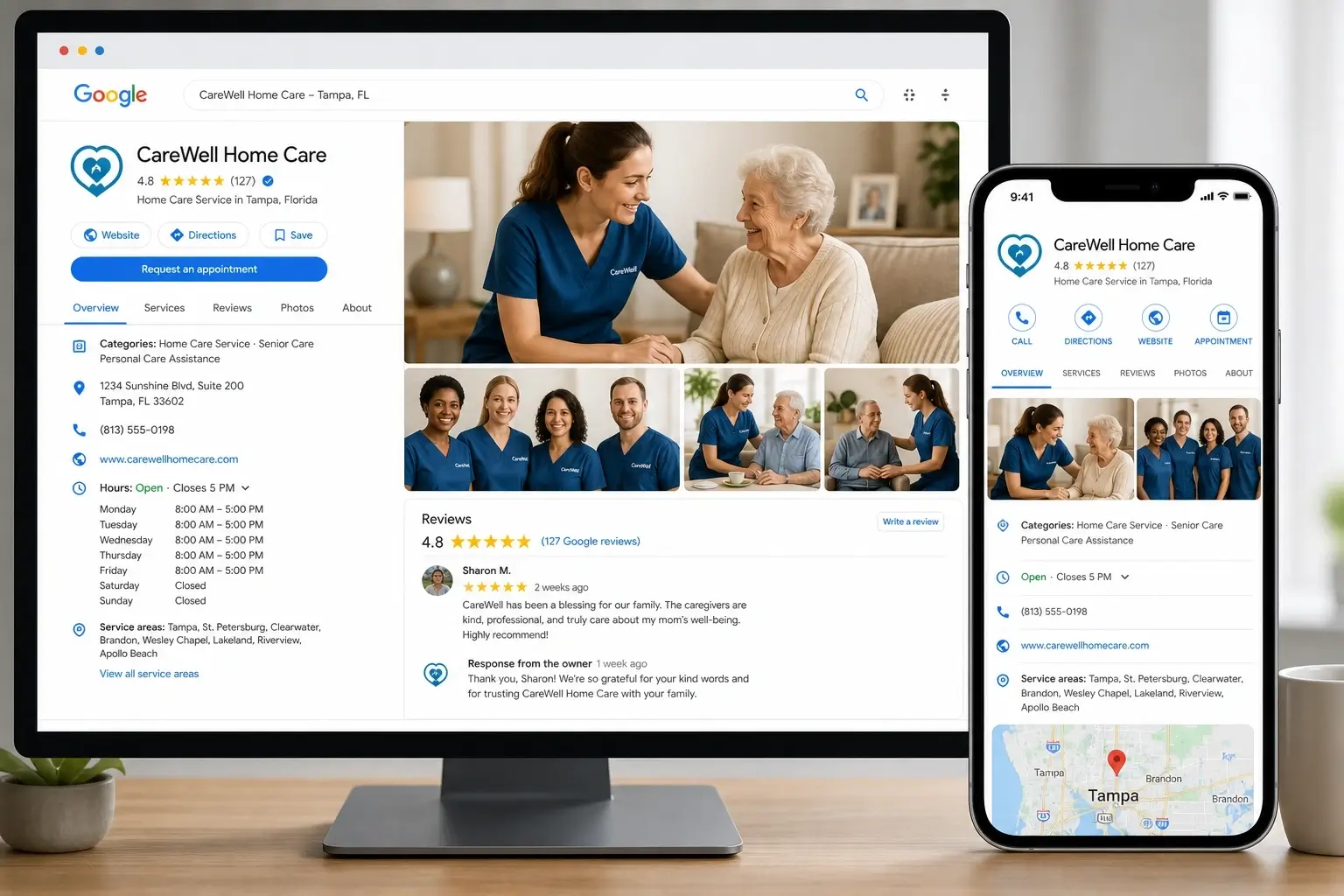
Google Business Profile is the free tool most agencies set up once and never touch again. That’s a significant mistake. Your GBP listing is often the first thing a family member sees when they search “home health care near me” at 11pm after a parent’s discharge call. A profile with four reviews and no recent activity loses to a competitor with 22 reviews and a photo posted last week — even if your actual care is better.
Here’s what matters most for GBP:
- Fill out every field: service areas, hours, services offered, team photos
- Ask satisfied family members (not patients directly — verify your state’s HIPAA guidance) to leave a Google review
- Respond to every review, positive or negative. Families searching for care read responses as closely as they read the ratings themselves
Beyond GBP, your website needs pages targeting city-level keywords: “in-home care in [City Name]” or “Alzheimer’s care aides in [County].” One generic homepage doesn’t rank for hyperlocal searches. It just… exists.
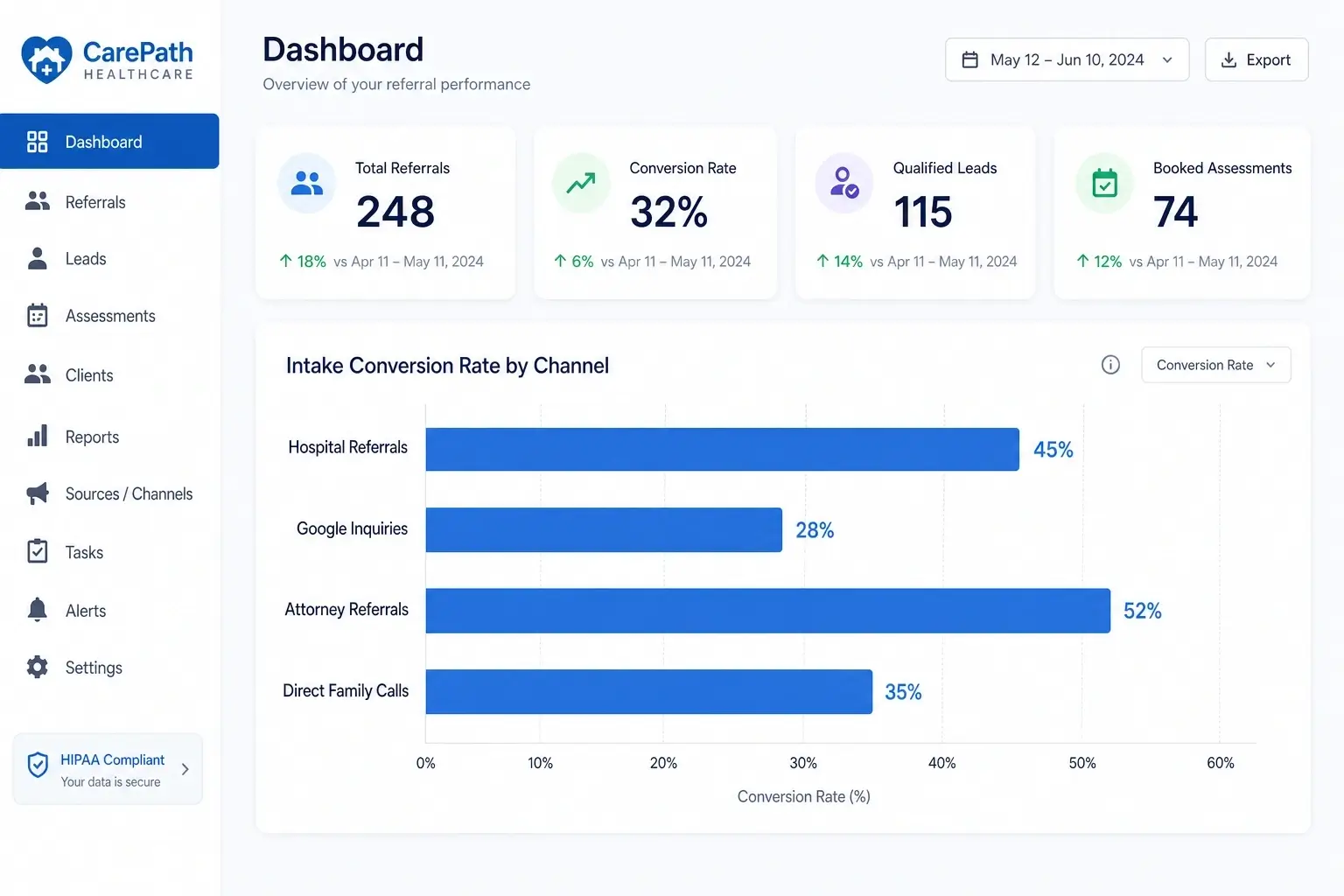
AxisCare includes a marketing module that tracks which referral sources and digital channels are generating clients — not just website visits, but signed intakes. That distinction matters. A lot of agencies are optimizing for the wrong metric.
Quick note: WellSky’s referral management module tracks the full referral journey from first contact to signed contract, which makes it far easier to identify which hospital contacts and digital channels are actually producing ROI. If you’re managing more than 20 active clients using a spreadsheet, you’re almost certainly losing data — and clients — to the gaps.
How to Make Your Home Health Agency Stand Out in a Crowded Market
Or maybe I should say it this way: the real question isn’t “how do I get more referrals” — it’s “why would someone choose me over the five other agencies with the same brochure?”
Most agency owners don’t have a good answer to that. That’s the actual problem.
Differentiation isn’t marketing fluff. It’s operational.
Referral outreach vs. digital marketing for home care client acquisition: Referral outreach (hospital discharge planners, SNF social workers) is better suited for Medicare and Medicaid cases because it generates fast, high-volume placements through trusted professionals. Digital marketing works better when targeting private pay families — they search independently and convert through trust signals like Google reviews and website credibility. The key difference is the decision-maker: clinicians refer; families search.
The agencies that stand out typically do one of three things:
- They specialize. “We specialize in dementia and Alzheimer’s care” is ten times more memorable — and more referable — than “we provide all home care services.” Discharge planners remember specialists. They refer specialists. A bilingual caregiver team serving a specific immigrant community in your city is another form of specialization competitors can’t copy overnight.
- They respond faster. Agencies that respond to inquiries within two hours convert at dramatically higher rates than those that call back the following morning. Speed communicates reliability before a single caregiver walks through a client’s door.
- They collect proof. Family testimonials, Google reviews, response rate data — these aren’t vanity metrics. They’re conversion tools. A family choosing between two agencies that look identical on paper picks the one with 30 real reviews.
Quick Comparison: Home Health Client Acquisition Channels
| Channel | Best For | Key Benefit | Limitation |
|---|---|---|---|
| Hospital discharge planners | Medicare/Medicaid referrals | High volume, fast placement | Relationship-dependent; can dry up suddenly |
| Google / local SEO | Private pay clients | Scalable, 24/7 inquiries | Takes 3–6 months to build traction |
| SNF / rehab facility outreach | Post-acute transitional care | High conversion rate | Competitive; requires consistent visits |
| Community events / senior centers | Long-term brand awareness | Trust-building, low cost | Slow conversion cycle |
| Client and family referrals | High-quality private pay | Highest trust, best retention | Requires actively and consistently asking |
Home health agencies that grow fastest typically combine structured hospital outreach with a strong local digital presence and at least one differentiating specialty. Most agencies that plateau do so because they rely on a single referral source or fail to give prospective clients a clear reason to choose them over competitors. Specialization — in dementia care, pediatric services, or bilingual support, for example — makes an agency significantly more referable among professional referral sources who deal in placement decisions daily.
Lesser-Known Referral Sources Most Agencies Completely Ignore
Hospitals and SNFs get all the attention. These don’t — and they’re worth your time.
Elder law attorneys regularly interact with families navigating care decisions during estate planning or guardianship proceedings. A referral from an elder law attorney arrives at exactly the moment families are making care choices, which means it converts at an unusually high rate.
Geriatric care managers (now often called Aging Life Care Professionals) are paid navigators who help families manage complex elder care. They refer constantly and specifically. They also vet every agency they recommend — which means earning one relationship takes time but produces steady, high-quality referrals.
Veterans Service Organizations — American Legion posts, VFW chapters, and VA-adjacent nonprofits — can channel referrals to veterans who qualify for Aid & Attendance benefits, a payer source most agencies underutilize entirely.
Primary care physicians are chronically overlooked. A patient with a new Parkinson’s diagnosis, a recent fall, or a family in caregiver burnout is a home care referral waiting to happen. Most PCPs don’t have a reliable local agency they trust. Show up. Tell them specifically what you handle. Leave your direct number.
I’ve seen conflicting data on which of these non-hospital sources produces the most volume — some agency operations benchmarks point to elder law attorneys, while others rank geriatric care managers higher. My read is that it depends heavily on your local market composition and your specific service specialty. The honest answer is: test two of these simultaneously and track the results for 90 days before drawing conclusions.
How to Track What’s Working (So You Stop Guessing)
Every channel described in this guide costs time, money, or both. If you’re not tracking which ones are producing signed clients — not leads, not referrals, signed intakes — you’re running blind.
At minimum: ask every new client how they heard about you. Log it. Review it monthly.
At the next level, use a platform built for this. AxisCare’s marketing tracking ties referral sources directly to intake data. WellSky’s referral management module does the same and integrates with clinical workflows for Medicare-certified agencies. Either way, the goal is identical: know your cost per acquisition by channel, then cut what isn’t producing and double down on what is.
The agencies that scale from 20 clients to 80 don’t do more things. They do fewer things, harder, on the channels that are actually working.
Frequently Asked Questions
What’s the best way to get home health care referrals from hospitals?
Build consistent in-person relationships with discharge planners using a structured visit cadence — introduce, follow up, solve problems. Visit monthly. Reliability matters more than brochures or marketing materials.
How do home health agencies get private pay clients?
Primarily through Google search and local SEO. Optimize your Google Business Profile, collect reviews, build city-level service pages on your website, and respond to inquiries within two hours. Speed and reviews convert families who are comparison-shopping.
Should I specialize my home health agency or offer all services?
For most small agencies, specialization accelerates growth. Discharge planners and geriatric care managers remember and refer specialists. Picking one niche — dementia care, bilingual services, post-surgical support — makes you referable in a way generalists rarely are.
How long does it take to build a reliable client pipeline?
Referral relationships typically take 3–6 months of consistent outreach before generating consistent volume. Google SEO operates on a similar timeframe. Plan for a 90-day ramp before evaluating whether a channel is actually working.
When should I use home care software to manage referrals?
Once you’re managing more than 15–20 active clients, a spreadsheet creates real gaps. Tools like AxisCare or WellSky track referral source performance, intake conversion, and scheduling in one place — which is where most growth-stage agencies start losing efficiency without realizing it.


No Comment! Be the first one.