






The Best Business Ideas for 2026: Filtered by What You Actually Have
Business ideas are concepts for generating income through a product, service, or platform that solves a real problem for a defined group of people. A strong business idea isn’t just original,...


Business ideas are concepts for generating income through a product, service, or platform that solves a real problem for a defined group of people. A strong business idea isn’t just original, it’s viable, meaning someone is already paying for the problem it solves.
Record numbers of people are looking for a way out. According to the U.S. Census Bureau (via Finder.com, 2025), a record 5.62 million new business applications were filed in the U.S. in 2025 alone, well above the historical annual average of 3.47 million. That number isn’t just a data point. It means the person in the next cubicle, or the parent at school pickup, is probably thinking about the same thing you are right now.
But most of the lists ranking “best business ideas” are built for traffic, not for people. They throw 50 ideas at you with no way to filter by your skills, your schedule, or your actual bank balance. This guide does something different. Every idea below is organized by what you already have, not what you’d need to acquire first.
What Makes a Business Idea Worth Pursuing in 2026
The best business ideas in 2026 share three characteristics: they solve a problem people are already paying to address, they can be launched with resources the founder already holds, and they have a clear first customer in mind before a single dollar is spent. According to the 2024 Global Entrepreneurship Monitor (GEM) report, entrepreneurial activity is rising globally, 51% of the 79 economies surveyed showed significant increases in early-stage entrepreneurship since 2001. The intent is there. The execution gap is what’s killing most ideas before they launch.
Most people approach this backwards. They find an idea they like, build it out, then go looking for customers. That’s how you end up three months deep into a Shopify store with $800 spent and zero sales. The smarter sequence is: identify who has the problem, confirm they’d pay to solve it, then build. Simple. Almost nobody follows it.
Here’s the thing: “passion” is not a business filter. Plenty of people are deeply passionate about photography and are barely paying rent. The better question is Is someone already paying for this, and can I serve them better or cheaper than what currently exists?
A profitable business idea doesn’t require heavy upfront investment. Service-based businesses, consulting, freelancing, local home services, typically cost under $5,000 to launch and carry profit margins of 15–50%, based on 2025 data from JoinHomebase. Product businesses cost significantly more ($50,000–$150,000 in many cases) and carry thinner margins on average. The right choice depends on one thing: whether your model sells your time or your inventory.
Business Ideas by Investment Level
This is where most guides fail entirely.
They list ideas without telling you what it actually costs to start, not the “you could technically do this for $0” fantasy version, but realistic numbers including tools, time, and your first month of operating costs. The breakdown below fixes that.
Service business vs. product business: A service business is better suited for first-time founders because startup costs run $0–$5,000 and income can begin within days of the first client. A product business works better when you have $10,000+ and at least 6 months before needing revenue. The key difference is whether you’re selling your time or physical inventory.
Quick Comparison: Business Ideas by Investment Level
| Business Type | Best For | Startup Cost | Avg. Profit Margin | Key Limitation |
|---|---|---|---|---|
| Freelance Services | Skill-holders with minimal savings | $0–$500 | 60–80% | Income ceiling tied to hours worked |
| Local Home Services | Hands-on workers, physical skills | $500–$3,000 | 30–50% | Geographic reach is limited |
| Digital Products | Patient creators with writing or design skills | $200–$1,500 | 70–90% | Takes 6–12 months to gain traction |
| E-commerce (Shopify) | Product-focused founders with a budget | $2,000–$10,000 | 10–30% | High competition, inventory risk |
| Coaching / Consulting | Domain experts with existing credibility | $0–$1,000 | 50–75% | Requires a defined niche to scale |
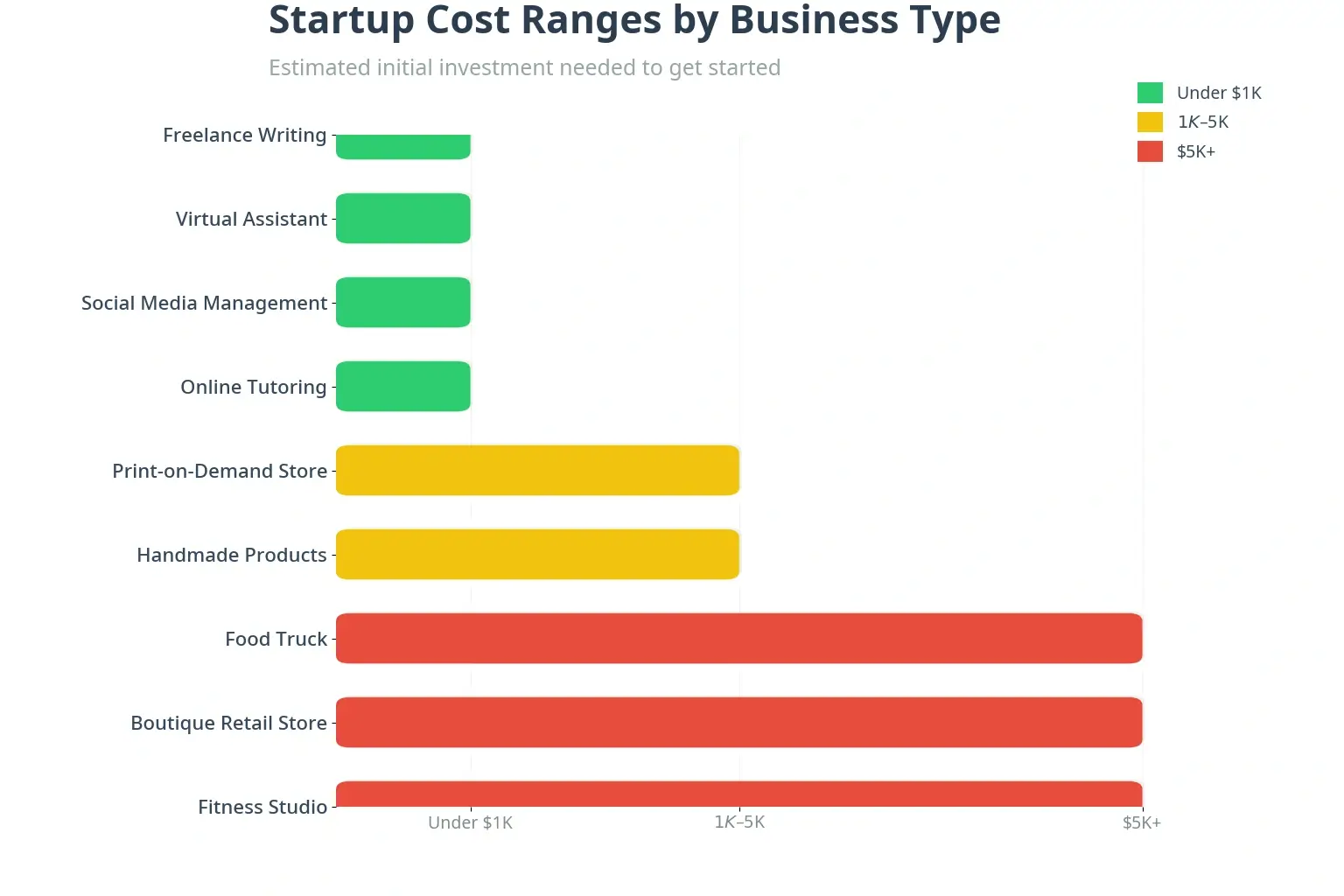
Under $500 to start:
- Freelance writing, editing, or copywriting (create a profile on Upwork within 24 hours)
- Virtual assistant services for small business owners
- Social media content scheduling for local businesses
- Resume and LinkedIn profile writing
- Online tutoring or instruction via Zoom or Preply
- Dog walking and pet sitting (list on Rover, setup cost is effectively zero)
$500–$3,000 to start:
- Mobile car detailing
- Lawn care or pressure washing
- Residential cleaning service
- Handmade product business via Etsy
- Event or real estate photography
- Notary signing agent (certification required, but inexpensive)
$3,000–$10,000 to start:
- Shopify e-commerce store with paid ad budget
- Branded dropshipping operation
- Content creation or copywriting agency with outsourced writers
- Short-term rental arbitrage, running an Airbnb without owning the property
Business Ideas by Skill Level
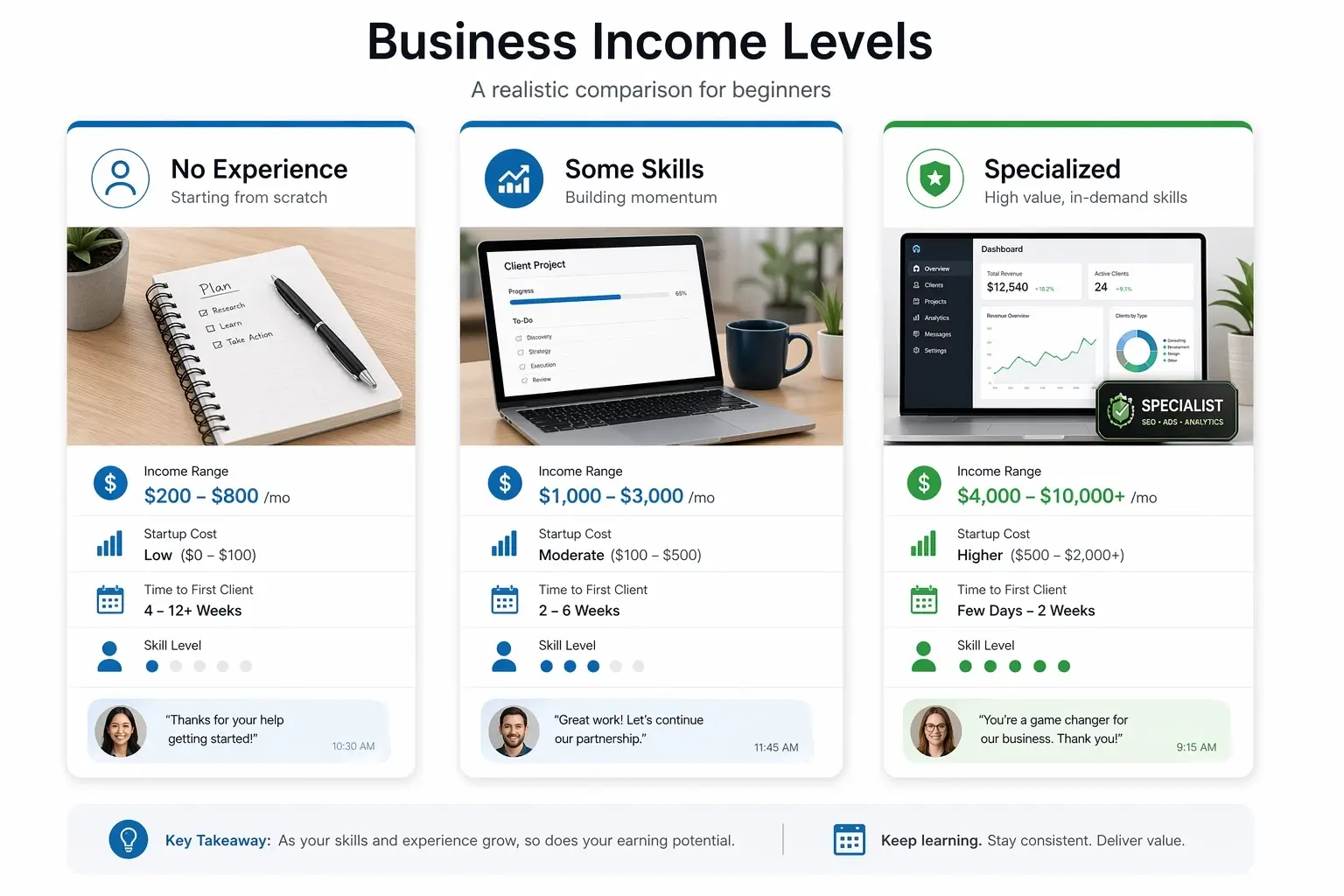
Look — if you’re reading this and you feel like you don’t have a “marketable skill,” I want to push back on that directly. Most adults have at least one skill that can be productized. The question isn’t whether it exists. The question is whether you’ve ever framed it as something worth paying for.
No Experience Required
These ideas require no prior business experience, no technical background, and no existing audience. They run on consistency and showing up.
- Residential and commercial cleaning
- Junk removal and hauling
- Furniture assembly (TaskRabbit has steady demand year-round)
- Personal grocery shopping for seniors or busy households
- Social media content scheduling, not strategy, just execution, for local businesses
The margins here are often better than people expect. A solo operator running a cleaning service 5 days a week can realistically reach $4,000–$6,000/month within 60–90 days using only Google My Business, Nextdoor posts, and referrals. No ad spend required.
Some Digital or People Skills
If you’ve ever managed a team, run a social account, written professionally, or sold anything, you qualify here. You don’t need a portfolio. You need one good case study, which you can get by doing the first job at a discounted rate.
- Freelance copywriting or blog content writing
- Social media management for local service businesses
- Email marketing setup for small business owners
- Career coaching or interview prep
- Podcast editing (tools like Descript reduce production time by roughly 70%)
- Virtual bookkeeping using QuickBooks
Here’s the thing: bookkeeping is consistently under-represented in business idea content, and the demand is enormous. Every registered business legally needs it. QuickBooks ProAdvisor certification is free and takes about three weeks. Charge $400–$1,500 per client per month. Get six clients.
Or maybe I should say it this way, bookkeeping isn’t glamorous, but $72,000 a year working 15 hours a week from home is genuinely possible. That doesn’t get enough attention.
Technical or Specialized Background
If your background is in software, design, data, healthcare, legal, finance, marketing, or engineering, this tier has the highest earning ceiling and, paradoxically, some of the lowest competition at the entry level. Most experts don’t think of themselves as business owners. That’s your opening.
- AI literacy training for non-technical business teams
- UX/UI design or web development consulting
- SEO or paid ads management for small-to-mid-size businesses
- HR compliance consulting for companies under 50 employees
- Fractional CFO services for early-stage startups
- Online course creation in your domain (Teachable, Kajabi, or Maven)
Most specialists undercharge significantly at first. A fractional CFO bills $150–$350/hour. An SEO consultant retainer runs $2,000–$8,000/month for mid-market clients. If you have the background, the problem isn’t the idea. It’s pricing and how you position it.
The Most Profitable Business Ideas in 2026: And How to Actually Evaluate Them
What most guides skip is that “profitable” is meaningless without two clarifiers: profitable for whom and profitable on what timeline. A digital product business carries 70–90% margins but might take 12 months to produce meaningful revenue. A cleaning business runs 30–50% margins but can generate cash in week one.
Most people assume high margin equals high profit. The data says otherwise. High revenue with thin margins, e-commerce, retail, often generates less net income for solo founders than a moderate-revenue, high-margin service operation. That’s the counter-intuitive reality that almost never makes it into these articles.
To evaluate a business idea’s real profit potential, follow these steps:
- Search the idea on Upwork or Google, confirm people are actively paying for it today.
- Estimate your monthly revenue at full capacity (maximum clients or sales you can realistically handle).
- Subtract real costs: tools, taxes, delivery time, and any outsourcing.
- Calculate months to profitability, not revenue, profit.
- Ask: Can I land one paying customer within 14 days, without a website?
If step 5 is a hard no, the idea needs more validation before you invest anything.
Some experts argue that online businesses always outperform local ones in profit potential. That’s valid for founders with existing audiences, technical skills, or a marketing budget. But if you’re starting from zero capital and need revenue within 60 days, a local service business will outperform an e-commerce store almost every time. Service businesses also have meaningfully higher first-year survival rates, largely because cash flow turns positive faster and there’s no inventory sitting in a garage.
10 Specific High-Profit Business Ideas for 2026
- AI literacy workshops for non-technical business teams, Companies are deploying AI tools without training their staff. A single workshop runs $500–$2,500. Almost zero overhead.
- Virtual bookkeeping, $400–$1,500/month per client via QuickBooks. Fully remote, recurring monthly income.
- SEO consulting for local businesses, Most local businesses have no SEO strategy whatsoever. Entry retainer: $1,000–$3,000/month.
- Niche paid newsletter, Substack reported 139% year-on-year growth in monthly active app users in 2025. At $15/month per subscriber, 500 readers equals $7,500/month.
- Online course creation services, Build courses for experts who lack the technical execution skill. Project rate: $3,000–$10,000.
- Senior move management, Underserved, emotionally valuable, and recession-resistant. Average service fee: $1,500–$4,000 per move.
- Mobile pet grooming, 66% of U.S. households own a pet (Forbes Advisor, 2024), and this segment is projected to grow at 6.7% annually through 2030.
- Fractional HR or compliance consulting, High legal exposure for businesses equals high willingness to pay for the right advisor.
- Home energy audit services, IRS energy efficiency credits are actively driving homeowner demand. Strong partnership potential with HVAC contractors.
- Short-form video editing, The creator economy is projected to reach $480 billion by 2027 (IAB). Editors specializing in a single platform, TikTok or Instagram Reels, command premium rates.
The Real Barrier Nobody Mentions: And Why Most People Never Start
Most business idea articles give you the list and stop there.
This section exists because the list is not actually why people don’t start.
Fear is. Specifically, the fear of being wrong about the idea, losing money, or being publicly judged for trying and failing. You’ve done the research, you’ve read the lists, and you still haven’t sent a single email or made a single call. That’s not a research problem. That’s something else entirely.
I’ve seen conflicting data on this, some sources identify access to capital as the primary barrier to entrepreneurship, while others cite fear of failure and lack of confidence as the dominant blockers. My read is that both are true, but they apply to different people: for individuals with savings, fear of failure dominates. For individuals without savings, funding is the actual wall. Generic advice that treats these as the same problem helps neither group.
Here’s what analysis paralysis actually looks like: four weeks of bookmarking articles, building mental pros-and-cons spreadsheets, watching YouTube videos on business models, and zero outreach. Not one message sent. That’s not research. That’s protection. And the antidote isn’t motivation, which fades. The antidote is one very small, very concrete next action.
From Idea to First Client in 7 Days
This plan covers the ideation-to-validation window only. It does NOT address building business infrastructure, hiring, or scaling past $10,000/month, those are later-stage decisions.
- Day 1: Choose one idea from the lists above, not the “best” one, the one you could explain to a stranger in under 30 seconds.
- Day 2: Identify 10 people on LinkedIn, Nextdoor, or in your network who match the profile of someone who has the problem you solve.
- Day 3: Write one short paragraph: what you offer, who it’s for, and what result they can expect. No website needed.
- Day 4: Send 5 direct messages using that paragraph, not as a pitch, but as a genuine question: “Is this something your business actually struggles with?”
- Day 5: Follow up on anyone who didn’t respond. Reply to everyone who did.
- Day 6: If anyone expressed interest, offer a free or discounted first session in exchange for honest, specific feedback.
- Day 7: Based on real responses, not your assumptions, decide whether to proceed, pivot, or try a different idea.
One rejection on Day 4 doesn’t invalidate your idea. Ten rejections might reshape it. That’s not failure, that’s market research that costs you nothing.
Frequently Asked Questions
What’s the best business to start with no money?
Service businesses need the least capital to launch. Freelance writing, virtual assistance, social media management, and dog walking can all start for under $100. List your services on Upwork or Rover and a first paying client is achievable within days, no website, no brand, no ad spend required.
How do I know if my business idea is actually profitable?
Check whether people are paying for it right now. Search the service on Upwork, Google, or Thumbtack. If competitors are operating and charging real rates, the demand exists. Your job is to identify a specific slice of that market and serve it better than the current options.
Should I start a product business or a service business first?
If you need revenue within 60 days and have limited startup capital, start with services. Product businesses carry higher revenue potential long-term but require more upfront investment and a longer runway to profitability. Start where your risk tolerance is, not where your ambition is.
Why do most small business ideas fail in the first year?
Nearly 25% of businesses don’t survive year one, per U.S. Bureau of Labor Statistics data. The most common causes are no clear target customer, insufficient cash flow, and building before validating. Launching lean, testing before investing, significantly reduces that risk.
When should I leave my job to pursue a business idea full time?
When your business generates at least 75–80% of your current take-home pay for three consecutive months. Starting while employed gives you the time to validate, make mistakes cheaply, and adjust without financial pressure forcing poor decisions.
Final Thoughts
The business landscape in 2026 isn’t harder to enter than it’s ever been, it’s louder. More ideas, more tools, more advice, and more people competing for attention. The signal is buried.
Pick one idea from this list. Test it this week. Adjust based on what the market tells you.
That’s the entire framework.







No Comment! Be the first one.