






Hoodies at Work: Here’s the Industry-by-Industry Breakdown You Actually Need
Whether a hoodie counts as business casual depends on industry, hoodie type, and styling, not any universal rule. According to Monster’s 2025 workplace survey, 43% of U.S. workers now report no...


Whether a hoodie counts as business casual depends on industry, hoodie type, and styling, not any universal rule. According to Monster’s 2025 workplace survey, 43% of U.S. workers now report no dress code at all, meaning most hoodie decisions rest on unwritten cultural norms rather than formal policy. The answer varies significantly by workplace context.
Are hoodies business casual? A hoodie is not automatically business casual in any environment. In tech, creative, and most hybrid workplaces, a well-chosen hoodie, particularly a zip-up in a solid neutral color, can qualify as smart casual when paired with structured pieces. In traditional corporate, legal, or finance settings, it generally does not qualify regardless of styling. Industry, hoodie type, and pairing are the three deciding factors.
For hybrid workers, the hoodie question also requires two separate assessments: one for in-person days and one for video call appearances. A clean, structured zip-up in a solid neutral color can read as professional at camera distance, while the same garment may appear more casual in an in-person meeting alongside colleagues in more structured attire.
Most people searching this question already sense it’s not a simple yes or no. The frustrating part is that most articles treat it like one anyway.
What Your Industry Actually Allows
Industry context determines hoodie appropriateness more than any other factor. Tech, creative, and hybrid-first environments allow hoodies regularly; traditional corporate, legal, and finance settings generally do not. According to Monster’s 2025 research, 63% of workers with any dress code describe it as business casual — a category flexible enough that the answer varies meaningfully by organization, not just by sector.
Tech and Startups
Hoodies are effectively standard issue in many tech environments. That’s not permission to look careless — a faded, oversized pullover in pilling fleece still reads as underdressed even in the most casual startup. The expectation is intentional casual, not casual by default.
The useful benchmark: if your office has an open floor plan, shared workspaces, and colleagues who wear sneakers without comment, a clean zip-up hoodie over a collared shirt is almost certainly appropriate for a regular workday. Nobody’s writing a memo about it.
Creative Agencies and Media
Creative environments are genuinely informal. But visual industries also pay close attention to how people present themselves — because presentation is the product. A hoodie works here, but the styling needs to read as a deliberate choice, not an afterthought. Pairing a well-fitted neutral hoodie with tailored chinos or straight-leg trousers creates a different impression than the same hoodie with joggers and athletic trainers.
Or maybe I should say it this way: in a creative office, you’re not aiming for “polished” in the corporate sense — you’re trying to look like someone who made a choice this morning, not someone who grabbed whatever was closest to the door.
Hybrid and Remote-First Companies
This is more complicated than most guides acknowledge. Professionals in hybrid environments navigate two genuinely different dress contexts — in-office days and remote days — and those contexts don’t always call for the same answer.
A hoodie that looks fine on camera from the shoulders up may feel conspicuously casual in a conference room next to colleagues in button-downs. The practical answer: default to a slightly more structured look on in-office days, and allow yourself more latitude when you’re fully remote. Treat them as two separate wardrobe decisions.
Traditional Corporate, Finance, and Legal
Hoodies don’t work here. The issue isn’t fabric or fit — it’s signal. In these industries, clothing communicates professional seriousness, and a hoodie, however premium, doesn’t deliver that signal. Even on dress-down Fridays, most professionals in these environments land at chinos and a polo at their most casual.
Some style consultants argue that a structured hoodie under a well-tailored blazer can bridge this gap in certain progressive offices. That’s valid in specific cases. But if you’re not certain your environment is that progressive, assume it isn’t.
Healthcare, Education, and Service-Adjacent Roles
These vary significantly by position and organizational culture. A teacher in a relaxed school has more latitude than a hospital administrator in a patient-facing environment. A retail buyer at a fashion brand operates under entirely different expectations than one at a grocery chain. When in doubt, identify someone one level above you in the org and dress to their standard — not your peers’.
Not All Hoodies Read the Same Way
Here’s the thing: “hoodie” covers an enormous range of garments, and that range changes the answer in ways most people underestimate.
Zip-up vs. pullover hoodie for work: A zip-up creates a more structured silhouette, layers cleanly over a collar, and reads closer to a lightweight jacket than streetwear. A pullover — particularly in heavier cotton or standard fleece — reads more casual by default. For most office contexts, a zip-up in a solid neutral color is the right starting point for making this work.
Quick Comparison: Hoodie Options for Work Environments
| Option | Best For | Key Benefit | Limitation |
|---|---|---|---|
| Zip-up hoodie | Tech, creative, hybrid offices | Layers over a collar; reads structured | Still informal in most corporate settings |
| Pullover hoodie | Remote work, casual team days | Comfortable and minimal | Harder to layer; leans toward streetwear |
| Quarter-zip fleece | Cross-industry versatility | Reads like elevated knitwear | Technically not a hoodie, which may be the goal |
| Hoodie + blazer | Creative agencies, casual-forward offices | Adds deliberate structure | Can look forced if pieces mismatch in weight |
Fabric makes the biggest individual difference. The Lululemon ABC Hoodie and the Patagonia Better Sweater Fleece appear consistently in workplace style discussions — not because of brand prestige, but because they sit in the narrower category of hoodies that read more like elevated knitwear than sweatshirts. The Uniqlo Supima Cotton Zip-Up applies the same principle at a lower price point: smooth, structured, and visually clean at camera distance.
Users in workplace style communities consistently point to these three as the go-to options for office-adjacent contexts — not the most expensive hoodies available, but the ones that don’t immediately read as gym wear.
How to Style a Hoodie Professionally
The collar trick is the most underused tool in this category. A hoodie worn over a button-down or Oxford shirt creates visible collar framing that immediately elevates the outfit. The layering signals dressed, not just covered.
To wear a hoodie in a business casual office, follow these steps:
- Choose a zip-up or structured pullover in a solid neutral: navy, grey, black, or olive.
- Wear it over a clean collared shirt; the visible collar creates deliberate structure.
- Pair with tailored trousers, chinos, or dark undistressed straight-leg jeans.
- Choose leather or leather-look shoes, or clean minimal sneakers, not athletic trainers.
- Keep every other piece simple: no graphic tees, large logos, or competing casual items.
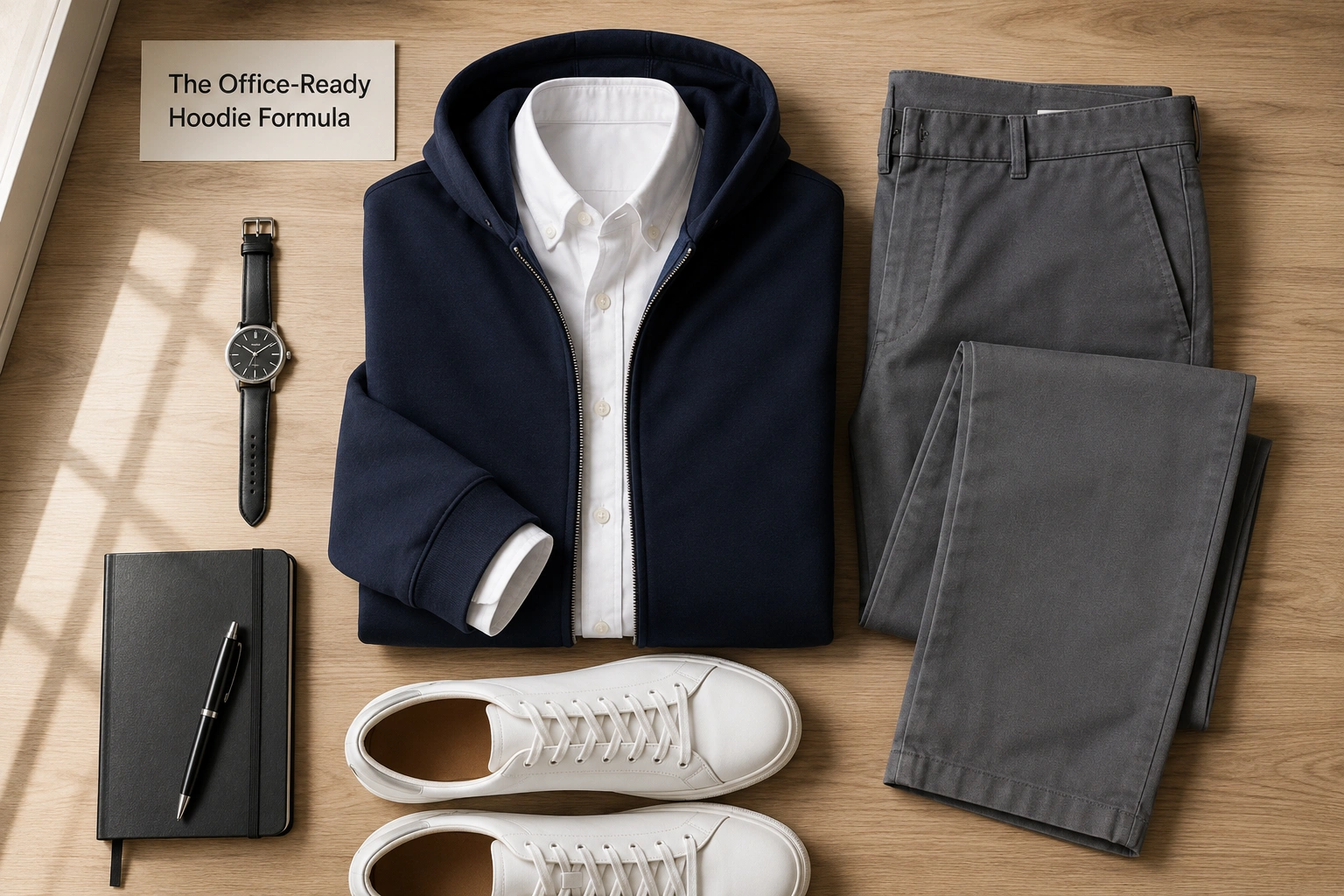
Avoid graphic prints and large visible branding on any piece — not just the hoodie. One casual signal compounds another. A small chest logo like a Patagonia wave or a Lululemon triangle is generally fine. A large university block-letter pullover is not.
What most guides skip is this: it’s not only about how the hoodie looks in isolation — it’s about whether every other element in the outfit is pulling equal or greater weight. A perfect hoodie next to scuffed trainers and baggy jeans still reads as casual. The hoodie is one piece of a complete read.
Reading Your Office Culture and the Zoom Distinction Nobody Mentions
How to Actually Read the Unwritten Dress Code
This is what almost no style guide addresses, and it’s more useful than any general rule about industries.
- The observation test. What does your manager — or someone two levels above you — wear on a regular Wednesday? That’s your actual ceiling, regardless of what the employee handbook says.
- The meeting calibration. Notice the gap between what people wear when senior leadership is in the building and what they wear on a normal team day. A large gap says the environment is dress-code-sensitive. A small gap says it’s genuinely relaxed.
- The new-hire baseline. New employees tend to slightly overdress; experienced colleagues tend to slightly underdress. The average of those two is the actual norm. Watch the middle, not the outliers.
If you’re still not sure whether it’s right for your office and you can’t tell whether it wouldn’t register to anyone you respect — that uncertainty is often its own answer. In environments where hoodies are genuinely fine, nobody thinks twice.
The Zoom and Hybrid Consideration
Look — if you’re working in a hybrid role where some days are remote and some aren’t, you’re navigating two genuinely different social contexts. It makes sense to dress for each separately.
On camera, from the shoulder up is what counts. A clean, solid-color zip-up photographs well — often better than a wrinkled dress shirt or a visually busy blazer. The Uniqlo Supima Cotton Zip-Up in navy or grey reads as a structured “top” at camera distance rather than loungewear.
In person, your whole outfit is visible. The hoodie that looked composed on a Teams call can feel underdressed standing next to colleagues in structured clothing.
Simple rule: dress slightly above your remote standard on in-office days.
Anyway, the honest read: most professionals already have a rough intuition about their office culture. The anxiety isn’t “I don’t know the rules” — it’s “I’m not sure my intuition is right.” The three observations above give you something concrete to check against rather than just hoping your gut is calibrated correctly.
I’ve seen conflicting takes from workplace style writers on exactly where the line sits. Some argue a well-chosen hoodie works in almost any environment if the rest of the outfit is strong enough. Others say a hoodie is too casual for any client-facing professional context, full stop. My read: both camps are partially right — for internal, team-focused workdays in roles with established reputations, a polished hoodie can work across a wider range of offices than most articles suggest; for client-facing or high-visibility moments, the signal a hoodie sends works against you regardless of quality.
Your Hoodie-at-Work Questions, Answered
What’s the best type of hoodie for a business casual office?
A zip-up hoodie in a solid neutral color — navy, grey, or black — worn over a collared shirt. Smooth fabrics like Supima cotton or structured fleece read more professional than standard French terry or pilling fleece.
How do I wear a hoodie to work without looking underdressed?
Layer it over a collared shirt, pair it with tailored trousers or chinos, and choose clean minimal footwear. Every other piece in the outfit should match or exceed the hoodie’s level of formality — no one casual piece covers for another.
Should I wear a hoodie to a job interview?
Almost never — even for tech roles. An interview is a specific social context where first impressions carry disproportionate weight. A clean shirt or light blazer signals effort and preparation. Save the hoodie for after you’ve confirmed the culture from the inside.
Is a zip-up hoodie more business casual than a pullover for work?
Yes. A zip-up creates a more structured silhouette, layers cleanly over a collar, and reads closer to a lightweight jacket than streetwear. For most office environments, it’s the more appropriate starting point between the two.
When should you not wear a hoodie to work?
Client meetings, presentations to senior leadership, job interviews, and any traditional corporate, finance, or legal environment. In those contexts, even a premium hoodie reads as underdressed — the signal it sends is the problem, not the fabric.






No Comment! Be the first one.