





The Real Justin Siegel Net Worth in 2026 and Why Every Site Gets It Wrong
What Is Justin Siegel’s Net Worth in 2026? Justin Siegel’s net worth refers to the estimated total value of his assets built through serial mobile entrepreneurship, an early co-founding...

What Is Justin Siegel’s Net Worth in 2026?
Justin Siegel’s net worth refers to the estimated total value of his assets built through serial mobile entrepreneurship, an early co-founding stake in NRG Esports, and a portfolio of angel investments in early-stage tech companies. As of 2026, credible estimates place his net worth in the $10 million to $30 million range, based on verified funding data, documented company exits, and known investment activity. No independently verified figure exists because Siegel operates entirely in the private sector.
The $10 million figure is the one that appears most consistently across biographical sources. The higher numbers floating around — some sites have casually published $75 million — share one thing in common: not a single source, data point, or methodology behind them.
That’s frustrating if you’re trying to make sense of this. But here’s why the range exists: Siegel’s wealth isn’t tied to one public company or one disclosed transaction. It compounds across a mobile company exit, a founding equity stake in one of the most celebrity-backed esports organizations in North America, and a VC portfolio built over a decade of angel activity. Parsing that kind of multi-source private wealth is inherently imprecise — but you can get much closer than “somewhere between $10M and $75M.”
According to TechCrunch and Crunchbase, Siegel’s company MocoSpace raised a total of $10.5 million in venture funding from General Catalyst and SoftBank Capital, growing to over 14 million registered users by 2010. His co-founding stake in NRG Esports since 2016, combined with his angel investing work through Capital Factory and NextGen Angels, forms the remainder of his financial base. Together, those layers produce an honest estimated floor of $10 million and a ceiling that depends almost entirely on what NRG does next.
Who Is Justin Siegel? A Career Built Before Anyone Was Watching
Before he co-owned an esports organization alongside Shaquille O’Neal and Jennifer Lopez, Justin Siegel was a high school French teacher.
That detail gets buried in almost every biography. It matters.
He made the pivot into mobile technology in the early 2000s, co-founding JSmart Technologies — a mobile gaming company that was eventually acquired by SK Group before the smartphone era had meaningfully arrived. According to VentureBeat, that early exit served as his first significant liquidity event and established his reputation in wireless circles.
He’s never been a media figure, he’s never chased celebrity, and he’s always kept his focus on building — it’s what makes his career arc genuinely difficult to track across a standard Google search.
After the JSmart sale, Siegel joined SkyZone Entertainment as VP of Publishing. He oversaw mobile titles built around Duke Nukem, The Crocodile Hunter, and Encyclopedia Britannica. Not glamorous by 2026 standards, but it gave him a complete view of the mobile publishing pipeline — knowledge he’d apply directly when launching his next company. From there, the moves accelerated.
How MocoSpace Built the Foundation of His Wealth
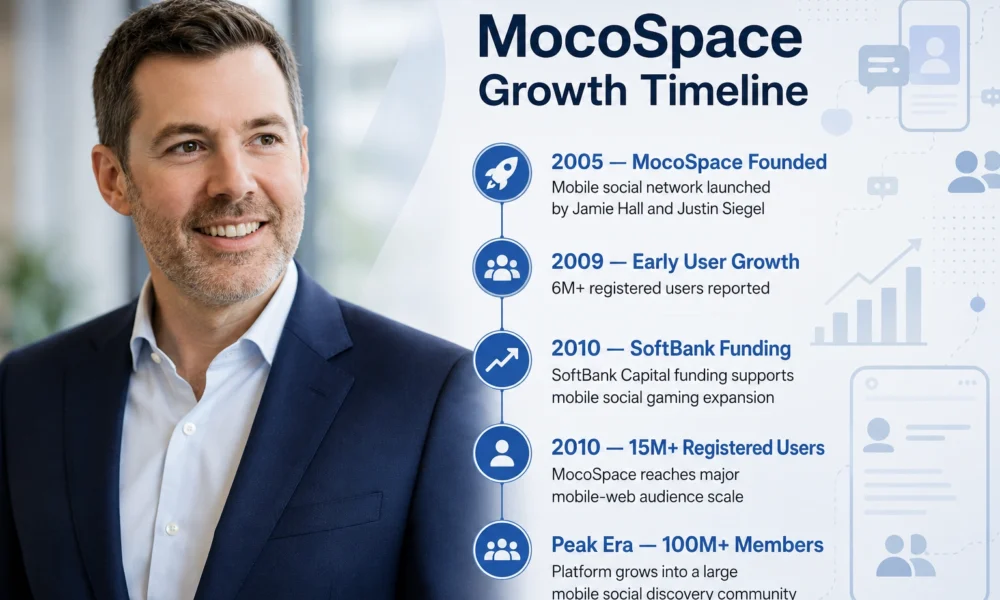
In October 2005 — two years before the iPhone launched — Justin Siegel and his childhood friend Jamie Hall co-founded JNJ Mobile, the parent company of MocoSpace. The timing was either genuinely visionary or wildly premature. Depending on which year you evaluate it from, the answer changes.
MocoSpace was a mobile-native social platform before that phrase had any commercial meaning. Users could chat, play games, share photos, and meet people entirely from a mobile browser — at a time when “mobile web” still meant a flip phone navigating a stripped-down WAP site. The company generated revenue through advertising and virtual currency, targeting the 18-to-34 demographic that advertisers consistently chase.
According to TechCrunch, MocoSpace raised $3.5 million from SoftBank Capital in 2010, bringing the platform’s total venture funding to $10.5 million across three rounds. At that point, MocoSpace was processing over three billion page views per month across 14 million registered users. Crunchbase records the platform eventually reaching 22 million registered users, making it the largest mobile gaming community in North America at its peak.
That’s real scale. For 2010, on mobile, before Android had even reached mass adoption — those numbers were exceptional.
Or maybe I should say it this way: MocoSpace was a foundational win, not a transformational one.
Facebook’s aggressive mobile expansion in 2012–2013 gutted the independent mobile social category. MocoSpace, like most of its peers, lost users and ad revenue to larger platforms with deeper targeting infrastructure. The company pivoted, survived, and continued operating — but a nine-figure acquisition exit never materialized. For Siegel, MocoSpace represents meaningful liquidity and hard-won equity, but it set the stage rather than closed the book.
NRG Esports Co-Ownership: What That Stake Could Actually Be Worth
In February 2016, Siegel became a co-owner of NRG Esports. The organization would go on to attract Shaquille O’Neal, Jennifer Lopez, Sacramento Kings co-owner Andy Miller, and an expanding list of celebrity investors who made it one of the most covered esports organizations in mainstream media.
Here’s the thing: Siegel didn’t join NRG as an investor. He co-founded it.
That distinction is where most coverage goes sideways — and it’s the single most important variable in any net worth calculation. Co-founders typically hold significantly larger equity positions than later-stage investors who buy in at appreciated valuations. The celebrity investors who entered during NRG’s growth years participated in a $15 million funding round in 2017 at prices that reflected the organization’s expanding brand equity. Siegel’s stake was established before NRG had any of that brand value on the books.
NRG has since built competing teams in VALORANT, CS2, Rocket League, and Apex Legends. Tournament prize earnings have surpassed $8.2 million. The organization acquired Counter Logic Gaming and has grown its content creator and lifestyle brand arms substantially. Its most recent valuation data isn’t publicly disclosed — PitchBook’s full cap table sits behind a paywall — but the organization’s operational footprint and celebrity backing place it in a category of esports orgs that command serious institutional interest.
Some experts argue that celebrity-backed esports organizations carry brand premiums that traditional revenue multiples don’t fully capture. That’s valid for orgs with clear exit trajectories. But founding equity only translates to realized wealth through a liquidity event — a sale, a significant secondary transaction, or a public offering. Until that happens, Siegel’s NRG stake is a real and potentially substantial asset that remains illiquid on paper.
The realistic read: this stake is likely worth more than his MocoSpace equity. How much more depends on timing.
The Angel Investing Layer: Capital Factory, NextGen Angels, and Early Bets
Siegel joined Capital Factory as a partner in September 2014. Capital Factory is among the most active seed-stage investors in Texas and serves as a gateway to early-stage dealflow that most angel investors would pay meaningful fees to access. In October 2015, he formalized his approach by co-founding NextGen Angels, a venture capital and private equity firm dedicated to early-stage technology companies.
To estimate a tech founder’s wealth from early-stage investing, follow these steps:
- Identify verified portfolio companies through Crunchbase or public filings.
- Find the funding round the investor entered at and the corresponding valuation.
- Compare entry valuation against current valuation, acquisition price, or IPO price.
- Apply typical dilution (expect 50–70% by Series C or later).
- Cross-reference against any disclosed ownership percentages or fund structures.
This process only works cleanly for public companies or disclosed transactions. Most of Siegel’s portfolio is private.
I’ve seen conflicting data on which companies Siegel holds directly versus through fund vehicles — some sources point to exposure in companies that went public around 2019, including Slack (acquired by Salesforce in 2021 for approximately $27.7 billion) and Pinterest (which IPO’d in 2019 at a valuation exceeding $10 billion). My read is that his VC activity represents meaningful appreciation, but attributing exact dollar amounts without fund-level disclosure would be guesswork dressed up as analysis. What’s clear is that a decade-plus of consistent early-stage dealflow, carried interest, and advisory income through Capital Factory and NextGen Angels adds a layer to his wealth that purely founder-focused estimates miss entirely.
Why the Estimates Range So Wildly and What That Actually Tells You
$10M estimate vs. $75M+ estimate: The $10 million figure serves as a documented floor, grounded in MocoSpace’s verified funding history, JSmart’s early exit, and known VC activity. Higher figures lack sourcing and likely inflate NRG’s stake without disclosing any methodology. For private entrepreneurs, the realistic range is always sensitive to undisclosed equity terms, vesting schedules, and fund carry — none of which are public in Siegel’s case.
Most people assume that celebrity co-investors like Shaq and J-Lo define the valuation story at NRG. The data suggests otherwise. What most coverage skips is that celebrity involvement came years after Siegel’s founding equity was established — meaning his position likely reflects better entry economics than the headlines imply.
Look — if you’re trying to make sense of Justin Siegel’s net worth after reading $10M on one site and $50M+ on another, here’s what actually works: trust the floor (it’s documented), treat the ceiling as a plausible-but-unverified scenario that depends on NRG’s next major transaction, and understand that any article claiming a precise high-end figure without a source is recycling speculation.
According to available public data, credible estimates as of 2026 place Justin Siegel’s net worth between $10 million and $30 million. The lower bound reflects documented exits and operational history. The upper end accounts for NRG founding equity and potential angel portfolio appreciation. No credible source has published a verified figure above $30 million with documented methodology. The true number will only become clear if NRG executes a major liquidity event or Siegel discloses a significant transaction.
Justin Siegel Wealth Sources
| Wealth Source | Verification Status | Confidence Level | Estimated Contribution |
|---|---|---|---|
| JSmart Technologies exit (SK Group) | Verified (VentureBeat) | High | Early-stage exit; low-to-mid 7 figures |
| MocoSpace / JNJ Mobile | Verified ($10.5M raised, 22M users peak) | High | Operational income + equity, foundational |
| NRG Esports co-founding stake (2016) | Verified role, no valuation disclosed | Medium | Material; potentially largest single asset |
| Angel portfolio (Capital Factory era) | Reported; scope unverified | Low–Medium | Meaningful appreciation if Slack/Pinterest exposure confirmed |
| NextGen Angels fund carry | Verified role; no fund disclosures | Low | Ongoing; unquantified |
Note: This is not financial advice. Net worth figures for private individuals are inherently estimates based on publicly available information. This article covers documented professional history only and does not address undisclosed transactions, personal assets, or family wealth.
5 Questions People Actually Ask About Justin Siegel
What is Justin Siegel’s net worth in 2026?
Most credible estimates place his net worth between $10 million and $30 million as of 2026, based on MocoSpace’s funding history, NRG Esports co-founding equity, and angel investment activity. No verified figure above $30 million has been sourced with methodology.
How did Justin Siegel make his money?
Siegel built his wealth across three stages: co-founding JSmart Technologies (sold to SK Group), building MocoSpace which raised $10.5 million and grew to over 22 million registered users, and co-founding NRG Esports in 2016 alongside Shaquille O’Neal and Jennifer Lopez.
Does Justin Siegel own NRG Esports?
Yes, Siegel is a co-founder of NRG Esports, establishing his ownership stake in February 2016. He co-founded the organization with Andy Miller before celebrity investors joined at later, higher valuations.
What is MocoSpace worth?
MocoSpace raised $10.5 million from General Catalyst and SoftBank Capital and grew to over 22 million users at peak. The platform did not complete a disclosed major acquisition. Its current scale is significantly smaller than its 2010–2012 peak following Facebook’s mobile expansion.
Is Justin Siegel still active in business in 2026?
Yes, Siegel remains active in venture capital through Capital Factory (named partner since 2014) and NextGen Angels, the VC firm he co-founded in 2015. He maintains his NRG Esports co-ownership while continuing to advise early-stage technology startups.



No Comment! Be the first one.