




When a Business Starts to Earn Revenue and What Stage You’re Actually At
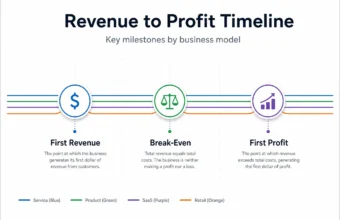
A business starts to earn revenue the moment it completes its first transaction — money changes hands in exchange for a product or service. This is not the same as profitability, which only occurs...

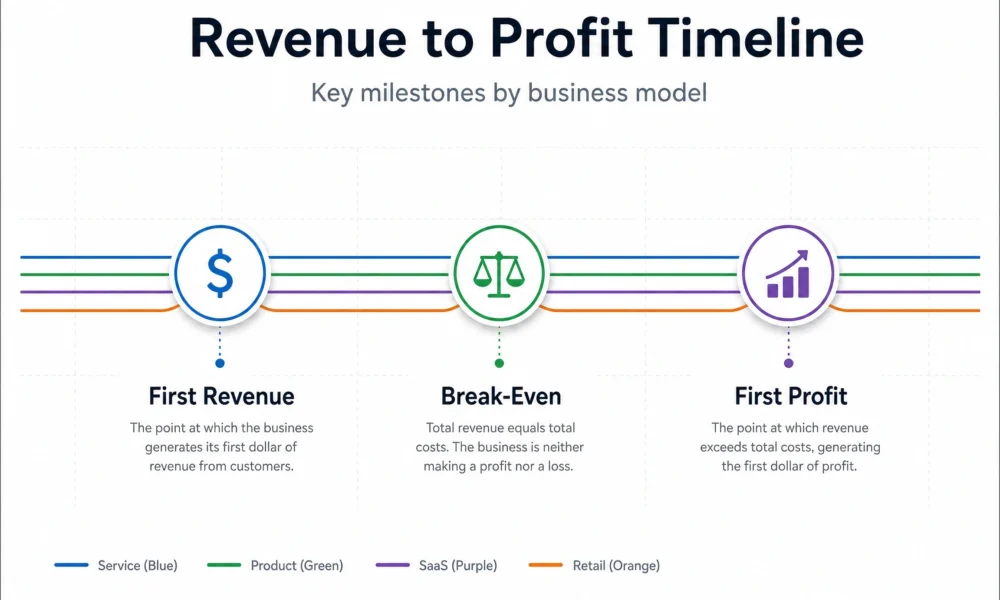
A business starts to earn revenue the moment it completes its first transaction — money changes hands in exchange for a product or service. This is not the same as profitability, which only occurs when revenue consistently exceeds all operating costs. Revenue can begin in week one for some business models. Consistent net profit typically takes two to three years.
That distinction matters more than most founders realize.
Most founders conflate two very different milestones: when a business starts earning revenue and when it turns a profit. According to the U.S. Small Business Administration (2023), only 40% of small businesses are profitable at any given point in time. That means the majority are either breaking even or operating at a loss — while still generating revenue. Revenue-positive and profit-positive are not the same finish line.
Why Your Business Model Determines Everything
Here’s the thing: the single biggest variable in when a business starts earning revenue has nothing to do with your marketing budget, your social media presence, or your hustle level. It’s your model.
A freelance copywriter can invoice their first client in week two. A physical product company is waiting on supplier lead times, customs clearance, and ad spend cycles before a single sale converts. A SaaS founder can’t charge anyone until the product actually works.
These are not comparable timelines — and every article that gives you one universal answer is averaging across categories that shouldn’t be averaged.
| Business Model | Typical First Revenue | Time to Break Even | Time to Consistent Profit |
|---|---|---|---|
| Service / Consulting | Days to 4 weeks | 3–12 months | 12–18 months |
| E-commerce (physical product) | 1–3 months | 12–18 months | 18–30 months |
| SaaS / Software | 6–12 months | 18–30 months | 24–42 months |
| Brick-and-Mortar Retail | 1–6 months | 18–24 months | 24–36 months |
According to FreshBooks (updated 2024), most new businesses take two to three years to reach consistent profitability — but first revenue can arrive much earlier. Service businesses often receive their first payment within the first month. E-commerce stores typically see initial sales within 30–90 days. SaaS products, which require full development cycles before any user-facing version exists, may take six to twelve months before any revenue is even possible.
A Stage-by-Stage Revenue Timeline (Month by Month)
Most articles give you annual snapshots with no context for what’s happening on the ground. Let’s go granular — because that’s how founders actually live it.
Months 1–3: Pre-Revenue or First-Sale Phase
This phase is normal. It’s uncomfortable. Most founders experience it.
During the first quarter, the overwhelming majority of new businesses are generating either zero revenue or small, one-off amounts. A survey of over 1,000 small business owners, cited by Vena Solutions (2026), found that 34% of small businesses earn under $50,000 in annual revenue — and for businesses still in months one through three, that annual figure often starts at zero. The pre-revenue phase isn’t a sign of failure. It’s the cost of building the foundation.
Service businesses break from this pattern fast. A bookkeeper, designer, or consultant can have an invoice paid in week two — but that single payment isn’t a revenue model yet. It’s a first transaction.
Product businesses shouldn’t expect their first sale this early. If you’re in months one through three waiting for a physical product to arrive or a platform to launch, you’re exactly where you should be.
Months 4–12: Revenue Arrives, Cash Flow Is Chaotic
Look, if you’re four to six months in and revenue is finally trickling in but it’s inconsistent, that is the most common experience at this stage. You’ll have a strong month and then a dead one. The offer isn’t fully refined. The customer acquisition channel isn’t repeatable yet.
The U.S. Bureau of Labor Statistics reports that 25% of new businesses don’t survive their first year. The inverse is more useful: 75% do survive, and most of them are in exactly this messy, uneven phase during months four through twelve.
Founders who track revenue from day one — using tools like QuickBooks or Wave (which is free for early-stage businesses) — consistently report that seeing their numbers clearly reduces the emotional spiral. The data doesn’t lie. The mood does.
Quick note: revenue and cash flow are not interchangeable. You can invoice a client for $8,000 on net-45 terms and have zero dollars in your account for six weeks. That’s revenue recorded. That’s not cash on hand. A basic 13-week cash flow projection in Google Sheets closes that blind spot faster than almost any other single habit.
Year 2–3: Revenue Stabilizes, Profitability Becomes Possible
This is where the real work starts to compound.
By year two, most founders who’ve survived the first phase have a clearer acquisition channel, a refined core offer, and at least some repeat customers. Revenue becomes more predictable. The business starts to feel like a business rather than a high-stakes experiment.
A Kabbage (American Express) survey found that 84% of small business owners reach profitability within their first four years. That’s not guaranteed, and the path isn’t linear — month 20 might be profitable, month 22 might not — but the trend line becomes visible. And that visibility changes everything about how decisions get made.
Revenue vs. Profit: The Distinction Every Founder Needs Early
Revenue is total money received from sales before any costs are subtracted. Profit is what remains after every expense — payroll, rent, software, taxes, cost of goods sold — is deducted.
A business can earn $200,000 in annual revenue and still lose $40,000 if its operating costs run $240,000. Revenue-positive means customers are paying you. Profitable means you’re keeping more than you spend. A business can be revenue-positive for two full years before it’s profitable. These are not the same milestone — and treating them as such is one of the most common causes of misplaced founder panic.
Revenue vs. Profit at a Glance
- Revenue is total sales income before deductions.
- Profit is revenue minus all expenses, including COGS, payroll, rent, and taxes.
- Revenue-positive means you have paying customers.
- Profitable means income exceeds every cost.
- The gap between those two milestones typically ranges from six months to three years depending on business model and startup costs.
Some advisors argue that building for profitability from day one produces more sustainable businesses. That’s valid — for lean, solo service businesses with no inventory and no staff. But if your model requires upfront product development, physical inventory, or team hiring, early profitability may be structurally impossible in the first twelve months, and pushing for it prematurely can throttle growth before it has a chance to compound.
I’ve seen conflicting data on the exact percentage of businesses that earn revenue in their first 30 days — some studies suggest 20%, others put the figure closer to 40% for service businesses specifically. My read is that the service-versus-product distinction explains most of that variance, and studies that lump all business models together are producing noise, not signal.
According to the SBA (2023), among all small businesses operating at a given moment, 40% are profitable, 30% are breaking even, and 30% are operating at a loss. What the data does not tell you is how long each of those businesses has been operating. Many in the “loss” category are healthy, early-stage businesses investing in growth. The snapshot is not the full picture.
How to Accelerate Your First Revenue — Without Cutting Corners
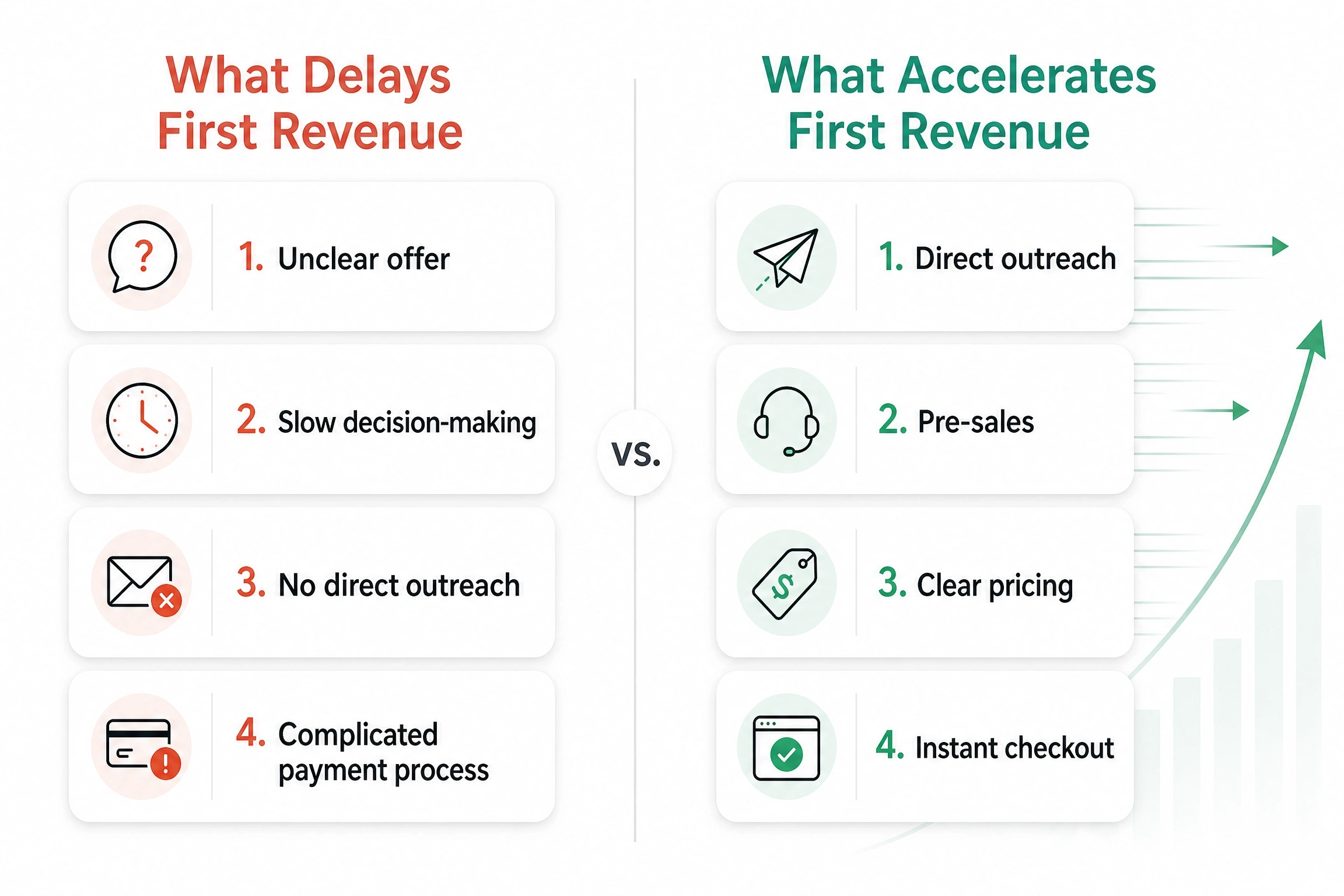
This isn’t a growth-hack section. It’s about removing the specific friction points that delay a first sale.
To reach your first business revenue faster, follow these steps:
- Define your smallest sellable offer — the version of your product or service someone can buy today, not in three months when the branding is perfect.
- Name your first ten potential buyers — specific people who have the problem you solve and the budget to pay for a solution.
- Have a direct conversation before running any ads — early revenue almost always comes from direct outreach, not organic discovery.
- Set up payment infrastructure before you launch — Stripe, Square, or Shopify’s checkout should be live before you take your first call. If collecting payment is friction, the sale won’t close.
- Track every dollar from week one — QuickBooks or Wave means you’ll catch revenue patterns early instead of fourteen months in.
Or maybe I should say it this way: the founders who reach first revenue fastest are the ones who remove all the reasons a willing buyer can’t complete a purchase — not the ones with the best product.
Shopify’s merchant data shows that sellers who run a pre-launch phase — collecting pre-orders or email sign-ups before going live — generate first revenue meaningfully faster than those who launch cold. That’s not a marketing gimmick; that’s demand validation before inventory commitment.
What Actually Happens in Year One (Real Founder Patterns)
Founders who’ve survived their first year tend to describe a recognizable arc: months one through four feel like nothing is working, months five through eight produce inconsistent signals, and somewhere around month nine something clicks — a channel starts converting, a referral comes in, a repeat customer appears.
Users in r/smallbusiness — one of the most candid communities for this type of question — report a wide range in time-to-first-revenue: anywhere from one week for service businesses to eight months for product-based ones. The median for the thread “How long did it take your business to reach its first $1,000?” clusters around three months for mixed-model businesses.
What most founders don’t anticipate is the emotional weight of the pre-revenue phase. It doesn’t feel like building. It feels like waiting. And because most content online celebrates the launch and the exit but skips the first twelve months entirely, there’s no reference point for what normal actually looks like.
Normal looks like inconsistency. Normal looks like slow. Normal is not the same as failing.
Frequently Asked Questions
What’s the fastest a business can start earning revenue?
Service businesses — consulting, freelancing, coaching, design — can earn their first revenue within days of launching. A single paying client means revenue exists. No inventory, no product build required.
How much revenue should a business make in the first year?
According to SBA data cited by Vena Solutions (2026), 34% of small businesses earn under $50,000 annually. For year one specifically, covering basic operating costs or breaking even is a legitimate and realistic benchmark — not a disappointment.
Should I worry if my business has no revenue after three months?
For service businesses, three months with no revenue warrants a strategy review — not panic, but a real look at outreach. For product-based and SaaS businesses, three months with no revenue is entirely within normal range.
Why does it take so long for a business to become profitable?
Because startup costs — equipment, inventory, software, branding, legal setup — must be recovered through cumulative sales before income exceeds expenses. Revenue arrives first. Profit arrives once those upfront investments have been offset.
When should a founder start paying themselves?
Most financial advisors suggest waiting until the business sustains a small, regular owner’s draw without disrupting operations — typically at or after the break-even point, which for most small businesses lands between month six and month eighteen.
The Real Takeaway
The gap between first revenue and first profit is not a sign your business is broken. It is the standard experience of building something real from zero.
Set your tracking up now — even if there’s nothing to track yet. Founders who understand their numbers in month two have a material advantage over those who start looking at them in month fourteen.
Revenue starts the clock. The system you build around that revenue determines whether the clock keeps running.


No Comment! Be the first one.