





What Business Form Gives Written Acknowledgement for Cash Received?
The answer is a receipt — specifically, a cash receipt. If your multiple-choice question lists receipt, invoice, memorandum, and voucher, pick receipt. No second-guessing needed. Knowing the answer...

The answer is a receipt — specifically, a cash receipt.
If your multiple-choice question lists receipt, invoice, memorandum, and voucher, pick receipt. No second-guessing needed.
Knowing the answer is one thing. Understanding why it’s a receipt — and why each of the other options fails — is what actually survives exam pressure. So let’s break it down.
The Direct Answer: It’s a Cash Receipt
A business form giving written acknowledgement for cash received is called a cash receipt. It documents the date, amount paid, payment method, and goods or services exchanged. In accounting, a cash receipt functions as a source document used to verify and record cash transactions in the journal. (48 words)
A receipt confirms one thing: cash changed hands. That’s the job.
When a business collects payment from a customer — whether in physical cash, check, or another method — it issues a receipt. The customer keeps their copy as proof they paid.
According to IRS Publication 583 (revised December 2024), receipt books are explicitly listed among the primary supporting documents businesses must retain to verify gross receipts. That makes the cash receipt not just a textbook vocabulary term — it’s a legally required business record in the United States.
Why the Other Answer Options Are Wrong
This is where most students drop points — not because they don’t know what a receipt is, but because they can’t quickly rule out the alternatives under pressure.
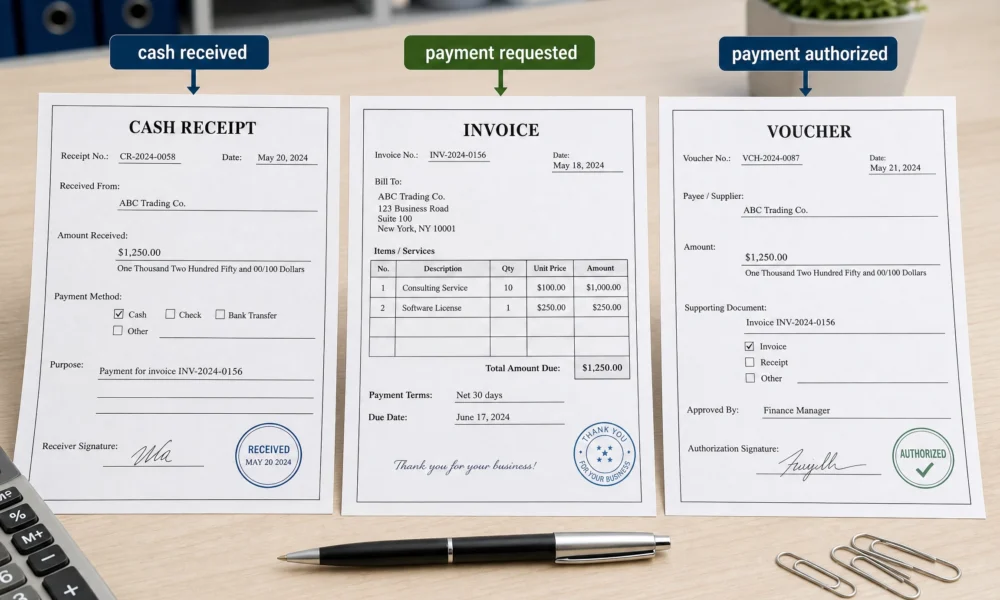
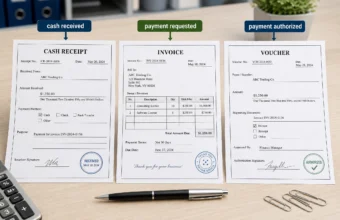
Receipt vs. Invoice vs. Voucher: A receipt is best suited for confirming cash already received because it documents a completed payment. An invoice works better before payment — it communicates what a buyer owes. A voucher is used internally to authorize outgoing payments. The key difference is direction and timing: receipts confirm incoming cash after it arrives. (58 words)
Quick Comparison
| Document | Best For | Key Function | Timing |
|---|---|---|---|
| Receipt | Confirming cash received | Proves payment was made | After payment |
| Invoice | Requesting payment | States what the buyer owes | Before payment |
| Voucher | Authorizing an expense | Approves outgoing payment (internal) | Before payment |
| Memorandum | Internal communication | Shares info between departments | Non-transaction context |
Invoice
An invoice is a request for payment — not proof that payment was received. A contractor finishes a job and sends a bill. You haven’t paid yet. No cash has arrived.
Or maybe I should say it this way: an invoice says “you owe me.” A receipt says “you paid me.”
Both documents involve a dollar amount. That’s why students confuse them. The difference is timing.
Voucher
A voucher is an internal authorization document used in accounts payable workflows. It tells the accounting department: this expense is approved, go ahead and process the payment. Vouchers exist before money leaves the business. Receipts exist after money enters it. They run in opposite directions.
Memorandum
A memorandum is an internal communication document — it passes information between departments or employees. It has no connection to cash transactions whatsoever. If “memo” appears as an answer choice on your exam, it’s the first option to eliminate.
What a Valid Cash Receipt Must Include
Not every piece of paper qualifies as a proper accounting receipt. In introductory accounting class — and certainly on exams built around the Century 21 Accounting curriculum — a cash receipt requires specific fields to function as a valid
How To verify a business form is a valid cash receipt, confirm it contains:
- Date payment was received
- Name of the payer — person or business
- Amount received, written in numerals
- Description of goods or services paid for
- Signature or initials of the person receiving payment
- Receipt number for audit trail purposes
Each field has a specific function in the accounting record. (76 words)
What most guides skip is item six: the receipt number. Numbered receipts create an unbroken sequence in the records. Missing numbers in that sequence flag gaps for auditors — gaps that suggest income may have been received but never recorded.
That’s not just a classroom detail. It’s the reason physical receipt books are pre-numbered from the factory.
Cash Receipts as Source Documents in Accounting
Look, if you’re studying for a test that covers journalizing, here’s what actually matters.
A source document is any original business record created at the time of a transaction that proves the transaction occurred. Cash receipts belong in this category alongside checks, purchase orders, and sales invoices. The distinction that makes cash receipts specific: they track incoming money — cash the business received, not cash it spent or is waiting to collect.
When a bookkeeper processes a cash receipt, the standard journal entry debits Cash and credits the appropriate revenue or accounts receivable account. The receipt is then filed as the supporting document for that entry.
I’ve seen conflicting explanations across accounting textbooks — some describe the receipt as created by the seller, others focus on the copy given to the buyer. My read is that both descriptions are accurate from different perspectives: the seller creates it and issues it; the buyer receives and retains their copy as proof of payment. For exam purposes, the receipt lives with whichever party needs it as a source document.
Anyway, for exam purposes: cash receipts feed into the cash receipts journal in businesses using special journals — or into the general journal in simpler systems — and they create the paper trail that makes records auditable.
Tools like QuickBooks, Square, and Wave Accounting generate digital cash receipts automatically at the point of sale. The function is identical to a pre-numbered paper receipt book from fifty years ago: acknowledge the cash, capture the required fields, retain the document. Technology changed the format. The accounting purpose didn’t.
Common Exam Traps Around This Topic
Most people assume “acknowledgement” is the word that points toward a memorandum — because memos acknowledge things. That’s backwards. A memorandum acknowledges information shared between people. The question asks about acknowledging cash received, which is a financial transaction. That answer is receipt, every time.
The second trap: confusing invoice and receipt because both documents list a specific dollar amount. The diagnostic question is simple — has the money already changed hands? Yes → receipt. No → invoice.
Quick note: some exam questions rephrase this as “a document issued when cash is received.” Same answer. Different wording. Don’t let the rephrasing throw you.
Some accounting educators argue that “sales receipt” and “cash receipt” are interchangeable terms in a classroom context. That’s valid for most intro-level tests. But if your course draws a distinction, a sales receipt typically confirms a retail sale that could include card payments, while a cash receipt is more narrowly tied to physical cash transactions. When in doubt, check your textbook’s glossary for the definition your teacher uses.
Frequently Asked Questions
What’s the best way to remember the difference between a receipt and an invoice?
A receipt proves payment already happened. An invoice asks for payment that hasn’t happened yet. Receipts come after the sale; invoices come before it.
How do I know if a business document qualifies as a source document in accounting?
If the document was created at the time of the transaction and can prove the transaction occurred, it’s a source document. Cash receipts, checks, invoices, and purchase orders all qualify.
Should I issue a receipt or an invoice when I collect cash from a customer?
Issue a receipt. An invoice goes out before payment, telling the customer what they owe. Once they pay, the receipt confirms the cash was received and closes the transaction.
Why does it matter if a cash receipt is missing from accounting records?
Missing receipts mean unverified income. The IRS requires businesses to retain receipts as proof of gross receipts. Gaps in receipt records can trigger audits and indicate unreported income.
When should I use a voucher instead of a receipt?
Use a voucher to authorize an outgoing payment through an accounts payable process — for example, approving a vendor bill before issuing the check. A receipt records incoming cash that has already arrived.


No Comment! Be the first one.