






Who Was Barbara Roufs? The Iconic Trophy Queen Who Defined 1970s Drag Racing
She stood at the finish line with long blonde hair and the kind of quiet, grounded presence that somehow cut straight through the noise of a full race day. Barbara Roufs didn’t drive the cars....

She stood at the finish line with long blonde hair and the kind of quiet, grounded presence that somehow cut straight through the noise of a full race day. Barbara Roufs didn’t drive the cars. She didn’t broadcast the events.
For a stretch of the 1970s, she was one of the most photographed faces in professional drag racing — and for more than two decades after her death in 1991, most people couldn’t even find her name.
That changed in 2016. One photographer uploaded his archive. The photos spread. And a daughter spoke publicly about her mother for the first time.
Here’s the full story.
Who Barbara Roufs Was — and Why the Answer Took So Long to Find
Barbara Roufs was a professional trophy queen and promotional model who worked primarily at Orange County International Raceway (OCIR) during the 1970s — the most commercially expansive decade professional drag racing had ever seen. She was crowned queen of the 6th Annual U.S. Professional Dragster Championship at OCIR, one of Southern California’s most significant professional drag events, and appeared consistently at the high-profile NHRA events that shaped the sport’s visual identity during that era.
Barbara Roufs was a professional event queen and promotional model active in 1970s Southern California drag racing. Working primarily at Orange County International Raceway, she became a figure of widespread renewed interest in 2016 when archival photographs taken by Tom West spread rapidly across social media. Her daughter, Jet Dougherty, publicly responded to the viral coverage — the first direct family acknowledgment of her legacy.
The question most people arrive with — Who is she? — has been harder to answer than it should be. No Wikipedia article covers her life. Most celebrity biography sites repeat the same three facts with no depth. Her story fell through a specific crack between pre-internet celebrity and posthumous digital fame, where the photographs survived in far better shape than any written record of her life.
According to NHRA documentation, the 1970 Hot Wheels Supernationals at Ontario Motor Speedway offered a then-record minimum purse of $50,000, with total contingencies surpassing $225,000. That level of commercial investment created real demand for professional promotional figures at the sport’s highest-profile events — and Barbara Roufs was among the most prominent working in that role on the Southern California circuit.
The viral rediscovery of her image in 2016 generated a wave of questions that existing sources simply couldn’t answer. Searches hit dead ends: a Find a Grave listing with dry memorial data, thin celebrity bio sites recycling identical bullet points, no Wikipedia page. The gap between how widely her photographs circulated and how little was written about her actual life was — and largely still is — striking.
The Era That Made Trophy Queens Matter
Drag racing in the early 1970s was mid-transformation. The NHRA had spent years turning a grassroots car culture into something broadcast-ready, and by 1970 that effort was paying off in real money, real television coverage, and real corporate sponsorship.
Trophy queens weren’t decorative extras at these events. They were a deliberate part of the promotional architecture — a human focal point for winner’s circle photography, a recognizable face for event programs, and a consistent visible presence that helped anchor a race day for the tens of thousands of spectators who showed up each weekend.
Look — if you stumbled across Barbara Roufs through a photo and assumed the trophy girl role was passive or purely ornamental, that’s an understandable read. It’s also off. What most coverage of this era skips entirely is the logistical competence involved: the scheduling, sponsor coordination, and the ability to project warmth and composure on demand across a twelve-hour race day in 90-degree Southern California heat.
Barbara Roufs was one of the best at it. The photographs show someone who understood the job completely — not performing glamour at the camera, but inhabiting the space with a naturalness that made the images feel inevitable.
Orange County International Raceway: Where Her Reputation Was Built
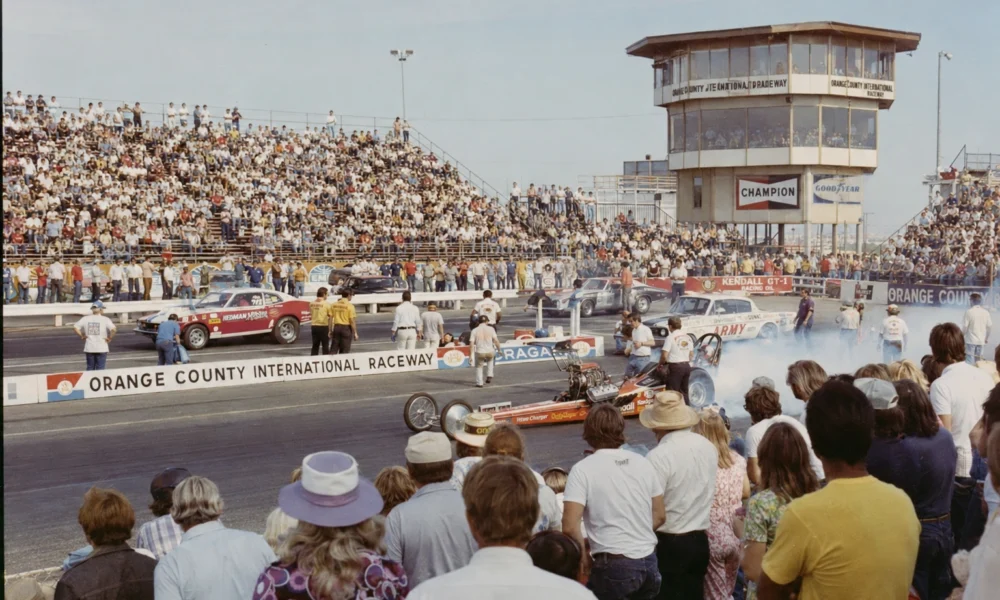
OCIR operated in Irvine, California from the mid-1960s until 1983, when the land was sold and redeveloped. For roughly fifteen years, it hosted some of the most significant professional drag racing events in the country and served as the operational center of Southern California’s racing scene.
It was the primary backdrop for Barbara’s career. Her coronation as queen of the U.S. Professional Dragster Championship was held there, and Tom West — one of the most prolific photographers working the SoCal circuit during this period — captured the majority of his best work of her at OCIR events.
The track closed before the internet existed. Everything that happened there survives primarily in two places: the memories of people who attended, and the archives of photographers who documented it. That’s precisely why Tom West’s decision to upload his archive in 2016 mattered as much as it did.
Barbara Roufs vs. Jungle Pam Hardy: Two Icons, Two Different Legacies
No article about Barbara Roufs does its job without addressing the comparison readers inevitably make. Where does she fit against Jungle Pam Hardy — the other woman most closely associated with 1970s drag racing celebrity?
The answer reveals something important about how fame survives across decades.
Jungle Pam Hardy built her public profile working directly alongside driver “Jungle Jim” Liberman — a flamboyant, crowd-drawing funny car racer whose traveling show drew enormous audiences at national events. Pam was part of the act. Her fame was attached to a driver’s celebrity and a touring circuit, which meant it stayed in circulation as long as Jungle Jim’s legend did.
Barbara’s fame was different in kind. It was tied to specific events, a specific venue, and — most significantly — specific still photographs. Quieter. More static. And entirely dependent on those photographs surviving intact until an audience existed to receive them.
Quick Comparison
| Category | Barbara Roufs | Jungle Pam Hardy |
|---|---|---|
| Primary Role | Event trophy queen and promotional model | Trackside personality alongside Jungle Jim Liberman |
| Home Venue | Orange County International Raceway (OCIR) | National touring circuit with Jungle Jim’s funny car operation |
| Fame Anchor | Archival still photography (Tom West) | Driver’s celebrity and national touring presence |
| Legacy Continuity | Interrupted by OCIR closure; limited pre-internet documentation | Maintained through Jungle Jim memorabilia and nostalgia circuit |
| 2016 Rediscovery | Viral photo archive upload triggered mass renewed interest | N/A — maintained ongoing recognition independently |
Neither is a lesser story. But the difference explains everything about why Barbara’s name disappeared and then came back so suddenly, four decades later.
Or maybe I should say it this way: Jungle Pam’s legacy had an engine running continuously. Barbara’s was dormant, waiting for someone to find the switch.
Tom West’s Photos and the 2016 Moment That Changed Everything
In 2016, photographer Tom West uploaded a large collection of archival images from his years covering Southern California drag racing events. The photos had been preserved carefully in his archive — but largely unseen by any mass audience.
Several featured Barbara Roufs.
They spread with a speed that surprised almost everyone who encountered them. Pinterest boards, Reddit threads, Instagram reposts, vintage photography forums — the images moved through every space where nostalgia and visual culture overlap. What made them travel wasn’t purely photographic craft, though the work is genuinely exceptional. It was Barbara herself: a woman who looked completely at home in a specific, irreplaceable moment, captured by a photographer who clearly knew what he was looking at.
Thousands of comments asked the same question: Who is she?
To find and verify images from Tom West’s Barbara Roufs archive, here’s what reliably works:
- Search “Tom West Photography drag racing” on Google Images or Flickr
- Filter results tagged with OCIR or Orange County International Raceway
- Cross-reference upload dates around 2016 to confirm the original archive release
- Look for Jet Dougherty’s public comments on image posts — her presence directly confirms authenticity
Jet Dougherty: When the Daughter Stepped Forward
Among the thousands of comments generated by the viral spread, one stood apart.
Jet Dougherty — Barbara Roufs’ daughter — publicly responded to the images, confirming her mother’s identity and offering personal context about the woman behind the photographs. It was the first time a family member had directly engaged with the viral rediscovery, and it transformed the story from a nostalgic mystery into something with real human weight behind it.
Jet’s response gave Barbara Roufs a name, in the mouths of people who had only known her as “the woman in the photo.” It connected a face that had traveled across the internet — often without a caption, often without attribution — to a real person, a real family, and a real history.
It also made visible something worth naming directly: for all the attention her photographs generated over the years, almost nothing accurate had been written about her actual life. Her image circulated freely. Her story barely existed in text.
Barbara Roufs’ Death: What the Records Show
Barbara Roufs died in 1991. She was in her mid-to-late forties.
Her death has been widely reported as a suicide. The primary sources for this information are accounts connected to family and those who knew her personally — not contemporary news coverage, which barely existed at the time. She died in the pre-internet era, when her public profile was no longer active and local news coverage of her death was limited.
I’ve seen conflicting biographical details across different sources — some cite different years for specific events, and her exact birth year doesn’t appear in any publicly verified record currently accessible. What can be confirmed is that her professional career was concentrated through the 1970s and that her death predated the digital era that would eventually make her one of the more recognized faces in vintage motorsport photography.
There’s a particular kind of sadness in that gap — between the sheer scale of people who have shared her photographs and the near-complete absence of carefully documented history about who she actually was. She became a minor internet legend without anyone truly knowing her.
Frequently Asked Questions About Barbara Roufs
Who was Barbara Roufs and why does her name keep resurfacing?
Barbara Roufs was a professional trophy queen in 1970s Southern California drag racing, primarily at Orange County International Raceway. She became widely known again in 2016 when Tom West’s archival photographs went viral, generating mass public interest in her identity, career, and story.
What was Barbara Roufs’ cause of death in 1991?
Barbara Roufs died in 1991 and her death has been reported as a suicide, based on accounts from family and those who knew her personally. Detailed contemporary news records are limited — she died before widespread internet coverage, and her public profile was not actively covered at the time.
Who is Jet Dougherty and what did she say?
Jet Dougherty is Barbara Roufs’ daughter. In 2016, she publicly responded to the viral spread of Tom West’s photographs, confirming her mother’s identity and providing personal context. It was the first direct family acknowledgment of the viral rediscovery and the most significant primary connection to Barbara’s actual story.
How does Barbara Roufs compare to Jungle Pam Hardy?
Both were iconic figures in 1970s drag racing, but their roles differed. Barbara was a formal event queen based at OCIR; Jungle Pam worked directly alongside driver Jungle Jim Liberman on a national tour. Jungle Pam’s fame persisted through her driver’s celebrity; Barbara’s legacy depended entirely on photographic archives surviving.
Where did Barbara Roufs work as a trophy queen?
Barbara worked primarily at Orange County International Raceway in Irvine, California, where she was crowned queen of the 6th Annual U.S. Professional Dragster Championship. OCIR was one of the most important professional drag racing venues in Southern California before it closed permanently in 1983.






No Comment! Be the first one.