





The Zappos CEO Who Built $850 Million and Left None of It Planned
Quick note: If you’ve seen “$500 million” and “$850 million” used interchangeably across different headlines, you’re not imagining a discrepancy. Both numbers are...

Quick note: If you’ve seen “$500 million” and “$850 million” used interchangeably across different headlines, you’re not imagining a discrepancy. Both numbers are real. They measure different things at different stages of the same ongoing legal mess. That confusion is exactly what this article untangles.
Tony Hsieh’s net worth refers to the total estimated value of his assets at the time of his death in November 2020. Court filings in the Nevada probate case placed that figure at approximately $850 million, covering equity from business exits, Downtown Project real estate holdings in Las Vegas, and personal investments. The lower $500 million figure reflects the estate’s value after accounting for creditor claims filed post-death.
This article covers Hsieh’s net worth, wealth sources, and the estate dispute through May 2026. It does not address his broader management philosophy or Zappos’ current operations under Amazon.
How Much Was Tony Hsieh Actually Worth?
Roughly $850 million — and that number comes from court documents, not celebrity estimates.
The $850M figure appears in Nevada probate filings submitted after Hsieh died on November 27, 2020. Some outlets cite $500 million instead. Here’s the distinction most articles skip entirely: gross estate value and net distributable estate value are not the same figure, and they’re measured at different points in a proceeding that’s been running for more than five years.
I’ve seen this framing handled inconsistently across sources — some use $850M, others $500M, and a few don’t clarify at all. My read is that the $850M represents total asset value at death, while the $500M reflects a working estimate of what remains after the wave of creditor claims that hit the estate in 2021 and 2022.
Tony Hsieh was 46, unmarried, and had no children. According to Wikipedia’s sourced figures, he personally made at least $214 million from the Zappos-Amazon sale alone — not counting proceeds from earlier exits or real estate appreciation.
According to court filings reviewed by 8 News Now Investigators (2026), previous probate documents estimated his wealth at nearly $850 million. That’s the authoritative figure for net worth at death.
Three Fortunes, One Life: Where the $850 Million Came From
Tony Hsieh didn’t build one fortune. He built three in sequence, each larger than the last.
Fortune #1 — LinkExchange (1996–1998)
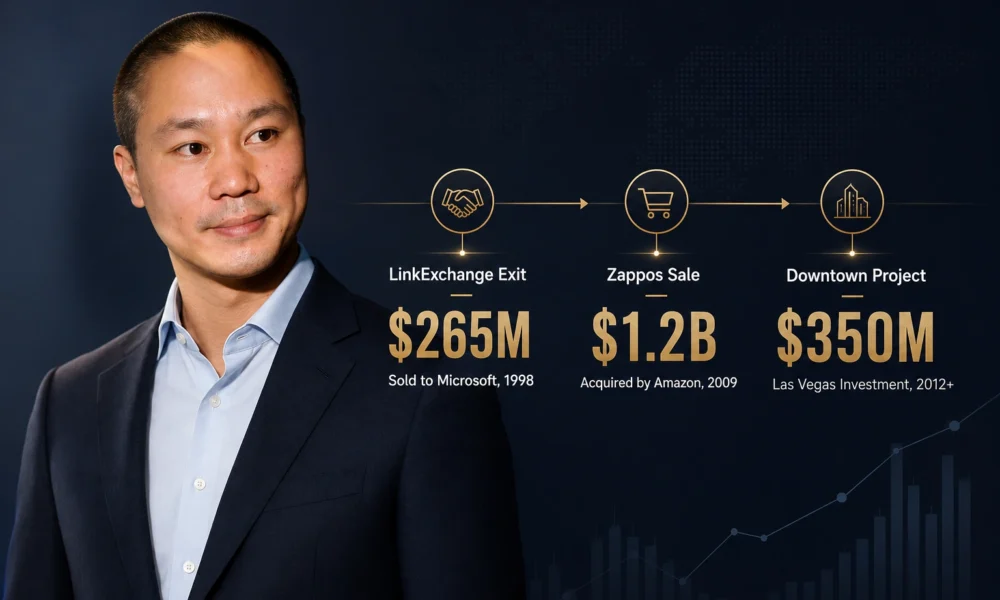
He co-founded LinkExchange at 24, straight out of Harvard. Microsoft acquired it for $265 million in 1998. He’d been running it for roughly two years. That exit funded everything that came next, including his investment firm Venture Frogs, which he used to seed early-stage companies — one of which would eventually become Zappos.
Fortune #2 — Zappos (1999–2009)
He initially invested $500,000 in a struggling startup called ShoeSite.com, later renamed Zappos. He eventually became CEO. In November 2009, Amazon acquired Zappos in a deal valued at $1.2 billion on the day of closing — paid in Amazon stock. Hsieh’s personal take from that deal was at least $214 million, per Wikipedia’s sourced figures, separate from what Venture Frogs recovered.
Fortune #3 — Downtown Project Las Vegas (2012 onward)
This one’s less discussed but crucial to understanding the estate complexity. Hsieh committed approximately $350 million of his own money to revitalizing the Fremont Street area of Las Vegas — buying apartment buildings, vacant lots, office spaces, and other properties. The portfolio was illiquid. Real estate doesn’t sell in a week, and it doesn’t sell cleanly when the owner is deceased and the estate is in active dispute.
That illiquidity is a core reason the estate hasn’t closed. Most net worth summaries give you the Zappos number and stop. The Downtown Project holdings are why courts are still sorting this out in 2026.
The $850M vs. $500M Confusion — Resolved
Quick Comparison
| Figure | What It Measures | Source | Key Limitation |
|---|---|---|---|
| ~$850M | Gross estate at death | Nevada probate court filings | Does not subtract creditor claims |
| ~$500M | Working net estate estimate | Probate proceedings, 2021–2022 | Subject to ongoing legal dispute |
| $1.2B | Total Zappos acquisition value | Amazon deal, November 2009 | Hsieh’s personal share was ~$214M+ |
| $265M | LinkExchange sale price | Microsoft acquisition, 1998 | Proceeds partially reinvested via Venture Frogs |
| ~$350M | Downtown Project investment | Public records, Las Vegas | Illiquid real estate — hard to value cleanly |
Use $850M when discussing what Hsieh was worth. Use $500M when discussing what was available to distribute — they’re answering different questions.
He Died With No Will. Then Things Got Stranger.
No will. That’s where the story should have been simple.
Under Nevada intestacy law — because his legal residence was Nevada — Hsieh’s estate was set to pass to his parents. His father, Richard Hsieh, was appointed co-administrator by a Clark County District Court judge. Routine, if painful.
That should’ve been the end of the legal complexity. It wasn’t.
In March 2025 — four-plus years after Hsieh’s death — a seven-page document arrived at the Clark County District Court clerk’s office. Mailed. No return address. The document purported to be Tony Hsieh’s will, allegedly signed in March 2015. It listed five witnesses. According to 8 News Now Investigators (2026), months after the document was submitted to court, there was no proof that any of the listed witnesses exist — no verified addresses, no confirmed identities, no one coming forward.
The document had reportedly been found in Pakistan, among the belongings of a man named “Pir Muhammad.”
Or maybe I should say it this way: this isn’t bureaucratic delay. This is a full will contest — now before the Nevada Supreme Court.
The mental capacity dimension adds another layer. Lawyers for the estate had repeatedly argued in court filings that Hsieh lacked the capacity to execute contracts in the years leading up to his death. Court documents cited sustained abuse of nitrous oxide and ketamine. Friends reportedly described him using “as many as 50 cartridges of nitrous oxide a day.” Whether that incapacity argument interacts with the 2015 will’s claimed signing date is one of the open legal questions currently being litigated.
Look, if you’re trying to understand why this estate hasn’t been settled in five years, this is why. It’s not slow courts or missing paperwork. There’s a potentially fabricated will that’s been given partial legal standing, two attorneys named as executors who had no verifiable prior relationship with Hsieh, and a family that has called the situation “immediate chaos” in court filings with the Nevada Supreme Court.
The Hsieh family’s attorneys stated in January 2026 filings: “There is no legal precedent for what the court did.” That’s the active situation.
What This Case Actually Tells You (One Opinion You Might Disagree With)
Here’s the thing: having $850 million made this estate harder to settle — not easier.
Some readers will push back on that. The intuition is that more money means more resources to resolve things faster. The reality in probate is the opposite. Larger estates attract more creditors, more contested claims, more incentive for third parties to fabricate documents or stake legal positions. A straightforward estate with a basic will and $2 million in assets gets resolved in a year. Hsieh’s estate — with $850 million, illiquid real estate, no will, documented capacity concerns, and now a mystery document from Pakistan — may take a decade.
What most guides skip: dying intestate doesn’t simply mean your assets flow cleanly to family. It means they flow to family after courts, creditors, capacity disputes, and — in this case — contested anonymous filings have all had their turn. Every one of those stages takes time and legal fees drawn from the estate itself.
Some experts argue Hsieh’s situation was uniquely complicated by his documented substance use and the nature of his holdings. That’s valid for the particulars. But the underlying failure — no estate plan despite hundreds of millions in assets — is something estate attorneys now cite as a textbook warning for anyone with significant wealth and no documented instructions.
Note: This article is informational only and does not constitute legal or financial advice. Estate planning laws vary by jurisdiction and individual circumstance.
Frequently Asked Questions
What was Tony Hsieh’s net worth when he died?
Court filings from the Nevada probate case estimated his estate at approximately $850 million at the time of his death in November 2020. Some sources cite $500 million, which reflects the estate value after creditor claims are factored in — a different calculation entirely.
Did Tony Hsieh leave a will?
He died with no known will. A seven-page document emerged in March 2025, mailed anonymously from Pakistan, but its authenticity remains contested in Nevada courts as of May 2026. None of the witnesses listed in it have been verified as real people.
Who inherited Tony Hsieh’s money?
Under Nevada intestacy law, his estate was directed toward his parents, with his father Richard Hsieh appointed co-administrator. The final distribution hasn’t happened — the contested will and ongoing creditor claims keep the estate unresolved.
How did Tony Hsieh make his money?
Through two major exits — LinkExchange, sold to Microsoft for $265 million in 1998, and Zappos, acquired by Amazon for approximately $1.2 billion in 2009, from which Hsieh personally made at least $214 million. Downtown Project real estate in Las Vegas accounted for significant additional value.
Why is Tony Hsieh’s estate still not settled?
Multiple factors compound each other: no original will at death, dozens of creditor claims filed post-2020, estate lawyers’ arguments about his mental incapacity in his final years, and a 2025 contested will of disputed origin now before the Nevada Supreme Court.

No Comment! Be the first one.