






Kilian Korth: The British Swimmer Who Rewrote the 200-Mile Record Books
Kilian Korth is a British-born professional ultramarathon runner and coach, best known for winning all three races in the Triple Crown of 200s — the Tahoe 200, Bigfoot 200, and Moab 240 — in a single...

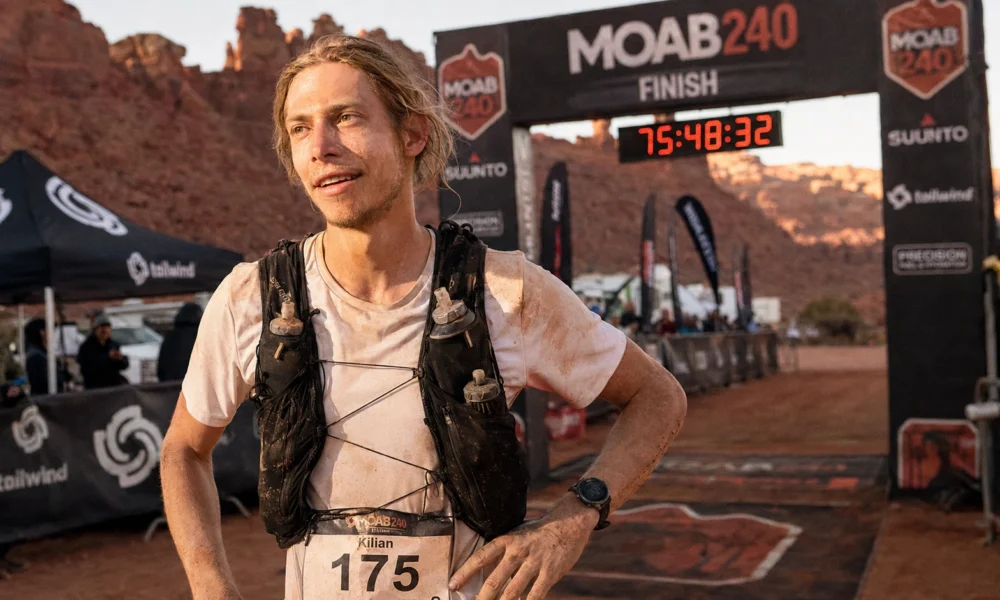
Kilian Korth is a British-born professional ultramarathon runner and coach, best known for winning all three races in the Triple Crown of 200s — the Tahoe 200, Bigfoot 200, and Moab 240 — in a single 2025 season, setting the all-time men’s cumulative record of 156 hours, 30 minutes, and 20 seconds. A former competitive swimmer, he now trains and lives in Grand Junction, Colorado, and coaches through his Everyday Ultra platform.
Who Is Kilian Korth?
Most people find a race result before they find a story. That’s the problem this page fixes.
Kilian Korth, age 29 as of 2025, is an American-based professional ultrarunner originally from Bury St. Edmunds, England. He discovered ultrarunning in 2018 after a competitive swimming career through college. According to ATRA and BroBible, he became only the second person in history to win all three Triple Crown of 200s races in a single season, shattering the cumulative time record set by Michael McKnight in 2019 by over five hours.
Korth grew up in Bury St. Edmunds — a market town in Suffolk, England — before crossing the Atlantic to attend American University in Washington, D.C., where he majored in political science while continuing to compete as a collegiate swimmer. He’s now fully Colorado-based, operating from Grand Junction, and writing publicly about training under his Substack, “The Run Tough Mindset.” His Instagram handle — @runtoughmindset — doubles as his operating philosophy.
He’s not just a runner. He’s an Icelantic Skis demo team ambassador. That detail tells you something about his athletic range: this isn’t someone who arrived at trail running and stopped there.
Quick note: some sources list his exact age differently. The ATRA profile from September 2025 identifies him as 29 years old, which is the most consistently cited figure across race coverage. His exact birthdate remains private by his own apparent choice.
The Swimming Years: From Bury St. Edmunds to American University
This is the chapter most race recaps skip entirely.
Kilian Korth’s athletic identity began in the water, not on a trail. He competed in backstroke events in England — winning regional championships in 2010 and 2012 — attended Lakenheath High School, and trained upward of four hours per day during peak swimming seasons. According to a Playbook profile, he woke at 3:30 a.m. for early-morning swim practice as a teenager, a routine that forged the discipline underpinning every 200-mile finish since.
Swimmers understand something trail runners often learn late: that suffering isn’t the signal to stop, it’s just information arriving. Korth has said as much. “From my swimming days to ultrarunning, I’ve had a long history with always doing what I set out to do.” That direct line — from chlorinated mornings in Suffolk to multi-day mountain racing in the American Southwest — is the through-line his whole career runs on.
There’s also a second origin story, less often cited. The summer he turned eight, Korth’s family completed a roughly 1,600-mile bicycle trip from Fort Collins, Colorado, to Seattle, Washington — 46 days, no shortcuts. His parents weren’t building an ultrarunner on purpose. But Korth draws a straight line from that trip to his tolerance for prolonged discomfort. “I don’t think my parents necessarily set out to create an endurance athlete,” he’s said, “but I do think it’s those types of experiences that you realize the tenacity required.”
He discovered ultrarunning in 2018. Not a 100-miler. Not a 50K. He gravitated quickly to the longest available format, recognizing — correctly, as it turned out — that pure speed wasn’t his edge but mental durability and strategic patience absolutely were.
The Two DNFs That Make the 2025 Record Mean More
Here’s the thing: the record doesn’t make sense without what came before it.
In 2022, Korth suffered a torn hamstring at the Cocodona 250. He didn’t finish. In 2023, the situation was more serious — a severe allergic reaction required ICU hospitalization during a race. Two different kinds of stops. Both beyond his control. Neither, it seems, beyond his processing.
DNFs carry a specific weight in the ultra community. Among serious practitioners, they also carry a specific respect — because you don’t get into an ICU and come back to break cumulative records by accident. What most coverage of Korth skips is how deliberately he rebuilt. He didn’t immediately re-enter 200-mile races. He dropped down to 100-milers and 100Ks, won those, rebuilt confidence systematically, and returned to the long format only when the body and the strategy were both right.
Two consecutive years stopped by his own body. Then a five-hour margin over the previous record.
That sequence matters more than the number.
The Triple Crown of 200s is a community-tracked achievement organized by Destination Trail. Runners complete the Tahoe 200, Bigfoot 200, and Moab 240 within the same race season. Their times are cumulative. No governing body hands you a trophy — just the numbers, and what the numbers say about you.
Korth’s 2025 campaign ran across roughly four months:
Quick Comparison: Kilian Korth’s 2025 Triple Crown Race-by-Race
| Race | Distance | Elevation Gain | Korth’s 2025 Finish Time | Winning Margin |
|---|---|---|---|---|
| Tahoe 200 | 200.2 mi | 36,857 ft | 52:40:52 | 1+ hour over field |
| Bigfoot 200 | 207.9 mi | 45,563 ft | 45:03:41 | 42 minutes over field |
| Moab 240 | 240 mi | Not published | 58:45:47 | Dozens of miles clear |
| Combined | ~648 mi | — | 156:30:20 | 5+ hrs under McKnight’s 2019 record |
Korth won the Tahoe 200 with a time of 52 hours, 40 minutes, and 52 seconds, beating the field by over an hour. At the Bigfoot 200 — 207.9 miles with 45,563 feet of elevation — he won by 42 minutes. At Moab, he stopped for a total of just over seven hours across the entire 240-mile course, putting dozens of miles between himself and the competition before the finish.
His combined Triple Crown time of 156:30:20 broke the previous record of 162:00:51, and in doing so, he became only the second person in history to win all three races outright in a single season.
His race strategy, as described directly in Destination Trail’s post-season interview, is counterintuitive for a competitive field: “I was prioritizing showing up on race day healthy as opposed to fitting in as much training as possible.” He describes his approach as “safety first, training second” — prioritizing sleep quality and dietary discipline over volume, a deliberate trade that he believes produced higher-quality training even if the weekly mileage looked modest.
From Fat-Adapted to 90 Grams of Carbs Per Hour
This is where Korth’s story gets genuinely counterintuitive for anyone who’s spent time in the low-carb endurance world.
He made a documented nutrition shift before 2025. He moved away from fat-adapted racing and toward a high-carbohydrate fueling strategy: approximately 90 grams of carbohydrates per hour in the first half of a race, dropping to 60 grams per hour in the second half, primarily using Precision Fuel & Hydration gels and drink mixes. CurraNZ blackcurrant supplement was described as “a significant piece of his nutrition puzzle,” supporting performance, gut health, and recovery throughout his training and racing in 2025.
Look, if you’re a 200-mile runner trying to optimize fueling, the fat-adaptation vs. high-carb debate isn’t abstract. The data increasingly supports carbohydrate availability at moderate-to-high output, and Korth ran his own experiment across multiple seasons before changing his formula. His 90g/hour figure aligns with the upper range that Precision Fuel & Hydration’s own research supports for well-trained athletes with adapted gut tolerance.
I’ve seen conflicting data on fat adaptation at extreme ultra distances — some coaches still argue it’s superior for events lasting beyond 36 hours, others point to mounting evidence that carb availability remains the limiting factor regardless of distance. My read is that Korth’s results support the carb-forward approach, at least at the output level he’s sustaining. Whether it generalizes across all 200-mile athletes at different pacing strategies is genuinely an open question.
Or maybe I should say it this way: the science is moving toward carbs, and Korth’s record is a data point, not a proof.
How to Adopt a High-Carb Fueling Strategy for Long-Distance Ultras]
- Establish your current carbohydrate tolerance on training runs lasting 4+ hours.
- Choose a tested product — Korth uses Precision Fuel & Hydration — and track grams per hour, not calories.
- Start at 60g/hour and build tolerance incrementally over 4–6 weeks.
- Introduce CurraNZ or comparable antioxidant support during high-training-load weeks.
- Test your full target intake in a race-simulation effort before competition day — never debut a new fueling protocol on race morning.
Everyday Ultra: Coaching the Distance He Dominates
Korth coaches through the Everyday Ultra program and writes long-form training and philosophy content on his Substack, “The Run Tough Mindset,” covering endurance, discipline, failure, and mental toughness.
He’s not retired into coaching. He coaches and competes simultaneously — that’s worth stating plainly, because it means his coaching content is being tested against real race outcomes in real time. That’s a meaningful distinction in a space crowded with coaches who last competed at distances nowhere near what they’re programming.
His swimming background shows up in the coaching philosophy. Swimmers understand periodization, session quality over session volume, and the discipline of showing up before the motivation arrives. These aren’t concepts the average self-taught trail runner has been trained to internalize. He credits his intense early-morning swim training — four hours per day during peak seasons — as foundational to his mental strength, calling discipline in the face of reluctance “not even framed to me as an option.”
The @runtoughmindset account functions as field notes, not a highlight reel. Nutrition transparency, training load reality, and recovery demands of multi-day racing are all documented there with the kind of specificity that makes it genuinely useful — not just inspirational.
An upcoming documentary titled Forged in Failure is in production, chronicling Korth’s full arc from his 2022 hamstring tear through the 2025 Triple Crown. Release was projected for the first half of 2026.
Q&A: What Runners Are Actually Asking About Kilian Korth
How old is Kilian Korth?
Kilian Korth was 29 years old during his 2025 Triple Crown season, placing his birth year around 1995–96. He’s based in Grand Junction, Colorado, and hasn’t publicized his exact birthdate.
What races make up the Triple Crown of 200s?
The Triple Crown consists of the Tahoe 200, Bigfoot 200, and Moab 240 — three races organized by Destination Trail, completed in the same season, with cumulative finishing times tracked across the field.
How did Kilian Korth set the Triple Crown record?
He won all three races outright in 2025 with a combined time of 156:30:20, beating Michael McKnight’s 2019 record of 162:00:51 by over five hours — the largest margin improvement since the record was first formally tracked.
What nutrition strategy does Kilian Korth use for 200-mile races?
He targets 90 grams of carbohydrates per hour in the early race stages using Precision Fuel & Hydration products, dropping to 60g/hour in the second half, and supplements with CurraNZ blackcurrant extract for gut health and recovery.
Why did Kilian Korth DNF twice before his 2025 record?
In 2022, a torn hamstring ended his Cocodona 250 race. In 2023, a severe allergic reaction required ICU hospitalization. After both DNFs, he dropped to 100-mile and 100K distances to rebuild, returning to 200-mile racing only after reestablishing momentum and health — a deliberate rebuild, not a desperate return.






No Comment! Be the first one.