






Squid Game Creator’s Real Net Worth And Why the Number Will Surprise You
Hwang Dong-hyuk’s net worth is estimated at $5 million to $7 million as of 2025. That’s the number. Write it down, because most sites either bury it or give you a range without telling...

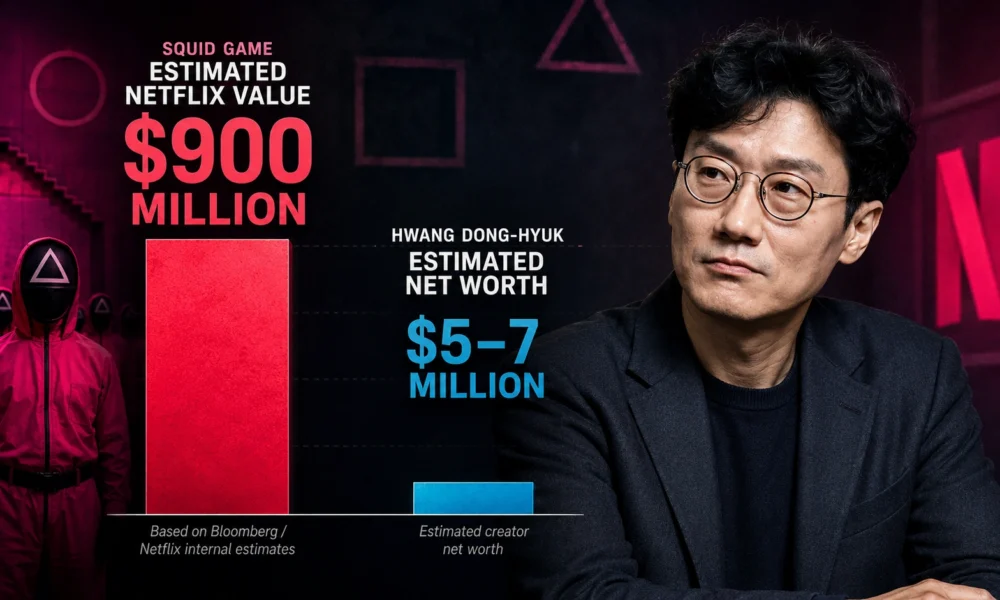
Hwang Dong-hyuk’s net worth is estimated at $5 million to $7 million as of 2025. That’s the number. Write it down, because most sites either bury it or give you a range without telling you what it actually means.
His show — Squid Game — generated an estimated $900 million in value for Netflix on a production budget of roughly $21.4 million, per a June 2023 Los Angeles Times investigation. He wrote every episode. He directed every episode. He spent 12 years trying to get the show made before Netflix finally said yes in 2019.
And he walked away with a flat fee.
No royalties. No profit share. No bonus check when the show shattered every streaming record Netflix had ever set.
What Is Hwang Dong-hyuk’s Net Worth in 2025?
Hwang Dong-hyuk’s net worth refers to his total estimated personal wealth, drawn from directing fees, screenwriting contracts, executive producer credits, and broadcast royalties accumulated across his career since 2007. As of 2025, credible estimates place it between $5 million and $7 million — built over nearly two decades of Korean film and television, not from a single Squid Game windfall.
The squid game creator net worth question catches most people off guard because the assumption is simple: biggest Netflix show ever = very rich creator. The data says otherwise.
Here’s where his money actually comes from:
- Directing and screenwriting fees — roughly 70–80% of his total estimated wealth, accumulated from films including Silenced (2011), Miss Granny (2014), and The Fortress (2017)
- Executive producer fees from Squid Game Seasons 1 and 2 — an additional credit layer that does carry its own fee, separate from his directing deal
- Overseas broadcast royalties — Korean copyright pools distribute these collectively; one 2023 pool of KRW 270 million (approximately $210,000) was shared among 60 to 70 directors combined, meaning individual payouts are modest
- Brand-adjacent consultancy work, including a reported creative role connected to a Louis Vuitton 2023 event — exact figures unconfirmed
South Korea’s top marginal income tax rate sits around 40%, which compresses take-home earnings significantly on any large fee payments. That’s not the main story, but it’s a real factor most net worth estimates ignore.
The squid game director net worth is modest by Hollywood standards — not because he underperformed, but because of how his deal was structured before anyone knew what the show would become.
Hwang Dong-hyuk’s net worth in 2025 is estimated between $5 million and $7 million, reflecting cumulative earnings from his Korean film and television career rather than profit-sharing from Squid Game. According to a June 2023 Los Angeles Times investigation, Hwang forfeited all intellectual property rights to the series under his original Netflix contract and received no residuals from the platform’s estimated $900 million gain from the show.
How Much Did Hwang Dong-hyuk Actually Make From Squid Game Season 1?
Here’s the thing: the exact figure has never been officially disclosed. That’s deliberate on both sides.
What has been disclosed — by Hwang himself, on the record, in multiple interviews — is more telling than any number. When a reporter asked him in October 2021 whether creating Squid Game had made him as rich as the fictional ₩45.6 billion prize winner of his own show, his answer to The Guardian was precise: he had enough to put food on the table, Netflix wasn’t paying him a bonus, and he’d been compensated according to the original contract.
That’s a carefully worded non-answer that tells you everything.
Then came the BBC interview, when Season 2 was announced. He was direct: “Even though the first series was such a huge global success, honestly, I didn’t make much. So doing the second series will help compensate me for the success of the first one too.”
I’ve seen conflicting estimates across sources — some put his total Season 1 compensation (writing, directing, and executive producing all nine episodes) at several hundred thousand dollars, others suggest it reached $1–2 million. My read, based on his documented pre-Squid Game market rate as a respected but mid-tier Korean filmmaker at the time of the 2019 deal, is that the lower end is more plausible. Netflix’s acquisition price reflected what Hwang was worth then — not what the show would become.
Or maybe I should say it this way: the contract was signed before anyone knew. That’s always how these deals go, and it’s always the creator who absorbs the risk of being wrong in both directions.
What most guides skip entirely: The IP forfeiture isn’t just about missing royalties. It means Hwang holds no legal claim to Squid Game: The Challenge (the Netflix reality spinoff), the David Fincher-attached American remake currently in development, or any merchandise or licensing revenue from the franchise. He built the entire creative universe — the rules, the characters, the visual language, the moral architecture. He doesn’t own a square inch of it.
How much Hwang Dong-hyuk earned from Squid Game Season 1 has not been officially confirmed, but his own public statements provide the clearest picture available. According to BBC reporting, Hwang stated he “didn’t make much” from Season 1 despite its record performance. According to the Los Angeles Times (June 2023), he received only a flat upfront fee and forfeited all intellectual property rights, earning zero residuals as Netflix’s estimated valuation of the show reached $900 million — roughly 42 times the show’s production budget.
Why Is His Net Worth So Low? The Flat-Fee Contract, Explained Simply
Most people who search how much did hwang dong-hyuk make from squid game are really asking a different question: how does someone create a $900M property and walk away with a fraction of that?
The answer is structural. It’s not unique to Hwang. And it has a name.
What a Flat-Fee Deal Actually Does to a Creator’s Earnings
Understanding a Flat-Fee Content Contract: To understand why a flat-fee deal limits a creator’s earnings from a breakout hit, here’s how the structure works:
- Creator accepts a fixed upfront payment — no performance bonuses, no revenue clauses.
- Studio takes full ownership of the IP and all future licensing rights.
- Show succeeds — studio captures all revenue above production cost.
- Creator receives nothing additional, regardless of viewership, spinoffs, or franchise value.
- Creator’s only path to more money is negotiating better terms on the next project.
This is precisely the structure governing Hwang’s Season 1 deal. Netflix confirmed to BBC that its model “guarantees solid compensation, regardless of the success or failure of their shows.” That statement is technically accurate — and it’s also the problem. The model was designed for average performance. It doesn’t have a mechanism for what happens when a show earns 42x its production budget in cultural and commercial value.
Flat-Fee vs. Profit-Participation: The Deal Types That Determine Everything
Quick Comparison
| Deal Type | Best For | Key Benefit | Key Limitation |
|---|---|---|---|
| Flat-Fee (Work-for-Hire) | Studio acquiring content | Predictable cost, full IP ownership, no upside liability | Creator earns nothing if show massively overperforms |
| Profit-Participation (Backend) | Creator with existing leverage | Upside potential if show succeeds | Complex accounting; studios often report zero net profit on paper |
| Hybrid (Fee + Backend Points) | Established showrunners | Guaranteed floor income plus performance upside | Requires significant bargaining power; rare for first-time sellers |
| IP Retention Deal | Creator with proven IP value | Full franchise revenue, merchandise, remake rights | Streamers typically reject full IP retention for acquisitions |
Flat-fee vs. profit-participation for content creators: A flat-fee deal guarantees upfront payment but transfers all IP and future revenue rights to the studio — better for studios acquiring unproven projects at low risk. Profit-participation gives creators upside if the project overperforms, but requires negotiating leverage most first-time sellers don’t have. The key difference is who benefits when the show becomes a franchise.
Some industry observers argue Hwang’s original deal was fair — Netflix took real financial risk in 2019 on an unknown Korean series from a director without an international profile. That’s a valid point for that specific scenario. But when a creator loses eight or nine teeth from stress during production (Hwang disclosed this in press interviews), and the show then earns enough to rival some studios’ annual revenue, the original risk-reward framing deserves a harder look.
He didn’t win. He was paid not to lose.
The reason Hwang Dong-hyuk’s net worth is low relative to Squid Game’s commercial performance is entirely structural. His Season 1 Netflix deal was a flat-fee, work-for-hire contract with full IP forfeiture — a standard structure Netflix used for Korean original content acquisitions at the time. According to Complex, citing the Los Angeles Times, this meant no residuals, no licensing revenue, and no stake in the Squid Game franchise regardless of its scale. His estimated $5–7M net worth reflects a directing career, not franchise ownership.
Hwang Dong-hyuk’s Career Before Squid Game: The Numbers That Built His Baseline
Before Squid Game, he wasn’t unknown. He was one of South Korea’s most respected working directors — commercially reliable, critically serious, and completely invisible to Western audiences.
Silenced (2011) grossed approximately $31 million worldwide. The film, based on a true case of abuse at a school for deaf children, triggered the passage of South Korea’s Dogani Act — direct legislative reform driven by public pressure from the film’s release. That’s rare. A movie changing a law is genuinely rare.
Miss Granny (2014) sold around 8.65 million domestic tickets and earned approximately $59 million globally. A genuine commercial hit for Korean cinema by any measure.
The Fortress (2017) earned roughly $28.6 million worldwide in the historical epic genre — an expensive, difficult category where most films lose money.
By the time Netflix acquired Squid Game in 2019, Hwang’s estimated net worth was in the $1–2 million range. Comfortable. Respected in his industry. Not wealthy enough to walk away from a major streaming deal, even one with unfavorable terms.
That context matters. It explains the negotiating position he was in — and wasn’t in.
Did Season 2 and the Planned Season 3 Finally Pay Him Fairly?
Better. Not fixed, but better.
Hwang confirmed to BBC during the Season 2 announcement that he didn’t want to return — and that money was a significant factor in his decision to do so anyway. He’s confirmed it publicly, he’s stated he didn’t make much from Season 1, and Netflix’s response hasn’t disputed the core claim. What changed for Season 2 was the fee. Almost certainly a substantially higher upfront payment, negotiated from a position of proven global leverage he simply didn’t have in 2019.
Look — if you’re trying to determine whether Hwang is now wealthy from Squid Game, here’s what actually matters: an improved Season 2 fee almost certainly doesn’t retroactively compensate him for Season 1’s IP forfeiture. You can’t renegotiate away rights you’ve already transferred. The franchise value — the spinoffs, the American remake, the merchandise — remains entirely in Netflix’s hands.
The Writers Guild of America called out Hwang’s situation publicly in 2023, using it as a high-profile example of the streaming residuals crisis affecting creators globally. His case isn’t a Korean problem or a Hwang problem. It’s a template problem — one that the most-watched show in Netflix history made impossible to ignore.
Season 3 of Squid Game has been confirmed and is in production as of 2025. Whether Hwang negotiated materially improved terms — particularly any performance upside or IP participation — has not been disclosed.
Quick note: If Season 3 matches or exceeds Season 2’s viewership, his cumulative compensation across all three seasons may push his net worth toward the upper end of current estimates, potentially into the $8–12 million range. That’s speculative. The floor is what’s documented.
People Also Ask: Hwang Dong-hyuk Net Worth
What’s the Squid Game creator’s net worth right now?
As of 2025, Hwang Dong-hyuk’s net worth is estimated at $5–7 million. That figure comes from nearly two decades of Korean film directing and writing fees — not Squid Game royalties, which he never received under his Season 1 flat-fee Netflix deal.
Why didn’t Hwang Dong-hyuk make more money from Squid Game?
His original Netflix contract was a flat-fee, work-for-hire deal with full IP forfeiture. He received an upfront payment and no residuals, no backend points, and no stake in the franchise — regardless of how large Squid Game grew. He confirmed this in interviews with The Guardian and BBC.
How much did Squid Game earn for Netflix compared to what Hwang earned personally?
According to the Los Angeles Times (June 2023), Squid Game generated an estimated $900 million in value for Netflix on a roughly $21.4 million production budget. Hwang has publicly stated he “didn’t make much” from Season 1 and received no bonus from Netflix’s record-breaking performance.
Did Hwang Dong-hyuk get paid more for Season 2 of Squid Game?
Yes, Hwang confirmed to BBC that his Season 2 compensation was improved compared to Season 1, and cited the better pay as a key reason he agreed to return. He did not disclose the specific amount, and Netflix has not published the contract terms.
Should Hwang Dong-hyuk have kept the Squid Game IP rights?
In hindsight, yes retaining any IP stake would have been worth hundreds of millions in franchise value. At the time of the 2019 deal, Netflix’s standard practice was full IP acquisition for Korean originals, and Hwang didn’t yet have the leverage to push back. The deal reflected his market position then, not what the show became.







No Comment! Be the first one.