





What Howard Lorber Is Actually Worth: And Why the Numbers Never Agree
If you’ve searched “Howard Lorber net worth” and walked away more confused than when you started, you’re not imagining things. One site says $74 million. Another says $600...


If you’ve searched “Howard Lorber net worth” and walked away more confused than when you started, you’re not imagining things.
One site says $74 million. Another says $600 million. A third claims $1.2 billion. They can’t all be right — and most of them aren’t explaining their math.
Here’s the short answer: Howard Lorber’s net worth is most credibly estimated between $200 million and $600 million, based on publicly disclosed equity holdings, SEC proxy compensation data, and the significant liquidity event created by the October 2024 acquisition of Vector Group by Japan Tobacco. The wide range exists because SEC filings capture only reported share ownership — not private assets, real estate holdings, or proceeds from three decades of equity compensation payouts.
This article covers publicly available data only. It does not address private holdings, family trusts, or assets not disclosed in SEC filings. This is not financial advice.
Who Is Howard Lorber?
Howard Lorber net worth refers to the estimated total value of assets held by American businessman Howard Mark Lorber — including publicly disclosed equity in Vector Group, Douglas Elliman, and Nathan’s Famous — minus liabilities. Estimates vary significantly because SEC filings capture only reported share ownership, not private wealth accumulated over decades.
Born September 8, 1948, in the Bronx, New York, Lorber built his career at the intersection of finance, tobacco, and luxury real estate. He joined Vector Group in 1994 as president of New Valley LLC and by 2006 was serving as president and CEO of Vector Group itself — a publicly traded holding company on the NYSE. He held that role until October 2024.
He’s also the executive who, in 2003, orchestrated the acquisition of Douglas Elliman Realty for approximately $72 million through Vector’s subsidiary New Valley LLC. That move looks prescient now. Douglas Elliman became the largest residential real estate brokerage in the New York metropolitan area, with over 4,000 agents as of 2014. One more role worth noting: chairman of Nathan’s Famous Inc. (NASDAQ: NATH). Not many people associate a hot dog chain with a real estate mogul. That’s Howard Lorber.
He’s also a documented longtime friend and economic adviser to Donald Trump — a connection that has brought him public visibility but doesn’t show up in any asset column.
The $74M vs. $1.2B Problem: Why Every Site Gets the Number Wrong
This is the section most articles skip entirely. Let’s fix that.
When you see “$74.3 million” attached to Lorber’s name, it’s almost always coming from insider trading databases — platforms like GuruFocus or Benzinga — that calculate net worth only from SEC-reported shares currently held in public companies. As of late 2024, those filings showed Lorber holding roughly 719,521 shares of Nathan’s Famous stock (NATH), worth approximately $74 million at that time.
That’s not his total wealth. Not even close.
Those databases don’t capture:
- Proceeds from stock sales over 30 years of executive compensation
- Real estate held privately
- Assets in trusts or private vehicles
- Cash and liquid investments sitting outside public company structures
The “$600 million to $1.2 billion” estimates, on the other hand, are almost entirely speculative — reverse-engineered from his lifestyle, compensation history, and assumed appreciation on equity grants across decades. They’re not sourced from disclosed data.
Or maybe I should say it this way: neither side is lying, but both sides are incomplete. The honest answer lives somewhere between them.
I’ve seen conflicting data across a dozen sources — SEC trackers show $74M to $180M, lifestyle estimators say $600M to $1.2B. My read is that the post-Japan Tobacco acquisition figure is the real inflection point, and most sites haven’t updated their analysis to account for it.
Quick Comparison: How Net Worth Estimates Are Actually Calculated
| Method | Primary Source | What It Captures | Key Limitation |
|---|---|---|---|
| SEC insider filing tracker | GuruFocus, Benzinga | Current public share holdings only | Misses private assets, past proceeds, cash |
| Proxy statement analysis | SEC EDGAR (DEF 14A) | Annual salary, bonus, equity grants | Point-in-time; doesn’t track cumulative wealth |
| Lifestyle/reputation estimate | Celebrity net worth sites | Broad wealth signals via spending patterns | Purely speculative; rarely sourced |
| Post-acquisition analysis | M&A merger proxy filings | Proceeds from equity at deal price per share | Only relevant after a liquidity event like 2024 |
According to proxy filings reviewed by The Real Deal, Lorber received $42.5 million in total compensation from Vector Group in 2015 alone — a 40% jump from the prior year’s $30 million.
Howard Lorber’s net worth, explained simply: According to SEC proxy filings and insider trading records, Lorber’s directly measurable public equity ranged between $74 million and $180 million as of late 2024 — but that figure excludes 30 years of compensation proceeds, private holdings, and the cash proceeds from Vector Group’s October 2024 Japan Tobacco acquisition, making the true figure significantly higher and impossible to pin down from public data alone.
Howard Lorber’s Wealth by Asset: The Real Breakdown
Vector Group Ltd. (NYSE: VGR) — The Foundation That Just Got Acquired
Vector Group was Lorber’s primary professional home for three decades. The holding company controlled two major business lines: tobacco production through Liggett Group (the fourth-largest U.S. cigarette manufacturer) and real estate investment through New Valley LLC, which held the Douglas Elliman stake.
In August 2024, Vector Group agreed to be acquired by Japan Tobacco (JT Group). The deal closed in October 2024. This is the development most net worth articles completely ignore — and it’s arguably the most important change in Lorber’s financial picture in recent years. When a public company is acquired, executives holding vested shares typically receive cash at the deal price. Lorber’s exact proceeds from this transaction haven’t been broken out in widely cited sources, but his equity position in VGR accumulated over 30 years of executive compensation was substantial.
He retired as CEO in October 2024, concurrent with the deal’s close.
Douglas Elliman Inc. (NYSE: DOUG) — The Crown Jewel Facing a Tough Market
Douglas Elliman was spun off from Vector Group as an independent public company in December 2021. Lorber took on the chairman and CEO role of the newly independent entity.
According to a January 2022 SEC filing, his base salary at Elliman was set at $1.8 million per year, with eligibility for an annual bonus of up to 150% of that figure. Executive perks included a corporate vehicle and driver, club memberships, corporate aircraft access, and a $3,750 monthly lodging allowance.
The company’s stock (DOUG) has faced significant headwinds since the 2022 interest rate cycle crushed residential real estate transaction volume. That pressure directly affects how much Lorber’s disclosed Elliman equity is worth at any point in time — which is partly why SEC-based estimates swing so dramatically between reporting periods.
Nathan’s Famous Inc. (NASDAQ: NATH) — The Quiet Earner
As of late 2024, Lorber held approximately 719,521 shares of Nathan’s Famous stock — worth roughly $74 million at the time of the last major filing. This is the figure that surfaces when people search insider trading databases. It routinely gets misread as his total net worth.
It’s one asset. Not the whole picture.
The October 2024 Japan Tobacco Deal: The Gap No Competitor Closes
This is where most articles stop, or never start.
When Japan Tobacco acquired Vector Group in October 2024, every equity holder — including executives who’d accumulated Vector shares across years of compensation grants — received a cash payout at the acquisition price. The full merger proxy would need to be analyzed to determine exactly what Lorber received from that transaction. We’re being transparent: we haven’t done that full analysis here, and neither has any widely ranked article on this topic.
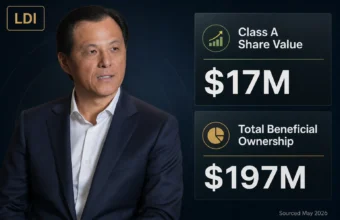
What we do know: Lorber’s disclosed ownership across multiple public companies had a combined reported value in the $180 million range as of November 2024, according to Benzinga’s tracking of his SEC-reported positions across Vector Group, Douglas Elliman, Clipper Realty, and Nathan’s Famous. That figure is post-deal, meaning some Vector Group equity had already converted to cash before that snapshot was taken.
The counter-intuitive insight most guides skip: his disclosed post-deal equity holdings may actually look smaller than pre-deal — because proceeds from the Japan Tobacco acquisition moved from a stock position (visible in SEC filings) into cash or private vehicles (invisible to the same databases).
Some analysts argue his peak wealth moment was 2015, when a single year’s compensation hit $42.5 million and real estate valuations were surging. That’s valid for a single-year compensation lens. But if you’re looking at cumulative net worth, the 2024 acquisition was the more significant structural event — because it crystallized equity that had previously been illiquid.
What SEC Proxy Filings Actually Reveal About His Pay
Most people assume that wealth like Lorber’s is hard to trace. For public company executives, the opposite is partly true — annual compensation is disclosed in the DEF 14A proxy statement filed with the SEC every year.
To read an executive’s proxy filing for net worth clues, follow these steps:
- Go to SEC EDGAR and search the company ticker (VGR or DOUG) plus the executive’s name
- Open the most recent DEF 14A filing and locate the “Summary Compensation Table”
- Note base salary, cash bonus, stock awards, and option awards — these are reported for the last three fiscal years
- Check the “Outstanding Equity Awards at Fiscal Year-End” table for unvested shares still in play
- Cross-reference Form 4 filings for actual open-market stock purchases or sales — these reflect real transactions, not just grants
For context: in 2022, Lorber received $4.117 million in total compensation from Douglas Elliman alone — $4.072 million in cash and $45,000 in other benefits — according to proxy data compiled by ERI Economic Research Institute. That year excluded his simultaneous Vector Group compensation, which was structured separately following the Elliman spinoff.
Here’s the thing: his single-year compensation figures are actually lower post-2022 than in peak years — not because he became less powerful, but because the Elliman spinoff restructured how his total pay was split across two companies rather than concentrated in one. Most people assume the IPO made him richer immediately. The pay structure tells a more complicated story.
Five Real Questions People Ask About Howard Lorber’s Net Worth
What’s Howard Lorber’s net worth in 2025?
The most defensible estimate is between $200 million and $600 million, based on SEC proxy data, disclosed equity, and the October 2024 Japan Tobacco acquisition of Vector Group. No independently verified total exists — estimates from $74M to $1.2B reflect different calculation methods, not different facts.
How did Howard Lorber make his money?
Lorber built his wealth through three decades of executive compensation at Vector Group, equity appreciation in Douglas Elliman, his chairmanship of Nathan’s Famous, and real estate investment through New Valley LLC — capped by the Japan Tobacco acquisition of Vector Group in October 2024.
What was Howard Lorber’s salary at Douglas Elliman?
According to a January 2022 SEC filing, his base salary as Douglas Elliman CEO was $1.8 million annually, with a 150% annual bonus entitlement. Total disclosed 2022 compensation from Douglas Elliman reached approximately $4.1 million.
Did the Japan Tobacco acquisition change Howard Lorber’s net worth?
Almost certainly yes, materially. The October 2024 deal created a liquidity event for all Vector Group equity holders. Lorber’s precise proceeds haven’t been publicly itemized, but his multi-decade equity position in VGR was substantial enough to move the needle significantly.
Why do different websites show such different net worth figures for Howard Lorber?
Sites using insider trading databases show only SEC-disclosed public equity — typically $74M to $180M. Lifestyle-based estimate sites project $600M to $1.2B using speculative assumptions. Neither method captures the full picture. The real figure almost certainly sits above the SEC-only range and below the top speculative estimates.






No Comment! Be the first one.