





Capital One Settlement Payments 2025: How Much Will You Get
If you had money sitting in a Capital One 360 Savings account between 2019 and 2025, a check may be heading your way this July. The problem is nobody can tell you what it’s worth — not the...

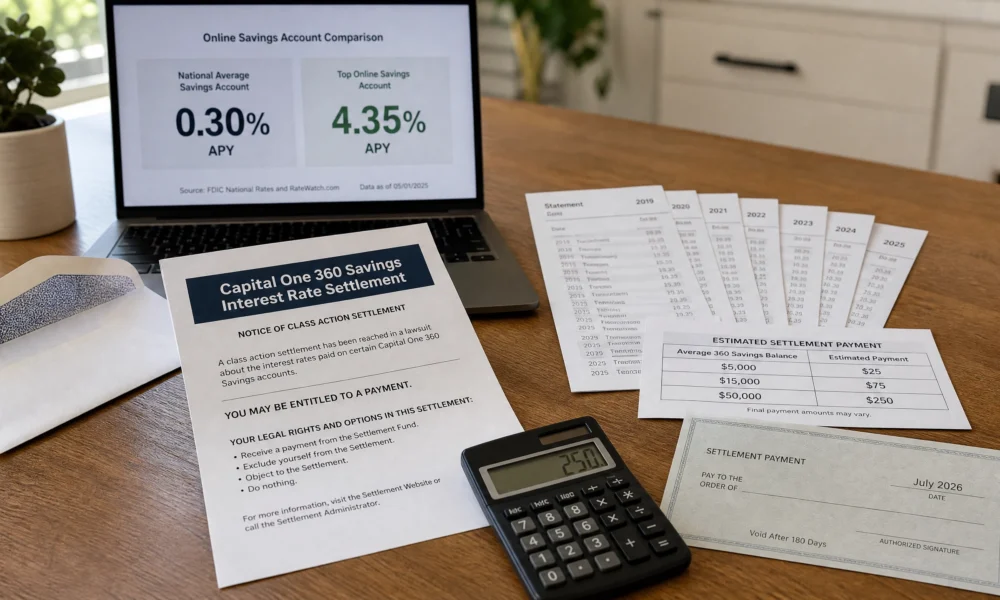
If you had money sitting in a Capital One 360 Savings account between 2019 and 2025, a check may be heading your way this July. The problem is nobody can tell you what it’s worth — not the settlement website, not the news coverage, and definitely not Capital One itself.
That ends here.
This guide shows exactly how the payout is calculated, with real dollar examples across three balance tiers, so you can form a realistic expectation before the check hits your mailbox.
Stop — Are You Thinking of the Wrong Settlement?
A significant number of people landing on articles about this case are actually remembering the 2019 Capital One data breach. That was a separate event — a cybersecurity incident that exposed roughly 100 million customers’ personal data. Those payments concluded years ago.
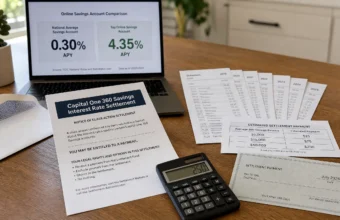
This is a completely different lawsuit. The interest rate settlement involves Capital One allegedly paying 360 Savings customers as little as 0.30% APY while quietly offering 4.35% APY on its newer 360 Performance Savings account — without adequately telling existing customers the better rate existed.
Quick Comparison: Two Capital One Settlements
| Settlement | Root Cause | Who’s Eligible | Payout Structure | Status |
|---|---|---|---|---|
| 360 Savings Interest Rate (2025–2026) | Rate suppression without disclosure | 360 Savings holders, 2019–2025 | Pro-rata by balance and duration | Distributions July 2026 |
| Data Breach Settlement (2019) | Security breach exposing personal data | Customers affected by 2019 hack | Flat + time-loss reimbursement | Concluded ~2022 |
If you already received a data breach payment, that has zero effect on your eligibility here.
What the Capital One 360 Savings Settlement Actually Is
Definition Block (Featured Snippet)
The Capital One 360 Savings settlement refers to a class action resolution in the Eastern District of Virginia in which Capital One agreed to compensate 360 Savings account holders who allegedly lost interest income between 2019 and 2025. The lawsuit claims Capital One maintained an artificially low rate on existing accounts while offering a significantly higher rate on a comparable new product — without disclosing the difference to existing customers.
According to the class action complaint filed in the Eastern District of Virginia, the interest rate gap between Capital One’s 360 Savings product (as low as 0.30% APY) and its 360 Performance Savings account (up to 4.35% APY) allegedly caused customers to lose over $2 billion in interest income across the class period. The CFPB filed a parallel enforcement action over the same underlying conduct — a signal of how seriously federal regulators viewed the alleged deception. Judge David Novak’s April 20, 2026 ruling cleared the way for settlement distributions to proceed.
The case is not about fraud in the criminal sense. It’s about disclosure — what Capital One told its customers, and what it chose not to.
Who Qualifies for a Payment
Eligibility is straightforward. You’re almost certainly in if:
- You held a Capital One 360 Savings account at any point between 2019 and 2025
- Your account earned interest below what Capital One offered on comparable products during that period
- You did not formally opt out of the class action by the court-set deadline
According to court documents, customers who closed their accounts before the class period began are not eligible. But if you held money in the account for even part of the class period — say, just 2021 and 2022 — you may qualify as a partial claimant.
That last point is what most people miss. Eligibility isn’t all-or-nothing. If you moved most of your money out in 2022 but left $1,000 in the account, that $1,000 counts toward your loss calculation for the period it sat there.
How-To Block (Featured Snippet): Verify Your Eligibility
- Visit capitalone360savingsaccountlitigation.com and enter the claim number from your mailed notice.
- Log into your Capital One account and locate 360 Savings statements from 2019 onward.
- Confirm you did not submit a formal opt-out form before the court deadline.
- If no notice arrived, complete a late claim form on the settlement site — missing the notice does not automatically exclude you.
Quick note: courts occasionally miss updated mailing addresses. The settlement website is the authoritative source — not what arrived, or didn’t arrive, in your mail.
How Your Payout Is Actually Calculated
This is what no other article covers properly. Here’s the real math.
Your payment isn’t pulled from a flat pool and divided equally. It’s weighted — meaning someone with $50,000 in their account for six years gets a meaningfully larger proportional claim than someone with $2,000 for one year.
Three variables determine your share: your average daily balance during the class period, the interest rate gap between what you were paid and the benchmark rate, and your proportional share of the total settlement fund after attorney fees.
The rate gap driving this entire case: Capital One allegedly paid 360 Savings customers 0.30% APY while simultaneously offering 4.35% APY on the 360 Performance Savings account. A 4.05 percentage point annual gap.
Estimated Lost Interest by Balance Tier
| Account Balance | Annual Rate Gap | Years Held | Estimated Lost Interest |
|---|---|---|---|
| $5,000 | 4.05% | 6 years | ~$1,215 |
| $15,000 | 4.05% | 6 years | ~$3,645 |
| $50,000 | 4.05% | 6 years | ~$12,150 |
These figures represent your estimated loss claim — not your check. Or maybe I should say it this way: the lost interest calculation is the size of your slice before anyone cuts the pie. The actual pie — the total settlement fund — determines how much of your slice survives the division.
Look — if you held $15,000 in a 360 Savings account for the full six years, you’d calculate roughly $3,645 in lost interest. After the 15% attorney fee reduction, that’s ~$3,098 of claimable loss. At a 15% recovery rate, your check is around $465. At 25%, around $775. That’s the realistic range — not $3,000.
This is not financial or legal advice. The IRS generally treats interest rate settlement proceeds as taxable income. Consult a tax professional for your specific situation.
After the Math: What Pro-Rata Really Means for Your Check
Here’s the thing: even with $12,000 in documented lost interest, your check almost certainly won’t be $12,000.
Class action settlements rarely recover 100 cents on the dollar. The total settlement fund gets divided proportionally across all valid claims, after approximately 15% in attorney fees comes off the top first. Every eligible claimant gets a share of what’s left, weighted by the size of their individual loss claim relative to all others.
I’ve seen conflicting data on recovery rates in interest rate class actions — some sources cite 10–25 cents on the dollar, others show cases where smaller class sizes drove recoveries above 40%. My read is that this case, given the $2 billion in alleged losses and Capital One’s enormous customer base, likely lands in the lower range. That’s not a guarantee. It’s a historical pattern applied cautiously.
What directly affects your individual check: how long you held the account, your average balance, the total number of valid claimants, and the total settlement fund size. That last figure — the exact settlement amount Capital One agreed to pay — had not been publicly released in documents available at time of publication. Check the settlement site as July approaches.
Some legal observers argue Capital One acted within its rights, since customers were technically free to open a 360 Performance Savings account at any time. That’s valid — in a world where every bank customer actively monitors competing internal product rates. The lawsuit’s surviving argument, strong enough to reach final settlement, is that Capital One’s marketing obscured the distinction for existing customers, making the non-disclosure material rather than trivial.
When Will Your Capital One Settlement Check Arrive?
July 2026.
That’s the target distribution window following Judge David Novak’s April 20, 2026 ruling. Settlement administrators typically need 60 to 90 days after final court approval to process claims and issue payments. Checks and direct deposit payments go through the settlement administrator — not Capital One.
According to court records from the Eastern District of Virginia, claimants who submitted valid claim forms by the court deadline will receive payments during this window. Late-addressed or corrected payments may arrive in a second disbursement later in 2026.
Comparison Block (Featured Snippet)
Capital One 360 Savings interest rate settlement vs. Capital One data breach settlement (2019): The interest rate settlement compensates account holders for lost income due to alleged rate suppression, calculated by balance and duration. The data breach settlement addressed identity theft exposure and paid flat compensation per affected customer. The key difference is the nature of harm — financial loss from underpaid interest versus privacy violation from a security incident.
If your check doesn’t arrive by mid-August 2026, use the claim ID from your original notice to contact the settlement administrator through the settlement website.
Five Questions, Answered Without the Runaround
What’s the best way to estimate how much I’ll get from the Capital One settlement?
Multiply your average 360 Savings balance by 4.05% by the number of years you held the account during 2019–2025. That’s your estimated loss claim. Multiply by 0.85, then by an estimated 15–25% recovery rate for a realistic check range.
How do I know if I’m included in the Capital One 360 Savings settlement?
You should have received a mailed notice with a claim number. If not, visit capitalone360savingsaccountlitigation.com. Anyone who held a 360 Savings account between 2019 and 2025 and didn’t formally opt out may be eligible.
Should I expect a large check from Capital One’s interest rate settlement?
Probably not. With over $2 billion in alleged losses across a large customer base, individual payouts in comparable class actions typically run $50 to a few hundred dollars for average balances. Higher balances held over the full period could yield significantly more.
Why does my settlement amount look lower than my lost interest calculation?
Because the pro-rata distribution adjusts your loss claim against the total settlement fund divided across all valid claims. Your calculation shows estimated losses — the check reflects your proportional share of what Capital One actually paid.
When should I contact the settlement administrator if I haven’t received my check?
Wait until mid-August 2026. July is the target distribution month, but processing and mailing for large class actions can run several weeks beyond the initial release date. Your original claim ID is the reference you’ll need.


No Comment! Be the first one.