






Anthony Hsieh’s Net Worth in 2026: What the Verified Numbers Actually Show
What Is Anthony Hsieh’s Net Worth Right Now? Anthony Hsieh net worth refers to the estimated total value of his assets — primarily his equity stake in loanDepot Inc. (NYSE: LDI) — minus known...

What Is Anthony Hsieh’s Net Worth Right Now?
Anthony Hsieh net worth refers to the estimated total value of his assets — primarily his equity stake in loanDepot Inc. (NYSE: LDI) — minus known liabilities. His peak figure reached approximately $2 billion in 2021. As of mid-2026, credible estimates range from roughly $100 million to $200 million, depending on which share class is measured and which filing source is used.
That range isn’t a cop-out. It’s the only honest answer, and the rest of this article explains exactly why.
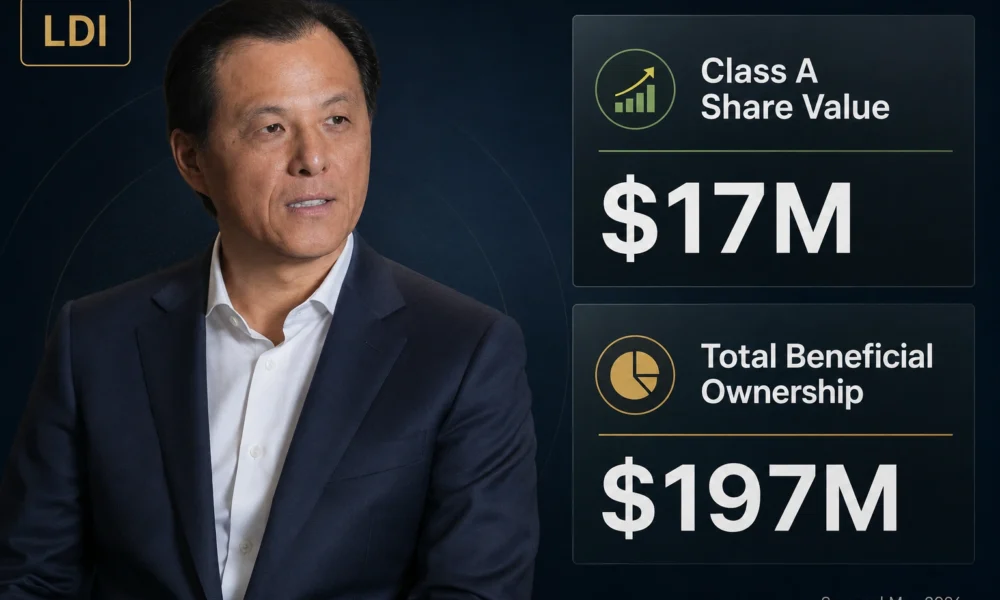
According to WallStreetZen data from May 2026, Hsieh holds approximately 130.84 million shares of loanDepot, representing roughly 39% of the company, with a current market value near $197 million. That’s his total beneficial ownership figure. A separate, narrower measure — his publicly reported Class A stake — placed his equity value at approximately $17 million as of October 2025, per the Orange County Business Journal’s “OC’s Wealthiest 2025” report. Both numbers are real. They’re measuring different things.
Most guides skip that distinction entirely. It’s the single biggest reason readers walk away more confused than when they arrived.
Anthony Hsieh’s net worth as of 2026 is most accurately estimated between $100 million and $200 million, based on his total beneficial ownership of loanDepot shares. According to WallStreetZen (May 2026), his 130.84 million shares — about 39% of the company — are valued at approximately $197 million at current prices. This is materially higher than estimates based solely on his Class A public shares, which ran as low as $17 million in 2025 reports.
Quick note: Hsieh’s fortune is almost entirely a function of a single stock. Any figure you read here — including this one — is a snapshot, not a forecast.
How to Verify Anthony Hsieh’s Net Worth From Primary Sources
How To accurately estimate Anthony Hsieh’s net worth from primary sources, follow these steps:
- Pull SEC Form 4 filings on EDGAR — these show open-market buys and sells.
- Cross-reference with 13D/G filings to capture full beneficial ownership beyond traded shares.
- Multiply total shares held by LDI’s current market price.
- Add disclosed real estate holdings and known liquidity events.
Each step takes under five minutes. The difference between doing step 2 and skipping it is what separates a $17 million estimate from a $197 million one.
The Three Ventures That Built His Foundation
Anthony Hsieh didn’t start with a Stanford network or a venture fund’s backing. He bought out the owners of a small California mortgage brokerage at 25 — writing the check, then rewriting the business.
That company became LoansDirect.com, one of the first internet-based mortgage platforms in the U.S. Hsieh swapped out typewriters and fax machines for online rate locks, digital disclosures, and web-based loan documents. He sold it to E*TRADE Financial in 2001 for approximately $51.5 million. That single transaction seeded everything else.
His next venture, HomeLoanCenter.com, became the first platform offering a complete mortgage product suite in all 50 states. By the 2004 sale to IAC — LendingTree’s parent company — it had 800 employees. The sale price was never publicly disclosed.
Or maybe I should say it this way: both exits were infrastructure, not endpoints. The cash funded a non-compete period, and the non-compete period funded patience. The patience funded loanDepot.
The Non-Compete Window
Hsieh couldn’t re-enter the mortgage space immediately after the 2004 HomeLoanCenter sale. That contractual restriction expired in 2010.
loanDepot launched in 2010.
The loanDepot IPO and How Hsieh Briefly Became a Billionaire
Anthony Hsieh became a billionaire in February 2021 when loanDepot completed its IPO on the New York Stock Exchange under the ticker LDI. According to Bloomberg’s reporting at the time, his net worth reached approximately $2 billion, making him one of the few Asian-American entrepreneurs to build a U.S.-founded company into a multibillion-dollar business. He held a controlling stake estimated at around 54% at the time of the offering.
The IPO itself was unusual. Direct proceeds totaled only about $62 million — far below initial targets. But a separate $200 million debt-funded dividend was distributed to shareholders, including Hsieh, roughly one month after listing. By mid-2021, LDI shares climbed toward $40, and his paper wealth passed the $2 billion threshold.
The underlying business was genuinely exceptional that year. The Federal Reserve’s near-zero rate environment had triggered a refinancing boom — loanDepot originated over $100 billion in loans in 2020, making it the second-largest direct-to-consumer mortgage lender in the country. The company’s 2020 revenue was more than triple 2019’s.
The problem with building a fortune on rate-sensitive mortgage originations is that rate sensitivity works in both directions.
Why Every Source Shows a Different Number — and Which One to Trust
This is the section most net worth articles don’t bother writing. It’s worth slowing down.
I’ve seen conflicting data across multiple sources — some showing $8.88 million (Benzinga, tracking only open-market Form 4 transactions), others $150 million (QuiverQuant, insider trade tracking), and others $197 million (WallStreetZen, total beneficial ownership). My read is that the $150–197 million range is the most complete picture available for mid-2026, and the lower figures reflect a methodological limitation, not Hsieh’s actual position.
Here’s the core issue:
Class A shares vs. total beneficial ownership: Class A shares are loanDepot’s publicly traded equity — the narrowest, most visible measure. Total beneficial ownership includes Class C shares and non-public equity units with economic value but limited float. Estimates based only on Class A figures (like the ~$17M OCBJ figure, October 2025) dramatically understate his real position. Total beneficial ownership estimates (~$197M, WallStreetZen May 2026) are the more complete, more accurate measure for understanding Hsieh’s actual stake.
GuruFocus, for example, shows Hsieh holding only 168,283 shares — a number so low it implies a net worth under $300,000. That’s not wrong; it’s just what you get when you exclude 13D/G filings and only count open-market Form 4 transactions. Their methodology is disclosed, but readers don’t always notice that fine print.
Quick Comparison: Net Worth Estimates by Source
| Source | Share Figure | Estimated Value | Basis |
|---|---|---|---|
| WallStreetZen (May 2026) | 130.84M shares (39.05%) | ~$197M | Total beneficial ownership |
| QuiverQuant (Oct 2025) | 85.5M shares | ~$150M | Insider trade tracking |
| OCBJ Wealthiest 2025 (Oct 2025) | 9.4% Class A | ~$17M | Public Class A shares only |
| GuruFocus (Jan 2026) | 168,283 shares | ~$230K | Form 4 open-market only |
| Peak estimate (Feb 2021) | ~54% stake | ~$2B | Pre-dilution IPO pricing |
The Wealth Collapse: 2022 to 2026
Anthony Hsieh’s net worth declined sharply after 2021 as loanDepot’s stock fell more than 80% from its IPO-era high. According to the Orange County Business Journal’s October 2025 report, his Class A stake — once worth over $2 billion — had shrunk to approximately $17 million. The decline tracked a broader collapse in mortgage origination volume: according to the Mortgage Bankers Association (2022 Annual Report), industry-wide originations fell from a record $4.4 trillion in 2021 to roughly $1.6 trillion in 2023.
The collapse wasn’t unique to loanDepot. Every nonbank mortgage lender was hurt. Rocket Companies, United Wholesale Mortgage, PennyMac — the entire sector took damage as the Fed moved rates from near-zero to a 22-year high between 2022 and 2023.
But loanDepot’s position was harder than most. The company carried significant fixed-cost infrastructure built during the 2020–2021 boom: 12,000 employees at peak, aggressive technology investment, a naming-rights deal for a major league baseball stadium. When volume collapsed, the overhead didn’t disappear overnight.
Hsieh himself sold shares steadily through the downturn. SEC filings tracked by QuiverQuant show he sold approximately 33.2 million shares between 2021 and early 2026, generating around $53.6 million in realized proceeds. That liquidity is real and likely held outside LDI.
It doesn’t offset the unrealized loss. But it matters for any honest accounting.
The Resignation and Return
Hsieh stepped down as CEO in April 2022, citing a lifelong dream of traveling for sportfishing. In June 2025, CEO Frank Martell resigned. The board called Hsieh back. He returned as interim CEO, then was named permanent CEO on July 28, 2025.
Retirement lasted three years.
Can His Net Worth Recover? The CEO Return and the PSU Structure
Look, if you’re a shareholder trying to understand whether Hsieh’s financial incentives are aligned with yours, here’s what actually works as a framework: read the compensation structure, not the press releases.
His arrangement, per the March 2025 proxy disclosure, includes a $1 base salary and $75,000 per month in expense reimbursements. The substantive compensation is 1.5 million performance stock units (PSUs) tied to stock price hurdles of $3, $5, and $7 per share — with an additional 1.5 million PSUs awarded for remaining as interim CEO through March 2026.
Those PSUs are worth nothing if LDI stays below $3. They’re worth real money if the stock climbs past $7. Hsieh’s personal financial recovery is structurally tied to shareholder recovery in a way that’s unusually direct for a founder-CEO.
Some analysts argue that a founder returning to rescue his own company is a signal of desperation rather than conviction. That’s a legitimate read for certain situations. But a $1 salary paired with price-contingent PSUs — rather than a guaranteed package — is about as explicit a bet on the company’s turnaround as a compensation structure allows. It also signals he’s not there to collect a paycheck while the ship sinks.
What this article cannot tell you is whether the housing market will cooperate. That’s macro, not personal.
Five Questions Readers Actually Ask
What is Anthony Hsieh’s net worth in 2026?
Estimated between $100 million and $200 million based on total beneficial ownership of approximately 130.84 million LDI shares, per WallStreetZen (May 2026). The figure varies widely depending on which share class each source measures. Not financial advice.
How did Anthony Hsieh make his money?
Through three mortgage company exits — LoansDirect.com (sold to E*TRADE for ~$51.5M in 2001), HomeLoanCenter.com (sold to IAC/LendingTree in 2004), and his founding equity stake in loanDepot, which peaked at approximately $2 billion during the LDI IPO in February 2021.
Is Anthony Hsieh still a billionaire?
No, His billionaire status lasted from roughly February to mid-2021. Forbes estimated his net worth at $649 million by late 2021. By 2025, all credible estimates placed him well below $200 million, with the narrowest measures showing as little as $17 million.
Why does loanDepot’s stock affect his net worth so dramatically?
Because the vast majority of his wealth is concentrated in LDI equity — a single, publicly traded company in a cyclical industry. He has no publicly disclosed large-scale diversification, meaning LDI’s price is, for practical purposes, his net worth.
What happened to Anthony Hsieh after the loanDepot IPO?
He stepped down as CEO in April 2022, citing personal goals. He was called back by the board in June 2025 after his successor resigned, and was named permanent CEO in July 2025 — taking a $1 salary and performance-only equity compensation tied to stock recovery.






No Comment! Be the first one.