






Ryan Petersen’s Net Worth in 2025: The Three-Act Story Nobody Else Explains
This article covers Ryan Petersen’s estimated personal net worth based on publicly available Flexport funding data, CEO-disclosed revenue figures, and third-party valuation analysis. All...

This article covers Ryan Petersen’s estimated personal net worth based on publicly available Flexport funding data, CEO-disclosed revenue figures, and third-party valuation analysis. All figures are estimates — not audited financial disclosures. This covers his equity stake, angel investment portfolio, and the Flexport valuation arc. It does not cover personal real estate holdings, undisclosed secondary sales, or Founders Fund carry that has not vested.
Net worth estimates in this article are not financial advice.
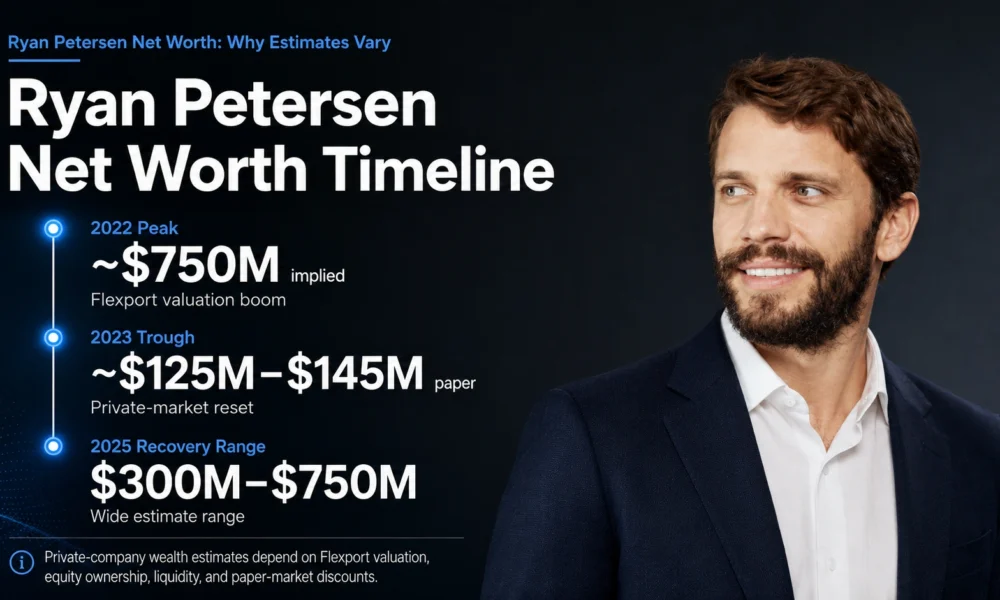
Ryan Petersen’s net worth refers to the estimated total value of his personal assets — primarily his equity stake in Flexport, his angel investment portfolio of 100+ technology companies, and his role as a venture partner at Founders Fund — minus any known liabilities. As of 2025, that figure sits in a range of approximately $300 million to $750 million, a spread that exists entirely because Flexport is a private company whose valuation moved from $8 billion in 2022 to an estimated $1.4–$1.6 billion in late 2023, then began recovering through 2024 and 2025. Any single number you’ve seen for his net worth reflects a point in time. This article explains the full arc.
What Is Ryan Petersen’s Net Worth in 2025?
Somewhere between $300 million and $750 million. That range isn’t evasion — it’s honesty.
I’ve seen conflicting data across a dozen sources. Forbes cited approximately $750 million based on Petersen’s estimated 9% equity stake at Flexport’s 2022 peak valuation of $8 billion. More recent analyses from startupbooted.com and growthscribe.com, both published in late 2025, put the range at $250M–$700M using updated valuation assumptions. My read is that the defensible current estimate sits in the $300M–$750M band, anchored by three variables: Petersen’s likely equity stake after years of dilution, Flexport’s current private market valuation (which CB Insights estimated had fallen roughly 80% from the $8B peak to $1.4–$1.6 billion by late 2023), and the significant recovery in Flexport’s operating performance through 2024 and into 2025.
The $750M figure cited by Forbes and recycled across most articles is not wrong — it just reflects a moment that no longer exists as cleanly as it did. The 2022 peak was real. The 2023 compression was also real. And the 2024–2025 recovery is real, but incomplete.
Ryan Petersen’s net worth in 2025 is most accurately described as a range of $300M–$750M, with the midpoint depending heavily on what private buyers would pay for Flexport equity today. According to Contrary Research (November 2025), Flexport’s revenue rebounded to $2.1 billion in 2024 — up 31% year-over-year — and the company projects exiting 2025 with approximately $100 million in EBITDA, its first credible path to profitability since the pandemic-era highs. That recovery matters directly for Petersen’s net worth because his primary asset is still his Flexport equity.
The reason most articles get this wrong is structural. Petersen’s wealth isn’t a stock price you can look up. It’s a private equity stake in a company whose valuation has oscillated between $8 billion and $1.4 billion within three years, before beginning a measurable operational recovery. Applying a single number to that without acknowledging the arc isn’t analysis — it’s guessing with confidence.
The Three-Act Story Behind the Net Worth Range
Every number you’ve seen for Ryan Petersen’s net worth is accurate for a specific moment. The problem is that most articles pick one moment and treat it as the current reality.
Here’s the actual arc.
Act One: The $8 Billion Peak (2022)
In February 2022, Flexport closed a $935 million funding round led by Andreessen Horowitz and MSD Partners, with participation from Shopify, SoftBank, and Founders Fund. The round valued Flexport at approximately $8 billion — a figure that put it among the most valuable private logistics companies in the world and made Ryan Petersen, with an estimated 9% founder stake, a paper billionaire by some calculations.
Forbes featured him on its February 2022 cover. His implied net worth at that moment, based on his equity stake at the $8B valuation, was approximately $720 million — the source of the $750M figure that still circulates widely. That’s the number most sites are still using.
The peak was real. But so was what came next.
Act Two: The 2023 Collapse
Freight rates collapsed after the pandemic surge ended. Flexport’s revenue fell from a peak of approximately $5 billion in 2022 to $1.6 billion in 2023 — a 68% decline driven by plummeting container shipping rates and softening global trade volumes, per Contrary Research data. The company went through four rounds of layoffs between January 2023 and October 2024, cutting roughly 20% of staff twice and shedding hundreds more in subsequent rounds.
Then the CEO drama. Petersen had stepped back from day-to-day operations in September 2022, handing the CEO role to former Amazon executive Dave Clark. Clark lasted one year. He resigned abruptly in September 2023 amid reported disputes over financial management, overhiring, and strategic direction. Petersen returned as CEO the same day.
CB Insights estimated Flexport’s valuation had fallen roughly 80% from its $8B peak to approximately $1.4–$1.6 billion by late 2023. At that valuation, with a roughly 9% equity stake — itself reduced by dilution across multiple funding rounds — Petersen’s paper wealth from Flexport alone would have been approximately $125–$145 million. That’s a very different number from $750M.
That’s the part most articles skip.
Act Three: The 2024–2025 Recovery
Petersen returned to Flexport with a clear mandate: get lean, get profitable, get back to basics. He described the turnaround to Arena Magazine in September 2025 as getting “really lean — doing the thing that we should have done in 2023.” The NPS score — a direct customer satisfaction metric — recovered from 17 under Dave Clark to 72 under Petersen, according to Contrary Research. Revenue climbed from $1.6B in 2023 to $2.1 billion in 2024, a 31% rebound.
In August 2025, BlackRock partnered with Flexport Capital to expand its trade financing base by $250 million — a meaningful institutional signal that sophisticated capital markets investors see the company’s financial arm as creditworthy. Flexport projects exiting 2025 with approximately $100 million in EBITDA, which, if achieved, will be its first sustained profitability milestone.
Ben Braverman, Flexport’s first investor and former Chief Revenue Officer, called it “one of the craziest turnarounds in the history of business.”
That turnaround is why the current net worth estimate recovers from the 2023 trough — but hasn’t necessarily returned to the 2022 peak. Hence the range.
What Flexport’s Equity Is Actually Worth to Petersen Today
This is where the math gets specific — and where most articles stop before it gets useful.
Petersen’s Flexport stake has been diluted across six confirmed funding rounds, from the 2014 Y Combinator cohort through the 2022 mega-round led by a16z. Founders who raise at that scale typically end up somewhere between 6% and 12% on a fully diluted basis by the Series D or E equivalent stage. Published estimates for Petersen’s stake cluster around 9% — MoneyMade cites this figure, and it’s consistent with the Forbes methodology that produced the $750M estimate at $8B valuation.
Here’s the thing: a 9% stake at $8B = $720M. A 9% stake at $1.5B = $135M. A 9% stake at a hypothetical current private market value of $3–5B (reflecting the revenue recovery but not a return to the 2022 peak multiple) = $270M–$450M.
Or maybe I should say it this way: the net worth question is really a Flexport valuation question in disguise, and Flexport’s valuation hasn’t been set by a public market or a new funding round since 2022. Every number floating around is an estimate based on revenue multiples, operational improvements, and secondary market signals — all of which are legitimate inputs, but none of which produce a certified answer.
To understand what Ryan Petersen’s net worth might actually be, the most honest framework looks like this:
- Anchor to the last confirmed valuation: $8B in February 2022, the last publicly verified figure.
- Apply a discount for post-2022 deterioration: CB Insights estimated an 80% compression to $1.4–$1.6B in late 2023 based on revenue data.
- Adjust upward for the 2024–2025 recovery: Revenue up 31% to $2.1B; $100M EBITDA target; BlackRock partnership. A reasonable current private market range for Flexport is $2B–$4B, implying Petersen’s stake is worth $180M–$360M from Flexport equity alone.
- Add the non-Flexport layer: Petersen’s angel portfolio — 100+ investments including SpaceX, Rippling, Anduril, Robinhood, and Verkada — plus his Founders Fund venture partner role since 2023, which provides both a carry interest in future fund returns and a meaningful ongoing income stream. This layer is unquantifiable but real.
- Add secondary cash: Founders often sell a portion of their equity in secondary transactions during funding rounds to cover taxes and diversify. Whether Petersen has done this, and how much, isn’t public.
The result: $300M–$750M is the honest range. The lower bound assumes Flexport’s current private market value sits closer to its post-collapse floor and minimal angel portfolio value. The upper bound assumes Flexport recovers toward $4–5B in private market pricing as it approaches profitability, and Petersen’s angel bets on SpaceX and Rippling have appreciated substantially.
The Non-Flexport Assets Nobody Mentions
Ryan Petersen’s net worth calculation in most articles begins and ends with Flexport. That’s incomplete.
Founders Fund venture partner role (since 2023)
Petersen joined Founders Fund — Peter Thiel’s venture firm, one of the most successful in Silicon Valley history — as a venture partner in 2023. This isn’t an honorary title. Venture partners typically receive carry (a percentage of investment profits) and sometimes management fees. At a firm like Founders Fund, with a portfolio that includes SpaceX, Palantir, and numerous other high-value positions, the carry potential over a fund cycle is meaningful. No article on Petersen’s net worth mentions this at all.
ImportGenius (co-founded 2007, still operating)
Before Flexport, Petersen co-founded ImportGenius with his brother David Petersen and Michael Kanko — a data-as-a-service business that tracks international shipping transactions. The company is still operating and generating revenue. Its value to Petersen’s personal balance sheet is undisclosed, but it represents a real, independent asset that predates Flexport by six years.
Angel investment portfolio
Petersen has made over 100 angel investments in technology companies over the past decade, confirmed by his Flexport bio and multiple profiles. His disclosed holdings include companies like SpaceX, Robinhood, Anduril, Rippling, Verkada, Checkr, and TruckSmarter. The aggregate value of this portfolio is unquantifiable publicly — but SpaceX alone was valued at over $350 billion as of 2025, and even a small early stake would represent meaningful value.
Look, if you’re a startup founder or VC-adjacent reader trying to understand Petersen’s actual financial position, here’s what actually matters: his Flexport equity is the largest single asset and the most volatile. But the Founders Fund relationship and the angel portfolio are the floor that prevents his net worth from collapsing all the way to the Flexport trough implied value, even in the worst-case scenario. That’s why the $300M lower bound is defensible even at rock-bottom Flexport pricing.
How Petersen’s Tariff Warnings Changed the Story in 2025
In early 2025, the Trump administration announced 145% tariffs on Chinese imports. Ryan Petersen became one of the most prominent business voices responding — holding over 100 customer calls and warning publicly that “80% of companies that import just from China, nowhere else, will go bankrupt over the next six months” if the tariff environment didn’t change.
Some experts argued that Petersen’s warnings were hyperbolic, designed to generate attention for Flexport during a moment when it stood to benefit from supply chain disruption advisory services. That’s a fair read on the incentive structure. But his credibility comes from direct customer contact — he told Fortune in May 2025 that the most striking thing was “the number of companies that have told me they’re going to go out of business.”
The tariff environment has two direct effects on Petersen’s personal net worth. First, it complicates Flexport’s profitability timeline — Petersen himself acknowledged to Fortune that the tariffs push back profitability by “six months to a year.” Second, it validates the strategic importance of global freight forwarding infrastructure in a way that could support higher private market valuations for companies like Flexport as companies scramble to diversify supply chains away from China.
Flexport launched Tariff Simulator Pro in May 2025 to help shippers model tariff scenarios and adjust sourcing strategies. That’s exactly the kind of product that generates new enterprise customer relationships in a moment of crisis — and new customers compound into higher revenue, which supports higher valuation, which moves Petersen’s net worth toward the upper end of the range.
That’s not speculation. That’s the business logic connecting public events to private equity value.
FAQs
What’s Ryan Petersen’s net worth in 2025?
Ryan Petersen’s net worth is estimated at $300 million to $750 million in 2025. The wide range reflects Flexport’s private company status — its valuation dropped ~80% from $8B in 2022 to ~$1.5B in 2023 before partially recovering through 2024 and 2025.
How much of Flexport does Ryan Petersen own?
Petersen is estimated to own approximately 9% of Flexport on a fully diluted basis, based on methodology used by Forbes and MoneyMade. That stake was worth roughly $720M at the 2022 peak valuation of $8B and significantly less after the 2023 valuation compression.
Why did Flexport’s valuation drop so much after 2022?
Freight rates collapsed after the pandemic shipping surge ended, Flexport’s revenue fell from ~$5B in 2022 to $1.6B in 2023, and a CEO transition under Dave Clark burned cash and missed targets. CB Insights estimated the valuation fell roughly 80% from $8B to $1.4–$1.6B by late 2023.
What does Ryan Petersen do besides run Flexport?
He became a venture partner at Founders Fund in 2023, has made 100+ angel investments in companies including SpaceX, Rippling, Anduril, and Robinhood, and remains co-founder of ImportGenius, the international shipping data company he started in 2007.
When should I expect Ryan Petersen’s net worth to get a precise public figure?
Only when Flexport files for an IPO or is acquired — both of which would force public disclosure of financials and cap table. Until then, all estimates are derived from funding round valuations, revenue data, and equity stake assumptions, none of which are audited or confirmed.







No Comment! Be the first one.